Form 10-K
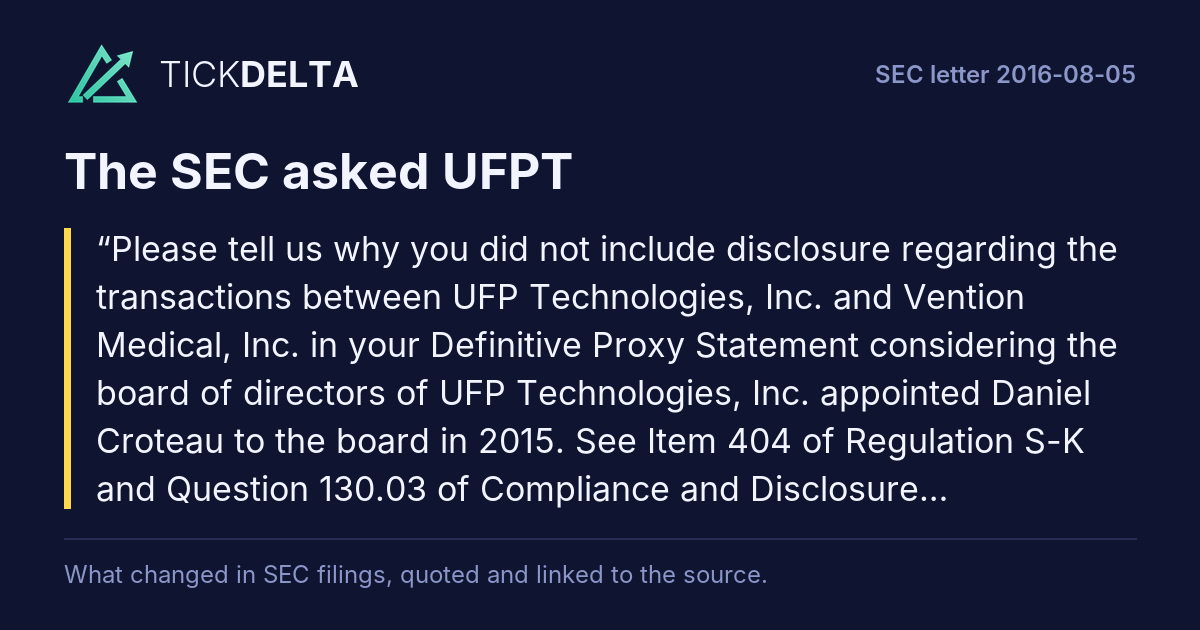
Please tell us why you did not include disclosure regarding the transactions between UFP Technologies, Inc. and Vention Medical, Inc. in your Definitive Proxy Statement considering the board of directors of UFP Technologies, Inc. appointed Daniel Croteau to the board in 2015. See Item 404 of Regulation S-K and Question 130.03 of Compliance and Disclosure Interpretations on Regulation S-K.
The Company acknowledges the Staff’s comment and submits that disclosure of the transactions (the “Transactions”) between the Company and Vention Medical, Inc. (“Vention”) was not required to be included in the Company’s Definitive Proxy Statement. Mr. Croteau did not have a direct or indirect material interest in the Transactions.Read in the reply
Item 404(a) would only require disclosure of the Transactions in the Company’s Definitive Proxy Statement if Mr. Croteau had a direct or indirect material interest in the Transactions.Rest of the answer
In addressing the definition of materiality in the context of Item 404(a) of Regulation S-K, the Commission’s 2006 Adopting Release indicates that “…we note that whether a transaction which was not material to the company or the other
100 Hale Street, Newburyport MA 01950 USA | P 978.352.2200 | www.ufpt.com entity involved and which was undertaken in the ordinary course of business of the company and on the same terms that the company offers generally in transactions with persons who are not related persons, are factors that could be taken into consideration when performing the materiality analysis for determining whether disclosure is required under the principle for disclosure.” 1
In advance of the Company’s preparation of its Definitive Proxy Statement, the Company reviewed the circumstances of the Transactions and obtained information about the Transactions from Mr. Croteau. The Company considered various factors in connection with its analysis of whether or not disclosure of the Transactions would be required in the Company’s Definitive Proxy Statement, including the following:
·
The Transactions were made in the ordinary course of business;
The terms of the Transactions, including pricing, were substantially the same terms that the Company generally offers in transactions with persons who are not related persons;
The amount of product that Vention purchased from the Company in 2015 represented less than 0.2% of Vention’s total sales in 2015 and approximately 0.2% of Vention’s total cost of sales in 2015;
The Transactions represented approximately 0.4% of the Company’s total sales in 2015; and
Mr. Croteau received no special compensation or other remuneration from Vention as a result of the Transactions. (Mr. Croteau holds less than 5% of Vention’s shares and any benefit he received from the Transactions as a Vention shareholder was also received by Vention’s other shareholders on a pro rata basis.)
Taking into account the above, the Company determined that Mr. Croteau did not have a direct or indirect material interest in the Transactions and that, therefore, disclosure of the Transactions was not required in the Company’s Definitive Proxy Statement pursuant to Item 404(a) of Regulation S-K. To the extent that the Company and Vention continue to conduct business with each other, the Company will continue to assess whether such transactions would be required to be disclosed pursuant to Item 404(a).
Exhibits
Exhibit 23.01
We note the date of the audit report disclosed in your auditor’s consent does not correspond with the date of the audit report included in your Form 10-K. Please obtain a revised auditor’s consent accordingly.
The Company acknowledges the Staff’s comment and advises the Staff that the discrepancy between the date of the audit reports included in the Form 10-K and the date of the audit reports included in the Company’s auditor’s consent is the result of a scrivener’s error that was present only in the Form 10-K that was filed with the Commission via EDGAR. The text of the audit reports included in the Form 10-K that was filed with the Commission via EDGAR contained the same scrivener’s errors. The original copies of each of the auditor’s consent and the audit reports that the Company received from its auditors reference the correct audit report date. On August 18, 2016, the Company filed an amendment to the Form 10-K that includes copies of the audit reports and auditor’s consent that reflect the correct dates.
1 Executive Compensation Related Person Disclosure, Securities Act Release No. 8732A (Aug. 29, 2006), pages 165-66.
The Company acknowledges that:
the Company is responsible for the adequacy and accuracy of the disclosure in the filing;
staff comments or changes to disclosure in response to staff comments do not foreclose the Commission from taking any action with respect to the filing; and the Company may not assert staff comments as a defense in any proceeding initiated by the Commission or any person under the federal securities laws of the United States.
We hope that his letter is fully responsive to the Staff’s comments. If you have further questions, please contact me at 978-234-0926.
First report after the company's reply of Aug 18, 2016: 10-Q filed Nov 9, 2016 ↗, against the 10-Q filed May 9, 2016 ↗.
Tickdelta does not hold the text of both reports, so they are not compared here.
We note the date of the audit report disclosed in your auditor’s consent does not correspond with the date of the audit report included in your Form 10-K. Please obtain a revised auditor’s consent accordingly.
No numbered answer found in the reply. Read the reply ↗
First report after the company's reply of Aug 18, 2016: 10-Q filed Nov 9, 2016 ↗, against the 10-Q filed May 9, 2016 ↗.
Tickdelta does not hold the text of both reports, so they are not compared here.
Also in this review: closing letter, 2016-09-07