Screener / SEC EDGAR /CIK 0001511737 /10-K filed Aug 21, 2026, compared with Aug 22, 2025 /Numbers from the XBRL of the 10-Ks
NYSE Technology · Communications Equipment

Ubiquiti Inc. UI

Compare with peers Embed
The 10-K against last year's

110 changes: 13 added, 10 removed, 85 reworded, 2 quiet changes

10-K Aug 21, 2026 vs Aug 22, 2025

10-K 0001511737-26-000056 (Aug 21, 2026) vs 10-K 0001511737-25-000053 (Aug 22, 2025)

Every paragraph, and how much of it changed

One bar per paragraph, in the order of the 10-K. Height and colour show the share of its words not in the closest paragraph a year earlier; the tallest bars are new paragraphs.

Risk Factors

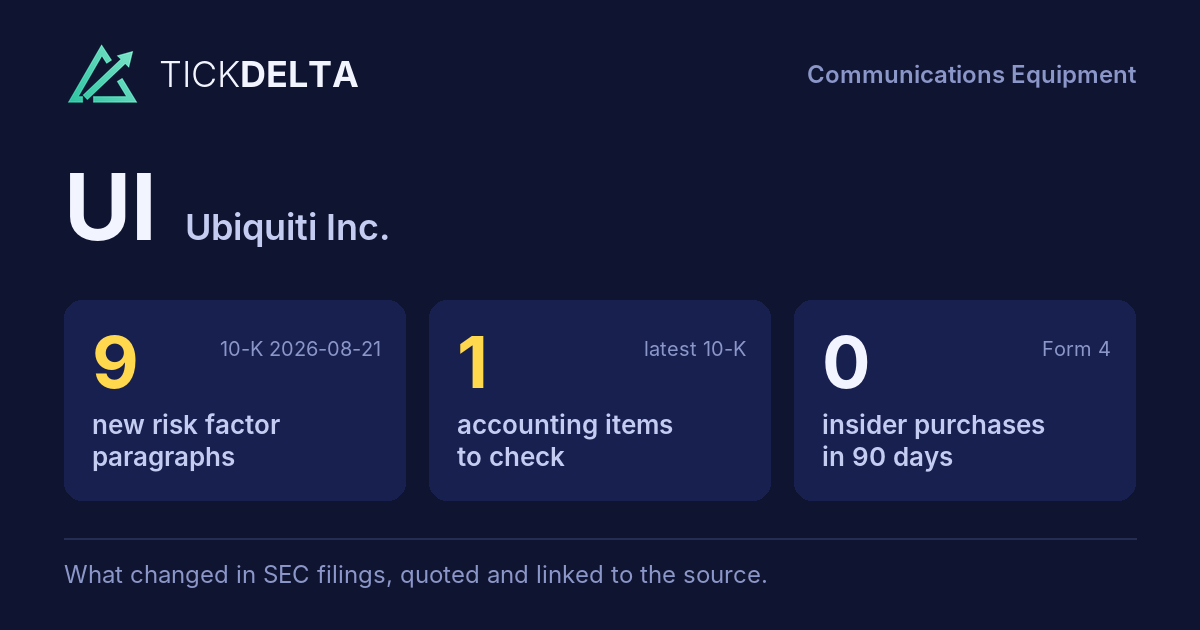
264 paragraphs · 9 new · 63 reworded · 8 gone · 10-K Aug 21, 2026 against Aug 22, 2025
New paragraph Reworded (5% of its words or more) Same or nearly
Paragraph 60 · 48% changed Every version of it
The quality and performance of some of our products and services may depend upon their ability to withstand cyber-attacks. Third parties may develop and deploy viruses, worms and other malicious software programs, some of which may be designed to attack our products, systems, or networks. Because we use our products in our own operations, any security vulnerabilities in our products could be disruptive to our business and harm our reputation. Some of our products and services also involve the storage and transmission of end users’ personally identifiable and customers’ proprietary information which may be the target of cyber-attacks. Hardware and software that we produce or procure from third parties also may contain manufacturing or design defects, including bugs and other problems, which could compromise their ability to withstand cyber-attacks. In addition, customers not deploying security updates in a timely manner or deciding not to upgrade products, services or solutions could result in claims of liability against us, damage our reputation or otherwise materially harm our business. Even when we prioritize a security vulnerability, it could take time for us to develop a remedy and the remedy may ultimately be insufficient to fully fix the issue. Security vulnerabilities can persist even after we have issued security updates if we have not identified and addressed the root cause of a particular vulnerability, if customers have not installed the most recent updates, if the attackers exploited the vulnerabilities before a security update is applied to install additional malware to further compromise customers’ systems, or if a previously patched vulnerability is inadvertently reintroduced during future development. Furthermore, the emergence and maturation of AI capabilities designed to circumvent controls, avoid detection and remove or obfuscate forensic evidence, and the utilization of these techniques by attackers, has led to new and more effective methods of cyber-attacks.
Paragraph 39 · 41% changed Every version of it
Weakness in orders, directly or indirectly, from the markets we serve, including as a result of any slowdown in capital expenditures by the markets we serve (which may be more prevalent during a global economic downturn, or periods of economic, political or regulatory uncertainty), could have a material adverse effect on our business, results of operations, liquidity and financial condition. Such slowdowns may continue or recur in future periods. Orders from the markets we serve could decline for many reasons other than the competitiveness of our products and services within their respective markets. These conditions have harmed our business and results of operations in the past, and some of these or other conditions in the markets we serve could affect our business and results of operations, liquidity or financial condition in any future period of such slowdowns.
Paragraph 136 · 37% changed Every version of it
Geopolitical uncertainties and events could cause damage or disruption to international commerce and the global economy, and thus could have a material adverse effect on us, our suppliers, logistics providers, manufacturing vendors and customers, including our distributors and other channel partners. For example, escalating tensions between the U.S., China and other countries may result in changes in laws or regulations that will affect our ability and/or increase our costs to manufacture and sell our products. Recently, the U.S. government has altered its approach to international trade policy and in some case renegotiated, or potentially terminated, certain existing bilateral or multi-lateral trade agreements and treaties with foreign countries. The current U.S. administration has imposed significant increases to tariffs on goods imported into the U.S., including from China and Vietnam, and has raised the possibility of imposing significant, additional tariff increases or expanding the tariffs to capture additional countries and types of goods. Some foreign governments, including China, have instituted retaliatory tariffs on certain U.S. goods. While the U.S. administration has negotiated tariff rates with several countries, the negotiation with many countries is ongoing. Due to the numerous executive orders, the overall determination of duties on imports has become complex. The tariffs and related policy changes have significantly affected our business, financial condition and results of operations, and we may not be able to plan for alternative sources for our supply chain and manufacturing operations or effectively mitigate the adverse impacts from such measures. Additional trade restrictions could be adopted with little to no advance notice, which could further increase the cost of our products, disrupt our supply chain, reduce the demand for our products, and impair our ability to effectively operate and compete in the countries where we do business. We are closely monitoring this evolving situation but there can be no assurance that we will be able to mitigate the impacts of any trade measures, which could be material to our operating results or harm our competitive position.
Paragraph 173 · 36% changed Every version of it
We have in the past and continue to discover counterfeit versions of our products. Although we have taken steps to combat counterfeiting, it is difficult or impossible to detect or prevent all instances of counterfeiting. Particularly if the quality of counterfeit products is poor, damage could be done to our brand. Counterfeit sales, to the extent they replace otherwise legitimate sales, could also adversely affect our operating results. Combating counterfeiting is difficult and expensive, and may not be successful, especially in countries that have a relatively weak legal regime for the protection of intellectual property.
Paragraph 245 · 34% changed Every version of it
We may be involved, from time to time, in a variety of claims, lawsuits, investigations, and proceedings relating proceedings. These matters may relate to contractual disputes, including disputes regarding limitations of liability clauses and liability disclaimers contained within our contracts with end users, customer claims, including claims relating to pricing, tariffs or other changes, intellectual property rights, employment matters, regulatory compliance matters, consumer or and securities class-actions and class-actions. We may also become involved in other litigation matters relating to various claims that arise in the normal course of business and otherwise. It can be difficult or impossible to predict the outcome of legal proceedings with any degree of certainty, particularly given that laws may be ambiguous and factual findings can often be the result of incomplete evidence, opinions, varying standards or proof, and extraneous factors. Any such proceedings or matters may adversely affect how we operate the business, divert the attention of management from the operation of the business and have an adverse effect on our reputation. In addition, management may not adequately reserve for a contingent liability, or we may suffer unforeseen liabilities, which could result in additional costs and adversely affect our results of operations. If one or more of the legal proceedings to which we may be or become a party are resolved against us, our results of operations and financial condition could be adversely affected.
Paragraph 251 · 33% changed Every version of it
Effective internal controls over financial reporting are necessary for us to provide reliable financial reports and, together with other controls and procedures, are designed to prevent fraud. Any failure to implement required new or improved controls, or difficulties encountered in their implementation, could cause us to fail to meet our reporting obligations, and prevent us from producing accurate and timely financial statements to manage our business. If we fail to do so, our business could be negatively affected and our independent registered public accounting firm may be unable to attest to the fair presentation of our consolidated financial statements included elsewhere in this our Annual Report Reports on Form 10-K in accordance with accounting principles generally accepted in the United States of America (“GAAP”) and the effectiveness of our internal control over financial reporting, as required by Section 404 of the Sarbanes-Oxley Act. If we cannot provide reliable financial reports and effectively prevent fraud, our reputation and results of operations could be harmed. Even effective internal controls have inherent limitations, including the possibility of human error, the circumvention or overriding of controls, or fraud. Therefore, even effective internal controls can provide only reasonable assurance with respect to the preparation and fair presentation of financial statements. The preparation of consolidated financial statements also requires us to make estimates and assumptions. We base our estimates on historical experience and other assumptions that we believe are reasonable under the circumstances. To the extent that there are differences between our estimates and actual results, our future financial statement presentation, financial condition, results of operations and cash flows will be affected. As events continue to evolve our estimates may change materially in future periods. In addition, projections of any evaluation of effectiveness of internal control over financial reporting in future periods are subject to the risk that the control may become inadequate because of changes in conditions or a deterioration in the degree of compliance with the policies or procedures. We have in the past and may in the future fail to maintain adequate internal controls. For example, as reported in the Annual Reports on Form 10-K for the years ended June 30, 2015 and 2016, management of the Company determined that the Company did not maintain an effective control environment, which contributed to three material weaknesses in internal control over financial reporting. As described in more detail in the Annual Report on Form 10-K for the fiscal year ended June 30, 2017, under Item 9A. “Controls and Procedures”, the Company completed the remediation efforts of such material weakness, completed testing of the controls to address such material weaknesses and concluded that the previously reported material weaknesses in internal controls over financial reporting have been satisfactorily remediated as of June 30, 2017. Any such failure (including any failure to implement new or improved controls, difficulties in the execution of such implementation or deterioration of our current control practices) may result in an inability to prevent fraud, or cause us to fail to meet our reporting obligations. Any such failures may cause a material adverse effect on our business and financial results, and investor confidence and the market price of our stock may be adversely affected.
Paragraph 9 · 32% changed Every version of it
•our reliance on a limited number of suppliers and suppliers, our inability to predict shortages in components components, price increases or other supply disruptions as a result of, including, without limitation, the military conflict between Russia and Ukraine, the escalating tensions between China and Taiwan, or our failure to identify or qualify alternative suppliers;
Paragraph 194 · 30% changed Every version of it
As of June 30, 2025, our balance outstanding under Subject to the Amended limits contained in the 2026 Credit Agreement for our Term Facilities (as defined herein), was $250.0 million. There was no outstanding balance on in Note 8, Debt of the Notes to our Consolidated Financial Statements) that governs the 2026 Revolving Facility (as defined herein) as of June 30, 2025. The Facilities mature in March 2026. Facility, we may be able to incur substantial additional debt from time to time to finance working capital, capital expenditures, investments or acquisition, or for other purposes. If we do so, the risks related to our debt level could increase. Specifically, our debt level could impair our ability to obtain additional financing for working capital, capital expenditures, debt service requirements, acquisitions and general corporate or other purposes. In the future we may need to raise additional capital to finance our payment of dividends or repurchase shares of our common stock and fund our growth and operational goals. If additional financing is not available when required or on acceptable terms, we may not be able to pay dividends, repurchase shares of common stock, expand our business, develop or enhance our products, take advantage of business opportunities or respond to competitive pressures, which could result in lower revenues and reduce the competitiveness of our products.

MD&A

79 paragraphs · 4 new · 40 reworded · 2 gone · 10-K Aug 21, 2026 against Aug 22, 2025
New paragraph Reworded (5% of its words or more) Same or nearly
Paragraph 47 · 48% changed
We have determined the geographical distribution of our product revenues based on our customers’ ship-to destinations. A majority of our sales are to distributors who either sell to resellers or directly to end customers, who may be located in different countries than the initial ship-to destination. The following are our revenues by geography for fiscal 2025 2026 and fiscal 2024: 2025:
Paragraph 59 · 32% changed
Our principal sources of liquidity are cash and cash equivalents, short term investments, cash generated by operations and the availability of additional funds under the Facilities 2026 Revolving Facility (as defined herein). We had below). The following summarizes our cash and cash equivalents of $149.7 million and $126.3 million at June 30, 2025 and 2024, respectively. investments (in thousands):
Paragraph 2 · 29% changed
We develop technology platforms for high-capacity distributed Internet internet access, unified information technology, for secure and consumer electronics easily managed network infrastructure, connected sensors, cameras, access devices, appliances and other endpoint devices for professional, home enterprises, industrial and personal use. service-provider environments. We categorize our solutions into three two main categories: high performance networking technology for enterprises, enterprises and service providers and consumers. providers. We target the enterprise and service provider markets through our highly engaged community of service providers, distributors, value added resellers, webstores, systems integrators and corporate IT professionals, which we refer to as the Ubiquiti Community. We target consumers through digital marketing, including through our webstores, retail chains and, to a lesser extent, the Ubiquiti Community.
Paragraph 45 · 27% changed
Enterprise Service Provider Technology revenues increased $636.6 decreased $17.4 million, or 39.4%, 5%, from $1,617.7 $319.3 million in fiscal 2024 2025 to $2,254.3 $301.9 million in fiscal 2025, 2026, primarily due to increase decrease in revenue from in our Enterprise Service Provider Technology platform in across all regions except South America. North America and Asia Pacific.
Paragraph 56 · 27% changed
Interest expense and other, net ("I&O") expenses decreased $44.6 $28.3 million, or 59.3%, 92%, from $75.2 million in fiscal 2024 to $30.6 million in fiscal 2025. As a percentage of Revenue, I&O expense decreased from 4% 2025 to $2.4 million in fiscal 2024 to 1% in fiscal 2025. 2026. The decrease decline in I&O expense for fiscal 2025 as 2026 compared to fiscal 2024 2025 was primarily driven by lower interest expense driven by a decrease in borrowings and outstanding debt, lower interest rates. rates and higher interest income on invested cash, offset in part by higher foreign exchange losses.
Paragraph 53 · 24% changed
Gross profit margin increased to 43.4% 46% in fiscal 2025 2026 from 38.4% 43% in fiscal 2024. 2025. The increase in gross profit margin for fiscal 2025 2026 as compared to fiscal 2024 2025 was primarily driven by favorable product mix, and as a percentage of revenue, lower excess and obsolete inventory charges and lower other indirect operating expenses, partially costs, offset in part by higher tariffs. tariff costs.
Paragraph 13 · 21% changed
•Enterprise Technology includes our UniFi platforms, including UniFi Cloud Gateways, UniFi WiFi, UniFi Switches, UniFi Protect, UniFi Access, Access and UniFi Talk, UniFi Connect and our AmpliFi platform. Talk.
Paragraph 65 · 17% changed
We used $12.6 $109.1 million of cash in investing activities during fiscal 2025. 2026. Our investing activities consisted primarily of $12.6 $89.4 million of net purchase of available for sale securities and $19.7 million of capital expenditures.

A paragraph is matched with the one last year that shares the most of its words; under half in common makes it new. The paragraphs shown are the 8 reworded the most in each section.

The paragraph that changed most in each section

The redline

Marked against last year's 10-K: cut words struck through, new words highlighted.

Risk Factors337 words changed in this paragraph; it is 53% similar to last year's version.
Effective internal controls over financial reporting are necessary for us to provide reliable financial reports and, together with other controls and procedures, are designed to prevent fraud. Any failure to implement required new or improved controls, or difficulties encountered in their implementation, could cause us to fail to meet our reporting obligations, and prevent us from producing accurate and timely financial statements to manage our business. If we fail to do so, our business could be negatively affected and our independent registered public accounting firm may be unable to attest to the fair presentation of our consolidated financial statements included elsewhere in this our Annual Report Reports on Form 10-K in accordance with accounting principles generally accepted in the United States of America (“GAAP”) and the effectiveness of our internal control over financial reporting, as required by Section 404 of the Sarbanes-Oxley Act. If we cannot provide reliable financial reports and effectively prevent fraud, our reputation and results of operations could be harmed. Even effective internal controls have inherent limitations, including the possibility of human error, the circumvention or overriding of controls, or fraud. Therefore, even effective internal controls can provide only reasonable assurance with respect to the preparation and fair presentation of financial statements. The preparation of consolidated financial statements also requires us to make estimates and assumptions. We base our estimates on historical experience and other assumptions that we believe are reasonable under the circumstances. To the extent that there are differences between our estimates and actual results, our future financial statement presentation, financial condition, results of operations and cash flows will be affected. As events continue to evolve our estimates may change materially in future periods. In addition, projections of any evaluation of effectiveness of internal control over financial reporting in future periods are subject to the risk that the control may become inadequate because of changes in conditions or a deterioration in the degree of compliance with the policies or procedures. We have in the past and may in the future fail to maintain adequate internal controls. For example, as reported in the Annual Reports on Form 10-K for the years ended June 30, 2015 and 2016, management of the Company determined that the Company did not maintain an effective control environment, which contributed to three material weaknesses in internal control over financial reporting. As described in more detail in the Annual Report on Form 10-K for the fiscal year ended June 30, 2017, under Item 9A. “Controls and Procedures”, the Company completed the remediation efforts of such material weakness, completed testing of the controls to address such material weaknesses and concluded that the previously reported material weaknesses in internal controls over financial reporting have been satisfactorily remediated as of June 30, 2017. Any such failure (including any failure to implement new or improved controls, difficulties in the execution of such implementation or deterioration of our current control practices) may result in an inability to prevent fraud, or cause us to fail to meet our reporting obligations. Any such failures may cause a material adverse effect on our business and financial results, and investor confidence and the market price of our stock may be adversely affected.

Source: Item 1A, 10-K 0001511737-26-000056 vs Item 1A, 10-K 0001511737-25-000053

MD&A129 words changed in this paragraph; it is 86% similar to last year's version.
We believe our existing cash and cash equivalents, short term investments in addition to the ability to draw cash under the existing 2026 Revolving Facility and our intention to have a new facility before the existing one matures in March 2026, Facility, if needed, will be sufficient to meet our near-term working capital requirements, pay quarterly dividends, make repurchases of our common stock and meet capital expenditure needs for the next twelve months. We believe that we have sufficient track record of managing working capital that we will be able to establish a new credit facility prior to the maturity of our existing credit facility, satisfying our long-term liquidity requirements in the event that the cash from operations is not adequate to meet our cash needs. However, this estimate is based on a number of assumptions that may prove to be wrong and we could exhaust our available cash and cash equivalents earlier than presently anticipated or need to rely more heavily on the credit facilities 2026 Revolving Facility or other sources of liquidity to continue to meet our needs. Our future capital requirements may vary materially from those currently planned and will depend on many factors, including our rate of revenue growth, the timing and extent of spending to support development efforts, the timing of new product introductions, market acceptance of our products, management of inventory and vendor deposits, the availability of additional funds under credit facilities deposits and overall economic conditions. Inflation and the current geopolitical environment have caused and may continue to cause significant volatility in financial markets and the domestic and global economy. This volatility can may contribute to potential payment delays or defaults in our accounts receivable, affect asset valuations resulting in impairment charges, and affect the availability of financing credit as well as other segments of the credit markets. See For a further discussion of the uncertainties and business risks, refer to “Part I-Item I - Item 1A. Risk Factors – Risks Related to Our Business and Industry - – Our contract manufacturers, logistics centers and certain administrative and research and development operations, as well as our customers and suppliers, are located in areas likely to be subject to natural disasters, public health problems, military conflicts and geopolitical tensions, which could adversely affect our business, results of operations and financial condition” and “Part I-Item I - Item 1A. Risk Factors – Risks Related to Our Business and Industry - – General global economic downturns and macroeconomic trends, including inflation or slowed economic growth, may negatively affect our customers and their ability to purchase our products. A downturn or such other trends may decrease our revenues and increase our costs and may increase credit risk with our customers and impact our ability to collect account accounts receivable and recognize revenue," revenue,” for additional information. We expect to continue to maintain financing flexibility in the current market conditions. However, due to the rapidly evolving global economic and geopolitical situation, it is not possible to predict whether unanticipated consequences of global economic downturns and macroeconomic trends are reasonably likely to materially affect our liquidity and capital resources in the future.

Source: Item 7, 10-K 0001511737-26-000056 vs Item 7, 10-K 0001511737-25-000053

Accounting Policies112 words changed in this paragraph; it is 47% similar to last year's version.
In November 2024, the FASB issued ASU No. 2024-03 Income Statement - Reporting Comprehensive Income - Expense Disaggregation Disclosures (Subtopic 220-40), Disaggregation of Income Statement Expenses ("ASU 2024-03") which requires public business entities to disclose in the notes to the financial statements, among other things, specific information about certain costs and expenses including purchases of inventory; employee compensation; and depreciation, amortization and depletion expenses for each caption on the income statement where such expenses are included. The amendments in ASU 2024-03 will become effective for annual disclosures in the Company's fiscal year beginning July 1, 2027, with interim period disclosures required effective with the Company's fiscal year beginning July 1, 2028. Early adoption is permitted, and the amendments may be applied prospectively to reporting periods after the effective date or retrospectively to all periods presented in the financial statements. We expect this ASU to only impact our disclosures with no impact to our results of operations, cash flows, and financial condition.

Source: 10-K text, Note 2 – SUMMARY OF SIGNIFICANT ACCOUNTING POLICIES, 10-K 0001511737-26-000056 vs 10-K text, Note 2 – SUMMARY OF SIGNIFICANT ACCOUNTING POLICIES, 10-K 0001511737-25-000053

Legal Proceedings90 words changed in this paragraph; it is 74% similar to last year's version.
The Company may be involved, from time to time, in a variety of claims, lawsuits, investigations, and proceedings relating to contractual disputes, intellectual property rights, employment matters, regulatory compliance matters and other litigation matters relating to various claims that arise in the normal course of business. The Company determines whether an estimated loss from a contingency should be accrued by assessing whether a loss is deemed probable and can be reasonably estimated. The Company assesses its potential liability by analyzing specific litigation and regulatory matters using available information. The Company develops its views on estimated losses in consultation with inside and outside counsel, which involves a subjective analysis of potential results and outcomes, assuming various combinations of appropriate litigation and settlement strategies. Taking all of the above factors into account, the Company records an amount where it is probable that the Company will incur a loss and where that loss can be reasonably estimated. However, the Company’s estimates may be incorrect and the Company could ultimately incur more or less than the amounts initially recorded. The Company may also incur significant legal fees, which are expensed as incurred, in defending against these claims. The Company is not currently aware of any pending or threatened litigation that would have a material adverse effect on the Company’s financial statements.

Source: Item 3, via Note 10 – COMMITMENTS AND CONTINGENCIES, 10-K 0001511737-26-000056 vs Item 3, via Note 9 – COMMITMENTS AND CONTINGENCIES, 10-K 0001511737-25-000053

Sentences and paragraphs added, removed or reworded

Every change, by type

Sentences and paragraphs of UI's Risk Factors and MD&A, 10-K Aug 21, 2026 against 10-K Aug 22, 2025. Each links to the text at sec.gov.

Quiet changes are sentences kept from last year with one to four words changed, at least one of them a hedge, a modal or a qualifier (may, could, will, not, significant, material…). A year or date rolling forward is not counted.

The full word list

adverse, adversely, all, although, anticipate, anticipates, any, approximately, believe, believes, can, cannot, certain, could, expect, expects, generally, however, if, intend, intends, largely, likely, many, material, materially, may, might, most, must, never, no, not, possible, primarily, probable, should, significant, significantly, some, substantial, substantially, unlikely, will, would

AddedRisk Factors
example, we currently rely upon some chipset suppliers, such as Qualcomm and Broadcom, as single-source suppliers of certain components for some of our products, and a disruption in the supply of those components would significantly disrupt our business.
Read it in 10-K Aug 21, 2026 at sec.gov
AddedRisk Factors
be incorrect, our financial performance could suffer and we could be required to write-off the value of excess products or components inventory, increase the vendor deposit levels, or not fully utilize firm purchase commitments.
Read it in 10-K Aug 21, 2026 at sec.gov
AddedRisk Factors
We believe that the success of our business depends, in part, on our ability to integrate with third party data, software and other functionalities into our products and services, and we anticipate that the growth of our business will continue to depend on these third-party relationships, including with payment processors, telecommunication providers, cloud storage providers, technology licensors, cybersecurity providers, monitoring centers, and other technology partners. Integrating third-party content, data and technology requires significant time and resources, and, in certain circumstances, third-party providers could alter the terms of their agreement or terminate their relationships with us, compete directly against us, partner with our competitors or make material changes to their businesses, solutions or services that could harm our business. We may also be adversely affected by features, changes or alterations to for the underlying technologies developed by third parties, or we may fail to maintain our relationship with certain third parties which could hinder our ability to integrate with, or transfer data from, their offerings into our platform. Third parties also may refuse to partner with us or choose to limit or restrict our access to their offerings. If we cannot continue integrating existing, or fail to integrate new, third-party offerings and technologies into our platform and solutions, then we may lose existing customers to competitors or be unable to successfully compete for new business opportunities. In addition, if we lose access to certain solutions or capabilities from a particular partner or experience a significant reduction or disruption in the supply of such solutions or capabilities, then our business and operating results could be adversely impacted.
Read it in 10-K Aug 21, 2026 at sec.gov
AddedRisk Factors
IEEPA. The ultimate availability, timing, and amount of any potential refunds of such tariffs remain highly uncertain and are subject to further legal, regulatory, and administrative developments. Following the Supreme Court's decision, the U.S. presidential administration announced its intention to invoke other laws to collect tariffs and announced certain new tariffs in addition to existing non-IEEPA tariffs. There remains substantial uncertainty regarding the duration of existing and newly announced tariffs, potential changes or pauses to such tariffs.
Read it in 10-K Aug 21, 2026 at sec.gov
AddedRisk Factors
patent applications. Any failure of our patents or other intellectual property rights to adequately protect our technology might make it easier for our competitors to offer similar products or technologies.
Read it in 10-K Aug 21, 2026 at sec.gov
Show the other 41
AddedRisk Factors
negatively impact our ability to sell our products to existing customers or the ability of our current and potential distributors, network operators and service providers outside the United States.
Read it in 10-K Aug 21, 2026 at sec.gov
RemovedRisk Factors
Additionally, our sales to end customers through our webstores have increased, which may expose us to liabilities associated with the online collection of customer data, including credit card information, and the costs we may incur to mitigate such risks. Our sales to end customers through our webstores require the transmission of confidential information, including credit card information, securely over public networks. Third parties may have the technology or knowledge to breach the security of customer transaction data.
Read it in 10-K Aug 22, 2025 at sec.gov
RemovedRisk Factors
While we do not expect the fraud to have a material impact on our business, we have borne, and will continue to bear additional expenses in connection with the remediation and investigation of the fraud.
Read it in 10-K Aug 22, 2025 at sec.gov
RemovedRisk Factors
Any future illegal acts such as phishing, social engineering or other fraudulent conduct that go undetected may have significant negative impacts on our reputation, operating results and stock price.
Read it in 10-K Aug 22, 2025 at sec.gov
RemovedRisk Factors
•limiting our ability to obtain additional financing for working capital, capital expenditures, debt service requirements, acquisitions and general corporate or other purposes; and
Read it in 10-K Aug 22, 2025 at sec.gov
RemovedRisk Factors
Pursuant to Section 1502 of the Dodd-Frank Act, United States publicly-traded companies are required to disclose use or potential use of certain minerals and their derivatives, including tantalum, tin, gold and tungsten, that are mined from the Democratic Republic of Congo and adjoining countries and deemed conflict minerals.
Read it in 10-K Aug 22, 2025 at sec.gov
RemovedRisk Factors
These requirements necessitate due diligence efforts to assess whether such minerals are used in our products in order to make the relevant required annual disclosures. There are, and will be, ongoing costs associated with complying with these disclosure requirements, including diligence to determine the sources of those minerals that may be used or necessary to the production of our products. Accordingly, our ability to determine with certainty the origin and chain of custody of these raw materials is limited. We may face reputational challenges that could impact future sales if we determine that certain of our products contain minerals not determined to be conflict free or if we are unable to verify with sufficient accuracy the origins of all conflict minerals used in our products.
Read it in 10-K Aug 22, 2025 at sec.gov
RemovedRisk Factors
Changes in tax laws and regulations and interpretations of such laws and regulations, including taxation of earnings outside of the U.S., may materially and adversely affect our business, results of operations and financial condition.
Read it in 10-K Aug 22, 2025 at sec.gov
RewordedRisk Factors
The CPRA amendments, among other things, give California residents the ability to limit use of certain sensitive personal information, further restrict the use of cross-contextual advertising, establish restrictions on the retention of personal information, expand the types of data breaches subject to the CCPA’s private right of action, provide for increased penalties for CCPA violations concerning California residents under the age of 16, and establish a new California Privacy Protection Agency to implement and enforce the new law.
Read it in 10-K Aug 21, 2026 at sec.gov
RewordedRisk Factors
We can provide no assurance regarding the magnitude, scope or duration of the imposed tariffs and trade restrictions or the magnitude, scope or duration from any relief in increases to such tariffs, as well as the potential for additional tariffs, quotas, duties, taxes or trade barriers by the U.S., China, Vietnam or other countries, nor that any strategies we may implement to mitigate the impact of such tariffs or other trade actions will be successful.
Read it in 10-K Aug 21, 2026 at sec.gov
RewordedRisk Factors
We may be involved, from time to time, in a variety of claims, lawsuits, investigations, and proceedings relating to contractual disputes, intellectual property rights, employment matters, regulatory compliance matters, consumer or securities class-actions and other litigation matters relating to various claims that arise in the normal course of business and otherwise. proceedings.
Read it in 10-K Aug 21, 2026 at sec.gov
RewordedRisk Factors
If there are shortages of chipsets or other components used to manufacture our products, while we expect to work closely with our suppliers and contract manufacturers to minimize the potential adverse impacts of such supply shortage, there are many companies seeking to purchase the same components, many of which have greater resources and larger market share than we have, which may limit the effectiveness of our efforts. efforts to minimize the potential adverse impacts of such supply shortages.
Read it in 10-K Aug 21, 2026 at sec.gov
RewordedRisk Factors
Additionally, if the assumptions on which we based our forecasts and management of product demand, purchase commitments, inventory levels or vendor deposit levels turn out to be incorrect, our financial performance could suffer and we could be required to write-off the value of excess products or components inventory, increase the vendor deposit levels, or not fully utilize firm purchase commitments.
Read it in 10-K Aug 21, 2026 at sec.gov
RewordedRisk Factors
We may be involved, from time to time, also become involved in a variety of claims, lawsuits, investigations, and proceedings relating to contractual disputes, intellectual property rights, employment matters, regulatory compliance matters, consumer or securities class-actions and other litigation matters relating to various claims that arise in the normal course of business and otherwise.
Read it in 10-K Aug 21, 2026 at sec.gov
RewordedRisk Factors
The cost, quality and availability of these components are essential to Disruptions in the production and sale of all of our products and disruptions in our supply of these components could delay or disrupt the supply of our products products, increase our costs and affect our business, results of operations and financial condition.
Read it in 10-K Aug 21, 2026 at sec.gov
RewordedRisk Factors
The cost, quality and availability of these components are essential to the production and sale of all of our products and disruptions in our supply of these components could delay or disrupt the supply of our products and affect our business, results of operations and financial condition. products.
Read it in 10-K Aug 21, 2026 at sec.gov
RewordedRisk Factors
Any change in export or import regulations or related legislation, shift in approach to the enforcement or scope of existing regulations, or change in the countries, persons or technologies targeted by such regulations, could negatively impact our ability to sell our products to existing customers or the ability of our current and potential distributors, network operators and service providers outside the United States.
Read it in 10-K Aug 21, 2026 at sec.gov
RewordedRisk Factors
A further escalation of Trade tensions have intensified and could continue to intensify, or new trade disputes could arise, in the trade tensions remains a possibility, future, which could reduce trade volume, investment, technological exchange, and other economic activities between major international economies, resulting in a material adverse effect on global economic conditions and the stability of global financial markets, which could in turn have a material adverse impact on our business, financial condition and the results of operations.
Read it in 10-K Aug 21, 2026 at sec.gov
RewordedRisk Factors
Our failure to comply with U.S. and foreign laws related to privacy, data security, data access, cybersecurity and data protection, such as the E.U. General Data Protection Regulation and China Cybersecurity Law, could adversely affect our financial condition, results of operations, and our brand.
Read it in 10-K Aug 21, 2026 at sec.gov
RewordedRisk Factors
A downturn or such other trends may decrease our revenues and increase our costs and may increase credit risk with our customers and impact our ability to collect accounts receivable and recognize revenue.
Read it in 10-K Aug 21, 2026 at sec.gov
AddedMD&A
PCS obligation. When our contracts contain multiple performance obligations, we allocate the transaction price based on the estimated standalone selling prices of the promised products or services underlying each performance obligation.
Read it in 10-K Aug 21, 2026 at sec.gov
AddedMD&A
Revenues by Product TypeYear ended June 30, 2026 2025 (in thousands, except percentages) Enterprise Technology $ 2,972,302 91% $2,254,254 88% Service Provider Technology 301,860 9% 319,291 12% Total revenues $ 3,274,162 100% $2,573,545 100%
Read it in 10-K Aug 21, 2026 at sec.gov
AddedMD&A
On February 27, 2026, we fully repaid all amounts outstanding under the Term Loan Facility. The Facilities were scheduled to mature on March 30, 2026. There were no amounts outstanding under the Revolving Facility at maturity. On May 7, 2026, the Company, as borrower and certain domestic subsidiaries, as guarantors, entered into the 2026 Credit Agreement with PNC, the other Lenders named therein, and PNC, as administrative agent for the Lenders, pursuant to which PNC provided the Company with the 2026 Revolving Facility (as defined in Note 8, Debt of the Notes to our Consolidated Financial Statements). In addition, the 2026 Revolving Facility includes an option to request increases in the amounts of such credit facility by up to an additional $500 million in the aggregate. See Note 8, “Debt” to the Consolidated Financial Statements.
Read it in 10-K Aug 21, 2026 at sec.gov
RemovedMD&A
During 2021, the Organization for Economic Co-operation and Development (OECD) announced an agreed-upon framework for its members to implement a global minimum corporate tax of 15% for multinational enterprises, commonly referred to as Pillar Two. Many countries have already proposed or enacted legislation to implement elements of the framework which apply to Ubiquiti beginning in fiscal year 2025. While we are monitoring developments and evaluating the potential impact on future periods, Pillar Two did not have a significant impact on our fiscal year 2025 financial results. As additional jurisdictions enact Pillar Two legislation, transactional rules lapse, and other provisions of the minimum tax legislation become effective in our fiscal year 2026, we anticipate that our effective tax rate and cash tax payments may increase in future years.
Read it in 10-K Aug 22, 2025 at sec.gov
RemovedMD&A
We have obligations of $28.1 million as of June 30, 2025, related to the mandatory transition tax on accumulated foreign earnings from the 2017 Tax Cuts and Jobs Act. We expect to make a payment to fully settle this obligation in the first quarter of fiscal 2026. This obligation is included within income tax payable on our consolidated balance sheets.
Read it in 10-K Aug 22, 2025 at sec.gov
RewordedMD&A
This net change in operating assets and liabilities consisted primarily of a $219.9 million increase in inventories, a an $86.9 million increase in accounts receivable, a $16.3 million increase in prepaid expenses and other assets, a $10.8 million decrease in income taxes payable, partially offset by a $180.3 million increase in accounts payable and accrued liabilities and $30.1 million increase in deferred revenues.
Read it in 10-K Aug 21, 2026 at sec.gov
RewordedMD&A
The increase in SG&A expenses costs for fiscal 2025 2026 compared to fiscal 2024 2025 was primarily driven by attributable to higher credit card processing fees arising from associated with incremental webstore sales, higher professional fees, marketing expenses, employee-related expenses and software expenses, offset by lower reserves taken against accounts receivable and higher employee-related expenses, marketing expenses and professional fees. receivables.
Read it in 10-K Aug 21, 2026 at sec.gov
RewordedMD&A
Enterprise Service Provider Technology revenues increased $636.6 decreased $17.4 million, or 39.4%, 5%, from $1,617.7 $319.3 million in fiscal 2024 2025 to $2,254.3 $301.9 million in fiscal 2025, 2026, primarily due to increase decrease in revenue from in our Enterprise Service Provider Technology platform in across all regions except South America. North America and Asia Pacific.
Read it in 10-K Aug 21, 2026 at sec.gov
RewordedMD&A
During fiscal 2025, 2026, we repaid $175.0 million on our Revolving Facility, net of borrowings, $283.1 $250.0 million on our Term Loan Facilities, Facility (as defined in Note 8, Debt of the Notes to our Consolidated Financial Statements), and paid $145.2 $193.6 million for dividends on our common stock.
Read it in 10-K Aug 21, 2026 at sec.gov
RewordedMD&A
We develop technology platforms for high-capacity distributed Internet internet access, unified information technology, for secure and consumer electronics easily managed network infrastructure, connected sensors, cameras, access devices, appliances and other endpoint devices for professional, home enterprises, industrial and personal use. service-provider environments.
Read it in 10-K Aug 21, 2026 at sec.gov
RewordedMD&A
The decrease decline in I&O expense for fiscal 2025 as 2026 compared to fiscal 2024 2025 was primarily driven by lower interest expense driven by a decrease in borrowings and outstanding debt, lower interest rates. rates and higher interest income on invested cash, offset in part by higher foreign exchange losses.
Read it in 10-K Aug 21, 2026 at sec.gov
RewordedMD&A
We believe our existing cash and cash equivalents, short term investments in addition to the ability to draw cash under the existing 2026 Revolving Facility and our intention to have a new facility before the existing one matures in March 2026, Facility, if needed, will be sufficient to meet our near-term working capital requirements, pay quarterly dividends, make repurchases of our common stock and meet capital expenditure needs for the next twelve months.
Read it in 10-K Aug 21, 2026 at sec.gov
RewordedMD&A
The increase in gross profit margin for fiscal 2025 2026 as compared to fiscal 2024 2025 was primarily driven by favorable product mix, and as a percentage of revenue, lower excess and obsolete inventory charges and lower other indirect operating expenses, partially costs, offset in part by higher tariffs. tariff costs.
Read it in 10-K Aug 21, 2026 at sec.gov
RewordedMD&A
For fiscal 2025 2026, the net cash provided by operating activities was $640.0 $928.7 million, primarily due to net income of $711.9 $960.3 million, and the benefit of decreasing vendor deposits an increase in accounts payable and accrued liabilities of $64.2 $172.1 million and non-cash adjustments of $1.9 million.
Read it in 10-K Aug 21, 2026 at sec.gov
RewordedMD&A
Enterprise Technology revenues increased $636.6 $718.0 million, or 39.4%, 32%, from $1,617.7 million in fiscal 2024 to $2,254.3 million in fiscal 2025, 2025 to $2,972.3 million in fiscal 2026, primarily due to increase in revenue from our Enterprise Technology platform in all regions except South America. regions.
Read it in 10-K Aug 21, 2026 at sec.gov
RewordedMD&A
Recently, the Recent changes in U.S. government has issued several executive orders imposing trade policy have resulted in significant tariffs on imports from China, and tariffs on most imports from other counties, countries, including Vietnam.
Read it in 10-K Aug 21, 2026 at sec.gov
RewordedMD&A
The increase in R&D expenses for fiscal 2025 2026 compared to fiscal 2024 2025 was primarily driven by higher employee-related expenses and higher depreciation expenses, prototype-related expenses, facility costs and software expenses, partially offset in part by lower prototype-related expenses depreciation.
Read it in 10-K Aug 21, 2026 at sec.gov
Quiet changesMD&A
This volatility can may contribute to potential payment delays or defaults in our accounts receivable, affect asset valuations resulting in impairment charges, and affect the availability of financing credit as well as other segments of the credit markets.
Read it in 10-K Aug 21, 2026 at sec.gov

Sources

The two latest 10-Ks on EDGAR, section by section. Each change links to the text at sec.gov.

Also

New risk factors: paragraphs with nothing like them last year, quoted in full.

Work with it

Excel workbook · CSV. Google Sheet that stays up to date: paste =IMPORTDATA("https://tickdelta.com/company/UI/export.csv") into a cell.

Next:Related parties
Esc

Type a ticker such as AAPL, a name, an investor such as Buffett, or a topic such as tariffs. ↑ ↓ to move, Enter to open.