Screener / SEC EDGAR /CIK 0000101382 /10-K filed Feb 26, 2026, compared with Feb 27, 2025 /Numbers from the XBRL of the 10-Ks
Nasdaq Financials · Banks

UMB Financial Corp UMBF

Compare with peers Embed
The 10-K against last year's

186 changes: 20 added, 23 removed, 143 reworded

10-K Feb 26, 2026 vs Feb 27, 2025

10-K 0001193125-26-076496 (Feb 26, 2026) vs 10-K 0000950170-25-028420 (Feb 27, 2025)

Every paragraph, and how much of it changed

One bar per paragraph, in the order of the 10-K. Height and colour show the share of its words not in the closest paragraph a year earlier; the tallest bars are new paragraphs.

Risk Factors

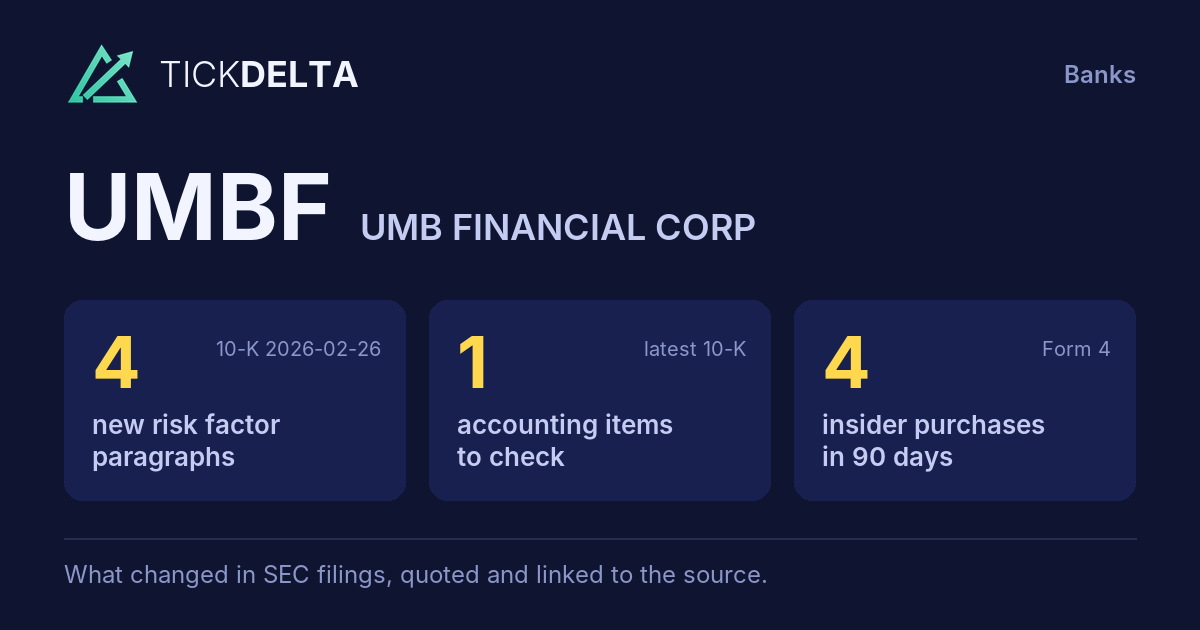
83 paragraphs · 4 new · 43 reworded · 14 gone · 10-K Feb 26, 2026 against Feb 27, 2025
New paragraph Reworded (5% of its words or more) Same or nearly
Paragraph 56 · 49% changed Every version of it
The Company faces intense competition from other financial-services and financial-services technology companies, and competitive pressures could adversely affect the Company’s business or performance. The Company faces intense competition in each of its business segments and in all of its markets and geographic regions, and the Company expects competitive pressures to intensify in the future—especially in light of recent legislative and regulatory initiatives, technological innovations that alter the barriers to entry, current economic and market conditions, and government monetary and fiscal policies. Competition with financial-services technology companies, including those related to digital currencies or cryptocurrencies (including stablecoins), or technology companies partnering with financial-services companies, may be particularly intense, due to, among other things, differing regulatory environments. For example, the Guiding and Establishing National Innovation for U.S. Stablecoins Act of 2025 (GENIUS Act) provides a legal framework for stablecoins to be issued in the United States, which may lead to new and increased competition for funds that may have otherwise been, or currently are, deposits with banks, such as the Bank. See “Competition” in Part I, Item 1 of this report. Competitive pressures may drive the Company to take actions that the Company might otherwise eschew, such as lowering the interest rates or fees on loans or raising the interest rates on deposits in order to keep or attract high-quality customers. These pressures also may accelerate actions that the Company might otherwise elect to defer, such as substantial investments in technology or infrastructure. The Company has certain businesses that utilize wholesale models which can lead to customer concentrations for those businesses that, if negatively impacted by new entrants, competitive pressures, or consolidations, could affect the Company’s fee income. Whatever the reason, actions that the Company takes in response to competition may adversely affect its results of operations and financial condition. These consequences could be exacerbated if the Company is not successful in introducing new products and other services, achieving market acceptance of its products and other services, developing and maintaining a strong customer base, or prudently managing expenses. See risk below “The financial services industry is rapidly evolving and the Company may not be successful in introducing new products or services on a large scale in response to these changes.”
Paragraph 64 · 48% changed Every version of it
Further, the Company acquired HTLF with the expectation that the acquisition will result in various benefits including, among other things, benefits relating to enhanced revenues, a strengthened market position for the combined company, cross selling opportunities, technological efficiencies, cost savings and operating efficiencies. Achieving the anticipated benefits of the acquisition of HTLF is remains subject to a number of uncertainties, including whether the Company integrates HTLF in an efficient, effective and timely manner, and general competitive factors in the marketplace. Failure to achieve these anticipated benefits on the anticipated timeframe, or at all, could result in a reduction in the price of the Company’s common stock as well as in increased costs, decreases in the amount of expected revenues and diversion of management’s time and energy and could materially and adversely affect the Company’s business, financial condition and operating results. Additionally, following consummation of the acquisition of HTLF, the Company made fair value estimates of certain assets and liabilities in recording the acquisition. Actual values of these assets and liabilities could differ from the estimates, which could impact regulatory capital ratios and result in the Company not achieving the anticipated benefits of the acquisition of HTLF. Finally, any cost savings that are realized may be offset by losses in revenues or other charges to earnings.
Paragraph 3 · 47% changed Every version of it
The impact of interest rate changes on the Company’s funding costs may differ from some peers given the Company’s concentration of funding from commercial and institutional sources. These deposits, which often include the benefit of other ancillary revenues, are generally more price-sensitive than consumer funding sources. In a rising rate environment, the Company may experience a sharper decline in low-cost funding sources or an increase in cost of deposits due to its customer profile. However, the expectation of higher earning asset growth and the benefit of higher interest rates on our earning assets may help mitigate any impact.
Paragraph 9 · 46% changed Every version of it
See “Quantitative and Qualitative Disclosures About Market Risk—Interest Rate Risk” Risk—Credit Risk Management” in Part II, Item 7A of this report for a discussion of how the Company monitors and manages interest-rate credit risk. A financial or systemic shock and a failure of a significant counterparty or a significant group of counterparties could negatively impact the Company, possibly to a severe degree, due to its role as a financial intermediary and the interconnectedness of the financial system.
Paragraph 25 · 42% changed Every version of it
Cybersecurity incidents and other security breaches of the Company’s information technology systems, or the information technology systems of the Company’s third-party service providers or their third-party service providers, the Company’s counterparties, or in the business community may negatively impact the Company’s business or performance. In the ordinary course of its business, the Company collects, stores, and transmits sensitive, confidential, or proprietary data and other information, including intellectual property, business information, funds-transfer instructions, and the personally identifiable information of its customers and employees. The secure processing, storage, maintenance, and transmission of this information is critical to the Company’s operations and reputation, and if any of this information were mishandled, misused, improperly accessed, lost, breached, held hostage or stolen, or if the Company’s operations were disrupted, the Company could suffer significant financial, business, reputational, regulatory, or other damage. Failures or errors in, or breach of the Company’s systems or networks, or those of its third-party service providers or their third-party service providers (collectively, third party service providers), or the Company’s counterparties, may expose the Company to litigation, disclosure requirements, remediation costs, increased costs for security measures, loss of revenue, regulatory scrutiny, governmental investigation and/or other actions, and other potential liability. For example, despite security measures, the Company’s or its third-party service providers’ information technology and infrastructure may be breached or rendered inaccessible due to a variety of factors, including from infrastructure changes or failures, introductions of new functionality, human or software errors, service failures, operational and technological outages, capacity constraints, loss or theft of assets, natural disasters, terrorist attacks, power outages, data breaches, cyber-attacks, denial of service attacks, hacking, ransomware and other computer viruses or malware, or acts of misconduct through pretext calls, electronic phishing or other means, and, as a result, an unauthorized party may obtain access to the Company’s or its customers’ confidential, proprietary, personal, or sensitive data. These risks and uncertainties are rapidly evolving and increasing in complexity, and the Company’s failure to effectively mitigate them could negatively impact its business and operations.
Paragraph 51 · 41% changed Every version of it
The Company’s ability to engage in routine funding transactions could be adversely affected by the actions and commercial soundness of other financial institutions. Financial services institutions are interrelated because of trading, clearing, counterparty and other relationships. The Company routinely executes transactions with counterparties in the financial services industry, including brokers and dealers, the FHLB, commercial banks, investment banks, payment processors, and other institutional clients, which may result in payment obligations to the Company or to its clients due to products it has arranged. As a result, defaults by, or even rumors or questions about, one or more financial services institutions, or the financial services industry generally, have led to market-wide liquidity problems and losses of depositor, creditor, and counterparty confidence and could lead to losses or defaults by the Company or by other institutions. Many of these transactions expose the Company to credit and market risk that may cause its counterparty or client to default. In addition, the Company is exposed to market risk when the collateral it holds cannot be realized or is liquidated at prices not sufficient to recover the full amount of the secured obligation. Any losses arising from such occurrences could materially and adversely affect the Company’s business, results of operations or financial condition.
Paragraph 62 · 36% changed Every version of it
•additional costs or unexpected problems •unexpected issues with operations, personnel, third-party service providers, technology and credit; and/or
Paragraph 46 · 34% changed Every version of it
The Company’s business relies on systems, employees, service providers, and other third parties, and failures or errors by any of them or other operational risks associated with the Company’s reliance on third parties could adversely affect the Company. The Company relies on hosted and on-premises systems, employees, service providers, and other third parties to properly oversee, administer, and process a high volume of transactions and otherwise support the Company’s day-to-day operations. This gives rise to meaningful operational risk—including the risk of fraud by employees or outside parties, unauthorized access to the Company’s premises or systems, errors in processing, failures of technology, breaches of internal controls or compliance safeguards, malware and other security or hacking incidents, inadequate integration of acquisitions, human or software errors, design or performance issues, capacity constraints or unexpected transaction volumes, unavailability of systems and services, including due to electrical or telecommunications outages, bad weather, acts of terrorism or the like, and other breakdowns in business continuity plans or acts of misconduct.

MD&A

179 paragraphs · 16 new · 65 reworded · 9 gone · 10-K Feb 26, 2026 against Feb 27, 2025
New paragraph Reworded (5% of its words or more) Same or nearly
Paragraph 143 · 50% changed
On April 28, 2024, the Company entered into the Merger Agreement with HTLF, a Delaware corporation and Blue Sky Merger Sub Inc., a Delaware corporation and wholly owned subsidiary of the Company. The Merger Agreement and the merger were unanimously approved by the boards of directors of the Company and HTLF. Pending regulatory approval and approval by the shareholders of the Company and HTLF, and the merger closed on January 31, 2025. Under the terms of the Merger Agreement, HTLF stockholders received a fixed exchange ratio of 0.55 shares of the Company’s common stock for each share of HTLF stock, with a total market value of approximately $2.8 billion.
Paragraph 158 · 49% changed
Regulatory fees decreased $45.1 million, or 58.6%, in 2024 Long-term debt totaled $474.2 million at December 31, 2025, compared to 2023 and increased $61.6 million, or 400.8%, in 2023 compared to 2022. $385.3 million at December 31, 2024. The decrease in 2024 and the increase in 2023 long-term debt in 2025 was driven by the FDIC special assessment acquisition of $52.8 million recorded in 2023. HTLF, which added total long-term
Paragraph 114 · 43% changed
Securities held to maturity had a net unrealized loss of $473.8 million or 8.3% of the $5.7 billion amortized cost value as of December 31, 2025, compared to a net unrealized loss of $630.0 million at December 31, 2024. During 2022, the Company transferred securities with an amortized cost balance of $4.1 billion and a fair value of $3.8 billion were transferred from the AFS classification category to the HTM classification as the Company has the positive intent and ability to hold these securities to maturity. category. The transfers transfer of securities were was made at fair value at the time of transfer. See further information in Note 4, “Securities” The remaining balance of unrealized pre-tax losses related to transferred securities was $139.2 million as of December 31, 2025 and $171.3 million as of December 31, 2024, and was included in the Notes to the Consolidated Financial Statements. amortized
Paragraph 82 · 40% changed
Salaries and employee benefits expense increased $290.0 million, or 48.8%, in 2025 compared to 2024 and $40.5 million, or 7.3%, in 2024 compared to 2023 2023. In 2025, bonus and $29.0 commission expense increased $108.3 million, or 5.5%, 78.9%, salaries and wage expense increased $143.7 million, or 40.7% and employee benefits expense increased $38.0 million, or 36.8%. The 2025 variances in 2023 compared salaries and employee benefits are primarily driven by increased severance, retention bonuses, and change in control payments made to 2022. HTLF associates, as well as higher bonus expense due to higher company performance. In 2024, bonus and commission expense increased $22.4 million, or 19.5%, salaries and wage expense increased $14.0 million, or 4.1% and employee benefits expense increased $4.1 million, or 4.1%. In 2023, salaries and wage expense increased $23.8 million, or 7.5% and employee benefits expense increased $20.5 million, or 26.0%. These increases were offset by a decrease in bonus and commission expense of $15.3 million, or 11.8%.
Paragraph 132 · 40% changed
At December 31, 2024, the Company held securities purchased under agreements to resell of $545.0 million compared to $240.3 million at December 31, 2023. The Company uses these instruments as short-term secured investments, in lieu of selling federal funds, or to acquire securities required for collateral purposes. Balances will fluctuate based on the Company’s liquidity and investment decisions as well as the Company’s correspondent bank borrowing levels. These investments averaged $776.8 million in 2025 and $303.0 million in 2024 and $310.5 million in 2023. 2024.
Paragraph 70 · 39% changed
A key objective of the Company is the growth of noninterest income to provide a diverse source of revenue not directly tied to interest rates. Fee-based services are typically non-credit related and are not generally affected by fluctuations in interest rates. Noninterest income increased in 2024 by $86.3 million, or 15.9%, compared to 2023 and decreased in 2023 by $12.4 million, or 2.2%, compared to 2022. investment securities gains, net. The increase in 2024 is primarily driven by increased trust and securities processing income, other miscellaneous income, investment securities gains, net, and bankcard income. The decrease in 2023 is primarily attributable to a decrease in investment securities gains, net, partially offset by an increase in other miscellaneous income and trust securities processing income. Changes in Noninterest income are presented in Table 6 below.
Paragraph 115 · 39% changed
For cost balance of HTM securities. See further information on income taxes refer to in Note 16, “Income Taxes,” 4, "Securities" in the Notes to the Consolidated Financial Statements.
Paragraph 97 · 37% changed
For the year ended December 31, 2024, Institutional 2025, Personal Banking net income increased $24.0 loss improved $20.1 million, or 18.5%, 69.4%, to $153.9 a net loss of $8.8 million as compared to the same period last year. Net interest income increased $7.1 $177.3 million, or 3.7%, 130.8%, compared to the same period last year, due to an increase in funds transfer pricing due to driven by the increase in interest rates. acquisition of HTLF, as well as organic loan growth and earning asset mix changes. Provision for credit losses increased $1.4 million $18.0 million, or 221.7%, for the period, driven by the acquisition of HTLF as well as by portfolio metric changes and changes in macro-economic metrics in 2025 as compared to 2023, driven by loan growth, portfolio metric changes, and changes in the macro-economic metrics in 2024 as compared to 2023. 2024. Noninterest income increased $50.4 $66.3 million, or 14.5%, 66.5%, for the same period primarily due to driven by increases of $28.4 $29.7 million in investment securities gains, $19.6 million in trust and securities processing income driven by higher fund services income, $7.3 million in bankcard fees, $4.1 million in deposit service charges, and corporate trust revenue, an increase of $7.1 $2.8 million in brokerage income, $6.5 million in bankcard income, an increase of $4.7 million in bond trading income, and an increase of $4.0 million in other income driven by the gain on the sale of UMB Distribution Services, LLC during the fourth quarter. These increases were partially offset by a decrease of $3.9 million in service charges on deposit accounts. income. Noninterest expense increased $25.6 $201.4 million, or 6.7% as compared 76.8%, primarily due to 2023, primarily driven by increases of $18.0 million in salaries and employee benefits expense, $8.6 million in bankcard expense, $6.1 million in processing fees, $1.7 million in legal and consulting expense, and $1.2 million in equipment expense. These increases were partially offset by a decrease of $11.1 $102.3 million in technology, service, and overhead expenses. expenses, and $62.5 million in salaries and employee benefits, both driven by the HTLF acquisition. Additionally, there were increases of $10.6 million in other expense driven by increased charitable contributions, $7.2 million in supplies and services, $5.6 million in processing fees, $3.4 million in regulatory fees, $3.4 million in equipment, and $3.3 million in marketing and business development.

A paragraph is matched with the one last year that shares the most of its words; under half in common makes it new. The paragraphs shown are the 8 reworded the most in each section.

The paragraph that changed most in each section

The redline

Marked against last year's 10-K: cut words struck through, new words highlighted.

Risk Factors281 words changed in this paragraph; it is 66% similar to last year's version.
Weak or deteriorating economic conditions, geopolitical events, more liberal origination or underwriting standards, or financial or systemic shocks could increase the Company’s credit risk and adversely affect its lending or other banking businesses and the value of its loans or investment securities. The Company’s business and results of operations depend significantly on general economic conditions. When those conditions are weak or deteriorating in any of the markets or regions where the Company operates, or there are impacts stemming from geopolitical events, its business or performance could be adversely affected. The Company provides financial services primarily throughout the Midwestern, Southwestern, and Western regions of the United States. As the Company does not have a significant banking presence in other parts of the country, a prolonged economic downturn in these markets could have a material adverse effect on the Company’s financial condition and results of operations. The Company’s lending and other banking businesses, in particular, are susceptible to weak or deteriorating economic conditions, including due to inflation, which could result in reduced loan demand or utilization rates and at the same time increased delinquencies or defaults. These kinds of conditions also could dampen the demand for products and other services in the Company’s investment-management, asset-servicing, insurance, brokerage, or related businesses. Financial markets and global supply chains may be adversely affected by the impact of military conflict, including the current conflicts in Ukraine and the Middle East, terrorism terrorism, or other geopolitical events. events, including in Venezuela. Increased delinquencies or defaults could result as well from the Company adopting—for strategic, competitive, or other reasons—more liberal origination or underwriting standards for extensions of credit or other dealings with its customers or counterparties. Further, changes to U.S. global policy, including as it relates to tariffs, trade disputes and renewing or changing trade agreements with various countries, could affect the Company’s results of operations. The global economy, the strength of the U.S. dollar, international trade conditions, and oil prices may ultimately affect interest rates, business import/export activity, capital expenditures by businesses, and investor confidence. Unfavorable changes in those factors may result in declines in consumer credit usage, increased delinquencies and defaults, and reduced loan demand. If delinquencies or defaults on the Company’s loans or investment securities increase, their value and the income derived from them could be adversely affected, and the Company could incur administrative and other costs in seeking a recovery on its claims and any collateral. Weak or deteriorating economic conditions also may negatively impact the market value and liquidity of the Company’s investment securities, and the Company may be required to record additional impairment charges if investment securities suffer a decline in value that is determined to have resulted from a credit loss. In addition, to the extent that loan charge-offs exceed estimates, an increase to the amount of provision expense related to the allowance for credit losses would reduce the Company’s income. See “Quantitative and Qualitative Disclosures About Market Risk—Credit Risk Management” in Part II, Item 7A of this report for a discussion of how the Company monitors and manages credit risk. A financial or systemic shock and a failure of a significant counterparty or a significant group of counterparties could negatively impact the Company, possibly to a severe degree, due to its role as a financial intermediary and the interconnectedness of the financial system.

Source: Item 1A, 10-K 0001193125-26-076496 vs Item 1A, 10-K 0000950170-25-028420

MD&A173 words changed in this paragraph; it is 49% similar to last year's version.
For the year ended December 31, 2025, Personal Banking net loss improved $20.1 million, or 69.4%, to a net loss of $8.8 million as compared to the same period last year. Net interest income increased $177.3 million, or 130.8%, compared to the same period last year, driven by the acquisition of HTLF, as well as organic loan growth and earning asset mix changes. Provision for credit losses increased $1.5 $18.0 million, or 22.3%, 221.7%, for the period, driven by loan growth, the acquisition of HTLF as well as by portfolio metric changes, changes and changes in macro-economic metrics in 2024 2025 as compared to 2023. 2024. Noninterest income increased $3.3 $66.3 million, or 3.4%, 66.5%, for the same period primarily driven by an increase increases of $5.0 $29.7 million in investment securities gains, $19.6 million in trust and securities processing income, and $2.9 $7.3 million in life insurance income, partially offset by a decrease of $3.2 bankcard fees, $4.1 million in investment securities gains. deposit service charges, and $2.8 million in brokerage income. Noninterest expense increased $11.7 $201.4 million, or 4.7%, 76.8%, primarily due to increases of $6.4 $102.3 million in technology, service, and overhead expenses, $5.2 and $62.5 million in salaries and employee benefits, and $1.0 both driven by the HTLF acquisition. Additionally, there were increases of $10.6 million in bankcard expense, partially offset other expense driven by a decrease of $1.7 increased charitable contributions, $7.2 million in operational losses. supplies and services, $5.6 million in processing fees, $3.4 million in regulatory fees, $3.4 million in equipment, and $3.3 million in marketing and business development.

Source: Item 7, 10-K 0001193125-26-076496 vs Item 7, 10-K 0000950170-25-028420

Accounting Policies67 words changed in this paragraph; it is 44% similar to last year's version.
Basic net income per common share is computed based on using net income available to common shareholders and the weighted average number of shares of common stock outstanding during each period. Diluted year-to-date net income per common share includes is determined using net income available to common shareholders and the dilutive effect of 309,142, 260,177, weighted average common shares and 406,477 assumed incremental common shares issuable upon the exercise of stock options and nonvested restricted stock units granted by the Company that were outstanding at December 31, 2024, 2023, and 2022, respectively. issued.

Source: Item 8, Note 1 – SUMMARY OF SIGNIFICANT ACCOUNTING POLICIES, 10-K 0001193125-26-076496 vs Item 8, Note 1 – SUMMARY OF SIGNIFICANT ACCOUNTING POLICIES, 10-K 0000950170-25-028420

Legal Proceedings25 words changed in this paragraph; it is 88% similar to last year's version.
The ACL for off-balance sheet credit exposures was $4.1 $5.7 million and $5.1 $4.1 million as of December 31, 2024 2025 and 2023, 2024, respectively, and was recorded in the Accrued expenses and taxes line of the Company’s Consolidated Balance Sheets. A reduction Reductions of $2.0 million and $950 thousand of provision for off-balance sheet credit exposures was were recorded for the year years ended December 31, 2024. 2025 and December 31, 2024, respectively. Provision of $2.0 million and $500 thousand were was recorded for off-balance sheet credit exposures for the years year ended December 31, 2023 and 2022, respectively. 2023. Provision for off-balance sheet credit exposures is recorded in the Provision for credit losses line of the Company’s Consolidated Statements of Income.

Source: Item 3, via Note 15 – COMMITMENTS, CONTINGENCIES AND GUARANTEES, 10-K 0001193125-26-076496 vs Item 3, via Note 15 – COMMITMENTS, CONTINGENCIES AND GUARANTEES, 10-K 0000950170-25-028420

Sentences and paragraphs added, removed or reworded

Every change, by type

Sentences and paragraphs of UMBF's Risk Factors and MD&A, 10-K Feb 26, 2026 against 10-K Feb 27, 2025. Each links to the text at sec.gov.

Quiet changes are sentences kept from last year with one to four words changed, at least one of them a hedge, a modal or a qualifier (may, could, will, not, significant, material…). A year or date rolling forward is not counted.

The full word list

adverse, adversely, all, although, anticipate, anticipates, any, approximately, believe, believes, can, cannot, certain, could, expect, expects, generally, however, if, intend, intends, largely, likely, many, material, materially, may, might, most, must, never, no, not, possible, primarily, probable, should, significant, significantly, some, substantial, substantially, unlikely, will, would

AddedRisk Factors
may not be able to effectively defend itself against these actions, and they in turn could give rise to litigation by private plaintiffs. Further, if the laws, rules, and regulations materially adversely affect the Company, including any changes that would negatively impact the tax treatment of the Company, the Company’s products and services or the Company’s shareholders, the Company may be adversely impacted. All of these and other regulatory risks and uncertainties could adversely affect the Company’s reputation, business, results of operations, financial condition, or prospects.
Read it in 10-K Feb 26, 2026 at sec.gov
AddedRisk Factors
Disruption to the businesses resulting from the Company's continued efforts could cause customers, including depositors, to move their business to a competing financial institution.
Read it in 10-K Feb 26, 2026 at sec.gov
AddedRisk Factors
affected. The Company could be negatively impacted as well if, despite programs being in place, its risk-management or compliance personnel are ineffective in executing them and mitigating risk and loss.
Read it in 10-K Feb 26, 2026 at sec.gov
RemovedRisk Factors
and types of fees financial institutions may charge, including the FRB’s Regulation II on debit card interchange fees and the CFPB’s regulations on consumer protection, such as the CFPB late fee regulation.
Read it in 10-K Feb 27, 2025 at sec.gov
RemovedRisk Factors
The Company believes that government scrutiny and the intensity of supervision of all financial-services companies has increased, fundamental changes have been made to the banking, securities, and other laws that govern financial services, and a host of related business practices have been reexamined and reshaped. The Company also may face further government scrutiny due to the increased size of the Company’s business resulting from the acquisition of HTLF. See risk below “The future results of the Company following the acquisition of HTLF may suffer if the Company does not effectively manage its expanded operations.” As a result, the Company expects to continue devoting increased time and resources to risk management, compliance, and regulatory change management. The legislative, regulatory, and supervisory environment is beyond the Company’s control, may change rapidly and unpredictably, and may negatively influence the Company’s revenue, costs, earnings, growth, liquidity and capital levels. For example, the Company is unable to predict what, if any, changes to the regulatory
Read it in 10-K Feb 27, 2025 at sec.gov
Show the other 53
RemovedRisk Factors
The Company faces intense competition from other financial-services and financial-services technology companies, and competitive pressures could adversely affect the Company’s business or performance. The Company faces intense competition in each of its business segments and in all of its markets and geographic regions, and the Company expects competitive pressures to intensify in the future—especially in light of recent legislative
Read it in 10-K Feb 27, 2025 at sec.gov
RemovedRisk Factors
Any disruption to the businesses could cause customers to remove their accounts and move their business to a competing financial institution. Integration efforts between the two companies may also divert management attention and resources. Additionally, general market and economic conditions or governmental actions affecting the financial industry generally may inhibit our successful integration of HTLF.
Read it in 10-K Feb 27, 2025 at sec.gov
RemovedRisk Factors
The dilution caused by the issuance of shares of the Company’s common stock in connection with the merger may adversely affect the market price of the Company’s common stock. The Company issued approximately 23.6 million shares of common stock as merger consideration to HTLF stockholders, and assuming full physical settlement, the Company will issue 3.2 million shares of common stock pursuant to the forward sale agreements. The dilution caused by the issuance of the shares of the Company’s common stock to HTLF stockholders in connection with the payment of the merger consideration may result in fluctuations in the market price of the Company’s common stock, including a stock price decrease.
Read it in 10-K Feb 27, 2025 at sec.gov
RemovedRisk Factors
The future results of the Company following the acquisition of HTLF may suffer if the Company does not effectively manage its expanded operations. As a result of the acquisition of HTLF, the size of the business of
Read it in 10-K Feb 27, 2025 at sec.gov
RemovedRisk Factors
In addition, HTLF’s historical bank subsidiary (HTLF Bank) was a Colorado state-chartered non-member bank subject to primary federal bank regulatory oversight by the FDIC and state bank regulatory oversight by the Colorado Department of Regulatory Agencies, Division of Banking, while the Bank is a national bank subject to oversight by the OCC. The laws, regulations, regulatory guidance and supervision applicable to HTLF Bank and the Bank therefore differ in ways that may affect the future operations of the Company following the acquisition of HTLF.
Read it in 10-K Feb 27, 2025 at sec.gov
RemovedRisk Factors
Additionally, the internal policies of HTLF Bank and the Bank with regards to their investment portfolios may differ on factors such as hold limits per bond issuer, life of the bond, or credit risk appetite. As a result, there are assets on the balance sheet of HTLF Bank that the Bank does not hold, whether based on differences in regulatory oversight or internal policies. Further, the Company may replace such disposed assets with lower-yielding investments, any of which could impact its future earnings and return on equity.
Read it in 10-K Feb 27, 2025 at sec.gov
RemovedRisk Factors
Moreover, the standards by which bank and financial institution acquisitions will be evaluated may be subject to change. For example, the OCC adopted a final rule in September 2024 amending its procedures for reviewing applications under the BMA and adding a policy statement on the OCC’s substantive approach to evaluating bank
Read it in 10-K Feb 27, 2025 at sec.gov
RewordedRisk Factors
These agreements In addition to the challenges of managing conflicting expectations of legislatures, agencies, and regulators with respect to climate change, measures designed to mitigate or bring awareness to climate change may result in the imposition of taxes and fees, the required purchase of emission credits, and the implementation of significant operational changes, each of which may require the Company to expend significant capital and incur compliance, operating, maintenance and remediation costs.
Read it in 10-K Feb 26, 2026 at sec.gov
RewordedRisk Factors
While the Company’s policies and controls are designed to ensure that it maintains adequate liquidity to conduct its business in the ordinary course even in a stressed environment, there can be no assurance that its liquidity position will never become compromised.
Read it in 10-K Feb 26, 2026 at sec.gov
RewordedRisk Factors
The Company also may be compelled to raise capital if regulatory or supervisory requirements change and as a result of the acquisition of HTLF may face further government scrutiny due to the increased size of the Company’s business. change.
Read it in 10-K Feb 26, 2026 at sec.gov
RewordedRisk Factors
The In the United States Congress, States, certain state legislatures and federal and state regulatory agencies have proposed and advanced numerous legislative and regulatory initiatives seeking to mitigate the effects of climate change. change, some of which conflict with other state or federal, initiatives or sentiments.
Read it in 10-K Feb 26, 2026 at sec.gov
RewordedRisk Factors
The failure or risks of other banks and financial institutions institutions, and the measures taken by governments, businesses, and other organizations in response to those events, could adversely impact the Company’s business, financial condition and results of operations.
Read it in 10-K Feb 26, 2026 at sec.gov
RewordedRisk Factors
Achieving the anticipated benefits of the acquisition of HTLF is remains subject to a number of uncertainties, including whether the Company integrates HTLF in an efficient, effective and timely manner, and general competitive factors in the marketplace.
Read it in 10-K Feb 26, 2026 at sec.gov
RewordedRisk Factors
The In doing so, the Company may not be able to combine its business with the business of HTLF without encountering encounter difficulties that could adversely affect the ability to maintain relationships with existing clients, customers, depositors and employees, such as:
Read it in 10-K Feb 26, 2026 at sec.gov
RewordedRisk Factors
Economic conditions or market conditions, such as increased use of digital currencies and cryptocurrencies (including stablecoin) can also reduce the usage of credit cards in general and the average purchase amount of transactions, which reduces interest income and transaction fees.
Read it in 10-K Feb 26, 2026 at sec.gov
RewordedRisk Factors
The Company may also face additional or different regulatory requirements and scrutiny from governmental authorities as a result of the significant increase in the size of its business. expanded business operations.
Read it in 10-K Feb 26, 2026 at sec.gov
RewordedRisk Factors
See “Quantitative and Qualitative Disclosures About Market Risk—Interest Rate Risk” Risk—Credit Risk Management” in Part II, Item 7A of this report for a discussion of how the Company monitors and manages interest-rate credit risk.
Read it in 10-K Feb 26, 2026 at sec.gov
RewordedRisk Factors
The Company routinely executes transactions with counterparties in the financial services industry, including brokers and dealers, the FHLB, commercial banks, investment banks, payment processors, and other institutional clients, which may result in payment obligations to the Company or to its clients due to products it has arranged.
Read it in 10-K Feb 26, 2026 at sec.gov
AddedMD&A
On January 31, 2025, UMBF completed its previously announced acquisition of Heartland Financial, USA, Inc. (HTLF). The acquisition added assets with a fair value of approximately $16.1 billion, $9.7 billion of loans, net of the allowance for credit losses, and $14.3 billion of deposits. The combined company retains its #1 deposit market share in Missouri and now ranks in the top 10 in Colorado, New Mexico, Kansas, and Arizona. The impacts of the acquisition are significant drivers in the results for 2025.
Read it in 10-K Feb 26, 2026 at sec.gov
AddedMD&A
shares of common stock during 2025 except for shares acquired pursuant to the Company's share-based incentive programs. In 2025, the Company declared $123.4 million in common dividends, which represents a 60.0% increase compared to dividends declared during 2024. In 2025, the Company declared $17.8 million in preferred dividends. The second quarter of 2025 includes the issuance of 12.0 million depositary shares, each representing a 1/400th interest in a share of the Company’s 7.75% Fixed-Rate Reset Non-Cumulative Perpetual Preferred Stock, Series B (the Series B Preferred Stock). During the third quarter of 2025, the Company completed the redemption of all of its outstanding 7.00% Fixed-Rate Reset Non-Cumulative Perpetual Preferred Stock, Series A at the redemption price of $10,000 per share.
Read it in 10-K Feb 26, 2026 at sec.gov
AddedMD&A
Amortization of other intangible assets expense increased $85.8 million, or 1,113.8%, in 2025 compared to 2024 and decreased $0.1 million, or 10.3%, in 2024 compared to 2023. The increase in 2025 is primarily due to amortization of the core deposit intangible, customer list and purchased credit card relationship intangibles recognized from the HTLF acquisition.
Read it in 10-K Feb 26, 2026 at sec.gov
AddedMD&A
On July 4, 2025, the One Big Beautiful Bill Act (OBBBA) was signed into law in the U.S., which contains a broad range of tax reform provisions affecting businesses, including restoring 100% bonus depreciation, removing the requirement to capitalize and amortize domestic research and development expenditures, and a 25% exclusion of interest income on loans secured by rural or agricultural real property. The legislation has multiple effective dates, with certain provisions effective in 2025 and others being phased in through 2027. The effective provisions of the OBBBA were reflected in the Company's financial results for the year ended December 31, 2025, and did not have a material impact on its Consolidated Financial Statements.
Read it in 10-K Feb 26, 2026 at sec.gov
AddedMD&A
based on methodologies in effect at December 31, 2025. Previously reported results have been reclassified in this Form 10-K to conform to the Company’s current organizational structure.
Read it in 10-K Feb 26, 2026 at sec.gov
AddedMD&A
the increase in the Company's investment portfolio was the acquisition of HTLF and its bond portfolio, which added total securities with an acquired fair value of $3.6 billion at January 31, 2025.
Read it in 10-K Feb 26, 2026 at sec.gov
AddedMD&A
The securities portfolio generates the Company’s second largest component of interest income. The AFS, HTM, and Other securities portfolios achieved an average yield on a tax-equivalent basis of 3.68% for 2025, compared to 2.96% in 2024.
Read it in 10-K Feb 26, 2026 at sec.gov
AddedMD&A
Total shareholders’ equity increased $4.2 billion, or 121.9% to $7.7 billion at December 31, 2025 as compared to December 31, 2024, driven by the acquisition of HTLF. Total common shareholders' equity was $7.4 billion as of December 31, 2025. Total accumulated other comprehensive loss was $261.5 million at December 31, 2025, which is an improvement of $311.5 million as compared to December 31, 2024. During the second quarter of 2025, the Company issued 12.0 million depositary shares, each representing a 1/400th interest in a share of the Company's 7.75% Fixed-Rate Reset Non-Cumulative Perpetual Preferred Stock, Series B. During the third quarter of 2025, the Company completed the redemption of all of its outstanding 7.00% Fixed-Rate Reset Non-Cumulative Perpetual Preferred Stock, Series A at the redemption price of $10,000 per share.
Read it in 10-K Feb 26, 2026 at sec.gov
AddedMD&A
At the Company's quarterly board meeting, the Board declared a $0.43 per common share quarterly cash dividend payable on April 1, 2026, to common shareholders of record at the close of business on March 10, 2026. Additionally, the Board declared a dividend of $193.75 per share of the Company's Series B Preferred Stock, which results in a dividend of $0.484375 per depositary share. The Series B Preferred Stock dividend is payable on April 15, 2026 to stockholders of record of the Series B Preferred Stock as of the close of business on March 31, 2026.
Read it in 10-K Feb 26, 2026 at sec.gov
RemovedMD&A
The shift to work-from-home and hybrid work environments has caused a decreased utilization of, and demand for, office space. The Company is actively monitoring its exposure to office space in its non-owner occupied commercial real estate portfolio. The average loan size in the Company’s office portfolio was approximately $8.9 million and $9.2 million as of December 31, 2024 and December 31, 2023, respectively. The average loan-to-value of the office portfolio was 63% and 64% as of December 31, 2024 and December 31, 2023, respectively, and 84% are recourse loans as of the end of both periods. Further, only 18% and 30% of the Company’s office portfolio as of December 31, 2024 and December 31, 2023, respectively, is in central business districts, which have been more heavily impacted by the shift to remote work. The remainder of the Company’s office portfolio is in suburban or medical properties.
Read it in 10-K Feb 27, 2025 at sec.gov
RemovedMD&A
Office CRE loans by MSA December 31, 2024 December 31, 2023 Dallas-Fort Worth-Arlington, TX 23.1% 22.7% Kansas City, MO-KS 10.1 7.8 Jacksonville, FL 9.3 9.1 St. Louis, MO-IL 7.5 6.7 Tampa-St. Petersburg-Clearwater, FL 7.3 6.8 Raleigh-Cary, NC 5.8 5.9 Cincinnati-Middletown, OH-KY-IN 5.8 5.1 Phoenix-Mesa-Scottsdale, AZ 5.3 4.5 Indianapolis-Carmel, IN 5.0 4.9 Milwaukee-Waukesha-West Allis, WI — 5.2 All others 20.8 21.3 Total Office CRE 100.0% 100.0%
Read it in 10-K Feb 27, 2025 at sec.gov
RemovedMD&A
Consumer real estate loans increased $226.5 million, or 7.7%, compared to 2023. These loans represented 12.4% of total loans as of December 31, 2024, compared to 12.8% as of December 31, 2023.
Read it in 10-K Feb 27, 2025 at sec.gov
RemovedMD&A
Total shareholders’ equity increased $366.1 million, or 11.8% to $3.5 billion at December 31, 2024 as compared to December 31, 2023. The increase in shareholders’ equity from 2023 to 2024 is largely due to an increase in retained earnings.
Read it in 10-K Feb 27, 2025 at sec.gov
RemovedMD&A
repurchase shares of common stock pursuant to any of its announced Repurchase Authorizations. The Company has not made any repurchase of its securities other than pursuant to the Repurchase Authorizations.
Read it in 10-K Feb 27, 2025 at sec.gov
RemovedMD&A
As of December 31, 2024, the Company had no borrowings outstanding with the Federal Reserve Bank's Bank Term Funding Program (BTFP). As of December 31, 2023, the Company had an $800.0 million short-term borrowing outstanding with the BTFP. The FRB terminated the BTFP during 2024. As of December 31, 2024, the Company's borrowing capacity with the Federal Reserve Discount Window was $12.5 billion.
Read it in 10-K Feb 27, 2025 at sec.gov
RemovedMD&A
As of December 31, 2024, the Company’s total liabilities for unrecognized tax benefits were $8.3 million. The Company cannot reasonably estimate the settlement of these liabilities. Therefore, these liabilities have been excluded from the table above. See Note 16, “Income Taxes,” in the Notes to the Consolidated Financial Statements for information regarding the liabilities associated with unrecognized tax benefits.
Read it in 10-K Feb 27, 2025 at sec.gov
RemovedMD&A
The estimation process involves the consideration of quantitative and qualitative factors relevant to the specific segmentation of loans. These factors have been established over decades of financial institution experience
Read it in 10-K Feb 27, 2025 at sec.gov
RewordedMD&A
Maturities due by Period Total Less than 1 year 1-3 years 3-5 years More than 5 years Commitments, Contingencies and Guarantees Commitments to extend credit for loans (excluding credit card loans) $ 12,904,749 17,819,711 $ 5,410,009 7,844,323 $ 4,978,117 6,132,122 $ 1,771,855 2,678,552 $ 744,768 1,164,714 Commitments to extend credit under credit card loans 5,474,758 5,474,758 5,994,640 5,994,640 — — — Commercial letters of credit 311 311 217 217 — — — Standby letters of credit 404,697 275,939 124,341 4,417 — 468,384 353,795 99,002 14,809 778 Forward contracts 55,174 55,174 119,978 119,978 — — — Spot foreign exchange contracts 50,006 50,006 34,233 34,233 — — — Commitments to extend credit for securities purchased under agreements to resell 96,000 66,000 30,000 191,000 191,000 — — — Total $ 18,985,695 24,628,163 $ 11,332,197 14,538,186 $ 5,132,458 6,231,124 $ 1,776,272 2,693,361 $ 744,768 1,165,492
Read it in 10-K Feb 26, 2026 at sec.gov
RewordedMD&A
Noninterest income increased $50.4 $50.5 million, or 14.5%, 12.8%, primarily due to increases of $28.4 $30.4 million in trust and securities processing income driven by higher fund services and corporate trust revenue, an increase of $7.1 $15.2 million in brokerage income, $6.5 and $5.1 million in bankcard income, an increase of $4.7 million in bond trading income, and an increase of $4.0 million in other income driven by the gain on the sale of UMB Distribution Services, LLC during the fourth quarter. deposit service charges.
Read it in 10-K Feb 26, 2026 at sec.gov
RewordedMD&A
Provision for credit losses increased $1.4 million $18.0 million, or 221.7%, for the period, driven by the acquisition of HTLF as well as by portfolio metric changes and changes in macro-economic metrics in 2025 as compared to 2023, driven by loan growth, portfolio metric changes, and changes in the macro-economic metrics in 2024 as compared to 2023. 2024.
Read it in 10-K Feb 26, 2026 at sec.gov
RewordedMD&A
This increase was primarily due to increases of $11.0 $19.6 million in investment security gains, $7.4 million in bankcard income, $5.8 deposit service charges, $15.7 million in other income driven by increased derivative income, recoveries of loans previously charged off by HTLF, a legal settlement in the first quarter of 2024 during 2025, and increased life insurance syndication income, and $4.0 $15.6 million in service charges on deposit accounts. bankcard fees.
Read it in 10-K Feb 26, 2026 at sec.gov
RewordedMD&A
Commercial and industrial 507 1,890 5,295 Specialty lending — 4 1 Commercial real estate 196 — 111 Consumer real estate 275 648 45 Consumer 845 241 211 Credit cards 3,519 2,355 1,536 Leases and other 6 3 — Total recoveries 5,348 5,141 7,199 Net charge-offs (82,371) (23,262) (10,474) Allowance for credit losses – end of period $421,162 $261,734 $222,996 Allowance for credit losses on loans $419,478 $259,089 $219,738 Allowance for credit losses on held-to-maturity securities 1,684 2,645 3,258 Loans at end of year, net of unearned interest 38,779,408 25,642,301 23,172,484 Held-to-maturity securities at end of period 5,724,227 5,378,912 5,691,868 Total assets at amortized cost 44,503,635 31,021,213 28,864,352 Average loans, net of unearned interest 36,065,953 24,209,547 22,334,942 Allowance for credit losses on loans to loans at end of period 1.08% 1.01% 0.95% Allowance for credit losses – end of period to total assets at amortized cost 0.95% 0.84% 0.77% Allowance as a multiple of net charge-offs 5.11x 11.25x 21.29x Net charge-offs to average loans 0.23% 0.10% 0.05%
Read it in 10-K Feb 26, 2026 at sec.gov
RewordedMD&A
Net interest margin, on an FTE basis, decreased increased to 3.10% for 2025, compared to 2.51% for 2024, compared to 2.52% for the same period in 2023, 2024, driven by repricing and mix changes of interest-bearing liabilities with from the HTLF acquisition, changes in short-term interest rates, partially offset by the repricing of earning assets. and purchase accounting accretion income.
Read it in 10-K Feb 26, 2026 at sec.gov
RewordedMD&A
Agency Treasury Securities Mortgage-backed Securities December 31, 2023 2025 Fair Value Weighted Fair Value Weighted Average Average Yield/Average Yield/Average Maturity Maturity Due in one year or less $ 6,933 2.91% $ — —% $ 341 0.34% Due after 1 year through 5 years 113,591 3.08 325,315 2.31 38,243 3.59 293,057 2.32 Due after 5 years through 10 years — — 1,610,142 1.63 1,779,723 1.89 Due over 10 years — — 446,157 1.78 135,841 1.97 Total $ 120,524 3.07% 38,243 3.59% $ 2,381,614 1.74% 2,208,962 1.95%
Read it in 10-K Feb 26, 2026 at sec.gov
RewordedMD&A
These long-term As of December 31, 2024, the debt obligations related to the four unconsolidated trusts acquired from Marquette had an aggregate contractual balance of $103.1 million and had a carrying value of $76.8 million at December 31, 2024 and $75.6 million at December 31, 2023. million.
Read it in 10-K Feb 26, 2026 at sec.gov
RewordedMD&A
Net interest margin, on a fully tax-equivalent (FTE) basis, decreased one increased 59 basis point points compared to the same period in 2023 2024 in large part due to repricing and mix changes of loan balances and interest-bearing liabilities with the changes in short-term interest rates, partially offset by the repricing of earning assets. liabilities.
Read it in 10-K Feb 26, 2026 at sec.gov
RewordedMD&A
This income category increased by $52.8 million, or 18.2% in 2025, compared to 2024, and increased by $33.4 million, or 13.0% 13.0%, in 2024, compared to 2023, and increased by $20.0 million, or 8.4%, in 2023, compared to 2022. 2023.
Read it in 10-K Feb 26, 2026 at sec.gov
RewordedMD&A
Management believes that the Company’s critical accounting policies and estimates are those relating to the allowance for credit losses. losses and certain purchase accounting fair value estimates including the fair value of loans acquired in, and the core deposit intangibles associated with, the acquisition of HTLF.
Read it in 10-K Feb 26, 2026 at sec.gov
RewordedMD&A
Noninterest expense increased in 2025 by $596.1 million, or 58.1%, compared to 2024 and increased by $27.5 million, or 2.8%, in 2024 compared to 2023 and increased by $101.0 million, or 11.2%, in 2023 compared to 2022. 2023.
Read it in 10-K Feb 26, 2026 at sec.gov

Sources

The two latest 10-Ks on EDGAR, section by section. Each change links to the text at sec.gov.

Also

New risk factors: paragraphs with nothing like them last year, quoted in full.

Work with it

Excel workbook · CSV. Google Sheet that stays up to date: paste =IMPORTDATA("https://tickdelta.com/company/UMBF/export.csv") into a cell.

Next:Related parties
Esc

Type a ticker such as AAPL, a name, an investor such as Buffett, or a topic such as tariffs. ↑ ↓ to move, Enter to open.