Screener / SEC EDGAR /CIK 0001020859 /Numbers from the XBRL of the 10-Ks
NYSE Consumer staples · Groceries, General Line

United Natural Foods Inc UNFI

Compare with peers Embed
SEC comment letters, last 20 years

2 reviews of UNFI's filings by SEC staff

UPLOAD and CORRESP
Reviews 2 latest letter Jan 31, 2018
Questions asked 3 each answered in the company's own letter
No closing letter 0 reviews without a letter saying the staff completed it

When the SEC's staff reviews a filing, it writes to the company with numbered questions, and the company answers each one in a letter. SEC publishes the exchange once the review is over, at least 20 business days later. A question is not an accusation; most reviews end with the company adding detail to its next filing.

How the reviews went

Every review on EDGAR, from the first staff letter to the letter that closes it

  1. 1. Staff letters 2 UPLOAD
  2. 2. Questions in them 3 numbered comments
  3. 3. Company replies 2 CORRESP
  4. 4. Reviews closed 2 of 2 closing letter

Half the closed reviews took 27 days or less from the first letter to the closing letter.

Form 10-K for the Fiscal Year Ended July 29, 2017

2018-01-31 to 2018-02-15 · 1 question · 1 letter from the SEC, 1 from the company
Review closed 2018-02-15
Non-GAAP measures
Item 8. Financial Statements and Supplementary Data · Notes to Consolidated Financial Statements
SEC asked
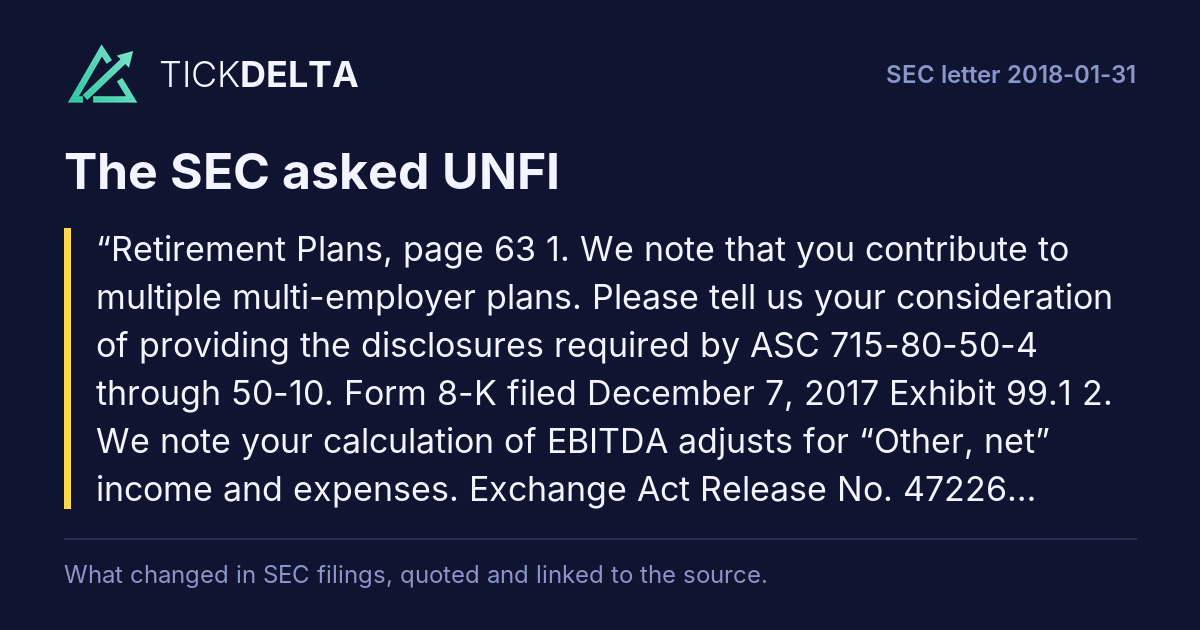
Retirement Plans, page 63 1. We note that you contribute to multiple multi-employer plans. Please tell us your consideration of providing the disclosures required by ASC 715-80-50-4 through 50-10. Form 8-K filed December 7, 2017 Exhibit 99.1 2. We note your calculation of EBITDA adjusts for “Other, net” income and expenses. Exchange Act Release No.
Rest of the question

47226 describes EBITDA as "earnings before interest, taxes, depreciation and amortization." Measures that are calculated differently than EBITDA as described in Exchange Act Release No. 47226 should not be characterized as EBITDA. Please revise your calculation of EBITDA or characterization of this measure in future filings. Refer to Question 103.01 of the Division’s Compliance and Disclosure Interpretations of the rules and regulations on the use of non-GAAP financial measures.

UNFI answered
We contribute to three multi-employer plans for certain of our associates that are represented by unions. Based on the most recently available information extending to the date of filing of our Annual Report on Form 10-K for the fiscal year ended July 29, 2017, the Company determined that none of the three plans were individually significant to our consolidated financial statements and therefore, did not include the narrative disclosures required by ASC 715-80-50-4 or the tabular disclosures required by sections 50-5 through 50-10 of ASC 715-80.
Rest of the answer

The following factors were considered when determining that none of our multi-employer plans were individually significant:

•

As of the end of the fiscal year ended July 29, 2017 we had withdrawn from one of the three plans which had a withdrawal liability of approximately $5.4 million, the present value of which was recorded in our consolidated financial statements, and began making withdrawal payments which total approximately $0.3 million annually.

The total combined estimated withdrawal liability for the two active plans was less than $3.5 million based on the most recently available information. The Company does not currently have any intention to withdraw from the two active plans.

As of the end of the fiscal year ended July 29, 2017, of our 9,700 active employees, the Company had approximately 150 union employees participating in the two active plans, which represented approximately 1.5% of our workforce.

The total combined annual contributions made to the two active plans were less than $0.5 million in the fiscal year ended July 29, 2017.

There were no recent changes that affected comparability from period to period and (excluding the one plan from which we have withdrawn) future contributions to these multi-employer plans are expected to be consistent with current levels.

We believe that all factors above support the conclusion that our multi-employer plans were not individually significant and therefore, disclosure of such plans under ASC 715-80-50-4 through 50-10 was not required. The Company will include disclosures related to the multi-employer plans in future filings if deemed to be significant in accordance with applicable requirements.

Exhibit 99.1

2. We note your calculation of EBITDA adjusts for “Other, net” income and expenses. Exchange Act Release No. 47226 describes EBITDA as “earnings before interest, taxes, depreciation and amortization.” Measures that are calculated differently than EBITDA as described in Exchange Act Release No. 47226 should not be characterized as EBITDA. Please revise your calculation of EBITDA or characterization of this measure in future filings. Refer to Question 103.01 of the Division’s Compliance and Disclosure Interpretations of the rules and regulations on the use of non-GAAP financial measures.

The Company acknowledges the Staff’s comment and will comply with the comment in future filings. If the Company presents EBITDA with adjustments beyond interest, taxes, depreciation and amortization in future filings it intends to refer to this financial measure as “Adjusted EBITDA.”

Read in the reply
In its next report

First report after the company's reply of Feb 9, 2018: 10-Q filed Mar 8, 2018 ↗, against the 10-Q filed Dec 7, 2017 ↗.

Tickdelta does not hold the text of both reports, so they are not compared here.
Also in this review: closing letter, 2018-02-15

Form 10-K for the Fiscal Year Ended July 30, 2016

2017-02-09 to 2017-03-08 · 2 questions · 1 letter from the SEC, 1 from the company
Review closed 2017-03-08
RevenueAcquisitionsInventoryControls
After reviewing your response to these comments, we may have additional comments · Notes to the consolidated financial statements
SEC asked (2)
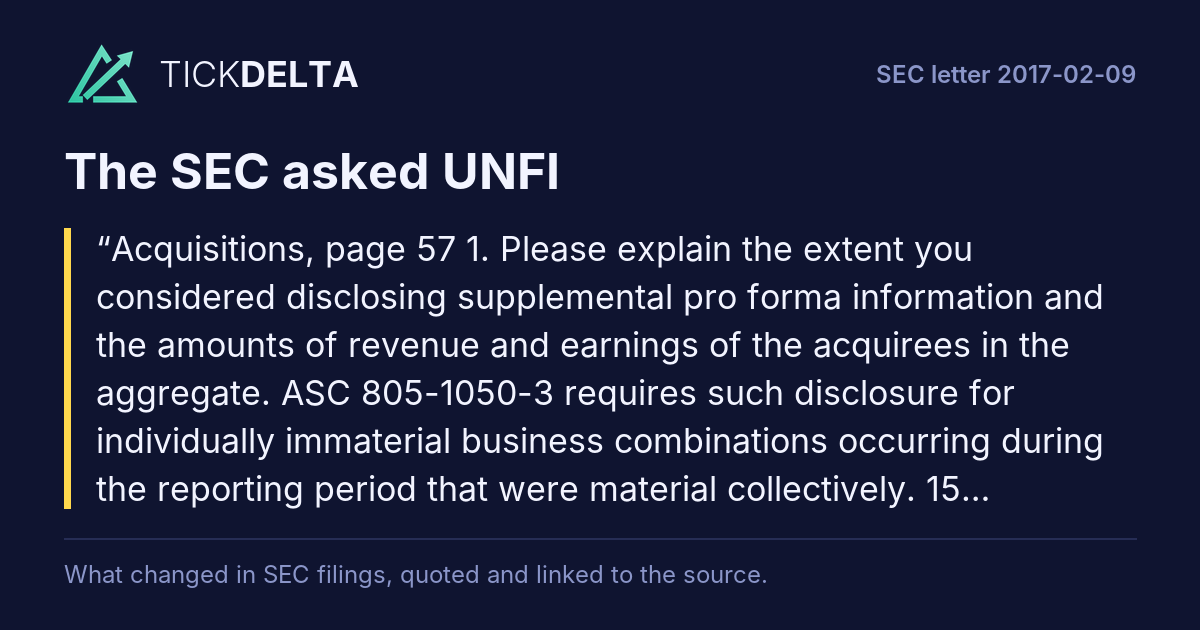
Acquisitions, page 57 1. Please explain the extent you considered disclosing supplemental pro forma information and the amounts of revenue and earnings of the acquirees in the aggregate. ASC 805-1050-3 requires such disclosure for individually immaterial business combinations occurring during the reporting period that were material collectively. 15.
Rest of the question

Immaterial Correction To Prior Period Financial Statements, page 74 2. We note your disclosure of the impact to the balance sheet and stockholders’ equity for identified errors in accounting for early payment discounts on inventory purchases. To help us better understand, please explain in greater detail the nature of error and why there was no apparent impact to the income statement.

UNFI answered
In consideration of the presentation of supplemental pro forma information, and the amounts of revenue and earnings of our three acquired businesses, Global Organic/Specialty Source, Inc. ("Global Organic"), Nor-Cal Produce, Inc. (Nor-Cal"), and Haddon House Food Products, Inc. ("Haddon House"), we considered both quantitative and qualitative factors in accordance with ASC 805-10-50-3, and concluded the acquisitions were immaterial to the users of our financial statements, either individually or in the aggregate.

Quantitative factors considered in our assessment included the
Rest of the answer

following:

•

Our investment in the acquirees individually and in the aggregate as a percentage of our total consolidated net assets at the end of the fiscal year immediately prior to the acquisition.

The total assets of the acquirees individually and in the aggregate at the date of the acquisition as a percentage of our consolidated total assets as of the fiscal year ended immediately prior to the acquisition.

The income before taxes of the acquirees individually and in the aggregate as a percentage of our income before taxes at the end of the fiscal year immediately prior to the acquisition.

Our investments in each of Global Organic, Nor-Cal and Haddon House, signified by the purchase prices we paid to acquire these businesses, represented 12.0%, in the aggregate, of our total assets as of August 1, 2015. The total assets of Global Organic, Nor-Cal and Haddon House that we acquired represented 6.7%, in the aggregate, of our total assets as of August 1, 2015. In the aggregate, the pre-tax income of the acquired businesses represented 6.5% of our pre-tax income in fiscal 2015.

In addition to the above quantitative considerations, qualitative factors considered included, but were not limited to:

Significant new relationships, segments, or geographic presence established by the business combinations;

The significance of the business combinations to our organizational structure or strategic plan; and

The relevance of the business combinations to the users' ability to understand our consolidated financial statements.

With regard to the acquired businesses, we note that in the aggregate they provided only one new relationship among our top twenty five customers and top twenty five suppliers. Although expanding our product offerings, all three acquirees became part of our existing wholesale segment and did not lead to the creation of a new segment. While we did acquire new distribution centers in connection with our business combinations, these locations expanded our existing distribution network within geographic areas where we already distributed our product. In addition, the acquired businesses did not lead to significant changes in our organizational structure or strategic plan. In consideration of these factors, the relevance of the business combinations to the users’ ability to understand our consolidated results was not deemed significant.

Based on the above quantitative and qualitative considerations, we did not consider the acquisitions to be material to the users of our financial statements, either individually or in the aggregate, and therefore the pro forma financial information described by ASC 805-10-50-3 was not required.

We also considered disclosing the amount of revenue and earnings for the acquirees subsequent to the acquisition (both individually and in the aggregate) and concluded that such disclosures would be immaterial based on the quantitative consideration of the income before taxes from our Nor-Cal and Haddon House acquisitions as a percentage of our total consolidated results for the fiscal year ended July 30, 2016. As of July 30, 2016, Global Organic's operations were combined within our existing Albert's Organics, Inc. business and results were not separable at the end of the fiscal year.

15. Immaterial Correction To Prior Period Financial Statements, page 74

2. We note your disclosure of the impact to the balance sheet and stockholders’ equity for identified errors in accounting for early payment discounts on inventory purchases. To help us better understand, please explain in greater detail the nature of error and why there was no apparent impact to the income statement.

As disclosed in Note 15 Immaterial Correction to Prior Period Financial Statements of our Form 10-K for the fiscal year ended July 30, 2016 (the "Form 10-K"), the Company revised previously reported amounts for identified errors in accounting for early payment discounts on inventory purchases. During the fiscal year ended August 1, 2015, the Company discovered that it was not properly reducing the value of inventory on hand to reflect early payment discounts received from its vendors. It was determined that the cause of the error was due to a system and process tracking issue that originated many years ago and as a result, this issue (i.e. reducing the cost of inventory by the applicable early payment discount) increased as the Company's inventory levels rose over many years. The Company corrected this practice promptly following discovery and appropriately accounted for the early payment discounts received in fiscal 2015 in its balance sheet and income statement as of and for the fiscal year ended August 1, 2015.

At the end of fiscal 2015, the Company believed it had a good, but still preliminary, estimate of the impact of the error in the aggregate for periods prior to fiscal 2015. Based on this estimate, the Company was confident that the impact was not material to the financial results of any individual year; however, additional time was needed to complete the analysis before correcting the out-of-period error. During fiscal 2016, the Company completed its analysis and determined that most of the impact related to fiscal 2014 opening retained earnings. Therefore, the Company decided to correct the error in its Form 10-K as this was the next time that fiscal 2014 would be presented in the financial statements.

The following is a summary of the financial impact reflected in the Form 10-K:

Period

Impact ($ millions)

Accounting Treatment

Prior to fiscal 2014

Balance Sheet

Recorded as an immaterial correction to prior period financial statements in the Company's fiscal 2016 Form 10-K.

$7.4 (gross)

$4.4 (net of tax)

Fiscal 2014

Income Statement

Recorded as an out-of-period immaterial correction of an error within the income statement during the fourth quarter of fiscal 2016.

$1.3 (gross)

$0.8 (net of tax)

When analyzing the impact of the adjustments to the prior periods and current period reflected in the Form 10-K, management considered both the quantitative and qualitative factors within the provisions of SEC Staff Accounting Bulletin No. 99, Materiality, and Staff Accounting Bulletin No. 108, considering the Effects of Prior Year Misstatements when Quantifying Misstatements in Current Year Financial Statements, including both the rollover method and iron curtain method. Based on evaluation of the errors, management concluded that the prior period errors were immaterial to the previously issued financial statements and the correction of the prior period error in fiscal 2016 would not have had a material impact on fiscal 2016 results. Management’s conclusion was discussed with both the Audit Committee and the Company's external auditors, and all parties concurred with management's conclusion that the out-of-period error was immaterial to all applicable periods. As such, management elected to correct the identified error related to periods prior to fiscal 2014 in the prior periods and the error related to fiscal 2014 in the results of fiscal 2016.

Read in the reply
Item9A. Controls and Procedures, page 77
SEC asked (3)
Please explain the extent you considered the impact of the identified errors on your internal controls and explain how management’s conclusion regarding the effectiveness of disclosure controls and procedures as well as internal control over financial reporting is appropriate in light of the errors.
UNFI answered
The Company evaluated the severity of the control deficiency related to the identified errors in accounting for early payment discounts on inventory purchases using both quantitative and qualitative factors in accordance with Auditing Standard No. 5. Based on this guidance, the Company considered whether the deficiency might prevent prudent officials in the conduct of their own affairs from concluding that they have reasonable assurance that transactions are recorded as necessary to permit the preparation of financial statements in conformity with GAAP to determine if the deficiency, or
Rest of the answer

combination of deficiencies, was an indicator of a material weakness.

The Company reviewed specific indicators of a material weaknesses outlined in PCAOB Auditing Standard 5.69 and determined that none of the following were applicable:

Identification of fraud, whether or not material, on the part of senior management;

Restatement of previously issued financial statements for a material misstatement;

Identification by the auditor of a material misstatement of financial statements in the current period in circumstances that indicate that the misstatement would not have been detected by the Company's internal control over financial reporting; and

Ineffective oversight of the Company’s external financial reporting and internal control over financial reporting by the Company's audit committee.

In addition, the Company performed an assessment to determine whether there was a deficiency, or a combination of deficiencies, in the Company’s internal control over financial reporting related to this particular issue such that there was a reasonable possibility with regards to the Company’s valuation of inventory that a material misstatement of the Company’s annual or interim financial information would not have been prevented or detected timely.

The Company’s conclusion that a significant deficiency, but not a material weakness, existed with respect to this matter, was based on the following factors:

The difference arose over a number of years and was not deemed material in the aggregate or in any individual year based on both quantitative and qualitative considerations.

Despite the deficiency, the amount of any misstatement to inventory was limited to the early payment discounts negotiated and received from vendors for the inventory on-hand and the misstatement in the income statement was limited to the change in inventory levels and would thus not rise to the level that would indicate a potential material weakness.

Compensating controls were identified around management’s review of margins which were determined to be operating at a level of precision sufficient enough to have caught a material issue related to early pay discounts.

There were no other control deficiencies identified relating to the valuation of inventory.

The control deficiency that resulted in the correction of this immaterial error was deemed to be a significant deficiency in accordance with Rule 1-02(a) of Regulation S-X and was reported to the Audit Committee prior to the filing of the Company's Form 10-K for the fiscal year ended August 1, 2015. Management established appropriate internal controls over the early payment discount process during the fiscal year ended July 30, 2016 and determined that these controls were operating effectively at the end of the reporting period.

Applying a similar analysis to the effectiveness of the Company's disclosure controls and procedures as it applied to the effectiveness of its internal control over financial reporting, the Company concluded that as of the end of the relevant periods, the Company's disclosure controls and procedures were effective to ensure that information required to be disclosed by the Company in the reports it filed with the Commission was accumulated and communicated to the Company's management to allow timely decisions regarding required disclosures.

Read in the reply
In its next report

First report after the company's reply of Feb 24, 2017: 10-Q filed Mar 9, 2017 ↗, against the 10-Q filed Dec 8, 2016 ↗.

Tickdelta does not hold the text of both reports, so they are not compared here.

Also in this review: closing letter, 2017-03-08

Letters without questions

Other letters

UPLOAD and CORRESP
2 other letters: notices that a filing will not be reviewed, requests to declare a registration effective, and the like

From the SEC's correspondence on EDGAR: staff letters (form UPLOAD) and company letters (form CORRESP), 8 letters filed since 2017-02-09. Questions and answers are matched by their numbers; topics come from words in each question. The reports are compared word for word (same form, before the first SEC letter against the first report after the company's reply). No AI.

Sources

The SEC's correspondence on EDGAR: staff letters (form UPLOAD) and company letters (form CORRESP), matched question by question. No AI.

Also

Filings: the letters in the filing list.

Work with it

Excel workbook · CSV. Google Sheet that stays up to date: paste =IMPORTDATA("https://tickdelta.com/company/UNFI/export.csv") into a cell.

Next in Owners and insiders:Insider trades
Esc

Type a ticker such as AAPL, a name, an investor such as Buffett, or a topic such as tariffs. ↑ ↓ to move, Enter to open.