US Foods Holding Corp. USFD
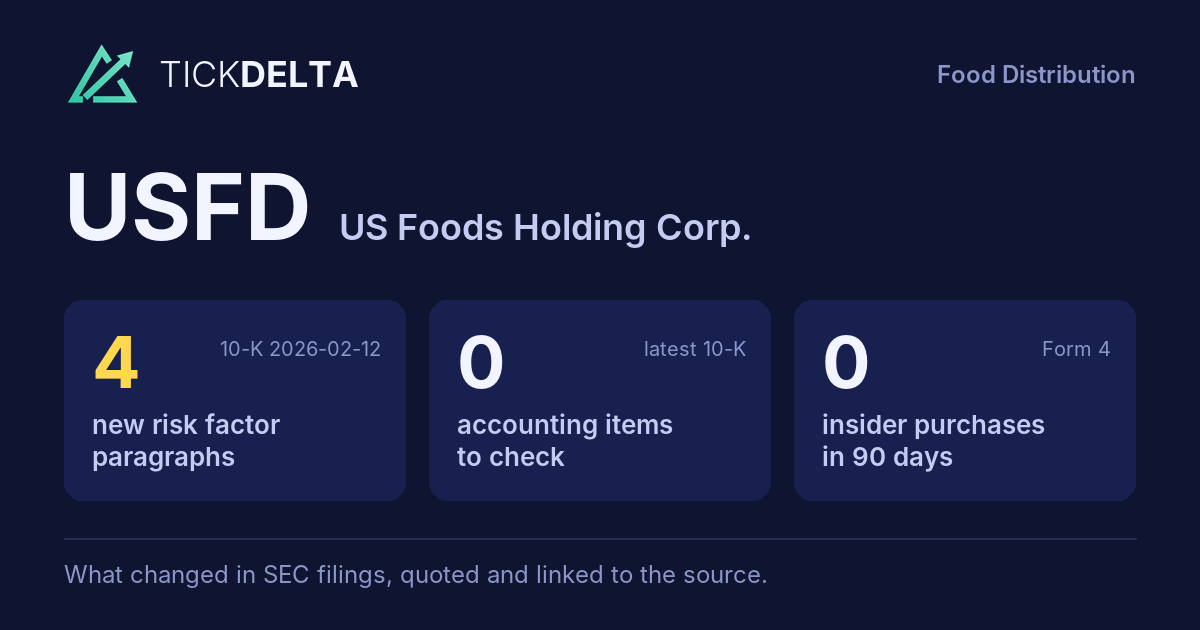
New risk paragraphs, branching off last year
Each branch is a paragraph in Risk Factors with nothing like it in the 10-K filed Feb 13, 2025. A box jumps to the paragraph as filed, below.
Paragraphs with nothing like them in last year's 10-K
4 paragraphs in Risk Factors of the 10-K filed Feb 12, 2026 with nothing like them in the 10-K filed Feb 13, 2025. Quoted exactly. Paragraphs that were only edited are under 10-K change.
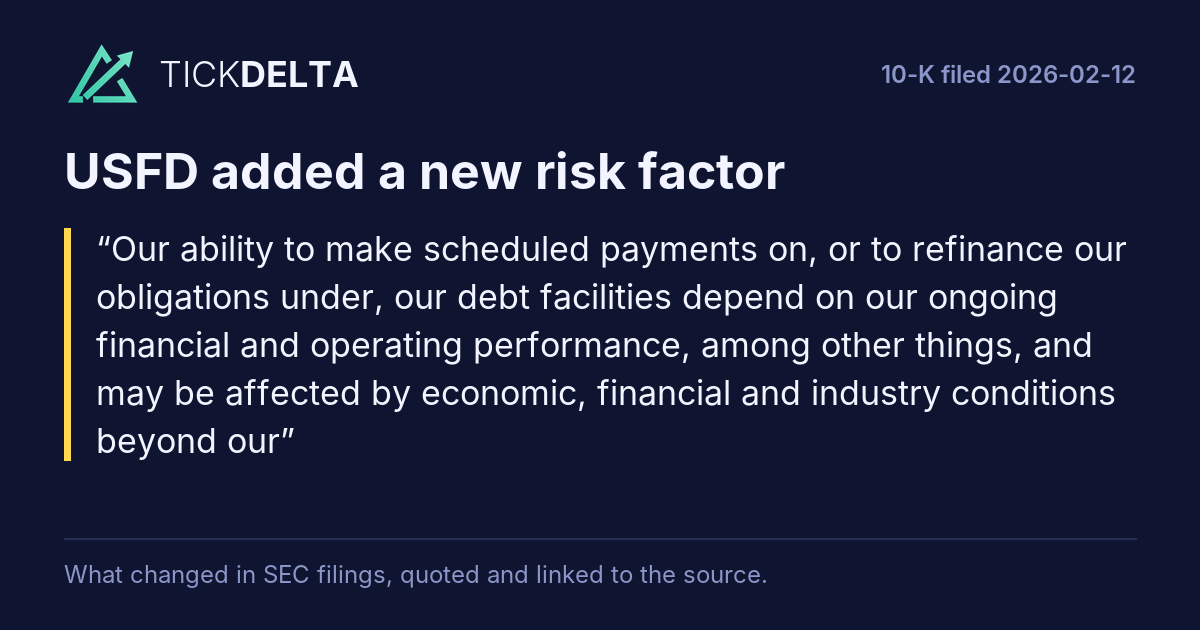
Our ability to make scheduled payments on, or to refinance our obligations under, our debt facilities depend on our ongoing financial and operating performance, among other things, and may be affected by economic, financial and industry conditions beyond our
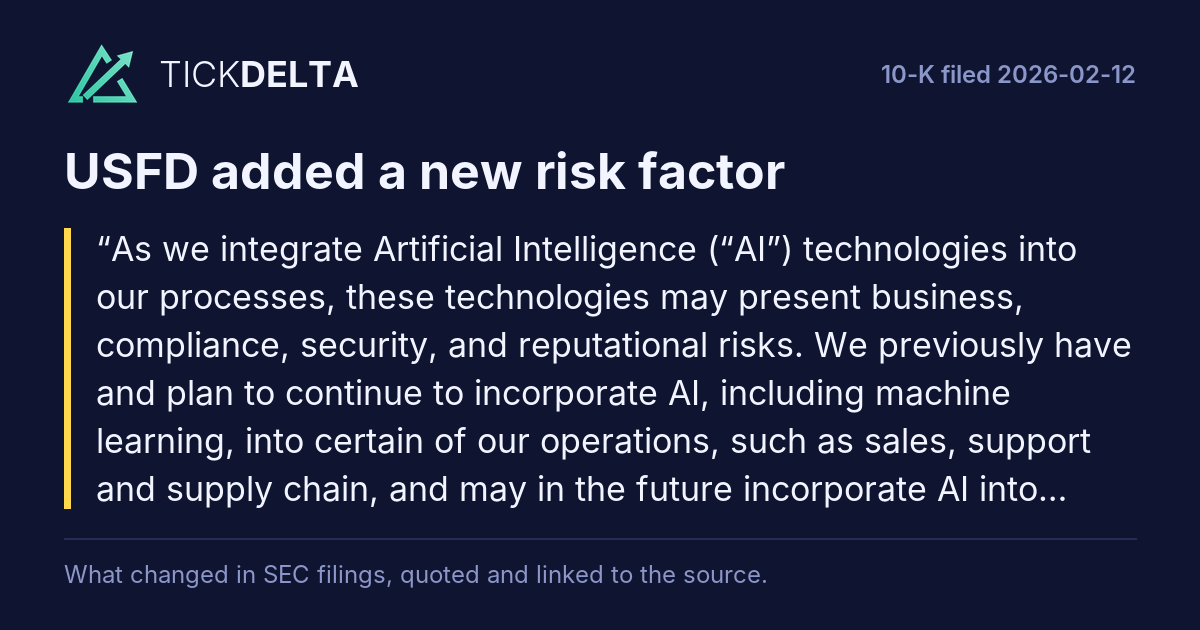
As we integrate Artificial Intelligence (“AI”) technologies into our processes, these technologies may present business, compliance, security, and reputational risks.
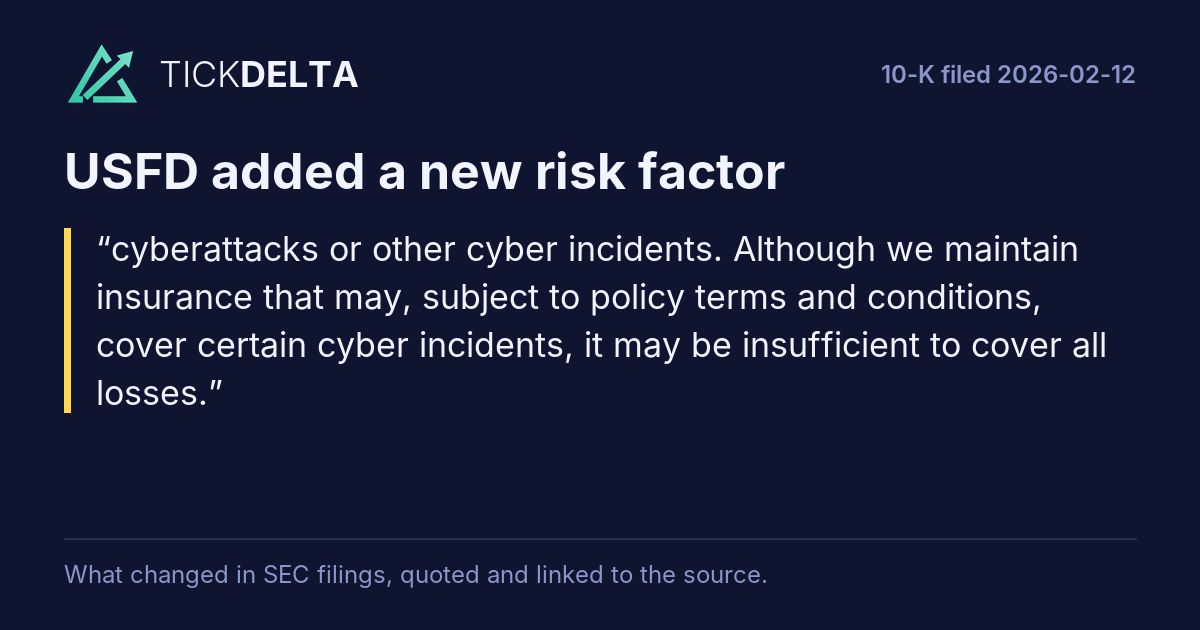
We previously have and plan to continue to incorporate AI, including machine learning, into certain of our operations, such as sales, support and supply chain, and may in the future incorporate AI into more of our operations. Flaws, breaches or malfunctions in these systems could lead to operational disruptions, data loss, or erroneous decision-making, impacting our operations, financial condition and reputation. Legal challenges may arise, including or as a result of cybersecurity incidents, non-compliance with data protection regulations, and lack of transparency relating to the use of AI. The legal and regulatory landscape and industry standards surrounding AI technologies is rapidly evolving and remains uncertain, and compliance may impose significant operational costs and may limit our ability to develop, deploy or use AI technologies. Furthermore, the rapid evolution and increasing deployment of AI systems could both intensify our cybersecurity risks, such as data breaches and unauthorized access, and introduce new risks, leading to financial losses, legal liabilities, and reputational damage. We also face competitive risks if we fail to adopt Artificial Intelligence or other machine-learning technologies in a timely manner.
cyberattacks or other cyber incidents. Although we maintain insurance that may, subject to policy terms and conditions, cover certain cyber incidents, it may be insufficient to cover all losses.
Paragraphs in the 10-Q filed Nov 5, 2026 that were not in the one before
New in the latest 10-Q
4 paragraphs in the 10-Q filed Nov 5, 2026 with nothing like them in the 10-Q filed Aug 6, 2026 (at least half the words must differ; new numbers alone do not count). Quoted exactly, grouped by the item heading above them. This is text that changed, not a judgement of how serious it is.
Financial statements and notes
Subsequent Event - On October 30, 2026, the Company completed an acquisition for approximately $ 125 million. The acquisition was a stock acquisition funded with cash on hand. The Company is in the process of measuring the acquired assets and assumed liabilities as of the acquisition date.
Read in the 10-Q
On October 2, 2026, the Company entered into a new senior secured term loan due 2033 for $ 810 million (the “2026 Incremental Term Loan Facility”). The Company used the proceeds of the 2026 Incremental Term Loan Facility, and cash on hand, to pay in full the existing 2021 Incremental Term Loan Facility, pay down the ABL Facility by $ 100 million and make a $ 100 million prepayment on the 2024 Incremental Term Loan Facility. The Company incurred lender fees and third-party costs of approximately $ 11 million.
Read in the 10-Q
Share sales and buybacks
(1) Average price paid per share includes broker commissions but excludes our liability under the 1% excise tax on the net amount of our share repurchases required by the Inflation Reduction Act of 2022.
Read in the 10-Q
Other information
On August 11, 2026, Dirk Locascio, Executive Vice President and Chief Financial Officer, adopted a trading plan intended to satisfy the affirmative defenses of Rule 10b5-1(c) of the Exchange Act. Mr. Locascio’s Rule 10b5-1 trading plan provides for the exercise and sale of up to 56,514 stock options, the sale of up to 15,000 shares of common stock and the gift of up to 15,000 shares of common stock. The foregoing exercises, sales or gifts will be made in accordance with the prices and formulas set forth in the plan and such plan terminates on the earlier of the date all the shares under the plan are sold and December 31, 2027.
Read in the 10-Q
The 10-Q's risk factors against the 10-K
Item 1A of the 10-Q filed Nov 5, 2026 against Item 1A of the 10-K filed Feb 12, 2026.
A 10-Q repeats only the risks that changed, so a 10-K paragraph that is missing from it is not counted as removed.
Added is a paragraph with nothing like it in the 10-K, Reworded a sentence that is in both with several words changed,
Quiet changes a sentence in both where one to four words changed and one is a hedge or a modal
(cut words struck through, new words highlighted).
Text on the page, not a score; each links to the filing at sec.gov.
What the 10-Q itself says about its risk factors:There have been no material changes to the principal risks that we believe are material to our business, results of operations, and financial condition from those disclosed in Part I, Item 1A - “Risk Factors” of the 2025 Annual Report.
Read in the 10-Q
1 paragraph in the 10-Q's Item 1A, and none of them adds, rewords or quietly edits a paragraph of the 10-K's.
Phrases used for the first time
Two-word phrases in Risk Factors of the 10-K filed Feb 12, 2026 that are in none of the 1 earlier 10-Ks stored, back to Feb 13, 2025
Where each one is used
- trade policies: The U.S. foodservice distribution industry is sensitive to national, regional and local economic conditions. An uneven level of general U.S. economic activity, uncertainty in the financial markets, inflation, and supply chain disruptions could have an adverse impact on consumer confidence and discretionary...
- volatile food: Our business is a low-margin business, and our profitability and results of operations are directly affected by cost deflation or inflation, volatile food costs and other factors.
- food costs: Our business is a low-margin business, and our profitability and results of operations are directly affected by cost deflation or inflation, volatile food costs and other factors.
- extended producer: The effects of climate change may create financial and operational risks to our business, both directly and indirectly. There is an increased focus around the world by regulatory and legislative bodies at all levels towards policies relating to climate change and the impact of global warming, including the...
- producer responsibility: The effects of climate change may create financial and operational risks to our business, both directly and indirectly. There is an increased focus around the world by regulatory and legislative bodies at all levels towards policies relating to climate change and the impact of global warming, including the...
- public confidence: Maintaining a good reputation and public confidence in the safety, quality and integrity of the products we produce and distribute are critical to our business, particularly in selling our private label products. Events like product recalls, occurrences of food-borne illness, or alleged food tampering may cause...
- safety quality: Maintaining a good reputation and public confidence in the safety, quality and integrity of the products we produce and distribute are critical to our business, particularly in selling our private label products. Events like product recalls, occurrences of food-borne illness, or alleged food tampering may cause...
Used at least twice, small words left out. Counted, not picked: a phrase can be new because the company renamed something.
What was taken out
4 paragraphs of last year's Risk Factors with nothing like them now. The longest are quoted.
Sources
Item 1A of each 10-K and 10-Q on EDGAR, quoted exactly. Each paragraph links to the filing at sec.gov.
Also
10-K change: what was reworded or cut, section by section.
Work with it
Excel workbook · CSV. Google Sheet that stays up to date: paste =IMPORTDATA("https://tickdelta.com/company/USFD/export.csv") into a cell.