Paragraph 10 · 46% changed
Every version of it
Screener
/
SEC EDGAR
/CIK 0001082554
/10-K filed Feb 25, 2026, compared with Feb 26, 2025
/Numbers from the XBRL of the 10-Ks
Nasdaq
Health care · Pharmaceuticals
UNITED THERAPEUTICS Corp UTHR
The 10-K against last year's
103 changes: 13 added, 11 removed, 77 reworded, 2 quiet changes
10-K Feb 25, 2026 vs Feb 26, 2025
Risk Factors
13.1%
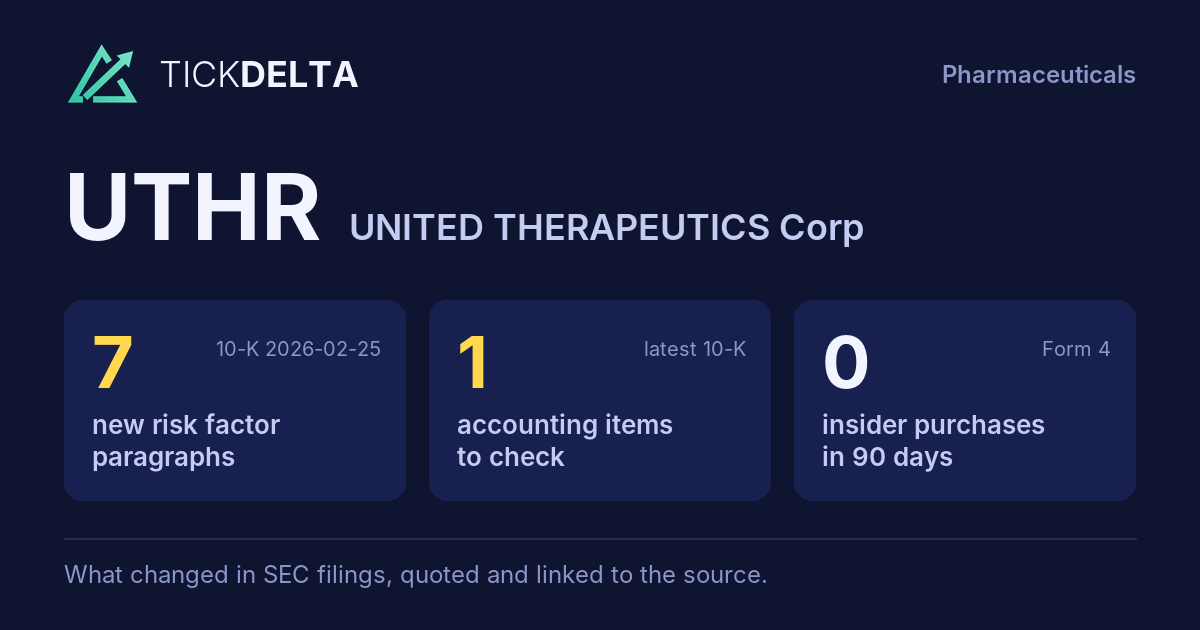
of the text changed · 13,550 words now · 7 new paragraphs, 6 gone
MD&A
22.6%
of the text changed · 5,815 words now · 6 new paragraphs, 5 gone
Legal Proceedings
24.6%
of the text changed · 2,181 words now
Accounting Policies
6.4%
of the text changed · 4,444 words now
10-K 0001082554-26-000006 (Feb 25, 2026) vs 10-K 0001082554-25-000005 (Feb 26, 2025)
Every paragraph, and how much of it changed
One bar per paragraph, in the order of the 10-K. Height and colour show the share of its words not in the closest paragraph a year earlier; the tallest bars are new paragraphs.
Risk Factors
154 paragraphs · 7 new · 52 reworded · 6 gone · 10-K Feb 25, 2026 against Feb 26, 2025
New paragraph
Reworded (5% of its words or more)
Same or nearly
Paragraph 86 · 42% changed
Every version of it
We participate in, and have certain price reporting obligations to, the Medicaid Drug Rebate program and other governmental programs that require us to pay rebates or offer discounts on our products. Certain programs, such as the 340B program, impose limits on the price we are permitted to charge certain entities for our products or for any future products for which we receive regulatory approval. Changes to these programs could negatively affect the coverage and reimbursement by these programs of our products or any future products for which we receive regulatory approval and could negatively impact our results of operations. Our failure to comply with these price reporting, rebate payment, or pricing requirements could adversely impact our financial results. Applicable laws and regulations, including the IRA, could affect our obligations in ways we cannot anticipate.
Paragraph 9 · 37% changed
Every version of it
Numerous treatments compete with our commercial therapies. For example, for the treatment of PAH, we compete with over fifteen branded and generic drugs. Sales of a generic version of Adcirca launched in August 2018 have had a material adverse impact on our sales of Adcirca. The availability of generic treprostinil injection in the United States could materially impact our revenues, and generic competition materially impacted our Remodulin revenues outside the United States. Our competitors are also developing numerous new products that may compete with ours, including products intended to treat PAH and/or PH-ILD. For example, Merck received approval for Winrevair (sotatercept-csrk) in March 2024, which competes with our treprostinil-based products. In addition, Liquidia is developing Yutrepia, which could receive final approval from the FDA for both PAH and PH-ILD in May 2025 (or sooner depending on the pending outcome of Liquidia’s lawsuit against the FDA) and if successful would compete with our treprostinil-based products. Both products could potentially materially adversely affect our revenues. There are also two therapies approved for the treatment of IPF, and we are aware of a
Paragraph 43 · 30% changed
Every version of it
We rely on various distributors to market, distribute, and sell our commercial products. If they are unsuccessful in, or reduce or discontinue, their sales efforts, our revenues may decline materially. Outside the United States, we rely substantially on our international distributors to obtain and maintain regulatory approvals for our products and to market and sell our products in compliance with applicable laws and regulations. In the United States, we derive substantially all our treprostinil-based revenues from sales to two distributors, Accredo and CVS Specialty. If either of these two distributors places significantly larger or smaller orders in a given time period, our revenues can be impacted in a way that does not reflect patient demand.
Paragraph 82 · 30% changed
Every version of it
In October 2020, HHS and the FDA issued a final rule and guidance concerning two new pathways for importing lower-cost drugs into the United States. The final rule allows certain prescription drugs to be imported from Canada, and the guidance describes procedures for drug manufacturers to facilitate the importation of FDA-approved drugs and biologics manufactured abroad and originally intended for sale in a foreign country into the United States. In January 2024, the FDA approved Florida’s drug importation plan. In November 2025, the FDA granted a six-month extension for Florida to begin implementing its plan.
Paragraph 19 · 29% changed
Every version of it
•We believe we and our third-party manufacturers may need to increase our respective manufacturing capacity by constructing new facilities, and/or expanding existing facilities, in order to continue meeting anticipated demand for our products. These efforts are often costly and time-consuming, and must meet rigorous regulatory requirements. For These efforts could be unsuccessful or take longer or cost more than we anticipate, due to a variety of factors including the lead time needed to procure, install, and qualify the highly specialized equipment necessary to manufacture the product.
Paragraph 123 · 29% changed
Every version of it
We may be required to seek additional sources of financing to meet unplanned or planned expenditures. Unplanned expenditures could be significant and may result from necessary modifications to product development plans or product offerings in response to difficulties encountered with clinical trials. We may also face unexpected costs in preparing products for commercial sale, or in maintaining sales levels of our currently marketed therapeutic products. Our credit agreement (the 2025 Credit Agreement Agreement) contains affirmative and negative covenants that, among other things, limit our ability to incur additional indebtedness. If we are unable to obtain additional funding on commercially reasonable terms or at all, we may be compelled to delay clinical studies, curtail operations, or obtain funds through collaborative arrangements that may require us to relinquish rights to certain products or potential markets.
Paragraph 77 · 28% changed
Every version of it
Paragraph 10 · 46% changed
Every version of it
10-K Feb 26, 2025Numerous treatments compete with our commercial therapies. For example, for the treatment of PAH, we compete with over fifteen branded and generic drugs. Sales of a generic version of Adcirca launched in August 2018 have had a material adverse impact on our sales of Adcirca. The availability of generic treprostinil injection in the United States could materially impact our revenues, and generic competition materially impacted our Remodulin revenues outside the United States. Our competitors are also developing numerous new products that may compete with ours, including products intended to treat PAH and/or PH-ILD. For example, Merck received approval for Winrevair (sotatercept-csrk) in March 2024, which competes with our treprostinil-based products. In addition, Liquidia is developing Yutrepia, which could receive final approval from the FDA for both PAH and PH-ILD in May 2025 (or sooner depending on the pending outcome of Liquidia’s lawsuit against the FDA) and if successful would compete with our treprostinil-based products. Both products could potentially materially adversely affect our revenues. There are also two therapies approved for the treatment of IPF, and we are aware of a
10-K Feb 25, 2026
competitors are also developing numerous new products that may compete with ours, including products intended to treat PAH and/or PH-ILD. For example, Merck commercially launched Winrevair (sotatercept-csrk) in the United States in March 2024, which competes with our treprostinil-based products. In addition, in June 2025 Liquidia launched U.S. sales of Yutrepia for PAH and PH-ILD, which now competes with our treprostinil-based products. Additional treatments, such as Insmed Incorporated’s TPIP, are in late-stage clinical trials for treatment of PAH and/or PH-ILD. Each of these products could potentially materially adversely affect our revenues. There are also three therapies approved for the treatment of IPF, including Boehringer Ingelheim’s Jascayd® (nerandomilast), which was approved by FDA in October 2025 for IPF, and later for PPF. A wide variety of additional therapies are being developed by our competitors for the treatment of IPF. Existing and future approved IPF therapies would compete with Tyvaso DPI and Nebulized Tyvaso if either or both of them is ultimately approved for that indication. The introduction of lower-priced competing products may reduce both the price that we are able to charge for our products and the volume of products we sell.
Paragraph 86 · 42% changed
Every version of it
10-K Feb 26, 2025
We participate in, and have certain price reporting obligations to, the Medicaid Drug Rebate program and other governmental programs that require us to pay rebates or offer discounts on our products. Certain programs, such as the 340B program, impose limits on the price we are permitted to charge certain entities for our products or for any future products for which we receive regulatory approval. Changes to these programs could negatively affect the coverage and reimbursement by these programs of our products or any future products for which we receive regulatory approval and could negatively impact our results of operations. Our failure to comply with these price reporting, rebate payment, or pricing requirements could adversely impact our financial results. Applicable laws and regulations, including the IRA, could affect our obligations in ways we cannot anticipate.
10-K Feb 25, 2026
We participate in, and have certain price reporting obligations to, the Medicaid Drug Rebate program and other governmental programs that require us to pay rebates or offer discounts on our products. Certain programs, such as the
Paragraph 9 · 37% changed
Every version of it
10-K Feb 26, 2025
Numerous treatments compete with our commercial therapies. For example, for the treatment of PAH, we compete with over fifteen branded and generic drugs. Sales of a generic version of Adcirca launched in August 2018 have had a material adverse impact on our sales of Adcirca. The availability of generic treprostinil injection in the United States could materially impact our revenues, and generic competition materially impacted our Remodulin revenues outside the United States. Our competitors are also developing numerous new products that may compete with ours, including products intended to treat PAH and/or PH-ILD. For example, Merck received approval for Winrevair (sotatercept-csrk) in March 2024, which competes with our treprostinil-based products. In addition, Liquidia is developing Yutrepia, which could receive final approval from the FDA for both PAH and PH-ILD in May 2025 (or sooner depending on the pending outcome of Liquidia’s lawsuit against the FDA) and if successful would compete with our treprostinil-based products. Both products could potentially materially adversely affect our revenues. There are also two therapies approved for the treatment of IPF, and we are aware of a
10-K Feb 25, 2026
Numerous treatments compete with our commercial therapies. For example, for the treatment of PAH, we compete with over fifteen branded and generic drugs. Sales of a generic version of Adcirca launched in August 2018 have had a material adverse impact on our sales of Adcirca. The availability of generic treprostinil injection in the United States could materially impact our revenues, and generic competition materially impacted our Remodulin revenues outside the United States. Our
Paragraph 43 · 30% changed
Every version of it
10-K Feb 26, 2025
We rely on various distributors to market, distribute, and sell our commercial products. If they are unsuccessful in, or reduce or discontinue, their sales efforts, our revenues may decline materially. Outside the United States, we rely substantially on our international distributors to obtain and maintain regulatory approvals for our products and to market and sell our products in compliance with applicable laws and regulations. In the United States, we derive substantially all our treprostinil-based revenues from sales to two distributors, Accredo and CVS Specialty. If either of these two distributors places significantly larger or smaller orders in a given time period, our revenues can be impacted in a way that does not reflect patient demand.
10-K Feb 25, 2026
We rely on various distributors to market, distribute, and sell our commercial products. If they are unsuccessful in, or reduce or discontinue, their sales efforts, our revenues may decline materially. Outside the United States, we rely substantially on our international distributors to obtain and maintain regulatory approvals for our products and to market and sell our products in
Paragraph 82 · 30% changed
Every version of it
10-K Feb 26, 2025
describes procedures for drug manufacturers to facilitate the importation of FDA-approved drugs and biologics manufactured abroad and originally intended for sale in a foreign country into the United States. In January 2024, the FDA approved Florida’s drug importation plan.
10-K Feb 25, 2026
In October 2020, HHS and the FDA issued a final rule and guidance concerning two new pathways for importing lower-cost drugs into the United States. The final rule allows certain prescription drugs to be imported from Canada, and the guidance describes procedures for drug manufacturers to facilitate the importation of FDA-approved drugs and biologics manufactured abroad and originally intended for sale in a foreign country into the United States. In January 2024, the FDA approved Florida’s drug importation plan. In November 2025, the FDA granted a six-month extension for Florida to begin implementing its plan.
Paragraph 19 · 29% changed
Every version of it
10-K Feb 26, 2025
•We believe we and our third-party manufacturers need to increase our respective manufacturing capacity by constructing new facilities, and/or expanding existing facilities, in order to continue meeting anticipated demand for our products. These efforts are often costly and time-consuming, and must meet rigorous regulatory requirements. For
10-K Feb 25, 2026
•We and our third-party manufacturers may need to increase our respective manufacturing capacity by constructing new facilities, and/or expanding existing facilities, in order to continue meeting anticipated demand for our products. These efforts are often costly and time-consuming, and must meet rigorous regulatory requirements. These efforts could be unsuccessful or take longer or cost more than we anticipate, due to a variety of factors including the lead time needed to procure, install, and qualify the highly specialized equipment necessary to manufacture the product.
Paragraph 123 · 29% changed
Every version of it
10-K Feb 26, 2025
We may be required to seek additional sources of financing to meet unplanned or planned expenditures. Unplanned expenditures could be significant and may result from necessary modifications to product development plans or product offerings in response to difficulties encountered with clinical trials. We may also face unexpected costs in preparing products for commercial sale, or in maintaining sales levels of our currently marketed therapeutic products. Our Credit Agreement
10-K Feb 25, 2026
We may be required to seek additional sources of financing to meet unplanned or planned expenditures. Unplanned expenditures could be significant and may result from necessary modifications to product development plans or product offerings in response to difficulties encountered with clinical trials. We may also face unexpected costs in preparing products for commercial sale, or in maintaining sales levels of our currently marketed therapeutic products. Our credit agreement (the 2025 Credit Agreement) contains affirmative and negative covenants that, among other things, limit our ability to incur additional indebtedness. If we are unable to obtain additional funding on commercially reasonable terms or at all, we may be compelled to delay clinical studies, curtail operations, or obtain funds through collaborative arrangements that may require us to relinquish rights to certain products or potential markets.
Paragraph 77 · 28% changed
Every version of it
10-K Feb 26, 2025Orenitram and Tyvaso DPI are both reimbursed under Medicare Part D, and the reimbursement amount will be impacted by the 10 and 20 percent discounts under the new manufacturer discounting program. These increased discounts will impact Tyvaso DPI and Orenitram revenues, while also having an industry-wide impact on the cost of Part D drugs. The impact on Tyvaso DPI and Orenitram revenues could be offset because the IRA’s redesign of certain Part D components, some of which went into effect in 2024, resulted in an increase in the number of patients able to afford these therapies. The amount of the offset, if any, is inherently uncertain and difficult to predict.
10-K Feb 25, 2026
Tyvaso DPI and Orenitram revenues could be offset because the IRA’s Part D redesign, which went into effect in 2025 and resulted in an increase in the number of patients able to afford these therapies. The amount of the offset, if any, is inherently uncertain and difficult to predict.
MD&A
97 paragraphs · 6 new · 45 reworded · 5 gone · 10-K Feb 25, 2026 against Feb 26, 2025
New paragraph
Reworded (5% of its words or more)
Same or nearly
Paragraph 70 · 44% changed
In March 2024, August 2025, we entered into an accelerated share repurchase agreement (the the 2025 ASR agreement) agreements with Citibank, N.A. (Citi). Citi, comprised of a $500 million Uncollared ASR and a $500 million Collared ASR. Under the 2025 ASR agreement, agreements, we made an aggregate upfront payment of $1.0 billion to Citi and received an aggregate initial delivery deliveries of 3,275,199 1,274,296 and 849,531 shares of our common stock on March 27, 2024, which represented August 4, 2025, representing approximately 80 75 percent and 50 percent of the total shares that would be repurchased under the Uncollared ASR agreement, and Collared ASR, respectively, measured based on the closing price of our common stock on March August 1, 2025. Upon completion of an agreed-upon hedging period and the subsequent determination of the minimum and maximum share amounts to be repurchased under the Collared ASR, we received an additional 514,789 shares of our common stock on August 25, 2024. 2025. The final settlement of the Uncollared ASR occurred in November 2025, and we received an additional 3,882 shares of our common stock upon settlement. The final settlement of the Collared ASR occurred in January 2026, and we received no additional shares of our common stock upon settlement as a result of a collar provision that established the minimum and maximum number of shares to be repurchased, as well as other adjustments. In total, we repurchased 2,642,498 shares of our common stock under the 2025 ASR agreements that we currently hold as treasury stock in our consolidated balance sheets.
Paragraph 40 · 40% changed
We operate in a highly competitive market in which several large pharmaceutical companies control many of the available PAH therapies. therapies, including Merck, which received FDA approval for Winrevair (sotatercept-csrk) to treat PAH in March 2024. These pharmaceutical companies are well established in the market and possess greater financial, technical, and marketing resources than we do. In addition, there are investigational products in late-stage development that, if approved, may erode the market share or net prices of our existing commercial therapies and make market acceptance more difficult to achieve for any therapies we attempt to market in the future. For example, Yutrepia has been tentatively was approved by the FDA in May 2025 for the treatment of PAH and PH-ILD, with final approval potentially occurring after expiration and the product was launched commercially in June 2025. While we have not seen a material impact on our net revenues as a result of an exclusivity period ending in May 2025. If Yutrepia receives final approval and is commercially launched, Winrevair or Yutrepia’s launch to date, our net revenues from Tyvaso DPI could be materially adversely affected, and the impact may be greater impacted if Yutrepia is ultimately approved either or both of these products gain significant market share or cause material price erosion for the treatment of PH-ILD. our existing products.
Paragraph 58 · 36% changed
Research and development, excluding share-based compensation. The increase in research and development expense for the year ended December 31, 2024, 2025, as compared to the same period in 2023, 2024, was primarily due to: (1) increased expenditures related to manufactured organ and organ alternative projects; and (2) non-refundable licensing payments increased expenditures for drug delivery device technologies and ex vivo lung perfusion technology; and (3) increased expenditures related to the TETON studies of nebulized Tyvaso in patients with IPF and PPF. These increases were partially offset by the impact of an IPR&D expense recorded during the year ended December 31, 2023 in connection with the acquisition of IVIVA, which expense did not recur in 2024. formulation technologies.
Paragraph 26 · 35% changed
We are engaged in research and development of new indications and delivery devices for our existing products. In 2021, we launched a new pump for subcutaneous delivery of Remodulin, called the Remunity Pump, and recently completed development of a new version of the Remunity Pump, called RemunityPRO, which was cleared by the FDA in January 2025. We are studying nebulized Nebulized Tyvaso in patients with idiopathic pulmonary fibrosis IPF and progressive pulmonary fibrosis PPF (the TETON studies).
Paragraph 39 · 35% changed
We anticipate our first commercial-scale existing DPF facility in Virginia and the two planned DPF facilities in Minnesota and Texas will provide an initial commercial supply of our xeno-organ products if and when they are approved by the FDA. Our commercial-scale However, if our xeno-organ products are approved by the FDA, we likely will need to continue building additional DPF facilities to satisfy demand for these products. Additional DPF facilities will be very capital-intensive, but we expect they will be executed in stages with the ability stages, which will enable us to adjust the schedule (and anticipated cost) of construction depending on the progress of our clinical and regulatory activities. In addition to the production capacity of our commercial-scale DPF facility, we anticipate additional commercial capacity stemming from at least three clinical-scale facilities: our existing DPF facility in Virginia; a DPF facility we are building in Minnesota, as noted above; and a third clinical-scale DPF facility we plan to build in Houston, Texas.
Paragraph 20 · 33% changed
•Nebulized Tyvaso, a nebulized liquid inhaled formulation of treprostinil, approved by the FDA and regulatory authorities in Argentina, Israel, and Japan to improve exercise ability in patients with PAH. Nebulized Tyvaso was also approved by the FDA in March 2021 and by regulators in Israel and Japan in December 2022 and September 2024, respectively, to improve exercise ability in patients with PH-ILD. In addition, marketing authorization applications for nebulized Nebulized Tyvaso has also been approved with respect to treat PAH and/or PH-ILD have also been approved, and others are pending, in various other countries in Latin America, Asia, and outside of the Middle East. United States.
Paragraph 57 · 33% changed
During the year ended December 31, 2024, we recorded $40.2 million and $8.0 million in expense related to upfront non-refundable licensing payments for drug delivery device technologies and ex vivo lung perfusion technology, respectively. During the year ended December 31, 2023, we recorded $46.0 million in IPR&D expense in connection with the acquisition of IVIVA Medical, Inc. (IVIVA). IVIVA.
Paragraph 69 · 30% changed
Income tax expense was $343.9 $379.2 million for the year ended December 31, 2024, 2025, as compared to $289.5 $343.9 million for the same period in 2023. For 2024. Our effective income tax rate was approximately 22 percent for the years ended December 31, 2024 2025 and 2023, our effective income tax rates (ETR) were approximately 22 percent and 23 percent, respectively. Our ETR for the year ended December 31, 2024 decreased, compared to our ETR for the year ended December 31, 2023, primarily due to a decrease in nondeductible acquisition costs and an increase in excess tax benefits from share-based compensation, partially offset by an increase in nondeductible compensation. 2024. For additional details, see Note 10—Income Taxes to our consolidated financial statements.
Paragraph 70 · 44% changed
10-K Feb 26, 2025
In March 2024, we entered into an accelerated share repurchase agreement (the ASR agreement) with Citibank, N.A. (Citi). Under the ASR agreement, we made an aggregate upfront payment of $1.0 billion to Citi and received an aggregate initial delivery of 3,275,199 shares of our common stock on March 27, 2024, which represented approximately 80 percent of the total shares that would be repurchased under the ASR agreement, measured based on the closing price of our common stock on March 25, 2024.
10-K Feb 25, 2026
In August 2025, we entered into the 2025 ASR agreements with Citi, comprised of a $500 million Uncollared ASR and a $500 million Collared ASR. Under the 2025 ASR agreements, we made an aggregate upfront payment of $1.0 billion to Citi and received initial deliveries of 1,274,296 and 849,531 shares of our common stock on August 4, 2025, representing approximately 75 percent and 50 percent of the total shares that would be repurchased under the Uncollared ASR and Collared ASR, respectively, measured based on the closing price of our common stock on August 1, 2025. Upon completion of an agreed-upon hedging period and the subsequent determination of the minimum and maximum share amounts to be repurchased under the Collared ASR, we received an additional 514,789 shares of our common stock on August 25, 2025. The final settlement of the Uncollared ASR occurred in November 2025, and we received an additional 3,882 shares of our common stock upon settlement. The final settlement of the Collared ASR occurred in January 2026, and we received no additional shares of our common stock upon settlement as a result of a collar provision that established the minimum and maximum number of shares to be repurchased, as well as other adjustments. In total, we repurchased 2,642,498 shares of our common stock under the 2025 ASR agreements that we currently hold as treasury stock in our consolidated balance sheets.
Paragraph 40 · 40% changed
10-K Feb 26, 2025
We operate in a highly competitive market in which several large pharmaceutical companies control many of the available PAH therapies. These pharmaceutical companies are well established in the market and possess greater financial, technical, and marketing resources than we do. In addition, there are investigational products in late-stage development that, if approved, may erode the market share or net prices of our existing commercial therapies and make market acceptance more difficult to achieve for any therapies we attempt to market in the future. For example, Yutrepia has been tentatively approved by the FDA for the treatment of PAH and PH-ILD, with final approval potentially occurring after expiration of an exclusivity period ending in May 2025. If Yutrepia receives final approval and is commercially launched, our revenues from Tyvaso DPI could be materially adversely affected, and the impact may be greater if Yutrepia is ultimately approved for the treatment of PH-ILD.
10-K Feb 25, 2026
We operate in a highly competitive market in which several large pharmaceutical companies control many of the available PAH therapies, including Merck, which received FDA approval for Winrevair (sotatercept-csrk) to treat PAH in March 2024. These pharmaceutical companies are well established in the market and possess greater financial, technical, and marketing resources than we do. In addition, Yutrepia was approved by the FDA in May 2025 for treatment of PAH and PH-ILD, and the product was launched commercially in June 2025. While we have not seen a material impact on our net revenues as a result of Winrevair or Yutrepia’s launch to date, our net revenues could be materially impacted if either or both of these products gain significant market share or cause material price erosion for our existing products.
Paragraph 58 · 36% changed
10-K Feb 26, 2025
Research and development, excluding share-based compensation. The increase in research and development expense for the year ended December 31, 2024, as compared to the same period in 2023, was due to: (1) increased expenditures related to manufactured organ and organ alternative projects; (2) non-refundable licensing payments for drug delivery device technologies and ex vivo lung perfusion technology; and (3) increased expenditures related to the TETON studies of nebulized Tyvaso in patients with IPF and PPF. These increases were partially offset by the impact of an IPR&D expense recorded during the year ended December 31, 2023 in connection with the acquisition of IVIVA, which expense did not recur in 2024.
10-K Feb 25, 2026
Research and development, excluding share-based compensation. The increase in research and development expense for the year ended December 31, 2025, as compared to the same period in 2024, was primarily due to: (1) increased expenditures related to manufactured organ and organ alternative projects; and (2) increased expenditures for drug delivery device and formulation technologies.
Paragraph 26 · 35% changed
10-K Feb 26, 2025
We are engaged in research and development of new indications and delivery devices for our existing products. In 2021, we launched a new pump for subcutaneous delivery of Remodulin, called the Remunity Pump, and recently completed development of a new version of the Remunity Pump, called RemunityPRO, which was cleared by the FDA in January 2025. We are studying nebulized Tyvaso in patients with idiopathic pulmonary fibrosis and progressive pulmonary fibrosis (the TETON studies).
10-K Feb 25, 2026
We are engaged in research and development of new indications and delivery devices for our existing products. We are studying Nebulized Tyvaso in patients with IPF and PPF (the TETON studies).
Paragraph 39 · 35% changed
10-K Feb 26, 2025
We anticipate our first commercial-scale DPF facility will provide an initial commercial supply of our xeno-organ products if and when they are approved by the FDA. Our commercial-scale DPF facilities will be very capital-intensive, but they will be executed in stages with the ability to adjust the schedule (and anticipated cost) depending on the progress of our clinical and regulatory activities. In addition to the production capacity of our commercial-scale DPF facility, we anticipate additional commercial capacity stemming from at least three clinical-scale facilities: our existing DPF facility in Virginia; a DPF facility we are building in Minnesota, as noted above; and a third clinical-scale DPF facility we plan to build in Houston, Texas.
10-K Feb 25, 2026
We anticipate our existing DPF facility in Virginia and the two planned DPF facilities in Minnesota and Texas will provide an initial commercial supply of our xeno-organ products if and when they are approved by the FDA. However, if our xeno-organ products are approved by the FDA, we likely will need to continue building additional DPF facilities to satisfy demand for these products. Additional DPF facilities will be very capital-intensive, but we expect they will be executed in stages, which will enable us to adjust the schedule (and anticipated cost) of construction depending on the progress of our clinical and regulatory activities.
Paragraph 20 · 33% changed
10-K Feb 26, 2025
•Nebulized Tyvaso, a liquid inhaled formulation of treprostinil, approved by the FDA and regulatory authorities in Argentina, Israel, and Japan to improve exercise ability in patients with PAH. Nebulized Tyvaso was also approved by the FDA in March 2021 and by regulators in Israel and Japan in December 2022 and September 2024, respectively, to improve exercise ability in patients with PH-ILD. In addition, marketing authorization applications for nebulized Tyvaso to treat PAH and/or PH-ILD have also been approved, and others are pending, in various other countries in Latin America, Asia, and the Middle East.
10-K Feb 25, 2026
•Nebulized Tyvaso, a nebulized liquid inhaled formulation of treprostinil, approved by the FDA to improve exercise ability in patients with PAH. Nebulized Tyvaso was also approved by the FDA in March 2021 to improve exercise ability in patients with PH-ILD. Nebulized Tyvaso has also been approved with respect to PAH and/or PH-ILD in various countries outside of the United States.
Paragraph 57 · 33% changed
10-K Feb 26, 2025
perfusion technology, respectively. During the year ended December 31, 2023, we recorded $46.0 million in IPR&D expense in connection with the acquisition of IVIVA Medical, Inc. (IVIVA).
10-K Feb 25, 2026
During the year ended December 31, 2024, we recorded $40.2 million and $8.0 million in expense related to upfront non-refundable licensing payments for drug delivery device technologies and ex vivo lung perfusion technology, respectively. During the year ended December 31, 2023, we recorded $46.0 million in IPR&D expense in connection with the acquisition of IVIVA.
Paragraph 69 · 30% changed
10-K Feb 26, 2025
Income tax expense was $343.9 million for the year ended December 31, 2024, compared to $289.5 million for the same period in 2023. For the years ended December 31, 2024 and 2023, our effective income tax rates (ETR) were approximately 22 percent and 23 percent, respectively. Our ETR for the year ended December 31, 2024 decreased, compared to our ETR for the year ended December 31, 2023, primarily due to a decrease in nondeductible acquisition costs and an increase in excess tax benefits from share-based compensation, partially offset by an increase in nondeductible compensation. For additional details, see Note 10—Income Taxes to our consolidated financial statements.
10-K Feb 25, 2026
Income tax expense was $379.2 million for the year ended December 31, 2025, as compared to $343.9 million for the same period in 2024. Our effective income tax rate was approximately 22 percent for the years ended December 31, 2025 and 2024. For additional details, see Note 10—Income Taxes to our consolidated financial statements.
A paragraph is matched with the one last year that shares the most of its words; under half in common makes it new. The paragraphs shown are the 8 reworded the most in each section.
The paragraph that changed most in each section
The redline
Marked against last year's 10-K: cut words struck through, new words highlighted.
MD&A187 words changed in this paragraph; it is 44% similar to last year's version.
Source: Item 7, 10-K 0001082554-26-000006 vs Item 7, 10-K 0001082554-25-000005
Risk Factors158 words changed in this paragraph; it is 62% similar to last year's version.
Individual U.S. states continue in the United States have also increasingly passed legislation and implemented regulations designed to consider control pharmaceutical and have enacted legislation biological product pricing, including price or patient reimbursement limitations, marketing cost disclosure, and transparency measures, and, in some cases, measures designed to limit the growth of healthcare costs, including the cost of prescription drugs. encourage importation from other countries and bulk purchasing. A number of states have either implemented or are considering implementation of drug price transparency legislation. Requirements of pharmaceutical manufacturers under such laws include advance notice of planned price increases; reporting price increase amounts and factors considered in taking such increases; wholesale acquisition cost information disclosure to prescribers, purchasers, and state agencies; and new product notice and reporting. Other legislation establishes so-called prescription drug affordability boards that could impose price caps on specific drugs. drugs, and at least one state board is imposing an upper payment limit. States are also seeking to implement general, across-the-board price caps for pharmaceuticals, or are seeking to regulate drug distribution. These state legislative measures could limit the price or payment for certain drugs, and a drugs or could complicate the distribution of drugs. A number of states are authorized to impose civil monetary penalties or pursue other enforcement mechanisms against manufacturers who fail to comply with state law requirements, including the untimely, inaccurate, or incomplete reporting of drug pricing information under transparency obligations. Additional legislation in these areas imposing additional requirements on manufacturers, as well as penalties for noncompliance, could be introduced in the future. In addition, regional healthcare authorities and individual hospitals are increasingly using bidding procedures to determine what pharmaceutical products and which suppliers will be included in their prescription drug and other healthcare programs.
Source: Item 1A, 10-K 0001082554-26-000006 vs Item 1A, 10-K 0001082554-25-000005
Legal Proceedings150 words changed in this paragraph; it is 54% similar to last year's version.
The court granted Sandoz’s motion for summary judgment with respect to Sandoz’s breach of contract claim. RareGen has no claim for breach of contract and, as a result, has no remaining claims in the litigation. The issue of what, if any, damages Sandoz is entitled to based on the court’s decision on the contract claim went to trial on April 29, 2024, and the court heard closing arguments on June 4, 2024. The trial was limited to determining the amount of damages under the breach of contract claim. The court issued an opinion on September 6, 2024, but did not determine the amount of damages with specificity. The court directed the parties to confer about the amount of damages based on the opinion and submit a proposed judgment with an amount of damages based on the factual findings in the opinion. On October 7, 2024, the parties submitted to the court their respective positions on damages. trial. On November 1, 2024, the court entered a final judgment in favor of Sandoz, ordering UT us to pay to Sandoz (a) $61,643,251 approximately $61.6 million in damages; (b) prejudgment interest in the amount of $8,956,749; approximately $9.0 million; and (c) post-judgment interest. All parties have appealed the final judgment, including the court’s March 30, 2022 summary judgment decision. The appeal is pending before the U.S. Court of Appeals for the Third Circuit, and oral argument was held in November 2025.
Source: Item 3, via Note 14 – Litigation, 10-K 0001082554-26-000006 vs Item 3, via Note 14 – Litigation, 10-K 0001082554-25-000005
Accounting Policies71 words changed in this paragraph; it is 58% similar to last year's version.
The accompanying consolidated financial statements of United Therapeutics Corporation and its consolidated subsidiaries have been prepared in accordance with accounting principles generally accepted in the United States (GAAP). All intercompany balances and transactions have been eliminated in consolidation. Certain prior year amounts current liabilities previously presented separately in our consolidated balance sheets have been reclassified aggregated with other current liabilities to conform to the current year presentation. In the operating activities section of our consolidated statements of cash flows, we reclassified a portion of the prior period amount within other assets and liabilities to the line item deferred income taxes to conform with the current period presentation. This reclassification had no effect on previously reported net cash provided by operating activities.
Source: Item 8, Note 2 – Summary of Significant Accounting Policies, 10-K 0001082554-26-000006 vs Item 8, Note 2 – Summary of Significant Accounting Policies, 10-K 0001082554-25-000005
Sentences and paragraphs added, removed or reworded
Every change, by type
Sentences and paragraphs of UTHR's Risk Factors and MD&A, 10-K Feb 25, 2026 against 10-K Feb 26, 2025. Each links to the text at sec.gov.
Quiet changes are sentences kept from last year with one to four words changed, at least one of them a hedge, a modal or a qualifier (may, could, will, not, significant, material…). A year or date rolling forward is not counted.
The full word list
adverse, adversely, all, although, anticipate, anticipates, any, approximately, believe, believes, can, cannot, certain, could, expect, expects, generally, however, if, intend, intends, largely, likely, many, material, materially, may, might, most, must, never, no, not, possible, primarily, probable, should, significant, significantly, some, substantial, substantially, unlikely, will, would
AddedRisk Factors
Investing in our securities involves uncertainty and risk due to a variety of factors. You should carefully consider each of the following risks and all of the other information contained in this Report and in other documents that we file with, or furnish to, the SEC before making any investment decision with respect to our securities. Statements in this section are based on our beliefs and opinions regarding matters that could materially adversely affect us in the future and are not representations as to whether such matters have or have not occurred previously. Further, the risks and uncertainties described below are not the only ones we face and should not be considered a complete statement of all potential risks or uncertainties that we face or may face in the future. Additional risks not presently known to us or that we currently deem immaterial may also materially affect our business.
Read it in 10-K Feb 25, 2026 at sec.gov
AddedRisk Factors
manufacturing processes, and we may never be able to do so successfully. Additional risks of our manufacturing strategy include the following:
Read it in 10-K Feb 25, 2026 at sec.gov
AddedRisk Factors
•Our primary manufacturing facilities are located in rapidly growing biopharmaceutical manufacturing hubs. Competition for experienced technical and entry level operations personnel is intense, and we may experience difficulty in staffing both our existing and future manufacturing facilities, which could limit the capacity of our facilities and/or delay startup of new facilities.
Read it in 10-K Feb 25, 2026 at sec.gov
AddedRisk Factors
•We and our third-party manufacturers rely upon utility companies to supply our facilities with electrical power. The U.S. power grid is aging and demand for electrical power is rapidly increasing, partially driven by the construction of data centers in certain regions. If utility companies are not able to reliably supply electrical power, we and our third-party manufacturers may be unable to operate our facilities at full capacity.
Read it in 10-K Feb 25, 2026 at sec.gov
AddedRisk Factors
In April 2025, the Trump administration announced a reduction in force at the U.S. Department of Health and Human Services, including layoffs at the FDA. These and other efforts to reduce the size of the FDA or its funding, combined with changes in FDA leadership, have begun to result in slower FDA response times and/or longer review periods. Future government shutdowns, funding disputes, reorganizations, furloughs, or reductions in resources or changes in priorities or focus may result in further delays. If response and review delays persist and/or worsen, they could potentially impact our ability to timely progress our pipeline efforts or obtain regulatory approval for new products and new indications for existing products.
Read it in 10-K Feb 25, 2026 at sec.gov
AddedRisk Factors
More recently, the One Big Beautiful Bill Act, which was enacted in July 2025, significantly reduced funding of the Medicaid program. Such reductions are expected to decrease the number of persons enrolled in Medicaid and reduce the services covered by Medicaid, which could adversely affect our sales of our commercial products.
Read it in 10-K Feb 25, 2026 at sec.gov
AddedRisk Factors
The Trump administration is pursuing a two-fold strategy to reduce drug costs in the U.S. On the one hand, the Trump administration has threatened to impose significant tariffs on pharmaceutical manufacturers that do not adopt pricing policies such as most favored nation pricing, which would tie the price for drugs in the U.S. to the lowest price in a group of other countries. In response, multiple manufacturers have entered into confidential pricing agreements with the federal government. On the other hand, the Trump administration is pursuing traditional regulatory pathways to impose drug pricing policies and published two proposed regulations in December 2025, referred to as GLOBE and GUARD. If finalized and adopted, these regulations would implement mandatory payment models under which manufacturers of eligible drugs would be required to pay rebates to the federal government on a portion of the units of their drugs that are reimbursed by Medicare, with the rebate amount based on most favored nation pricing. Imposing a rebate in the U.S. that is based on drug prices outside the U.S. would mark a drastic and unprecedented shift in the U.S. pharmaceutical market. While it is unclear whether and how the Trump administration proposals will be implemented, the Trump administration policies are likely to have a significant negative impact on the pharmaceutical industry and may negatively affect our ability to receive revenues from sales of our commercial products. Even regulatory proposals or executive actions that ultimately are deemed unlawful or otherwise repealed could negatively impact the U.S. pharmaceutical sector and our business.
Read it in 10-K Feb 25, 2026 at sec.gov
RemovedRisk Factors
Show the other 42
RemovedRisk Factors
RemovedRisk Factors
RemovedRisk Factors
RemovedRisk Factors
RemovedRisk Factors
RewordedRisk Factors
RewordedRisk Factors
It is difficult to predict the impact, if any, that future legislation federal or state legislation, or executive actions actions, might have on the use of and reimbursement for our products in the United States, including such as the potential for the importation of generic versions of our products, for price caps under state laws, or for increased difficulties and costs related to the distribution of our products.
Read it in 10-K Feb 25, 2026 at sec.gov
RewordedRisk Factors
RewordedRisk Factors
Although we do not directly source any raw materials or consumables from Ukraine, Russia, Belarus, Gaza, Lebanon, or Israel, the directly impacted countries, our European- and Middle East-based international suppliers and service providers in these regions could be impacted by extended conflicts or an escalation of these conflicts into neighboring countries.
Read it in 10-K Feb 25, 2026 at sec.gov
RewordedRisk Factors
The regulatory approval process is particularly uncertain for our transplantation programs, which include the development of xenotransplantation, regenerative medicine, 3D bioprinting of organ alternatives, and cell-based products. manufacturing program.
Read it in 10-K Feb 25, 2026 at sec.gov
RewordedRisk Factors
Smiths Medical (which has since been acquired by ICU Medical) discontinued manufacturing the MS-3 system used to administer subcutaneous Remodulin, and specialty pharmacy distributors informed us that supplies of new MS-3 pumps are fully exhausted. exhausted, although a limited number of refurbished pumps may be available for use with generic treprostinil.
Read it in 10-K Feb 25, 2026 at sec.gov
RewordedRisk Factors
RewordedRisk Factors
We could be held liable for errors in our the submissions we are required to make with regards to governmental drug pricing data, program, including retroactive rebates and program refunds.
Read it in 10-K Feb 25, 2026 at sec.gov
RewordedRisk Factors
We may incur significant civil monetary penalties if we are found to have knowingly provided false information to the government or to have charged 340B covered entities more than the statutorily mandated ceiling price. price, and resolution of any claims that we violated these provisions could be costly.
Read it in 10-K Feb 25, 2026 at sec.gov
RewordedRisk Factors
(5) we, or clinical trial sites or other third parties, do not adhere to trial protocols and required quality controls under good clinical practices (GCP) regulations and similar regulations outside the United States; GCP regulations;
Read it in 10-K Feb 25, 2026 at sec.gov
RewordedRisk Factors
We currently rely entirely on MannKind to manufacture Tyvaso DPI finished drug product and inhalers for us. us, with no plans to develop an alternate or backup supply arrangement.
Read it in 10-K Feb 25, 2026 at sec.gov
RewordedRisk Factors
Among other things, the IRA requires manufacturers of certain drugs to engage in price negotiations with Medicare, with prices that can be negotiated subject to a cap (with resulting prices for the initial ten drugs first effective in 2026); cap; imposes rebates under Medicare Part B and Medicare Part D to penalize price increases that outpace inflation (first due in 2023); redesigns the Medicare Part D benefit (beginning in 2024); and replaces the Medicare Part D coverage gap discount program with a new manufacturer discounting program (beginning in 2025).
Read it in 10-K Feb 25, 2026 at sec.gov
Quiet changesRisk Factors
The approval and launch of new therapies may materially negatively impact sales of our current and potential new products.
Read it in 10-K Feb 25, 2026 at sec.gov
Quiet changesRisk Factors
Should the prices of raw materials and consumables further increase significantly as a result of inflation or tariffs, we could see higher than average year-over-year increases in cost of goods sold.
Read it in 10-K Feb 25, 2026 at sec.gov
AddedMD&A
The fair value of stock options is measured using inputs and assumptions under the Black-Scholes-Merton model. The fair value of restricted stock units is measured using our stock price on the date of grant.
Read it in 10-K Feb 25, 2026 at sec.gov
AddedMD&A
(1)Excluding impairment of PP&E and litigation accrual. See Impairment of PP&E and Litigation accrual sections below.
Read it in 10-K Feb 25, 2026 at sec.gov
AddedMD&A
Impairment of PP&E. During the second quarter of 2025, we recorded a $21.7 million impairment charge to write down the carrying value of certain PP&E.
Read it in 10-K Feb 25, 2026 at sec.gov
AddedMD&A
In March 2022, we entered into a credit agreement (the 2022 Credit Agreement) with Wells Fargo, as administrative agent and a swingline lender, and various other lender parties, which provided for: (1) an unsecured revolving credit facility of up to $1.2 billion; and (2) a second unsecured revolving credit facility of up to $800.0 million.
Read it in 10-K Feb 25, 2026 at sec.gov
AddedMD&A
(1)We have contractual obligations to pay unused commitment fees under the 2025 Credit Agreement. As of December 31, 2025, our outstanding balance on the 2025 Credit Agreement was zero.
Read it in 10-K Feb 25, 2026 at sec.gov
AddedMD&A
details. In addition, we may owe additional earn-out consideration to the former securityholders of IVIVA, as described in Note 15—Acquisitions—Asset Acquisition to our consolidated financial statements.
Read it in 10-K Feb 25, 2026 at sec.gov
RemovedMD&A
RemovedMD&A
RemovedMD&A
RemovedMD&A
RemovedMD&A
RewordedMD&A
RewordedMD&A
During the year ended December 31, 2024, 2025, we recorded $40.2 million and $8.0 (a) $42.2 million in expense related to upfront non-refundable licensing milestone payments for drug delivery device technologies and ex vivo lung formulation technologies; and (b) $10.8 million in expense related to adjustments to the fair value of contingent consideration obligations for manufactured organ and organ alternative projects.
Read it in 10-K Feb 25, 2026 at sec.gov
RewordedMD&A
RewordedMD&A
Liquidia’s patent lawsuit against the FDA us related to the FDA’s decision to grant us a period of exclusivity and our cross-claims against the FDA related to Liquidia’s efforts to add an indication for PH-ILD to the NDA for Yutrepia; Tyvaso DPI; and our litigation with Humana Inc., United Healthcare Services, Inc., MSP Recovery Claims, Series LLC, and related entities;
Read it in 10-K Feb 25, 2026 at sec.gov
RewordedMD&A
Under the 2025 ASR agreement, agreements, we made an aggregate upfront payment of $1.0 billion to Citi and received an aggregate initial delivery deliveries of 3,275,199 1,274,296 and 849,531 shares of our common stock on March 27, 2024, which represented August 4, 2025, representing approximately 80 75 percent and 50 percent of the total shares that would be repurchased under the Uncollared ASR agreement, and Collared ASR, respectively, measured based on the closing price of our common stock on March 25, 2024. August 1, 2025.
Read it in 10-K Feb 25, 2026 at sec.gov
RewordedMD&A
This amount is primarily dedicated to construction of a new Tyvaso DPI manufacturing facility in Research Triangle Park, North Carolina (RTP); RTP; and construction of a clinical-scale designated pathogen-free (DPF) facility DPF facilities in Stewartville, Minnesota; Minnesota and initial pre-construction activities for a commercial-scale DPF facility. Houston, Texas.
Read it in 10-K Feb 25, 2026 at sec.gov
RewordedMD&A
On March 31, 2022, April 25, 2025, we borrowed $800.0 $200.0 million under the facilities 2025 Credit Agreement and used the funds proceeds to repay all outstanding indebtedness under our then-existing credit agreement. the 2022 Credit Agreement in connection with its termination.
Read it in 10-K Feb 25, 2026 at sec.gov
RewordedMD&A
RewordedMD&A
(1) a $1,099.7 $682.6 million decrease increase in cash used for total purchases, sales, and maturities of marketable investments; and (2) an $89.2 a $274.0 million decrease increase in net cash paid related to the acquisitions of IVIVA purchase property, plant, and Miromatrix in 2023; partially offset by: equipment.
Read it in 10-K Feb 25, 2026 at sec.gov
RewordedMD&A
Estimates associated with our participation in state Medicaid government healthcare programs are particularly susceptible to adjustment given the extensive time lag that may occur between our recording of an accrual and its ultimate invoicing by individual state Medicaid programs, which can occur up to several years after the sale of our product. invoicing.
Read it in 10-K Feb 25, 2026 at sec.gov
RewordedMD&A
Total Tyvaso net product sales grew 31 16 percent to $1,878.2 million in 2025, compared to $1,620.4 million in 2024, compared to $1,233.7 million for 2023. driven by growth in Tyvaso DPI net product sales.
Read it in 10-K Feb 25, 2026 at sec.gov
RewordedMD&A
Tyvaso DPI net product sales increased in 2024, 2025, as compared to 2023, 2024, primarily due to an increase in quantities sold of $269.2 million and, to a lesser extent, price increases, partially offset by higher gross-to-net revenue deductions. $268.5 million.
Read it in 10-K Feb 25, 2026 at sec.gov
Sources
The two latest 10-Ks on EDGAR, section by section. Each change links to the text at sec.gov.
Also
New risk factors: paragraphs with nothing like them last year, quoted in full.
Work with it
Excel workbook · CSV. Google Sheet that stays up to date: paste =IMPORTDATA("https://tickdelta.com/company/UTHR/export.csv") into a cell.