MARRIOTT VACATIONS WORLDWIDE Corp VAC
New risk paragraphs, branching off last year
Each branch is a paragraph in Risk Factors with nothing like it in the 10-K filed Feb 28, 2025. A box jumps to the paragraph as filed, below.
Paragraphs with nothing like them in last year's 10-K
15 paragraphs in Risk Factors of the 10-K filed Mar 2, 2026 with nothing like them in the 10-K filed Feb 28, 2025. Quoted exactly. Paragraphs that were only edited are under 10-K change.
Uncertainty in the current global macroeconomic environment created by rapid governmental policy and regulatory changes could negatively impact our business.
Our business operations and financial performance are significantly influenced by governmental policies, the regulatory environment and consumers' willingness to travel to our resorts. Rapid changes to governmental policies worldwide and, evolving governmental regulations regarding international trade and other matters have introduced substantial uncertainty and volatility into the financial markets which can negatively impact consumer sentiment. These changes could negatively impact our supply chain, cost structure, market access and consumers' willingness to travel to our resorts and purchase our products and services. Additionally, recent and future policy and regulatory changes could disrupt our strategic planning and investments, require us to increase maintenance fees and negatively impact owners’ ability to pay such fees, decrease consumers' disposable income and impact our ability to originate, and the borrowers’ repayment of, vacation ownership notes receivable, among other consequences. These factors may also adversely impair our ability to execute strategies to mitigate negative impacts of the current environment.
The unpredictable nature of the current global macroeconomic environment makes it challenging to anticipate and address possible material risks. This uncertainty and its effects could have a material adverse effect on our financial condition, results of operations and cash flows.
unable to hire and retain employees capable of performing at a high level, our business, including our cash flows, results of operations, owner, guest and associate satisfaction and reputation, could be adversely affected.
The success of our business and our financial results depend, in substantial part, upon the health of the travel industry. The COVID-19 pandemic significantly disrupted international and U.S. economies and markets and had a material adverse impact on participants in the travel and hospitality industries, including our Company. For example, in 2020 we saw marked declines in resort occupancy, rentals, and contract sales due to temporary closures of nearly all of our sales centers and many of our resorts and the limited operations at all of our resorts. Consumer fears, government restrictions and changes in travel behavior related to future Health Crises could similarly impact our business and financial results.
If third-parties do not comply with their contractual obligations to us our financial condition, results of operations, internal controls over financial reporting and stock price could be materially and adversely affected.
We rely on various third parties, including suppliers, service providers, and business partners, to fulfill contractual obligations that are critical to our operations. For example, we have outsourced certain corporate functions, including a significant portion of our global technology, finance and accounting, and human resources functions to third-party service providers and shared service centers. While these actions are intended to streamline operations and improve scalability, at times they have resulted in disruptions, increased transition costs, delays in service delivery and disputes with vendors and we may experience similar or more severe issues in the future. Additionally, such initiatives may lead to the loss of institutional knowledge, reduced employee morale, or increased attrition, including among key personnel. We may increase our reliance on third-party providers to deliver critical services and any failure by these providers to
perform their contractual obligations, or any disruption in our ability to manage or transition these services effectively, could adversely affect our internal controls, compliance functions, or overall business operations. Furthermore, these initiatives may expose us to additional risks, including data security vulnerabilities, regulatory compliance challenges across jurisdictions and reputational harm. If we are unable to successfully execute and manage these third-party relationships, our financial condition, results of operations, internal controls over financial reporting and stock price could be materially and adversely affected.
segment, as well as our business and financial condition. The ability for owners of Spanish timeshares to void their contracts has negatively impacted other developers with resorts in Spain and led to a decrease in the number of resorts located in Spain in the Interval Network with active sales and the loss of members who own VOIs at those resorts.
Show the other 5
Acquisitions may also significantly increase our debt or result in dilutive issuances of our equity securities, impairments of assets or substantial amortization expenses associated with other intangible assets. For example, we have not achieved all of the anticipated benefits from the ILG Acquisition or the Welk Acquisition, and have incurred unanticipated expenses and impairment charges in 2024 and 2025 related to inventory.
Our project development activities entail risks that may cause project delays or increased project costs and therefore may adversely impact our results of operations, cash flows and financial condition. These risks include construction delays or cost overruns; shortages of skilled labor; claims for construction defects, including claims by purchasers and owners’ associations; the discovery of hazardous or toxic substances, or other environmental, culturally-sensitive, or related issues; an inability to timely obtain required governmental permits and authorizations; compliance with zoning, building codes and other local regulations; performance by third parties involved in the financing and development of our projects; the cost or availability of raw materials; and interference of weather-related, geological or other events, such as hurricanes, earthquakes, floods, tsunamis, fires, and volcanic eruptions.
management contract for the property and, to the extent such property operates under a licensed brand, the property may lose operating rights under the associated brand. We may also incur liabilities or losses in the operation of our business that are only partially covered by insurance, or not covered at all. Any of these events could have a material adverse effect on our business, financial condition and results of operations.
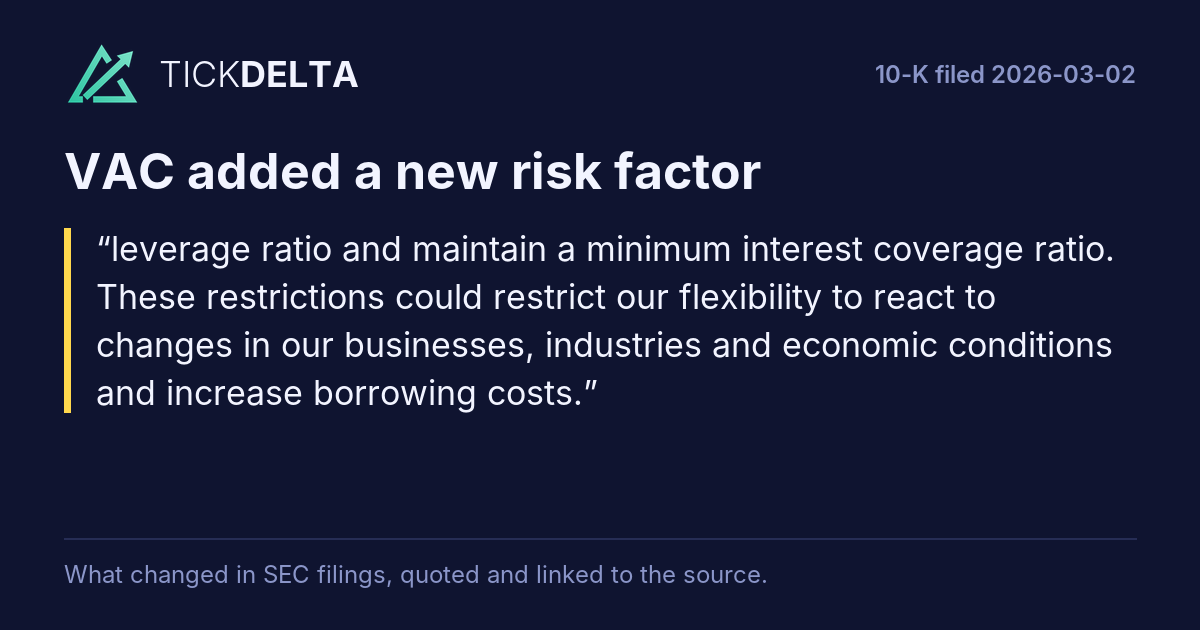
leverage ratio and maintain a minimum interest coverage ratio. These restrictions could restrict our flexibility to react to changes in our businesses, industries and economic conditions and increase borrowing costs.
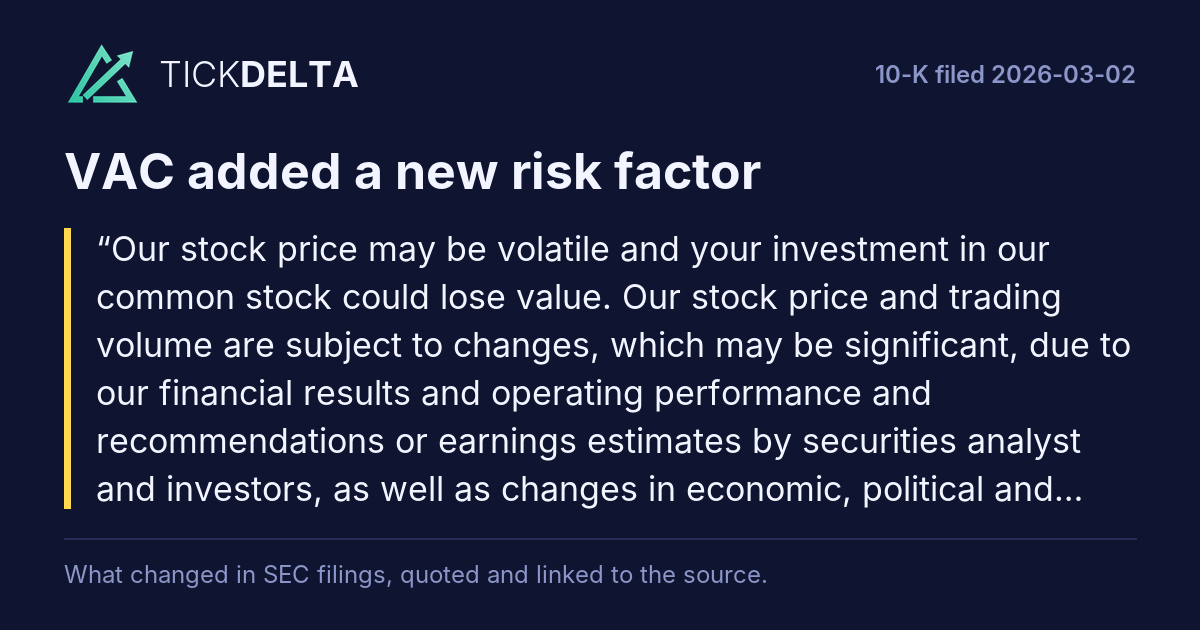
Our stock price may be volatile and your investment in our common stock could lose value.
Our stock price and trading volume are subject to changes, which may be significant, due to our financial results and operating performance and recommendations or earnings estimates by securities analyst and investors, as well as changes in economic, political and market conditions, including changes that affect demand for travel and consumer discretionary spending, such as inflationary pressures, health crises, acts of war and terrorism, and other factors unrelated to our financial results and operating performance. Speculation in the press or investment community about our business and results of operation can also cause changes in our stock price and trading volume. Many of these factors are out of our control. A significant drop in our stock price could expose us to the risk of securities class action lawsuits, which may result in substantial expense and divert management’s attention and resources, which may adversely affect our business.
Paragraphs in the 10-Q filed Nov 4, 2026 that were not in the one before
New in the latest 10-Q
16 paragraphs in the 10-Q filed Nov 4, 2026 with nothing like them in the 10-Q filed Aug 6, 2026 (at least half the words must differ; new numbers alone do not count). Quoted exactly, grouped by the item heading above them. This is text that changed, not a judgement of how serious it is.
Financial statements and notes
During the third quarter of 2025, we acquired 48 completed vacation ownership units located at our Marriott Vacation Club, Waikiki property for $ 82 million. The transaction was accounted for as an asset acquisition with $ 80 million of the purchase price allocated to Property and Equipment, net, representing the portion of vacation ownership units purchased that were not registered and available for sale in their current form, and the remaining $ 2 million allocated to Inventory.
Read in the 10-Q
of the loan, and other similar factors that may reflect investor demand in a securitization transaction or the cost to effectively securitize the vacation ownership notes receivable.
Read in the 10-Q
(2) For the third quarter of 2025, $ 4 million of interest expense related to convertible notes, net of tax, was excluded from the above calculation of diluted net loss per share attributable to common stockholders as the effects would have been anti-dilutive.
Read in the 10-Q
(3) For the third quarter of 2025, the following potentially dilutive securities were excluded from the above calculation of diluted net loss per share attributable to common stockholders as the effects of including these securities would have been anti-dilutive.
Read in the 10-Q
During the third quarter of 2026, we completed a securitization of a pool of $ 91 million of vacation ownership notes receivable originated in our Asia-Pacific business that we previously classified as not eligible for securitization. In connection with this securitization, $ 66 million of vacation ownership loan backed notes with an interest rate of 6.70 % were issued by Liburan 2026-A LLC in a private placement. The securitized loans previously were classified as not eligible for securitization based on criteria applicable to then current securitization transactions in the traditional ABS market.
Read in the 10-Q
Show the other 11
The PSUs and MRSUs granted during the first three quarters of 2026 require continuous employment, or service as outlined in the terms of the respective award agreements over the respective performance periods and are classified as equity under ASC 718, Compensation - Stock Compensation (“ASC 718”). Compensation expense for the MRSUs is recognized straight line over the requisite service period.
Read in the 10-Q
• We continued to improve profitability and Adjusted EBITDA, both sequentially and compared to the prior-year quarter and year to date periods. We also remained focused on improving operating cash flow, generating significantly higher cash from operating activities during the first three quarters of 2026 compared the first three quarters of 2025, while maintaining disciplined capital spending on inventory and property and equipment.
Read in the 10-Q
• In September, we generated $66 million of net proceeds from the private placement of $ 91 million of vacation ownership notes receivable with collateral located in Asia Pacific that were not eligible for sale in the traditional ABS market at a blended interest rate of 6.70 %.
Read in the 10-Q
• Subsequent to the end of the third quarter of 2026, we securitized a pool of $ 469 million of vacation ownership notes receivable at a blended interest rate of 5.91 % and a gross advance rate of 98%.
Read in the 10-Q
We expect the higher contract sales and VPG to continue in the last quarter of 2026, as well as into 2027 but at a lower rate of growth. We also expect the sales reserve, measured as a percentage of contract sales, to reflect higher utilization of our Company-provided financing.
Read in the 10-Q
• a lower marketing and sales rate primarily attributed to higher VPG and continued progress on our marketing and sales initiatives.
Read in the 10-Q
During the third quarter of 2026, we recorded $6 million of restructuring costs in connection with the termination of a future inventory purchase commitment in Mexico and $3 million of severance.
Read in the 10-Q
During the first three quarters of 2026, we recorded $6 million of restructuring costs in connection with the termination of a future inventory purchase commitment in Mexico, $2 million relating to the change in strategy for Asia Pacific and $1 million of severance.
Read in the 10-Q
The increase in general and administrative expenses for the third quarter of 2026 was primarily attributable to a $16 million increase in incentive compensation expense related to Company performance and a $3 million increase in stock-based compensation expense partially offset by a $2 million decrease in insurance expense.
Read in the 10-Q
The increase in general and administrative expenses for the third quarter of 2026 was primarily attributable to a $23 million increase in incentive compensation expense related to Company performance and a $6 million increase in stock-based compensation expense partially offset by a $4 million decrease in insurance expense.
Read in the 10-Q
In September, we generated $66 million of net proceeds from the private placement of $91 million of vacation ownership notes receivable with collateral located in Asia Pacific that was not eligible for sale in the traditional ABS market at a blended interest rate of 6.70%. Subsequent to the end of the third quarter of 2026, we securitized a pool of $469 million of vacation ownership notes receivable at a blended interest rate of 5.91% and a gross advance rate of 98%.
Read in the 10-Q
The 10-Q's risk factors against the 10-K
Item 1A of the 10-Q filed Nov 4, 2026 against Item 1A of the 10-K filed Mar 2, 2026.
A 10-Q repeats only the risks that changed, so a 10-K paragraph that is missing from it is not counted as removed.
Added is a paragraph with nothing like it in the 10-K, Reworded a sentence that is in both with several words changed,
Quiet changes a sentence in both where one to four words changed and one is a hedge or a modal
(cut words struck through, new words highlighted).
Text on the page, not a score; each links to the filing at sec.gov.
What the 10-Q itself says about its risk factors:There have been no material changes to the risk factors set forth in Item 1A of Part I of our 2025 Annual Report, except to the extent factual information disclosed elsewhere in this Quarterly Report relates to such risk factors, which is incorporated herein by reference.
Read in the 10-Q
1 paragraph in the 10-Q's Item 1A, and none of them adds, rewords or quietly edits a paragraph of the 10-K's.
Phrases used for the first time
Two-word phrases in Risk Factors of the 10-K filed Mar 2, 2026 that are in none of the 1 earlier 10-Ks stored, back to Feb 28, 2025
Where each one is used
- contractual obligations: If third-parties do not comply with their contractual obligations to us our financial condition, results of operations, internal controls over financial reporting and stock price could be materially and adversely affected.
- cases filed: A series of Spanish court rulings starting in 2015 (“2015 Rulings”) increased our exposure to litigation that may materially adversely affect our business and financial condition. These rulings voided certain timeshare contracts entered into after January 1999 related to certain resorts in Spain if a resort’s...
- current global: Uncertainty in the current global macroeconomic environment created by rapid governmental policy and regulatory changes could negatively impact our business.
- global macroeconomic: Uncertainty in the current global macroeconomic environment created by rapid governmental policy and regulatory changes could negatively impact our business.
- macroeconomic environment: Uncertainty in the current global macroeconomic environment created by rapid governmental policy and regulatory changes could negatively impact our business.
- regulatory changes: Uncertainty in the current global macroeconomic environment created by rapid governmental policy and regulatory changes could negatively impact our business.
- governmental policies: Our business operations and financial performance are significantly influenced by governmental policies, the regulatory environment and consumers' willingness to travel to our resorts. Rapid changes to governmental policies worldwide and, evolving governmental regulations regarding international trade and other...
- consumers willingness: Our business operations and financial performance are significantly influenced by governmental policies, the regulatory environment and consumers' willingness to travel to our resorts. Rapid changes to governmental policies worldwide and, evolving governmental regulations regarding international trade and other...
Used at least twice, small words left out. Counted, not picked: a phrase can be new because the company renamed something.
What was taken out
12 paragraphs of last year's Risk Factors with nothing like them now. The longest are quoted.
Sources
Item 1A of each 10-K and 10-Q on EDGAR, quoted exactly. Each paragraph links to the filing at sec.gov.
Also
10-K change: what was reworded or cut, section by section.
Work with it
Excel workbook · CSV. Google Sheet that stays up to date: paste =IMPORTDATA("https://tickdelta.com/company/VAC/export.csv") into a cell.