Screener / SEC EDGAR /CIK 0001524358 /10-K filed Mar 2, 2026, compared with Feb 28, 2025 /Numbers from the XBRL of the 10-Ks
NYSE Real estate · Real Estate Agents & Managers (For Others)

MARRIOTT VACATIONS WORLDWIDE Corp VAC

Compare with peers Embed
The 10-K against last year's

158 changes: 56 added, 34 removed, 61 reworded, 7 quiet changes

10-K Mar 2, 2026 vs Feb 28, 2025

10-K 0001524358-26-000010 (Mar 2, 2026) vs 10-K 0001524358-25-000044 (Feb 28, 2025)

Every paragraph, and how much of it changed

One bar per paragraph, in the order of the 10-K. Height and colour show the share of its words not in the closest paragraph a year earlier; the tallest bars are new paragraphs.

Risk Factors

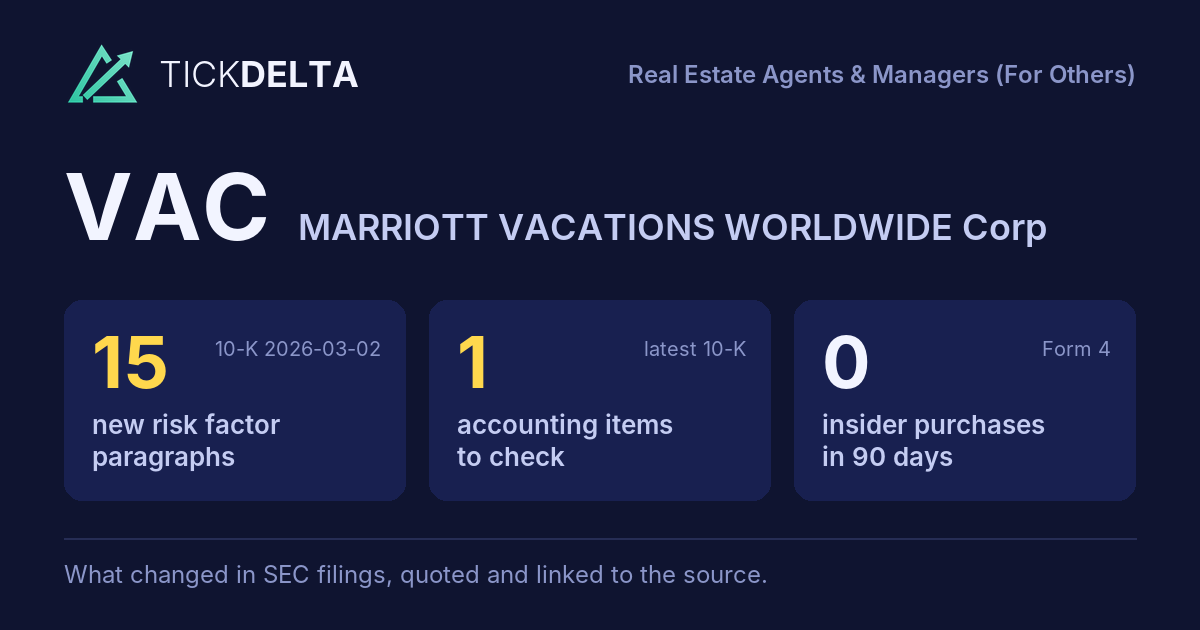
123 paragraphs · 15 new · 36 reworded · 12 gone · 10-K Mar 2, 2026 against Feb 28, 2025
New paragraph Reworded (5% of its words or more) Same or nearly
Paragraph 46 · 40% changed Every version of it
A series of Spanish court rulings starting in 2015 (“2015 Rulings”) increased our exposure to litigation that may materially adversely affect our business and financial condition. These rulings voided certain timeshare contracts entered into after January 1999 related to certain resorts in Spain if a resort’s timeshare structure did not meet requirements prescribed by Spanish timeshare laws enacted in 1998, even if the structure was lawful prior to 1998 and adapted pursuant to mechanisms specified in the 1998 laws. These rulings have led to an increase in lawsuits by owners seeking to void timeshare contracts in Spain, including lawsuits by owners at certain of our resorts in Spain which are currently pending. However, In November 2025, the Supreme Court of Spain has not yet substantively opined overturned the 2015 Rulings and thereby eliminated the principal legal grounds on which the issue as it pertains to the Company’s timeshare contracts. If the contract cancellation cases had been brought. Lesser remedies, including monetary damages, remain available for certain claims based on alleged errors or omissions in, or tardy delivery of, contract documents. The Supreme Court of Spain rules adversely to us and determines that our timeshare contracts are voidable, that may materially adversely affect the results of operations of our Vacation Ownership segment, as well as our business and financial condition. Defending these lawsuits has required, and may continue to require, the Company to incur legal fees and reserve for judgments. Under recently enacted legislation, Court’s decision was based in part on legislation effective April 4, 2025, existing timeshare owners will have five years to bring lawsuits based 2025 that placed a five-year limitation on the 2015 Rulings filing of new cancellation cases and reduced the scope of available remedies. A subsequent decision of the Supreme Court, issued in January 2026, overturned another legal theory previously relied upon by owners seeking to void their timeshare contracts, after which contracts. Cases filed prior to the Supreme Court’s November 2025 and January 2026 decisions remain pending, including cases filed against us, and insufficient time such claims will no longer be recognized. Damages recoverable for claims brought during has passed since the five-year period will be reduced by the market value of the benefits the owners received or were entitled to receive under their timeshare contracts. Owners who purchase after April 4, 2025, will not be entitled to make claims under the 2015 Rulings. If additional owners at our resorts in Spain file similar lawsuits, this may void certain issuance of those owners’ timeshare contracts; decisions for us to predict the likely outcomes, in light of that ruling, of pending or future cases against us. Currently pending cases and any cases filed in the future have caused and could continue to cause us to incur material litigation and other costs, including judgment or settlement payments; and materially adversely affect the results of operations of our Vacation Ownership segment, as well as our business and financial condition. The ability for owners of Spanish timeshares to void their contracts has negatively impacted other developers with resorts in Spain and led to a decrease in the number of resorts located in Spain in the Interval Network with active sales and the loss of members who own VOIs at those resorts.
Paragraph 83 · 39% changed Every version of it
Selling VOIs in a system of resorts under a points-based business model increases the risk of temporary inventory depletion. Currently, our VOI sales are made primarily through a limited number of trust entities that issue VOIs. These structures can lead to a temporary depletion of inventory available for sale caused by: (1) delayed delivery of inventory under construction by us or third parties; (2) delayed receipt of required governmental registrations of inventory for sale; or (3) significant unanticipated increases in sales pace. If the inventory available for sale for a particular trust were to be depleted before new inventory is added and available for sale, we would be required to temporarily suspend sales until inventory is replenished or shift to selling an alternative product, which may increase marketing and sales costs and lower volume per guest (“VPG”). Our efforts to avoid the risk of temporary inventory depletion by maintaining a surplus supply of completed inventory based on our forecasted sales pace, and by employing other mitigation strategies such as accelerating completion of resorts under construction, acquiring VOIs on the secondary market, or reducing sales pace by adjusting prices or sales incentives, may not be successful. A depletion of VOI inventory could decrease our financing revenues generated from purchasers of VOIs and fee revenues generated by providing club, management, exchange, sales, and marketing services. In addition, any temporary suspension of sales due to lack of inventory could reduce our cash flow and have a negative impact on our results of operations.
Paragraph 16 · 33% changed Every version of it
The success of our business Our sales volume and our financial results depend, in substantial part, upon the health of the travel industry. Our business and financial results were rental revenue are materially adversely affected impacted by the COVID-19 pandemic in 2020; for example, we saw marked declines in occupancy, rentals, desire and contract sales ability of vacationers to travel, because of the temporary closure of nearly all of our sales centers and many of our resorts and the reduction in operations and amenities at all of our resorts. When Health Crises make headlines, consumer fear about contracting an illness and government recommendations or mandates to avoid large gatherings of people or self-quarantine may increase. These fears, recommendations and mandates have affected, and may affect in the future, resort occupancies. A a substantial amount of our sales activity occurs at our resorts, and the number of prospective and current owners who visit our resorts impacts sales volume. Our rental revenue is also substantially impacted by the desire and ability of vacationers to travel. Fear of exposure to illnesses, government restrictions on travel, resorts. Concerns about travel restrictions, low vaccination rates in some parts of the world and exposure to illness, including vaccine-resistant illnesses that may be resistant to available vaccines could cause travelers to cancel or delay plans to visit our resorts. These changes in vacation and travel patterns resorts, which could adversely affect our cash flows, revenues, and results of operations. Moreover, when even after travel advisories and restrictions are lifted, travel demand could be unpredictable and could remain so for a significant period. Adverse changes in the perceived or actual economic climate, including higher unemployment rates, declines in income levels, inflation, recession and loss of personal wealth whether or not resulting from the impact of a future Health Crisis may negatively affect travel demand for a prolonged period.
Paragraph 73 · 31% changed Every version of it
Approximately 25% of our Vacation Ownership segment resorts are co-located with same-branded or affiliated hotel properties. If a branded hotel property with which one of our resorts is co-located ceases to be operated by or affiliated with the same brand as our resort, which has happened in the past, we could lose benefits such as shared amenities, infrastructure and staff, integration of services, and other cost efficiencies. Our owners could lose access to the more varied and elaborate amenities that are generally available at the larger campus of an integrated vacation ownership and hotel resort. We could also lose our on-site access to hotel customers, including brand customer loyalty program members, at such resorts, which is a cost-effective marketing channel for our vacation ownership products, and our sales may decline.
Paragraph 119 · 30% changed Every version of it
Our share repurchase program does not obligate us to repurchase any shares of our common stock. The timing and amount of any repurchases depend upon several factors, including market conditions, business conditions, statutory and contractual restrictions, the trading price of our common stock and the nature of other investment opportunities available to us. In addition, repurchases of our common stock could affect our stock price and increase its volatility. The existence of a share repurchase program could cause our stock price to be higher than it would be absent the program and could reduce market liquidity for our stock. Use of our funds to repurchase shares could diminish our cash reserves, which may impact our ability to finance growth, pursue strategic opportunities, and discharge liabilities. Our share repurchases may not enhance stockholder value because the market price of our common stock may decline below the prices at which we repurchased shares and short-term stock price fluctuations could reduce the program’s effectiveness.
Paragraph 62 · 26% changed Every version of it
Companies are facing increasing and frequently evolving scrutiny globally from customers, regulators, investors, employees and other stakeholders related to their environmental, social, and governance (“ESG”) practices and disclosure as expectations for, and support or criticism of, such matters continues to evolve. Investor advocacy groups, investment funds and influential investors are also increasingly focused on these practices. Third parties have developed proprietary ratings or analyses of companies based on certain ESG metrics. ESG disclosure rules have been adopted by California, the European Union and other jurisdictions; various ESG regulations are under consideration, and the Company cannot determine what final regulations will be enacted, modified, or reversed or the ultimate impact on its business. Increased ESG-related compliance costs could increase our overall operational costs. Failure to adapt to or comply with regulatory requirements or investor or other stakeholder expectations and standards could increase the risk of antidiscrimination lawsuits and customer backlash, negatively impact our reputation, ability to do business with certain partners, sales and stock price, and result in penalties. New government regulations could also result in new or more stringent forms of ESG oversight and expanding mandatory and voluntary reporting, diligence, and disclosure. Our corporate responsibility initiatives and goals are based on standards for measuring progress that are still developing, internal controls and processes that continue to evolve and assumptions that are subject to change in the future. As we report on our corporate responsibility initiatives or goals, we may be subject to heightened reputational and operational risk and compliance costs related to these matters. Our control over resorts and properties that we manage is generally limited by the terms of the applicable management agreements. As a result, our ability to achieve some or all of our corporate responsibility initiatives or goals may be limited without additional support or action by the owners’ associations of the vacation ownership resorts and properties we manage. Complying with increased regulations could increase our costs and adversely impact our results of operations. Our inability or failure to meet, or the perceived failure to meet, such stakeholders’ expectations, as well as adverse incidents, could negatively impact our stock price, results of operations, or reputation and increase our cost of capital.
Paragraph 14 · 26% changed Every version of it
The COVID-19 pandemic had, Future global or regional health concerns, outbreaks, and pandemics (each a future Health Crisis “Health Crisis”) may have, have serious adverse effects on our business, financial condition, cash flows, and results of operations for an unknown period of time.
Paragraph 78 · 25% changed Every version of it
In connection with our vacation ownership business, we provide loans to purchasers to finance their purchase of VOIs. Accordingly, we are subject to the risk that those borrowers may default on the financing that we provide. The risk of borrower defaults may increase due to man-made or natural disasters, inflation, recessions or other economic downturns that cause financial hardship for borrowers. In the past, we have experienced increased defaults as a result of economic downturns. Certain of our borrowers have been impacted by man-made and natural disasters, including the recent wildfires near Los Angeles. However, at this time, we cannot quantify the effect the wildfires near Los Angeles may have on borrower defaults. disasters. The risk of borrower defaults may also increase if we do not evaluate accurately the creditworthiness of the customers to whom we extend financing or due to the influence of timeshare relief firms. Borrower defaults have caused, and may continue to cause, us to foreclose on vacation ownership notes receivable and reclaim ownership of the financed interests, both for loans that we have not securitized and in our role as servicer for the vacation ownership notes receivable we have securitized through the ABS market or the Warehouse Credit Facility. If default rates for our borrowers increase, we have been required, and may in the future be required, to increase our reserve on vacation ownership notes receivable, which would adversely affect our results of operations and cash flows.

MD&A

176 paragraphs · 41 new · 78 reworded · 22 gone · 10-K Mar 2, 2026 against Feb 28, 2025
New paragraph Reworded (5% of its words or more) Same or nearly
Paragraph 84 · 50% changed
•lower Excluding the favorable impact of the additional sales reserve in 2024, both Cost of vacation ownership products due to the increase in and Cost of vacation ownership products as a percentage of sales reserve discussed above; and were flat.
Paragraph 102 · 50% changed
During 2024, we recorded a non-cash impairment charge •$75 million to write down the value of $28 million vacation ownership interests related to Legacy-Welk inventory. The impairment charge reflects an reflecting a further elongated pace of sales at a higher marketing and selling cost than that estimated in purchase accounting. as the Hyatt-branded vacation ownership business continues to underperform expectations;
Paragraph 134 · 50% changed
Subsequent to the end of 2025, we used the proceeds from the 2033 Notes to repay our 2026 Convertible Notes upon maturity. See Footnote 17 “Stockholders' Equity” 15 “Debt” to our Financial Statements for further information related to maturities of our current share repurchase program. debt.
Paragraph 62 · 49% changed
Fiscal Years ($ in millions) 2025 2024 2023 2022 REVENUES Resort management and other services Change Fiscal Years 2025 vs. 2024 Net (loss) income attributable to common stockholders $ 49 (308) $ 39 218 $ 64 Cost reimbursements (43) (42) (44) TOTAL REVENUES 6 (3) 20 EXPENSES Resort management and other services 67 54 84 Rental (17) (14) (18) Cost reimbursements (43) (42) (44) TOTAL EXPENSES 7 (2) 22 Losses and other expense, net — — (3) 254 $ (526) NM Interest expense, net 1 1 — FINANCIAL RESULTS BEFORE INCOME TAXES AND NONCONTROLLING INTERESTS — — (5) 169 162 145 7 4% Provision for income taxes (1) (1) (1) Net loss attributable to noncontrolling interests 1 2 8 89 146 (81) NM Depreciation and amortization 149 146 135 3 3% EBITDA 18 615 680 (597) NM Share-based compensation expense 38 33 31 5 15% Amortization of cloud computing software implementation costs(1)(2) 6 3 — FINANCIAL RESULTS ATTRIBUTABLE TO COMMON STOCKHOLDERS 3 NM Certain items(1) 689 85 50 604 NM Adjusted EBITDA(1) $ — 751 $ 1 736 $ (6) 761 $ 15 2% Adjusted EBITDA Margin(1) 22.5% 22.5% 24.0% 0.0 pts
Paragraph 80 · 48% changed
Contract sales increased The increase in 2024 Sale of vacation ownership products was primarily due to a 7% increase decrease in tours, our sales reserve reflecting the $70 million sales reserve adjustment (the “additional sales reserve”) recorded in the second quarter of 2024, which did not recur in 2025. Lower contract sales were partially offset by a 4% decline higher revenue reportability and financing propensity in VPG. The decrease in VPG was due to a larger percentage mix of international and North America first 2025. First time buyer tours, both of which carry a contract sales were flat on 1% higher tours. Owner contract sales declined 4% on lower VPG than existing owner and tours. While existing owner VPG was in line with the prior year, first time buyer VPG declined 9%.
Paragraph 142 · 47% changed
Our During 2025, we entered into an amendment to the Corporate Credit Facility (the “Amendment”), which, among other things, increased the borrowing capacity on our Revolving Corporate Credit Facility, which expires on March 31, 2027, provides for up Facility from $750 million to $750 $800 million of aggregate borrowings for general corporate needs, including working capital, capital expenditures, letters of credit, and acquisitions. At December The Amendment also extended the termination date from March 31, 2024, $125 million of borrowings and $18 million of letters of credit were outstanding under our Revolving Corporate Credit Facility. See Footnote 16 “Debt” 2027 to our Financial Statements for more information on interest rates pertaining to this facility. March 24, 2030, reduced
Paragraph 54 · 47% changed
EBITDA, a financial measure that is not prescribed by GAAP, is defined as earnings, or net income or loss attributable to common stockholders, before interest expense, net (excluding consumer financing interest expense associated with term securitization transactions), income taxes, depreciation and amortization. Adjusted EBITDA reflects additional adjustments for certain items, and excludes share-based compensation expense and amortization of cloud computing software implementation costs. Share-based compensation expense is excluded to address considerable variability among companies in recording compensation expense because companies use share-based payment awards differently, both in the type and quantity of awards granted. For purposes During the first quarter of our EBITDA, Adjusted EBITDA, 2025, we began excluding amortization of cloud computing software implementation costs, which are not included in depreciation and amortization, from Adjusted EBITDA margin calculations, we do not adjust for consumer financing interest expense associated with term securitization transactions because we consider it comparability purposes to be an operating expense of our business. We consider Adjusted EBITDA to be an indicator of operating performance, which we use to measure our ability to service debt, fund capital expenditures, expand our business, and return cash to stockholders. We consider Adjusted EBITDA margin to be an indicator of our operating profitability. We also use Adjusted EBITDA and Adjusted EBITDA margin, as do analysts, lenders, investors, and others, because these measures exclude certain items that can vary widely across different industries or address the considerable variability among companies within the same industry. For example, interest expense can be dependent on a company’s capital structure, debt levels and credit ratings. Accordingly, the impact of interest expense on earnings can vary significantly among companies. The tax positions of companies can also vary because of their differing abilities to take advantage of tax benefits and because of the tax policies of the jurisdictions in which they operate. As a result, effective tax rates and provisions for income taxes can vary considerably among companies. EBITDA, Adjusted EBITDA, and Adjusted EBITDA margin also exclude depreciation and amortization because companies utilize productive assets of different ages and use different methods of both acquiring and depreciating productive assets. These differences can result in considerable variability in the relative costs utilization of productive assets assets, and the depreciation and amortization expense among companies. We believe Adjusted EBITDA and Adjusted EBITDA margin are useful as indicators of operating performance and profitability, respectively, because they allow for period-over-period comparisons of have reclassified prior year amounts to conform with our ongoing core operations before the impact of the excluded items. Adjusted EBITDA and Adjusted EBITDA margin also facilitate comparisons by us, analysts, investors, and others of results from our ongoing core operations before the impact of these items with results from other companies. current year presentation.
Paragraph 10 · 46% changed
We recognize revenues from the sale of vacation ownership products (also referred to as “VOIs”) when control of the vacation ownership product is transferred to the customer and the transaction price is deemed collectible. Based upon the different terms of our contracts with the customer and business practices, control collectible, which typically correlates to expiration of the vacation ownership product has historically transferred to the customer at different points in time for each brand of VOIs. In the third quarter of 2022 and the fourth quarter of 2024, we aligned our business practices and contract terms for the sale of vacation ownership products (the “Contract Alignments”), resulting in the prospective change in the timing of the transfer of control to the statutory rescission period.

A paragraph is matched with the one last year that shares the most of its words; under half in common makes it new. The paragraphs shown are the 8 reworded the most in each section.

The paragraph that changed most in each section

The redline

Marked against last year's 10-K: cut words struck through, new words highlighted.

Risk Factors379 words changed in this paragraph; it is 46% similar to last year's version.
A series of Spanish court rulings starting in 2015 (“2015 Rulings”) increased our exposure to litigation that may materially adversely affect our business and financial condition. These rulings voided certain timeshare contracts entered into after January 1999 related to certain resorts in Spain if a resort’s timeshare structure did not meet requirements prescribed by Spanish timeshare laws enacted in 1998, even if the structure was lawful prior to 1998 and adapted pursuant to mechanisms specified in the 1998 laws. These rulings have led to an increase in lawsuits by owners seeking to void timeshare contracts in Spain, including lawsuits by owners at certain of our resorts in Spain which are currently pending. However, In November 2025, the Supreme Court of Spain has not yet substantively opined overturned the 2015 Rulings and thereby eliminated the principal legal grounds on which the issue as it pertains to the Company’s timeshare contracts. If the contract cancellation cases had been brought. Lesser remedies, including monetary damages, remain available for certain claims based on alleged errors or omissions in, or tardy delivery of, contract documents. The Supreme Court of Spain rules adversely to us and determines that our timeshare contracts are voidable, that may materially adversely affect the results of operations of our Vacation Ownership segment, as well as our business and financial condition. Defending these lawsuits has required, and may continue to require, the Company to incur legal fees and reserve for judgments. Under recently enacted legislation, Court’s decision was based in part on legislation effective April 4, 2025, existing timeshare owners will have five years to bring lawsuits based 2025 that placed a five-year limitation on the 2015 Rulings filing of new cancellation cases and reduced the scope of available remedies. A subsequent decision of the Supreme Court, issued in January 2026, overturned another legal theory previously relied upon by owners seeking to void their timeshare contracts, after which contracts. Cases filed prior to the Supreme Court’s November 2025 and January 2026 decisions remain pending, including cases filed against us, and insufficient time such claims will no longer be recognized. Damages recoverable for claims brought during has passed since the five-year period will be reduced by the market value of the benefits the owners received or were entitled to receive under their timeshare contracts. Owners who purchase after April 4, 2025, will not be entitled to make claims under the 2015 Rulings. If additional owners at our resorts in Spain file similar lawsuits, this may void certain issuance of those owners’ timeshare contracts; decisions for us to predict the likely outcomes, in light of that ruling, of pending or future cases against us. Currently pending cases and any cases filed in the future have caused and could continue to cause us to incur material litigation and other costs, including judgment or settlement payments; and materially adversely affect the results of operations of our Vacation Ownership segment, as well as our business and financial condition. The ability for owners of Spanish timeshares to void their contracts has negatively impacted other developers with resorts in Spain and led to a decrease in the number of resorts located in Spain in the Interval Network with active sales and the loss of members who own VOIs at those resorts.

Source: Item 1A, 10-K 0001524358-26-000010 vs Item 1A, 10-K 0001524358-25-000044

MD&A362 words changed in this paragraph; it is 34% similar to last year's version.
EBITDA, a financial measure that is not prescribed by GAAP, is defined as earnings, or net income or loss attributable to common stockholders, before interest expense, net (excluding consumer financing interest expense associated with term securitization transactions), income taxes, depreciation and amortization. Adjusted EBITDA reflects additional adjustments for certain items, and excludes share-based compensation expense and amortization of cloud computing software implementation costs. Share-based compensation expense is excluded to address considerable variability among companies in recording compensation expense because companies use share-based payment awards differently, both in the type and quantity of awards granted. For purposes During the first quarter of our EBITDA, Adjusted EBITDA, 2025, we began excluding amortization of cloud computing software implementation costs, which are not included in depreciation and amortization, from Adjusted EBITDA margin calculations, we do not adjust for consumer financing interest expense associated with term securitization transactions because we consider it comparability purposes to be an operating expense of our business. We consider Adjusted EBITDA to be an indicator of operating performance, which we use to measure our ability to service debt, fund capital expenditures, expand our business, and return cash to stockholders. We consider Adjusted EBITDA margin to be an indicator of our operating profitability. We also use Adjusted EBITDA and Adjusted EBITDA margin, as do analysts, lenders, investors, and others, because these measures exclude certain items that can vary widely across different industries or address the considerable variability among companies within the same industry. For example, interest expense can be dependent on a company’s capital structure, debt levels and credit ratings. Accordingly, the impact of interest expense on earnings can vary significantly among companies. The tax positions of companies can also vary because of their differing abilities to take advantage of tax benefits and because of the tax policies of the jurisdictions in which they operate. As a result, effective tax rates and provisions for income taxes can vary considerably among companies. EBITDA, Adjusted EBITDA, and Adjusted EBITDA margin also exclude depreciation and amortization because companies utilize productive assets of different ages and use different methods of both acquiring and depreciating productive assets. These differences can result in considerable variability in the relative costs utilization of productive assets assets, and the depreciation and amortization expense among companies. We believe Adjusted EBITDA and Adjusted EBITDA margin are useful as indicators of operating performance and profitability, respectively, because they allow for period-over-period comparisons of have reclassified prior year amounts to conform with our ongoing core operations before the impact of the excluded items. Adjusted EBITDA and Adjusted EBITDA margin also facilitate comparisons by us, analysts, investors, and others of results from our ongoing core operations before the impact of these items with results from other companies. current year presentation.

Source: Item 7, 10-K 0001524358-26-000010 vs Item 7, 10-K 0001524358-25-000044

Accounting Policies114 words changed in this paragraph; it is 64% similar to last year's version.
We account for vacation ownership inventory and cost of vacation ownership products in accordance with the authoritative guidance for accounting for real estate time-sharing transactions, which defines a specific application of the relative sales value method for reducing vacation ownership inventory and recording cost of sales as described in our policy for revenue recognition for vacation ownership products. Also, pursuant to the guidance for accounting for real estate time-sharing transactions, we do not reduce inventory for the cost of vacation ownership products related to variable consideration which has not been included within the transaction price (accordingly, no adjustment is made when inventory is reacquired upon default of the related originated vacation ownership note receivable). These standards provide for changes in estimates within the relative sales value calculations to be accounted for as real estate inventory true-ups, which we refer to as product cost true-up activity, and to be recorded in Cost of vacation ownership product expenses on the Income Statements to retrospectively adjust the margin previously recorded subject to those estimates to the amounts that would have been recorded historically had the revised estimates been used. Product cost true-up activity relating to vacation ownership products increased carrying values of inventory by $39 million, $36 million and $24 million during 2024, 2023 and 2022, respectively.

Source: Item 8, Note 2 – SUMMARY OF SIGNIFICANT ACCOUNTING POLICIES, 10-K 0001524358-26-000010 vs Item 8, Note 2 – SUMMARY OF SIGNIFICANT ACCOUNTING POLICIES, 10-K 0001524358-25-000044

Legal Proceedings59 words changed in this paragraph; it is 47% similar to last year's version.
•We have remaining commitments •In connection with our sale of $32 million a hotel in Cancun, we entered into a commitment to purchase vacation ownership units located in Bali, Indonesia in two separate transactions, Puerto Vallarta, Mexico, contingent upon completion of construction to agreed-upon standards within specified timeframes, for use in our Vacation Ownership segment. We expect to complete the acquisition of 64 vacation ownership units in 2028, and we expect to make payments of $46 million when specific construction milestones are completed in 2028.

Source: Item 3, via Note 12 – CONTINGENCIES AND COMMITMENTS, 10-K 0001524358-26-000010 vs Item 3, via Note 13 – CONTINGENCIES AND COMMITMENTS, 10-K 0001524358-25-000044

Sentences and paragraphs added, removed or reworded

Every change, by type

Sentences and paragraphs of VAC's Risk Factors and MD&A, 10-K Mar 2, 2026 against 10-K Feb 28, 2025. Each links to the text at sec.gov.

Quiet changes are sentences kept from last year with one to four words changed, at least one of them a hedge, a modal or a qualifier (may, could, will, not, significant, material…). A year or date rolling forward is not counted.

The full word list

adverse, adversely, all, although, anticipate, anticipates, any, approximately, believe, believes, can, cannot, certain, could, expect, expects, generally, however, if, intend, intends, largely, likely, many, material, materially, may, might, most, must, never, no, not, possible, primarily, probable, should, significant, significantly, some, substantial, substantially, unlikely, will, would

AddedRisk Factors
Our business operations and financial performance are significantly influenced by governmental policies, the regulatory environment and consumers' willingness to travel to our resorts. Rapid changes to governmental policies worldwide and, evolving governmental regulations regarding international trade and other matters have introduced substantial uncertainty and volatility into the financial markets which can negatively impact consumer sentiment. These changes could negatively impact our supply chain, cost structure, market access and consumers' willingness to travel to our resorts and purchase our products and services. Additionally, recent and future policy and regulatory changes could disrupt our strategic planning and investments, require us to increase maintenance fees and negatively impact owners’ ability to pay such fees, decrease consumers' disposable income and impact our ability to originate, and the borrowers’ repayment of, vacation ownership notes receivable, among other consequences. These factors may also adversely impair our ability to execute strategies to mitigate negative impacts of the current environment.
Read it in 10-K Mar 2, 2026 at sec.gov
AddedRisk Factors
The unpredictable nature of the current global macroeconomic environment makes it challenging to anticipate and address possible material risks. This uncertainty and its effects could have a material adverse effect on our financial condition, results of operations and cash flows.
Read it in 10-K Mar 2, 2026 at sec.gov
AddedRisk Factors
unable to hire and retain employees capable of performing at a high level, our business, including our cash flows, results of operations, owner, guest and associate satisfaction and reputation, could be adversely affected.
Read it in 10-K Mar 2, 2026 at sec.gov
AddedRisk Factors
The success of our business and our financial results depend, in substantial part, upon the health of the travel industry. The COVID-19 pandemic significantly disrupted international and U.S. economies and markets and had a material adverse impact on participants in the travel and hospitality industries, including our Company. For example, in 2020 we saw marked declines in resort occupancy, rentals, and contract sales due to temporary closures of nearly all of our sales centers and many of our resorts and the limited operations at all of our resorts. Consumer fears, government restrictions and changes in travel behavior related to future Health Crises could similarly impact our business and financial results.
Read it in 10-K Mar 2, 2026 at sec.gov
AddedRisk Factors
If third-parties do not comply with their contractual obligations to us our financial condition, results of operations, internal controls over financial reporting and stock price could be materially and adversely affected.
Read it in 10-K Mar 2, 2026 at sec.gov
AddedRisk Factors
We rely on various third parties, including suppliers, service providers, and business partners, to fulfill contractual obligations that are critical to our operations. For example, we have outsourced certain corporate functions, including a significant portion of our global technology, finance and accounting, and human resources functions to third-party service providers and shared service centers. While these actions are intended to streamline operations and improve scalability, at times they have resulted in disruptions, increased transition costs, delays in service delivery and disputes with vendors and we may experience similar or more severe issues in the future. Additionally, such initiatives may lead to the loss of institutional knowledge, reduced employee morale, or increased attrition, including among key personnel. We may increase our reliance on third-party providers to deliver critical services and any failure by these providers to
Read it in 10-K Mar 2, 2026 at sec.gov
AddedRisk Factors
perform their contractual obligations, or any disruption in our ability to manage or transition these services effectively, could adversely affect our internal controls, compliance functions, or overall business operations. Furthermore, these initiatives may expose us to additional risks, including data security vulnerabilities, regulatory compliance challenges across jurisdictions and reputational harm. If we are unable to successfully execute and manage these third-party relationships, our financial condition, results of operations, internal controls over financial reporting and stock price could be materially and adversely affected.
Read it in 10-K Mar 2, 2026 at sec.gov
Show the other 71
AddedRisk Factors
segment, as well as our business and financial condition. The ability for owners of Spanish timeshares to void their contracts has negatively impacted other developers with resorts in Spain and led to a decrease in the number of resorts located in Spain in the Interval Network with active sales and the loss of members who own VOIs at those resorts.
Read it in 10-K Mar 2, 2026 at sec.gov
AddedRisk Factors
Acquisitions may also significantly increase our debt or result in dilutive issuances of our equity securities, impairments of assets or substantial amortization expenses associated with other intangible assets. For example, we have not achieved all of the anticipated benefits from the ILG Acquisition or the Welk Acquisition, and have incurred unanticipated expenses and impairment charges in 2024 and 2025 related to inventory.
Read it in 10-K Mar 2, 2026 at sec.gov
AddedRisk Factors
Our project development activities entail risks that may cause project delays or increased project costs and therefore may adversely impact our results of operations, cash flows and financial condition. These risks include construction delays or cost overruns; shortages of skilled labor; claims for construction defects, including claims by purchasers and owners’ associations; the discovery of hazardous or toxic substances, or other environmental, culturally-sensitive, or related issues; an inability to timely obtain required governmental permits and authorizations; compliance with zoning, building codes and other local regulations; performance by third parties involved in the financing and development of our projects; the cost or availability of raw materials; and interference of weather-related, geological or other events, such as hurricanes, earthquakes, floods, tsunamis, fires, and volcanic eruptions.
Read it in 10-K Mar 2, 2026 at sec.gov
AddedRisk Factors
management contract for the property and, to the extent such property operates under a licensed brand, the property may lose operating rights under the associated brand. We may also incur liabilities or losses in the operation of our business that are only partially covered by insurance, or not covered at all. Any of these events could have a material adverse effect on our business, financial condition and results of operations.
Read it in 10-K Mar 2, 2026 at sec.gov
RemovedRisk Factors
The COVID-19 pandemic caused, and a future Health Crisis may cause, significant disruptions in international and U.S. economies and markets and have a material adverse impact on participants in the travel and hospitality industries, including our Company.
Read it in 10-K Feb 28, 2025 at sec.gov
RemovedRisk Factors
loss, disclosure, or fraudulent use of our customer, employee or company data could adversely impact our reputation and result in remedial and other expenses, fines, penalties or litigation, any of which may be exacerbated by a delay or failure to detect a cybersecurity incident or the full extent of such incident.
Read it in 10-K Feb 28, 2025 at sec.gov
RemovedRisk Factors
Companies are facing increasing and frequently evolving scrutiny globally from customers, regulators, investors, employees and other stakeholders related to their environmental, social, and governance (“ESG”) practices and disclosure. Investor advocacy groups, investment funds and influential investors are also increasingly focused on these practices, especially as they relate to the environment, health and safety, board and workforce diversity, labor conditions, human rights, and cybersecurity and data privacy. Third parties have developed proprietary ratings or analyses of companies based on certain ESG metrics. ESG disclosure rules have been adopted by California and the European Union, and are being considered by the SEC. Increased ESG-related compliance costs could increase our overall
Read it in 10-K Feb 28, 2025 at sec.gov
RemovedRisk Factors
Our project development activities entail risks that may cause project delays or increased project costs and therefore may adversely impact our results of operations, cash flows and financial condition, including:
Read it in 10-K Feb 28, 2025 at sec.gov
RemovedRisk Factors
our financial condition and results of operations. Our ability to maintain affiliation agreements with resort developers is also impacted by consolidation in the vacation ownership industry.
Read it in 10-K Feb 28, 2025 at sec.gov
RemovedRisk Factors
The way we account for our convertible notes may impact our financial results and the market price of our common stock. For example, in 2022, we adopted a new accounting standard that requires the use of the “if-converted” method for calculating diluted earnings per share, which resulted in the reduction of our reported diluted earnings per share. See Footnote 16 “Debt” and Footnote 2 “Summary of Significant Accounting Policies” to our Financial Statements for additional information regarding the accounting for our convertible notes.
Read it in 10-K Feb 28, 2025 at sec.gov
RewordedRisk Factors
If additional owners at our resorts Currently pending cases and any cases filed in Spain file similar lawsuits, this may void certain of those owners’ timeshare contracts; the future have caused and could continue to cause us to incur material litigation and other costs, including judgment or settlement payments; and materially adversely affect the results of operations of our Vacation Ownership segment, as well as our business and financial condition.
Read it in 10-K Mar 2, 2026 at sec.gov
RewordedRisk Factors
However, if we breach our obligations under a license agreement and remain in breach after the applicable notice and fail to cure period, such breach, or if our properties do not meet brand standards, the applicable licensor may be entitled to terminate the license agreement and our rights to use its brands. brands and trademarks at the subject properties.
Read it in 10-K Mar 2, 2026 at sec.gov
RewordedRisk Factors
Inflation has had and in the future could also have an indirect adverse impact on our business by making travel more expensive, increasing maintenance costs and fees for consumers consumers, and reducing consumer discretionary income. income and negatively impacting the performance of our vacation ownership notes receivable portfolio.
Read it in 10-K Mar 2, 2026 at sec.gov
RewordedRisk Factors
Our sales volume and rental revenue is also substantially are materially impacted by the desire and ability of vacationers to travel. travel, because a substantial amount of our sales activity occurs at our resorts.
Read it in 10-K Mar 2, 2026 at sec.gov
RewordedRisk Factors
The COVID-19 pandemic had, Future global or regional health concerns, outbreaks, and pandemics (each a future Health Crisis “Health Crisis”) may have, have serious adverse effects on our business, financial condition, cash flows, and results of operations for an unknown period of time.
Read it in 10-K Mar 2, 2026 at sec.gov
RewordedRisk Factors
In a high inflationary environment, we may be unable to raise the price of our products and services in a proportional manner, which at times has reduced and in the future could reduce reduce, our operating margins, including in our financing business, margins and negatively impact our results or operations.
Read it in 10-K Mar 2, 2026 at sec.gov
RewordedRisk Factors
Concentration of some of our resorts, sales centers and exchange destinations in particular geographic areas exposes our business to the effects of severe weather and other regional events natural or man-made disasters or adverse economic conditions in these areas.
Read it in 10-K Mar 2, 2026 at sec.gov
RewordedRisk Factors
For example, higher loan delinquencies or defaults have caused us to increase and in the future could lead to an increase new increases in our estimated reserve for vacation ownership notes receivable.
Read it in 10-K Mar 2, 2026 at sec.gov
RewordedRisk Factors
Many of these policies, including policies relating to the recognition of revenue, determination of cost of sales and evaluation of our assets for impairment, are highly complex and involve many numerous assumptions, estimates and judgments. judgments which we regularly review and revise as needed.
Read it in 10-K Mar 2, 2026 at sec.gov
RewordedRisk Factors
Failure to adapt to or comply with regulatory requirements or investor or other stakeholder expectations and standards could increase the risk of antidiscrimination lawsuits and customer backlash, negatively impact our reputation, ability to do business with certain partners, sales and stock price, and result in penalties.
Read it in 10-K Mar 2, 2026 at sec.gov
RewordedRisk Factors
If a branded hotel property with which one of our resorts is co-located ceases to be operated by or affiliated with the same brand as our resort, which has happened in the past, we could lose benefits such as shared amenities, infrastructure and staff, integration of services, and other cost efficiencies.
Read it in 10-K Mar 2, 2026 at sec.gov
RewordedRisk Factors
In addition, an increase increases in the cost of capital, labor and materials have had, and in the future could have an adverse impact on our business or financial results.
Read it in 10-K Mar 2, 2026 at sec.gov
Quiet changesRisk Factors
Adverse changes in the perceived or actual economic climate, including higher unemployment rates, declines in income levels, inflation, recession and loss of personal wealth whether or not resulting from the impact of a future Health Crisis may negatively affect travel demand for a prolonged period.
Read it in 10-K Mar 2, 2026 at sec.gov
Quiet changesRisk Factors
The termination of our license agreements with Marriott International, Hyatt or their affiliates would could materially harm our business and results of operations and materially impair our ability to market and sell our products and maintain our competitive position, and could have a material adverse effect on our financial position, results of operations or cash flows.
Read it in 10-K Mar 2, 2026 at sec.gov
Quiet changesRisk Factors
In addition, we would not be able to use the brand websites as channels through which to rent available inventory, which would could cause our rental revenue to decline materially.
Read it in 10-K Mar 2, 2026 at sec.gov
Quiet changesRisk Factors
We may not have sufficient surplus under Delaware law to be able to pay any dividends, which may result from extraordinary cash expenses, actual expenses exceeding contemplated costs, funding of capital expenditures or increases in reserves.
Read it in 10-K Mar 2, 2026 at sec.gov
AddedMD&A
Management uses the following key performance metrics to assess the Company’s operational efficiency and market competitiveness, identify trends, develop financial projections, and support strategic decision-making. Management continuously monitors and analyzes these metrics to help ensure that the Company remains responsive to changing market conditions and aligned with our long-term growth objectives. The definitions and methodologies of certain of these metrics may differ from those used by other companies, and as a result, these metrics may not be directly comparable to similarly titled measures reported by other companies.
Read it in 10-K Mar 2, 2026 at sec.gov
AddedMD&A
Our management priorities for 2026 are centered on driving stronger profitability and improving cash flow. We are focused on reshaping the quality and composition of our tours, tightening our cost structure, and refining our global development strategy. We expect that delivering higher‑quality tours via various initiatives will increase VPGs while reducing default rates on newly originated vacation ownership notes receivable. For example, we are using FICO scores to pre-qualify prospective purchasers and focusing on increasing in-house capture rates, which has historically been one of our highest VPG channels. Additional priorities include reducing overhead, focusing on marketing and sales talent, delaying modernization projects to manage cash flow, monetizing certain non-core assets on our balance sheet, and managing maintenance fee increases for each of our vacation ownership products.
Read it in 10-K Mar 2, 2026 at sec.gov
AddedMD&A
A key element of our revised strategy relates to our Asia Pacific business, where we have experienced lower returns than expected, partially due to higher defaults that are primarily driven by customers from newer source markets. To address these dynamics, we are scaling back growth expectations and right‑sizing our business in the region. This includes reducing tours for first‑time buyers in select countries, reducing headcount in the region, deferring the purchase of the next phase of our resort in Khao Lak, Thailand, and canceling a purchase commitment for inventory in Bali. Collectively, these actions are designed to concentrate our efforts on markets with the greatest potential to drive profitability and cash flow and resulted in Restructuring expense in our Vacation Ownership segment. We also recorded a non-cash impairment for vacation ownership units in Khao Lak, Thailand primarily attributed to the elongation of the pace of sales and changes in our marketing approach.
Read it in 10-K Mar 2, 2026 at sec.gov
AddedMD&A
As part of our broader financial strategic review, we conducted a comprehensive review to assess the strategic alignment of inventory and property and equipment within our North America vacation ownership business. This review focused on assessing inventory needs in light of our current inventory position and identifying opportunities to monetize non-core assets. The outcome of this review represented an indicator of impairment for certain assets. As a result of our impairment analysis, we recorded a non‑cash impairment related to assets associated with future phases of our existing resorts that we no longer plan to further develop. The carrying values of the assets associated with these resorts exceeded their estimated fair values because the carrying values included historical allocations of common infrastructure costs incurred when we built the resorts. In addition, we recorded a non-cash impairment related to certain property and equipment identified for disposition in our Vacation Ownership segment.
Read it in 10-K Mar 2, 2026 at sec.gov
AddedMD&A
We expect to generate between $250 million and $300 million of net cash proceeds over a two year period from the disposition of certain non-core property and equipment and other assets, including $50 million from the disposition of the Cancun hotel in January 2026.
Read it in 10-K Mar 2, 2026 at sec.gov
AddedMD&A
For purposes of our EBITDA, Adjusted EBITDA, and Adjusted EBITDA margin calculations, we do not adjust for consumer financing interest expense associated with term securitization transactions because we consider it to be an operating expense of our business. We consider Adjusted EBITDA to be an indicator of operating performance, which we use to measure our ability to service debt, fund capital expenditures, expand our business, and return cash to stockholders. We consider Adjusted EBITDA margin to be an indicator of our operating profitability.
Read it in 10-K Mar 2, 2026 at sec.gov
AddedMD&A
We believe Adjusted EBITDA and Adjusted EBITDA margin are useful as indicators of operating performance and profitability, respectively, because they allow for period-over-period comparisons of our ongoing core operations before the impact of the excluded items. Adjusted EBITDA and Adjusted EBITDA margin also facilitate comparisons by us, analysts, investors, and others of results from our ongoing core operations before the impact of these items with results from other companies.
Read it in 10-K Mar 2, 2026 at sec.gov
AddedMD&A
Additionally, during 2025, we reclassified $6 million of certain amounts related to ongoing litigation from General and administrative expense to Litigation charges in order to conform our 2024 results with our current year presentation.
Read it in 10-K Mar 2, 2026 at sec.gov
AddedMD&A
Commencing in 2026, interest expense associated with our Warehouse Credit Facility will be included as a component of Consumer financing interest expense within Financing expense. Interest expense on our Warehouse Credit Facility was $13 million and $10 million for the years ended December 31, 2025 and December 31, 2024, respectively.
Read it in 10-K Mar 2, 2026 at sec.gov
RemovedMD&A
customer for Marriott-branded VOIs and Hyatt-branded VOIs derived from Legacy-Welk sales contracts, respectively. Prior to these changes, control transfer occurred at closing for these vacation ownership products. Subsequent to the Contract Alignments, transfer of control of these vacation ownership products occurs at expiration of the statutory rescission period, consistent with the historical timing of Sheraton-, Westin- and Hyatt- branded transactions. Marriott-branded VOIs and Hyatt-branded VOIs derived from Legacy-Welk sales contracts executed prior to the applicable Contract Alignment have been accounted for with the transfer of control of the VOI occurring at closing.
Read it in 10-K Feb 28, 2025 at sec.gov
RemovedMD&A
As a result of the unification of our Marriott-, Sheraton- and Westin- branded vacation ownership products under the Abound by Marriott Vacations program and stabilization of the default rates, in the third quarter of 2022, we combined and aligned our reserve methodology for vacation ownership notes receivable for our Marriott, Sheraton and Westin brands. See Footnote 6 “Vacation Ownership Notes Receivable” to our Financial Statements for further information.
Read it in 10-K Feb 28, 2025 at sec.gov
RemovedMD&A
In the third quarter of 2023, we increased our vacation ownership notes receivable reserve to reflect then-current trends in delinquencies and default rates. We estimated the increase in our sales reserve primarily using information from a historical period of increased defaults. The $59 million additional reserve recorded in 2023 was the result of an adjustment to our future default rate estimate to reflect then-current macroeconomic conditions, including inflation outpacing wage growth, continuing high interest rates, mixed economic indicators and increased global insecurity.
Read it in 10-K Feb 28, 2025 at sec.gov
RemovedMD&A
During the second quarter of 2024, we increased our sales reserve by $70 million to reflect increases in expected cumulative loss rates for our vacation ownership notes receivable originated during 2021-2024. Consistent with our analysis in the third quarter of 2023, we considered the cumulative impact of inflation and mixed economic environment on delinquencies and default rates. We believed the related impact of higher than historical year-over-year increases in maintenance fees for 2023 and 2024 would continue to drive elevated delinquencies and defaults. As expected, maintenance fee increases for our points-based products for 2025, which were approved by the relevant property owners’ association, returned to levels consistent with historical experience. We have increased our sales reserve rate to reflect higher expected cumulative losses on new originations and do not expect to lower the sales reserve rate until we have sufficient evidence of improvement in delinquency and default rates.
Read it in 10-K Feb 28, 2025 at sec.gov
RemovedMD&A
We expect rental profit to decline in 2025 due to a higher mix of keys in lower ADR markets, lower plus point revenue due the expiration of enhanced sales incentives programs put in place during COVID, additional preview usage and higher costs associated with unsold maintenance fees.
Read it in 10-K Feb 28, 2025 at sec.gov
RemovedMD&A
The increase in Financing revenues reflects $20 million of higher interest income as a result of a higher average vacation ownership notes receivable balance and $1 million of higher late and service fees, partially offset by $1 million of higher plus point financing incentive costs (recorded as a reduction of interest income).
Read it in 10-K Feb 28, 2025 at sec.gov
RemovedMD&A
The increase in consumer financing interest expense is attributable to the higher average securitized debt at a higher average interest rate for our more recent term securitization transactions.
Read it in 10-K Feb 28, 2025 at sec.gov
RemovedMD&A
We expect our average interest rate to continue to increase as the current interest rate environment for new securitization transactions is higher than the average interest rate on our existing securitized debt. We do not adjust interest rates on consumer financing offerings at the same pace as, or in lock-step with, broader market interest rates.
Read it in 10-K Feb 28, 2025 at sec.gov
RemovedMD&A
The decrease in General and administrative expense is primarily due to one-time information technology expenses incurred in 2023 and lower consulting and compliance related expenses, partially offset by higher variable compensation expense and higher operating costs.
Read it in 10-K Feb 28, 2025 at sec.gov
RewordedMD&A
Fiscal Years ($ in millions) 2025 2024 2023 2022 REVENUES Sale of vacation ownership products $ 1,464 $ 1,448 $ 1,460 $ 1,618 Management and exchange 860 843 813 827 Rental 650 645 571 551 Financing 360 342 322 293 Cost reimbursements 1,698 1,689 1,561 1,367 TOTAL REVENUES 5,032 4,967 4,727 4,656 EXPENSES Cost of vacation ownership products 184 200 224 289 Marketing and sales 943 919 823 807 Management and exchange 476 482 442 444 Rental 523 481 452 382 Financing 150 146 113 75 Royalty fee 113 114 117 General and administrative 243 administrative(1) 242 237 273 249 Depreciation and amortization 149 146 135 132 Litigation charges charges(1) 17 23 13 11 Restructuring 10 Modernization(1) 122 4 — Restructuring(1) 15 6 — Royalty fee 114 117 114 6 Impairment 577 30 32 2 Cost reimbursements 1,698 1,689 1,561 1,367 TOTAL EXPENSES 5,209 4,477 4,191 3,872 (Losses) gains Gains (losses) and other (expense) income, income (expense), net 47 (1) 47 40 Interest expense, net (169) (162) (145) (118) Transaction and integration costs — (18) (37) (125) Other — (3) (3) 1 (LOSS) INCOME BEFORE INCOME TAXES AND NONCONTROLLING INTERESTS (299) 306 398 582 Provision for income taxes (8) (89) (146) (191) NET (LOSS) INCOME (307) 217 252 391 Net (income) loss attributable to noncontrolling interests (1) 1 2 — NET (LOSS) INCOME ATTRIBUTABLE TO COMMON STOCKHOLDERS $ (308) $ 218 $ 254 $ 391
Read it in 10-K Mar 2, 2026 at sec.gov
RewordedMD&A
Issuers Senior Notes Guarantors Non-Guarantor Subsidiaries Total Eliminations MVW Consolidated ($ in millions) MVWC MORI 2024 2025 Revenues $ — $ 1,146 1,086 $ 2,727 2,798 $ 1,137 1,192 $ (43) (44) $ 4,967 5,032 Expenses (44) (1,291) (2,542) (827) 43 (4,661) (1,396) (2,906) (1,029) 44 (5,331) Benefit from (provision for) income taxes 13 71 (43) (130) 12 87 (49) (58) — (89) (8) Equity in net income (loss) of subsidiaries 249 411 (276) 129 — — (660) 147 — Net loss (308) (94) (157) 105 147 (307) Net income (loss) 218 337 142 180 (660) 217 Net loss attributable to noncontrolling interests — — — 1 (1) — 1 (1) Net income (loss) loss attributable to common stockholders $ 218 (308) $ 337 (94) $ 142 (157) $ 181 104 $ (660) 147 $ 218 (308)
Read it in 10-K Mar 2, 2026 at sec.gov
RewordedMD&A
Fiscal Years ($ in millions) 2025 2024 2023 2022 REVENUES Resort management and other services $ 57 $ 49 $ 39 $ 67 Cost reimbursements (43) (43) (42) (44) TOTAL REVENUES 14 6 (3) 23 EXPENSES Resort management and other services 68 67 54 84 Rental (14) (17) (14) (18) General and administrative 243 242 237 273 249 Depreciation and amortization 19 18 11 9 Litigation charges (1) charges(1) 6 5 — 2 Restructuring 8 Modernization(1) 122 4 — Restructuring(1) — 4 6 — Impairment — — 16 — Cost reimbursements (43) (43) (42) (44) TOTAL EXPENSES 400 275 304 282 (Losses) gains Gains (losses) and other (expense) income, income (expense), net 28 (17) 17 (12) Interest expense, net (169) (162) (145) (118) Transaction and integration costs — (18) (37) (122) Other (1) — — FINANCIAL RESULTS BEFORE INCOME TAXES AND NONCONTROLLING INTERESTS (528) (466) (472) (511) Provision for income taxes (8) (89) (146) (191) Net (income) loss attributable to noncontrolling interests (1) 1 2 — FINANCIAL RESULTS ATTRIBUTABLE TO COMMON STOCKHOLDERS $ (537) $ (554) $ (616) $ (702)
Read it in 10-K Mar 2, 2026 at sec.gov
RewordedMD&A
($ in millions) 2025 2024 2023 2022 Change Fiscal Years 2025 vs. 2024 vs. 2023 Management fee revenues $ 221 $ 207 $ 180 $ 166 $ 27 15% 14 7% Ancillary revenues 273 266 252 241 14 6% 7 2% Other management and exchange revenues 139 139 136 127 3 — —% Resort management and other services revenues 633 612 568 21 3% Resort management and other services revenues 612 568 534 44 8% Resort management and other services expenses (291) (293) (270) (240) (23) (9%) 2 1% Resort management and other services profit $ 342 $ 319 $ 298 $ 294 $ 21 23 7% Resort management and other services profit margin 54.1% 52.1% 52.4% 55.1% (0.3 pts) 2.0 pts Resort occupancy(1) 89.2% 89.8% 88.1% 89.3% 1.7 pts (0.6 pts)
Read it in 10-K Mar 2, 2026 at sec.gov
RewordedMD&A
Fiscal Years ($ in millions) 2025 2024 2023 2022 REVENUES Sale of vacation ownership products $ 1,464 $ 1,448 $ 1,460 $ 1,618 Resort management and other services 633 612 568 534 Rental 615 605 531 509 Financing 360 342 322 293 Cost reimbursements 1,733 1,723 1,587 1,388 TOTAL REVENUES 4,805 4,730 4,468 4,342 EXPENSES Cost of vacation ownership products 184 200 224 289 Marketing and sales 943 919 823 807 Resort management and other services 291 293 270 240 Rental 537 498 466 400 Financing 150 146 113 75 Royalty fee 113 114 117 Depreciation and amortization 106 100 93 92 Litigation charges 11 18 12 9 Restructuring 15 1 — — Royalty fee 114 117 114 Impairment 395 28 12 2 Cost reimbursements 1,733 1,723 1,587 1,388 TOTAL EXPENSES 4,478 4,040 3,717 3,416 Gains and other income, net 18 16 29 37 Transaction and integration costs — Other — (3) Other (3) (3) 1 SEGMENT FINANCIAL RESULTS ATTRIBUTABLE TO COMMON STOCKHOLDERS $ 345 $ 703 $ 777 $ 961
Read it in 10-K Mar 2, 2026 at sec.gov
RewordedMD&A
Fiscal Years ($ in millions) 2025 2024 2023 Purchase accounting adjustments $ 1 $ 8 Litigation charges 18 12 Restructuring charges 1 — Impairment charges 28 12 Gain on disposition of hotel, land, and other (7) $ $ (7) Insurance proceeds (15) (5) (9) Change in indemnification asset — (9) Change in estimates relating to pre-acquisition contingencies (2) (4) Other (1) — Other — (4) Gains and other income, net (18) (16) (29) Purchase accounting adjustments — 1 Litigation charges 11 18 Restructuring 15 1 Impairment 395 28 Other 2 — 2 Total Certain items $ 403 $ 34 $ 5
Read it in 10-K Mar 2, 2026 at sec.gov
RewordedMD&A
Our During 2025, we entered into an amendment to the Corporate Credit Facility (the “Amendment”), which, among other things, increased the borrowing capacity on our Revolving Corporate Credit Facility, which expires on March 31, 2027, provides for up Facility from $750 million to $750 $800 million of aggregate borrowings for general corporate needs, including working capital, capital expenditures, letters of credit, and acquisitions.
Read it in 10-K Mar 2, 2026 at sec.gov
RewordedMD&A
Fiscal Years ($ in millions) 2025 2024 2023 2022 REVENUES Management and exchange $ 170 $ 182 $ 206 $ 226 Rental 35 40 40 42 Cost reimbursements 8 9 16 23 TOTAL REVENUES 213 231 262 291 EXPENSES Management and exchange 117 122 118 120 Depreciation and amortization 24 28 31 31 Litigation charges — — 1 Restructuring — 1 — Restructuring 1 — — Impairment 182 2 4 — Cost reimbursements 8 9 16 23 TOTAL EXPENSES 331 162 170 174 Gains and other income, net 1 — 1 15 Other 1 — — SEGMENT FINANCIAL RESULTS ATTRIBUTABLE TO COMMON STOCKHOLDERS $ (116) $ 69 $ 93 $ 132
Read it in 10-K Mar 2, 2026 at sec.gov
RewordedMD&A
Fiscal Years ($ in millions) 2025 2024 2023 2022 REVENUES Resort management and other services $ 57 $ 49 $ 39 $ 64 Cost reimbursements (43) (43) (42) (44) TOTAL REVENUES 14 6 (3) 20 EXPENSES Resort management and other services 68 67 54 84 Rental (14) (17) (14) (18) Cost reimbursements (43) (43) (42) (44) TOTAL EXPENSES 11 7 (2) 22 Losses and other Interest expense, net — — (3) Interest expense, net 1 1 — FINANCIAL RESULTS BEFORE INCOME TAXES AND NONCONTROLLING INTERESTS 3 — — (5) Provision for income taxes (1) (1) (1) Net (income) loss attributable to noncontrolling interests (1) 1 2 — FINANCIAL RESULTS ATTRIBUTABLE TO COMMON STOCKHOLDERS $ 1 $ — $ 1 $ (6)
Read it in 10-K Mar 2, 2026 at sec.gov
RewordedMD&A
Cost reimbursements include direct and indirect costs that are reimbursed to us by owners’ associations and customers under management contracts. contracts, which costs are principally payroll-related costs at the locations where we employ the associates providing on-site services, costs associated with property refurbishments (including those where we act as the project manager), and insurance costs.
Read it in 10-K Mar 2, 2026 at sec.gov
RewordedMD&A
Adjusted EBITDA reflects additional adjustments for certain items, and excludes share-based compensation expense to address considerable variability among companies in recording compensation expense because companies use share-based payment awards differently, both in the type and quantity amortization of awards granted. cloud computing software implementation costs.
Read it in 10-K Mar 2, 2026 at sec.gov
RewordedMD&A
In 2024, 2025, we recorded $12 $22 million of foreign currency translation losses and $5 gains, a $4 million of tax related adjustments to increase in the receivable from Marriott International for indemnified tax matters. matters, $1 million of insurance proceeds, and $1 million of other gains.
Read it in 10-K Mar 2, 2026 at sec.gov
Quiet changesMD&A
Our Vacation Ownership segment generates most of its revenues from four primary sources: selling vacation ownership products; managing vacation ownership resorts, clubs and owners’ associations; financing consumer purchases of vacation ownership products; and renting vacation ownership inventory.
Read it in 10-K Mar 2, 2026 at sec.gov

Sources

The two latest 10-Ks on EDGAR, section by section. Each change links to the text at sec.gov.

Also

New risk factors: paragraphs with nothing like them last year, quoted in full.

Work with it

Excel workbook · CSV. Google Sheet that stays up to date: paste =IMPORTDATA("https://tickdelta.com/company/VAC/export.csv") into a cell.

Next:Related parties
Esc

Type a ticker such as AAPL, a name, an investor such as Buffett, or a topic such as tariffs. ↑ ↓ to move, Enter to open.