Screener / SEC EDGAR /CIK 0000887359 /10-K filed Feb 26, 2026, compared with Feb 27, 2025 /Numbers from the XBRL of the 10-Ks
Nasdaq Health care · Biotechnology

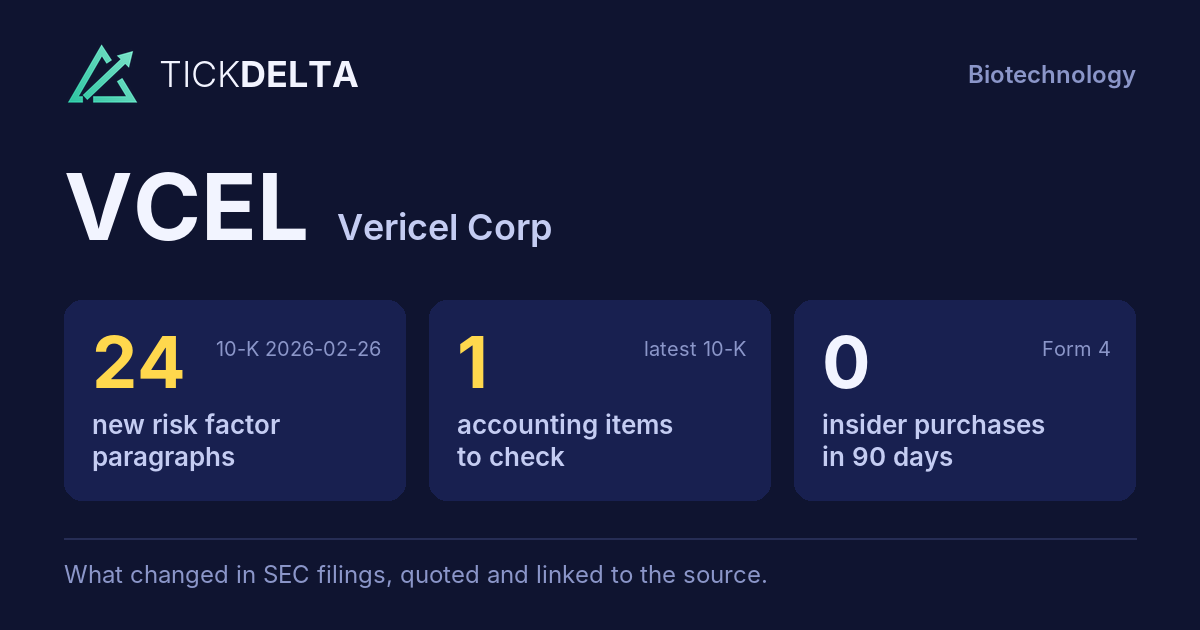
Vericel Corp VCEL

Compare with peers Embed
SEC comment letters, last 20 years

4 reviews of VCEL's filings by SEC staff

UPLOAD and CORRESP
Reviews 4 latest letter Nov 4, 2019
Questions asked 6 each answered in the company's own letter
No closing letter 1 reviews without a letter saying the staff completed it

When the SEC's staff reviews a filing, it writes to the company with numbered questions, and the company answers each one in a letter. SEC publishes the exchange once the review is over, at least 20 business days later. A question is not an accusation; most reviews end with the company adding detail to its next filing.

How the reviews went

Every review on EDGAR, from the first staff letter to the letter that closes it

  1. 1. Staff letters 5 UPLOAD
  2. 2. Questions in them 6 numbered comments
  3. 3. Company replies 4 CORRESP
  4. 4. Reviews closed 3 of 4 closing letter

Half the closed reviews took 20 days or less from the first letter to the closing letter.

Form 10-K for the Fiscal Year Ended December 31, 2018

2019-11-04 to 2019-11-19 · 1 question · 1 letter from the SEC, 1 from the company
Review closed 2019-11-19
Notes to Condensed Consolidated Financial Statements
SEC asked
NexoBrid License and Supply Agreements, page 18 1. You disclose that you will pay MediWound tiered royalties on net sales ranging from high single-digit to low double-digit percentages, subject to customary reductions. Please revise your disclosure in future filings to disclose a royalty rate or range that does not exceed a 10 point range.
VCEL answered
The Company respectfully acknowledges the Staff’s comment and respectfully advises the Staff that it will update its disclosure in future filings to refer to the tiered royalties that it will pay MediWound on net sales as ranging from “mid-high single-digit to mid-teen percentages”.

* * *

If you require additional information, please telephone the undersigned at (212) 459-7238.
Read in the reply

Also in this review: closing letter, 2019-11-19

Filing review

2017-08-11 to 2017-11-15 · 2 questions · 2 letters from the SEC, 2 from the company
Review closed 2017-11-15
RevenueCritical estimatesReserves and insurance
Critical Accounting Estimates · Recognition and Net Product Sales, page 57
SEC asked
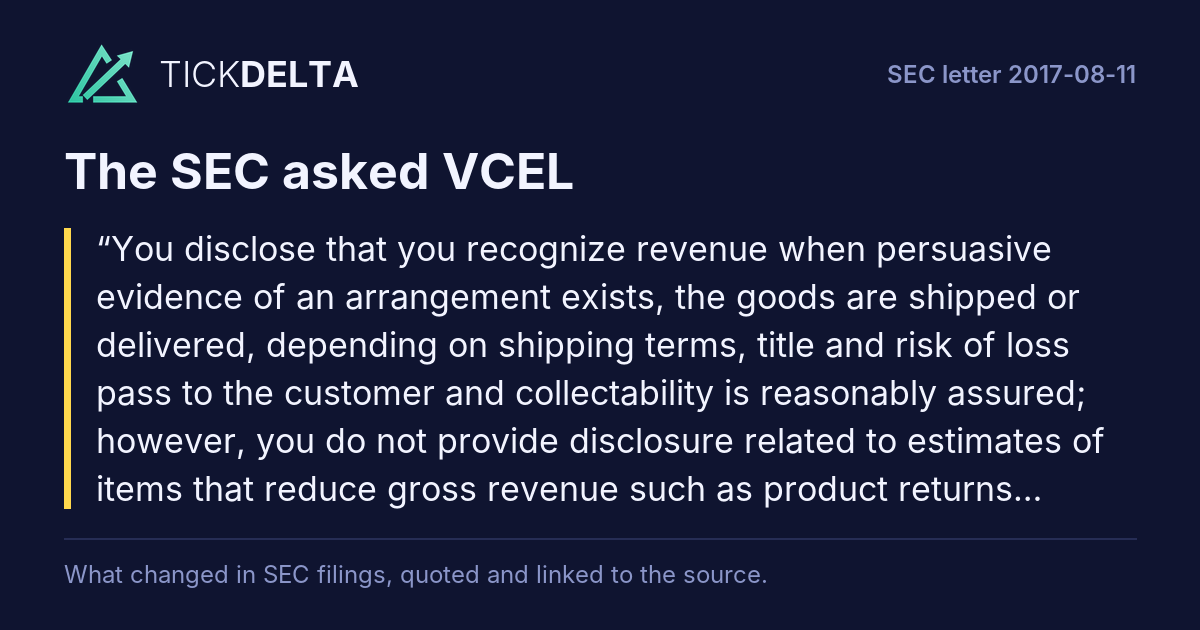
You disclose that you recognize revenue when persuasive evidence of an arrangement exists, the goods are shipped or delivered, depending on shipping terms, title and risk of loss pass to the customer and collectability is reasonably assured; however, you do not provide disclosure related to estimates of items that reduce gross revenue such as product returns, chargebacks, customer rebates and other discounts and
Rest of the question

allowances. Please address the following: • Clarify your accounting policy for your customer and end user incentives describing the factors that you consider in estimating each gross to net adjustment and any related reserves. • In your response please include a roll forward of the liability for each estimate for each period presented showing the following: • Beginning balance, • Current provision related to sales made in current period, • Current provision related to sales made in prior periods, • Actual returns or credits in current period related to sales made in current period, • Actual returns or credits in current period related to sales made in prior periods, • Ending balance • Please provide us a discussion of the amount of and reason for fluctuations for each type of reduction of gross revenue (i.e. product returns, chargebacks, customer rebates and other discounts and allowances) including the effect that changes in your estimates of these items had on your revenues and operations. • Tell us whether and how your customer and end user incentives changed pursuant to the June 30, 2016 change in the scope of your agreement with US Bioservices Corporation and due to the new agreement with Dohmen Life Science Services, LLC. Please explain your accounting for this change. • Explain to us how the contractual dispute between Vital Care, Inc., and the third- party payer related to certain of its insurance reimbursement claims associated with Carticel and MACI surgeries performed in 2016 and the first quarter of 2017 affects your revenue recognition analysis. Clarify whether or not the “negotiated reimbursement” represents the final settlement of the dispute. Please provide the date of the final negotiation or settlement in your response.

VCEL answered
Our products consist of implantable autologous cultured chondrocytes, which are human-derived cells obtained from the patient’s own cartilage, implanted by orthopedic surgeons after obtaining a cartilage biopsy during an arthroscopic procedure for that particular patient. Because the products are patient-specific and implantable there are no product returns. Sales volumes are known because our implantable cell therapy products cannot be stored at a third party distributor or wholesaler and are prepared for the individual patient.
Rest of the answer

Prior to June 30, 2016, we sold our product through a pharmacy, US Bioservices Corporation (“US Bio”), who purchased the product and assumed risks associated with reimbursement from insurance providers but never took physical possession, as the products are always shipped directly from our facility to the surgical suite. Sales incentives such as rebates or chargebacks that were offered to this distributor were known and recorded at the time of sale and not subject to significant estimation. Following June 30, 2016, after we changed to a direct distribution model involving third party service providers Dohmen Life Sciences Services, LLC (“Dohmen”) and Vital Care, Inc. and its franchisees (“Vital Care”). We did not offer our customers or end users any chargebacks, rebates or other types of sales incentives that would factor into a gross to net revenue calculation or result in a liability requiring a reserve.

As stated in footnote 2 of our Form 10-K, under the direct sales model net product revenue for all products (Carticel, MACI and Epicel) is recognized when the surgery is performed and calculated based on expected insurance, hospital and/or patient payments. Prior authorization or confirmation of coverage by the patient’s private insurance plan, hospital payer or government payer is a prerequisite to the shipment of product to a patient. In order to recognize revenue, evidence of coverage and medical necessity from the insurance provider or hospital must exist. The net revenue recorded per implant is based on several factors including the patient’s type of insurance coverage, contractual rates in effect for certain payers, and the reimbursement history for certain classes of customers. Our contractual arrangements with both Dohmen and Vital Care incorporated the inclusion of Carticel and MACI into Dohmen and Vital Care’s contracts with insurance companies.

All available information, including payment history, is taken into consideration when we recognize the amount of insurance reimbursement expected as revenue and therefore, neither reserves nor liabilities are initially recorded. In certain cases, insurance payment and reimbursement received can differ from the original estimate, which results in changes to the amounts ultimately recognized in net revenue. Factors that could cause differences between the original revenue recognized versus the amount reimbursed for individual implants include changes in the actual or expected levels of patient co-pay amounts and deductibles, and the insurance company questioning the in-network or out-of-network status of the product or the adequacy of documentation regarding medical necessity and authorization. As required by Financial Accounting Standards Board (“FASB”) Accounting Standards Codification (“ASC”) Topic 954-605 Health Care Entities, in each quarter we may increase or decrease the expected insurance reimbursement for previous claims based on the best information available at the time of issuance of the financial statements. Such adjustments have historically been immaterial with the exception of the Vital Care matter which is discussed in detail below.

· In your response please include a roll forward of the liability for each estimate for each period presented showing the following:

· Beginning balance,

· Current provision related to sales made in current period,

· Current provision related to sales made in prior periods,

· Actual returns or credits in current period related to sales made in current period,

· Actual returns or credits in current period related to sales made in prior periods,

· Ending balance

RESPONSE:

As noted above, there are no product returns, and we do not offer customer or end user sales incentives and therefore do not have any such liabilities recorded. As stated in footnote 4 of our quarterly filings for the period ended March 31, 2017 and June 30, 2017, there has been a change in estimate related to a contractual dispute between our third party service provider, Vital Care, and a third party payer regarding the settlement of insurance reimbursement. This was recognized as a change in estimated revenue in accordance with ASC 954-605 Health Care Entities – Revenue Recognition. All of the information and subsequent changes related to the reserve is included in our quarterly reports on Form 10-Q for the periods ended March 31, 2017 and June 30, 2017. This adjustment to our revenue is discussed in further detail below.

· Please provide us a discussion of the amount of and reason for fluctuations for each type of reduction of gross revenue (i.e. product returns, chargebacks, customer rebates and other discounts and allowances) including the effect that changes in your estimates of these items had on your revenues and operations.

RESPONSE:

As noted above, the only significant adjustment to our revenue in 2017 was limited to the contractual dispute between our third party service provider, Vital Care, and a third party payer related to the settlement of a dispute regarding insurance reimbursement. This adjustment to our revenue is discussed in further below.

· Tell us whether and how your customer and end user incentives changed pursuant to the June 30, 2016 change in the scope of your agreement with US Bioservices Corporation and due to the new agreement with Dohmen Life Science Services, LLC. Please explain your accounting for this change.

RESPONSE:

Prior to June 30, 2016, US Bio was our only end customer. US Bio took title to our products and assumed counter party reimbursement risk, which included the risk associated with any settlements with insurance providers or collections from patients. We received a fixed amount per Carticel implant from US Bio when the surgery was performed. These transactions were accounted for in accordance with ASC Topic 605 Revenue Recognition and Staff Accounting Bulletin (“SAB”) No. 104, Revenue Recognition, given the traditional buyer and seller relationship with US Bio. As stated in footnote 4 of our Form 10-K, effective July 1, 2016, we transitioned to a direct sales model whereby the third party payer (insurance company, hospital, government, etc.) paid on the patient’s behalf, with the exception of patient co-pays. As discussed above we accounted for these multiple party transactions in accordance with ASC Topic 954-605 Healthcare Entities. As of July 1, 2017, we utilized a new service provider, Dohmen, to provide patient support and reimbursement services under their reimbursement contracts but this provider did not purchase or take title to Carticel. We subsequently added Vital Care as a second service provider to expand the available network of contracted third-party payers for Carticel and MACI. Pursuant to our agreements with Dohmen and Vital Care, we retained counter party risk from the sale of our products including settlements with insurance providers or collections from patients. Dohmen and Vital Care were compensated as service providers.

We note for the Staff that by the start of the third quarter in the fiscal year ended December 31, 2017, we have moved the majority of our MACI and Carticel business to Orsini Pharmaceutical Services, Inc. (“Orsini”). Orsini is a distributor and we will account for our transactions with Orsini similar to how we accounted for our arrangement with US Bio described above in accordance with

ASC 605. Orsini will take title and will pay us a fixed fee and there is no adjustment related to final reimbursement and/or patient payment. We intend to include the disclosure below regarding our transition to Orsini in our quarterly report on Form 10-Q for the quarter ended September 30, 2017.

· Explain to us how the contractual dispute between Vital Care, Inc., and the third-party payer related to certain of its insurance reimbursement claims associated with Carticel and MACI surgeries performed in 2016 and the first quarter of 2017 affects your revenue recognition analysis. Clarify whether or not the “negotiated reimbursement” represents the final settlement of the dispute. Please provide the date of the final negotiation or settlement in your response.

RESPONSE:

In April 2017, one third party payer notified Vital Care that [****].

[****].

[****]. Our original reserve of $2.8 million related to 2016 and 2017 surgeries, subject to reimbursement from this third party payer, assumed an out-of-network reimbursement rate.

[****]. The change in estimate from the quarter-ended March 31, 2017 to June 30, 2017 resulted in a reversal of $1.4 million of the previously recorded reserve. FASB ASC Topic 954-605 Health Care Entities is predicated on the fact that revenue recognition of health care entities is subject to inherent uncertainties and complexities and revenue for the period reflects the amount the entity expects to collect based upon management’s best estimate, knowledge of and experience with past and current events and assumptions about conditions that it expects to exist and courses of action that it expects to take. We concluded in accordance with ASC 954-605 that settlements should reflect our best estimate of amounts expected to be received and the final settlement agreement in July 2017 as discussed above confirmed our best estimate as of June 30, 2017.

We highlight for the Staff that given the different nature of the two arrangements (US Bio and Dohmen/Vital Care) described above, the accounting policy and accounting guidance followed for each differs. The reimbursement received under the Dohmen and Vital Care contracts is received from third party payers on behalf of the patients receiving the Carticel and MACI implants. We have determined that these arrangements should be accounted for under ASC 954-605 Health Care Entities – Revenue Recognition. This arrangement differs from our other revenue arrangements in which the distributor, acting as our customer, purchases and takes title for the product and pays for the product directly without adjustments related to final reimbursement which are accounted for under ASC Topic 605 Revenue Recognition and SAB No. 104, Revenue Recognition. While we continue to believe our disclosure was acceptable, we have further refined our disclosure in footnote 4 prospectively as follows beginning in our Form 10-Q for the period-ended September 30, 2017. For ease of the Staff we have presented a track changes version to our current disclosure, which includes some disclosure from our Form 10-K for the year ended December 31, 2016:

Total revenues are comprised of product sales of Carticel,The Company sells Epicel, MACI and surgical kits. directly to the customer based on contracted amounts. Revenue is from sales to the customers are recognized in accordance with ASC 605, Revenue Recognition and SAB Topic 104, Revenue Recognition, when persuasive evidence of an arrangement exists, the goods are shipped or delivered and implanted, depending on shipping terms, title and risk of loss pass to the customer and collectability is reasonably assured. Shipping and handling costs are included as a component of revenue.

The Company recognizes product revenues from sales of Epicel, Carticel and MACI upon delivery to patients as long as (i) there is persuasive evidence that an arrangement exists between ourselves and the customer, (ii) collectability is reasonably assured and (iii) the price is fixed or determinable. For Carticel and MACI, prior

Prior to July 1, 2016, the Company sold Carticel to a distributor and followed ASC 605, Revenue Recognition and SAB Topic 104 Revenue Recognition to record revenue. This distributor purchased and took title to Carticel upon shipment of the product and assumed credit and collection risk related to the end customers. The distributor worked with the payers on behalf of patients and surgeons to ensure medical coverage and to obtain reimbursement for Carticel implantation procedures. The Company retained responsibility for shipment of the product to the surgical suite. Revenue was recorded for Carticel upon occurrence of the surgery, net of provisions for rebates and cash discounts which were $0.5 million for the six month period ending June 30, 2016. These rebates and prompt payment cash discounts were established by the Company at the time of sale, based on actual experience adjusted to reflect known changes in the factors that impact such reserves. Adjustments to these reserves have historically not been significant.

On June 30, 2016, the Company reduced the scope of the agreement with its exclusive distributor by terminating their services for a significant portion of its Carticel sales. On July 1, 2016, the Company transitioned to a direct sales model for Carticel and MACI whereby the Company retains credit and collection risk from the end customer, the patient. The Company utilized a new provider, Dohmen Life Science Services, LLC (DLSS), to provide patient support services but this provider did not purchase and take title to Carticel or MACI. In addition, the Company utilized Vital Care Inc. and its franchisees as a second provider to expand the available network of contracted third-party payers for Carticel and MACI. Under this direct sales model, the patient bears the ultimate financial responsibility for the purchase of Carticel or MACI and as such the Company recognized revenue in accordance with ASC 954-605, Health Care Entities – Revenue Recognition. The third party payer (insurance company, government, etc.) pays all or some of the product price on the patient’s behalf.

Under the direct sales model, the Company recognized product revenues from sales of Carticel upon implantation at which time the claim is billable to patient’s insurance provider on behalf of the patient and is billed by either DLSS or Vital Care. Prior authorization or confirmation of coverage level by the patient’s private insurance plan, hospital or government payer is a prerequisite to the shipment of product to a patient. The Company’s net product revenues are calculated by estimating expected payments for insurance, hospital or patient payments at the time it invoices and recognizes the gross revenue. The estimates are updated prospectively as new information becomes available.

The Company sells Epicel directly to hospitals and retains the credit and collection risk from the end customer. From July 1, 2016 through June 30, 2017, the Company utilized a direct sales model for Carticel and MACI whereby the Company retained the credit and collection risk from the end customer. During that period, the Company utilized Dohmen Life Science Services, LLC (DLSS) to provide patient support services and reimbursement services, but this provider did not purchase and take title to Carticel or MACI. On May 15, 2017, both parties mutually terminated the agreement effective June 30, 2017.

The Company utilizes Vital Care, Inc. (Vital Care) to provide data reporting services and to purchase, bill and collect from certain payers for Carticel and MACI.

In April 2017, the Company was notified of a contractual dispute between Vital Care and a third-party payer and as a result, during the three months ended March 31, 2017, the Company increased its estimated revenue allowances, reducing revenue by $2.1 million related to 2016 sales and $0.7 million related to 2017 sales to reflect the lower reimbursement that would be obtained if the claims are ultimately required to be treated as out-of-network. SubsequentlyDuring the three months ended June 30, 2017, the dispute was resolved and the negotiated reimbursement resulted in the Company’s ability to reduce its estimated sales allowances by $1.4 million, which resulted in additional revenue in the second quarter related to sales which originated primarily in 2016. As a result of the continuing evaluation and assessment of these expected payments, our estimates for expected payments could change.

On May 15, 2017, the Company entered into a distribution agreement with Orsini Pharmaceutical Services, Inc. (Orsini) to appoint Orsini as a specialty pharmacy distributor of Carticel and MACI to patients’ physicians and other healthcare providers. Orsini will work with the Company’s third party service provider for the management of patient cases related to Carticel and MACI. The initial term of the distribution agreement will end on May 15, 2019 with the option of two additional two-year terms. Orsini takes title to Carticel and MACI upon shipment of the product and assumes credit and collection risk. at which point the Company recognizes revenue. The Company ships the product to the surgical suite. There are no chargebacks, rebates or other types of sales incentives that would impact revenue under the agreement with Orsini.

***

In connection with responding to the Staff’s comments, the Company acknowledges that (i) it is responsible for the adequacy and accuracy of the disclosure in the Form 10-K, (ii) Staff comments or changes to disclosure in response to Staff comments do not foreclose the Commission from taking any action with respect to the Form 10-K and (iii) the Company may not assert Staff comments as a defense in any proceeding initiated by the Commission or any person under the federal securities laws of the United States.
Read in the reply
Critical Accounting Estimates · Recognition and Net Product Sales, page 57
SEC asked
We acknowledge your response to our prior comment 1 and the disclosures you propose to include in your quarterly report for the period ended September 30, 2017. It is unclear from your response why you concluded that ASC 954-605 is applicable to your sales to Dohmen Life Sciences Services, LLC and Vital Care, Inc. and its franchisees instead of ASC 605 and SAB 104; please clarify.
Rest of the question

In your response please explain how you meet the requirements in ASC 954-10-15-1A and 1B for ASC 954 to be applicable. If you conclude that ASC 605 and SAB 104 are applicable, please explain why, without establishing a pattern of collectability, you were allowed to recognize revenues at contract inception given that SAB 104 requires the price to be fixed or determinable and collectibility to be reasonably assured before revenue can be recognized.

VCEL answered
We respectfully believe that [****] with the third party payer (such as a commercial insurance company or government payer) agreeing to pay some or all of the fees for the patient’s treatment. Based on discussion in the AICPA Audit and Accounting Guide for Health Care Entities (“Health Care Guide”) we believe that the requirements in ASC 954-10-15-1A and 1B were met and ASC 954 was applicable to the transactions in question. Our operations consist of providing, or agreeing to provide, biological and medical device products and we derive revenue from the sale of these goods.
Rest of the answer

Refer to further discussion below for our analysis.

Description of Direct Sales Model

Prior to July 1, 2016 and after June 30, 2017, we primarily sold to third party pharmacies, and accounted for such sales under ASC 605. However, between July 1, 2016 and June 30, 2017 we operated under a direct sales model.

[****] We assumed counterparty risk for the third party reimbursement payment from the payer and the patient co-pay. To support this direct sales model, we utilized DLSS to provide administrative services associated with case management and reimbursement support and to provide billing and collection services. We utilized Vital Care to provide similar billing and collection services for a subset of insurance payers and patients.

The production of both Carticel and MACI biological devices requires close coordination with physician’s office and patient since the product is produced from a patient’s own cells (see below for further details). DLSS provided patient support services, biopsy coordination, implant coordination, clinical support and other reporting services for all Carticel and MACI implants and billing and collection services for most Carticel and MACI implants. We bore the full credit and collection risk, along with the risk that a third party payer rejected a claim or reduced the allowed amount payable for an implant.

[****] We were solely responsible for setting prices for our product and retained the credit and collection risk, as well as the risk that a third party payer rejected a claim or reduced the allowed amount payable for an implant. While DLSS was providing billing and collection support, cash receipts from our customers were deposited into a segregated DLSS account and swept daily to us. DLSS did not have inventory risk, either before the customer order was shipped or in the case the surgery was cancelled and the product was discarded. DLSS did not purchase product for resale and they did not hold or control any inventory. We retained the risks associated with product liability resulting from the implantation of our product and we were required to maintain adequate insurance coverage protecting DLSS from any commercial general liability, including product liability. We compensated DLSS with a fixed fee for support services provided associated with each biopsy and implantation procedure which represented less than 5% of our products’ average selling price. As a result of the factors described above, we believe that DLSS acted as our agent for administrative, billing and collection services in connection with our sale of implants to patients. Furthermore, we (with the assistance of DLSS) billed the patients or submitted claims to third party payers directly; we did not bill the doctors performing the procedure who would have in turn billed the patients or third party payers for the entire procedure inclusive of the implant.

Vital Care played an even more limited role, solely supporting the post-surgery billing and collections process associated with a certain subset of insurance payers for Carticel and MACI. Vital Care provided data reporting services and managed the billing and collections from certain payers. Vital Care did not provide patient support services associated with the implantation process. [****]

[****] We were the primary obligor in providing the product to the patient; we retained liability for product defects with the implant and we maintained general inventory risk, including bearing the cost of discarded product if the surgery is cancelled or rescheduled; we maintained latitude in establishing pricing based on an average wholesale price published by us. [****] We had counterparty credit-risk including the risk of recoupment from third party payers and non-payment by the patient.

Assessment of ASC 954-605, Health Care Entities—Revenue Recognition

As discussed in the AICPA Audit and Accounting Guide for Health Care Entities (“Health Care Guide”), we believe ASC 954-605 has a fairly broad scope, and would apply to all entities which engage in transactions that derive revenue from the sale of health care services, which includes services provided to individuals by or under the direction of licensed medical professionals in connection with the diagnosis or treatment of illness.

We note that paragraph 1.05 of the Health Care Guide states the following:

1.05 Some entities may have health care as a component of a larger, more diversified operation. For example, some senior independent living facilities are primarily real estate operations with a health care component. The Financial Reporting Executive Committee believes that to the extent such entities have unique transactions of the type covered by this guide, the recognition and measurement guidance of this guide would be applicable. Professional judgment should be exercised in determining the applicability of this guide to transactions entered into by such entities.

We evaluated the applicability of this guidance to our transactions as follows:

Under our direct sales model we sold Carticel and MACI to patients based on a prescription from their physicians, as described above. Carticel and MACI are both autologous chondrocyte implants (“ACI”) used for repairing cartilage defects in the knee. The product is a multistep healthcare procedure utilizing the patients’ own cells. First, normal cartilage is harvested from a patient’s joint by a physician during an initial surgical repair procedure. This specimen of live articular cartilage is placed into a culture medium and shipped to us. Second, we separate and expand the cartilage producing cells in our tissue culture laboratory. Third, the cells are then frozen until the physician determines the patient would benefit from an ACI implant. The company then thaws and expands the cells again and produces either a cell suspension (Carticel) or cell seeded membrane (MACI). Finally, the ACI product is shipped directly to the operating room on the day of the implantation. No distributor is involved in warehousing or transporting the product since the product is patient specific and has a shelf life of only several days.

Further, as described above, under the direct sales model our revenue arrangements involved three parties: the Company, the patient, and the third-party payer (such as a commercial insurance company) which has agreed to pay for some or all of the patient’s treatment based on the physician determining medical necessity. DLSS and Vital Care on our behalf took actions necessary to obtain reimbursement from each such third party payer for each claim at a targeted reimbursement rate. We did not bill the physician performing the implantation procedure.

Other factors that we considered in assessing applicability of ASC 954-605, Health Care Entities—Revenue Recognition included:

· We bear the risks associated with information collected and transmitted related to the sale of Carticel and MACI.

· The patient’s personal information is considered “individually identifiable health information” under the federal Health Insurance Portability and Accountability Act.

· We are also subject to the risks of violating Medicare/Medicaid and state fraud and abuse laws.

· We have a specific product liability insurance program for our products.

Based upon the nature of the product we are providing, the three parties involved in the arrangement, and the factors noted above, we believe that these direct sales of implantable products to patients are subject to the guidance in ASC 954–605, Health Care Entities—Revenue Recognition. The guidance in ASC 954-605 is applicable to the sale of Carticel and MACI from July 1, 2016 to June 30, 2017 when we operated under a direct sales model.

We note for the Staff that by the start of the third quarter in the fiscal year ended December 31, 2017, we have moved the majority of our MACI and Carticel business to Orsini Pharmaceutical Services, Inc. (“Orsini”). Orsini is a distributor that we consider to be the principal in the transaction (Orsini will purchase the product from us and take title and will pay us a fixed price per implant regardless of whether they are reimbursed by the patient or its payer. Therefore Orsini will have credit risk associated with the patient or 3rd party payer, as well as the risk that a third party payer rejects a claim or reduces the allowed amount payable for an implant) and we are accounting for our transactions with Orsini as our customer under ASC 605.

***

In connection with responding to the Staff’s comments, the Company acknowledges that (i) it is responsible for the adequacy and accuracy of the disclosure in the Form 10-K, (ii) Staff comments or changes to disclosure in response to Staff comments do not foreclose the Commission from taking any action with respect to the Form 10-K and (iii) the Company may not assert Staff comments as a defense in any proceeding initiated by the Commission or any person under the federal securities laws of the United States.
Read in the reply

Also in this review: closing letter, 2017-11-15

Form S-1

2014-02-24 to 2014-02-24 · 2 questions · 1 letter from the SEC, 0 from the company
No closing letter
SEC letter of Feb 24, 2014 ↗ no reply letter on EDGAR (the company may have answered in an amended filing)
General
SEC asked (1)
Please amend your registration statement to provide the power-of-attorney that allows your Chief Executive Officer to sign on behalf of your directors and officers. You may either file the power-of-attorney as an exhibit to the registration statement or include it on the signature page.
VCEL answered

No reply letter found.

Exhibit 23.1
SEC asked (2)
Please refile the exhibit containing the consent of your independent registered accounting firm to include a signature to such consent.
VCEL answered

No reply letter found.

Schedule 14A

2013-08-30 to 2013-09-19 · 1 question · 1 letter from the SEC, 1 from the company
Review closed 2013-09-19
Proposal No. 1 – Proposal to Amend the Articles …, page 4
SEC asked
Please disclose whether you currently have, or do not have, any plans with respect to the potential increased number of authorized shares available for issuance. If such plans exist, please disclose all material information.
VCEL answered
In response to the Staff’s comment, the Company has added additional disclosure on page 5 of the Definitive Proxy Statement clarifying that the Company does not have any plans with respect to the potential increased number of authorized shares.

* * *

If you should have any questions concerning the enclosed matters, please contact the undersigned at (617) 570-1055.
Read in the reply

Also in this review: closing letter, 2013-09-19

Letters without questions

Other letters

UPLOAD and CORRESP
11 other letters: notices that a filing will not be reviewed, requests to declare a registration effective, and the like

From the SEC's correspondence on EDGAR: staff letters (form UPLOAD) and company letters (form CORRESP), 23 letters filed since 2013-08-30. Questions and answers are matched by their numbers; topics come from words in each question. The reports are compared word for word (same form, before the first SEC letter against the first report after the company's reply). No AI.

Sources

The SEC's correspondence on EDGAR: staff letters (form UPLOAD) and company letters (form CORRESP), matched question by question. No AI.

Also

Filings: the letters in the filing list.

Work with it

Excel workbook · CSV. Google Sheet that stays up to date: paste =IMPORTDATA("https://tickdelta.com/company/VCEL/export.csv") into a cell.

Next in Owners and insiders:Insider trades
Esc

Type a ticker such as AAPL, a name, an investor such as Buffett, or a topic such as tariffs. ↑ ↓ to move, Enter to open.