Victory Capital Holdings, Inc. VCTR
New risk paragraphs, branching off last year
Each branch is a paragraph in Risk Factors with nothing like it in the 10-K filed Feb 28, 2025. A box jumps to the paragraph as filed, below.
Paragraphs with nothing like them in last year's 10-K
28 paragraphs in Risk Factors of the 10-K filed Feb 26, 2026 with nothing like them in the 10-K filed Feb 28, 2025. Quoted exactly. Paragraphs that were only edited are under 10-K change.
•Our certificate of incorporation contains a corporate opportunity waiver that permits certain of our significant stockholders and their affiliates to compete with us and to pursue business opportunities without offering them to us, which may result in conflicts of interest and limit our access to potentially beneficial transactions.
•Regulatory and governmental examinations and/or investigations, litigation and the legal risks associated with our business, could adversely impact our AUM, increase costs and negatively impact our profitability and/or our future financial results.
•The investment management industry is intensely competitive and is consolidating.
•Our use of Artificial Intelligence technologies may not be successful and may present business, compliance and reputational risks.
Our certificate of incorporation contains a corporate opportunity waiver that permits certain of our significant stockholders and their affiliates to compete with us and to pursue business opportunities without offering them to us, which may result in conflicts of interest and limit our access to potentially beneficial transactions.
Under the Certificate of Amendment to the Second Amended and Restated Certificate of Incorporation, there is a corporate opportunities waiver in favor of Amundi and its directors, officers, employees representatives and affiliates and certain entities associated with Crestview Victory, L.P. (the “Identified Persons”) which provides that, for so long as any directors, officers, employees and/or other representatives of the Identified Persons serves as director, officer or agent of Victory, the Identified Persons do not have a duty to refrain from: (i) engaging in the same or similar business activities or lines of business in which Victory or any of its affiliates now engages or proposes to engage, or (ii) otherwise competing with Victory or any of its affiliates, and, to the fullest extent permitted by law, no Identified Person shall be liable to Victory or its stockholders or to any affiliate of Victory for breach of any fiduciary duty solely by reason of the fact that such Identified Person engages in any such activities. Further, if an Identified Person acquires knowledge of a potential transaction which may
constitute a corporate opportunity for both (a) the Identified Person outside of his or her capacity as an officer of Victory or a member of the Victory board, and (b) Victory, then the Identified Person shall not have any duty to offer or communicate information regarding such corporate opportunity to us, and we renounce any interest or expectancy in any potential transaction or matter of which the Identified Person acquires knowledge, except for any corporate opportunity which is expressly offered to an Identified Person solely in his or her capacity as an officer of Victory or a member of the Victory board.
Show the other 12
Our operations outside the U.S. are subject to the laws and regulations of various non-U.S. jurisdictions and non-U.S. regulatory agencies and bodies. Our international operations are subject to regulatory systems in various jurisdictions, comparable to those covering our operations in the U.S.
In the U.K., the Financial Conduct Authority (the “FCA”) regulates our subsidiary. Authorization by the FCA is required to conduct any financial services-related business in the U.K. pursuant to the Financial Services and
Markets Act 2000. The FCA’s rules under that act govern a firm’s capital resources requirements, senior management arrangements, business conduct, interaction with clients, and systems and controls.
Our compliance with multiple regulatory regimes may increase operational costs, complexity and the time required to execute transactions that may require regulatory approval.
Regulatory and governmental examinations and/or investigations, litigation and the legal risks associated with our business, could adversely impact our AUM, increase costs and negatively impact our profitability and/or our future financial results.
In addition, we have received and routinely receive and respond to regulatory and governmental requests for documents or other information, subpoenas, examinations and, in some instances, investigations in connection with our business activities. In addition, from time to time we are named as a party in litigation in the ordinary course of business. Claims made against us, including those without merit, may result in reputational harm and responding to such matters is an expensive process. Risks associated with legal liability often are difficult to assess or quantify and their existence and magnitude can remain unknown for significant periods of time. In addition, we may be obligated, and under our certificate of incorporation, bylaws and form of director indemnification agreement are obligated under certain conditions, or may choose, to indemnify directors, officers or personnel against liabilities and expenses they may incur in connection with such matters to the extent permitted under applicable law. Financial exposures, including AUM outflows, from and expenses incurred relating to any examinations, investigations, enforcement actions, litigation, and/or settlements have and may adversely impact our AUM, increase costs, and negatively impact our reputation, profitability, and revenue any of which could have a material negative impact on our financial results.
We may be adversely affected as a result of new or revised legislation or regulations or by changes in the interpretation of existing laws and regulations, in the U.S. and other non-U.S. jurisdictions. Over the years, the U.S. federal corporate governance and securities laws, and laws in other non-U.S. jurisdictions, have been augmented substantially and made significantly more complex by various legislation. As we continue to address our legal and regulatory requirements or focus on meeting new or expanded requirements, we may need to continue to expend a substantial amount of additional time, costs and resources. Regulatory reforms may add further complexity to our business and operations and could require us to alter our investment management
services and related activities, which could be costly, impede our growth and adversely impact our AUM, revenues and income. Regulatory reforms may also impact our clients, which could cause them to change their investment strategies or allocations in a manner adverse to our business.
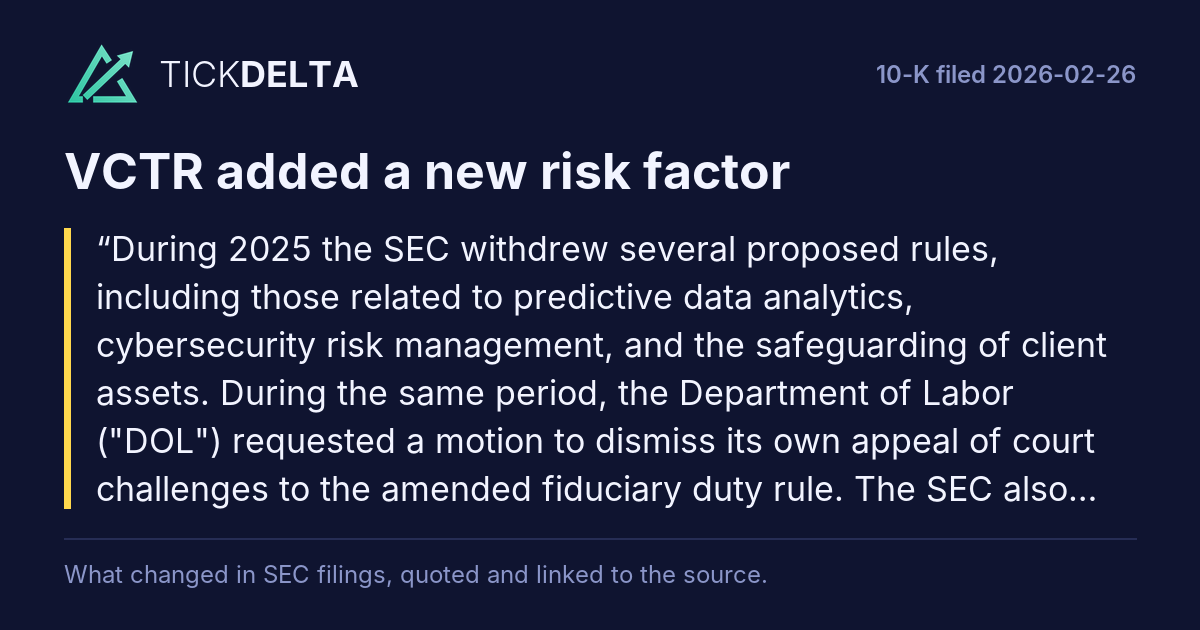
During 2025 the SEC withdrew several proposed rules, including those related to predictive data analytics, cybersecurity risk management, and the safeguarding of client assets. During the same period, the Department of Labor ("DOL") requested a motion to dismiss its own appeal of court challenges to the amended fiduciary duty rule. The SEC also extended compliance dates for certain recently adopted rules, including Form N-PORT and Form N-CEN reporting requirements and the Investment Company Names Rule.
In 2023 and 2024, the SEC adopted new rules and amendments to Form PF for registered investment advisers requiring new disclosures, filing obligations and enhanced reporting. On June 11, 2025, the SEC announced an extension of the deadline for fund managers to begin filing a new version of Form PF, until October 1, 2025. Then on September 17, 2025, the SEC again extended the compliance date for the Form PF amendments until October 1, 2026.
Implementing these rules and amendments may increase VCM reporting, disclosure and compliance obligations and create additional operational complexities for VCM.
The investment management industry is intensely competitive and is consolidating.
•the consolidation of financial services firms through mergers and acquisitions;
•as competitors grow through consolidation their increased size and scale increases competitive pressures on fees and distribution relationships.
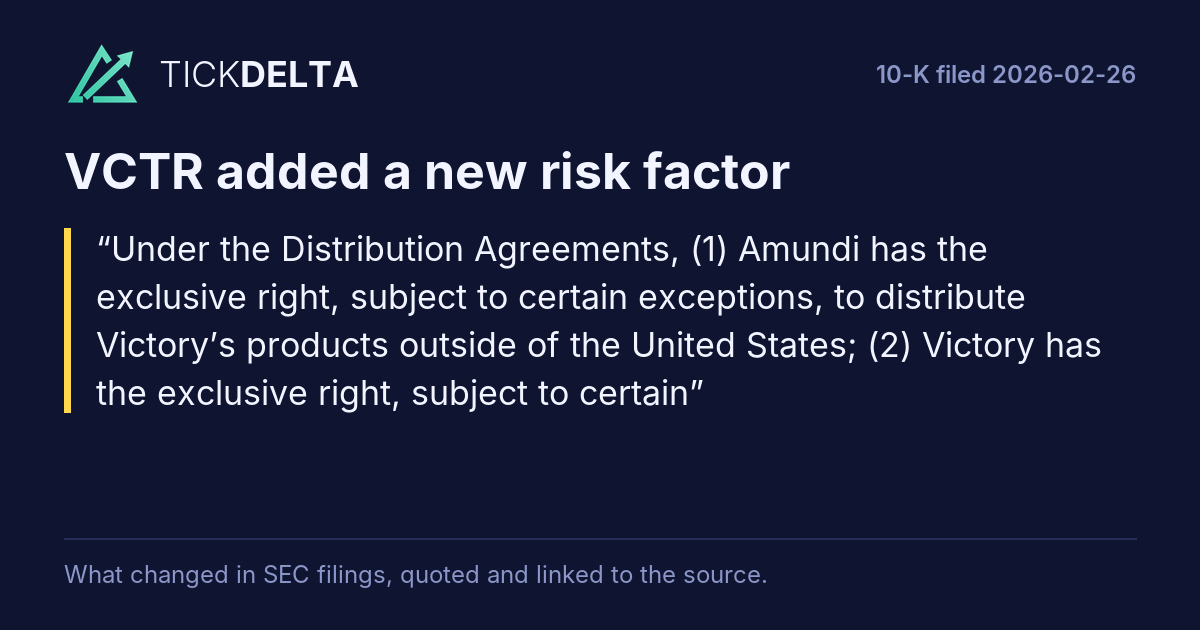
Under the Distribution Agreements, (1) Amundi has the exclusive right, subject to certain exceptions, to distribute Victory’s products outside of the United States; (2) Victory has the exclusive right, subject to certain
misconduct and the precautions we take to prevent and detect this activity may not always be effective. Employee misconduct could have a material adverse effect on our business.
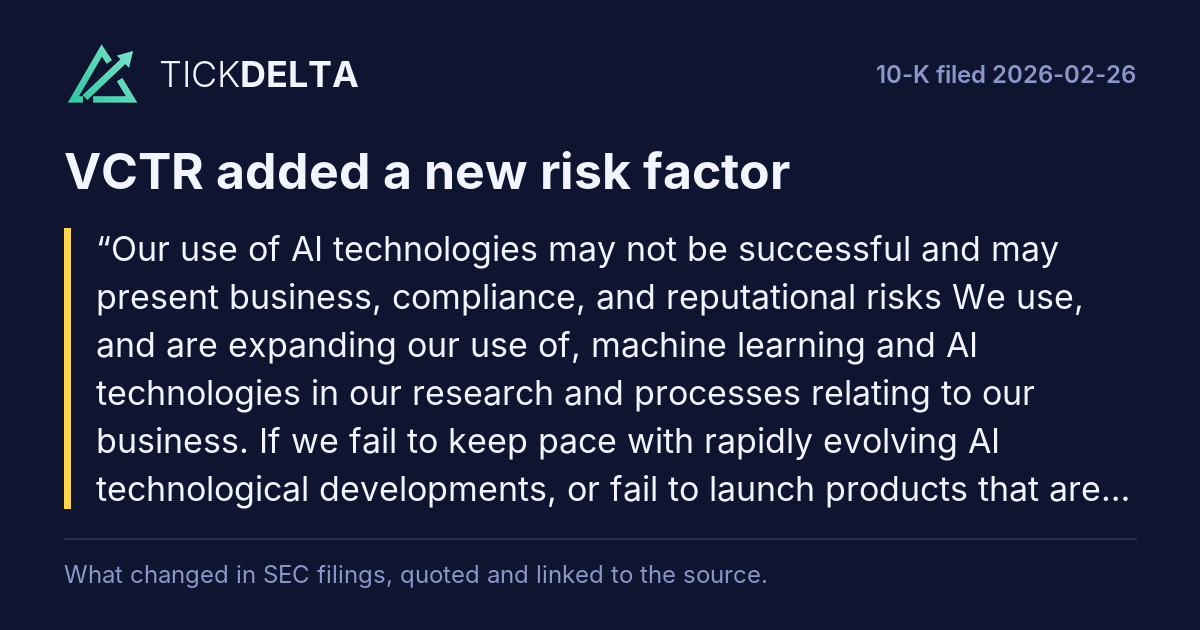
Our use of AI technologies may not be successful and may present business, compliance, and reputational risks
We use, and are expanding our use of, machine learning and AI technologies in our research and processes relating to our business. If we fail to keep pace with rapidly evolving AI technological developments, or fail to launch products that are competitive, our competitive position and business results may be negatively impacted. If our competitors or other third parties incorporate AI technologies, such as emerging generative and agentic AI, into their research, processes, and products relating to their business more quickly or more successfully than us, this could impair our ability to compete effectively. Our use of AI technologies, including generative and agentic AI, requires resources to develop, test and maintain, which is costly. Despite our investments in, and commitment of resources to, the development of AI, we may not be successful in our efforts. In addition, third parties may be able to use AI to create technology that could reduce demand for our products and services.
The introduction of AI technologies, particularly generative and agentic AI, into new or existing offerings may result in new or expanded risks and liabilities, due to enhanced governmental or regulatory scrutiny, litigation, compliance issues, ethical concerns, confidentiality, data privacy or security risks, as well as other factors that could adversely affect our business, reputation, and financial results. For example, AI technologies can lead to unintended consequences and errors, including generating content that appears correct but is factually inaccurate, misleading or otherwise flawed, or that results in unintended biases and discriminatory outcomes, which could harm our reputation and expose us to liability. If the content, analyses, or recommendations that AI applications assist in producing are, or are alleged to be, deficient, inaccurate, unreliable, misleading, biased, discriminatory or otherwise flawed, any of which may not be easily detectable, our business and reputation may be adversely affected. Use of AI technologies, and the evolving legal, regulatory and compliance framework for AI, could impact our ability to protect our data and intellectual property, as well as vendor and client information, and could expose us to intellectual property or other claims by third parties. Use of AI technologies may also increase risks related to cyberattacks or other security incidents or result in a failure to protect confidential information. Because AI technology is highly complex and rapidly developing, it is not possible to predict all of the legal, operational or technological risks that may arise relating to our use of AI. These risks include the possibility of enhanced governmental or regulatory scrutiny, litigation or other legal liability, compliance issues, ethical concerns, negative client perceptions, confidentiality or security risks, as well as other factors. Any of these issues could materially adversely affect our business, financial condition or results of operations.
AI technologies used in our research and processes relating to our business may use or incorporate data from third-party sources, including information they input into the AI tools, which may expose us to risks associated with data rights and protection.
or trading halts are invoked by the relevant stock exchange or market, investors may lose confidence in ETF products and redeem their holdings, which may cause our AUM, revenue and earnings to decline.
Paragraphs in the 10-Q filed Nov 5, 2026 that were not in the one before
New in the latest 10-Q
25 paragraphs in the 10-Q filed Nov 5, 2026 with nothing like them in the 10-Q filed Aug 6, 2026 (at least half the words must differ; new numbers alone do not count). Quoted exactly, grouped by the item heading above them. This is text that changed, not a judgement of how serious it is.
10-Q
Securities and Exchange Commission (the “SEC”) on February 26, 2026, which is accessible on the SEC’s website at www.sec.gov.
Read in the 10-Q
We believe that investment performance can influence AUM growth, flows, and overall operational results. Management utilizes the percentage of AUM and the percentage of strategies outperforming benchmarks, together with the percentage of our rated mutual fund and ETF AUM and the number of our mutual funds and ETFs rated 4 or 5 stars overall by Morningstar, to evaluate the investment performance of our Investment Franchises, our Solutions Platform, and specific investment products.
Read in the 10-Q
AUM measured versus benchmark on a one, three, five, and 10-year basis represents 90%, 89%, 85%, and 78% of Total AUM, respectively, as of September 30, 2026. Composites are calculated by asset weighting included accounts, using gross-of-fee, linked time weighted returns for each period. The composite return is then compared to the primary strategy benchmark. Composites without sufficient performance history are excluded from periods for which a full track record does not yet exist. Certain separate accounts are excluded where Victory Capital has determined, in accordance with its GIPS® Procedures, that inclusion would not be representative of the strategy's performance.
Read in the 10-Q
As of September 30, 2026, of our 113 rated mutual funds and ETFs, 56 received 4 or 5 star Overall Morningstar RatingsTM and 57 did not, representing 62% and 38% of rated mutual fund and ETF AUM, respectively. Funds not rated by Morningstar are excluded from the analysis. Not all asset classes considered are available to the general public and not all funds included have a history to be included in each period. Had fees not been waived and/or expenses reimbursed currently or in the past, the Morningstar ratings could have been lower. Ratings for other share classes not shown may be lower.
Read in the 10-Q
Past performance is not indicative of future results and may not reflect an investor's experience.
Read in the 10-Q
Show the other 20
Financial statements and notes
and related fees and expenses. The First Eagle Transaction is expected to close by the end of the first quarter of 2027 subject to customary closing conditions, including approval by the Company’s stockholders, regulatory approvals, and receipt of required client consents.
Read in the 10-Q
Acquisition-related costs include legal fees, advisory services, mutual fund proxy voting costs and other one-time expenses related to business combinations. The Company recognized $15.5 million and $22.5 million of these costs for the three and nine months ended September 30, 2026, respectively, and $0.4 million and $34.9 million for the three and nine months ended September 30, 2025, respectively. These amounts are included in acquisition-related costs in the unaudited Condensed Consolidated Statements of Operations.
Read in the 10-Q
For the nine months ended September 30, 2026 and 2025, the Company incurred $0.1 million and $1.4 million, respectively, of costs directly associated with the issuance of equity in connection with acquisitions. These costs include fees paid to attorneys, accountants, printers and other third parties and are recorded in additional paid-in capital in the unaudited Condensed Consolidated Balance Sheets.
Read in the 10-Q
ASU 2023-07, which is based on a management approach to segment reporting, establishes requirements to report segment revenue and significant expenses reported in net income, the primary measurement used by our Chief Operating Decision Maker ("CODM") in evaluating segment performance.
Read in the 10-Q
Significant segment expenses are presented in the unaudited Condensed Consolidated Statements of Operations. Additional disaggregated significant segment expenses that are not separately presented in the unaudited Condensed Consolidated Statements of Operations are presented below:
Read in the 10-Q
contingent payments, less any contingent payments previously paid, is due upon the occurrence of certain specified events within a five year period following the Start Date.
Read in the 10-Q
The Company determined that substantially all of the contingent payments payable per the NEC purchase agreement represent compensation for post-closing services. The Company records compensation expense over the estimated service period in an amount equal to the total contingent payments currently forecasted to be paid.
Read in the 10-Q
As of September 30, 2026 and December 31, 2025, the Company determined that the contingent payments are no longer probable of occurring and the liability for NEC contingent payments is zero.
Read in the 10-Q
NOTE 13. DERIVATIVES Interest Rate Swaps In the fourth quarter of 2023, the Company monetized the gain on the floating-to-fixed interest rate swap transaction (“Swap”) entered into in 2020 to effectively fix the interest rate on $450 million of its outstanding Term Loan through the Term Loan maturity date of July 1, 2026. The deferred gain on the termination of the Swap is being amortized on a straight-line basis through September 23, 2032 and is included in interest expense and other financing costs on the unaudited Condensed Consolidated Statements of Operations. For the three months ended September 30, 2026 and 2025, the Company recorded $0.4 million and $4.5 million, in amortization of deferred gain on Swap monetization. For the nine months ended September 30, 2026 and 2025, the Company recorded $2.9 million and $12.7 million in amortization of deferred gain on Swap monetization. As and September 30, 2026 and December 31, 2025, the unamortized deferred gain on Swap monetization was $8.8 million and $11.7 million, respectively, before tax. The following tables summarize the classification of the Swap in our unaudited condensed financial statements (in thousands): Three Months Ended Nine Months Ended September 30, September 30, Statement of Operations Description 2026 2025 2026 2025 ───────────────────────────────────────────────────────────────────────────────────────────────────────────────────────────────────────────────────────────────────────────────────────────────────────────────────────────────── Interest expense and other financing costs Reclassification from AOCI - Amortization of Swap deferred gain 366 4,474 2,921 12,737 Three Months Ended Nine Months Ended September 30, September 30, Statements of Comprehensive Income Description 2026 2025 2026 2025 ───────────────────────────────────────────────────────────────────────────────────────────────────────────────────────────────────────────────────────────────────────────────────────────────────────────────────────────── Other comprehensive income (loss) Amortization of deferred gain on terminated Swap, net of tax (277) (3,384) (2,219) (9,633)
Read in the 10-Q
Three months ended September 30, 2025 includes the impact of approximately $1 billion of divested assets from the closure of three Investment Franchises. Nine months ended September 30, 2025 includes the impact of Pioneer Investments, increasing AUM by $114.6 billion, partially offset by assets divested due to the closure of three Investment Franchises.
Read in the 10-Q
Three months ended September 30, 2025 includes the impact of approximately $1 billion of divested assets from the closure of three Investment Franchises. Nine months ended September 30, 2025 includes the impact of Pioneer Investments, increasing AUM by $114.6 billion, partially offset by assets divested due to the closure of three Investment Franchises.
Read in the 10-Q
Three months ended September 30, 2025 includes the impact of approximately $1 billion of divested assets from the closure of three Investment Franchises.
Read in the 10-Q
Nine months ended September 30, 2025 includes the impact of Pioneer Investments, increasing AUM by $114.6 billion, partially offset by assets divested due to the closure of three Investment Franchises.
Read in the 10-Q
Three months ended September 30, 2025 includes the impact of approximately $1 billion of divested assets from the closure of three Investment Franchises. Nine months ended September 30, 2025 includes the impact of Pioneer Investments, increasing AUM by $114.6 billion, partially offset by assets divested due to the closure of three Investment Franchises.
Read in the 10-Q
On September 23, 2025, pursuant to the Sixth Amendment of the 2019 Credit Agreement, the Company extended the maturity date of the first lien revolving credit facility (the "Revolving Facility") from March 31, 2026 to September 23, 2030 and decreased the drawn interest rate margin by 0.25% per annum. The Company also refinanced its Existing Term Loans with the Repriced Term Loans in an aggregate principal amount of $985 million.
Read in the 10-Q
There were no financing cash outflows or inflows or costs incurred associated with this transaction during the three months ended September 30, 2026.
Read in the 10-Q
Legal proceedings
On October 2, 2026, Victory filed with the Securities and Exchange Commission (the “SEC”) a preliminary proxy statement (the “Preliminary Proxy Statement”), and on October 16, 2026, Victory filed with the SEC a definitive proxy statement (the “Proxy Statement”), in each case in connection with the First Eagle Transaction.
Read in the 10-Q
As of November 4, 2026, two complaints have been filed in the Supreme Court of the State of New York, New York County by purported Victory stockholders against Victory and the members of the Victory board of directors (the “Board”) in connection with the proposed transaction: Wright v. Victory Capital Holdings, Inc., et al., Index No. 656101/2026 (filed October 27, 2026) and Taylor v. Victory Capital Holdings, Inc., et al., Index No. 656139/2026 (filed October 28, 2026) (collectively, the “Stockholder Litigation”). The Stockholder Litigation includes allegations that, among other things, the defendants caused to be filed a materially incomplete and misleading Proxy Statement with the SEC relating to the proposed transaction and asserts claims for alleged negligent misrepresentation and concealment and negligence under New York common law. Additionally, since the filing of the Preliminary Proxy Statement, Victory received 10 demand letters from purported Victory stockholders alleging similar insufficiencies in the disclosures in the Preliminary Proxy Statement and/or the Proxy Statement (such letters, the “Demand Letters,” and together with the Stockholder Litigation, the “Litigation Matters”).
Read in the 10-Q
The plaintiffs in the Stockholder Litigation seeks various remedies, which include, among other things: (i) enjoining the defendants from consummating the proposed transaction until the defendants disclose certain allegedly material information that was allegedly omitted from the Proxy Statement; (ii) in the event that the proposed transaction is consummated, rescinding it or awarding actual and punitive damages to the plaintiffs; (iii) awarding the plaintiff fees and expenses in connection with the Stockholder Litigation, including reasonable attorneys’ and experts’ fees and expenses; and (iv) granting such other and further relief as the court may deem just and proper.
Read in the 10-Q
Victory believes that the allegations contained in the Litigation Matters are without merit and that the disclosures in the Proxy Statement comply with applicable laws. Victory specifically denies all allegations in the Litigation Matters. The proceedings are subject to uncertainties inherent in the litigation process, and we cannot predict the outcome of the above matters or estimate the possible loss or range of possible loss, if any.
Read in the 10-Q
The 10-Q's risk factors against the 10-K
Item 1A of the 10-Q filed Nov 5, 2026 against Item 1A of the 10-K filed Feb 26, 2026.
A 10-Q repeats only the risks that changed, so a 10-K paragraph that is missing from it is not counted as removed.
Added is a paragraph with nothing like it in the 10-K, Reworded a sentence that is in both with several words changed,
Quiet changes a sentence in both where one to four words changed and one is a hedge or a modal
(cut words struck through, new words highlighted).
Text on the page, not a score; each links to the filing at sec.gov.
Phrases used for the first time
Two-word phrases in Risk Factors of the 10-K filed Feb 26, 2026 that are in none of the 1 earlier 10-Ks stored, back to Feb 28, 2025
Where each one is used
- identified person: Under the Certificate of Amendment to the Second Amended and Restated Certificate of Incorporation, there is a corporate opportunities waiver in favor of Amundi and its directors, officers, employees representatives and affiliates and certain entities associated with Crestview Victory, L.P. (the “Identified...
- corporate opportunity: •Our certificate of incorporation contains a corporate opportunity waiver that permits certain of our significant stockholders and their affiliates to compete with us and to pursue business opportunities without offering them to us, which may result in conflicts of interest and limit our access to potentially...
- china taiwan: •The ongoing conflicts and potential military conflicts in Ukraine, Venezuela, China/Taiwan and/or the Middle East have, and will likely continue to, negatively impact the global economy.
- middle east: •The ongoing conflicts and potential military conflicts in Ukraine, Venezuela, China/Taiwan and/or the Middle East have, and will likely continue to, negatively impact the global economy.
- ukraine venezuela: •The ongoing conflicts and potential military conflicts in Ukraine, Venezuela, China/Taiwan and/or the Middle East have, and will likely continue to, negatively impact the global economy.
- unregistered funds: •Our failure to comply with investment guidelines set by our clients, including the boards of registered and unregistered funds, and limitations imposed by applicable law, could result in damage awards against us and a loss of AUM, either of which could adversely affect our results of operations or financial condition.
- aum increase: •Regulatory and governmental examinations and/or investigations, litigation and the legal risks associated with our business, could adversely impact our AUM, increase costs and negatively impact our profitability and/or our future financial results.
- increase costs: •Regulatory and governmental examinations and/or investigations, litigation and the legal risks associated with our business, could adversely impact our AUM, increase costs and negatively impact our profitability and/or our future financial results.
Used at least twice, small words left out. Counted, not picked: a phrase can be new because the company renamed something.
What was taken out
54 paragraphs of last year's Risk Factors with nothing like them now. The longest are quoted.
Sources
Item 1A of each 10-K and 10-Q on EDGAR, quoted exactly. Each paragraph links to the filing at sec.gov.
Also
10-K change: what was reworded or cut, section by section.
Work with it
Excel workbook · CSV. Google Sheet that stays up to date: paste =IMPORTDATA("https://tickdelta.com/company/VCTR/export.csv") into a cell.