
Added10-Q Nov 10, 2026 vs 10-K Mar 2, 2026
Our strategy to expand into data center development and construction may not be successful and could adversely affect our business and financial condition.
Each branch is a paragraph in Risk Factors with nothing like it in the 10-K filed Mar 6, 2025. A box jumps to the paragraph as filed, below.
30 paragraphs in Risk Factors of the 10-K filed Mar 2, 2026 with nothing like them in the 10-K filed Mar 6, 2025. Quoted exactly. Paragraphs that were only edited are under 10-K change.
In addition to our post-COD SPAs, we have also entered into certain Firm-start SPAs. Our ability to satisfy our obligations under such Firm-start SPAs following the applicable firm start dates will depend in part on our ability to produce sufficient LNG cargos, either before or after COD, or in excess of nameplate capacity. While we expect to produce sufficient LNG volumes prior to the start date of each Firm-start SPA, there can be no assurance that our projects or bolt-on expansions will not be delayed, in which case we may not produce sufficient LNG to meet our obligations under the relevant Firm-start SPAs.
Similarly, under certain SPAs for the sale of commissioning cargos and certain sales by VG Commodities, our customers pay a fixed fee or a fee based on an index other than Henry Hub (such as the TTF or JKM benchmarks), and in such cases our operating margins may be reduced in the event of an increase in the price at which we are required to purchase feed gas relative to the relevant fixed fee or alternate index, or in the event of a reduction in the price of the relevant index used to calculate the fee under the relevant SPA relative to the price at which we are required to purchase feed gas.
Natural gas producers may curtail or shut in production due to market, pricing or other conditions, which could reduce the availability of feed gas for our LNG facilities.
We depend on third-party natural gas suppliers to provide the natural gas necessary to operate our liquefaction facilities. Significant sustained declines in natural gas prices, oversupply in natural gas markets or crude, or materially adverse changes in the cost structure or profitability of upstream producers could cause producers to shut-in, curtail or reduce production from existing wells and defer or cancel planned drilling activity. Natural gas supply curtailments or shut-ins, whether due to low commodity prices, operational constraints, government actions, weather, or other market conditions, could limit the volume of natural gas available to us, and may significantly increase our feed gas costs, constrain our ability to operate our facilities at expected utilization levels, and have a material adverse effect on our business, financial condition, results of operations and future growth prospects.
In periods of low or volatile natural gas prices, producers may elect to reduce output from higher-cost wells or delay completion of drilled but uncompleted wells, which may lead to reduced supply in the natural gas markets where we obtain our feed gas. Such supply variability could, among other things, result in increased competition for available natural gas supplies and reduced reliability of delivery commitments from suppliers. Our inability to obtain sufficient natural gas on commercially reasonable terms, or at all, could adversely affect our relationships with our customers and counterparties, who rely on us to deliver contracted volumes of LNG.
Additionally, regulatory actions, pipeline infrastructure constraints, extreme weather events, or other force majeure occurrences affecting our supply regions could exacerbate upstream production curtailments and further limit the availability of natural gas. While we seek to mitigate these risks through long-term supply arrangements, portfolio diversification and pipeline connectivity, there can be no assurance that such measures will fully protect us from the effects of upstream production slowdowns or curtailments. Any prolonged or widespread reduction in upstream natural gas production could have a material adverse effect on our business, financial condition, results of operations and future growth prospects.
Certain metrics that we track and may present are illustrative and are subject to a number of assumptions, and any real or perceived inaccuracies in such metrics may adversely affect our business and reputation.
We track and may present from time to time certain metrics that are illustrative and not independently verified by any third party. Such metrics may be based on a range of assumptions, such as the development, completion and commissioning of the relevant projects (including obtaining any required regulatory approvals), estimated contracted
We anticipate that insurance premiums for LNG projects may increase due to a continuing increase in demand by LNG projects seeking insurance coverage, and losses and claims that have arisen or been experienced in
Our LNG business and the development of domestic LNG facilities and projects generally is based on assumptions about the future availability and price of natural gas and LNG, and the prospects for international
In addition, our project financing credit agreements require our projects to maintain certain historical debt service coverage ratios, respective to each project and upon achieving certain milestones.
In addition, the terms of the VGLNG Revolving Credit Facility require us to maintain a maximum total leverage ratio of no more than 6.00:1.00.
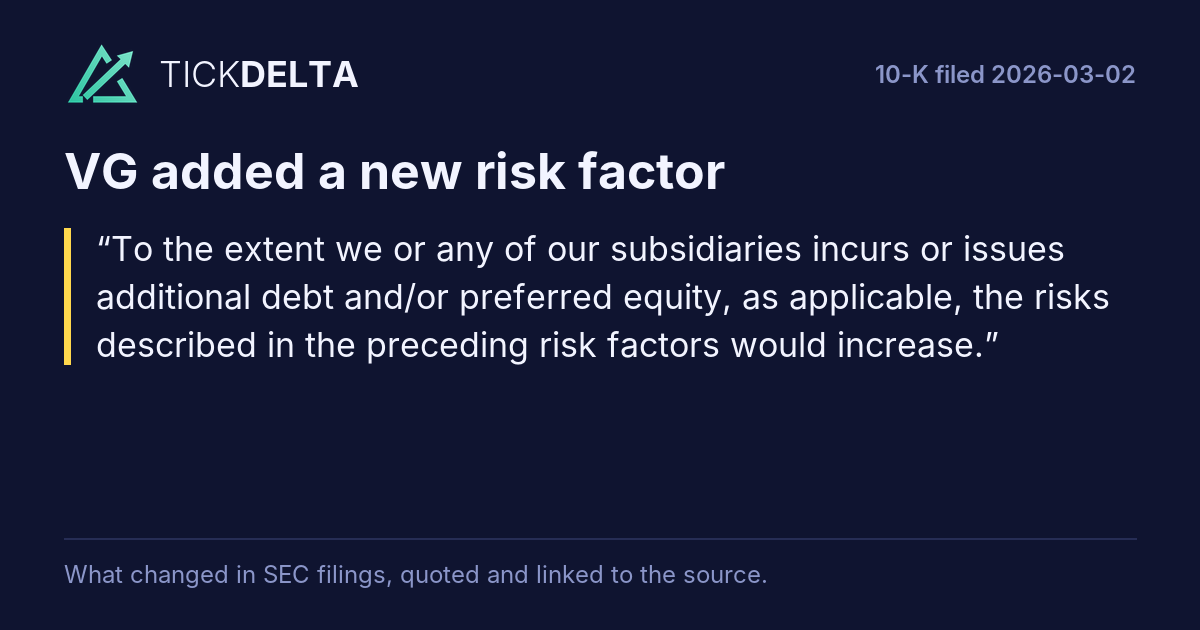
To the extent we or any of our subsidiaries incurs or issues additional debt and/or preferred equity, as applicable, the risks described in the preceding risk factors would increase.
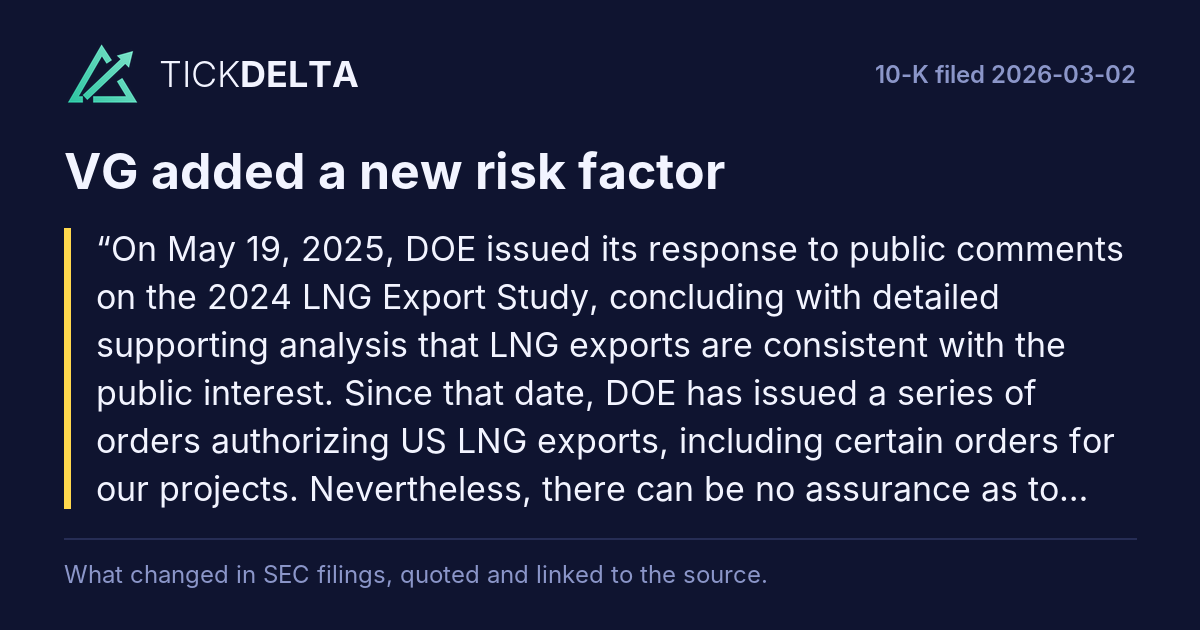
On May 19, 2025, DOE issued its response to public comments on the 2024 LNG Export Study, concluding with detailed supporting analysis that LNG exports are consistent with the public interest. Since that date, DOE has issued a series of orders authorizing US LNG exports, including certain orders for our projects. Nevertheless, there can be no assurance as to DOE’s future policies, or the impact of those policies on our existing and future projects, including our related contracts.
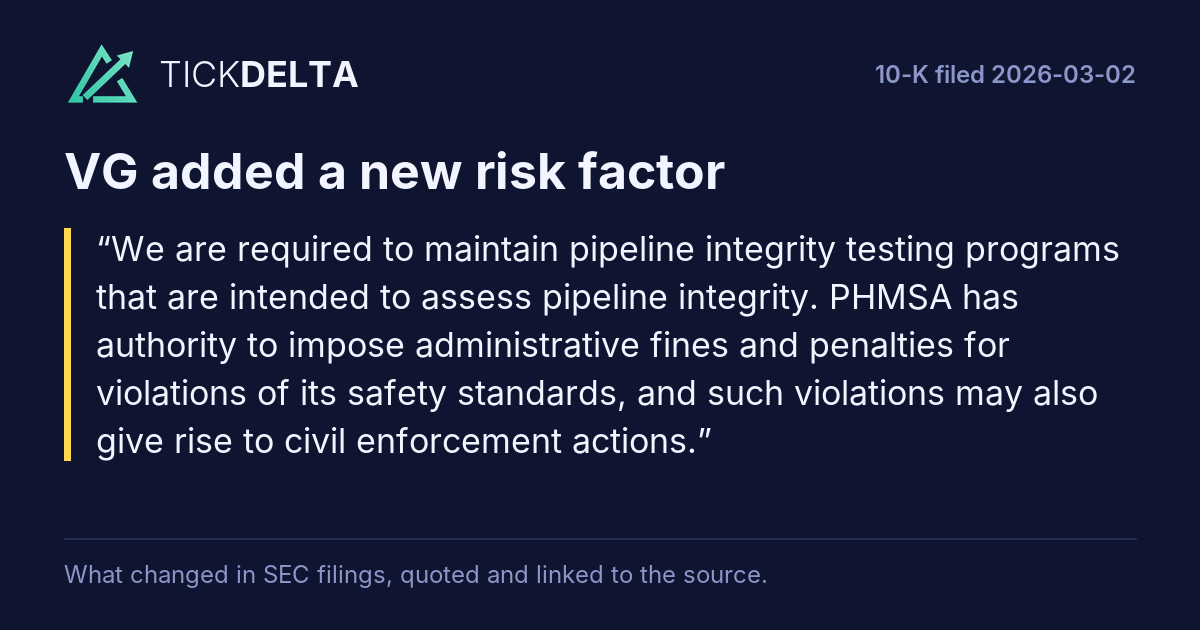
We are required to maintain pipeline integrity testing programs that are intended to assess pipeline integrity. PHMSA has authority to impose administrative fines and penalties for violations of its safety standards, and such violations may also give rise to civil enforcement actions.
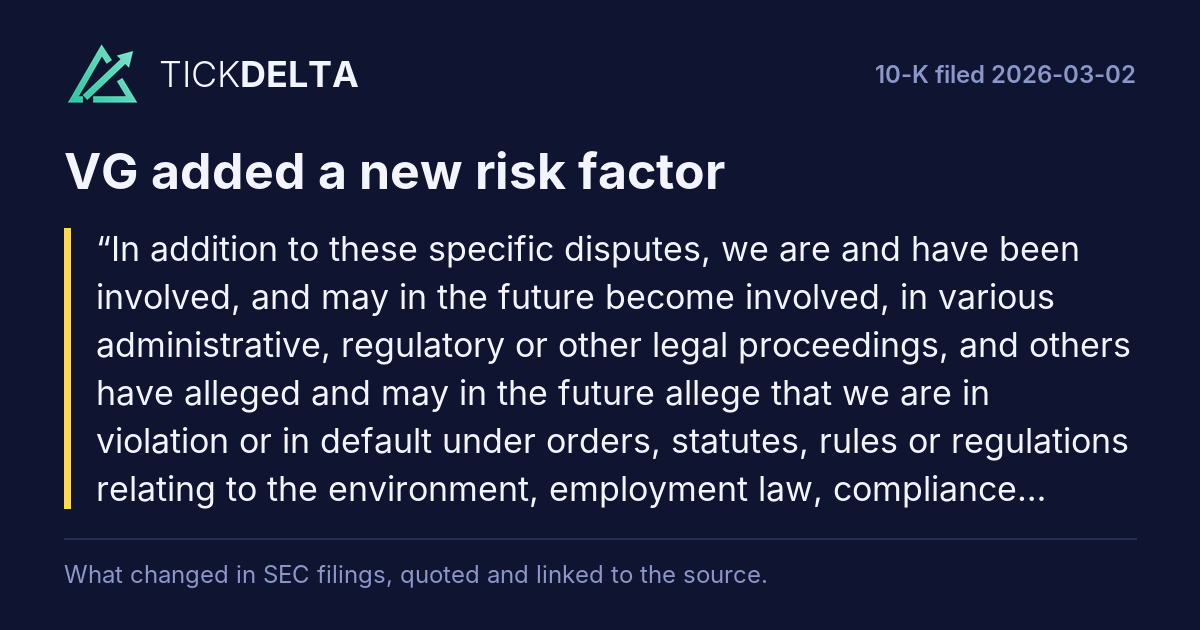
In addition to these specific disputes, we are and have been involved, and may in the future become involved, in various administrative, regulatory or other legal proceedings, and others have alleged and may in the future allege
that we are in violation or in default under orders, statutes, rules or regulations relating to the environment, employment law, compliance plans imposed or agreed to by us, or permits issued by various local, state or federal agencies for the construction or operation of our natural gas liquefaction facilities. We have been and may in the future also be subject to claims for personal injury, or property damage, in connection with the construction or operation of our natural gas liquefaction facilities.
We are involved, and may in the future become involved, in disputes and arbitration proceedings with the customers under our SPAs as described in more detail under Item 3.—Legal Proceedings. Certain of such claims have been denied or settled, but a number of such claims remain ongoing and in one instance the customer whose claim was denied in arbitration has filed a petition with the New York Supreme Court seeking to vacate the applicable arbitral award.
result, our cost estimates are only an approximation of the actual costs of construction and financing for such projects.
which could also require us to obtain additional sources of capital to fund development, construction and commissioning of our projects.
For example, in 2024 Zachry Industrial, Inc., one of the joint owners of KZJV, LLC, the EPC contractor for the Plaquemines Project, filed for bankruptcy protection under Chapter 11 of the U.S. bankruptcy code. While Zachry Industrial, Inc. successfully emerged from Chapter 11 proceeding in 2025 and we were able to successfully mitigate most of the bankruptcy’s impacts to the construction of the Plaquemines Project, there can be no assurance that any future bankruptcies of any of our contractors will not have a material adverse impact on any of our ongoing projects. Any such future contractor bankruptcies could result in material delays or termination of any of our projects and could have a material adverse impact on our ability to complete such projects on our anticipated schedule and budget, or at all.
Additionally, satisfying required performance tests is a condition precedent for project completion under our project financing, and a failure to achieve the project completion date for a project by a date certain may result in an
Our contracts for newbuild LNG tankers subject us to counterparty and cost-increase risks. The final cost of LNG tankers may increase pursuant to adjustment provisions in our contracts, and if we fail to make required payments, we could experience delivery delays, defaults under our acquisition agreements or the loss of rights to
deferring or preventing a change in control, and may discourage bids for our Class A common stock at a premium over our market price.
The Middle East remains a critical region for global energy production and ongoing and escalating conflicts in the region—including armed hostilities involving Israel, Gaza, Iran and Iran-aligned groups in Lebanon and Gaza, including Hamas and Hezbollah—could adversely affect global energy markets. Such conflicts have resulted in, and could continue to result in, supply disruptions, damage to energy infrastructure, increased shipping and insurance costs, delays or rerouting of oil and gas cargos, heightened security risks, and increased volatility in oil and gas prices. Any material escalation or regional expansion of these conflicts could further disrupt global energy supply chains and trade flows and adversely affect market conditions relevant to our business.
Venezuela, a country estimated to hold the largest proven oil reserves in the world, has been subject to significant political, economic and social instability resulting from decades of underinvestment, infrastructure deterioration and the imposition of extensive international sanctions on its state-owned oil company. Recent events in Venezuela have raised the prospect of a potential increase in Venezuelan hydrocarbon production over the medium- to long-term. If such increased output were to materialize, the increase in oil supply could exert downward
pressure on oil and other benchmark energy prices and alter regional supply dynamics, which in turn could affect global natural gas and LNG demand and prices.
In addition, the disruptions caused by the invasion of Ukraine, instability in the Middle East and Venezuela, and other geopolitical events have included, and may continue to include, political, social, and economic disruptions and uncertainties. Moreover, continued or escalating geopolitical conflicts, including those involving Russia, Ukraine, the Middle East and Venezuela, could contribute to sustained periods of elevated commodity price volatility (including material increases in certain commodity prices), shifting global supply patterns, reduced liquidity in energy markets and increased risk premiums in financial and commodity markets. Any prolonged, intensified or expanded conflict could materially disrupt international energy trade flows, constrain access to or the cost of imported energy and feedstock supplies, negatively impact demand for LNG and other energy commodities, and materially and adversely affect our competitive position, financial condition, results of operations and future growth prospects.
included a 10% baseline tariff and higher country-specific tariffs, and resulted in some countries announcing additional retaliatory tariffs, or plans for retaliatory tariffs. While the U.S. Supreme Court issued a ruling against the
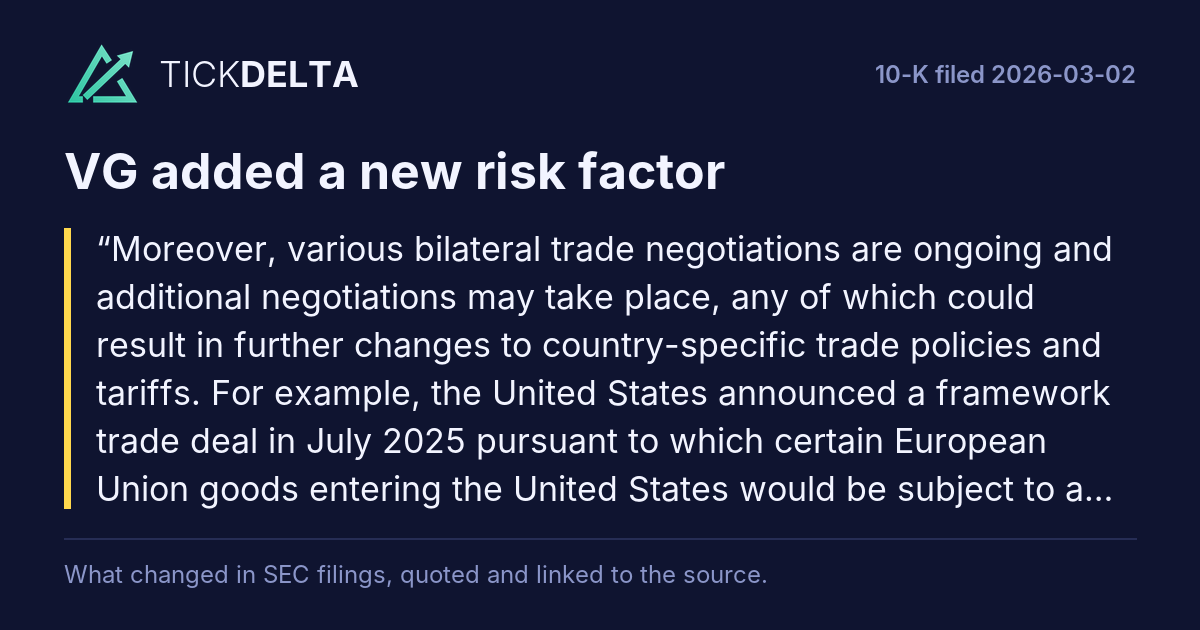
Moreover, various bilateral trade negotiations are ongoing and additional negotiations may take place, any of which could result in further changes to country-specific trade policies and tariffs. For example, the United States announced a framework trade deal in July 2025 pursuant to which certain European Union goods entering the United States would be subject to a 15% tariff, and the European Union would commit to make $750 billion of strategic energy purchases, covering oil, LNG and nuclear technology, during President Trump’s term in office. However, in February 2026, the European Parliament halted the ratification process in light of the U.S. Supreme Court ruling against the validity of tariffs and the subsequent tariffs announced by the Trump administration. There can be no assurance as to the outcome of any ongoing or additional negotiations, or as to the final terms of the trade deal with the European Union. The European Union is the largest provider of foreign-sourced equipment for our LNG construction projects by dollar value. Global economic uncertainty and any related reduction in economic activity or capital investment may slow growth in global GDP or lead to global recession. Accordingly, these tariffs and any retaliatory actions from other countries could have a material impact on our financial condition, results of operations and/or cash flows through reduced demand and competitiveness for both our long-term and short-term contract sales in countries that may be affected by those policies, and increased project costs for future imported equipment and materials.
New in the latest 10-Q
34 paragraphs in the 10-Q filed Nov 10, 2026 with nothing like them in the 10-Q filed Aug 11, 2026 (at least half the words must differ; new numbers alone do not count). Quoted exactly, grouped by the item heading above them. This is text that changed, not a judgement of how serious it is.
◦ AI Utility means integrated data center and power infrastructure that is capable of supporting compute capacity with no reliance on the public electric grid;
Read in the 10-Q
◦ costs of feed gas means the costs of natural gas indexed to Henry Hub and transportation costs (including costs to supply feed gas to less liquid delivery locations, or basis differentials);
Read in the 10-Q
◦ VGLNG means Venture Global LNG, Inc., a wholly-owned direct subsidiary of Venture Global, Inc.;
Read in the 10-Q
◦ VGLNG Long-Term Revolver means the senior secured credit facility obtained by VGLNG;
Read in the 10-Q
• the risks related to our potential expansion into data center infrastructure for compute and AI utility, as well as our ability to compete in this rapidly evolving industry;
Read in the 10-Q
In August 2026, Blackfin, a controlled indirect subsidiary, repriced the outstanding $ 1.1 billion aggregate term loan B senior secured term loan facility ("Blackfin TLB Facility"), reducing the applicable margin by 50 basis points to 2.500 % and 1.500 %, at the Company's election of a SOFR-based rate or base rate, respectively. The transaction was accounted for as a partial debt extinguishment resulting in a $ 5 million loss on financing transactions during the nine months ended September 30, 2026.
Read in the 10-Q
(b) The interest rate swaps associated with the CP2 Credit Facilities have a maximum notional of $ 14.5 billion.
Read in the 10-Q
September 30, 2026 2025 ────────────────────────────────────────────────────────────────────────────────────────────────────────────────────────────────── Accrued capital expenditures $ 2,255 $ 1,661 Cash paid for interest, net of amounts capitalized 1,238 728 Conversion of equity method investment to property, plant and equipment — 327 Right-of-use assets in exchange for new operating lease liabilities 322 224 Paid-in-kind distribution on redeemable stock of subsidiary — 121 Cash paid for operating leases 98 98
Read in the 10-Q
Plaquemines Expansion Project. Our applications with the FERC and DOE proposing a 31.0 mtpa expansion of the Plaquemines Project are pending approval.
Read in the 10-Q
In August 2026, the U.S. Court of Appeals for the D.C. Circuit unanimously denied petitions challenging FERC’s order authorizing the CP2 Project. Our applications with the FERC and DOE to increase the CP2 Project's permitted production and authorized export capacity from 28.0 mtpa to 35.0 mtpa are pending approval.
Read in the 10-Q
In September 2026, we took delivery of an LNG tanker, Venture Manatee, bringing our total owned fleet of LNG tankers to eight. One additional LNG tanker is currently under construction and is expected to be delivered in the fourth quarter of 2026.
Read in the 10-Q
• repricing the Blackfin TLB Facility, which reduced the applicable margin on the variable interest rate by 50 basis points.
Read in the 10-Q
In October 2026, we entered into power and grid frame agreements to support the continued expansion of our grid-independent, island-mode industrial power network. These agreements establish a framework for the option to purchase up to 16 new power island units and associated power transformers and other equipment, providing a pathway to add significant island-mode power generation capacity through 2034. This infrastructure is intended to support the continued growth of our LNG operations, while also providing the potential to develop and own or lease up to 10 GW of compute capacity through our own AI Utility. We expect to place the first purchase order for a power island by the end of 2026, with potential additional phased deployments subject to market demand, customer commitments, and regulatory approvals. See Item 1A. - Risk Factors of this Form 10-Q.
Read in the 10-Q
Three months ended September 30, 2026 compared to three months ended September 30, 2025
Read in the 10-Q
Nine months ended September 30, 2026 compared to nine months ended September 30, 2025
Read in the 10-Q
Three months ended September 30, 2026 compared to three months ended September 30, 2025
Read in the 10-Q
Nine months ended September 30, 2026 compared to nine months ended September 30, 2025
Read in the 10-Q
VGLNG. In September 2026, VGLNG entered into a $3.0 billion senior secured VGLNG Short-Term Revolver due 2027. VGLNG has two options to extend the maturity date of the VGLNG Short-Term Revolver by an additional 364 days per option, subject to the approval of the lenders. Proceeds from the VGLNG Short-Term Revolver may be used for general corporate purposes of VGLNG and its subsidiaries.
Read in the 10-Q
Nine months ended September 30, 2026 compared to nine months ended September 30, 2025
Read in the 10-Q
Actual impacts will depend on changes in tariff regimes, supplier negotiations, procurement strategies and delivery timing.
Read in the 10-Q
Our strategy to expand into data center development and construction may not be successful and could adversely affect our business and financial condition.
Read in the 10-Q
We are pursuing opportunities to develop our own AI Utility, at sites we own or control. These markets are highly competitive and rapidly evolving, and our ability to successfully develop or participate in such projects will depend on a number of factors, including our ability to procure and deploy sufficient data center and power generation capacity, availability of capital, our ability to secure customers or strategic partners, our technical and operational expertise, our ability to obtain regulatory and land use approvals and the development of suitable sites and infrastructure. If we are unable to execute this strategy successfully, our anticipated growth opportunities may not materialize, and our business, financial condition and results of operations could be adversely affected. In addition, allocating resources to support data center and power infrastructure development and related initiatives may divert capital, personnel and management attention from our existing LNG business.
Read in the 10-Q
The development of data center and power infrastructure may also require significant capital investment and could affect the timing of our cash flows. Data center and power development may require substantial upfront capital expenditures for infrastructure, equipment and site development, while revenues from hosting, leasing or related services generally are not realized until construction is complete and customers have been onboarded. As a
Read in the 10-Q
result, there may be a significant lag between capital investment and revenue generation, which could increase our short-term liquidity needs. We may need to seek additional financing to support these investments or to preserve liquidity during periods of market volatility, and such financing may not be available on favorable or acceptable terms or at all.
Read in the 10-Q
The success of our data center and power infrastructure development strategy may be affected by a number of factors, including the timely delivery and reliable performance of power generation equipment, supply chain disruptions, labor shortages, tariffs or trade restrictions, technological changes, changes in demand for data centers or AI technology, regulatory environment, increased public opposition to data center projects and our ability to develop or retain the specialized expertise required to construct and operate data center infrastructure.
Read in the 10-Q
We may also encounter difficulties in the design, engineering, development or modification of data center infrastructure, which could result in cost overruns and significant delays. Although we have experience deploying and operating large-scale, behind-the-meter power generation for our LNG projects, we have limited experience developing or operating data centers, and the likelihood of our success must be considered in light of the expenses, difficulties and delays frequently encountered in expanding into, and operating in, an industry that is competitive and rapidly evolving. If we are unable to successfully develop and operate anticipated data center projects, our business, financial condition, results of operations and prospects could be adversely affected.
Read in the 10-Q
The data center market is highly competitive, and our inability to compete could adversely affect our business, financial condition and results of operations.
Read in the 10-Q
The data center market is highly competitive and rapidly evolving. Our ability to generate revenue from our data center and power infrastructure projects depends on our ability to negotiate and enter into binding, long-term agreements with a limited number of potential customers for our data center capacity, and if these parties delay or decline to enter into such agreements, or if the terms are not favorable or acceptable to us, the construction and operation of our data center and power infrastructure projects could be significantly delayed, which could hinder our ability to gain market traction with other potential customers as compared to our competitors.
Read in the 10-Q
There can be no assurance that we will be able to compete successfully in this market, and our failure to do so could adversely affect our business, financial condition and results of operations.
Read in the 10-Q
Evolving governmental regulation and opposition from environmental groups and other stakeholders, including through litigation or reputational campaigns, could delay or prevent the permitting, construction or operation of our data center and power infrastructure projects.
Read in the 10-Q
A growing number of state and local governments have enacted, or are considering, moratoria, restrictive zoning amendments, energy efficiency mandates, water use restrictions, heightened permitting requirements and other land use and regulatory limitations that prohibit or significantly constrain the development of new data centers or related gas-fired generation facilities or other energy infrastructure, and similar measures could be adopted in jurisdictions where we develop or intend to develop our data center and power infrastructure projects. If such measures are adopted, we may be required to delay, redesign or abandon those projects, relocate to alternative sites that may be less suitable or more costly to develop, or incur significant unrecoverable costs for land, permitting, engineering and equipment. Negative public sentiment regarding the AI industry - including concerns about the societal implications of AI, its energy intensity and the pace of deployment - could result in adverse publicity, regulatory scrutiny, or political opposition that makes it more difficult for us to site, permit and construct our facilities. Public opposition to our projects could also lead to campaigns in the media or in political forums that adversely impact our reputation.
Read in the 10-Q
In addition, data center and energy infrastructure projects in the United States frequently face opposition from policymakers, non-governmental organizations, environmental advocacy coalitions and local stakeholders due to concerns about their consumption of energy, water and other resources and broader environmental and community impacts. These groups may intervene in or challenge regulatory proceedings, file administrative appeals, contest the issuance of required environmental permits or other governmental approvals or initiate litigation under the National
Read in the 10-Q
Environmental Policy Act, the Clean Air Act, the Clean Water Act, the Endangered Species Act, analogous state laws or common law. Such opposition could result in the denial or delay of land use approvals, building permits or other approvals required to construct or commence commercial operation of our data centers, restrict our ability to expand, or lead to the imposition of conditions or mitigation measures that increase project costs or reduce project feasibility. Even unsuccessful challenges can delay project timelines, increase legal costs and discourage investment.
Read in the 10-Q
As a result, the construction and operation of our data center and power infrastructure projects could be delayed, suspended or abandoned, which could adversely affect our ability to generate revenue from any data center and power infrastructure projects we develop and our business, financial condition and results of operations.
Read in the 10-Q
Item 1A of the 10-Q filed Nov 10, 2026 against Item 1A of the 10-K filed Mar 2, 2026.
A 10-Q repeats only the risks that changed, so a 10-K paragraph that is missing from it is not counted as removed.
Added is a paragraph with nothing like it in the 10-K, Reworded a sentence that is in both with several words changed,
Quiet changes a sentence in both where one to four words changed and one is a hedge or a modal
(cut words struck through, new words highlighted).
Text on the page, not a score; each links to the filing at sec.gov.
What the 10-Q itself says about its risk factors:There have been no material changes with respect to the risk factors disclosed in our 2025 Form 10-K, except as disclosed below.
Read in the 10-Q
The first 12 of 13 are shown (at most 12 of each type).
Two-word phrases in Risk Factors of the 10-K filed Mar 2, 2026 that are in none of the 1 earlier 10-Ks stored, back to Mar 6, 2025
Used at least twice, small words left out. Counted, not picked: a phrase can be new because the company renamed something.
39 paragraphs of last year's Risk Factors with nothing like them now. The longest are quoted.
Item 1A of each 10-K and 10-Q on EDGAR, quoted exactly. Each paragraph links to the filing at sec.gov.
10-K change: what was reworded or cut, section by section.
Excel workbook · CSV. Google Sheet that stays up to date: paste =IMPORTDATA("https://tickdelta.com/company/VG/export.csv") into a cell.