Screener / SEC EDGAR /CIK 0001592386 /10-K filed Feb 20, 2026, compared with Feb 21, 2025 /Numbers from the XBRL of the 10-Ks
NYSE Financials · Brokers & Investment Banks

Virtu Financial, Inc. VIRT

Compare with peers Embed
The 10-K against last year's

97 changes: 7 added, 5 removed, 78 reworded, 7 quiet changes

10-K Feb 20, 2026 vs Feb 21, 2025

10-K 0001592386-26-000009 (Feb 20, 2026) vs 10-K 0001592386-25-000055 (Feb 21, 2025)

Every paragraph, and how much of it changed

One bar per paragraph, in the order of the 10-K. Height and colour show the share of its words not in the closest paragraph a year earlier; the tallest bars are new paragraphs.

Risk Factors

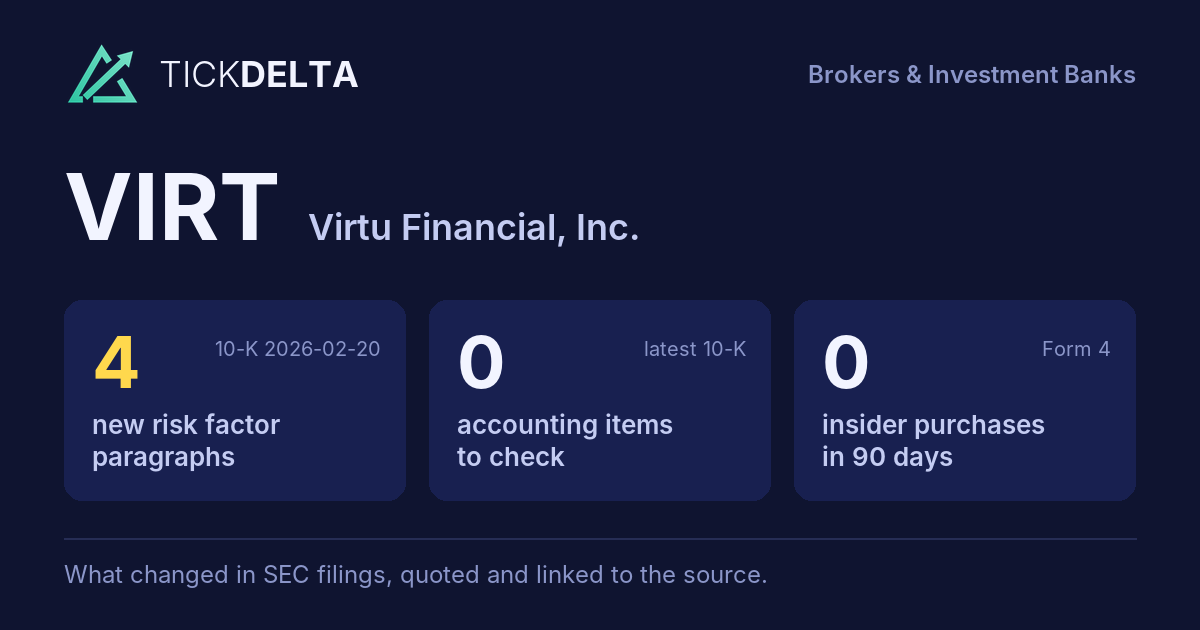
215 paragraphs · 4 new · 37 reworded · 4 gone · 10-K Feb 20, 2026 against Feb 21, 2025
New paragraph Reworded (5% of its words or more) Same or nearly
Paragraph 64 · 49% changed Every version of it
Similarly, changes in applicable laws, regulations or rules promulgated by government administrations, regulators or exchanges could conceivably prevent us from providing liquidity directly to clients or counterparties or other trading venue where we provide liquidity today. Following recent regulatory attention on U.S. equities market structure, including the practice of wholesale market making and other forms of off exchange trading, the SEC proposed the adoption of new Rule 615, which, if adopted, would dramatically change U.S. equities market structure, the routing, handling and potentially the amount, character and cost of retail order flow, and therefore may substantially diminish the volume of our transactions with retail client orders. This and other potential legal and regulatory changes are discussed in further detail in “Item 1A. Risk Factors—Legal and Regulatory Risks.” Though our revenues are diversified across exchanges and other trading venues, asset classes and geographies, the loss of access to or reduction in opportunities to transact with one or more significant clients or counterparties, exchanges or other trading venues for any reason could have a material adverse effect on our business, financial condition, results of operations and cash flows.
Paragraph 129 · 48% changed Every version of it
Additionally, the regulatory and legal status and classification of various cryptocurrencies and other digital assets is subject to substantial uncertainty. For example, a given digital asset could be considered a security, a commodity or currency, or some combination thereof, and therefore may be subject to rules and regulations promulgated by federal regulators, including but not limited to the SEC, the CFTC, the Department of Treasury, in addition to state regulators. Changes in this regulatory environment, including changing interpretations and the implementation of new or varying regulatory requirements by the government, may significantly affect or change the manner in which we currently conduct some aspects of our business or may significantly impact or limit our ability to increase our participation or could otherwise expose us to potential liability or losses.
Paragraph 95 · 46% changed Every version of it
Further, because cryptocurrency, along with other digital assets, is a new and emerging asset class with unique electronic exposure, there is a high degree of fraud, theft, cyberattacks and other forms of risk in the cryptocurrency space, and legal, Legal, regulatory and market standards around market conduct, transparency, custody, segregation of client assets, clearing and settlement for these assets, including when traded in spot, ETP/ETF, or other form, are all evolving or unsettled, which can increase risks for us and other market participants. The implementation of the GENIUS Act in the United States and MiCAR in the EU, as well as the adoption of other crypto focused legislation in the United States or other jurisdictions, and other potential for new rules or regulations or the application of existing rules or regulations related to cryptocurrency and digital assets could also increase the costs and risks associated with participating in these markets. While the Company employs a variety of controls to mitigate risk of loss and theft in the cryptocurrency positions we maintain, it is possible, for example, for electronic wallet keys to become lost or stolen, for blockchains to experience detrimental changes, such as forks, or for our cryptocurrency exchange and custodian partners to experience cybersecurity incidents. In the event of such events, we could experience financial loss, we could lose customers and clients as a result of reputational damage, and we may face regulatory or legal consequences. Although we maintain insurance, there can be no assurance that liabilities or losses we may incur will be covered under such policies or that the amount of insurance will be adequate.
Paragraph 57 · 41% changed Every version of it
Revenues from our market making activities depend on our ability to offer to buy and sell financial instruments at prices that are attractive and represent the best bid and/or offer in a given instrument at a given time. To attract order flow, we compete with other firms not only on our ability to provide liquidity at competitive prices, but also on other factors such as order execution speed and technology. Similarly, revenues from our technology services and agency execution services depend on our ability to offer cutting edge technology and risk management solutions. Across our businesses, our relationships with clients, customers and other counterparties could be adversely impacted by competitive dynamics across the industry, including but not limited to consolidation in the retail brokerage industry or asset management industry.
Paragraph 72 · 35% changed Every version of it
As of December 31, 2024, 2025, we had an aggregate of $1,767.3 $2,067.3 million outstanding indebtedness under our long-term borrowings. In 2022, we incurred $1.8 billion of term loans under the Credit Agreement (as defined below) in connection with a refinancing transaction entered into on January 13, 2022, which was subsequently amended to $1.2 billion on June 21, 2024. 2024 and to $1.5 billion on September 23, 2025. In 2024, we also incurred $0.5 billion of senior secured first lien notes. See Note 9 “Borrowings” of Part II, Item 8 “Financial Statements and Supplementary Data” of this Annual Report on Form 10-K for further details. If we cannot generate sufficient cash flow from operations to service our debt, we may need to refinance our debt, dispose of assets, or issue equity to obtain necessary funds. We do not know whether we will be able to take any of such actions on a timely basis, on terms satisfactory to us or at all.
Paragraph 134 · 35% changed Every version of it
Certain market participants, SROs, government officials and regulators have requested that the U.S. Congress, the SEC, and the CFTC propose and adopt additional laws and rules, including rules relating to payment for order flow, off-exchange trading, additional registration requirements, restrictions on co‑location, order‑to‑execution ratios, minimum quote life for orders, incremental messaging fees to be imposed by exchanges for “excessive” order placements and/or cancellations, further transaction taxes, tick sizes, changes to maker/taker rebates programs, and other market structure proposals. For example, the Committee on Financial Services of the U.S. House of Representatives held hearings on the events surrounding the January 2021 market volatility and disruptions surrounding Gamestop and other “meme” stocks at which various members of Congress expressed their concerns about various market practices, including payment for order flow and short-selling. The prior SEC administration proposed several rule changes focused on equity market structure reform, some of which have been adopted. Specifically, the SEC under the previous administration (i) adopted rule amendments to minimum pricing increments under Rule 612 of Regulation NMS, access fee caps under Rule 610 of Regulation NMS, acceleration of the implementation of certain Market Data Infrastructure Rules, and an amendment to the odd-lot information definition adopted under the MDI rules (collectively referred to as the “tick size, access fees and infrastructure rule proposals”) which have had a compliance date commencing in November 2025, 2025 which has now been postponed to November 2026, (ii) adopted amendments to Rule 605 of Regulation NMS, which has a had an initial compliance date on or about December 15, 2025, 2025 that has now been postponed until August 1, 2026 , (iii) approved a funding model submitted by several exchanges in relation to the Consolidated Audit Trail (CAT) which provides for fee collection commencing November 2024 but is currently subject to legal challenge, was vacated by the 11th Circuit Court of Appeals in July 2025, and (iv) adopted rules to amend the definitions of “dealer” and “government securities dealer” within the Exchange Act, which would have broadened the scope of these registrant categories, though this rule was recently vacated by the United States District Court. Additional proposals under the prior SEC administration which could impact our operations if adopted include (i) Proposed Rule 615 of Regulation NMS, which proposes to dramatically change the U.S. equities market structure, the routing, handling and potentially the amount, character, and cost of retail order flow, (ii) Regulation Best Execution, which would impose best execution requirements on broker-dealers which would be distinct from, but overlapping with, FINRA’s existing best execution rule (Rule 5310), (iii) a series of amendments to the definition of Exchange and Alternative Trading Systems (ATS), which would expand the scope of exchange and ATS registration and compliance requirements, and (iv) a proposal to restrict volume based tiered pricing by equity exchanges in certain cases. If adopted, these or Regulators may propose other potential rule changes may alter the market structure for NMS securities in ways that would disfavor changes, particularly considering the current competing market center model and lessen the amount of volume executed off-exchange in favor of a central limit order book model or other centralized model for order interaction. Proposed revisions to SEC Rule 3b-16, Regulation ATS, and Regulation SCI would increase the number of technology platforms that meet the definition of an exchange and would then be required to register as an exchange or alternatively operate as an ATS, and/or operate under the more complex and costly Regulation SCI regime. Proposed changes to Regulation ATS would revise the format of Form ATS required to be filed and would impose additional disclosures and costs to rewrite and refile those forms. Further, on April 23, 2024, the Federal Trade Commission (FTC) announced a final rule banning most non-compete clauses in employer-employee contracts. The final rule was scheduled to become effective on September 4, 2024, but it was enjoined by a federal district court in September 2024 on the grounds that the rule exceeds the FTC’s authority. The FTC is appealing the ruling and therefore its implementation has not yet been definitively resolved. These recently adopted and potential additional changes, as well as other rules, regulations, executive orders or other changes in the continued
Paragraph 186 · 35% changed Every version of it
Finally, because we are a holding company with no operations of our own, our ability to make payments under the tax receivable agreements are dependent on the ability of our subsidiaries to make distributions to us. Our Credit Agreement restricts the ability of our subsidiaries to make distributions to us, which could affect our ability to make payments under the tax receivable agreements. To the extent that we are unable to make payments under the tax receivable agreements for any reason, such payments will be deferred and will accrue interest until paid, which could negatively impact our results of operations and cash flows and could also affect our liquidity in periods in which such payments are made.
Paragraph 194 · 33% changed Every version of it
We intend to pay cash dividends on a quarterly basis. See Item 5, “Market for Registrant’s Common Equity, Related Stockholder Matters and Issuer Purchases of Equity Securities.” However, we are a holding company, with our principal asset being our direct and indirect equity interests in Virtu Financial, and we will have no independent means of generating revenue. Accordingly, as the sole managing member of Virtu Financial, we intend to cause, and will rely on, Virtu Financial to make distributions to its equity holders, including the Founder Post-IPO Member, the Employee Trust, Virtu Employee Holdco and us, to fund our dividends. When Virtu Financial makes such distributions, the other equity holders of Virtu Financial will be entitled to receive equivalent distributions pro rata based on their economic interests in Virtu Financial. In order for Virtu Financial to make distributions, it may need to receive distributions from its subsidiaries. Certain of these subsidiaries are or may in the future be subject to regulatory capital requirements that limit the size or frequency of distributions. See “Item 1A. Risk Factors - Risks Related to Our Business - Non-compliance with applicable laws or regulatory requirements could subject us to sanctions and could negatively impact our reputation, prospects, revenues and earnings.” If Virtu Financial is unable to cause these subsidiaries to make distributions, we may not receive adequate distributions from Virtu Financial in order to fund our dividends.

MD&A

202 paragraphs · 3 new · 58 reworded · 1 gone · 10-K Feb 20, 2026 against Feb 21, 2025
New paragraph Reworded (5% of its words or more) Same or nearly
Paragraph 134 · 48% changed
In connection with its entry into the First Amended Credit Agreement and the associated reduction in term loan balance, the Company partially terminated the December 2023 Swap, reducing the notional amount thereof from $1,525.0 million to $1,075.0 million and received $2.0 million in proceeds from the counterparty. The cash flow hedge was proportionally dedesignated under ASC 815 as of June 21, 2024. As a result of the partial dedesignation, we recognized a gain of $5.7 million in Other Income. The current interest rate swap effectively fixed interest payment obligations on the $1,075.0 million of principal of the New Term Loans at a rate of 7.17% through November 2025, based on the interest rates set forth in the Credit Agreement.
Paragraph 36 · 45% changed
In connection with its entry into the Credit Agreement and the associated reduction in term loan balance, the Company partially terminated the December 2023 Swap, reducing the notional amount thereof from $1,525.0 million to $1,075.0 million and received $2.0 million in proceeds from the counterparty. The cash flow hedge was proportionally dedesignated under ASC 815 as of June 21, 2024. As a result of the partial dedesignation, we recognized a gain of $5.7 million in Other Income. The current interest rate swap effectively fixed interest payment obligations on the $1,075.0 million of principal of the New Term B-2 Loans at a rate of 7.17% 6.92% through November 2025, based on the interest rates set forth in the Credit Agreement.
Paragraph 106 · 43% changed
Interest and dividends expense. Interest and dividends expense increased $28.7 million, or 5.7%, to $529.2 million for the year ended December 31, 2024, compared to $500.5 million for the year ended December 31, 2023. This increase was primarily attributable to higher interest expense incurred on cash collateral received driven by an increase in securities lending transactions, as well as higher dividends expense with respect to securities sold, not yet purchased for the period compared to the same period during the prior year. As indicated above, rather than analyzing interest and dividends expense in isolation, we generally evaluate it in the broader context of our Adjusted Net Trading Income.
Paragraph 33 · 42% changed
On June 21, 2024 February 19, 2025 (the “Amendment No. 2 Effective Date”), the Company entered into Amendment No. 1 2 to the Original First Amended Credit Agreement (“Amendment No. 2”). Amendment No. 2 amended the First Amended Credit Agreement (as amended, the “Credit Agreement”) and completed the issuance to, among other things, effect a repricing of the Notes (as defined below). Pursuant to the Credit Agreement, $1,245.0 million in aggregate principal amount of Term B-1 Loans by establishing a new refinancing tranche of $1,245.0 million in aggregate principal amount of Senior Secured First Lien Term B-1 B-2 Loans due 2031 (the “New “Original Term Loans”) were issued, B-2 Loans”), the proceeds of which were used, along with the proceeds of the Notes, used to repay in full all term loans previously outstanding under the Original Credit Agreement. Additionally, the Credit Agreement provides an increase in its senior secured first lien revolving credit facility from $250.0 million to $300.0 million and an extension of the maturity thereof to three years after Term B-1 Loans on the Amendment No. 2 Effective Date.
Paragraph 136 · 42% changed
On June 21, 2024 February 19, 2025 (the “Amendment No. 2 Effective Date”), the Company entered into Amendment No. 1 2 to the Original First Amended Credit Agreement (“Amendment No. 2”). Amendment No. 2 amended the First Amended Credit Agreement (as amended, the “Credit Agreement”) and completed the issuance to, among other things, effect a repricing of the Notes (as defined below). Pursuant to the Credit Agreement, $1,245.0 million in aggregate principal amount of Term B-1 Loans by establishing a new refinancing tranche of $1,245.0 million in aggregate principal amount of Senior Secured First Lien Term B-1 B-2 Loans due 2031 (the “New “Original Term Loans”) were issued, B-2 Loans”), the proceeds of which were used, along with the proceeds of the Notes, used to repay in full all term loans previously outstanding under the Original Credit Agreement. Additionally, the Credit Agreement provides an increase in its senior secured first lien revolving credit facility from $250.0 million to $300.0 million and an extension of the maturity thereof to three years after Term B-1 Loans on the Amendment No. 2 Effective Date.
Paragraph 139 · 41% changed
In connection with its entry into the Credit Agreement and the associated reduction in term loan balance, the Company partially terminated the December 2023 Swap, reducing the notional amount thereof from $1,525.0 million to $1,075.0 million and received $2.0 million in proceeds from the counterparty. The cash flow hedge was proportionally dedesignated under ASC 815 as of June 21, 2024. As a result of the partial dedesignation, we recognized a gain of $5.7 million in Other Income. The current interest rate swap effectively fixed interest payment obligations on the $1,075.0 million of principal of the New Term B-2 Loans at a rate of 7.17% 6.92% through November 2025, based on the interest rates set forth in the Credit Agreement. The cash flow hedge was discontinued upon the termination of the interest rate swap in November 2025.
Paragraph 110 · 34% changed
Termination of office leases. Termination of office leases increased $15.7 million expenses, when incurred, are related to $16.2 million the impairment of lease right-of-use assets, leasehold improvements and fixed assets for certain abandoned or vacated office space. The expenses for the year ended December 31, 2024, compared to $0.5 million for the year ended December 31, 2023. The increase was related to 2024 included the impairment of lease right-of-use assets and asset retirement obligations for certain abandoned or vacated office spaces spaces. The expenses for the year ended December 31, 2025 included a reduction of $6.5 million in 2024. cost related to asset retirement obligations that the Company previously recorded. See Note 17 “Leases” for further details.
Paragraph 171 · 33% changed
Statements. See Note 21 “Regulatory Requirement” 10 “Financial Assets and Liabilities” of Part II, Item 8 “Financial Statements and Supplementary Data” of this Annual Report on Form 10-K for a discussion of regulatory capital requirements of our regulated subsidiaries. further information about fair value measurements.

A paragraph is matched with the one last year that shares the most of its words; under half in common makes it new. The paragraphs shown are the 8 reworded the most in each section.

The paragraph that changed most in each section

The redline

Marked against last year's 10-K: cut words struck through, new words highlighted.

Risk Factors436 words changed in this paragraph; it is 55% similar to last year's version.
Certain market participants, SROs, government officials and regulators have requested that the U.S. Congress, the SEC, and the CFTC propose and adopt additional laws and rules, including rules relating to payment for order flow, off-exchange trading, additional registration requirements, restrictions on co‑location, order‑to‑execution ratios, minimum quote life for orders, incremental messaging fees to be imposed by exchanges for “excessive” order placements and/or cancellations, further transaction taxes, tick sizes, changes to maker/taker rebates programs, and other market structure proposals. For example, the Committee on Financial Services of the U.S. House of Representatives held hearings on the events surrounding the January 2021 market volatility and disruptions surrounding Gamestop and other “meme” stocks at which various members of Congress expressed their concerns about various market practices, including payment for order flow and short-selling. The prior SEC administration proposed several rule changes focused on equity market structure reform, some of which have been adopted. Specifically, the SEC under the previous administration (i) adopted rule amendments to minimum pricing increments under Rule 612 of Regulation NMS, access fee caps under Rule 610 of Regulation NMS, acceleration of the implementation of certain Market Data Infrastructure Rules, and an amendment to the odd-lot information definition adopted under the MDI rules (collectively referred to as the “tick size, access fees and infrastructure rule proposals”) which have had a compliance date commencing in November 2025, 2025 which has now been postponed to November 2026, (ii) adopted amendments to Rule 605 of Regulation NMS, which has a had an initial compliance date on or about December 15, 2025, 2025 that has now been postponed until August 1, 2026 , (iii) approved a funding model submitted by several exchanges in relation to the Consolidated Audit Trail (CAT) which provides for fee collection commencing November 2024 but is currently subject to legal challenge, was vacated by the 11th Circuit Court of Appeals in July 2025, and (iv) adopted rules to amend the definitions of “dealer” and “government securities dealer” within the Exchange Act, which would have broadened the scope of these registrant categories, though this rule was recently vacated by the United States District Court. Additional proposals under the prior SEC administration which could impact our operations if adopted include (i) Proposed Rule 615 of Regulation NMS, which proposes to dramatically change the U.S. equities market structure, the routing, handling and potentially the amount, character, and cost of retail order flow, (ii) Regulation Best Execution, which would impose best execution requirements on broker-dealers which would be distinct from, but overlapping with, FINRA’s existing best execution rule (Rule 5310), (iii) a series of amendments to the definition of Exchange and Alternative Trading Systems (ATS), which would expand the scope of exchange and ATS registration and compliance requirements, and (iv) a proposal to restrict volume based tiered pricing by equity exchanges in certain cases. If adopted, these or Regulators may propose other potential rule changes may alter the market structure for NMS securities in ways that would disfavor changes, particularly considering the current competing market center model and lessen the amount of volume executed off-exchange in favor of a central limit order book model or other centralized model for order interaction. Proposed revisions to SEC Rule 3b-16, Regulation ATS, and Regulation SCI would increase the number of technology platforms that meet the definition of an exchange and would then be required to register as an exchange or alternatively operate as an ATS, and/or operate under the more complex and costly Regulation SCI regime. Proposed changes to Regulation ATS would revise the format of Form ATS required to be filed and would impose additional disclosures and costs to rewrite and refile those forms. Further, on April 23, 2024, the Federal Trade Commission (FTC) announced a final rule banning most non-compete clauses in employer-employee contracts. The final rule was scheduled to become effective on September 4, 2024, but it was enjoined by a federal district court in September 2024 on the grounds that the rule exceeds the FTC’s authority. The FTC is appealing the ruling and therefore its implementation has not yet been definitively resolved. These recently adopted and potential additional changes, as well as other rules, regulations, executive orders or other changes in the continued

Source: Item 1A, 10-K 0001592386-26-000009 vs Item 1A, 10-K 0001592386-25-000055

Legal Proceedings408 words changed in this paragraph; it is 67% similar to last year's version.
The Company owns subsidiaries including regulated entities that are subject to extensive oversight under federal, state and applicable international laws as well as self-regulatory organization (“SRO”) rules. Changes in market structure and the need to remain competitive require constant changes to the Company’s systems, order routing and order handling procedures. The Company makes these changes while continuously endeavoring to comply with many complex laws and rules. Compliance, surveillance and trading issues common in the securities industry are monitored by, reported to, and/or reviewed in the ordinary course of business by the Company’s regulators in the U.S. and abroad. As a major order flow execution destination, the Company is named from time to time in, or is asked to respond to a number of regulatory matters brought by U.S. regulators, foreign regulators, SROs, as well as actions brought by private plaintiffs, which arise from its business activities. There has recently been an increased focus by regulators on Anti-Money Laundering and sanctions compliance by broker-dealers and similar entities, as well as an enhanced interest on suspicious activity reporting and transactions involving microcap and low-priced securities. In addition, there has been increased regulatory, congressional and media scrutiny of U.S. equities market structure, the retail trading environment in the U.S., wholesale market making and the relationships between retail broker-dealers and market making firms including, but not limited to, payment for order flow arrangements, other remuneration arrangements such as profit-sharing relationships and exchange fee and rebate structures, alternative trading systems and off-exchange trading more generally, high frequency trading, short selling, market fragmentation, colocation, and access to market data feeds. In 2022 and 2023, the SEC under the prior administration proposed several rule changes focused on equity market structure reform, certain of which have been adopted adopted, while others remain pending. pending while others have been withdrawn. The SEC has recently (i) adopted rule amendments to minimum pricing increments under Rule 612 of Regulation NMS, access fee caps under Rule 610 of Regulation NMS, acceleration of the implementation of certain Market Data Infrastructure Rules, and an amendment to the odd-lot information definition adopted under the MDI rules (collectively referred to as the “tick size, access fees and infostructure infrastructure rule proposals”) proposals”), which have had a previous compliance date commencing in November 2025, though are currently subject to ongoing legal challenge, and the compliance date for tick size and access fees rule changes have been delayed until November 2026, and the infrastructure rule proposal concerning odd lots has been delayed until May 2026, (ii) adopted amendments to Rule 605 of Regulation NMS, which has a had an initial compliance date on or about December 15, 2025, 2025 which has been postponed until August 1, 2026, and (iii) approved a funding model submitted by several exchanges in relation to the Consolidated Audit Trail (CAT) which provides provided for fee collection commencing in November 2024 but is currently subject to legal challenge, and (iv) adopted rules to amend which was ultimately struck down by the definitions 11th Circuit Court of “dealer” and “government securities dealer” within the Exchange Act, which would have broadened the scope of these registrant categories, though this rule was recently vacated by a United States district court. The remaining pending proposals include, but are not limited to, (i) Proposed Rule 615 of Regulation NMS, which proposes to dramatically change U.S. equities market structure, the routing, handling and potentially the amount, character and cost of retail order flow, (ii) Regulation Best Execution, which would impose best execution requirements on broker-dealers which would be distinct from, but overlapping with, FINRA’s existing best execution rule (Rule 5310), (iii) a series of amendments to the definition of Exchange and Alternative Trading Systems (ATS), which would expand the scope of exchange and ATS registration and compliance requirements, (iv) proposed amendments to expand and update Regulation Systems Compliance and Integrity (SCI), and (v) a proposal to restrict volume based tiered pricing by equity exchanges in certain cases, and the SEC has indicated that additional rule proposals may be forthcoming. Further, on April 23, 2024, the Federal Trade Commission (FTC) announced a final rule banning most non-compete clauses in employer-employee contracts. The final rule was scheduled to become effective on September 4, 2024, but it was enjoined by a federal district court in September 2024 on the grounds that the rule exceeds the FTC's authority. The FTC is appealing the ruling and therefore its implementation has not yet been definitively resolved. These pending or potential rule changes, to the extent adopted, along with those that have recently been adopted, could adversely affect the Company’s business or the Company’s industry. As indicated above, from time to time, the Company is the subject of requests for information and documents from the SEC, the Financial Industry Regulatory Authority (“FINRA”), state attorneys general, and other regulators and governmental authorities. It is the Company’s practice to cooperate and comply with the requests for information and documents. Appeals.

Source: Item 3, via Note 16 – Commitments, Contingencies and Guarantees, 10-K 0001592386-26-000009 vs Item 3, via Note 15 – Commitments, Contingencies and Guarantees, 10-K 0001592386-25-000055

MD&A185 words changed in this paragraph; it is 46% similar to last year's version.
In October 2019, January 2022, in order to align the swap agreements with the Original Credit Agreement, the Company entered into a amended its existing five-year $525.0 million floating-to-fixed interest rate swap agreement. In January 2020, the Company entered into a agreement and five-year $1,000.0 million floating-to-fixed interest rate swap agreement. agreement to align the floating rate term of such swap agreements to SOFR. These two interest rate swaps met the criteria to be considered and were designated as qualifying cash flow hedges under ASC 815 in the first quarter of 2020, 815, and they effectively fixed interest payment obligations on $525.0 million and $1,000.0 million of principal under the previous first lien term loan facility in relation to the ITG Acquisition Original Credit Agreement at rates of 4.3% 4.5% and 4.4% 4.6% through September 2024 and January 2025, respectively. In April 2021, each of the swap agreements described above was novated to another counterparty and amended in connection with such novation. The amendments included certain changes to collateral posting obligations and also had the effect of increasing the effective fixed interest payment obligations to rates of 4.5%, with respect to the earlier maturing swap arrangement, and 4.6% with respect to the later maturing swap arrangement. In January 2022, in order to align the swap agreements with the Original Credit Agreement, the Company amended each of the swap agreements to align the floating rate term of such swap agreements to SOFR. The effective fixed interest payment obligations remained at 4.5%, with respect to the earlier maturing swap arrangement, and 4.6% with respect to the later maturing swap arrangement.

Source: Item 7, 10-K 0001592386-26-000009 vs Item 7, 10-K 0001592386-25-000055

Accounting Policies115 words changed in this paragraph; it is 33% similar to last year's version.
Segment Reporting Intangibles—Goodwill and Other—Internal-Use Software - In November 2023, September 2025, the FASB issued ASU 2023-07, Segment Reporting (Topic 280). 2025-06, Intangibles—Goodwill and Other—Internal-Use Software (Subtopic 350-40). This ASU requires incremental disclosures related updates the capitalization criteria for internal-use software cost by removing references to a public entity’s reportable segments. It aims to provide financial statement users with more disaggregated information, specifically, significant expenses software development project stages. This ASU is effective for each reportable segment. annual reporting periods beginning after December 15, 2027, and interim periods within those annual reporting periods. The Company adopted is currently evaluating the impact of this ASU during the year ended December 31, 2024 and included additional required disclosures in Note 22 “Geographic Information and Business Segments.” The ASU did but does not expect it to have other a material impact on the Company’s Consolidated Financial Statements. Statements and related disclosures.

Source: Item 8, Note 2 – Summary of Significant Accounting Policies, 10-K 0001592386-26-000009 vs Item 8, Note 2 – Summary of Significant Accounting Policies, 10-K 0001592386-25-000055

Sentences and paragraphs added, removed or reworded

Every change, by type

Sentences and paragraphs of VIRT's Risk Factors and MD&A, 10-K Feb 20, 2026 against 10-K Feb 21, 2025. Each links to the text at sec.gov.

Quiet changes are sentences kept from last year with one to four words changed, at least one of them a hedge, a modal or a qualifier (may, could, will, not, significant, material…). A year or date rolling forward is not counted.

The full word list

adverse, adversely, all, although, anticipate, anticipates, any, approximately, believe, believes, can, cannot, certain, could, expect, expects, generally, however, if, intend, intends, largely, likely, many, material, materially, may, might, most, must, never, no, not, possible, primarily, probable, should, significant, significantly, some, substantial, substantially, unlikely, will, would

AddedRisk Factors
•We are pursuing a growth strategy which involves increased investment in employee-related expenses and technical infrastructure, and our ability to realize benefits from these investments is uncertain.
Read it in 10-K Feb 20, 2026 at sec.gov
AddedRisk Factors
We are pursuing a growth strategy which involves increased investment in employee related expenses and technical infrastructure, and our ability to realize benefits from these investments is uncertain.
Read it in 10-K Feb 20, 2026 at sec.gov
AddedRisk Factors
We are making, and intend to continue making, significant investments to pursue growth opportunities across our business. These investments include increases in headcount and other employee-related expenditures, as well as technology and infrastructure investments. These investments are expected to increase our capital expenditures and our operating expenses. The anticipated benefits from these investments are uncertain and may not be realized for an extended period of time, if at all. To the extent these investments do not yield the anticipated benefits or do not yield such benefits on our anticipated timeline, this could materially adversely affect our business, financial condition, results of operations, all of which may negatively impact our stock price. Additionally, if we determine that these investments are impaired or that our strategy should change, we may need to recognize significant charges or write-downs, restructure our operations, or reduce our workforce, any of which could harm our business and reputation.
Read it in 10-K Feb 20, 2026 at sec.gov
RemovedRisk Factors
We require liquidity to fund various ongoing obligations, including operating expenses, margin requirements, capital expenditures, debt service and dividend payments. Our main sources of liquidity are cash flow from the operations of our
Read it in 10-K Feb 21, 2025 at sec.gov
RemovedRisk Factors
We also rely on certain third‑party software, third‑party computer systems and third‑party service providers, including clearing systems, exchange systems, alternate trading systems, order routing systems, internet service providers,
Read it in 10-K Feb 21, 2025 at sec.gov
RemovedRisk Factors
shareholders. In addition, we could be required to make payments under the tax receivable agreements that are substantial and in excess of our, or a potential acquirer’s, actual cash savings in income tax.
Read it in 10-K Feb 21, 2025 at sec.gov
Show the other 35
RewordedRisk Factors
We entered into three tax receivable agreements with the Virtu Post-IPO Members and the Investor Post-IPO Stockholders (one with the Founder Post-IPO Member, the Employee Trust, Virtu Employee Holdco and other post IPO investors, other than affiliates of Silver Lake Partners and affiliates of Temasek, another with the Investor Post-IPO Stockholders and the other with the Silver Lake Post-IPO Members) that provide for the payment by us to the Virtu Post-IPO Members and the Investor Post-IPO Stockholders (or their transferees of Virtu Financial Units or other assignees) of 85% of the amount of actual cash savings, if any, in U.S. federal, state and local income tax or franchise tax that we actually realize as a result of (i) any increase in tax basis in Virtu Financial’s assets resulting from (a) the acquisition of equity interests in Virtu Financial from an affiliate of Silver Lake Partners and Temasek, and the Temasek Pre-IPO Member in the Reorganization Transactions (which represents the unamortized portion of the increase in tax basis in Virtu Financial’s assets resulting from a
Read it in 10-K Feb 20, 2026 at sec.gov
RewordedRisk Factors
Specifically, the SEC under the previous administration (i) adopted rule amendments to minimum pricing increments under Rule 612 of Regulation NMS, access fee caps under Rule 610 of Regulation NMS, acceleration of the implementation of certain Market Data Infrastructure Rules, and an amendment to the odd-lot information definition adopted under the MDI rules (collectively referred to as the “tick size, access fees and infrastructure rule proposals”) which have had a compliance date commencing in November 2025, 2025 which has now been postponed to November 2026, (ii) adopted amendments to Rule 605 of Regulation NMS, which has a had an initial compliance date on or about December 15, 2025, 2025 that has now been postponed until August 1, 2026 , (iii) approved a funding model submitted by several exchanges in relation to the Consolidated Audit Trail (CAT) which provides for fee collection commencing November 2024 but is currently subject to legal challenge, was vacated by the 11th Circuit Court of Appeals in July 2025, and (iv) adopted rules to amend the definitions of “dealer” and “government securities dealer” within the Exchange Act, which would have broadened the scope of these registrant categories, though this rule was recently vacated by the United States District Court.
Read it in 10-K Feb 20, 2026 at sec.gov
RewordedRisk Factors
Further, because cryptocurrency, along with other digital assets, is a new and emerging asset class with unique electronic exposure, there is a high degree of fraud, theft, cyberattacks and other forms of risk in the cryptocurrency space, and legal, Legal, regulatory and market standards around market conduct, transparency, custody, segregation of client assets, clearing and settlement for these assets, including when traded in spot, ETP/ETF, or other form, are all evolving or unsettled, which can increase risks for us and other market participants.
Read it in 10-K Feb 20, 2026 at sec.gov
RewordedRisk Factors
The implementation of the GENIUS Act in the United States and MiCAR in the EU, as well as the adoption of other crypto focused legislation in the United States or other jurisdictions, and other potential for new rules or regulations or the application of existing rules or regulations related to cryptocurrency and digital assets could also increase the costs and risks associated with participating in these markets.
Read it in 10-K Feb 20, 2026 at sec.gov
RewordedRisk Factors
Cifu, Simons, may not directly or indirectly engage in certain competitive activities until the third anniversary of the date on which such person ceases to be an officer, director or employee of ours.
Read it in 10-K Feb 20, 2026 at sec.gov
RewordedRisk Factors
These changes at the ‘Level 1’ legislative level include a substantial number of ‘Level 2’ measures, including by means of regulatory technical standards and implementing technical standards, that are yet to be developed. several of which remain outstanding.
Read it in 10-K Feb 20, 2026 at sec.gov
RewordedRisk Factors
As of December 31, 2024, 2025, we had 84,976,325 84,919,931 shares of Class A Common Stock outstanding and 5,564,532 5,876,036 shares of Class A Common Stock issuable pursuant to the Second Amended and Restated 2015 Management Incentive Plan (as defined below) upon the vesting of granted but unvested restricted stock units, excluding 2,606,625 shares of Class A Common Stock issuable pursuant to the Second Amended and Restated 2015 Management Incentive Plan but not yet granted, and 68,653,710 68,061,925 shares of Class A Common Stock issuable upon potential exchanges and/or conversions.
Read it in 10-K Feb 20, 2026 at sec.gov
RewordedRisk Factors
We have filed a registration statement statements under the Securities Act registering 26,000,000 an aggregate of 33,500,000 shares of our Class A Common Stock reserved for issuance under our Second Amended and Restated 2015 Management Incentive Plan, 2,606,625 7,625,526 of which are issuable, and we entered into the Registration Rights Agreement (as defined below) pursuant to which we granted demand and piggyback registration rights to the Founder Post-IPO Member, Temasek, another former stockholder, and piggyback registration rights to certain of the other Virtu Post-IPO Members.
Read it in 10-K Feb 20, 2026 at sec.gov
RewordedRisk Factors
In 2022, we incurred $1.8 billion of term loans under the Credit Agreement (as defined below) in connection with a refinancing transaction entered into on January 13, 2022, which was subsequently amended to $1.2 billion on June 21, 2024. 2024 and to $1.5 billion on September 23, 2025.
Read it in 10-K Feb 20, 2026 at sec.gov
RewordedRisk Factors
The two acts entered into force on March 28, 2024, with the MiFIR amending regulation Amending Regulation applying from that date, and the MiFID II amendments Amending Directive requiring adoption by Member States by September 29, 2025.
Read it in 10-K Feb 20, 2026 at sec.gov
RewordedRisk Factors
If unsuccessful, such litigation could result in the loss of important intellectual property rights, require us to pay substantial damages, subject us to injunctions that prevent us from using certain intellectual property, require us to make admissions that affect our reputation in the marketplace and require us to enter into license agreements that may not be available on favorable terms or at all.
Read it in 10-K Feb 20, 2026 at sec.gov
Quiet changesRisk Factors
Although we maintain insurance coverage that may, subject to policy terms and conditions, cover certain aspects of cyber risks, such insurance coverage may be insufficient to cover all losses or may not cover any losses.
Read it in 10-K Feb 20, 2026 at sec.gov
AddedMD&A
•risks associated with investments in our growth strategy which increase our capital expenditures and operating expenses and which may not ultimately yield returns that justify these increases;
Read it in 10-K Feb 20, 2026 at sec.gov
AddedMD&A
On September 23, 2025 (the “Amendment No. 3 Effective Date”), the Company entered into Amendment No. 3 to the First Amended Credit Agreement (“Amendment No. 3”). Amendment No. 3 amended the Credit Agreement to effect the issuance of incremental Senior Secured First Lien Term B-2 Loans in the amount of $300.0 million, the proceeds of which were used for general corporate purposes, for a total Term B-2 Loan balance of $1,545.0 million (collectively, the “Term B-2 Loans”).
Read it in 10-K Feb 20, 2026 at sec.gov
AddedMD&A
On September 23, 2025 (the “Amendment No. 3 Effective Date”), the Company entered into Amendment No. 3 to the First Amended Credit Agreement (“Amendment No. 3”). Amendment No. 3 amended the Credit Agreement to effect the issuance of incremental Senior Secured First Lien Term B-2 Loans in the amount of $300.0 million, the proceeds of which were used for general corporate purposes, for a total Term B-2 Loan balance of $1,545.0 million (collectively, the “Term B-2 Loans”).
Read it in 10-K Feb 20, 2026 at sec.gov
RemovedMD&A
•SEC proposals under the prior administration focused on equity markets which may, if adopted, materially change U.S. equity market structure, including by reducing overall trading volumes, reducing off-exchange trading and market making opportunities, requiring additional tools, platforms and services to register as an ATS or exchange, and generally increasing the implicit and explicit cost as well as the complexity of the U.S. equities eco-system for all participants;
Read it in 10-K Feb 21, 2025 at sec.gov
RewordedMD&A
Years Ended December 31, (in thousands) 2025 2024 2023 2022 Reconciliation of Trading income, net to Adjusted Net Trading Income Trading income, net $ 2,436,707 $ 1,822,437 $ 1,301,344 $ 1,628,898 Interest and dividends income 508,817 462,070 462,566 159,120 Commissions, net and technology services 617,025 516,783 455,598 529,845 Brokerage, exchange, clearance fees and payments for order flow, net (769,774) (674,426) (508,358) (619,168) Interest and dividends expense (647,448) (529,177) (500,467) (231,060) Adjusted Net Trading Income $ 2,145,327 $ 1,597,687 $ 1,210,683 $ 1,467,635 Reconciliation of Net Income to EBITDA and Adjusted EBITDA Net income $ 912,264 $ 534,535 $ 263,921 $ 468,332 Financing interest expense on long-term borrowings 132,859 97,802 99,294 92,035 Debt issue cost related to debt refinancing, prepayment, and commitment fees 6,510 29,479 8,317 29,910 Depreciation and amortization 64,420 65,816 63,306 66,377 Amortization of purchased intangibles and acquired capitalized software 47,132 50,471 63,960 64,837 Provision for income taxes 182,065 110,435 61,210 88,466 EBITDA $ 1,345,250 $ 888,538 $ 560,008 $ 809,957 Severance 29,028 7,930 8,793 8,070 Transaction advisory fees and expenses 414 313 314 1,124 Termination of office leases (5,982) 16,224 455 6,982 Gain on sale of RFQ-hub (66,988) — — Other (2,902) (69,795) (65,536) (34,229) Share based compensation 100,403 75,475 63,933 67,219 Adjusted EBITDA $ 1,399,223 $ 918,685 $ 567,967 $ 859,123 Selected Operating Margins GAAP Net income Margin (1) 25.1 % 18.6 % 11.5 % 19.8 % Non-GAAP Net income Margin (2) 42.5 % 33.5 % 21.8 % 31.9 % EBITDA Margin (3) 62.7 % 55.6 % 46.3 % 55.2 % Adjusted EBITDA Margin (4) 65.2 % 57.5 % 46.9 % 58.5 %
Read it in 10-K Feb 20, 2026 at sec.gov
RewordedMD&A
Years Ended December 31, (in thousands, except share and per share data) 2025 2024 2023 2022 Reconciliation of Net Income to Normalized Adjusted Net Income Net income $ 912,264 $ 534,535 $ 263,921 $ 468,332 Provision for income taxes 182,065 110,435 61,210 88,466 Income before income taxes 1,094,329 644,970 325,131 556,798 Amortization of purchased intangibles and acquired capitalized software 47,132 50,471 63,960 64,837 Debt issue cost related to debt refinancing, prepayment, and commitment fees 6,510 29,479 8,317 29,910 Severance 29,028 7,930 8,793 8,070 Transaction advisory fees and expenses 414 313 314 1,124 Termination of office leases (5,982) 16,224 455 6,982 Gain on sale of RFQ-hub (66,988) — — Other (2,902) (69,795) (65,536) (34,229) Share based compensation 100,403 75,475 63,933 67,219 Normalized Adjusted Net Income before income taxes 1,201,944 755,067 405,367 700,711 Normalized provision for income taxes (1) 288,466 181,217 97,286 168,171 Normalized Adjusted Net Income $ 913,478 $ 573,850 $ 308,081 $ 532,540 Weighted Average Adjusted shares outstanding (2) 159,479,643 161,845,371 167,782,513 177,688,188 Basic earnings per share $ 5.14 $ 2.98 $ 1.42 $ 2.45 Normalized Adjusted EPS $ 5.73 $ 3.55 $ 1.84 $ 3.00
Read it in 10-K Feb 20, 2026 at sec.gov
RewordedMD&A
The cash used in financing activities of $585.0 $469.6 million during the same period of 2023 2024 primarily reflects $306.1 $1,727.0 million of repayment of our previous long-term borrowings, $299.4 million net dividends to stockholders and distributions to noncontrolling interests interests, and $229.0 $191.1 million purchase of treasury stock. stock, partially offset by $1,741.9 million of net proceeds from long-term borrowings and $38.5 million of net proceeds from short-term borrowings.
Read it in 10-K Feb 20, 2026 at sec.gov
RewordedMD&A
The cash used in financing activities for the year ended December 31, 2024 2025 was primarily attributable to $1,741.9 million of net proceeds from long-term borrowings and $38.5 million of net proceeds from short-term borrowings, offset by $1,727.0 $1,245.0 million of repayment of our previous long-term borrowings, $299.4 $349.3 million in dividends to stockholders and distributions made to noncontrolling interests, and $191.1 $188.8 million in purchases of treasury stock. stock, partially offset by $1,545.0 million of net proceeds from long-term borrowings.
Read it in 10-K Feb 20, 2026 at sec.gov
RewordedMD&A
On April 22, 2022, the Company’s Board of Directors adopted another amendment to the Company’s The Second Amended and Restated 2015 Management Incentive Plan to increase the number of shares to an aggregate of 26,000,000 shares of Class A Common Stock and the amendment was approved by the Company’s shareholders at the Company’s annual meeting of shareholders on June 2, 2022. 2025.
Read it in 10-K Feb 20, 2026 at sec.gov
RewordedMD&A
This decrease increase was primarily attributable to the decrease completion in outstanding principal as a result February 2025 of the voluntary prepayment in December 2023, the amortization of the amounts in AOCI related to the interest rate swaps that were terminated in December 2023, as well as a partially offset by the effect from lower overall interest rates as a result of rate after cuts and our debt refinancing described in Note 9 “Borrowings”.
Read it in 10-K Feb 20, 2026 at sec.gov
RewordedMD&A
Brokerage, exchange, clearance fees and payments for order flow, net 769,774 674,426 508,358 619,168 Communication and data processing 249,207 236,446 230,760 219,505 Employee compensation and payroll taxes 528,085 434,823 394,039 390,947 Interest and dividends expense 647,448 529,177 500,467 231,060 Operations and administrative 97,922 97,002 98,972 86,069 Depreciation and amortization 64,420 65,816 63,306 66,377 Amortization of purchased intangibles and acquired capitalized software 47,132 50,471 63,960 64,837 Termination of office leases (5,982) 16,224 455 6,982 Debt issue cost related to debt refinancing, prepayment and commitment fees 6,510 29,479 8,317 29,910 Transaction advisory fees and expenses 414 313 314 1,124 Financing interest expense on long-term borrowings 132,859 97,802 99,294 92,035 Total operating expenses 2,537,789 2,231,979 1,968,242 1,808,014 Income before income taxes and noncontrolling interest 1,094,329 644,970 325,131 556,798 Provision for income taxes 182,065 110,435 61,210 88,466 Net income $ 912,264 $ 534,535 $ 263,921 $ 468,332 Selected Operating Margins GAAP Net income Margin (1) 25.1 % 18.6 % 11.5 % 19.8 %
Read it in 10-K Feb 20, 2026 at sec.gov
RewordedMD&A
Total Average Daily (1) % Total Average Daily (1) % Total Average Daily % Total Average Daily % Market Making $ 1,666,304 $ 6,705 77.7% $ 1,195,107 $ 4,771 74.8% $ 846,607 $ 3,386 69.9% $ 1,058,474 $ 4,217 72.1% Execution Services 479,023 1,928 22.3% 402,580 1,607 25.2% 364,076 1,456 30.1% 409,161 1,630 27.9% Corporate — — —% — — —% — — —% Adjusted Net Trading Income $ 2,145,327 $ 8,633 100.0% $ 1,597,687 $ 6,378 100.0% $ 1,210,683 $ 4,842 100.0% $ 1,467,635 $ 5,847 100.0% (1) Effective fourth quarter 2024, we began counting days on which U.S. equities exchanges close early or otherwise operate for less than a full trading day as half-days.
Read it in 10-K Feb 20, 2026 at sec.gov
RewordedMD&A
If an event of default occurs and is continuing, the lenders under the Credit Agreement will be entitled to take various actions, including the acceleration of amounts outstanding under the Credit Agreement and all actions permitted to be taken by a secured creditor in respect of the collateral securing the obligations under the Credit Agreement.
Read it in 10-K Feb 20, 2026 at sec.gov
RewordedMD&A
(in thousands) Years Ended December 31, Market Making 2025 2024 2023 2022 Total revenue $ 2,949,221 $ 2,374,096 $ 1,843,523 $ 1,812,839 Total operating expenses 2,058,627 1,783,044 1,527,921 1,332,280 Income (loss) before income taxes and noncontrolling interest 890,594 591,052 315,602 480,559 Execution Services Total revenue 668,192 507,230 446,542 514,241 Total operating expenses 477,630 445,470 436,102 472,899 Income (loss) before income taxes and noncontrolling interest 190,562 61,760 10,440 41,342 Corporate Total revenue 14,705 (4,377) 3,308 37,732 Total operating expenses 1,532 3,465 4,219 2,835 Income (loss) before income taxes and noncontrolling interest 13,173 (7,842) (911) 34,897 Consolidated Total revenue 3,632,118 2,876,949 2,293,373 2,364,812 Total operating expenses 2,537,789 2,231,979 1,968,242 1,808,014 Income (loss) before income taxes and noncontrolling interest $ 1,094,329 $ 644,970 $ 325,131 $ 556,798
Read it in 10-K Feb 20, 2026 at sec.gov
RewordedMD&A
Trading income, net, net increased $521.1 $614.3 million, or 40.0%, 33.7%, to $2,436.7 million for the year ended December 31, 2025, compared to $1,822.4 million for the year ended December 31, 2024, compared to $1,301.3 million for the year ended December 31, 2023. 2024.
Read it in 10-K Feb 20, 2026 at sec.gov
RewordedMD&A
Other, net increased $1.8 decreased $6.1 million, or 2.4%, 8.1%, to $69.6 million for the year ended December 31, 2025, compared to $75.7 million for the year ended December 31, 2024, compared to $73.9 million for the year ended December 31, 2023. 2024.
Read it in 10-K Feb 20, 2026 at sec.gov
Quiet changesMD&A
Additionally, the First Amended Credit Agreement provides an increase in its senior secured first lien revolving credit facility from $250.0 million to $300.0 million and an extension of the maturity thereof to three years after the Amendment No. 1 Effective Date.
Read it in 10-K Feb 20, 2026 at sec.gov
Quiet changesMD&A
The New Term B-1 Loans will bear interest, at the Company’s election, at either (i) the greatest of (a) the prime rate in effect, (b) the greater of (1) the federal funds effective rate and (2) the overnight bank funding rate, in each case plus 0.50%, (c) term SOFR for a borrowing with an interest period of one month plus 1.00% and (d) 1.00%, plus, in each case, 1.75%, or (ii) the greater of (x) term SOFR for the interest period in effect and (y) 0%, plus, in each case, 2.75%.
Read it in 10-K Feb 20, 2026 at sec.gov
Quiet changesMD&A
Additionally, the First Amended Credit Agreement provides an increase in its senior secured first lien revolving credit facility from $250.0 million to $300.0 million and an extension of the maturity thereof to three years after the Amendment No. 1 Effective Date.
Read it in 10-K Feb 20, 2026 at sec.gov
Quiet changesMD&A
The New Term B-1 Loans will bear interest, at the Company’s election, at either (i) the greatest of (a) the prime rate in effect, (b) the greater of (1) the federal funds effective rate and (2) the overnight bank funding rate, in each case plus 0.50%, (c) term SOFR for a borrowing with an interest period of one month plus 1.00% and (d) 1.00%, plus, in each case, 1.75%, or (ii) the greater of (x) term SOFR for the interest period in effect and (y) 0%, plus, in each case, 2.75%.
Read it in 10-K Feb 20, 2026 at sec.gov
Quiet changesMD&A
Trading income, net, is primarily comprised of changes in fair value of financial instruments owned and financial instruments sold, not yet purchased assets and liabilities (i.e., unrealized gains and losses) and realized gains and losses on equities, fixed income securities, currencies and commodities.
Read it in 10-K Feb 20, 2026 at sec.gov

Sources

The two latest 10-Ks on EDGAR, section by section. Each change links to the text at sec.gov.

Also

New risk factors: paragraphs with nothing like them last year, quoted in full.

Work with it

Excel workbook · CSV. Google Sheet that stays up to date: paste =IMPORTDATA("https://tickdelta.com/company/VIRT/export.csv") into a cell.

Next:Related parties
Esc

Type a ticker such as AAPL, a name, an investor such as Buffett, or a topic such as tariffs. ↑ ↓ to move, Enter to open.