Screener / SEC EDGAR /CIK 0001607678 /10-K filed Feb 11, 2026, compared with Feb 26, 2025 /Numbers from the XBRL of the 10-Ks
Nasdaq Health care · Pharmaceuticals

Viking Therapeutics, Inc. VKTX

Compare with peers Embed
New in the 10-K 61 paragraphs with nothing like them in the 10-K filed Feb 26, 2025 New in the 10-Q 47 paragraphs not in the 10-Q filed Jul 29, 2026 10-Q against the 10-K 56 risk factor paragraphs and sentences added or reworded

New risk paragraphs, branching off last year

Each branch is a paragraph in Risk Factors with nothing like it in the 10-K filed Feb 26, 2025. A box jumps to the paragraph as filed, below.

61 new

Paragraphs with nothing like them in last year's 10-K

Quoted exactly

61 paragraphs in Risk Factors of the 10-K filed Feb 11, 2026 with nothing like them in the 10-K filed Feb 26, 2025. Quoted exactly. Paragraphs that were only edited are under 10-K change.

•we may not be able to achieve or maintain third-party payor coverage and adequate reimbursement; and

•the product candidate may become less competitive, and our reputation and physician or patient acceptance of our products may suffer.

Read in the 10-K

•unexpected changes in tariffs, trade barriers, price and exchange controls and other regulatory requirements, which may negatively impact the supply chain or cause other disruptions;

Read in the 10-K

•failing to demonstrate statistical significance in early stage or Phase 2 clinical trials of our product candidates, which may impact the timing and design of late-stage clinical trials for such product candidates;

Read in the 10-K

If any of our relationships with these third-party CROs, medical institutions, clinical investigators or contract laboratories terminate, we may not be able to enter into arrangements with alternative third parties on commercially reasonable terms, or at all. In addition, our

Read in the 10-K

•mandate modifications to promotional materials or require us to provide corrective information to healthcare practitioners, or require other restrictions on the labeling or marketing of such product;

Read in the 10-K
Show the other 14

•suspend or modify any ongoing clinical trials or require us to conduct additional clinical trials;

Read in the 10-K

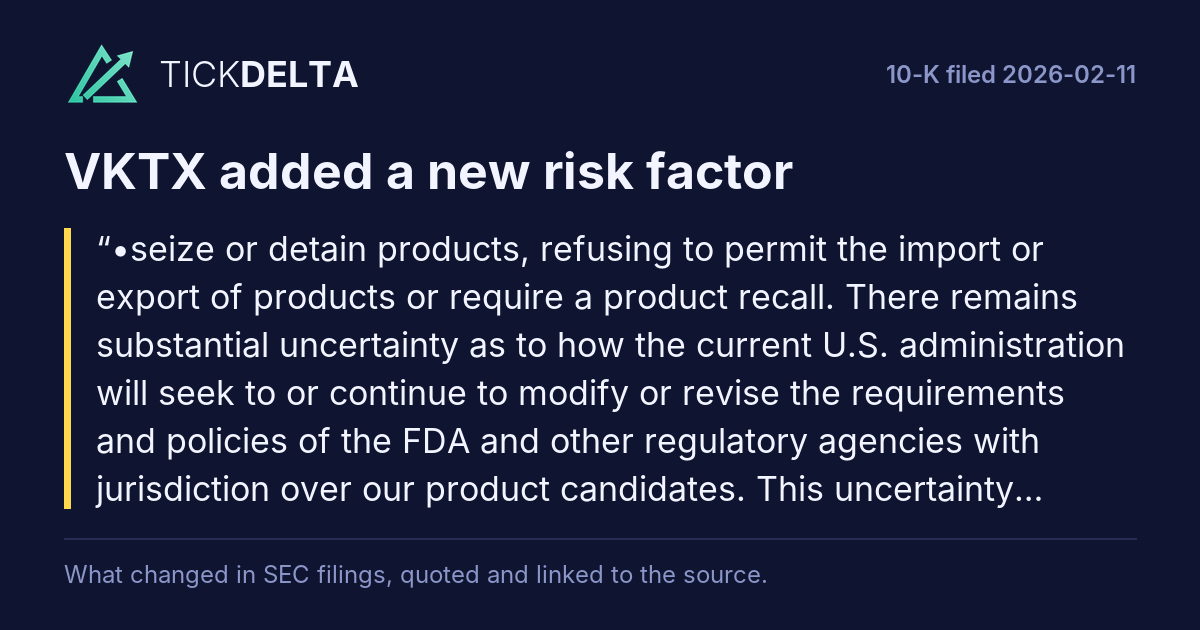
•seize or detain products, refusing to permit the import or export of products or require a product recall.

There remains substantial uncertainty as to how the current U.S. administration will seek to or continue to modify or revise the requirements and policies of the FDA and other regulatory agencies with jurisdiction over our product candidates. This uncertainty could present new challenges or potential opportunities as we navigate the clinical development and approval process for our product candidates. Furthermore, the U.S. Supreme Court’s June 2024 decision in Loper Bright Enterprises v. Raimondo, which overturned the long-standing Chevron doctrine that required courts to give deference to regulatory agencies’ reasonable interpretations of ambiguous federal statutes, could result in additional legal challenges to regulations and guidance issued by federal agencies, including the FDA, on which we rely. The Loper decision may result in increased regulatory uncertainty, inconsistent judicial interpretations and other impacts to the agency rule-making process, any of which could adversely impact our business and operations. We cannot predict the likelihood, nature or extent of government regulation that may arise from future legislation or administrative action or as a result of legal challenges, either in the United States or abroad. If we are slow or unable to adapt to changes in existing requirements or the adoption of new requirements or policies, or if we are not able to maintain regulatory compliance, our business could be materially harmed.

Read in the 10-K

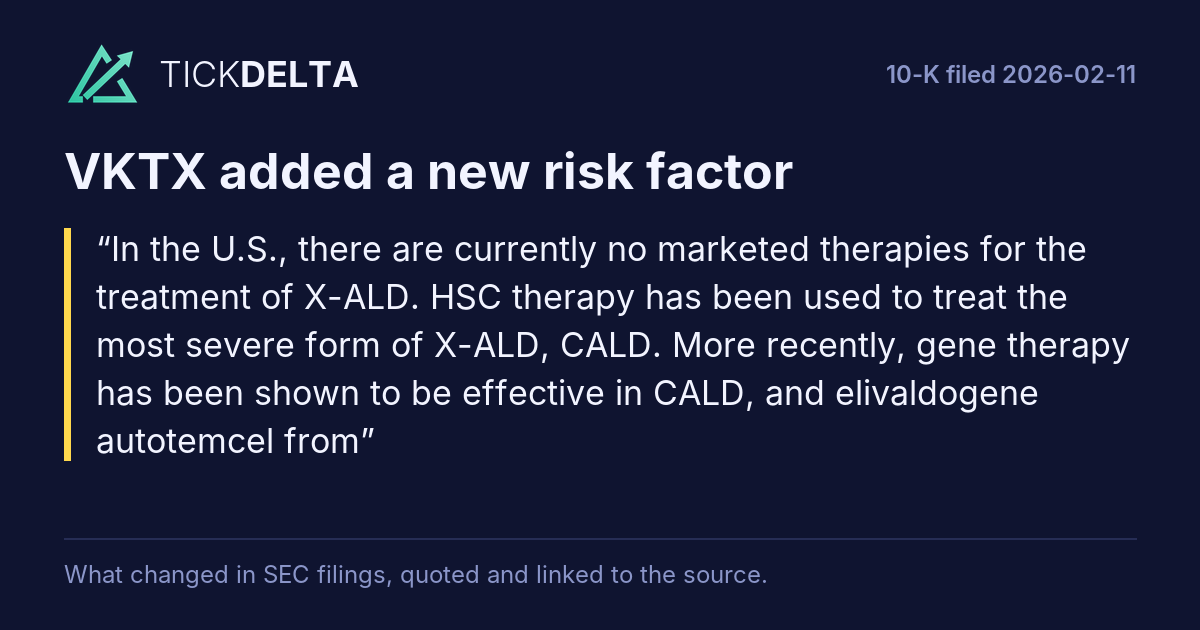
In the U.S., there are currently no marketed therapies for the treatment of X-ALD. HSC therapy has been used to treat the most severe form of X-ALD, CALD. More recently, gene therapy has been shown to be effective in CALD, and elivaldogene autotemcel from

Read in the 10-K

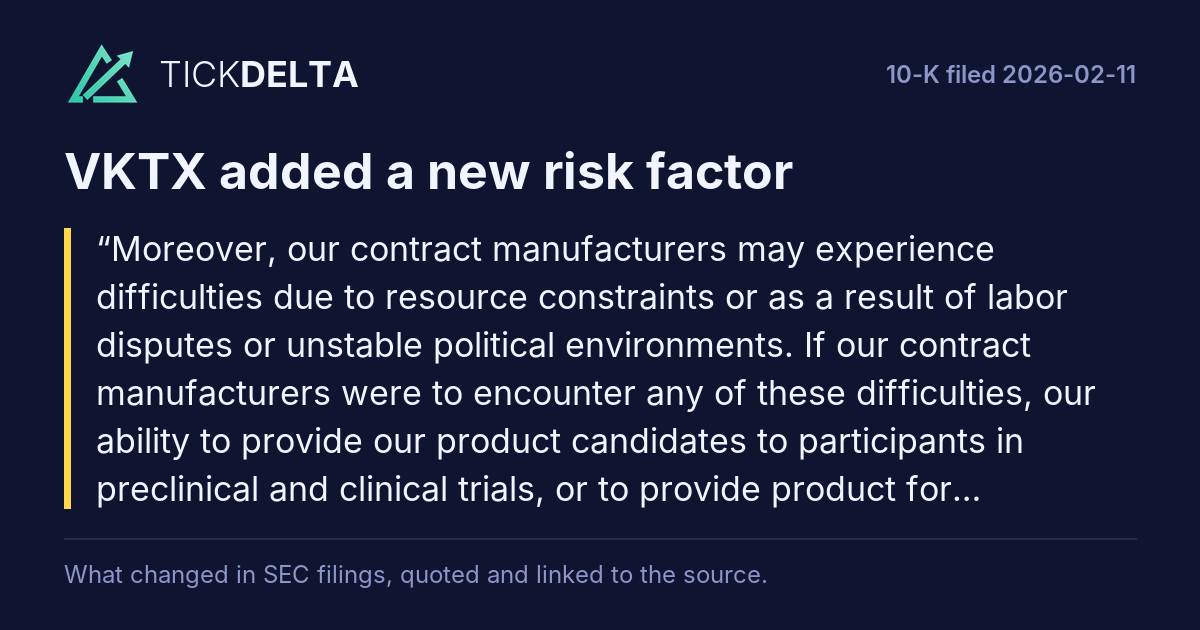
Moreover, our contract manufacturers may experience difficulties due to resource constraints or as a result of labor disputes or unstable political environments. If our contract manufacturers were to encounter any of these difficulties, our ability to provide our product candidates to participants in preclinical and clinical trials, or to provide product for treatment of participants if approved, would be jeopardized.

Read in the 10-K

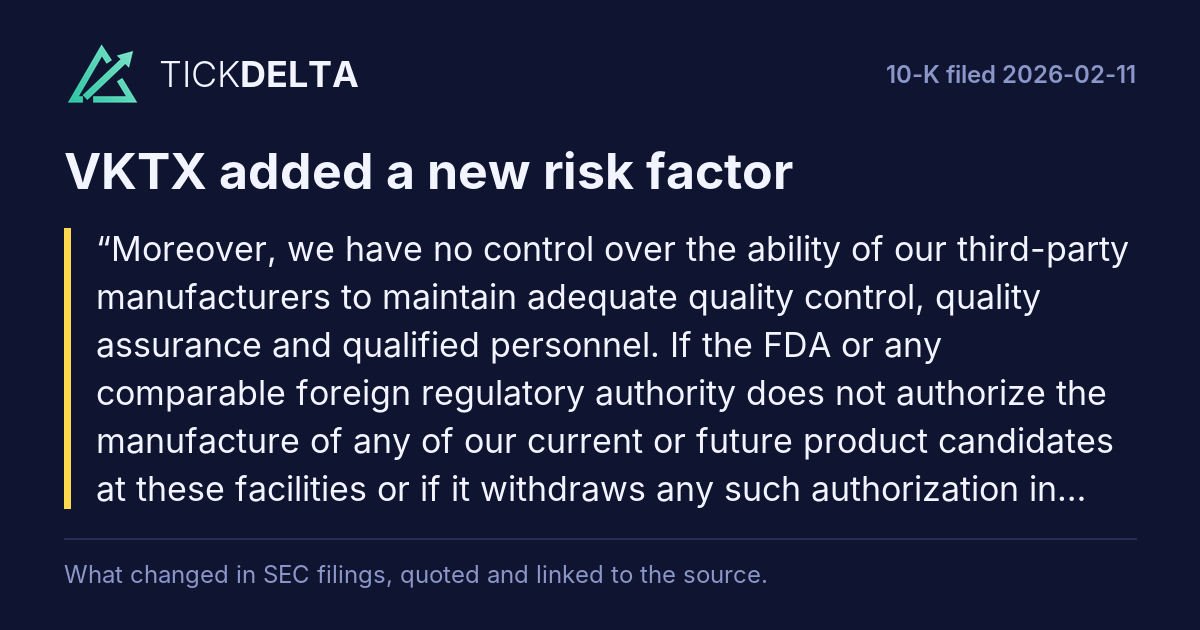
Moreover, we have no control over the ability of our third-party manufacturers to maintain adequate quality control, quality assurance and qualified personnel. If the FDA or any comparable foreign regulatory authority does not authorize the manufacture of any of our current or future product candidates at these facilities or if it withdraws any such authorization in the future, we may need to find alternative manufacturing facilities, which would significantly impact our ability to develop, obtain regulatory approval for or market any of our current or future product candidates, if approved. Our failure, or the failure of our third-party manufacturers, to comply with applicable regulations could result in sanctions being imposed on us, including clinical holds, fines, injunctions, civil penalties, delays, suspension or withdrawal of approvals, seizures or recalls of any of our current or future product candidates, operating restrictions and criminal prosecutions, any of which could significantly and adversely affect supplies of any of our current or future product candidates.

Our or a third party’s failure to execute on our manufacturing requirements on commercially reasonable terms, in a timely manner and in compliance with cGMP or other regulatory requirements could adversely affect our business in a number of ways, including:

•an inability to initiate or continue clinical trials of any of our current or future product candidates, or a hold on clinical trials of any of our current or future product candidates;

•delay in submitting marketing applications, or receiving regulatory approvals, for any of our current or future product candidates;

•subjecting third-party manufacturing facilities to additional inspections by regulatory authorities;

•requirements to cease development or to recall batches of any of our current or future product candidates; and

•in the event of approval to market and commercialize any of our current or future product candidates, an inability to meet commercial demands for any of our current or future product candidates.

We have contracted with third-party manufacturers to produce, in collaboration with us, our product candidates. For example, on March 10, 2025, we entered into broad, multi-year manufacturing agreements, or the Manufacturing Agreements, with CordenPharma, covering both the active pharmaceutical ingredient, or API, and final finished product supply for VK2735. Under the terms of the Manufacturing Agreements, we have secured dedicated capacity for the annual manufacture and supply of multiple metric tons of VK2735 API. In addition, CordenPharma will provide fill/finish capacity for both the injectable and oral formulations of VK2735. In exchange for dedicated API and fill/finish capacity, we will make prepayments to CordenPharma, to be paid over the period from 2025 to 2028. These prepayments will be fully credited against future orders.

Other than our agreements with CordenPharma, we do not have any long-term commitments or commercial supply agreements with third-party manufacturers. We may be unable to establish any other long-term supply agreements with third-party manufacturers or to

do so on acceptable terms or at all, which increases the risk of failing to timely obtain sufficient quantities of our product candidates or such quantities at an acceptable cost. Moreover, if we encounter delays or difficulties in the scale-up of our manufacturing processes or our relationships with CordenPharma, this could delay the submission of product candidates for regulatory approval and also delay the market introduction and subsequent sales of any of our product candidates that receive regulatory approval, which would have a material adverse effect on our business, financial condition and results of operations. Our reliance on third-party manufacturers, such CordenPharma, entails additional risks, including:

•failure of our third-party manufacturers to comply with regulatory requirements and maintain quality assurance;

•failure to obtain adequate raw materials and other materials required for manufacturing;

•misappropriation of our proprietary information, including our trade secrets and know-how; and

•termination or nonrenewal of the agreement by the third party at a time that is costly or inconvenient for us.

Further, any of our current and future product candidates that we may develop may compete with other product candidates and products for access to manufacturing facilities.

Any performance failure on the part of our existing or future manufacturers, suppliers or vendors could delay clinical development or regulatory approval, and any related remedial measures may be costly or time-consuming to implement. If our existing or future third-party manufacturers and suppliers cannot perform as agreed or cannot fulfill our clinical or commercial supply requirements, we may be required to replace such manufacturers or suppliers and we may be unable to replace them on a timely basis or at all. If we later switch third-party manufacturers, we may be unable to demonstrate comparability between lots produced previously and those produced by such new third-party manufacturers, in which case we may be required to gather additional data utilizing material produced by such new third-party manufacturers before we are able to submit an NDA or similar marketing application for our product candidates, if ever.

As a result, our current and anticipated future dependence upon others for the manufacture of any of our current or future product candidates may adversely affect our future profit margins and our ability to commercialize any products that receive regulatory approval on a timely and competitive basis.

Read in the 10-K

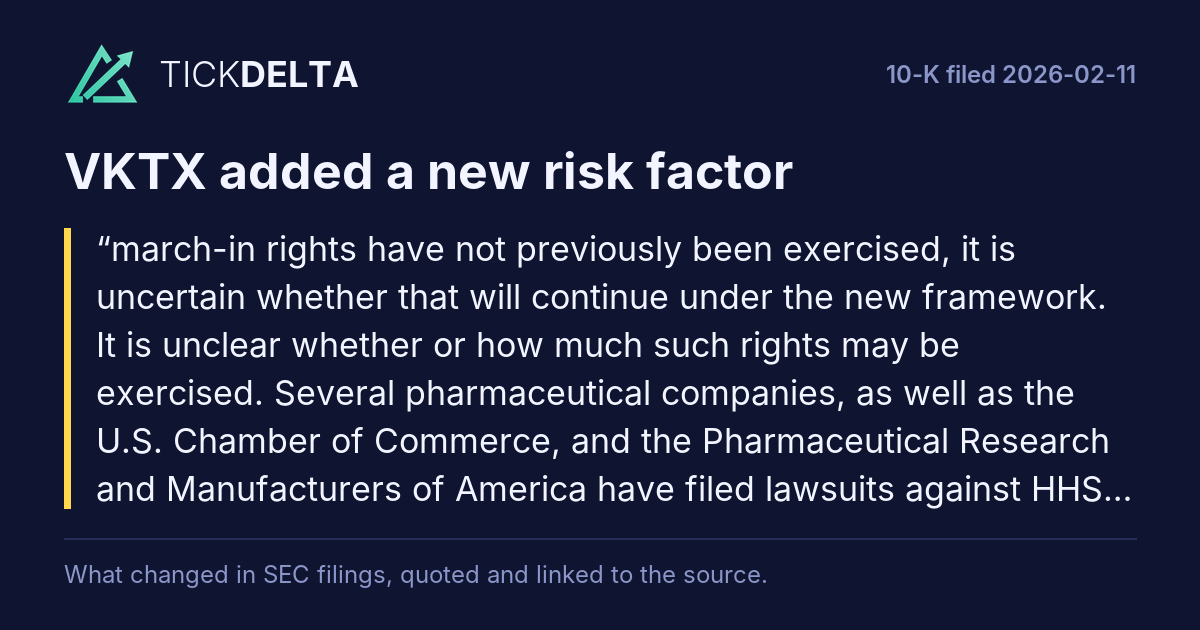
march-in rights have not previously been exercised, it is uncertain whether that will continue under the new framework. It is unclear whether or how much such rights may be exercised.

Several pharmaceutical companies, as well as the U.S. Chamber of Commerce, and the Pharmaceutical Research and Manufacturers of America have filed lawsuits against HHS and CMS asserting that, among other things, the IRA’s drug price negotiation program for Medicare constitutes an uncompensated taking in violation of the Fifth Amendment of the U.S. Constitution and is otherwise unlawful. HHS has generally won the substantive disputes in these cases, and several federal district court judges have expressed skepticism regarding the merits of the legal arguments being pursued by the pharmaceutical industry. HHS has generally continued to win the substantive disputes in appeals, although certain cases continue to seek appellate review.

Other legislative changes have also been proposed and adopted since the ACA was enacted. For example, on August 2, 2011, the Budget Control Act of 2011 was signed into law, which, among other things, resulted in reductions to Medicare payments to providers of 2% per fiscal year, which went into effect on April 1, 2013, and, due to subsequent legislative amendments to the statute, will remain in effect through 2032 unless additional Congressional action is taken. In certain countries outside the United States, reimbursement for products that have not yet received marketing authorization may be provided through national managed access programs.

We expect that the ACA, the IRA, and any other healthcare reform measures that may be adopted in the future may result in additional reductions in Medicare and other healthcare funding, more rigorous coverage criteria, new payment methodologies and additional downward pressure on the price that we receive for any approved product. Any reduction in reimbursement from Medicare or other government programs may result in a similar reduction in payments from private payors. The implementation of cost containment measures or other healthcare reforms may prevent us from being able to generate revenue, attain profitability or commercialize our product candidates, if approved.

Read in the 10-K

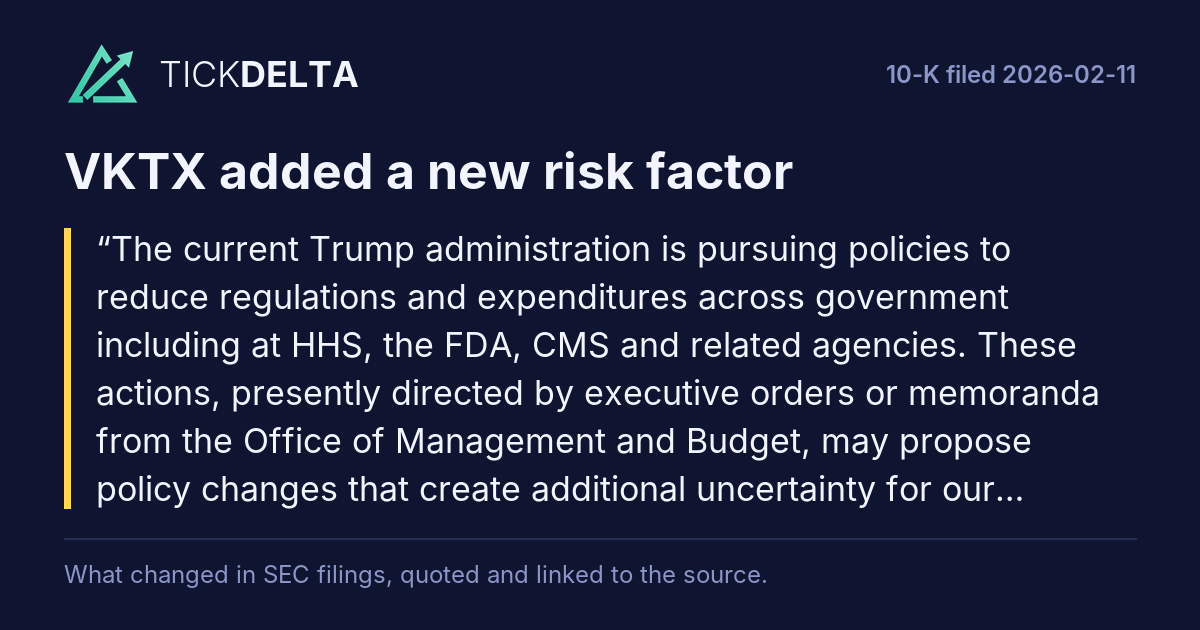
The current Trump administration is pursuing policies to reduce regulations and expenditures across government including at HHS, the FDA, CMS and related agencies. These actions, presently directed by executive orders or memoranda from the Office of Management and Budget, may propose policy changes that create additional uncertainty for our business. These actions and proposals may, for example, include directives: (1) reducing agency workforce and cutting programs; (2) rescinding a Biden administration executive order tasking the Center for Medicare and Medicaid Innovation, or CMNI, to consider new payment and healthcare models to limit drug spending; (3) eliminating the Biden administration’s executive order that directed HHS to establish an AI task force and developing a strategic plan; (4) directing HHS and other agencies to lower prescription drug costs through a variety of initiatives, including by improving upon the Medicare Drug Price Negotiation Program and establishing Most-Favored-Nation pricing for pharmaceutical products; (5) imposing tariffs on imported pharmaceutical products; and (6) directing certain federal agencies to enforce existing law regarding hospital and plan price transparency and by standardizing prices across hospitals and health plans. Congress may introduce and ultimately pass health care related legislation that could impact the drug approval process and make changes to the Medicare Drug Price Negotiation Program created under the IRA. This could lower the price that we receive for any approved product. Any denial in coverage or reduction in reimbursement from Medicare or other government-funded programs may result in a similar denial or reduction in payments from private payors, which may prevent us from being able to generate sufficient revenue, attain profitability or commercialize our product candidates, if approved. Furthermore, on July 4, 2025, legislation commonly referred to as the One Big Beautiful Bill Act was signed into law, which reduced funding to federal healthcare programs and imposed additional requirements to be eligible for healthcare, which may result in decreased access to healthcare, particularly in Medicaid programs.

Read in the 10-K

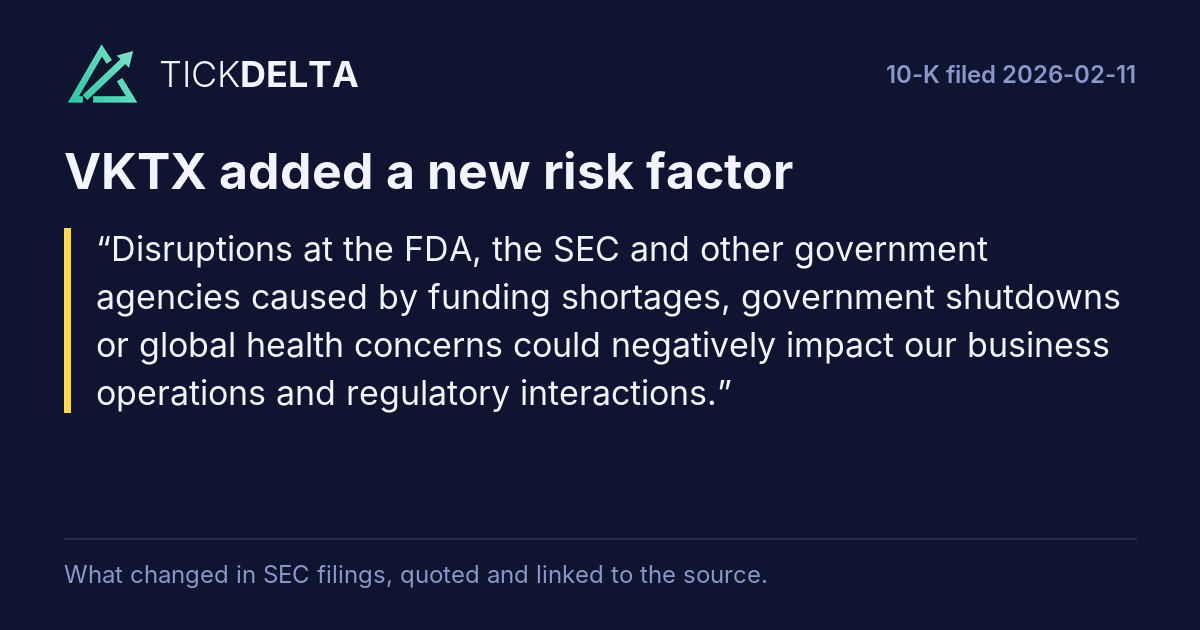
Disruptions at the FDA, the SEC and other government agencies caused by funding shortages, government shutdowns or global health concerns could negatively impact our business operations and regulatory interactions.

Read in the 10-K

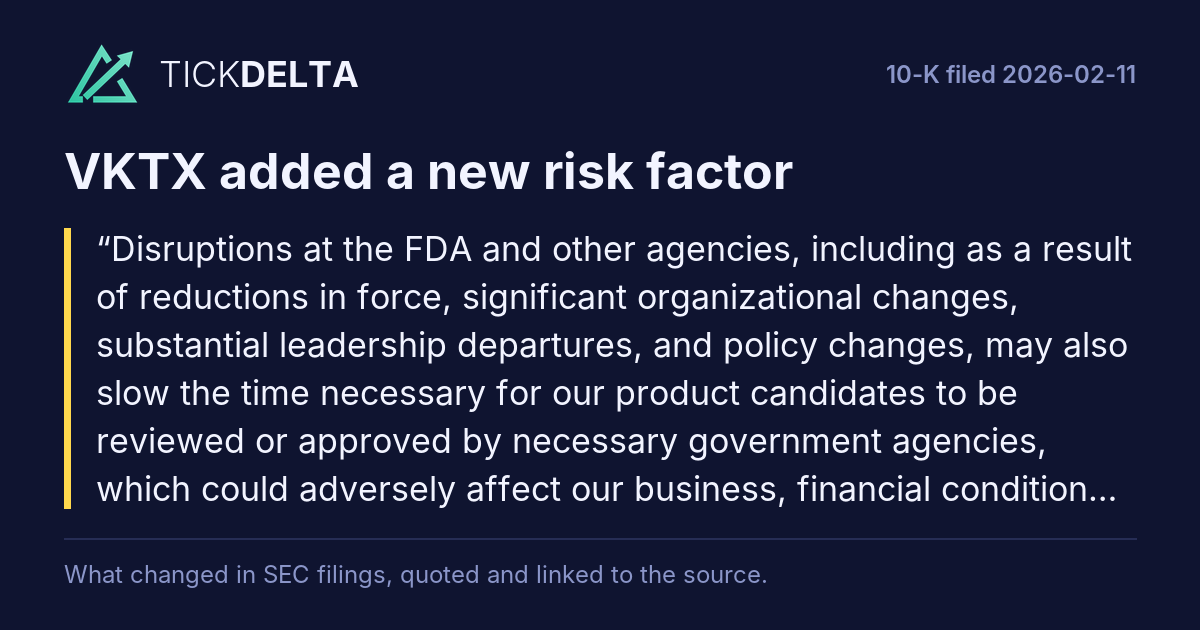
Disruptions at the FDA and other agencies, including as a result of reductions in force, significant organizational changes, substantial leadership departures, and policy changes, may also slow the time necessary for our product candidates to be reviewed or approved by necessary government agencies, which could adversely affect our business, financial condition and results of operations. With the change in presidential administrations in 2025, there is substantial uncertainty as to how the current U.S. administration will continue to modify or revise the requirements and policies of the FDA and other regulatory agencies with jurisdiction over our product candidates. For example, the current U.S. administration has discussed several changes to the reach and oversight of the FDA, which could affect its relationship with the pharmaceutical industry, transparency in decision making and ultimately the cost and availability of prescription drugs. Additionally, over the past decade, the U.S. government has shut down several times, and certain regulatory agencies, such as the FDA, have had to furlough critical employees and stop critical activities. The current U.S. administration previously announced plans to reduce the number of federal employees by establishing voluntary termination programs, by position eliminations or by involuntary terminations. If funding for the FDA is reduced, if the FDA workforce is reduced, or if the current government shutdown continues, it could significantly impact the ability of the FDA to timely review and process our regulatory submissions, which could have a material adverse effect on our business.

Further, a prolonged or future shutdown of the U.S. federal government could materially impact the operations of the SEC. For example, the SEC announced that during the prior U.S. federal government shutdown, it would not declare registration statements effective. In the event of an extended shutdown, the SEC may operate with limited staff or suspend certain functions altogether, which could delay the review or effectiveness of our filings, including registration statements or other financing-related disclosures. Such delays could adversely affect our ability to access the public markets and obtain necessary capital in order to properly capitalize and continue to fund our operations.

There remains substantial uncertainty as to how the current U.S. administration will seek to or continue to modify or revise the requirements and policies of the FDA and other regulatory agencies with jurisdiction over our product candidates. This uncertainty could present new challenges or potential opportunities as we navigate the clinical development and approval process for our product candidates. If we or our collaborators experience delays in obtaining approval or if we or they fail to obtain approval of our product candidates, the commercial prospects for our product candidates may be harmed and our ability to generate revenue will be materially impaired.

Read in the 10-K

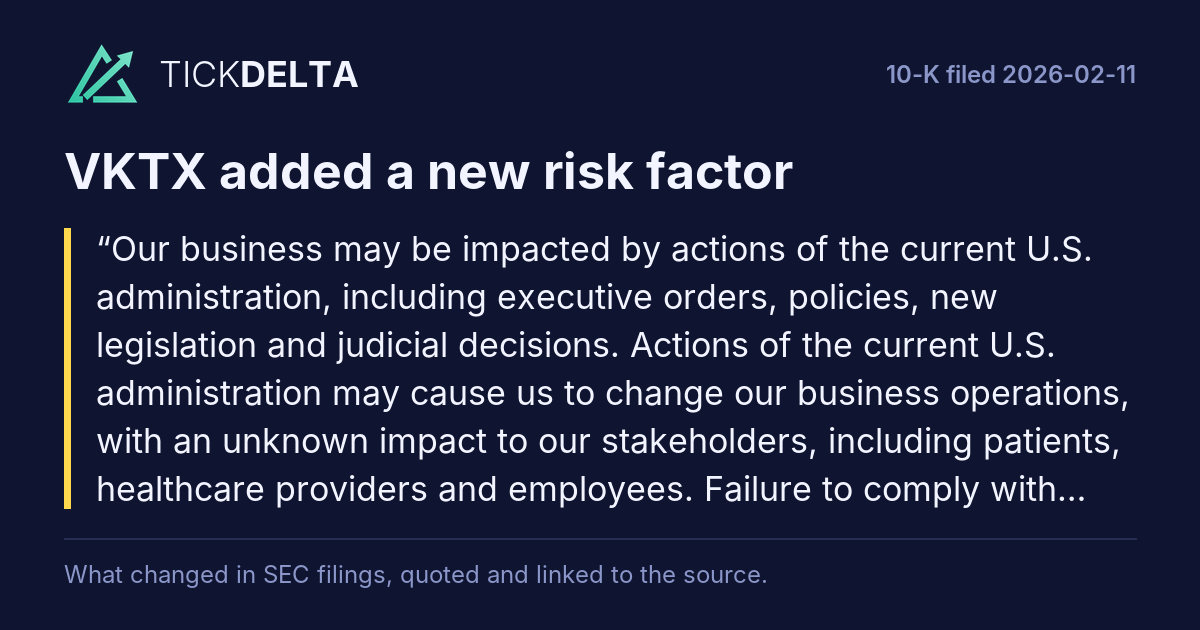
Our business may be impacted by actions of the current U.S. administration, including executive orders, policies, new legislation and judicial decisions.

Actions of the current U.S. administration may cause us to change our business operations, with an unknown impact to our stakeholders, including patients, healthcare providers and employees. Failure to comply with new administration actions could expose us to litigation or other government actions. There can be no assurance that our compliance with new administration actions will provide sufficient mitigation.

Read in the 10-K

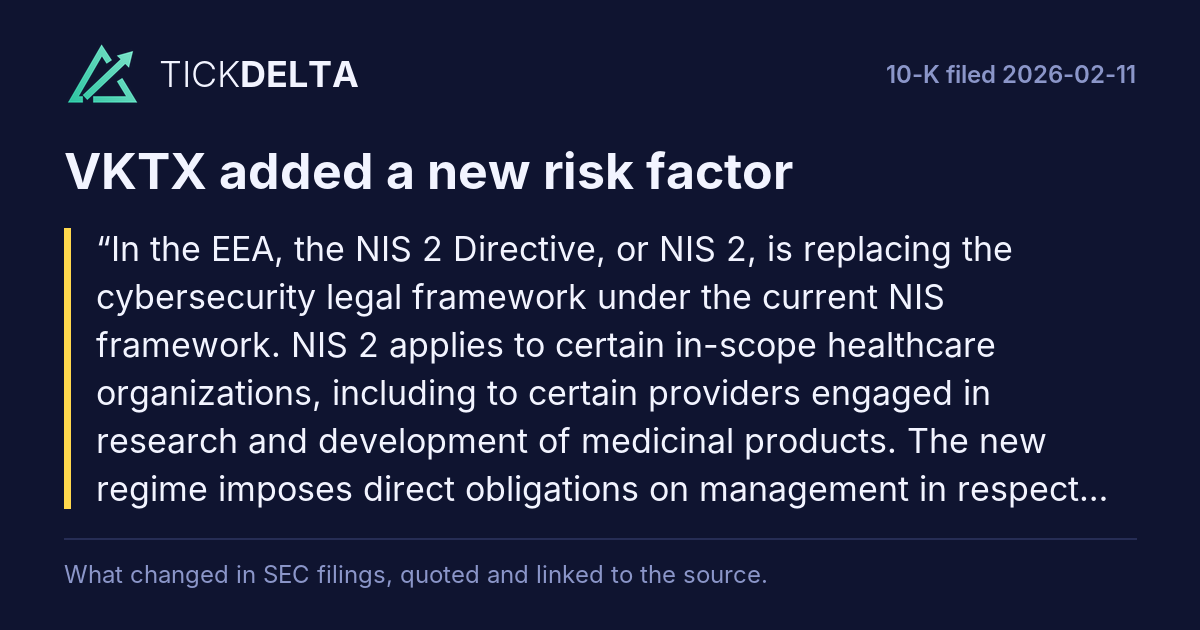
In the EEA, the NIS 2 Directive, or NIS 2, is replacing the cybersecurity legal framework under the current NIS framework. NIS 2 applies to certain in-scope healthcare organizations, including to certain providers engaged in research and development of medicinal products. The new regime imposes direct obligations on management in respect of an in-scope organization’s compliance with NIS 2, requires covered organizations to put in place certain cyber risk management measures, strengthens incident reporting requirements and provides supervisory authorities with greater oversight. The majority of obligations will come into force when national legislation implementing NIS 2 becomes effective in the relevant EU Member State. EU Member States had until October 17, 2024 to transpose NIS 2 into national legislation, although many countries have still not completed the transposition. As such, the cybersecurity regulatory landscape in the EU is currently fragmented and uncertain. To the extent that we are subject to NIS 2 in the future, we may require additional investment of our resources in compliance programs. Under NIS 2, companies may be subject to administrative fines of up to the higher amount of €10 million or 2% of worldwide turnover.

Similar actions are either in place or under way in the United States. There are a broad variety of data protection and breach notification laws that are applicable to our activities, and a wide range of enforcement agencies at both the state and federal levels that can review companies for privacy and data security concerns based on general consumer protection laws. All 50 U.S. states and territories and international jurisdictions have varying breach notification laws that may require us to notify patients, employees or regulators in the event of unauthorized access to or disclosure of personal or confidential data experienced by us or our service providers. These laws are not consistent, and compliance in the event of a widespread data breach is difficult and may be costly. We also may be contractually required to notify patients or other counterparties of a security breach. In addition to government regulation, privacy advocates and industry groups have and may in the future propose self-regulatory standards from time to time. These and other industry standards may legally or contractually apply to us, or we may elect to comply with such standards.

Read in the 10-K

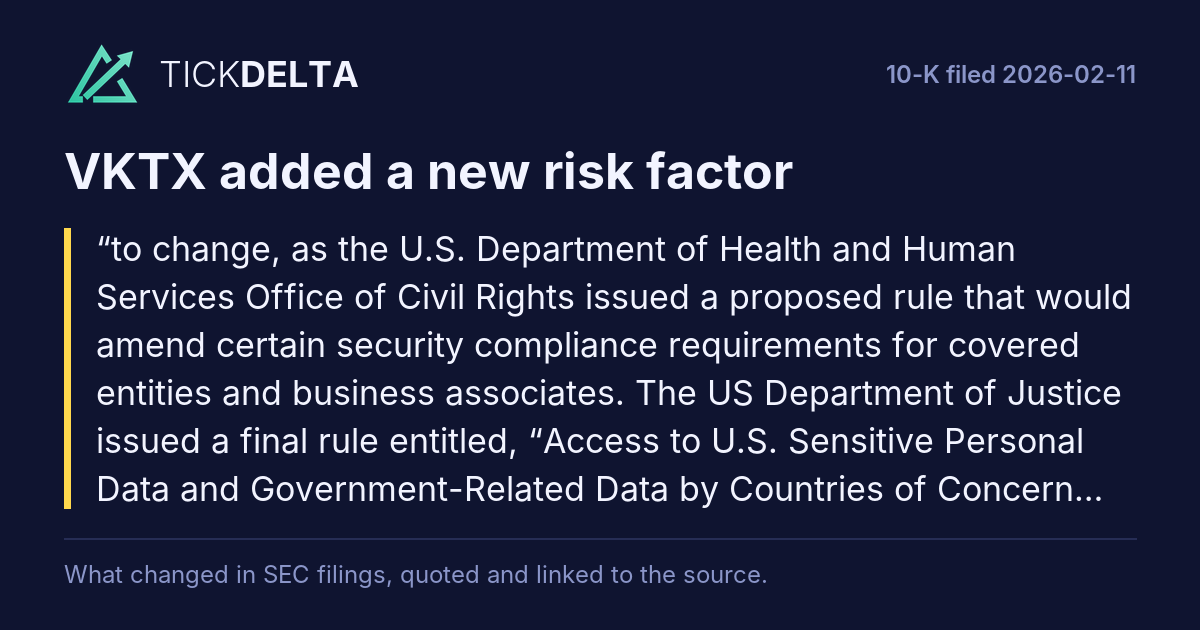
to change, as the U.S. Department of Health and Human Services Office of Civil Rights issued a proposed rule that would amend certain security compliance requirements for covered entities and business associates. The US Department of Justice issued a final rule entitled, “Access to U.S. Sensitive Personal Data and Government-Related Data by Countries of Concern or Covered Persons,” codified at 28 CFR part 202, or the Bulk Transfer Rule. The Bulk Transfer Rule prohibits and restricts bulk transfers of sensitive personal data (including genetic and health data) to countries of concern, such as China, Russia, and Iran to prevent access by foreign adversaries. It restricts our ability to engage in certain cross-border transactions involving genomic or biological samples and related data, which may increase compliance costs, lead to increased regulatory scrutiny or liability, and may require additional contractual negotiations, which may adversely impact our business, financial condition and operating results.

Read in the 10-K

products and product candidates outside of the United States, which could limit our growth potential and increase our development costs.

Read in the 10-K

Furthermore, the current U.S. administration has substantially departed from prior U.S. government international trade policy and has commenced activities to renegotiate, or potentially terminate, certain existing bilateral or multi-lateral trade agreements and treaties with foreign countries. In addition, the current U.S. administration has initiated and is continuing to consider imposing additional tariffs on certain foreign goods. Related to this action, certain foreign governments, including China, have instituted or are considering imposing reciprocal tariffs on certain U.S. goods. It remains unclear what the current U.S. administration or foreign governments will or will not

do with respect to tariffs or other international trade agreements and policies. A trade war or other governmental action related to tariffs or international trade agreements or policies has the potential to disrupt our research activities, affect our suppliers, increase the cost of materials purchased to manufacture our products, impact our ability to sell our products outside the United States or to sell our products outside the United States at competitive prices and/or to affect the United States or global economy or certain sectors thereof and, thus, could adversely impact our business and financial condition.

We are subject to economic, political, regulatory and other risks associated with international operations.

Our business is subject to risks associated with conducting business outside of the United States. One of our subsidiaries is located in Ireland and another is located in Australia and we may further expand our international operations. Accordingly, our future results could be harmed by a variety of factors, including:

•economic weakness, including inflation, or political instability in particular non-U.S. economies and markets;

•differing jurisdictions could present different issues for securing, maintaining or obtaining freedom to operate in such jurisdictions;

•difficulties in compliance with different, complex and changing laws, regulations and court systems of multiple jurisdictions and compliance with a wide variety of foreign laws, treaties and regulations;

•changes in non-U.S. currency exchange rates of the pound sterling, U.S. dollar, euro and currency controls;

•trade protection measures, import or export licensing requirements or other restrictive actions by governments;

•differing reimbursement regimes and price controls in certain non-U.S. markets;

•compliance with tax, employment, immigration and labor laws for employees living or traveling abroad, including, for example, the variable tax treatment in different jurisdictions of options granted under our share option schemes or equity incentive plans;

•workforce uncertainty in countries where labor unrest is more common than in the United States;

•litigation or administrative actions resulting from claims against us by current or former employees or consultants individually or as part of class actions, including claims of wrongful terminations, discrimination, misclassification or other violations of labor law or other alleged conduct;

•difficulties associated with staffing and managing international operations, including differing labor relations;

•production shortages resulting from any events affecting raw material supply or manufacturing capabilities abroad; and

•business interruptions resulting from geo-political actions, including war and terrorism, or natural disasters including earthquakes, typhoons, floods and fires.

Our international operations may subject us to greater than anticipated tax liabilities.

The amount of taxes we may pay in different jurisdictions depends on the application of the tax laws of various jurisdictions, including the United States, to our international business activities, changes in tax rates, new or revised tax laws or interpretations of existing tax laws and policies, and our ability to operate our business in a manner consistent with our corporate structure and intercompany arrangements. The taxing authorities of the jurisdictions in which we operate may challenge our methodologies for pricing intercompany transactions pursuant to any future intercompany arrangement or disagree with our determinations as to the income and expenses attributable to specific jurisdictions. If such a challenge or disagreement were to occur, and our position was not sustained, we could be required to pay additional taxes, interest and penalties, which could result in one-time tax charges, higher effective tax rates, reduced cash flows, and lower overall profitability of our operations. Our financial statements could fail to reflect adequate reserves to cover such a contingency. Similarly, a taxing authority could assert that we are subject to tax in a jurisdiction where we believe we have not established a taxable connection, often referred to as a “permanent establishment” under international tax treaties, and such an assertion, if successful, could increase our expected tax liability in one or more jurisdictions.
Read in the 10-K

Paragraphs in the 10-Q filed Oct 29, 2026 that were not in the one before

New in the latest 10-Q

47 paragraphs in the 10-Q filed Oct 29, 2026 with nothing like them in the 10-Q filed Jul 29, 2026 (at least half the words must differ; new numbers alone do not count). Quoted exactly, grouped by the item heading above them. This is text that changed, not a judgement of how serious it is.

Financial statements and notes

Investments Available-for-Sale Available-for-sale securities are carried at fair value, with the unrealized gains and losses reported in accumulated other comprehensive loss. The amortized cost of debt securities is adjusted for amortization of premiums and accretion of discounts to maturity. The amortization of premiums and accretion of discounts is included in interest income. Realized gains and losses on available-for-sale securities are included in other income (expense). The cost of securities sold is based on the specific identification method. Interest and dividends on securities classified as available-for-sale are included in interest income. Concentration of Credit Risk Financial instruments, which potentially subject the Company to concentration of credit risk, consist primarily of cash, cash equivalents, restricted cash and marketable securities. The Company maintains deposits in federally insured depository institutions in excess of federally insured limits. Management believes that the Company is not exposed to significant credit risk due to the financial position of the depository institutions in which those deposits are held. Additionally, the Company has established guidelines regarding approved investments and maturities of investments, which are designed to maintain safety and liquidity. Prepaid Clinical Trial and Preclinical Study Costs Prepaid clinical trial and preclinical study costs represent advance payments by the Company for future clinical trial and preclinical study services to be performed by the clinical research organization and other research organizations. Such amounts are recognized as research and development expense as the related clinical trial and preclinical study services are performed. Leases The Company determines if an arrangement is a lease at inception. Operating leases are included in right-of-use (“ROU”) assets, and lease liability obligations are included in the Company’s condensed consolidated balance sheets. ROU assets represent the Company’s right to use an underlying asset for the lease term and lease liability obligations represent its obligation to make lease payments arising from the lease. ROU assets and liabilities are recognized at the commencement date based on the present value of lease payments over the lease term. As the Company’s leases typically do not provide an implicit rate, the Company estimates its incremental borrowing rate based on the information available at commencement date in determining the present value of lease payments. The Company uses the implicit rate when readily determinable. The ROU asset also includes any lease payments made and excludes lease incentives. The Company’s lease terms may include options to extend or terminate the lease when it is reasonably certain that the Company will exercise that option. Lease expense is recognized on a straight-line basis over the lease term. Please refer to Note 4 for additional information. Deferred Financing Costs Deferred financing costs represent legal, accounting and other direct costs related to the Company’s efforts to raise capital through a public or private sale of the Company’s common stock. Costs related to the public sale of the Company’s common stock are deferred until the completion of the applicable offering, at which time such costs are reclassified to additional paid-in-capital as a reduction of the proceeds. Costs related to the private sale of the Company’s common stock are deferred until the completion of the applicable offering, at which time such costs are amortized to equity over the term of the applicable purchase agreement. Costs related to the issuance of debt are presented as a direct deduction from the carrying amount of the related debt and are amortized to interest expense using the effective interest method over the term of the debt. Convertible Senior Notes The Company accounts for its 2.00% convertible senior notes due 2032 (the “2032 Notes”) in accordance with Financial Accounting Standards Board (“FASB”) Accounting Standards Codification (“ASC”) Topic 470-20, Debt with Conversion and Other Options, as amended by Accounting Standards Update (“ASU”) No. 2020-06, and ASC Topic 815, Derivatives and Hedging. The Company has not elected the fair value option under ASC Topic 825-10. The Company evaluates the embedded features of the 2032 Notes, including the conversion option, to determine whether any features require bifurcation and separate accounting as derivatives under ASC Topic 815-15. The Company concluded that the conversion option, including the make-whole adjustment to the conversion rate, is indexed to the Company’s own common stock and meets the requirements for equity classification under ASC Topic 815-40, and therefore qualifies for the scope exception from derivative accounting. The Company further concluded that the redemption, repurchase, acceleration and special interest features are clearly and closely related to the debt host and do not require bifurcation. Accordingly, the 2032 Notes are accounted for as a single liability measured at amortized cost. Debt issuance costs, including underwriting discounts and other direct costs, are presented as a direct deduction from the carrying amount of the 2032 Notes and are amortized to interest expense using the effective interest method over the contractual term of the 2032 Notes. Special interest, if any, is recognized as interest expense as it accrues.

Read in the 10-Q

270 a list of the interim disclosures required by other ASC topics. ASU 2025-11 also adds a disclosure principle to help entities determine whether disclosures not specified in ASC Topic 270 should be provided in interim reporting periods. ASU 2025-11 is effective for interim reporting periods within annual reporting periods beginning after December 15, 2027, with early adoption permitted, and may be applied prospectively or retrospectively. The Company is currently evaluating the impact of ASU 2025-11 on its condensed consolidated financial statements.

Read in the 10-Q

than 12 months. The Company does not intend to sell these investments and it is not more likely than not that the Company will be required to sell these investments before recovery of their amortized cost basis, which may be at maturity.

Read in the 10-Q

At December 31, 2025, none of these securities were classified as cash and cash equivalents on the Company’s consolidated balance sheet and $105.0 million of the corporate debt securities were scheduled to mature outside of one year at the time of purchase.

Read in the 10-Q

In September 2026, the Company completed concurrent public offerings pursuant to the 2026 Shelf Registration Statement consisting of (i) 9,035,714 shares of its common stock at a public offering price of $35.00 per share and (ii) $258.8 million aggregate principal

Read in the 10-Q
Show the other 42

amount of 2032 Notes. The offerings included the full exercise of the underwriters’ option to purchase additional shares of common stock and the option to purchase additional 2032 Notes.

Read in the 10-Q

The Company received gross proceeds of approximately $316.25 million from the sale of common stock and approximately $258.8 million from the issuance of the 2032 Notes. Net proceeds were approximately $296.9 million from the common stock offering and approximately $250.6 million from the 2032 Notes offering, after deducting underwriting discounts, commissions and estimated offering expenses.

Read in the 10-Q

The 2032 Notes are senior, unsecured obligations of the Company and bear interest at a rate of 2.00% per annum, payable semi-annually in arrears on April 15 and October 15 of each year, beginning on April 15, 2027. The 2032 Notes will mature on October 15, 2032, unless earlier converted, redeemed, or repurchased. The initial conversion rate is 19.7044 shares of common stock per $1,000 principal amount of 2032 Notes, which represents an initial conversion price of approximately $50.75 per share, subject to customary adjustments. Refer to Note 9 for additional information regarding the 2032 Notes.

Read in the 10-Q

On September 25, 2026, the Company issued $258.8 million aggregate principal amount of 2032 Notes. The Company received net proceeds of approximately $250.6 million from the issuance of the 2032 Notes, after deducting underwriting discounts and commissions and estimated offering expenses.

Read in the 10-Q

The 2032 Notes are senior, unsecured obligations of the Company and rank equally in right of payment with the Company’s existing and future senior, unsecured indebtedness.

Read in the 10-Q

The 2032 Notes bear interest at a rate of 2.00% per year, payable semi-annually in arrears on April 15 and October 15 of each year, beginning April 15, 2027. The 2032 Notes will mature on October 15, 2032, unless earlier converted, redeemed or repurchased in accordance with their terms.

Read in the 10-Q

Holders of the 2032 Notes may convert their 2032 Notes at their option only under specified circumstances. Before July 15, 2032, holders may convert their 2032 Notes only (i) during any calendar quarter commencing after the calendar quarter ending on December 31, 2026, if the last reported sale price of the Company’s common stock exceeds 130% of the conversion price for at least 20 trading days (whether or not consecutive) during the 30 consecutive trading days ending on, and including, the last trading day of the immediately preceding calendar quarter; (ii) during the five consecutive business days immediately after any ten consecutive trading day period in which the trading price per $1,000 principal amount of 2032 Notes for each trading day was less than 98% of the product of the last reported sale price of the Company’s common stock and the conversion rate on such trading day; (iii) upon the occurrence of certain specified corporate events; or (iv) if the Company calls the 2032 Notes for redemption. On or after July 15, 2032, holders may convert their 2032 Notes at any time until the close of business on the second scheduled trading day immediately preceding the maturity date.

Read in the 10-Q

The initial conversion rate is 19.7044 shares of the Company’s common stock per $1,000 principal amount of 2032 Notes, which represents an initial conversion price of approximately $50.75 per share. The conversion rate is subject to adjustment upon the occurrence of certain events specified in the indenture governing the 2032 Notes, including certain dividends or distributions, stock splits, combinations, tender or exchange offers and other specified transactions.

Read in the 10-Q

Upon conversion, the Company may satisfy its conversion obligation by paying or delivering, as applicable, cash, shares of its common stock or a combination of cash and shares of its common stock, at the Company’s election. In connection with certain corporate events constituting a make-whole fundamental change, the conversion rate may be increased for a specified period of time in accordance with the terms of the indenture governing the 2032 Notes.

Read in the 10-Q

On or after October 22, 2029 and on or before the 25th scheduled trading day immediately preceding the maturity date, the Company may redeem for cash all or any portion of the 2032 Notes, but only if the last reported sale price of the Company’s common stock exceeds 130% of the conversion price for a specified period of time, and the Company may not redeem less than all of the outstanding 2032 Notes unless at least $100.0 million aggregate principal amount of 2032 Notes remains outstanding and not called for redemption. The redemption price will equal 100% of the principal amount of the 2032 Notes to be redeemed, plus accrued and unpaid interest, if any, to, but excluding, the redemption date. Calling any 2032 Note for redemption will constitute a make-whole fundamental change with respect to that 2032 Note.

Read in the 10-Q

The Company may also redeem all, but not less than all, of the 2032 Notes if the aggregate principal amount of 2032 Notes outstanding is less than 15% of the aggregate principal amount of 2032 Notes originally issued in the offering, including any additional 2032 Notes issued pursuant to the exercise of the underwriters’ option to purchase additional 2032 Notes.

Read in the 10-Q

If a fundamental change occurs, holders may require the Company to repurchase their 2032 Notes for cash at a repurchase price equal to 100% of the principal amount of the 2032 Notes to be repurchased, plus accrued and unpaid interest, if any, to, but excluding, the fundamental change repurchase date, subject to the terms and conditions of the indenture governing the 2032 Notes.

Read in the 10-Q

The Company recognized $88,000 of interest expense related to the 2032 Notes for the three months ended September 30, 2026, which consisted of the amortization of issuance costs and accrued contractual interest.

Read in the 10-Q

As of September 30, 2026, the 2032 Notes had a remaining contractual principal amount of $258.8 million and a carrying amount of $250.6 million. The Company classified the 2032 Notes as a long-term liability on its condensed consolidated balance sheet.

Read in the 10-Q

The estimated fair value of the 2032 Notes was approximately $265.3 million as of September 30, 2026. The fair value was determined based on the quoted market price of the 2032 Notes and is classified as Level 2 within the fair value hierarchy.

Read in the 10-Q

liabilities that are not readily apparent from other sources. Actual results may differ from these estimates under different assumptions or conditions.

Read in the 10-Q

Statement. The specific terms of any offering under the 2026 Shelf Registration Statement will be established at the time of such offering. The 2026 Shelf Registration Statement will expire on July 30, 2029.

Read in the 10-Q

Risk Factors

We received gross proceeds of approximately $316.25 million from the sale of common stock and approximately $258.8 million from the issuance of the 2032 Notes. Net proceeds were approximately $296.9 million from the common stock offering and approximately $250.6 million from the 2032 Notes offering, after deducting underwriting discounts, commissions and estimated offering expenses.

Read in the 10-Q

The 2032 Notes are senior, unsecured obligations of the Company and bear interest at a rate of 2.00% per annum, payable semi-annually in arrears on April 15 and October 15 of each year, beginning on April 15, 2027. The 2032 Notes will mature on October 15, 2032, unless earlier converted, redeemed, or repurchased. The initial conversion rate is 19.7044 shares of common stock per $1,000 principal amount of 2032 Notes, which represents an initial conversion price of approximately $50.75 per share, subject to customary adjustments. For additional information regarding the 2032 Notes, see Note 9 to our condensed consolidated financial statements included in Part I, Item 1 of this Quarterly Report on Form 10-Q.

Read in the 10-Q

Financial statements and notes

To date, our operations have been financed primarily by the sale of our securities and the issuance of the 2032 Notes.

Read in the 10-Q

Risk Factors

• the extent to which we satisfy any conversions of the 2032 Notes with cash payments rather than in shares of our common stock; and

Read in the 10-Q

leading to development and potential commercialization delays, which would adversely affect our business, financial condition and results of operations.

Read in the 10-Q

• the extent to which we satisfy any conversions of the 2032 Notes with cash payments rather than in shares of our common stock; and

Read in the 10-Q

Registration Statement. The specific terms of any offering under the 2026 Shelf Registration Statement will be established at the time of such offering. The 2026 Shelf Registration Statement will expire on July 30, 2029.

Read in the 10-Q

We received gross proceeds of approximately $316.25 million from the sale of common stock and approximately $258.8 million from the issuance of the 2032 Notes. Net proceeds were approximately $296.9 million from the common stock offering and approximately $250.6 million from the 2032 Notes offering, after deducting underwriting discounts, commissions and estimated offering expenses.

Read in the 10-Q

The 2032 Notes are senior, unsecured obligations of the Company and bear interest at a rate of 2.00% per annum, payable semi-annually in arrears on April 15 and October 15 of each year, beginning on April 15, 2027. The 2032 Notes will mature on October 15, 2032, unless earlier converted, redeemed, or repurchased. The initial conversion rate is 19.7044 shares of common stock per $1,000 principal amount of 2032 Notes, which represents an initial conversion price of approximately $50.75 per share, subject to customary adjustments. For additional information regarding the 2032 Notes, see Note 9 to our condensed consolidated financial statements included in Part I, Item 1 of this Quarterly Report on Form 10-Q.

Read in the 10-Q

*Our indebtedness and liabilities could limit the cash flow available for our operations, expose us to risks that could adversely affect our business, financial condition and results of operations and impair our ability to satisfy our obligations under the 2032 Notes.

Read in the 10-Q

As of September 30, 2026, we had $258.8 million aggregate principal amount of indebtedness under the 2032 Notes. We may also incur additional indebtedness to meet future financing needs. Our indebtedness could have significant negative consequences for our security holders and our business, results of operations and financial condition by, among other things:

Read in the 10-Q

• requiring the dedication of a substantial portion of our cash flow from operations to service our indebtedness, which will reduce the amount of cash available for other purposes;

Read in the 10-Q

• diluting the interests of our existing stockholders as a result of issuing shares of our common stock upon conversion of the 2032 Notes; and

Read in the 10-Q

• placing us at a possible competitive disadvantage with competitors that are less leveraged than us or have better access to capital.

Read in the 10-Q

Our business may not generate sufficient funds, and we may otherwise be unable to maintain sufficient cash reserves, to pay amounts due under our indebtedness, including the 2032 Notes, and our cash needs may increase in the future. In addition, future indebtedness that we may incur may contain financial and other restrictive covenants that limit our ability to operate our business, raise capital or

Read in the 10-Q

make payments under our other indebtedness. If we fail to comply with these covenants or to make payments under our indebtedness when due, then we would be in default under that indebtedness, which could, in turn, result in that and our other indebtedness becoming immediately payable in full.

Read in the 10-Q

*We may be unable to raise the funds necessary to repurchase the 2032 Notes for cash following a fundamental change or to pay any cash amounts due upon maturity or conversion of the notes, and our other indebtedness may limit our ability to repurchase the notes or to pay any cash amounts due upon their maturity or conversion.

Read in the 10-Q

Holders of the 2032 Notes may, subject to limited exceptions, require us to repurchase their 2032 Notes following a “fundamental change” (as defined in the indenture governing the 2032 Notes) at a cash repurchase price generally equal to the principal amount of the 2032 Notes to be repurchased, plus accrued and unpaid interest, if any. Upon maturity of the 2032 Notes, we must pay their principal amount and accrued and unpaid interest in cash, unless they have been previously repurchased, redeemed or converted. In addition, upon conversion, we will satisfy part or all of our conversion obligation in cash unless we elect to settle conversions solely in shares of our common stock. We may not have enough available cash or be able to obtain financing at the time we are required to repurchase the 2032 Notes or pay any cash amounts due upon their maturity or conversion. In addition, applicable law, regulatory authorities and the agreements governing our other indebtedness may restrict our ability to repurchase the 2032 Notes or to pay any cash amounts due upon their maturity or conversion. Our failure to repurchase 2032 Notes or to pay any cash amounts due upon their maturity or conversion when required will constitute a default under the indenture governing the 2032 Notes. A default under the indenture governing the 2032 Notes or the fundamental change itself could also lead to a default under agreements governing our other indebtedness, which may result in that other indebtedness becoming immediately payable in full. We may not have sufficient funds to satisfy all amounts due under the other indebtedness and the 2032 Notes.

Read in the 10-Q

*Provisions in the indenture governing the 2032 Notes could delay or prevent an otherwise beneficial takeover of us.

Read in the 10-Q

Certain provisions in the 2032 Notes and the indenture governing the 2032 Notes could make a third-party attempt to acquire us more difficult or expensive. For example, if a takeover constitutes a fundamental change, then, subject to limited exceptions, holders of the 2032 Notes will have the right to require us to repurchase their 2032 Notes for cash. In addition, if a takeover constitutes a “make-whole fundamental change” (as defined in the indenture governing the 2032 Notes), then we may be required to temporarily increase the conversion rate. In either case, and in other cases, our obligations under the 2032 Notes and the indenture governing the 2032 Notes could increase the cost of acquiring us or otherwise discourage a third party from acquiring us, including in a transaction that holders of the 2032 Notes or holders of our common stock may view as favorable.

Read in the 10-Q

Other information

Name & Title Date Adopted Type of Plan Aggregate Number of Shares of Common Stock to be Sold Pursuant to Trading Arrangement Duration

Read in the 10-Q

Charles A. Rowland, Director September 4, 2026 Rule 10b5-1 trading arrangement 128,000 December 7, 2027(1)

Read in the 10-Q

The trading arrangement permits transactions through and including the earlier to occur of (a) the date that all shares subject to the trading arrangement have been sold and (b) the date listed in the table.

Read in the 10-Q

Item 6

SEC ──────────────────────────────────────────────────────────────────────────────────────────────────────────────────────────────────────────────────────────────────────────────────────────────────────────────────────────────────────────────────────────────────────────────────────────────────────────────────────────────── 3.1 Amended and Restated Certificate of Incorporation. S-1 7/1/2014 3.3 3.2 Amended and Restated Bylaws of Viking Therapeutics, Inc., effective as of May 9, 2023. 8-K 5/11/2023 3.1 4.1 Form of Common Stock Certificate. S-1 7/1/2014 4.1 4.2 Indenture, dated as of September 25, 2026, between Viking Therapeutics, Inc. and U.S. Bank Trust Company, National Association, as trustee. 8-K 9/28/2026 4.1 4.3 First Supplemental Indenture, dated as of September 25, 2026, between Viking Therapeutics, Inc. and U.S. Bank Trust Company, National Association, as trustee. 8-K 9/28/2026 4.2 4.4 Form of certificate representing the 2.00% Convertible Senior Notes due 2032 (included as Exhibit A to the First Supplemental Indenture filed as Exhibit 4.3). 8-K 9/28/2026 4.3 10.1† Amendment No. 1 to Manufacturing and Supply (Drug Product) Agreement, dated August 4, 2026, by and between Viking Therapeutics Ireland Limited, on the one hand, and Corden Pharma GmbH, Corden Pharma Lisbon S.A. and Corden Pharma S.p.A., on the other hand. 31.1 Certification of the Principal Executive Officer pursuant to Rule 13a-14(a) or 15d-14(a) of the Securities Exchange Act of 1934. 31.2 Certification of the Principal Financial Officer pursuant to Rule 13a-14(a) or 15d-14(a) of the Securities Exchange Act of 1934. 32.1 Certification of the Principal Executive Officer and Principal Financial Officer pursuant to 18 U.S.C. Section 1350, as adopted pursuant to Section 906 of the Sarbanes-Oxley Act of 2002. 101. INS Inline XBRL Instance Document – the instance document does not appear in the Interactive Data File because its XBRL tags are embedded within the Inline XBRL document. 101. SCH Inline XBRL Taxonomy Extension Schema With Embedded Linkbase Documents. 104 Cover Page Interactive Data File (formatted as inline XBRL and contained in Exhibit 101)

Read in the 10-Q

† Certain identified information has been omitted pursuant to Item 601(b)(10) of Regulation S-K because such information is both (i) not material and (ii) information that the Registrant treats as private or confidential. The Registrant hereby undertakes to furnish supplemental copies of the unredacted exhibit upon request by the SEC.

Read in the 10-Q

The 10-Q's risk factors against the 10-K

Item 1A of the 10-Q filed Oct 29, 2026 against Item 1A of the 10-K filed Feb 11, 2026. A 10-Q repeats only the risks that changed, so a 10-K paragraph that is missing from it is not counted as removed. Added is a paragraph with nothing like it in the 10-K, Reworded a sentence that is in both with several words changed, Quiet changes a sentence in both where one to four words changed and one is a hedge or a modal (cut words struck through, new words highlighted). Text on the page, not a score; each links to the filing at sec.gov.

What the 10-Q itself says about its risk factors:Risk factors marked with an asterisk (*) below include a change from or an update to the risk factors included in our Annual Report on Form 10-K for the fiscal year ended December 31, 2025, filed with the SEC on February 11, 2026.

Read in the 10-Q
Added10-Q Oct 29, 2026 vs 10-K Feb 11, 2026
On April 24, 2026, Ligand notified us that Ligand is purporting to terminate Ligand’s license of the TR-Beta Program to us under the Master License Agreement. The TR-Beta Program includes our VK2809 and VK0214 product candidates. On May 19, 2026, Ligand filed a complaint against us in the Superior Court of California, County of San Diego, asserting claims for breach of contract and declaratory relief and seeking, among other things, damages and a decree of specific performance compelling us to perform certain post-termination obligations with respect to the TR-Beta Program, including the return of certain intellectual property. On July 2, 2026, we filed a cross-complaint against Ligand and its affiliate, Metabasis, in the same action, seeking a declaration that we did not breach the Master License Agreement, that Ligand’s purported termination of our license to the TR-Beta Program was invalid, and that we retain our exclusive rights to develop and commercialize products under the TR-Beta Program. In our cross-complaint, we also asserted claims against Ligand and Metabasis for breach of contract and breach of the implied covenant of good faith and fair dealing for improperly purporting to terminate our license to the TR-Beta Program in violation of the Master License Agreement. On August 19, 2026, Ligand and Metabasis filed a demurrer seeking dismissal of our cross-claims for breach of contract and breach of the implied covenant of good faith and fair dealing. We intend to oppose the demurrer, and our opposition is due on February 11, 2027. A hearing on the demurrer is currently scheduled for February 26, 2027. The parties have also commenced written discovery. We will continue to vigorously defend and enforce our rights under the Master License Agreement against any attempt to violate, misappropriate or infringe those rights with respect to any of our licensed programs. However, if we are unable to resolve the dispute and Ligand ultimately has the right to terminate the Master License Agreement with respect to the TR-Beta Program, we will lose certain intellectual property rights, including the right to develop or commercialize VK2809 and VK0214. The loss of such intellectual property rights and inability to continue to develop VK2809 and VK0214 could have a material adverse effect on our business, financial condition, results of operations and prospects.

Read it in the 10-Q at sec.gov

Added10-Q Oct 29, 2026 vs 10-K Feb 11, 2026
leading to development and potential commercialization delays, which would adversely affect our business, financial condition and results of operations.

Read it in the 10-Q at sec.gov

Added10-Q Oct 29, 2026 vs 10-K Feb 11, 2026
• the extent to which we satisfy any conversions of the 2032 Notes with cash payments rather than in shares of our common stock; and

Read it in the 10-Q at sec.gov

Added10-Q Oct 29, 2026 vs 10-K Feb 11, 2026
Registration Statement. The specific terms of any offering under the 2026 Shelf Registration Statement will be established at the time of such offering. The 2026 Shelf Registration Statement will expire on July 30, 2029.

Read it in the 10-Q at sec.gov

Added10-Q Oct 29, 2026 vs 10-K Feb 11, 2026
We received gross proceeds of approximately $316.25 million from the sale of common stock and approximately $258.8 million from the issuance of the 2032 Notes. Net proceeds were approximately $296.9 million from the common stock offering and approximately $250.6 million from the 2032 Notes offering, after deducting underwriting discounts, commissions and estimated offering expenses.

Read it in the 10-Q at sec.gov

Show the other 19
Added10-Q Oct 29, 2026 vs 10-K Feb 11, 2026
The 2032 Notes are senior, unsecured obligations of the Company and bear interest at a rate of 2.00% per annum, payable semi-annually in arrears on April 15 and October 15 of each year, beginning on April 15, 2027. The 2032 Notes will mature on October 15, 2032, unless earlier converted, redeemed, or repurchased. The initial conversion rate is 19.7044 shares of common stock per $1,000 principal amount of 2032 Notes, which represents an initial conversion price of approximately $50.75 per share, subject to customary adjustments. For additional information regarding the 2032 Notes, see Note 9 to our condensed consolidated financial statements included in Part I, Item 1 of this Quarterly Report on Form 10-Q.

Read it in the 10-Q at sec.gov

Added10-Q Oct 29, 2026 vs 10-K Feb 11, 2026
*Our indebtedness and liabilities could limit the cash flow available for our operations, expose us to risks that could adversely affect our business, financial condition and results of operations and impair our ability to satisfy our obligations under the 2032 Notes.

Read it in the 10-Q at sec.gov

Added10-Q Oct 29, 2026 vs 10-K Feb 11, 2026
As of September 30, 2026, we had $258.8 million aggregate principal amount of indebtedness under the 2032 Notes. We may also incur additional indebtedness to meet future financing needs. Our indebtedness could have significant negative consequences for our security holders and our business, results of operations and financial condition by, among other things:

Read it in the 10-Q at sec.gov

Added10-Q Oct 29, 2026 vs 10-K Feb 11, 2026
• requiring the dedication of a substantial portion of our cash flow from operations to service our indebtedness, which will reduce the amount of cash available for other purposes;

Read it in the 10-Q at sec.gov

Added10-Q Oct 29, 2026 vs 10-K Feb 11, 2026
• diluting the interests of our existing stockholders as a result of issuing shares of our common stock upon conversion of the 2032 Notes; and

Read it in the 10-Q at sec.gov

Added10-Q Oct 29, 2026 vs 10-K Feb 11, 2026
• placing us at a possible competitive disadvantage with competitors that are less leveraged than us or have better access to capital.

Read it in the 10-Q at sec.gov

Added10-Q Oct 29, 2026 vs 10-K Feb 11, 2026
Our business may not generate sufficient funds, and we may otherwise be unable to maintain sufficient cash reserves, to pay amounts due under our indebtedness, including the 2032 Notes, and our cash needs may increase in the future. In addition, future indebtedness that we may incur may contain financial and other restrictive covenants that limit our ability to operate our business, raise capital or

Read it in the 10-Q at sec.gov

Reworded10-Q Oct 29, 2026 vs 10-K Feb 11, 2026
As From the date of December 31, 2025, the ATM Prospectus through September 30, 2026, 1,476,600 shares of our common stock were sold pursuant to the ATM Agreement and, as of September 30, 2026, we may sell shares of our common stock for remaining gross proceeds of up to $75.7 $449.8 million from time to time pursuant to the ATM Prospectus.

Read it in the 10-Q at sec.govThe 10-K sentence

Reworded10-Q Oct 29, 2026 vs 10-K Feb 11, 2026
You should consider carefully the following information about the risks and uncertainties described below, together with all of the other information contained in this Annual Quarterly Report on Form 10-K and 10-Q, before making a decision to invest in our other public filings in evaluating our business. common stock.

Read it in the 10-Q at sec.govThe 10-K sentence

Reworded10-Q Oct 29, 2026 vs 10-K Feb 11, 2026
As of December 31, 2025, September 30, 2026, for each of VK2809 and VK0214, we in-licensed two patents in the U.S. and additional patents in certain foreign jurisdictions, and owned or co-owned and in-licensed four five U.S. patents, three two U.S. patent applications, and additional patents and patent applications in certain foreign jurisdictions.

Read it in the 10-Q at sec.govThe 10-K sentence

Reworded10-Q Oct 29, 2026 vs 10-K Feb 11, 2026
We also in-licensed one additional U.S. patent and one Japanese patent directed to VK0214, and owned three additional U.S. patents, three four U.S. patent applications, one PCT application, and several patent applications in certain foreign jurisdictions directed to VK2809 as of December 31, 2025. September 30, 2026.

Read it in the 10-Q at sec.govThe 10-K sentence

Reworded10-Q Oct 29, 2026 vs 10-K Feb 11, 2026
In February 2025, July 2026, our board of directors authorized a stock repurchase program effective February 27, 2025, program, or the Repurchase Program, whereby we may purchase up to $250.0 $500.0 million in shares of our common stock over a period of up to two years, or the Repurchase Program. three years.

Read it in the 10-Q at sec.govThe 10-K sentence

Reworded10-Q Oct 29, 2026 vs 10-K Feb 11, 2026
If we expand our presence outside of the United States, we will be required to dedicate additional resources to comply with these laws, and these laws may preclude us from developing, manufacturing, or selling certain products and product candidates outside of the United States, which could limit our growth potential and increase our development costs.

Read it in the 10-Q at sec.govThe 10-K sentence

Reworded10-Q Oct 29, 2026 vs 10-K Feb 11, 2026
However, our discussions with potential collaborators may not lead to the establishment of collaborations on acceptable terms, if at all, or it may take longer than expected to establish new collaborations, leading to development and potential commercialization delays, which would adversely affect our business, financial condition and results of operations.

Read it in the 10-Q at sec.govThe 10-K sentence

Reworded10-Q Oct 29, 2026 vs 10-K Feb 11, 2026
With the change in presidential administrations in 2025, there is There continues to be substantial uncertainty as to how the current U.S. administration will continue to modify or revise the requirements and policies of the FDA and other regulatory agencies with jurisdiction over our product candidates.

Read it in the 10-Q at sec.govThe 10-K sentence

Reworded10-Q Oct 29, 2026 vs 10-K Feb 11, 2026
The short and long-term implications of the ongoing conflict between Russia and Ukraine, the war in Iran and other conflicts and instability in the Middle East and Venezuela, and uncertainty regarding Greenland are difficult to predict at this time.

Read it in the 10-Q at sec.govThe 10-K sentence

Reworded10-Q Oct 29, 2026 vs 10-K Feb 11, 2026
Patient enrollment may also be affected by other factors outside of our control, such as overall economic conditions and volatility in the credit and financial markets, tariffs imposed by the U.S. and other countries, inflationary pressures, trade wars, the ongoing conflict between Russia and Ukraine, the war in Iran and other conflicts and instability in the Middle East and Venezuela, uncertainty regarding Greenland and other geopolitical conflicts.

Read it in the 10-Q at sec.govThe 10-K sentence

The first 24 of 56 are shown (at most 12 of each type).

Phrases used for the first time

Two-word phrases in Risk Factors of the 10-K filed Feb 11, 2026 that are in none of the 1 earlier 10-Ks stored, back to Feb 26, 2025

current administration ×10middle east ×6uncertainty regarding ×4regarding greenland ×4geopolitical conflicts ×4negotiation program ×4ukraine instability ×3venezuela uncertainty ×3substantial uncertainty ×3manufacturing agreements ×3medicare drug ×3march-in rights ×3government shutdown ×3sensitive personal ×3trade agreements ×3oral dacra ×2
Where each one is used
  • current administration: There remains substantial uncertainty as to how the current U.S. administration will seek to or continue to modify or revise the requirements and policies of the FDA and other regulatory agencies with jurisdiction over our product candidates. This uncertainty could present new challenges or potential opportunities...
  • middle east: We may not be able to initiate or continue clinical trials for our product candidates if we are unable to locate and enroll a sufficient number of eligible patients to participate in these trials as required by the FDA or other regulatory authorities. Patient enrollment, a significant factor in the timing of...
  • uncertainty regarding: We may not be able to initiate or continue clinical trials for our product candidates if we are unable to locate and enroll a sufficient number of eligible patients to participate in these trials as required by the FDA or other regulatory authorities. Patient enrollment, a significant factor in the timing of...
  • regarding greenland: We may not be able to initiate or continue clinical trials for our product candidates if we are unable to locate and enroll a sufficient number of eligible patients to participate in these trials as required by the FDA or other regulatory authorities. Patient enrollment, a significant factor in the timing of...
  • geopolitical conflicts: We may not be able to initiate or continue clinical trials for our product candidates if we are unable to locate and enroll a sufficient number of eligible patients to participate in these trials as required by the FDA or other regulatory authorities. Patient enrollment, a significant factor in the timing of...
  • negotiation program: Since the enactment of the ACA, there have been judicial, congressional, and executive branch challenges to the act, which have resulted in delays in the implementation of, and action taken to repeal or replace, certain aspects of the ACA. On June 17, 2021, the U.S. Supreme Court dismissed a challenge on procedural...
  • ukraine instability: We may not be able to initiate or continue clinical trials for our product candidates if we are unable to locate and enroll a sufficient number of eligible patients to participate in these trials as required by the FDA or other regulatory authorities. Patient enrollment, a significant factor in the timing of...
  • venezuela uncertainty: We may not be able to initiate or continue clinical trials for our product candidates if we are unable to locate and enroll a sufficient number of eligible patients to participate in these trials as required by the FDA or other regulatory authorities. Patient enrollment, a significant factor in the timing of...

The 10-K at sec.gov

Used at least twice, small words left out. Counted, not picked: a phrase can be new because the company renamed something.

What was taken out

18 paragraphs of last year's Risk Factors with nothing like them now. The longest are quoted.

Across all companies
There is an increasing focus from certain investors, employees, regulators, listing exchanges and other stakeholders concerning corporate responsibility and sustainability matters, including with regarding environmental, social and governance factors. Some investors and investor groups may use these factors—either positively or negatively—to guide their investment strategies and, in some cases, investors may choose not to invest in our company if they believe our policies or practices relating to corporate responsibility and sustainability do not align with their expectations. Currently, a...
In the 10-K filed Feb 26, 2025
or the SEC Climate Disclosure Rules, and extensive attestation requirements. The new rules require disclosure of, among other things and to the extent material, our climate-related risks and opportunities, greenhouse gas emissions inventory, climate-related targets and goals, and financial impacts of physical and transition risks. Subsequently, in April 2024, the SEC issued an order staying implementation of the SEC Climate Disclosure Rules pending the resolution of certain challenges. Nonetheless, our legal, accounting, and other compliance expenses may increase significantly, and...
In the 10-K filed Feb 26, 2025
Further, Brexit has led and could also lead to legislative and regulatory changes that may increase our compliance costs. As of January 1, 2021 and the expiry of transitional arrangements agreed to between the UK and the EU, data processing in the UK is governed by a UK version of the GDPR (combining the GDPR and the Data Protection Act 2018), exposing us to two parallel regimes, each of which authorizes similar fines and other potentially divergent enforcement actions for certain violations. On June 28, 2021, the European Commission adopted an Adequacy Decision for the UK, allowing for...
In the 10-K filed Feb 26, 2025
The European Data Protection Board continues to release guidelines for industries and impose fines related to the GDPR, some of which have been very significant. To improve coordination among EU supervisory authorities, the European Commission has proposed a new regulation that would help to streamline enforcement of the GDPR in cross-border cases. Meanwhile, there continues to be persistent uncertainty relating to the transfer of personal data from Europe to the U.S., or other non-adequate countries, following the Schrems II decision. On July 10, 2023, the European Commission adopted its...
In the 10-K filed Feb 26, 2025

Sources

Item 1A of each 10-K and 10-Q on EDGAR, quoted exactly. Each paragraph links to the filing at sec.gov.

Also

10-K change: what was reworded or cut, section by section.

Work with it

Excel workbook · CSV. Google Sheet that stays up to date: paste =IMPORTDATA("https://tickdelta.com/company/VKTX/export.csv") into a cell.

Next:10-K change
Esc

Type a ticker such as AAPL, a name, an investor such as Buffett, or a topic such as tariffs. ↑ ↓ to move, Enter to open.