Form 10-K for the Fiscal Year ended December 31, 2016
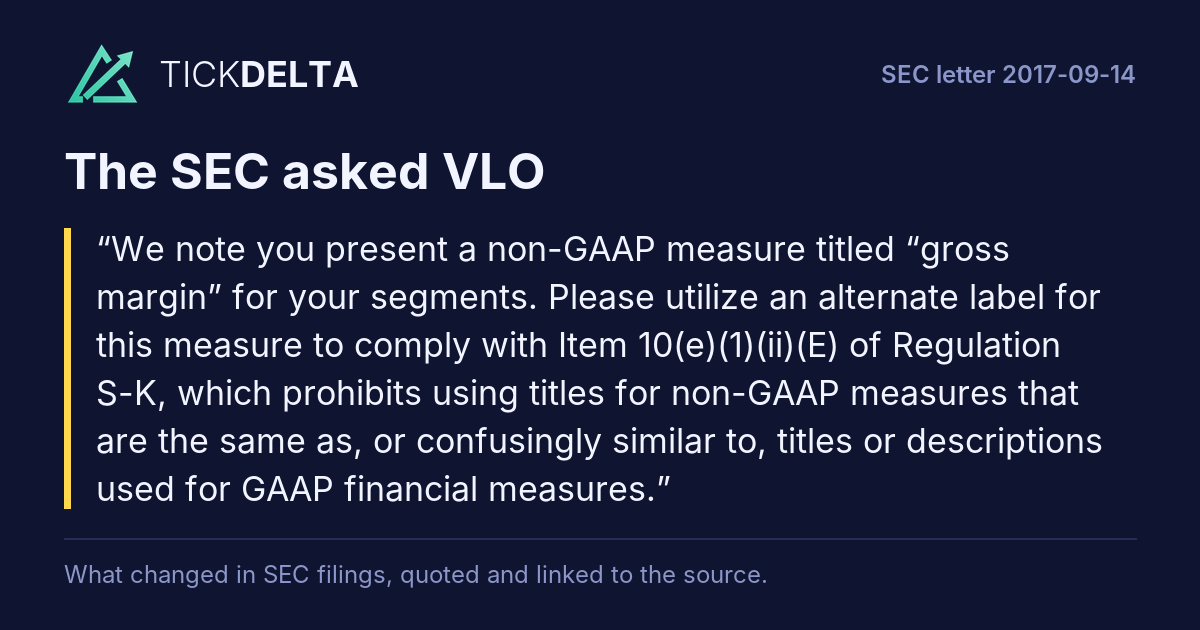
We note you present a non-GAAP measure titled “gross margin” for your segments. Please utilize an alternate label for this measure to comply with Item 10(e)(1)(ii)(E) of Regulation S-K, which prohibits using titles for non-GAAP measures that are the same as, or confusingly similar to, titles or descriptions used for GAAP financial measures.
In response to the Staff’s comment, we will revise in future filings the label of our non-GAAP measure previously titled “gross margin” to “refining margin” or “ethanol margin,” as applicable, in order to distinguish our non-GAAP financial measure(s) from the GAAP term and to comply with Item 10(e)(1)(ii)(E) of Regulation S-K. Read in the reply ↗
First report after the company's reply of 2017-09-22: 10-Q filed 2017-11-07 ↗, against the 10-Q filed 2017-08-07 ↗.
Tickdelta does not hold the text of both reports, so they are not compared here.
Please describe for us any common characteristics of the amounts you report as cost of sales as opposed to operating expenses, and explain your rationale in making a distinction between these two categories of cost.Rest of the question
Tell us the extent to which your operating expenses were inventoriable, based on the guidance in FASB ASC 330-10-30-1 through 8, and explain why you believe these costs are not required to be included in the cost of sales measure that you report pursuant to Rule 5-03.2(a) of Regulation S-X.
The common characteristics of our “cost of sales,” as opposed to our “operating expenses,” are that “cost of sales” primarily relate directly to materials that are a component of our products sold. These costs include (i) the direct cost of materials (such as crude oil and other refinery feedstocks, refined petroleum products and blendstocks, and ethanol feedstocks and products) that are a component of our products sold (see Form 10-K, page 84, Note 4); (ii) costs directly related to the delivery (such as shipping and handling costs) of products sold (see Form 10-K, page 79, Product ShippingRead in the reply ↗Rest of the answer
and Handling Costs); (iii) costs directly related to our environmental credit obligations to comply with various governmental and regulatory programs (such as the cost of renewable identification numbers as required by the EPA’s Renewable Fuel Standard and emission credits under various cap-and-trade systems) (see Form 10-K, page 79, Environmental Compliance Program Costs, and page 131, Environmental Compliance Program Price Risk); and (iv) gains and losses on our commodity derivative instruments (see Form 10-K, page 133, Effect of Derivative Instruments on Income and
Other Comprehensive Income). “Operating expenses” include costs to operate our refineries and ethanol plants. These costs primarily include employee-related expenses, energy and utility costs, catalysts and chemical costs, and repairs and maintenance expenses. Based on the guidance in FASB ASC 330-10-30-1, our operating expenses are inventoriable and, therefore, such costs are included in our product inventory. We believe our presentation of these two categories of costs reflects important measures of operating and financial performance of our refining and ethanol results and is consistent with industry practice.
We also believe the presentation of our statement of income appropriately reflects the components that comprise cost of goods sold as indicated by Rule 5-03.2(a) of Regulation S-X. However, based on the information described above and our review of the disclosure requirements of Rule 5-03.2(a), we propose that our line item label for “cost of sales” be revised and presented as “cost of materials and other” in our future filings.
We also propose to include additional disclosures in our future filings to more clearly describe our cost classifications, which consist of “cost of materials and other” and “operating expenses,” presented in our statement of income as follows:
•
“Cost of materials and other primarily relate directly to materials that are a component of our products sold. These costs include (i) the direct cost of materials (such as crude oil and other refinery feedstocks, refined petroleum products and blendstocks, and ethanol feedstocks and products) that are a component of our products sold; (ii) costs related to the delivery (such as shipping and handling costs) of products sold; (iii) costs related to our environmental credit obligations to comply with various governmental and regulatory programs (such as the cost of renewable identification numbers as required by the EPA’s Renewable Fuel Standard and emission credits under various cap-and-trade systems); and (iv) gains and losses on our commodity derivative instruments.”
“Operating expenses include costs to operate our refineries and ethanol plants, excluding depreciation and amortization expense. These costs primarily include employee-related expenses, energy and utility costs, catalysts and chemical costs, and repairs and maintenance expenses. Depreciation and amortization expense is separately presented in our statement of income and disclosed by reportable segment in Note 16.”
First report after the company's reply of 2017-09-22: 10-Q filed 2017-11-07 ↗, against the 10-Q filed 2017-08-07 ↗.
Tickdelta does not hold the text of both reports, so they are not compared here.
Clarify for us the extent to which the amounts included in your line item, Depreciation and amortization expense, are attributable to your cost of sales. If you rely upon the accommodation outlined in SAB Topic 11.B, in excluding depreciation and amortization from certain cost and expense categories, you should separately report depreciation and amortization that is attributable to each line item from which it hasRest of the question
been excluded.
Approximately 97 percent (or $1.8 billion) of our “depreciation and amortization expense” for the year ended December 31, 2016 relates to “operating expenses” (a component of cost of goods sold) for our refining and ethanol reportable segments, and the remaining 3 percent (or $48 million) relates to our “general and administrative expenses” for our corporate category as disclosed in Note 16 “Segment Information,” on page 120 of the Form 10-K.
In order to clarify our reliance on the accommodation outlined in SAB Topic 11.B to exclude “depreciation and amortization expense” from our “operatingRead in the reply ↗Rest of the answer
expenses” and “general and administrative expenses,” we propose presenting these line item labels in the statement of income in our future filings as “operating expenses (excluding depreciation and amortization expense)” and “general and administrative expenses (excluding depreciation and amortization expense),” respectively. Our segment information note will continue to disclose “depreciation and amortization expense” by segment.
In response to Comments 2 and 3, an example of our proposed statement of income presentation based on December 31, 2016 financial information is shown below:
Operating revenues
$
75,659
Costs and expenses:
Cost of materials and other (excluding the lower of cost or market inventory valuation adjustment)
65,962
Lower of cost or market inventory valuation adjustment
(747
First report after the company's reply of 2017-09-22: 10-Q filed 2017-11-07 ↗, against the 10-Q filed 2017-08-07 ↗.
Tickdelta does not hold the text of both reports, so they are not compared here.
We have read your response to prior comments two and three in which you propose to relabel the line item Cost of sales as “cost of materials and other”, and clarify that amounts reported separately in your Operating expenses line item also include inventoriable costs.Rest of the question
However, the extent to which all of these costs are inventoriable and appropriately characterized as Cost of sales under generally accepted accounting principles remains unclear. We note that although you propose to make various changes to your Statements of Income and related disclosures, the proposed changes do not include a complete Cost of sales measure and do not separately quantify the amounts of depreciation and amortization expense excluded from individual line items. Given your rationale for presenting the various cost categories, we will not object if you wish to include a subtotal of amounts that are appropriately attributed to the Cost of sales measure that is required by Rule 5-03.2(a) of Regulation S-X. However, if you exclude depreciation and amortization expense from this measure, or other cost categories that follow this measure, the excluded amounts should be quantified on separate lines or parenthetically. Please ensure that your computation is consistent with that utilized in computing the gross profit measure that is required for your quarterly periods.
In order to present a cost of sales measure in our statements of income as required by Rule 5-03.2(a) of Regulation S-X, we will include in our future filings with the Commission a subtotal in our statements of income labeled “cost of sales.” The cost of sales subtotal will be comprised of the cost components attributed to that measure, including depreciation and amortization expense.Read in the reply ↗Rest of the answer
In addition, we will reflect that amount of depreciation and amortization expense as a separate component of cost of sales and will, therefore, parenthetically note that the operating expense component excludes the depreciation and amortization expense component in accordance with the accommodation provided by SAB Topic 11.B. Furthermore, we will separately present in our statements of income the amount of depreciation and amortization expense not attributed to cost of sales and will parenthetically note that general and administrative expenses excludes that depreciation and amortization expense amount.
Based on the foregoing, an example of our proposed statement of income using 2016 financial information is shown below (in millions):
Operating revenues
$
75,659
Cost of sales:
Cost of materials and other
65,962
Operating expenses (excluding depreciation and amortization expense reflected below)
4,207
Depreciation and amortization expense
1,846
Lower of cost or market inventory valuation adjustment
(747
)
Total cost of sales
71,268
General and administrative expenses (excluding depreciation and amortization expense reflected below)
715
Asset impairment loss
Operating income
3,572
We believe that the inclusion of a cost of sales measure in our statements of income will clarify that its component parts are inventoriable costs.
As noted in our response to comment 2 below, the gross profit measure that will be included in our disclosure of quarterly financial data will be computed as the difference between operating revenues and the cost of sales subtotal.
In addition, as noted in our response dated September 22, 2017, we will include additional disclosures in our future filings to more clearly describe our cost classifications, which consist of “cost of materials and other” and “operating expenses,” presented in our statements of income.
First report after the company's reply of 2017-10-12: 10-Q filed 2017-11-07 ↗, against the 10-Q filed 2017-08-07 ↗.
Tickdelta does not hold the text of both reports, so they are not compared here.
We note that you have not disclosed all of the information required by Item 302 of Regulation S-K. Please expand your disclosure to include “gross profit (net sales less costs and expenses associated directly with or allocated to products sold or services rendered),” for each quarterly period within the two most recent fiscal years.
In response to the Staff’s comment, we will expand in future filings with the Commission our tabular disclosure of quarterly financial data required by Item 302 of Regulation S-K to include gross profit, and we will include a footnote to that disclosure to describe that gross profit is computed as the difference between operating revenues and cost of sales. In addition, we will ensure that the sum of the quarterly gross profit amounts equals the gross profit for the applicable annual period as computed from the face of our statements of income.Read in the reply ↗Rest of the answer
We will also note the reason(s) for any material changes in quarterly gross profit.
First report after the company's reply of 2017-10-12: 10-Q filed 2017-11-07 ↗, against the 10-Q filed 2017-08-07 ↗.
Tickdelta does not hold the text of both reports, so they are not compared here.
Also in this review: closing letter, 2017-10-17