Form 10-K for the fiscal year ended December 31, 2022
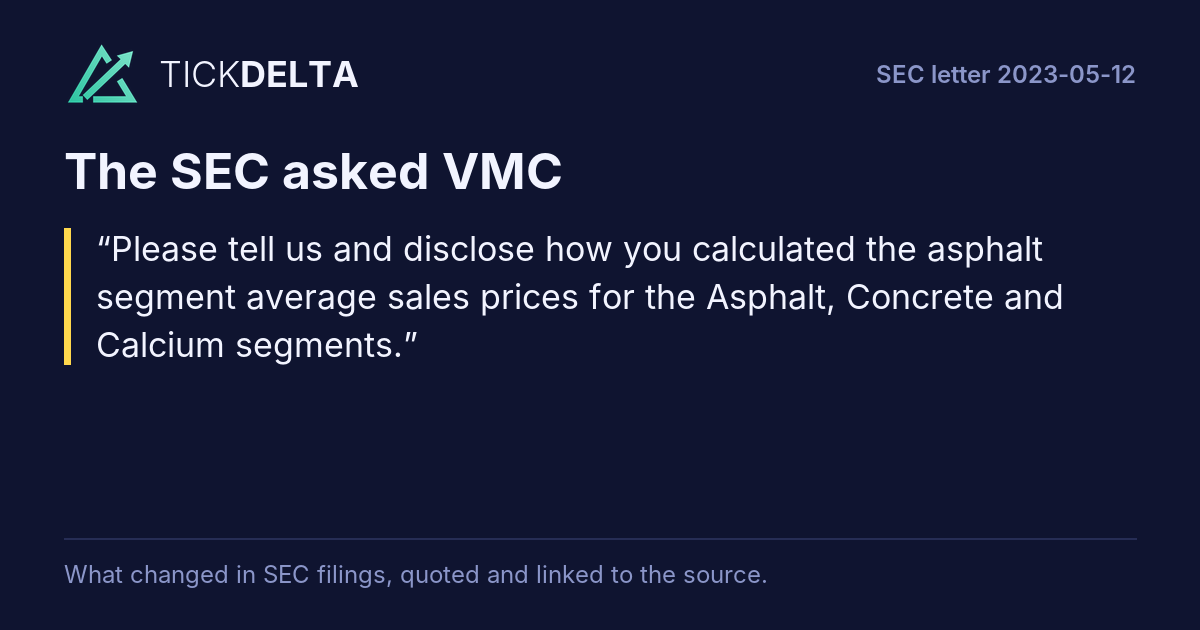
Please tell us and disclose how you calculated the asphalt segment average sales prices for the Asphalt, Concrete and Calcium segments.
We calculate average sales prices for the Asphalt, Concrete and Calcium segments by dividing revenues generated from the shipments of asphalt mix, ready-mixed concrete and calcium carbonate product by the total units of the product shipped. The Asphalt segment average sales price calculation excludes service revenues generated from our asphalt construction paving business. The Concrete segment average sales price calculation excludes immaterial revenues generated from the sale of raw materials.Read in the reply ↗Rest of the answer
To clarify how average sales prices for the Asphalt, Concrete and Calcium segments are calculated, we undertake to modify our disclosure in future filings as follows:
“GAAP does not define “cash gross profit,” and it should not be considered as an alternative to earnings measures defined by GAAP. We and the investment community use this metric to assess the operating performance of our business. Additionally, we present this metric as we believe that it closely correlates to long-term shareholder value. We do not use this metric as a measure to allocate resources. Cash gross profit adds back noncash charges for depreciation, depletion, accretion and amortization to gross profit. Segment cash gross profit per unit is computed by dividing segment cash gross profit by units shipped. Segment cash cost of sales per unit is computed by subtracting segment cash gross profit per unit from segment freight-adjusted sales price. Segment freight-adjusted sales price is calculated by dividing revenues generated from the shipment of product (excluding service revenues generated by the segments) by the total units of the product shipped. Reconciliation of these metrics to their nearest GAAP measures are presented below:”
First report after the company's reply of 2023-06-20: 10-Q filed 2023-08-04 ↗, against the 10-Q filed 2023-05-05 ↗.
Tickdelta does not hold the text of both reports, so they are not compared here.
Your presentation of EBITDA includes an adjustment for discontinued operations. Measures that are calculated differently than those described as EBITDA in Question 103.01 of the Commission’s updated Compliance and Disclosure Interpretations should not be characterized as EBITDA. Accordingly, either revise your calculation of EBITDA or revise the title to distinguish it from EBITDA.
We acknowledge the Staff’s comment and in future filings will revise our calculation of EBITDA to exclude adjustments for discontinued operations in accordance with
Question 103.01 of the Commission’s updated Compliance and Disclosure Interpretations. Read in the reply ↗
First report after the company's reply of 2023-06-20: 10-Q filed 2023-08-04 ↗, against the 10-Q filed 2023-05-05 ↗.
Tickdelta does not hold the text of both reports, so they are not compared here.
We note that Adjusted EBITDA contains adjustments for charges associated with divested operations and adjustments for business development in each of the three years presented. We further note that charges for divested operations describe the amounts as non-routine charges or gains associated with acquisitions or dispositions.Rest of the question
Given that you disclose that acquisitions represent a priority in your growth management and capital allocation, please tell us why these adjustments are deemed appropriate when considering Question 100.01 of the SEC Staff’s Compliance and Disclosure Interpretation on Non-GAAP Financial Measures and Item 10(e)(1)(ii) of Regulation S-K.
We acknowledge the Staff’s comment and considered that the labeling of the business development adjustment may be enhanced to clarify that it is related to certain business acquisition costs. We assess all charges or gains associated with divested operations and business acquisitions against predefined quantitative and qualitative factors. Only amounts that meet our predefined criteria are included in Adjusted EBITDA.
For example, we acquire relatively small, bolt-on businesses regularly but acquisitions requiring clearance under federal antitrust laws are less common.Read in the reply ↗Rest of the answer
We include acquisition related expenses and the cost impact of purchase accounting inventory valuations in Adjusted EBITDA only for acquisitions requiring clearance under federal antitrust laws and only if those costs are expected to exceed a predefined quantitative threshold. Likewise, it is not uncommon that we retain responsibility for environmental matters associated with divested operations. Remediation is generally completed shortly after the divestiture at insignificant cost. Only those retained environmental matters that extend for years and for which costs are expected to exceed a predefined quantitative threshold and can vary significantly period-over-period are included in Adjusted EBITDA. We apply these quantitative and qualitative factors to both charges and gains consistently for each reporting period to ensure that our non-GAAP Adjusted EBITDA measures are not misleading and to provide a more consistent comparison of earnings performance from period to period. We do not refer to these adjustments as non-recurring, infrequent or unusual in compliance with
Item 10(e)(1)(ii) of Regulation S-K. In future filings, we will change the line item “Business development” to “Acquisition related costs”. We will also further clarify the criteria for and nature of the costs included in the adjustment.
The Company acknowledges that it is responsible for the adequacy and accuracy of its disclosures. If you have any questions regarding the above responses, please do not hesitate to call the undersigned at (205) 298-3569.
First report after the company's reply of 2023-06-20: 10-Q filed 2023-08-04 ↗, against the 10-Q filed 2023-05-05 ↗.
Tickdelta does not hold the text of both reports, so they are not compared here.
Also in this review: company letter, 2023-06-06, closing letter, 2023-07-06