Screener / SEC EDGAR /CIK 0000899689 /10-K filed Feb 9, 2026, compared with Feb 10, 2025 /Numbers from the XBRL of the 10-Ks
NYSE, OTC Real estate · REIT

Vornado Realty Trust VNO

Compare with peers Embed
SEC comment letters, last 20 years

6 reviews of VNO's filings by SEC staff

UPLOAD and CORRESP
Reviews 6 latest letter May 18, 2017
Questions asked 21 each answered in the company's own letter
No closing letter 0 reviews without a letter saying the staff completed it

When the SEC's staff reviews a filing, it writes to the company with numbered questions, and the company answers each one in a letter. SEC publishes the exchange once the review is over, at least 20 business days later. A question is not an accusation; most reviews end with the company adding detail to its next filing.

How the reviews went

Every review on EDGAR, from the first staff letter to the letter that closes it

  1. 1. Staff letters 10 UPLOAD
  2. 2. Questions in them 21 numbered comments
  3. 3. Company replies 10 CORRESP
  4. 4. Reviews closed 6 of 6 closing letter

Half the closed reviews took 48 days or less from the first letter to the closing letter.

Form 10-K for the Year Ended December 31, 2016

2017-05-18 to 2017-06-01 · 1 question · 1 letter from the SEC, 1 from the company
Review closed 2017-06-01
Non-GAAP measures
Form 8-K filed on February 14, 2017 · Exhibit 99.1 and Exhibit 99.2
SEC asked
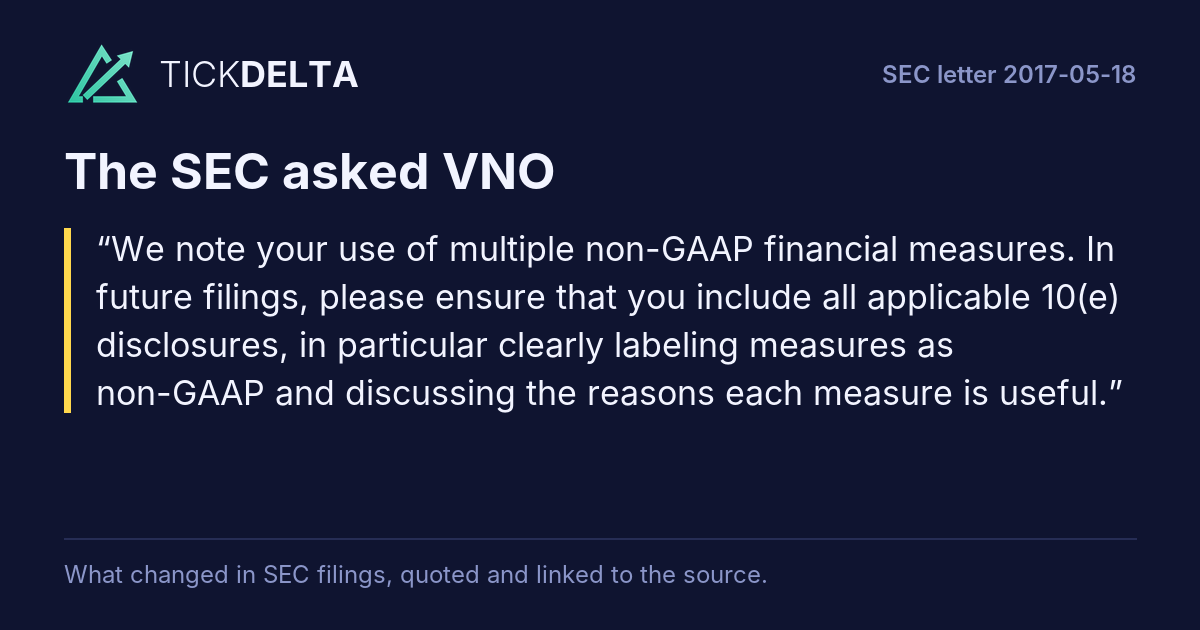
We note your use of multiple non-GAAP financial measures. In future filings, please ensure that you include all applicable 10(e) disclosures, in particular clearly labeling measures as non-GAAP and discussing the reasons each measure is useful.
VNO answered
The Companies acknowledge the Staff’s comment and in future filings will ensure that they include all applicable disclosures required by Item 10(e) of Regulation S-K, in particular clearly labeling measures as non-GAAP and discussing the reasons each such measure is useful. The Companies note that in the case of filings other than the Companies’ Annual Reports on Form 10-K, the Companies may not include the reasons each measure is useful in reliance on Item 10(e)(iii) of Regulation S-K.
Read in the reply
In its next report

First report after the company's reply of May 31, 2017: 10-Q filed Jul 31, 2017 ↗, against the 10-Q filed May 1, 2017 ↗.

Tickdelta does not hold the text of both reports, so they are not compared here.

Also in this review: closing letter, 2017-06-01

Form 10-K for the fiscal year ended December 31, 2015

2016-05-16 to 2016-06-20 · 2 questions · 1 letter from the SEC, 1 from the company
Review closed 2016-06-20
Operations · Capital Expenditures for the Year Ended December 31, 2015, page 82
SEC asked (1)
We note your accounting policy on page 102 indicating that maintenance and repairs are expensed as incurred. Please tell us the composition of capital expenditures that comprise the line item Expenditures to maintain assets, and how such capitalized costs differ from repairs and maintenance costs charged to expense.
VNO answered
The Company notes for the information of the Staff the line item “expenditures to maintain assets” for the year ended December 31, 2015 in the amount of $125,215,000 represents capital expenditures which benefit future periods, such as (i) replacement and/or major upgrades to building mechanical systems such as heating, ventilation and cooling (“HVAC”), elevators and escalators, sprinkler and fire prevention, electrical and lighting, plumbing and (ii) renovations and improvements to lobbies, bathrooms, exterior façades and other building components.
Rest of the answer

In accordance with ASC 970-360, because these expenditures provide a future benefit by extending the useful life of our fixed assets, they are capitalized on our balance sheet. These capitalized expenditures differ from repairs and maintenance costs which are comprised of service maintenance costs and repairs to our building systems mentioned above, painting, metal and marble maintenance and other preventative maintenance items which are expensed as incurred because they do not extend the useful life of our fixed assets.

Read in the reply
In its next report

First report after the company's reply of May 27, 2016: 10-Q filed Aug 1, 2016 ↗, against the 10-Q filed May 2, 2016 ↗.

Tickdelta does not hold the text of both reports, so they are not compared here.

Note 13. Fair Value Measurements · Fair Value Measurements on a Nonrecurring Basis, page 22
SEC asked (2)
Please disclose quantitative information about the significant unobservable inputs used in the fair value measurement of the Skyline properties as required by ASC 820-10-502bbb.
VNO answered
to the Staff’s comment, the Company will revise its disclosure in future periodic filings during 2016 to include significant unobservable quantitative inputs used in determining the fair value of the Skyline properties. The Company will provide this disclosure in Note 9 – Debt of its second quarter consolidated financial statements to be included in its next Form 10-Q substantially as follows:

On March 15, 2016, we notified the servicer of the $678,000,000 mortgage loan on the Skyline properties in Virginia that cash flow will be insufficient to service the debt and pay other property
Rest of the answer

related costs and expenses and that we were not willing to fund additional cash shortfalls. Accordingly, at our request, the loan has been transferred to the special servicer. Consequently, based on our shortened estimated holding period for the underlying assets, we concluded that the excess of carrying amount over our estimated fair value was not recoverable and recognized a $160,700,000 non-cash impairment loss in the first quarter of 2016. The Company’s estimate of fair value was derived from a discounted cash flow model based upon market conditions and expectations of growth and utilized unobservable quantitative inputs including a capitalization rate of 8.0% and discount rate of 8.2%.

We acknowledge that:

· We are responsible for the adequacy and accuracy of the disclosure in the filing;

· Staff comments or changes to disclosure in response to Staff comments do not foreclose the Commission from taking any action with respect to the filing; and

· We may not assert Staff comments as a defense in any proceeding initiated by the Commission or any person under the federal securities laws of the United States.

Any questions or comments with respect to the foregoing may be communicated to Stephen W. Theriot, Chief Financial Officer at (201) 587‑1000.
Read in the reply
In its next report

First report after the company's reply of May 27, 2016: 10-Q filed Aug 1, 2016 ↗, against the 10-Q filed May 2, 2016 ↗.

Tickdelta does not hold the text of both reports, so they are not compared here.

Also in this review: closing letter, 2016-06-20

Vornado Realty Trust · Forms 10-K and 10-K/A for the Fiscal Year Ended December 31, 2014 · Filed February 17, 2015 and March 27, 2015 · File No. 1-11954 · Vornado Realty LP · Filed February 23, 2015 and March 27, 2015 · File No. 1-34482

2015-04-27 to 2015-05-18 · 1 question · 1 letter from the SEC, 1 from the company
Review closed 2015-05-18
Results discussion (MD&A)
Item 7. Management's Discussion and Analysis of Financial Condition and Results of Operations · Funds From Operations (“FFO”), page 93
SEC asked
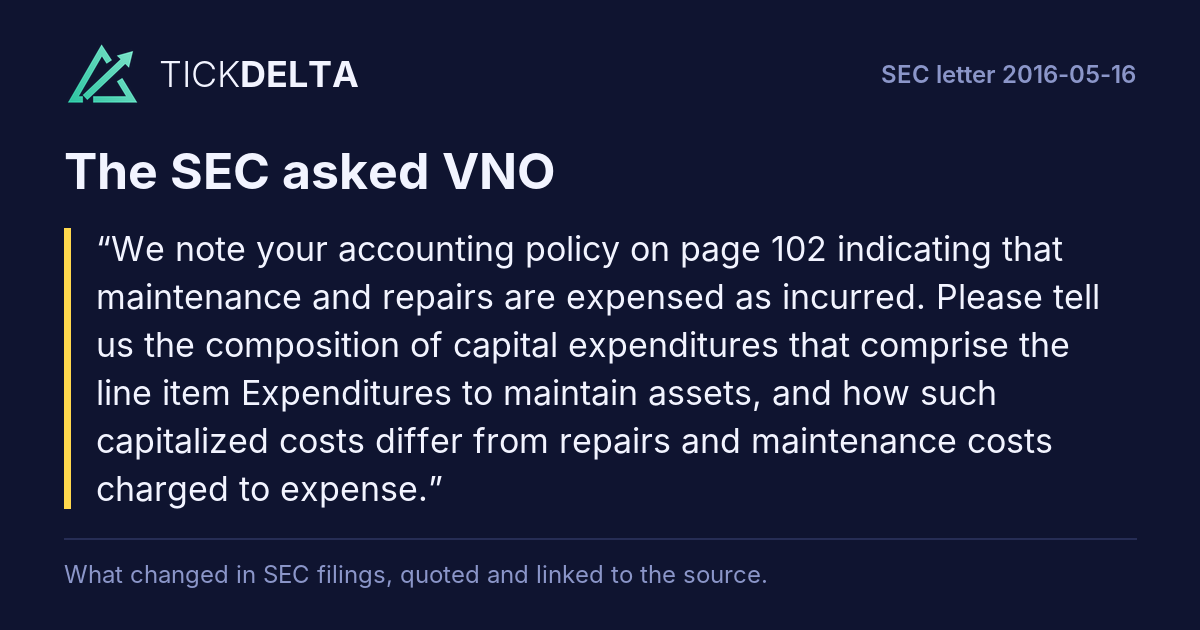
In future filings, please revise your disclosure to identify the line item “FFO” as “FFO – attributable to Vornado”.
VNO answered
Beginning with the Company’s Quarterly Report on Form 10-Q for the quarterly period ended March 31, 2015, the Company has revised its disclosure and identified the line item previously disclosed as “FFO” as “FFO attributable to Vornado”. The Company will continue to identify this line item as “FFO attributable to Vornado” in future filings.

We acknowledge that:

· We are responsible for the adequacy and accuracy of the disclosure in the filing;

· Staff comments or changes to disclosure in response to Staff comments do not foreclose the Commission from taking any action with respect to the
Rest of the answer

filing; and

· We may not assert Staff comments as a defense in any proceeding initiated by the Commission or any person under the federal securities laws of the United States.

Any questions or comments with respect to the foregoing may be communicated to Stephen W. Theriot, Chief Financial Officer at (201) 587‑1000.
Read in the reply

Also in this review: closing letter, 2015-05-18

Form 10-K for the Year Ended December 31, 2013

2014-07-09 to 2014-08-26 · 6 questions · 2 letters from the SEC, 2 from the company
Review closed 2014-08-26
ChinaNon-GAAP measuresLiquidity and cashResults discussion (MD&A)
Form 10-K for the Fiscal Year Ended December 31, 2013 · Item 2. Properties, page 18
SEC asked (1)
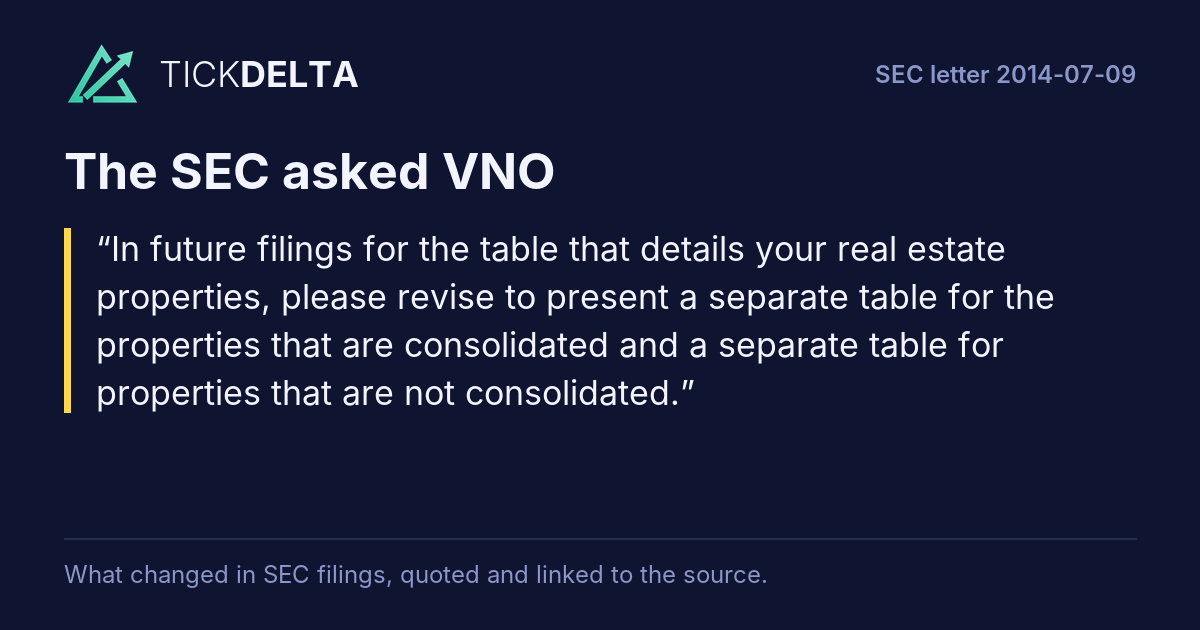
In future filings for the table that details your real estate properties, please revise to present a separate table for the properties that are consolidated and a separate table for properties that are not consolidated.
VNO answered
We note from your response to comment 5 of our letter dated July 9, 2014 that you receive a leasing fee for the leasing of the retail space and that your partner receives a management fee for the management and leasing of the residential space. Please describe for us in detail the terms of all contractual arrangements, that you and your partner have with the VIE and its affiliates, and quantify the fees and reimbursements received by type and by entity for the past three fiscal years.

Company’s Response:

The Company notes for the information of the Staff that the Company first obtained a
Rest of the answer

58.75% common equity interest in the VIE on December 21, 2012 when it exercised a warrant to acquire 25% of an equity interest in the VIE and acquired a 90% interest in another entity (“Plaza Entity”) which owned a 37.5% interest in the VIE. On June 7, 2013, the Company sold a 23.1% interest in the Plaza Entity to its partner which reduced the Company’s interest in the VIE to 50.1% and increased its partner’s interest in the VIE to 49.9%.

The Company notes there are three contractual arrangements that the VIE has with the Company and its partner:

The Company is entitled to receive leasing fees for the retail portion of the property (43,000 square feet of retail space) which were estimated by the Company to aggregate approximately $640,000 on a present-value basis using a 10% discount rate over the estimated 10-year holding period.

The Company’s partner is entitled to receive management and leasing fees for the residential portion of the property (1,328 units aggregating 1.2 million square feet of residential space) which were estimated by the Company to aggregate approximately $10.4 million on a present-value basis using the same discount rate and the same holding period.

The Company’s partner is entitled to receive fees for providing building and maintenance services for the property which were estimated by the Company to aggregate approximately $5.5 million on a present-value basis using the same 10% discount rate and the same holding period.

Agreement for Leasing Retail Space

Pursuant to the December 2012 Exclusive Leasing Brokerage Agreement (“Leasing Agreement”) between the VIE and the Company, upon the execution of new leases for the retail space, the VIE is required to pay a leasing fee to the Company as follows:

a) For the first lease year, 5% of annual rent b) For the second lease year through and including the third lease year, 4% of annual rent c) For the fourth lease year, 2.5% of annual rent d) For the fifth lease year, 3% of annual rent e) For the sixth lease year through and including the eleventh lease year, 2.5% of annual rent f) For the twelfth lease year through and including the twentieth lease year, 2% of annual rent g) For the twenty-first lease year and thereafter, 1% of annual rent

The term of the Leasing Agreement will continue until (1) the VIE transfers its interest in the property to a third party or (2) either the Company or its partner commits a material violation or breach of the LLC Agreement of the VIE.

During the fiscal years ended December 31, 2013, 2012 and 2011, the VIE did not incur, and the Company did not earn, any fees pursuant to the Leasing Agreement.

Agreement for Management of Residential Space

Pursuant to the December 2012 Property Management Agreement (“Management Agreement”) between the VIE and an affiliate of our partner (“Property Manager”), the VIE pays a management fee to the Property Manager equal to 2.0% of total gross receipts. The term of the Management Agreement will continue unless terminated by the VIE upon (1) the Company or its partner committing a material violation or breach of the LLC Agreement of the VIE and (2) the Company’s partner no longer owning an interest in the VIE. Management fees earned by the Property Manager for the fiscal year ended December 31, 2013 were $1,090,312.

Prior to the execution of the Management Agreement, such management services for the VIE were performed by entities controlled by the Company’s partner and a previous investor in the VIE. For the fiscal years ended December 31, 2012 and 2011, these entities charged the VIE management fees of $2,482,714 and $1,243,155, respectively.

Agreement for Building Maintenance Services

Pursuant to the January 2013 Maintenance Agreement between the VIE and an affiliate of the Company’s partner (“Maintenance Manager”), the VIE pays the Maintenance Manager $626,672 per year for providing specified maintenance services to the VIE. In addition, the Maintenance Manager may provide additional building maintenance services for additional fees. The term of the Maintenance Agreement is one year, however, the Company expects that the Maintenance Agreement will be renewed annually over the Company’s 10-year holding period. Building maintenance fees earned by the Maintenance Manager for the fiscal year ended December 31, 2013 were $965,741.

Prior to the execution of the Maintenance Agreement, such building maintenance services for the VIE were performed by the Maintenance Manager. For the fiscal years ended December 31, 2012 and 2011, the Maintenance Manager charged the VIE building maintenance services of $820,525 and $809,723, respectively.

When the Company considered the exposure to the variability associated with the anticipated economic performance of the VIE, the Company did not include the $5.5 million aggregate present value of the building maintenance fees estimated to be paid to the Maintenance Manager as the Company did not consider these fees to be associated with the economic performance of the VIE. Had the Company included the building maintenance fees, the Company’s share of the exposure to the variability of the VIE’s performance would have decreased from 48.5% to 47.6% and our partner’s share of the exposure to the variability of the VIE’s performance would have increased from 51.5% to 52.4%.

The Company notes for the information of the Staff that there are no other contractual arrangements between the Company and its partner and the VIE.

We acknowledge that:

· We are responsible for the adequacy and accuracy of the disclosure in the filing;

· Staff comments or changes to disclosure in response to Staff comments do not foreclose the Commission from taking any action with respect to the filing; and

· We may not assert Staff comments as a defense in any proceeding initiated by the Commission or any person under the federal securities laws of the United States.

Any questions or comments with respect to the foregoing may be communicated to Stephen W. Theriot, Chief Financial Officer at (201) 587‑1000.
Read in the reply
In its next report

First report after the company's reply of Aug 7, 2014: 10-Q filed Nov 3, 2014 ↗, against the 10-Q filed May 5, 2014 ↗.

Tickdelta does not hold the text of both reports, so they are not compared here.

Same Store EBITDA, page 60
SEC asked (2)
We note that you have presented EBITDA on a same-store basis. Please explain to us your basis for referring to your same store EBITDA as GAAP basis when EBITDA is a non-GAAP measure.
VNO answered

No numbered answer found in the reply. Read the reply ↗

In its next report

First report after the company's reply of Aug 7, 2014: 10-Q filed Nov 3, 2014 ↗, against the 10-Q filed May 5, 2014 ↗.

Tickdelta does not hold the text of both reports, so they are not compared here.

Development and Redevelopment Expenditures, page 86
SEC asked (3)
We note that you disclose development and redevelopment expenditures by property that reconcile to the capitalized expenditures included in cash flows from investing activities within the consolidated statement of cash flows. In future filings please also disclose the total amount of soft costs capitalized for the years presented for costs such as interest, payroll and other soft costs.
Rest of the question

We realize that capitalized interest is disclosed elsewhere in the 10-K but we believe it would be helpful to a user of the financial statements to have all of this information included with the chart of capitalized expenditures. 6. Investments in Partially Owned Entities, page 111

VNO answered

No numbered answer found in the reply. Read the reply ↗

In its next report

First report after the company's reply of Aug 7, 2014: 10-Q filed Nov 3, 2014 ↗, against the 10-Q filed May 5, 2014 ↗.

Tickdelta does not hold the text of both reports, so they are not compared here.

Development and Redevelopment Expenditures, page 86
SEC asked (4)
We note that you considered a third-party valuation in determining the fair value of your investment in Toys “R” Us, Inc. Please explain to us and include in future filings the methodologies used to determine the fair value, including a qualitative and quantitative description of the material assumptions and estimates used in the analysis.
VNO answered

No numbered answer found in the reply. Read the reply ↗

In its next report

First report after the company's reply of Aug 7, 2014: 10-Q filed Nov 3, 2014 ↗, against the 10-Q filed May 5, 2014 ↗.

Tickdelta does not hold the text of both reports, so they are not compared here.

Development and Redevelopment Expenditures, page 86
SEC asked (5)
We note that you no longer consolidate Independence Plaza after reducing your economic interest to 50.1% and determining that you are no longer the primary beneficiary of the VIE. Please provide us with your analysis of how you determined that you are no longer the primary beneficiary. Please cite the applicable guidance in your response.
VNO answered

No numbered answer found in the reply. Read the reply ↗

In its next report

First report after the company's reply of Aug 7, 2014: 10-Q filed Nov 3, 2014 ↗, against the 10-Q filed May 5, 2014 ↗.

Tickdelta does not hold the text of both reports, so they are not compared here.

SEC letter of Jul 25, 2014 ↗ no reply letter on EDGAR
Form 10-K for the Fiscal Year Ended December 31, 2013
SEC asked
Investments in Partially Owned Entities, page 111 1. We note from your response to comment 5 of our letter dated July 9, 2014 that you receive a leasing fee for the leasing of the retail space and that your partner receives a management fee for the management and leasing of the residential space.
Rest of the question

Please describe for us in detail the terms of all of the contractual arrangements, including all fee and reimbursement arrangements, that you and your partner have with the VIE and its affiliates, and quantify the fees and reimbursements received by type and by entity for the past three fiscal years.

VNO answered

No reply letter found.

Also in this review: company letter, Jul 21, 2014, closing letter, 2014-08-26

Form 10-Q for the Quarter Ended September 30, 2013

2013-11-18 to 2014-01-30 · 3 questions · 2 letters from the SEC, 2 from the company
Review closed 2014-01-30
Goodwill and impairmentResults discussion (MD&A)
Form 10-Q for the quarter ended September 30, 2013 · LNR Property LLC (”LNR”), page 14
SEC asked
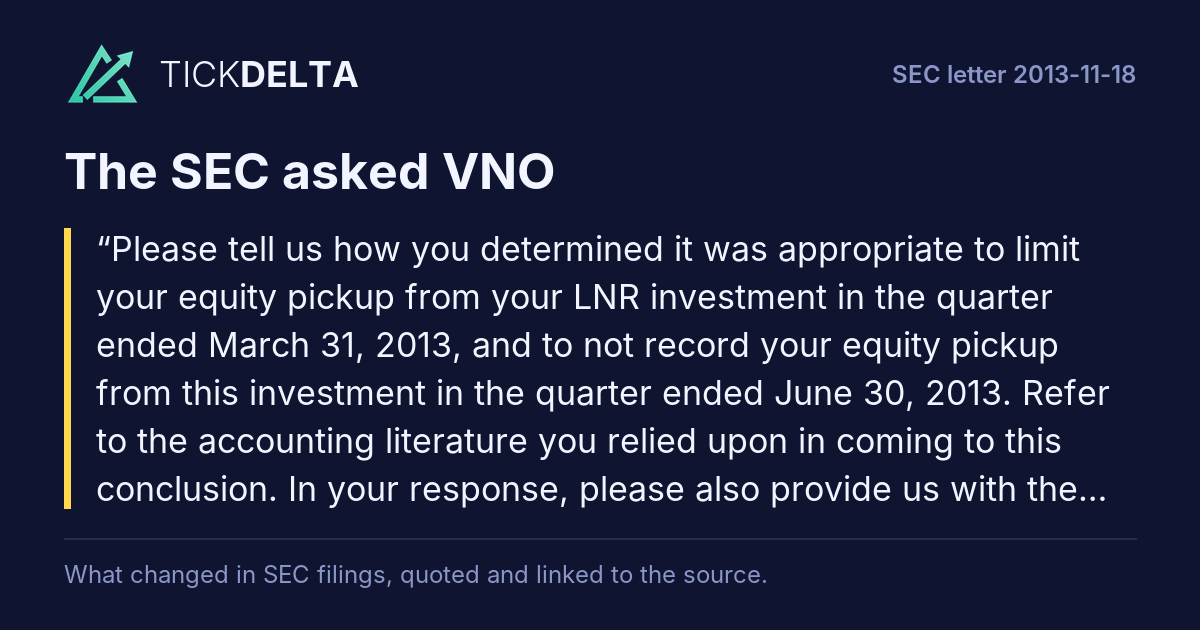
Please tell us how you determined it was appropriate to limit your equity pickup from your LNR investment in the quarter ended March 31, 2013, and to not record your equity pickup from this investment in the quarter ended June 30, 2013. Refer to the accounting literature you relied upon in coming to this conclusion.
Rest of the question

In your response, please also provide us with the financial information you obtained from LNR for the quarters ended September 30, 2012, December 31, 2012, March 31, 2013 and for the period from April 1 until the sale of the investment.

VNO answered
On January 23, 2013, we and the other equity investors in LNR entered into an agreement (the “Unit Purchase Agreement”) to sell LNR to Starwood Property Trust and Starwood Capital Group (“Starwood”). The sale closed on April 19, 2013, prior to the May 6, 2013 filing of our quarterly report on Form 10-Q for the quarter ended March 31, 2013 (the “Form 10-Q). We accounted for our investment in LNR under the equity method and recorded our share of LNR’s earnings on a one-quarter lag basis.
Rest of the answer

As we disclosed on page 14 of the Form 10-Q, our share of proceeds from the sale of our investment in LNR was $241,000,000. Accordingly, our share of LNR’s fourth quarter 2012 earnings, which we recognized in our first quarter ended March 31, 2013, was limited such that the carrying amount of our investment in LNR was equal to our $241,000,000 share of the sale proceeds. Below is a table summarizing the financial information we received from LNR for the periods from July 1, 2012 through April 19, 2013, and our 26.17% share of LNR’s earnings.

LNR Net Income

Our 26.17% share

July 1 – September 30, 2012

$102,969,000

$26,951,000

October 1 – December 31, 2012

$175,603,000

$45,962,000*

January 1- March 31, 2013

**

April 1 – April 19, 2013

_______________________________

* Of which $18,731,000 was recognized in our first quarter ended March 31, 2013 and $27,231,000 was not recognized in earnings. The March 31, 2013 carrying amount of the investment in LNR was equal to the $241,000,000 share of sale proceeds to be received; therefore, we believed that it would not have been appropriate to record any further earnings attributable to LNR.

** We did not receive financial information from LNR for the quarter ended March 31, 2013, or for the period from April 1 through April 19, 2013. We also did not receive any dividends or distributions from LNR from January 1 through January 22, 2013 and were prohibited from receiving any dividends or distributions from LNR subsequent thereto pursuant to the Unit Purchase Agreement.

Our conclusion to limit our share of LNR’s fourth quarter earnings such that the carrying amount of the investment did not exceed our $241,000,000 share of the sales proceeds was based on the Unit Purchase Agreement, which was entered into on January 23, 2013, and resulted in the loss of significant influence, as defined in ASC 323-10 Investments – Equity Method and Joint Ventures, over LNR’s operating and financial policies. Pursuant to Section 6.1, Interim Operations, of the Unit Purchase Agreement (Exhibit 2.1 to Starwood’s current report on Form 8-K dated January 24, 2013), the existing equity holders had effectively given control of LNR to Starwood as of January 23, 2013 and were contractually obligated to maintain “ordinary course” operations during the pendency of the sale, and pursuant to Section 6.18 of the Unit Purchase Agreement, were prohibited from receiving any dividends or distributions from LNR (other than from certain sale proceeds).

Although our loss of significant influence over LNR did not occur until January 23, 2013, we did not recognize the portion of earnings ($27,231,000) related to the fourth quarter of 2012 that would have increased the carrying amount of our investment in LNR above our $241,000,000 share of the sale proceeds, which would have required us to immediately conclude that such additional income was not collectible and, accordingly, require an offsetting impairment charge for the same amount. This treatment would have resulted in the same income recognition in our consolidated statement of income as our share of income from LNR and the offsetting impairment charge would have been presented net, on one-line in “income from partially owned entities” in our consolidated statement of income. We believed that in addition to not being material or meaningful to our shareholders, the additional disclosures surrounding this treatment would have been confusing given that the sale of LNR had been completed and we no longer had any continuing involvement or investment in LNR.

We acknowledge that:

· We are responsible for the adequacy and accuracy of the disclosure in the filing;

· Staff comments or changes to disclosure in response to Staff comments do not foreclose the Commission from taking any action with respect to the filing; and

· We may not assert Staff comments as a defense in any proceeding initiated by the Commission or any person under the federal securities laws of the United States.

Any questions or comments with respect to the foregoing may be communicated to the undersigned (212‑894‑7000) or to Stephen W. Theriot, Chief Financial Officer (201‑587‑1000).

Read in the reply
In its next report

First report after the company's reply of Dec 2, 2013: 10-K filed Feb 24, 2014 ↗, against the 10-K filed Feb 26, 2013 ↗.

Tickdelta does not hold the text of both reports, so they are not compared here.

Form 10-Q for the quarter ended September 30, 2013 · LNR Property LLC (”LNR”), page 14
SEC asked (1)
We note your response to our previous comment, and that you ceased accounting for your investment in LNR under the equity method rather than recording your income with an offsetting impairment. In your next amendment, please revise your accounting for this investment to recognize all income under the equity method in accordance with GAAP, and record impairments or loss on sale as necessary.
Rest of the question

To the extent you believe you should cease equity method accounting for your investment in LNR on January 23, 2013 rather than the date of the sale of your investment, please provide a detailed analysis of your determination, referring to the specific language in the purchase agreement and the accounting literature that led you to this determination. Please note, cessation of dividends and/or distributions does not lead to a cessation in equity method accounting. Please revise your financial statement footnote disclosure to include a table detailing your beginning and ending investment in LNR, your equity in earnings of LNR, your impairment or loss on sale and your sales proceeds for each quarter during 2013.

VNO answered
Please find herein our response to your letter, dated January 8, 2014 on behalf of the Staff of the Division of Corporation Finance (the “Staff”) of the Securities and Exchange Commission (the “Commission”) to Mr. Stephen W. Theriot, Chief Financial Officer of Vornado Realty Trust (“Vornado” and/or the “Company”) regarding the above referenced filing with the Commission. We have carefully considered the Staff’s comment and have provided additional information, as requested. For your convenience, we have included in bold the Staff’s comment before our response.
Rest of the letter

Form 10-Q for the quarter ended September 30, 2013 We note your response to our previous comment, and that you ceased accounting for your investment in LNR under the equity method rather than recording your income with an offsetting impairment. In your next amendment, please revise your accounting for this investment to recognize all income under the equity method in accordance with GAAP, and record impairments or loss on sale as necessary. To the extent you believe you should cease equity method accounting for your investment in LNR on January 23, 2013 rather than the date of the sale of your investment, please provide a detailed analysis of your determination, referring to the specific language in the purchase agreement and the accounting literature that led you to this determination. Please note, cessation of dividends and/or distributions does not lead to a cessation in equity method accounting. Please revise your financial statement footnote disclosure to include a table detailing your beginning and ending investment in LNR, your equity in earnings of LNR, your impairment or loss on sale and your sales proceeds for each quarter during 2013. In response to the Staff’s comment, the Company will include in the footnotes to its consolidated financial statements in its Annual Report on Form 10-K for the year ended December 31, 2013 (the “Form 10-K”), the disclosure set forth below with respect to its investment in LNR. The Company notes for the information of the Staff that it will also include in such disclosures, the disclosures required pursuant to Rule 4-08(g) of Regulation S-X with respect to LNR. In January 2013, we and the other equity holders of LNR entered into a definitive agreement to sell LNR for $1.053 billion, of which our share of the net proceeds was $240.5 million. The definitive agreement provided that LNR would not (i) make any cash distributions to the equity holders, including us, through the completion of the sale, which occurred on April 19, 2013, and (ii) take any of the following actions (among others) without the purchaser’s approval, the lending or advancing of any money, the acquisition of assets in excess of specified amounts, or the issuance of equity interests. Notwithstanding the terms of the definitive agreement, in accordance with GAAP, we recorded our pro rata share of LNR’s earnings through the date of sale, which increased our investment in LNR above our share of the net sales proceeds and resulted in us recognizing an other than temporary impairment loss on our investment during 2013. The following table summarizes the activity related to our investment in LNR by quarter for the year ended December 31, 2013. Please include a discussion of the reasons for your sale of LNR at an amount significantly less than your unimpaired equity method investment in Management’s Discussion and Analysis. In its Form 10-K, the Company will include in Management’s Discussion and Analysis, the following disclosure: On January 23, 2013, we and the other equity holders of LNR entered into a definitive agreement to sell LNR for $1.053 billion, of which our 26.2% share was $275,900,000. The sale was the result of a competitive bidding process that we believe resulted in a sale price that represented the fair value of our investment in LNR. The sale was consummated on April 19, 2013, and we received net proceeds after transaction and closing costs of $240,474,000. In accordance with GAAP, we recognized our share of LNR’s earnings through the closing date, which caused the carrying amount of our investment in LNR, subsequent to the January 2013 sale agreement, to exceed the net proceeds we expected to receive at closing. Accordingly, we recognized an other than temporary impairment loss of $27,231,000 in the three months ended March 31, 2013 and $10,775,000 in the three months ended June 30, 2013. Substantially all of the impairment losses resulted from closing and other costs incurred in this transaction. · We are responsible for the adequacy and accuracy of the disclosure in the filing; · Staff comments or changes to disclosure in response to Staff comments do not foreclose the Commission from taking any action with respect to the filing; and · We may not assert Staff comments as a defense in any proceeding initiated by the Commission or any person under the federal securities laws of the United States. Any questions or comments with respect to the foregoing may be communicated to the undersigned (212‑894‑7000) or to Stephen W. Theriot, Chief Financial Officer (201‑587‑1000).

One letter for all the questions, without numbered answers. Read the reply
In its next report

First report after the company's reply of Jan 22, 2014: 10-K filed Feb 24, 2014 ↗, against the 10-K filed Feb 26, 2013 ↗.

Tickdelta does not hold the text of both reports, so they are not compared here.

Form 10-Q for the quarter ended September 30, 2013 · LNR Property LLC (”LNR”), page 14
SEC asked (2)
Please include a discussion of the reasons for your sale of LNR at an amount significantly less than your unimpaired equity method investment in Management’s Discussion and Analysis.
VNO answered

See the reply above.

In its next report

First report after the company's reply of Jan 22, 2014: 10-K filed Feb 24, 2014 ↗, against the 10-K filed Feb 26, 2013 ↗.

Tickdelta does not hold the text of both reports, so they are not compared here.

Also in this review: closing letter, 2014-01-30

Vornado Realty Trust · Vornado Realty L.P. · Forms 10-K for the Year Ended December 31, 2012 · File Nos. 001-11954 and 001-34482

2013-04-19 to 2013-08-20 · 8 questions · 3 letters from the SEC, 3 from the company
Review closed 2013-08-20
AcquisitionsRevenueResults discussion (MD&A)LeasesDebtGoodwill and impairmentDerivatives and hedging
Form 10-K for the Fiscal Year Ended December 31, 2012 · Management’s Discussion and Analysis of Financial Condition and Results of Operations, page
SEC asked (1)
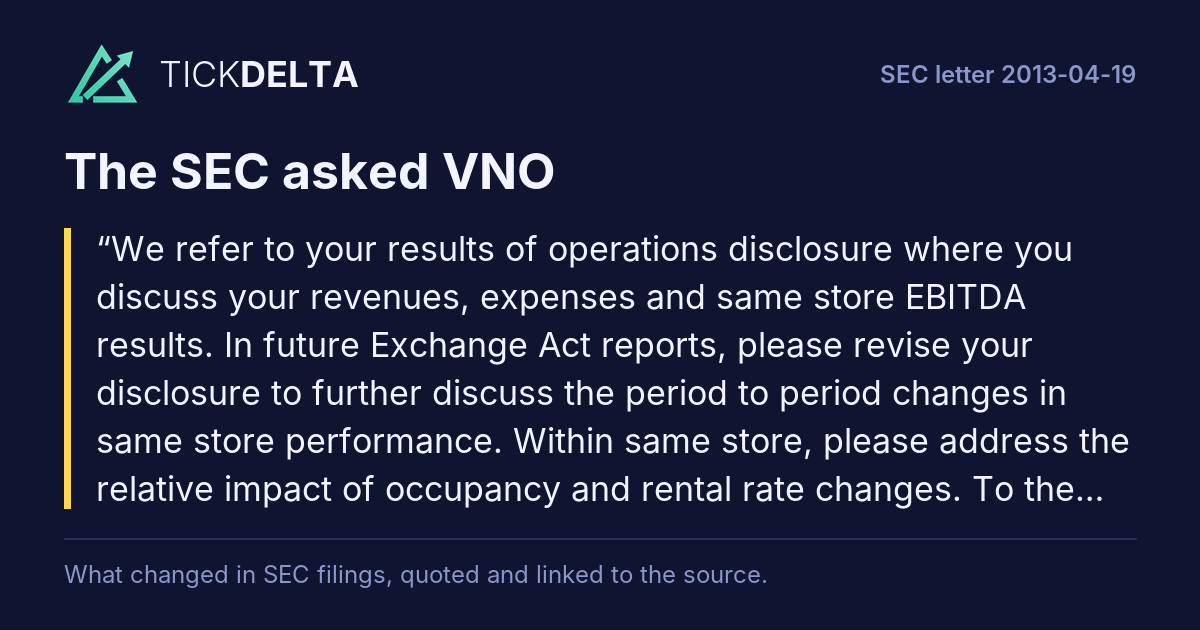
We refer to your results of operations disclosure where you discuss your revenues, expenses and same store EBITDA results. In future Exchange Act reports, please revise your disclosure to further discuss the period to period changes in same store performance. Within same store, please address the relative impact of occupancy and rental rate changes.
Rest of the question

To the extent “same store” is used differently from “same store EBITDA,” please also disclose how you define “same store” for these purposes.

VNO answered

No numbered answer found in the reply. Read the reply ↗

Lease Activity, page 77
SEC asked (2)
We note that leases representing 4.0% and 7.4% of the New York office properties, and 8.1% and 13.7% of the Washington, DC properties are expiring in 2013 and 2014, respectively. We further note that in the property section you disclosed weighted average initial rent per square foot and indicated by footnote that it is indicative of market rents.
Rest of the question

We finally note that, in your response letter dated May 16, 2011, in response to our comment 7 of our comment letter dated April 22, 2011 you stated that you will revise future Exchange Act reports to include the statement that “the Company believes that these rents are indicative of rents to be achieved on leases expiring in the next period” We have been unable to locate this disclosure. Please advise. To the extent the disclosure is not included, in future Exchange Act reports, please clearly discuss the relationship between market rents (current asking rents) and leases expected to expire in the next period.

VNO answered

No numbered answer found in the reply. Read the reply ↗

Acquisitions, page 142
SEC asked (3)
Please provide us with a detailed discussion of the gains that were recognized during 2012 related to Independence Plaza. In your response, please address how the purchase of the debt and the warrant were accounted for, provide us with further details about the debt that was purchased, including the convertibility feature, and tell us how the gain amounts were calculated.
VNO answered
The

Company notes for the information of the Staff that prior to the December 21,

2012 transactions the JV’s only assets were debt securities of the Plaza Entity.

As described in our response to comment 3 of the Staff’s comment letter dated

April 19, 2013, among the transactions related to Independence Plaza that occurred on December 21, 2012 were the exchange of the JV’s debt securities for non-voting, non-transferrable preferred equity interests in the Plaza Entity and the transfer to the JV of non-voting, non-transferrable common interests in the

Plaza Entity formerly held by one of
Rest of the answer

the owners of the Plaza Entity in exchange for certain interests in the JV. Based on the terms of the December 21, 2012 transactions, the Company determined that the Plaza entity met the definition of a business as defined in ASC 805-10, Business Combinations. The

Company also determined that the JV did not meet the definition of a business under ASC 805-10 because the sole assets of the JV consisted of non-voting, non-transferrable common and preferred interests in the Plaza Entity, and because the JV is a holding company that does not have any operational elements, any employees or an integrated set of activities. Notwithstanding the Company’s determination that the JV did not meet the definition of a business, the Company determined it was required to consolidate the JV based on the provisions of ASC 810-10-30.

Accordingly, the Company recorded the JV’s identified assets at their fair value in accordance with ASC 805, which is the same financial statement presentation that would have been required had the JV been determined to be a business.

Read in the reply
Vornado Capital Partners Real Estate Fund, page 143
SEC asked (4)
Please tell us how you have determined it is appropriate to report the Fund’s investments at fair value with changes recognized in earnings.
VNO answered
In the Company’s evaluation of whether Vornado Capital Partners Real Estate Fund (the

“Fund”) met the definition of an Investment Company in accordance with

Accounting Standards Codification (“ASC”) 946-10 Financial Services – Investment

Companies, the Company considered the definition of an investment company in accordance with ASC 946-10-15. The Fund did not adopt Statement of Position 07-1(1) prior to the Financial Accounting Standards Board (“FASB”) indefinitely deferring the guidance in the SOP.
Rest of the answer

Accordingly, the Company’s evaluation was performed under the requirements originally included in the AICPA’s Audit and

Accounting Guide for Investment Companies (currently included in ASC

946-10-15-2).

Fund was established as a separate legal entity (a limited partnership) whose business purpose and activity is investing in real estate for capital appreciation and current income. The Fund has specific investment plans and exit strategies for each of its investments over its eight-year term, which may be extended for two additional years by consent of the partners. In addition, although the

Company is a real estate investment trust (“REIT”), the Fund did not elect REIT status under the Internal Revenue Code. Accordingly, the REIT scope exception in paragraph 946-10-15-3 is not applicable to the Fund.

_____________________________

(1)

AICPA SOP 07-01, Clarification of the Scope of the Audit and Accounting Guide for Investment Companies and

Accounting by Parent Companies and Equity Method Investors for Investments in

Investment Companies.

Company evaluated whether the Fund meets the scope of an investment company in accordance with the requirements of ASC 946-10-15-2, as follows:

a.

Investment activity: The investment company’s primary business activity involves investing its assets, usually in the securities of other entities not under common management, for current income, appreciation, or both.

Consistent with the Fund’s organizational documents, the Company determined that this attribute was met as the Fund’s primary business activity is investing in multiple substantive real estate investments for the maximum possible return through the realization of current income, capital appreciation, or both. The Fund did not contemplate acquisitions of entities that were under common management with the

Company or any of the other partners of the Fund. To date, the eleven investments made by the Fund have been acquired from unrelated third parties. While the Company receives customary market-based fees for certain management activities, the Fund utilizes third party property management and leasing companies

(who are not affiliates of the Company or any of the Fund’s other investors) for the majority of its investments and a third party hotel operator for its investment in a New York City hotel.

b.

Unit ownership: Ownership in the investment company is represented by units of investments, such as shares of stock or partnership interests, to which proportionate shares of net assets can be attributed.

Company determined that this attribute was met as each of the Fund’s investors has a proportional partnership interest to which the net assets of the Fund are attributed on a quarterly basis.

c.

Pooling of funds: The funds of the investment company’s owners are pooled to avail owners of professional investment management.

Company determined that this attribute was met as the Fund’s business objective is to provide investors with the opportunity to pool capital in a professionally managed investment vehicle with multiple substantive real estate investments. The

Fund has seven investors, including the Company, which $800 million of total capital committed to the Fund. In addition to the Company, the Fund’s investors include three pension funds, two private equity funds and a foreign sovereign investor.

d.

Reporting Entity: The investment company is the primary reporting entity.

Company concluded that this attribute was met as the Fund is the primary reporting entity for reporting to the Fund’s partners the financial position and results of operations of their proportional interest in Fund. The Fund distributes audited financial statements to its investors annually and provides investors with fair value information quarterly.

addition to the above, the Company also considered its objective in forming the

Fund, which was to provide an opportunity for investors to invest in a real estate investment fund whose primary purpose is maximizing the return to the investors.

The Company has a 25% interest in the Fund to share in the risk and rewards of investment ownership. The Company is also expressly prohibited from acquiring any of the Fund’s investments from, or selling any of its assets to, the Fund.

summary, based on the Company’s evaluation of all of the above criteria, the

Company concluded that the Fund met the definition of an investment company in accordance with ASC 946-10 Financial Services – Investment Companies.

We acknowledge that:

· We are responsible for the adequacy and accuracy of the disclosure in the filing;

· Staff comments or changes to disclosure in response to Staff comments do not foreclose the Commission from taking any action with respect to the filing; and

· We may not assert Staff comments as a defense in any proceeding initiated by the Commission or any person under the federal securities laws of the United States.

Any questions or comments with respect to the foregoing may be communicated to the undersigned (212‑894‑7000) or to Stephen Theriot, Chief Financial Officer (201‑587‑1000).

Read in the reply
Marketable Securities and Derivative Instruments, page 145
SEC asked (5)
Please tell us whether the significant loss of value of the common shares of JC Penney during the first quarter 2013, or your sale of shares of JC Penney during the quarter at a significant loss caused you to evaluate your remaining investment in JC Penney for impairment. Please tell us whether or not you considered reporting the impairment, or the material realized loss on the sale of the shares on Form 8-K.
VNO answered

No numbered answer found in the reply. Read the reply ↗

SEC letter of Jun 5, 2013 ↗ no reply letter on EDGAR
Form 10-K for the Fiscal Year Ended December 31, 2012
SEC asked (3)
Acquisitions, page 142 1. We have reviewed your response to comment 3. Please tell us how you determined the JV was not a business.
VNO answered

No reply letter found.

Form 10-K for the Fiscal Year Ended December 31, 2012
SEC asked (4)
Vornado Capital Partners Real Estate Fund, page 143 2. We have reviewed your response to comment 4. Please provide us with a detailed analysis showing us how you came to the determination that Vornado Capital Partners Real Estate Fund met the definition of an Investment Company in accordance with Accounting Standards Codification (“ASC”) 946-10 Financial Services – Investment Companies.
VNO answered

No reply letter found.

Form 10-K for the Fiscal Year Ended December 31, 2012
SEC asked
Vornado Capital Partners Real Estate Fund, page 143 1. We have reviewed your response to comment 2 and it is not clear how the investments of the Fund are not for strategic operating purposes given that the properties are similar to those you invest in, and that you are the investment manager. Please tell us more about your overall purpose in creating this entity, and your reasons for structuring it in this manner.
Rest of the question

In addition please provide the following:  An analysis of each management agreement with third parties for the properties in the Fund;  An analysis of the management agreement with the general partner for certain management services;  Copies of the management agreements;  Amounts earned by the REIT under the management agreement for each year and a description of all services provided;  The limited partnership agreement  The Fund subscription agreement and any related offering document;  An analysis of the rights and obligations of the general partner and limited partners, including whether or not the limited partners can remove the general partner; and  The by-laws of the Fund. Additionally, please clarify what is included in the line item Operating income (loss) in the table on page 144. Refer to ASC-946-225-45. Finally, please tell us what impact you believe the new guidance within ASC 946, effective for periods ending after December 15, 2013, will have on the Fund’s investment company accounting, and your retention of the Fund’s accounting in your consolidated financial statements. Refer to ASC 946-81045-5b.

VNO answered
· Amounts earned by the REIT under the management agreement for each year end and a description of the services provided;

­SC1:3482316.2

· The limited Partnership Agreement;

· The Fund subscription agreement and any related offering document;

· An analysis of the rights and obligations of the general partner and limited partners; including whether or not the limited partners can remove the general partner; and

· The by-laws of the Fund.

Additionally, please clarify what is included in the line item Operating income (loss) in the table on page 144. Refer to ASC 946-225-45.
Rest of the answer

Finally, please tell us what impact you believe the new guidance within ASC 946, effective for periods ending after December 15, 2013, will have on the Fund’s investment company accounting, and your retention of the Fund’s accounting in your consolidated financial statements. Refer to ASC 946-810-45-5b.

Company’s Response:

Following discussions with the Staff, the Company was informed by the Staff on August 14, 2013 that the Staff is no longer pursuing these comments.

We acknowledge that:

· We are responsible for the adequacy and accuracy of the disclosure in the filing;

· Staff comments or changes to disclosure in response to Staff comments do not foreclose the Commission from taking any action with respect to the filing; and

· We may not assert Staff comments as a defense in any proceeding initiated by the Commission or any person under the federal securities laws of the United States.

Any questions or comments with respect to the foregoing may be communicated to the undersigned (212‑894‑7000) or to Stephen Theriot, Chief Financial Officer (201‑587‑1000).

Read in the reply

Also in this review: company letter, May 15, 2013, closing letter, 2013-08-20

From the SEC's correspondence on EDGAR: staff letters (form UPLOAD) and company letters (form CORRESP), 26 letters filed since 2013-04-19. Questions and answers are matched by their numbers; topics come from words in each question. The reports are compared word for word (same form, before the first SEC letter against the first report after the company's reply). No AI.

Sources

The SEC's correspondence on EDGAR: staff letters (form UPLOAD) and company letters (form CORRESP), matched question by question. No AI.

Also

Filings: the letters in the filing list.

Work with it

Excel workbook · CSV. Google Sheet that stays up to date: paste =IMPORTDATA("https://tickdelta.com/company/VNO/export.csv") into a cell.

Next in Owners and insiders:Insider trades
Esc

Type a ticker such as AAPL, a name, an investor such as Buffett, or a topic such as tariffs. ↑ ↓ to move, Enter to open.