Form 10-K
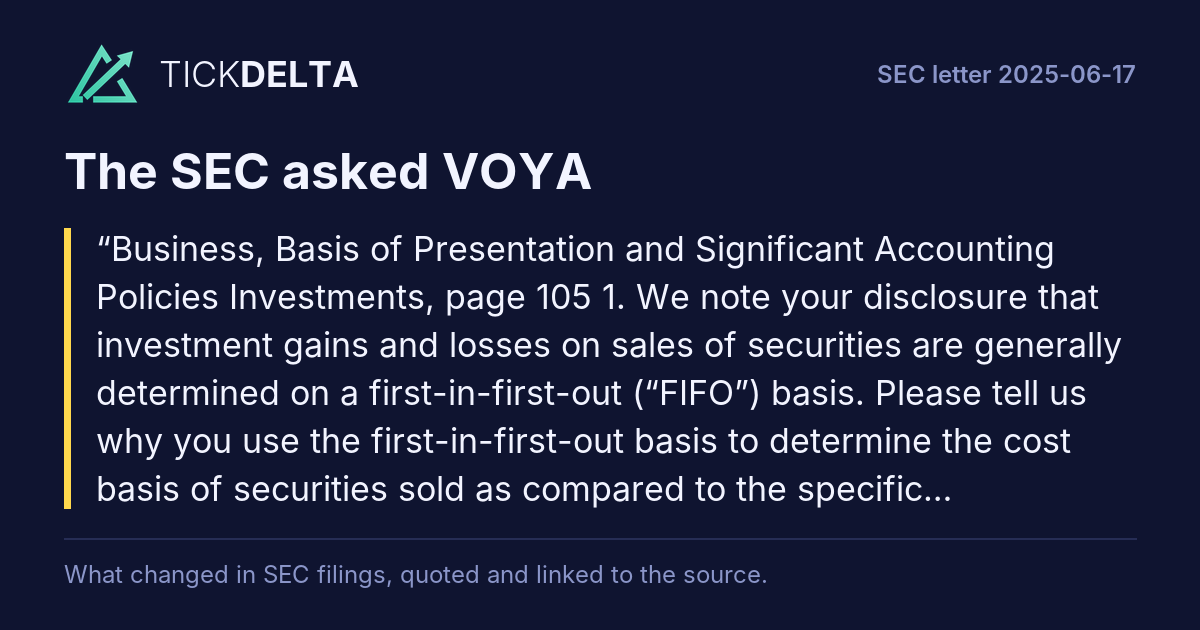
Business, Basis of Presentation and Significant Accounting Policies Investments, page 105 1. We note your disclosure that investment gains and losses on sales of securities are generally determined on a first-in-first-out (“FIFO”) basis. Please tell us why you use the first-in-first-out basis to determine the cost basis of securities sold as compared to the specific identification method.Rest of the question
Tell us the nature of your investments that results in first-in-first-out being appropriate. 4. Insurance Subsidiaries
While we use the FIFO basis to determine the cost basis of securities sold, as currently disclosed, we do apply the specific identification method in order to record gains and losses in accordance with GAAP. Upon acquiring these securities, our portfolio management system assigns a CUSIP (asset identifier) and a specific lot number for each traded quantity (“Specific Lot”), along with the cost basis for each Specific Lot purchased.Read in the replyRest of the answer
At the time of disposition, the Company identifies the CUSIP and the Specific Lot it plans to sell, and our portfolio management system processes the disposition in an ascending order using the FIFO basis to account for partial sales of a Specific Lot. Our portfolio management system then calculates gains and losses for each lot using the disposition proceeds and the amortized cost basis associated with the Specific Lot sold. This approach provides a systematic and rational method of specific identification and supports our ability to accurately account for investment gains and losses in accordance with GAAP.
Voya.com
United States Securities And Exchange Commission | July 1, 2025
Page
Our current disclosure was intended to indicate this manner of using the FIFO basis to account for partial sales, and that investment gains and losses are calculated based on the amortized cost basis associated with the Specific Lot sold. To clarify, we will update our future filings in Note 1: Business, Basis of Presentation, and
Significant Accounting Policies as follows:
“Investment gains and losses on sales of securities are generally determined based on the amortized cost of the asset being disposed of using the specific identification method”.
We believe that
FIFO, with the specific identification method as described above, is appropriate given the nature of our investments. Our investment strategy seeks to achieve sustainable risk-adjusted returns by focusing on principal preservation, disciplined matching of asset characteristics with liability requirements and the diversification of risks. Consequently, our investment portfolio is predominantly comprised of high-credit-quality, fixed-income securities.
4. Insurance Subsidiaries
For each material entity, please provide us with, and revise future filings to disclose, the amount of statutory capital and surplus necessary to satisfy regulatory requirements if significant in relation to the entity’s statutory capital and surplus. Refer to ASC 944-505-50-1 for guidance. Exhibit 99.1 Reconciliation of Net Income (Loss) to Adjusted Operating Earnings and Earnings Per Share (Diluted), page 3
ASC 944-505-50-1(b) requires the Company to disclose “The amount of statutory capital and surplus necessary to satisfy regulatory requirements (based on the entity’s current operations) if significant in relation to the entity’s statutory capital and surplus”. The minimum statutory capital and surplus necessary to satisfy regulatory requirements for each of the Company’s principal insurance subsidiaries, Voya Retirement Insurance and Annuity Company (“VRIAC”), domiciled in Connecticut, and ReliaStar Life Insurance Company (“RLIC”), domiciled in Minnesota, are $1 million for statutory capitalRead in the replyRest of the answer
and $2 million for surplus capital. These amounts, when compared to the combined statutory capital and surplus as of December 31, 2024 for VRIAC and RLIC, which were $2,033 million and $1,098 million, respectively, were deemed insignificant. Consequently, management determined that these amounts do not warrant separate disclosure based on the referenced guidance.
Form 8-K filed May 6, 2025
Exhibit 99.1
Reconciliation of Net Income (Loss) to
Adjusted Operating Earnings and Earnings Per Share
(Diluted), page 3
First report after the company's reply of Jul 1, 2025: 10-Q filed Aug 7, 2025 ↗, against the 10-Q filed May 8, 2025 ↗.
Tickdelta does not hold the text of both reports, so they are not compared here.
Please tell us how you considered whether the adjustment for alternative investment income and prepayment fees above (below) long-term expectations net of variable compensation, as shown throughout Exhibits 99.1 and 99.2, substitutes an individually tailored recognition and measurement method for those of GAAP, which results in a misleading non-GAAP measure that violates Rule 100(b) of Regulation G.Rest of the question
Please refer to Question 100.04 of the Division of Corporation Finance’s Compliance & Disclosure Interpretations on Non-GAAP Financial Measures for guidance. Alternatively, please remove this adjustment from future filings.
The Company has considered Question 100.04 of the Compliance and Disclosure Interpretations (C&DI) onRead in the reply
Non-GAAP Financial Measures and does not believe that the adjustment for alternative investment income and prepayment fees above (below) long-term expectations net of variable compensation substitutes an individually tailored recognition and measurement method for those of GAAP.Rest of the answer
Our reporting of alternative investment income and prepayment fees continues to use the same accounting policies and procedure as we do for the most directly comparable GAAP measure, including a marked-to-market valuation approach, with the only further adjustment being an arithmetical addition or subtraction to a disclosed benchmark. In the Company’s view, this does not result in a non-GAAP measure that substitutes a different recognition or measurement method akin to the examples described in CD&I 100.04. Therefore, the Company believes that the adjustment does not result in a misleading non-GAAP measure that violates Rule 100(b) of Regulation G. Additionally, reporting these amounts in our investor materials is common among our peers and commonly referred to by investors and peers as
“Variable Income”. The purpose of this adjustment is to help our investors understand the variance between the alternative investment income and prepayment fees reported in our Adjusted Operating Earnings, which is consistent with GAAP but which varies significantly from period to period based on market conditions, versus an established benchmark represented by our expected long-term return on these investments. We refer to this adjustment as a “notable item”.
In accordance with Regulation G, we provide a reconciliation between our GAAP Net Income and Loss Before Income Taxes and our Adjusted
Operating Earnings Before Income Taxes, as well as a reconciliation between our Adjusted Operating Earnings Before Income Taxes and our Adjusted Operating Earnings Before Income Taxes Excluding Notable Items. The actual amount of alternative investment income and prepayment fees for each period presented, our expectations for alternative investment income and prepayments fees for each period presented, and the amount above (below) our expectations are transparently provided to enable investors to understand the metric and the amounts included in the Notable Items as defined in Exhibits 99.1 and 99.2.
First report after the company's reply of Jul 1, 2025: 10-Q filed Aug 7, 2025 ↗, against the 10-Q filed May 8, 2025 ↗.
Tickdelta does not hold the text of both reports, so they are not compared here.
Please provide us with, and revise future filings to include, a reconciliation of adjusted operating benefits and expenses to the most directly comparable U.S. GAAP measure, which appears to be benefits and expenses as presented in the consolidated statement of operations on page 6.Rest of the question
In your response and revised disclosures, explain what the adjustments represent, the underlying reason for the adjustments, and why you consider the resulting measure (i.e., adjusted operating benefits and expenses) to be useful in understanding your overall results of operations. Further, please revise future filings to label adjusted operating benefits and expenses as a non-GAAP measure or explain to us why this is not necessary.
The Company has historically provided a reconciliation of Adjusted Operating Revenue and Adjusted Operating Earnings Before Income Taxes to the most directly comparable U.S. GAAP measures, and we have provided an explanation of what the adjustments represent and the reason for the adjustments. The reconciliation and explanations of Adjusted Operating Earnings Before Income Taxes included the adjustments between Adjusted Operating Benefits and Expenses and Total Benefits and Expenses.Read in the replyRest of the answer
However, in response to the Staff’s comment, the Company will revise future filings to include a separate reconciliation and explanation for the adjustments between Adjusted Operating Benefits and Expenses and Total Benefits and Expenses similar to what is presented below, and we will label Adjusted Operating Benefits and Expenses as a Non-GAAP measure. We believe that Adjusted Operating Revenue, Adjusted Operating Benefits and Expenses, and Adjusted Operating Earnings Before Income Taxes are meaningful measures used by management and investors to evaluate our business and segment performance. These measures enhance the understanding of our financial results by focusing on the operating performance and trends of the underlying core business segments. They exclude results from exited businesses and items that tend to be highly variable from period to period based on capital market conditions or other factors which distort the ability to make a meaningful evaluation of our segments. The Company will rely on existing disclosures that explain what the adjustments represent and the underlying reason for the adjustments, in order to avoid redundancy. Below is the proposed reconciliation disclosure we plan to include in future filings:
Adjusted Operating Benefits and Expenses
Adjusted operating benefits and expenses is a measure of our segment operating benefits and expenses and a non-GAAP financial measure. Each segment’s Adjusted operating benefits and expenses are calculated by adjusting Total benefits and expenses for the following items:
•
Changes in market risk benefits;
Benefits and expenses related to businesses exited or to be exited through reinsurance or divestment;
Expenses attributable to noncontrolling interests;
Dividend payments made to preferred shareholders are included in adjusted operating benefits and expenses to reflect expenses related to our common shareholders;
Other adjustments include:
Income (loss) related to early extinguishment of debt;
Impairment of goodwill and intangible assets;
Amortization of acquisition-related intangible assets as well as contingent consideration fair value adjustments incurred in connection with certain acquisitions;
Expected return on plan assets net of interest costs associated with our qualified defined benefit pension plan and immediate recognition of net actuarial gains (losses) related to all of our pension and other postretirement benefit obligations and gains (losses) from plan amendments and curtailments;
Commissions paid to our broker-dealers for sales of non-proprietary products and other items where the income is passed on to third parties, which are reflected in adjusted operating revenue with the fee income related to those products;
Other items not indicative of normal operations or performance of our segments or that may be related to events such as capital or organizational restructurings, including certain costs related to debt and equity offerings, acquisition / merger integration expenses, severance and other third-party expenses associated with such activities, and expenses attributable to vacant real estate.
The most directly comparable U.S. GAAP measure to Adjusted operating benefits and expenses is Total benefits and expenses. For a reconciliation of Adjusted operating benefits and expenses to Total benefits and expenses, refer to the “Reconciliations” section of this document.
Three Months Ended
Year-to-Date
(In millions USD)
12/31/2024
9/30/2024
6/30/2024
3/31/2024
12/31/2023
Total benefits and expenses
(1,890
)
(1,840
(1,757
(1,764
(1,717
(7,251
(6,670
Less:
Changes in market risk benefits
—
Benefits and Expenses related to businesses exited or to be exited through reinsurance or divestment
(35
(104
(50
(56
(120
(244
(295
Expenses attributable to noncontrolling interests
(51
(85
(39
(53
(231
(191
Dividend payments made to preferred shareholders
Other adjustments
(83
(79
(54
(74
(89
(291
(391
Total Adjusted operating benefits and expenses
(1,728
(1,622
(1,576
(1,629
(1,471
(6,554
(5,858
Adjusted operating benefits and expenses by segment
Wealth Solutions
(521
(516
(534
(539
(2,085
(2,144
Health Solutions
(990
(869
(832
(846
(720
(3,537
(2,767
Investment Management
(182
(171
(169
(181
(170
(703
(690
Corporate
(66
(59
(68
(42
(228
(256
First report after the company's reply of Jul 1, 2025: 10-Q filed Aug 7, 2025 ↗, against the 10-Q filed May 8, 2025 ↗.
Tickdelta does not hold the text of both reports, so they are not compared here.
Please tell us, and revise future filings to disclose, what the adjustment for interest credited and other benefits to contract owners/policyholders represents, the underlying reason for the adjustment, and to explain in more detail why you consider the resulting measure (i.e., Net Revenue) to be useful in understanding your overall results of operations.
The adjustment for interest credited and other benefits to contract owners/policyholders primarily reflects the interest credited to customers for General Account products in our Wealth and Health Segments and the benefits paid to customers in our Health Segment for Group Life, Stop Loss, and Voluntary products. This adjustment allows us to report to investors our “Investment Spread” and our “Net Underwriting Gain and Loss”, which are meaningful measures used by management to evaluate our business and segment performance.Read in the replyRest of the answer
Investment Spread informs investors how we set crediting rates relative to the yield we earn on our general account investments and Net Underwriting Gain and Loss informs investors how we set premiums relative to incurred benefits to policyholders (“Loss Ratio”).
The Company believes that providing Investment Spread, Fee Income, Net Underwriting Gain and Loss and the sum of those revenue sources
(“Net Revenue”) enhances the understanding of our financial results and the operating performance of our underlying core business segments. In response to the Staff’s comment, we will expand on current definitions on page 4 of Exhibit
99.2 to include what the adjustment for interest credited and other benefits to contract owners/policyholders represents. See bolded section below.
4 of Exhibit 99.2
Net revenue is the sum of investment spread and other investment income, fee-based margin, and net underwriting gain (loss). Please see the “Reconciliations” section of this document for reconciliation of net revenue to adjusted operating revenue for each of our segments.
The primary adjustment is “Interest credited and other benefits to contract owners / policyholders”.
This adjustment primarily reflects the interest credited to customers for General Account products in our Wealth and Health Segments and the benefits paid to customers in our Health Segment for Group Life, Stop Loss, and Voluntary products. This adjustment allows us to report to investors our “Investment Spread” and our “Net Underwriting Gain and Loss”, which are meaningful measures used by management to evaluate our business and segment performance. Investment Spread informs investors how we set crediting rates relative to the yield we earn on our general account investments and Net Underwriting Gain and Loss informs investors how we set premiums relative to incurred benefits to policyholders (“Loss
Ratio”).
First report after the company's reply of Jul 1, 2025: 10-Q filed Aug 7, 2025 ↗, against the 10-Q filed May 8, 2025 ↗.
Tickdelta does not hold the text of both reports, so they are not compared here.
Please refer to prior comment 3. Adjustments related to actual financial results above/(below) management's expectations substitute an individually tailored recognition and measurement method for those of GAAP, which results in a misleading non-GAAP measure that violates Rule 100(b) of Regulation G. In future filings, please remove these adjustments from your non-GAAP financial measures.Rest of the question
Please refer to Question 100.04 of the Division of Corporation Finance's Compliance & Disclosure Interpretations on Non-GAAP Financial Measures.
No numbered answer found in the reply. Read the reply ↗
Also in this review: closing letter, 2025-08-15