Form 10-Q for the Quarter Ended March 31, 2019
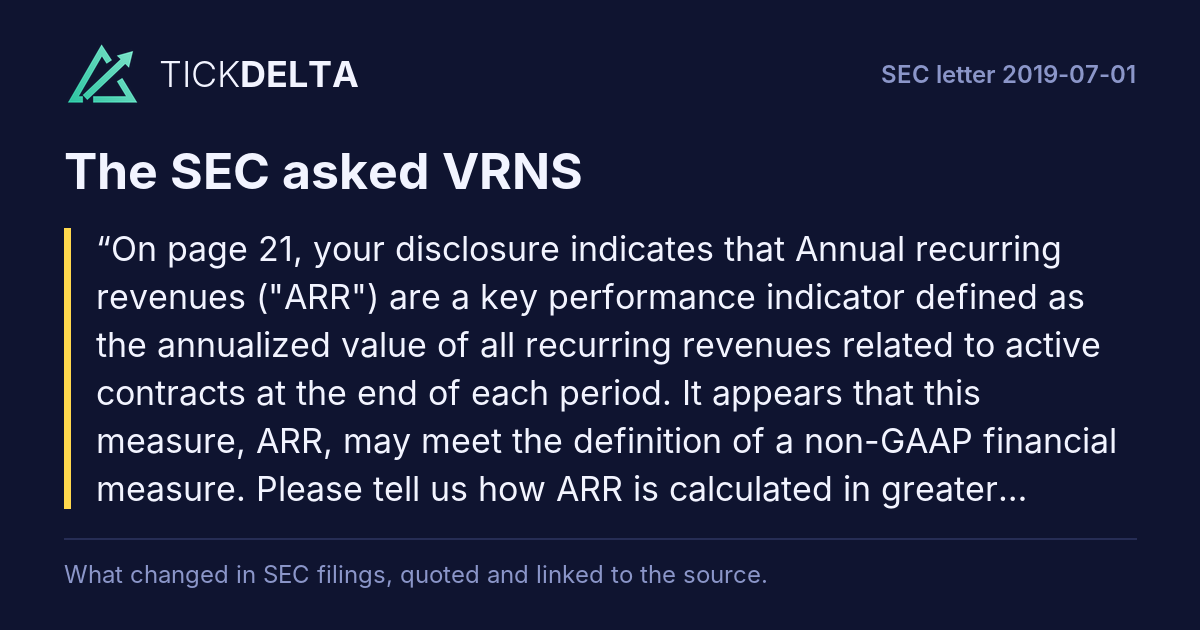
On page 21, your disclosure indicates that Annual recurring revenues ("ARR") are a key performance indicator defined as the annualized value of all recurring revenues related to active contracts at the end of each period. It appears that this measure, ARR, may meet the definition of a non-GAAP financial measure.Rest of the question
Please tell us how ARR is calculated in greater detail; how management uses this measure; why it is useful to investors; and, how you considered Item 10(e)(2) of Regulation S-K and Rule 100 of Regulation G. We note that you cited this measure in your earnings release dated April 29, 2019, which was furnished as exhibit 99.1 to Form 8-K on the same date.
The Company respectfully advises the Staff that it believesRead in the reply
ARR as used by the Company is not a non-GAAP financial measure. ARR represents the annualized value of all active contracts at the end of the relevant reporting period. As such, ARR is purely a contractual determination made solely by examining the legal and contractual terms of active revenue-producing contracts and multiplying their value by a factor of time. ARR should be viewed independently of revenue and deferred revenue as ARR and is not intended to be combined with or replace these items.Rest of the answer
As a result of not being calculated by reference to a GAAP financial measure, ARR is an operating metric and not a non-GAAP financial measure.
Further support for this determination can be found in the definition of non-GAAP financial measure in Rule 101 of Regulation G and Item 10(e) of Regulation S-K. Pursuant to that definition
(with our emphasis),
“[a] non-GAAP financial measure is a numerical measure of a registrant’s historical or future financial performance, financial position or cash flows that:
(i) [e]xcludes amounts, or is subject to adjustments that have the effect of excluding amounts, that are included in the most directly comparable measure calculated and presented in accordance with GAAP in the statement of income, balance sheet or statement of cash flows (or equivalent statements) of the issuer; or
(ii) [i]ncludes amounts, or is subject to adjustments that have the effect of including amounts, that are excluded from the most directly comparable measure so calculated and presented.”
The term “non-GAAP financial measures” does not capture measures of operating performance that do not have the effect of excluding, including or adjusting an otherwise GAAP financial measure. Essentially, in order to qualify sufficiently as a non-GAAP measure, any given measure would, at a minimum, have the effect of adjusting an otherwise GAAP financial measure. Furthermore, as stated in the adopting release for Regulation
G (Release No. 33-8176/34-47226, March 28, 2003), disclosures about “contracted and anticipated amounts” or “estimated revenues” do not represent non-GAAP financial measures, as they are derived from legal, contractual or forward-looking concepts rather than directly comparable GAAP financial measures.
VARONIS SYSTEMS, INC. – 2.12.7.2019
ARR is used by management to track, and convey to investors, the Company’s progress in transitioning to a subscription-based license model. The Company was specifically requested by investors and securities analysts to provide ARR as a key indicator for a company with subscription licenses. The Company believes that disclosing ARR provides management and investors with greater visibility to the underlying performance of our business operations and facilitates comparisons with the results of other companies employing a subscription license model.
In order to provide additional clarity and minimize the risk of confusion among investors, the Company proposes to revise its explanation of ARR in future SEC filings by adding the following disclosure:
Annual recurring revenues (“ARR”) is a key performance indicator defined as the annualized value of active term-based subscription license contracts and maintenance contracts related to perpetual licenses in effect at the end of that period. Subscription license contracts and maintenance for perpetual license contracts are annualized by dividing the total contract value by the number of days in the term and multiplying the result by 365. The annualized value of contracts is a legal and contractual determination made by assessing the contractual terms with our customers. The annualized value of maintenance contracts is not determined by reference to historical revenues, deferred revenues or any other GAAP financial measure over any period. ARR is not a forecast of future revenues, which can be impacted by contract start and end dates and renewal rates.
First report after the company's reply of Jul 12, 2019: 10-Q filed Jul 30, 2019 ↗, against the 10-Q filed Apr 30, 2019 ↗.
Tickdelta does not hold the text of both reports, so they are not compared here.
On page 69, you disclose that you use the residual approach to determine the software licenses’ standalone selling prices due to the lack of history of selling software license on a standalone basis when software licenses, maintenance, and professional services were sold in bundled packages. Please tell us how you evaluated other methods to estimate standalone selling price of your software licenses.Rest of the question
Also, please tell us if and how you considered whether the selling price of the software is highly variable. Refer to ASC 60610-32-34.
The Company generates revenues in the form of software license fees and related maintenance and services fees. All of the Company’s software licenses are sold with maintenance and, to a lesser extent, with professional services (“PS”).Read in the reply
VARONIS SYSTEMS, INC. – 3.12.7.2019
Under ASC 606-10-32-34(c), an entity may use the residual approach to estimate the standalone selling price (“SSP”) by reference to the total transaction price less the sum of the observable standalone selling prices of other goods or services promised in the contract.Rest of the answer
However, in accordance with ASC 606-10-32-33, an entity may use the residual approach to estimate the standalone selling price of a good or service only if one of the following criteria is met:
(i) the entity sells the same good or service to different customers (at or near the same time) for a broad range of amount (that is, the selling price is highly variable because a representative standalone selling price is not discernible from past transactions or other observable evidence); or
(ii) the entity has not yet established a price for that good or service, and the good or service has not previously been sold on a standalone basis (that is, the selling price is uncertain).
The Company considered the other methods included in ASC 606-10-32-34
(i.e., the adjusted market assessment approach and the cost-plus margin approach) to estimate the standalone selling price of the license and determined that these alternative methods would not be appropriate to apply given insufficient data about the market factors necessary to estimate standalone selling prices.
1. Adjusted market assessment approach: The Company’s software licenses contain proprietary technology that highly differentiates its licenses from the offerings of its competitors. Moreover, each of the Company’s individual products does not have direct correlation with other products available in an observable market. The Company’s solution and offering are different from those of competitors, which make use of market competitor pricing even less relevant.
Although published competitor list price information may be available, actual selling price information is not. Based upon the results of this analysis, the adjusted market assessment approach would not provide for appropriate use of observable internal company inputs and/or third-party sales inputs in estimating SSP for the Company’s licenses.
2. Expected cost-plus margin approach: There is no expected cost-plus margin approach available for the software component of the bundled packages. The Company’s software licenses do not have clear identifiable fulfillment costs, so the expected cost-plus margin approach is not practical. Moreover, the Company’s selling and pricing strategies are focused on the value its products and solutions provide to customers and vary based on several factors, such as customer classification, the volume of users of each license and term of the license (whether perpetual or defined term). In addition, estimating a margin based on what the market is willing to pay for the Company products cannot be done reliably given the multiple factors involved, including rapid changes in technologies offered in the marketplace, changes in customer spending behavior impacted by internal budget cycles and constraints and macroeconomic changes beyond the Company’s control. Based upon the results of this analysis, the expected cost-plus margin approach would not be appropriate to estimate SSP for the Company’s licenses.
The Company does not sell software licenses on a standalone basis
(i.e., unbundled) but does sell maintenance and PS on a standalone basis (i.e., optional maintenance renewals and additional PS hours). Since the SSP for maintenance and PS (if included) are directly observable, the residual approach can be used for the license for which observable inputs are not available if the pricing of the license is highly variable or uncertain in accordance with
ASC 606-10-32-34(c).
VARONIS SYSTEMS, INC. – 4.12.7.2019
Software license selling prices have historically been highly variable or uncertain, as a range of discounts are typically provided. Pricing can vary from large discounts to sales at original list price, based on the facts and circumstances of the arrangement.
In order to support the determination that the software license selling prices are highly variable, the Company annually analyzes all contracts with discounts from the applicable selling prices on the Company’s original list price. The Company determined that the price would be considered highly variable if a large portion of the discounts (relative to the corresponding original list prices) fell outside of a narrow range. The results were categorized based on the size of the arrangement, which is consistent with the Company’s categorization when determining the selling price of its standalone maintenance. The Company has provided below aggregated information on the discount it offered to customers from its list prices for software licenses entered into in 2018.
Data Points
[***]
Minimum Discount %
[***]%
Maximum Discount %
Median Selling Price as a % of List Price
Compliant Data Points +/- [***]% from median #
Compliant % +/- [***]% from median #
The Company notes the distribution of license agreements from the median as one indicator that the price is highly variable. An additional indicator is the fact that approximately [***]% of contracts deviate more than +/-[***]% from the median. The analysis is substantially the same when examined by category and when applied to revenues rather than number of license agreements. Across all data points analyzed, the variability of the discounts of the contract price from the original list price supported a determination that a large portion of the discounts were broadly dispersed. The analysis further supported a determination that the Company sells licenses for a broad range of amounts to different customers at or near the same time. Accordingly, the Company deems the pricing of software licenses to be highly variable.
Based on the factors discussed above, the Company believes that the selling prices of its software licenses are uncertain and highly variable and meet the definition in ASC 606-10-32-34(c). Thus, the Company believes its use of the residual approach in allocating SSP for licenses represents the appropriate method. As set forth above, this conclusion was based on a thorough annual analysis and evaluation of both qualitative and quantitative factors.
Finally, as set forth in ASC 606 – BC273 (Basis for Conclusions), using the residual approach cannot result in zero, or very little, consideration being allocated to a performance obligation (i.e., the license). The Company has an analysis to capture those situations in which the license SSP is very small or zero and considers all reasonably available data and whether the SSP of the software license using the residual approach should be estimated using another method to meet the SSP objective.
* * *
VARONIS SYSTEMS, INC. – 5.12.7.2019
We welcome any questions you may have and thank you for your attention to our filings. We request that should you require further clarification or additional information, please direct any questions or comments regarding the foregoing to the undersigned at (212) 819-8754 or to Dov Gottlieb at (212) 819-8228.
First report after the company's reply of Jul 12, 2019: 10-Q filed Jul 30, 2019 ↗, against the 10-Q filed Apr 30, 2019 ↗.
Tickdelta does not hold the text of both reports, so they are not compared here.
We refer to the Q2 2019 investor presentation posted on your website. This presentation includes disclosure and analysis of “Normalized Revenue,” which you determined by multiplying reported subscription revenue by a conversion factor of 2.2. Normalized Revenue appears to be a non-GAAP measure as defined by Regulation G. Please explain why you have not identified it as such.Rest of the question
In addition, it is not clear that presenting reported revenue as if you had been operating under a different subscription mix complies with Rule 100(b) of Regulation G. Please remove these disclosures in future presentations or tell us how you considered Rule 100 of Regulation G and Question 100.04 of the Non- GAAP Compliance and Disclosure Interpretations.
As discussed in the Company’s response to the Staff’s previous comment letter, the Company is transitioning from a perpetual license model to a subscription-based license model. This transition necessarily results in a decrease in revenues, because the cost of an annual subscription license is less than the one-time cost of the equivalent perpetual license.Read in the reply
The Company announced the transition on February
11, 2019 in connection with its Q4 2018 earnings announcement and at the same time provided Q1 and full year 2019 guidance.Rest of the answer
While the transition was generally welcomed by investors, they and analysts covering the Company both expressed a clear desire for additional means to allow them continued visibility into the Company’s underlying growth rate, consistent with approaches used by other companies during similar transitions.
In connection with its first quarter 2019 earnings announcement on April 29, 2019, the Company sought to address those concerns by defining a “conversion factor” to allow investors to understand better how to assess revenues from a subscription license compared to a perpetual license. Based on the average subscription license purchase price being approximately 45% of the initial equivalent perpetual license price (including first year maintenance), the Company disclosed a conversion factor of 2.2. The conversion factor is relevant only during the transition and will not be provided by the Company once it is substantially complete.
Subscription revenues accounted for 56% of the Company’s license and subscription revenues in Q2 2019, compared to 4% in the prior year period. The substantially higher mix of subscription revenues prevents any useful comparison of license and subscription revenues growth without the conversion factor. Specifically, the conversion factor enables investors to estimate the approximate value of subscription sales if sold as perpetual licenses.
The Company respectfully informs the Staff that, in its view, normalized revenues are not a non-GAAP measure. As support for this view, the Company has looked to the definition of non-GAAP financial measure in Rule 101 of Regulation G and Item 10(e) of Regulation S-K. Pursuant to that definition (with our emphasis),
“[a] non-GAAP financial measure is a numerical measure of a registrant’s historical or future financial performance, financial position or cash flows that:
(i) [e]xcludes amounts, or is subject to adjustments that have the effect of excluding amounts, that are included in the most directly comparable measure calculated and presented in accordance with GAAP in the statement of income, balance sheet or statement of cash flows (or equivalent statements) of the issuer; or
(ii) [i]ncludes amounts, or is subject to adjustments that have the effect of including amounts, that are excluded from the most directly comparable measure so calculated and presented.”
Normalized revenues do not include amounts or exclude amounts that are included in or excluded from a GAAP measure. There is no formulaic means to reconcile normalized revenues to GAAP revenues other than through the conversion factor, because the metric simply provides a means for investors to assess the
Company’s performance during this period of transition.
The Company also considered Rule 100(b) of
Regulation G and Question 100.04 of the Non-GAAP Financial Measures Compliance and Disclosure Interpretations. As noted above, the Company does not consider its presentation of normalized revenues to be a non-GAAP measure. In addition, with respect to Question
100.04, the Company’s presentation does not create an “individually tailored revenue recognition and measurement method.”
The Company is simply applying a formulaic means to enable investors to compare subscription license revenues to perpetual license revenues for the reasons described above. The conversion factor and the resulting normalized revenues are important tools to enable investors to assess the Company’s performance during its transition from a perpetual license model to subscription-based licenses and, as discussed above, are not intended to be used, and will not be provided by the Company, once the transition is substantially complete.
In order to provide additional clarity for investors, the Company proposes to add the following disclosure to its investor presentation:
“The conversion factor of 2.2 is an estimate that reflects a three-year break-even period for a subscription license compared to a perpetual license. It is used to calculate normalized revenue, an operating metric that we use to approximate the value of subscription license sales had they been sold as perpetual licenses. Normalized revenues is a tool used by management to assess the overall performance of the company during the transition from a perpetual license model to a subscription-based license model. Management believes that normalized revenues may be useful to investors as a metric to assess such performance by facilitating a period-to-period comparison during the transition.
This metric should not be viewed in isolation from other operating metrics or the GAAP and non-GAAP measures that the Company publishes.”
First report after the company's reply of Sep 12, 2019: 10-Q filed Oct 30, 2019 ↗, against the 10-Q filed Apr 30, 2019 ↗.
Tickdelta does not hold the text of both reports, so they are not compared here.
We note you provide the disclosure of the conversion factor for your normalized revenue calculation. Such disclosure appears to be very instructive in how to calculate the normalized revenue. Please consider expanding your disclosure to clearly explain how management uses the conversion factor and why this metric is useful to your investors.Rest of the question
This disclosure should clearly explain that the conversion rate is an assumption and that the calculated revenue amount may not represent what revenue would be due to various uncertainties such as whether a customer purchase decision might be different based on different product offerings. In addition, consider separating this disclosure from your Annual Recurring Revenue discussion as to clearly distinguish these two disclosures.
In response to the Staff’s comment, the Company proposes to augment and clarify its future Form 10-Qs and 10-Ks as follows:Read in the reply
In the first quarter of 2019, we announced our transition to a subscription-based business model which, due to shifts in the mix of perpetual and subscription licenses, could produce significant variation in the reported revenues for a given period compared to the same period in the previous year.Rest of the answer
In order to normalize between perpetual revenues and subscription revenues, subscription revenues are multiplied by the conversion factor to yield an estimate of equivalent perpetual revenues. Based on the average subscription license purchase price being approximately 45% of the initial equivalent perpetual license price (including first year maintenance), we have disclosed a conversion factor of 2.2. We arrived at the conversion factor by considering many variables, including perpetual price list, average discount levels provided on perpetual deals, mix of new and upsell revenues and licenses sold. We believe that the conversion factor is useful to investors to assess our performance by facilitating a period-to-period comparison during the transition. This metric should not be viewed in isolation from other operating metrics or the GAAP and non-GAAP measures that we publish.
The Company will also separate this disclosure from its discussion of Annual Recurring Revenues by adding subsection headings to avoid any confusion between the topics.
* * *
In response to the comment conveyed orally to the undersigned by Becky Chow from the Staff of the SEC on July 29, 2019, the Company confirms that it will include disclosure in its future Form 10-Ks and 10-Qs stating that the Company uses the residual approach under ASC 606 because the sale price of its software licenses is highly variable.
We welcome any questions you may have and thank you for your attention to our filings. We request that should you require further clarification or additional information, please direct any questions or comments regarding the foregoing to the undersigned at 212 819 8754 or to Dov Gottlieb at 212 819
8228.
First report after the company's reply of Sep 12, 2019: 10-Q filed Oct 30, 2019 ↗, against the 10-Q filed Apr 30, 2019 ↗.
Tickdelta does not hold the text of both reports, so they are not compared here.
Also in this review: company letter, Sep 12, 2019, company letter, Nov 19, 2019, closing letter, 2019-12-04