Screener / SEC EDGAR /CIK 0000070866 /10-K filed Feb 26, 2026, compared with Feb 27, 2025 /Numbers from the XBRL of the 10-Ks
NYSE, OTC Technology · Calculating & Accounting Machines (No Electronic Computers)

NCR Voyix Corp VYX

Compare with peers Embed
SEC comment letters, last 20 years

5 reviews of VYX's filings by SEC staff

UPLOAD and CORRESP
Reviews 5 latest letter Sep 16, 2024
Questions asked 13 each answered in the company's own letter
No closing letter 0 reviews without a letter saying the staff completed it

When the SEC's staff reviews a filing, it writes to the company with numbered questions, and the company answers each one in a letter. SEC publishes the exchange once the review is over, at least 20 business days later. A question is not an accusation; most reviews end with the company adding detail to its next filing.

How the reviews went

Every review on EDGAR, from the first staff letter to the letter that closes it

  1. 1. Staff letters 7 UPLOAD
  2. 2. Questions in them 13 numbered comments
  3. 3. Company replies 8 CORRESP
  4. 4. Reviews closed 5 of 5 closing letter

Half the closed reviews took 45 days or less from the first letter to the closing letter.

Form 10-K for the Fiscal Year Ended December 31, 2023

2024-09-16 to 2024-10-31 · 1 question · 1 letter from the SEC, 1 from the company
Review closed 2024-10-31
Cybersecurity
Item 1C. Cybersecurity, page 26
SEC asked
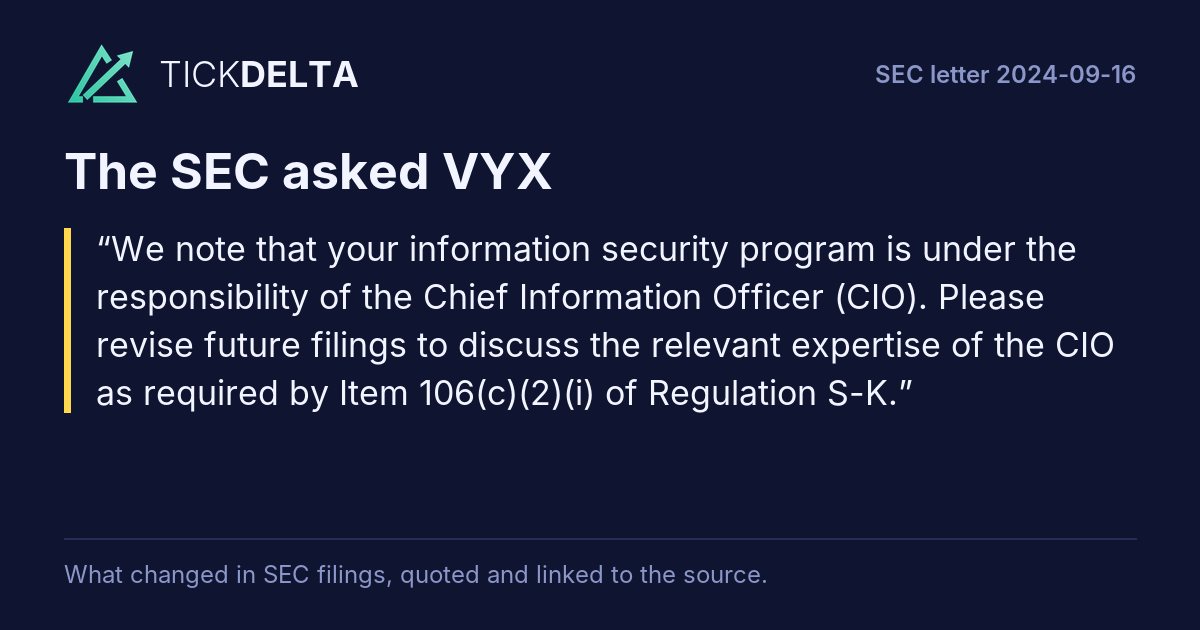
We note that your information security program is under the responsibility of the Chief Information Officer (CIO). Please revise future filings to discuss the relevant expertise of the CIO as required by Item 106(c)(2)(i) of Regulation S-K.
VYX answered
The Company will revise future filings to include the relevant expertise of the persons or members responsible for assessing and managing cybersecurity risks, as required by Item 106(c)(2)(i) of Regulation S-K. As the Company’s Chief Information Officer’s title and role was expanded to the role of Chief Technology Officer subsequent to the filing of the Company’s most recent annual report, the Company anticipates that it will include language similar to the following to address Item 106(c)(2)(i) of Regulation S-K in its next annual report.

“Our Chief Technology Officer (CTO) is responsible
Rest of the answer

for oversight of our information security strategy, program, and operations. Our CTO has over 25 years of information technology experience, including leadership experience managing global information security, IT infrastructure and engineering. He holds a doctorate in

Business Administration, Master of Business Administration, and Bachelor of Engineering in Electrical and Electronics Engineering / Information Systems. In previous roles at large scale fintech and cybersecurity companies, the CTO has designed comprehensive cybersecurity programs and managed and mitigated high profile cybersecurity incidents to ensure business continuity.

Our Chief Information Security Officer (CISO), who reports directly to the CTO, is responsible for day-to-day assessment and management of cybersecurity risk. The CISO has over 20 years of experience in various roles related to information security and related technology, including previously serving as

Vice President of Information Technology and Senior Vice President of Information Technology at other companies, and holds a Bachelor of Science in Math and a Master of Business Administration in Computer Information Systems and Information

Technology. The CISO’s responsibilities in prior roles at large, global fintech and healthcare companies has included initiatives to identify and reduce cybersecurity vulnerabilities.”

In addition, NCR Voyix acknowledges that the Company and its management are responsible for the accuracy and adequacy of their disclosures, notwithstanding any review, comments, action or absence of action by the Staff.
Read in the reply
In its next report

First report after the company's reply of Sep 23, 2024: 10-Q filed Nov 7, 2024 ↗, against the 10-Q filed Aug 6, 2024 ↗.

Tickdelta does not hold the text of both reports, so they are not compared here.

Also in this review: closing letter, 2024-10-31

Form 10-K for the Year Ended December 31, 2019

2020-10-14 to 2020-12-21 · 3 questions · 1 letter from the SEC, 2 from the company
Review closed 2020-12-21
RevenueSegments
Note 1. Basis of Presentation and Significant Accounting Polices · Revenue Recognition, page 56
SEC asked (1)
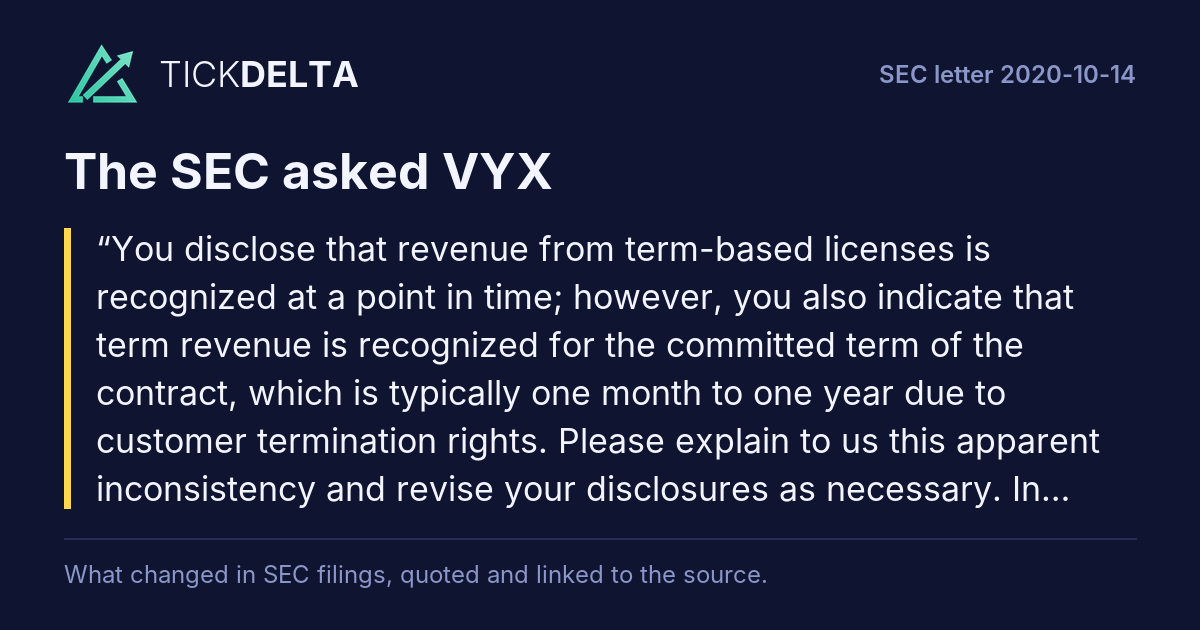
You disclose that revenue from term-based licenses is recognized at a point in time; however, you also indicate that term revenue is recognized for the committed term of the contract, which is typically one month to one year due to customer termination rights. Please explain to us this apparent inconsistency and revise your disclosures as necessary.
Rest of the question

In this regard, tell us whether revenue is recognized at a point in time or over time, during the "committed term." Further, tell us what the customer termination rights are, how they impacted your accounting for these arrangements, and the accounting guidance followed. Lastly, tell us how much revenue was recognized for term-based licenses for fiscal 2019 and to date in fiscal 2020. Please include proposed revised disclosures in your response.

VYX answered
We acknowledge the Staff’s comment that the disclosure related to term-based licenses included in Note 1 of the Notes to the Consolidated Financial Statements included in the 2019 Annual Report on Form 10-K may appear inconsistent as currently drafted and are providing the following additional clarification as requested.

In accordance with Financial Accounting Standards Board (“FASB”) Accounting Standards Codification (“ASC”) 606-10-55-58B, the Company recognizes revenue from the sale of on-premise, software licenses – both perpetual and term-based – at the point in time when the license has
Rest of the answer

been made available for use to the customer, the license term has commenced and all other revenue recognition criteria have been met.

Term-based licenses are typically sold for a period of three or five years and may include customer termination rights whereby the customer can terminate the contract for convenience within 30 days prior to either each contract anniversary date or the start of the next calendar month, dependent on the specific customer contract. Upon termination, the customer must cease use of and destroy on-premise copies of the license. Contracts also may include early termination penalties, which range from 0% to 20% of the total contract value. The Company assesses the termination rights as well as the early termination penalties to determine the appropriate duration for the term-based licenses for the purpose of measuring the amount of contractual consideration to recognize in accordance with ASC 606-10-25-3, which states that the revenue guidance should be applied “to the duration of the contract in which parties to the contract have present and enforceable rights,” which the Company has defined as the “committed term.”

For these arrangements, the Company has concluded that the committed term is from the commencement date of the license until the contract anniversary date or the next calendar month, depending on the termination provisions. If a customer chooses not to execute each termination right, the Company considers it akin to the exercise of a renewal right and the Company will recognize the revenue at a point in time at the beginning of the next committed term.

Revenue from term-based licenses was $12 million for the year ended December 31, 2019 and $19 million for the nine months ended September 30, 2020, which is less than 0.5% of total revenue for the periods noted.

The Company plans to update the revenue recognition policy related to term-based licenses included in Note 1 of the Notes to the Consolidated Financial Statements in the 2020 Annual Report on Form 10-K as follows:

Software products may be sold as perpetual licenses, term-based licenses, cloud-enabled and software as a service. Perpetual license revenue is recognized at a point in time when control transfers to the customer and reported within product revenue. Control is typically transferred when the customer takes possession of, or has access to, the software. Term-based license revenue is recognized at a point in time upon the commencement of the committed term of the contract, concurrent with the possession of the license, and reported within product revenue. The committed term of the contract is typically one month or one year due to customer termination rights. If the amount of consideration the Company expects to be paid in exchange for the licenses depends on customer usage, revenue is recognized when the usage occurs.

Read in the reply
In its next report

First report after the company's reply of Nov 11, 2020: 10-K filed Feb 26, 2021 ↗, against the 10-K filed Feb 28, 2020 ↗.

Tickdelta does not hold the text of both reports, so they are not compared here.

Note 1. Basis of Presentation and Significant Accounting Polices · Revenue Recognition, page 56
SEC asked (2)
Please describe for us the nature of your product solutions in which you combine the cloud-enabled SaaS and on-premise term-based software license as one performance obligation, and tell us how you considered ASC 606-10-25-21 in accounting for these arrangements.
Rest of the question

Also, tell us how much revenue was recognized from the sale of such solutions in fiscal 2019 and to date in fiscal 2020 and, to the extent material, expand your disclosures accordingly.

VYX answered
In 2019, we launched a new offering for NCR’s food, drug, and mass merchandise retailers called NCR Emerald (“Emerald”). The customer base is expected to be comprised primarily of grocery store and supermarket operators. In today’s current retail environment of fragmented systems, devices and software, it is difficult for grocers to understand their operations day-to-day given the lack of timely dissemination of data across disparate systems.
Rest of the answer

NCR Emerald is a complete, cloud-enabled point-of-sale platform that allows retailers to share sales and customer data in a bi-directional manner between the store sales terminal equipped with NCR point of sale software (“POS”) and NCR’s central cloud-platform (“NCR Cloud”). This bi-directional data flow allows NCR’s retail customers to operate and manage their stores centrally and more efficiently.

Retailers purchase Emerald because they seek the enhanced functionality that only results from the interaction of the NCR Cloud and NCR’s POS software across multiple points of sale, devices and locations. When retailers purchase Emerald from us, our one promise is to provide the retailer with a commercial software platform that allows them to operate and manage their retail business across multiple channels, point of sale terminals, and locations. We fulfill this one promise by providing a product with the following features:

1.To execute and process sales transactions across channels (in-store, online)

2.Central access to transactional and business information near real time

Read in the reply
In its next report

First report after the company's reply of Nov 11, 2020: 10-K filed Feb 26, 2021 ↗, against the 10-K filed Feb 28, 2020 ↗.

Tickdelta does not hold the text of both reports, so they are not compared here.

Note 16. Segment Information and Concentrations, page 41
SEC asked (3)
You disclose that recurring revenue includes maintenance, cloud revenue, and payments. In the Form 8-K earnings release, furnished on July 28, 2020, you state that "recurring revenue means revenue from products and services for which revenue is recognized over time". Please tell us what specific revenue streams comprise recurring revenue.
Rest of the question

Clarify which products are recognized over time, consistent with your revenue recognition policy, and explain the nature of "payments." Lastly, revise your disclosures, as necessary, and include the proposed disclosures in your response.

VYX answered
To manage important configurations and pricing updates centrally across their enterprise
Read in the reply
In its next report

First report after the company's reply of Nov 11, 2020: 10-K filed Feb 26, 2021 ↗, against the 10-K filed Feb 28, 2020 ↗.

Tickdelta does not hold the text of both reports, so they are not compared here.

Also in this review: company letter, Oct 23, 2020, closing letter, 2020-12-21

NCR Corporation · 10-K for Fiscal Year Ended December 31, 2017 · Filed February 26, 2018 · File No. 1-00395

2018-11-14 to 2018-12-12 · 1 question · 1 letter from the SEC, 1 from the company
Review closed 2018-12-12
RevenueRussia and Ukraine
General
SEC asked
You indicate on page 86 of the 10-K that you may have had a Syrian branch, two employees and property in Syria as recently as April 2016. Additionally, you state on page 36 of the 10-K filed February 24, 2017 that you maintained a bank account and guarantees at the Commercial Bank of Syria between January 1, 2016 and April 30, 2016.
Rest of the question

We are aware of news reports which appear to indicate that Commercial Bank of Syria operates NCR ATMs. Finally, you provide on page 29 of the 10-K revenue figures by “geographic theater” including for “Europe, Middle East Africa (EMEA),” a region that includes Sudan and Syria. As you know, Sudan and Syria are designated by the Department of State as state sponsors of terrorism, and are subject to U.S. economic sanctions and/or export controls. Please describe to us the nature and extent of any past, current, and anticipated contacts with Sudan and Syria since your letter to us dated November 18, 2015, including contacts with their governments, whether through subsidiaries, affiliates, distributors, partners, resellers, customers, joint ventures or other direct or indirect arrangements. Please also discuss the materiality of those contacts, in quantitative terms and in terms of qualitative factors that a reasonable investor would deem important in making an investment decision. Tell us the approximate dollar amounts of revenues, assets and liabilities associated with those countries for the last three fiscal years and the subsequent interim period. Address for us the potential impact of the investor sentiment evidenced by divestment and similar initiatives that have been directed toward companies that have operations associated with U.S.-designated state sponsors of terrorism.

VYX answered
Securities and Exchange Commission

Ms. Cecilia Blye subsidiaries, affiliates, distributors, partners, resellers, customers, joint ventures or other direct or indirect arrangements. Please also discuss the materiality of those contacts, in quantitative terms and in terms of qualitative factors that a reasonable investor would deem important in making an investment decision. Tell us the approximate dollar amounts of revenues, assets and liabilities associated with those countries for the last three fiscal years and the subsequent interim period.
Rest of the answer

Address for us the potential impact of the investor sentiment evidenced by divestment and similar initiatives that have been directed toward companies that have operations associated with U.S.-designated state sponsors of terrorism.

With respect to Syria, in 2012 NCR voluntarily notified the U.S. Treasury Department Office of Foreign Assets Control (OFAC) of potential violations and ceased operations in Syria, which were commercially insignificant. The notification related to confusion stemming from the Company's failure to register in Syria the transfer of the Company's Syrian branch to a foreign subsidiary and to deregister the Company's legacy Syrian branch, which was a branch of NCR Corporation.

There is an extensive record of communication and cooperation between the Company and OFAC relating to the Company’s efforts to wind down its past operations in Syria. The Company applied for and received from OFAC, commencing in 2013, various licenses that permitted the Company to take measures required to wind down its past operations in Syria. The last such license expired in April 2016, and in connection with that expiration the Company abandoned its remaining property in Syria, which was commercially insignificant, and ended the employment of its final two employees there, who had remained employed by the Company solely to assist with the execution of the Company's wind-down activities pursuant to authority granted by the OFAC licenses. The Company submitted detailed reports to OFAC regarding this matter, including a description of the Company's comprehensive export control program and related remedial measures, and a description of the abandonment and related circumstances. In correspondence dated May 5, 2017, OFAC advised the Company it would not seek monetary penalties against the Company with respect to the matter, and issued a so-called “cautionary letter,” which it characterized as its “final enforcement response.”

NCR confirms that, since the Company’s letter to the Staff dated November 18, 2015, the Company’s only contacts with and activities in Syria have been pursuant to, and in accordance with, applicable OFAC wind-down licenses and abandonment of remaining company property in Syria. This activity was directed initially at possible disposition or donation of the Company’s property in Syria and, when that proved infeasible, abandonment of all remaining Company property in Syria following the expiration of the last of such licenses, as communicated in detail to OFAC.

NCR fully expects that, for at least the duration of sanctions and export controls, it will have no contacts with Syria, including contacts with their governments, whether through subsidiaries, affiliates, distributors, partners, resellers, customers, joint ventures or other direct or indirect arrangements.

With respect to Sudan, NCR confirms that, since the Company’s letter to the Staff dated November 18, 2015, the Company has not engaged in any contacts with Sudan, and fully expects that, for at least the duration of sanctions and export controls, it will have no contacts with Sudan, including contacts with their governments, whether through subsidiaries, affiliates, distributors, partners, resellers, customers, joint ventures or other direct or indirect arrangements.

With respect to the materiality of the contacts with Syria since the Company’s letter to the Staff dated November 18, 2015, the contacts, in quantitative terms and in terms of qualitative factors that a reasonable investor would deem important in making an investment decision, were immaterial.

The following table shows the approximate dollar amounts of revenue, assets, and liabilities associated with each of Syria and the Sudan for the last three fiscal years and the subsequent interim period (amounts shown are in millions).

For the year ended December 31, 2015

For the year ended December 31, 2016(1)

For the year ended December 31, 2017

For the nine months ended

September 30, 2018

Syria

Revenue

$0.0

Assets

$0.6

Liabilities

$0.4

Sudan

(1)

In 2016, the Company wrote off remaining assets and liabilities in connection with the abandonment, as described above, of its remaining property in Syria.

Consistent with the Staff's comments and our ordinary assessment of materiality in a variety of contexts, we have also considered qualitative factors in our evaluation of the materiality of our contacts in Syria since the Company’s letter to the Staff dated November 18, 2015. In light of the factors and reasons set forth below, we believe that our contacts with Syria do not include factors a reasonable investor would deem important in making an investment decision.

•

No NCR revenue was associated with Syria for fiscal 2015, fiscal 2016, fiscal 2017 and for the nine months ended September 30, 2018.

Since July 2012, when we suspended operations in Syria, our contacts with Syria have consisted solely of activities related to the wind-down of operations consistent with the terms of wind-down licenses issued by OFAC and abandonment of the Company’s remaining property in Syria, which was commercially insignificant. We also note that since July 2012, our ongoing public disclosures have made clear for the benefit of our investors that we have suspended operations in Syria. We do not, at this time, anticipate pursuing future business in Syria.

We are aware of no divestment or similar initiatives directed at NCR by any investors, and have received no notices or inquiries with respect to any such initiatives, and also disclosed the wind-down and abandonment. We believe the de minimis nature of the Company's former business in Syria makes it unlikely that such investors would propose divestment.

Our past business contacts in Syria, which were suspended in 2012, were comprised of sales of ATMs, related software and peripherals, and parts, supplies and services sold to banks and other customers for use by consumers in their day-to-day life, and are not, we believe, of a nature that would engender negative investor sentiment.

In addition, NCR acknowledges that the Company and its management are responsible for the accuracy and adequacy of their disclosures, notwithstanding any review, comments, action or absence of action by the Staff.
Read in the reply

Also in this review: closing letter, 2018-12-12

Form 10-K for the Fiscal Year Ended December 31, 2016

2017-10-16 to 2017-12-11 · 6 questions · 3 letters from the SEC, 3 from the company
Review closed 2017-12-11
Results discussion (MD&A)SegmentsRevenueNon-GAAP measures
Management’s Discussion and Analysis of Financial Condition and Results of Operations · General
SEC asked (1)
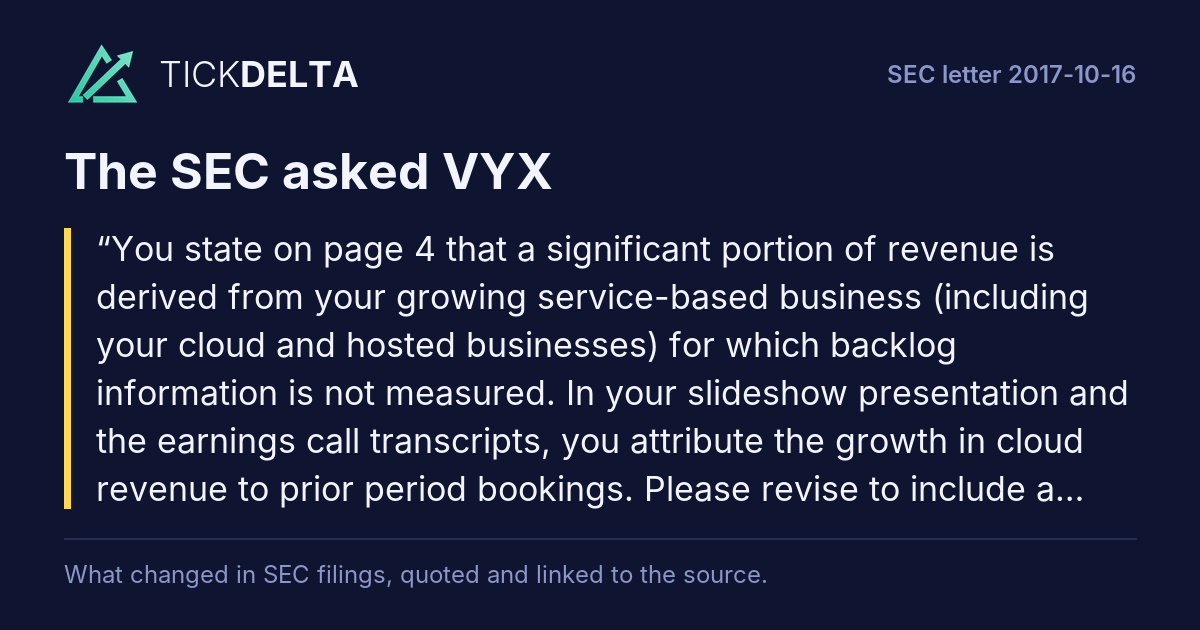
You state on page 4 that a significant portion of revenue is derived from your growing service-based business (including your cloud and hosted businesses) for which backlog information is not measured. In your slideshow presentation and the earnings call transcripts, you attribute the growth in cloud revenue to prior period bookings. Please revise to include a discussion of bookings in MD&A or advise.
Rest of the question

Refer to Item 303(a) of Regulation S-K and Section III.B of SEC Release No. 33-8350.

VYX answered
We acknowledge the Staff’s comment, and direct the Staff’s attention to the Software Segment discussion in the Management’s Discussion and Analysis of Financial Condition and Results of Operations (“MD&A”) section disclosures included in our quarterly reports beginning with the Form 10-Q for the quarter ended March 31, 2017, filed on April 28, 2017 (the “First Quarter Form 10-Q”). In those discussions, we note that cloud revenue growth is due to prior period bookings.
Rest of the answer

Bookings from customer contracts signed in prior periods drive future cloud revenue as solutions are implemented pursuant to customer requirements and contract terms.

We confirm that, consistent with the Staff’s comment, in future filings we will continue to discuss drivers of cloud growth, where cloud growth is material.

Read in the reply
In its next report

First report after the company's reply of Oct 27, 2017: 10-K filed Feb 26, 2018 ↗, against the 10-K filed Feb 24, 2017 ↗.

Tickdelta does not hold the text of both reports, so they are not compared here.

Revenue and Operating Income by Segment, page 30
SEC asked (2)
You state that software revenue increased due to growth in all revenue streams, which include software license, software maintenance, cloud and professional services. You do not provide quantification to demonstrate the relative magnitude of each factor in your MD&A disclosures; however, we note such information is provided in your slide show presentations.
Rest of the question

Similarly, you attribute the flat growth in hardware revenue to growth in ATM and self-checkout revenue offset by declines in point-of-sale and IPS revenue without quantifying how each impacted your 2016 revenues. Please quantify the individual impact when two or more factors contribute to material changes in the operating segment revenue. Refer to Item 303(a)(3)(iii) of Regulation S-K and Section III.D of SEC Release No. 33-6835.

VYX answered
Beginning with our First Quarter Form 10-Q, we have included year-over-year growth percentages for the main drivers of our Software Segment revenue growth in the Revenue and Operating Income by Segment discussion in the MD&A disclosures to show the relative magnitude of each driver. We expanded the discussion to also include year-over-year growth percentages for the main drivers of our Hardware Segment revenue growth in the Revenue and Operating Income by Segment discussion in the MD&A disclosures in our Form 10-Q for the third quarter of 2017, filed on October 27, 2017 (the “Third Quarter
Rest of the answer

Form 10-Q”). Specifically, the Software Segment and Hardware Segment discussions in MD&A in the Third Quarter Form 10-Q include the following:

•

In the three months ended September 30, 2017 compared to the three months ended September 30, 2016, Software revenue increased 2%, driven by growth in cloud revenue of 5%, software maintenance revenue of 3% and professional services revenue of 6%, partially offset by declines in software license revenue of 12%.

In the three months ended September 30, 2017 compared to the three months ended September 30, 2016, Hardware revenue decreased 6% due to declines in ATM revenue of 16% and SCO revenue of 24% partially offset by an increase in POS revenue of 19%.

We acknowledge the Staff’s comment, and will continue in future filings to provide appropriate quantification to demonstrate the relative magnitude of each factor when two or more factors contribute to material changes in operating segment revenue.

Read in the reply
In its next report

First report after the company's reply of Oct 27, 2017: 10-K filed Feb 26, 2018 ↗, against the 10-K filed Feb 24, 2017 ↗.

Tickdelta does not hold the text of both reports, so they are not compared here.

Form 8-K Filed July 20, 2017
SEC asked (3)
We note your presentation on non-GAAP gross margin and non-GAAP gross margin rate for each of your software, services and hardware segments in Exhibit 99.2. In your future presentations, please revise to present the most directly comparable GAAP financial measure and provide a reconciliation to such measure. Refer to Regulation G.
VYX answered
The references to non-GAAP gross margin and non-GAAP gross margin rate for each of our segments in Exhibit 99.2 to our Form 8-K filed July 20, 2017 were, in fact, references to each segment’s gross margin and gross margin rate - measures of profit and loss under ASC 280, Segment Reporting. We have updated the references to these segment gross profit measures to be Software Gross Margin and Software Gross Margin Rate, Services Gross Margin and Services Gross Margin Rate, and Hardware Gross Margin and Hardware Gross Margin Rate in Exhibit 99.2 to our Form 8-K filed October 19, 2017, and will,
Rest of the answer

when providing these measures in future materials, use these revised terms. Additionally, as ASC 280 requires a reconciliation of the total of the reportable segments’ measures of profit or loss to the public entity’s consolidated income before income taxes and discontinued operations, we have included this reconciliation in both our earnings release and related slideshow presentations.

Read in the reply
Management’s Discussion and Analysis of Financial Condition and Results of Operations · General
SEC asked (1)
We note your response to prior comment 1. Please revise your qualitative discussion of cloud revenue growth in terms of prior period bookings to include a quantified discussion of your bookings and/or changes in net annual contract value, consistent with your earnings call transcripts and presentation slides.
VYX answered
We acknowledge the Staff’s comment and will include in the “Overview” section of our future MD&A disclosures a quantified discussion of period over period changes in net annual contract value (ACV) when it is material to an understanding of cloud revenue growth and trends in our cloud business.

As we first disclosed in our second quarter 2016 earnings conference call and related supplementary materials, net ACV is a forward-looking measure that NCR tracks and discloses as an indicator of potential cloud revenue growth in future periods.
Rest of the answer

We calculate net ACV for a particular period as twelve months of expected future cloud revenues under new contracts, less twelve months of expected future cloud revenues under expired or terminated contracts, adjusted for twelve months of expected pricing discounts or price increases from renewals of existing contracts. Because growth in net ACV is a forward-looking indicator for our cloud business, we believe that a discussion of net ACV growth is most appropriately included in the “Overview” section of our MD&A.

However, net ACV growth for a particular period does not necessarily explain or drive actual cloud revenue growth during that period. Actual cloud revenue growth for a particular period is driven instead as cloud revenue solutions from prior period cloud bookings are implemented and customers begin to pay subscription fees. Implementation of a prior period cloud booking depends on the solution, customer requirements and contract terms, and can take up to 12 months after contract signing. As such, as we noted in our October 27 letter to the Staff, where actual cloud revenue growth for a particular period is material, we will continue to include discussions of prior period cloud bookings and other significant drivers of such revenue growth in the Software Segment section of our MD&A.

Separately, we note for the Staff that year over year cloud revenue growth, as disclosed on slide 21 of the related supplementary materials for our fourth quarter of 2016 earnings conference call, was not a significant driver of overall revenue growth relative to other segment revenue streams.

Read in the reply
In its next report

First report after the company's reply of Nov 16, 2017: 10-K filed Feb 26, 2018 ↗, against the 10-K filed Feb 24, 2017 ↗.

Tickdelta does not hold the text of both reports, so they are not compared here.

Form 8-K Filed July 20, 2017
SEC asked (2)
We note from your response to prior comment 3 that gross margin and gross margin rates by segment were provided pursuant to ASC 280 and were not intended to be non-GAAP measures. As such, please include these measures in your segment footnote pursuant to ASC 280-10-50-27 and 28. Also, revise your segment disclosures in MD&A to include a discussion of these performance measures by segment pursuant to Section III.F.
Rest of the question

of SEC Release No. 33-6835 and Section III.B.2 of SEC Release No. 33-8350.

VYX answered
We acknowledge the Staff’s comment and note for the Staff that we include segment gross margin and segment gross margin rate in our earnings call transcripts and presentation slides to provide the data in a readily accessible format to bridge segment revenue to segment operating income for our investors and stakeholders.

We have included segment operating income, but not, as the Staff noted, segment gross margin or gross margin rate in our segment footnote and segment disclosures in MD&A.
Rest of the answer

Segment operating income, which also includes operating expenses such as sales and marketing, research and development as well as general and administrative expenses, is the measure of profit and loss used by NCR’s chief operating decision maker to allocate resources and assess performance. Segment gross margin and gross margin rate are also measures of profit and loss (as we noted in our October 27 letter to the Staff), but they are incorporated in, and are components of, the more comprehensive measure of segment operating income. Therefore, while we respect the Staff’s comment, we do not believe that it is necessary to separately disclose segment gross margin and gross margin rate in addition to segment operating income in our segment footnote or segment disclosures in MD&A. However, when segment gross margin is a significant driver of segment operating results, we have, and will continue to, include additional discussion in our segment disclosures in MD&A.

Read in the reply
SEC asked
You state in your response to prior comment 2 that segment operating income is the measure of profit or loss used by the chief operating decision maker (CODM) to allocate resources and assess performance. Please tell us whether segment gross margin and segment gross margin rates are also regularly provided to and reviewed by your CODM.
Rest of the question

If so, tell us how such measures are used by your CODM in assessing performance or allocating resources. To the extent that your CODM uses more than one measure to allocate resources or assess segment performance, tell us how you applied the guidance in ASC 280-10-50-28 in determining the segment measure or measures to be reported.

VYX answered
Revenue, gross margin, gross margin rate, operating expenses, operating income and operating income rate for each segment are provided to the CODM on a monthly basis. While these measures are reviewed by our

Ms. Kathleen Collins

CODM, our CODM has determined that segment operating income is the measure of profit and loss to use in assessing segment performance and making decisions on resource allocation, because it is comprehensive and incorporates segment gross margin and segment operating expenses.
Rest of the answer

By focusing on segment operating income, our CODM can make decisions on opportunities and investments to drive growth consistent with our long term strategy.

Recent examples in our business where investments were made based on these principles are (i) the creation of our Industry Solutions Group, formed to develop a complete strategic solution framework, from offer design to go-to-market, to drive consistency and reduce complexity; (ii) a research and development investment to develop our omni-channel decision support software platform, which is expected to drive new and profitable software revenue streams, accelerate time to market, and drive innovation; and (iii) investment in our Services renewals desk, which was formed to provide our sales function with a centralized, low-cost team to drive timely renewals of Services contracts.

In summary, we acknowledge the Staff’s comment, and note for the Staff that our CODM uses only one measure, and not multiple measures, to allocate resources and assess segment performance. Therefore, in accordance with the guidance in ASC 280-10-50-28, we have determined that we have one measure of profit and loss (segment operating income), and we have included that measure in our segment footnote and in the segments disclosure in MD&A.

Separately, we note for the Staff that we have consistently included reconciliations of our total non-GAAP gross margin and gross margin rate in the supplemental materials included in our earnings call slideshow presentations. Going forward, we also will include segment gross margin and segment gross margin rate in separate tables reconciling to total GAAP gross margin and gross margin rate in our supplemental materials, in order to provide additional clarity on these segment results for our investors and stakeholders.

Read in the reply

Also in this review: closing letter, 2017-12-11

Form 10-K for the Fiscal Year Ended December 31, 2015

2016-10-28 to 2016-12-05 · 2 questions · 1 letter from the SEC, 1 from the company
Review closed 2016-12-05
DebtSegmentsGoodwill and impairment
Notes to Consolidated Financial Statements · Note 2. Series A Convertible Preferred Stock, page 60
SEC asked (1)
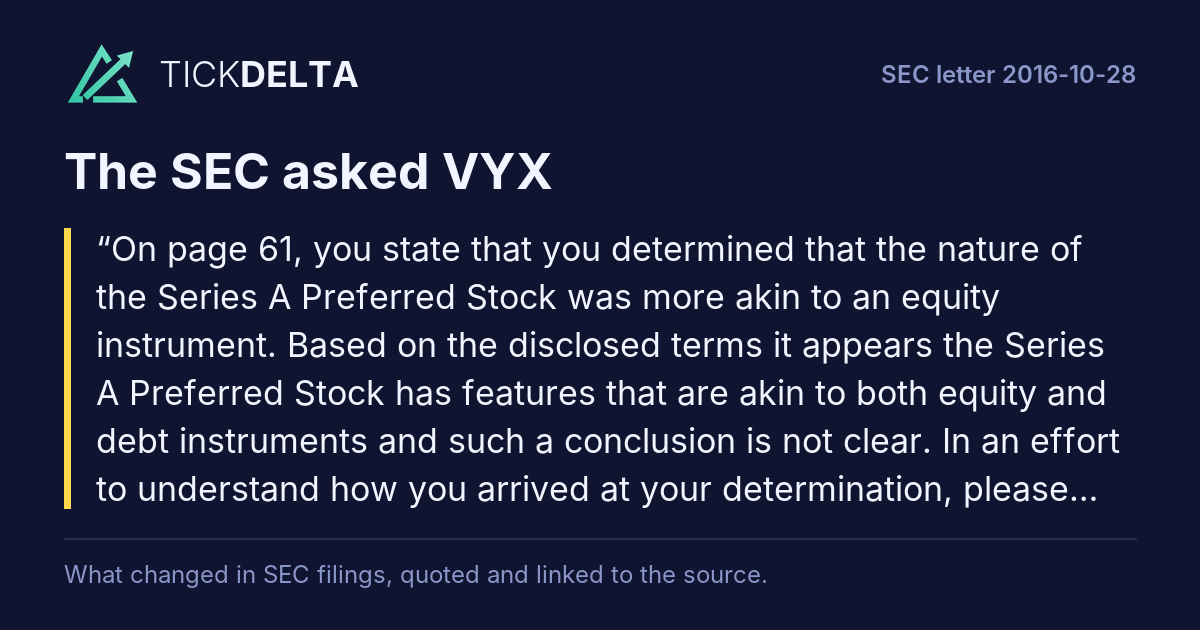
On page 61, you state that you determined that the nature of the Series A Preferred Stock was more akin to an equity instrument. Based on the disclosed terms it appears the Series A Preferred Stock has features that are akin to both equity and debt instruments and such a conclusion is not clear.
Rest of the question

In an effort to understand how you arrived at your determination, please provide us with your analysis and consideration of the guidance in ASC 815-15-25-17 and ASC 815-10-S99-3.

VYX answered
At the time of issuance, we assessed the Series A Preferred Stock pursuant to ASC 815-15-25-17 and ASC 815-10-S99-3 to determine whether the Series A Preferred Stock should be considered more akin to debt or more akin to equity for the purposes of determining whether embedded derivatives should be bifurcated and accounted for separately. We performed the assessment by considering all of the economic characteristics and risks and all of the stated or implied substantive terms and features.

Ms.
Rest of the answer

Kathleen Collins

In completing the assessment, we noted the following features as more indicative of a debt host:

•

At various times following March 16, 2024, the holders of Series A Preferred Stock can require the Company to redeem the Series A Preferred Stock for an amount equal to 100% of the liquidation preference plus accrued dividends as of the redemption date.

The Series A Preferred Stock carries a fixed rate annual dividend of 5.5%.

Upon certain “change of control” events or if the Company's common stock fails to be listed on NYSE or NASDAQ, the holder of Series A Preferred Stock can require the Company to redeem the Series A Preferred Stock.

The Company has the right, upon certain “change of control” events to redeem (i.e. call) the Series A Preferred Stock.

The Series A Preferred Stock has a preference on liquidation or dissolution that includes accrued and unpaid dividends.

We noted the following features as more indicative of an equity host:

The Series A Preferred Stock is convertible at the option of the holders at any time into a fixed number of shares of the Company’s common stock.

The Series A Preferred Stock may be converted, at the election of the Company, into a fixed number of shares of common stock at any time after the third anniversary of the date of the issuance if the volume weighted average price of the Company’s common stock exceeds $54.00 for a specified period.

Holders of Series A Preferred Stock are entitled to vote with the holders of the Company’s common stock on an as-converted basis.

Holders of Series A Preferred Stock are entitled to a separate class vote with respect to amendments to the Company’s organizational documents that have an adverse effect on the Series A Preferred Stock and issuances by the Company of securities that are senior to, or equal in priority with, the Series A Preferred Stock.

The holders of the Series A Preferred Stock were granted the right to designate, two directors to the Company’s Board of Directors.

The Company notes that the non-mandatory date certain redemption feature and the 5.5% annual dividend rate are debt-like features, but we weighted these features less heavily in the evaluation than certain of the equity-like features. Specifically, we noted that the Series A Preferred Stock is convertible into a fixed number of shares of common stock at any time. We also considered the fact that the holders of the Series A Preferred Stock have voting rights on an as-converted basis, and the holders were awarded two seats on the Company's Board of Directors, which allows them to have significant input into our strategy. This is not a right that is generally granted to debt investors, and therefore, we weighted it heavily in our evaluation of the economic characteristics and risks of the Series A Preferred Stock.

In addition, in evaluating the economic characteristics and risks, we considered the expected outcomes of the investment. We believed, based on statements of the Series A Preferred Stock investors as well as discussions with the investors and their advisers, that they shared a belief in our long-term strategy and vision and expected a rate of return significantly higher than the 5.5% fixed annual dividend rate on their investment. This higher return could only be achieved through conversion of the Series A Preferred Stock into shares of our common stock, and as a result, we believed the probability of conversion into a fixed number of shares substantially exceeded the probability of redemption.

As a result, although certain features, such as the non-mandatory date certain redemption feature and the cumulative fixed dividend rate, are debt-like, we considered the conversion feature, voting rights, and the Board representation granted to the Series A Preferred Stock investors as more significant factors. We therefore concluded the Series A Preferred Stock is more akin to equity than debt.

Read in the reply
In its next report

First report after the company's reply of Nov 14, 2016: 10-K filed Feb 24, 2017 ↗, against the 10-K filed Feb 26, 2016 ↗.

Tickdelta does not hold the text of both reports, so they are not compared here.

Notes to Condensed Consolidated Financial Statements · Note 2. Goodwill and Purchased Intangible Assets, page 8
SEC asked (2)
You disclose on page 7 that effective January 1, 2016 you began management of your business on a solutions basis which resulted in a corresponding change in your reportable segments. Please tell us how you considered the guidance in ASC 350-20-35-45 as well as ASC 350-20-35-3C.f. in determining the impact of the change in reportable segments on goodwill and your reporting units.
Rest of the question

Also tell us your consideration for revising your disclosures in future filings to incorporate this information.

VYX answered
In accordance with ASC 350-20, on January 1, 2016, the effective date of the change to manage our business on a solution basis, we completed the following as a result of the change in reportable segments:

Determined reporting units and reassigned assets and liabilities;

Reassigned goodwill to the new reporting units based on the relative fair value allocation approach; and

Completed an impairment assessment of goodwill for the new reporting units.

As a result of this analysis, we determined that there was no indication of impairment of goodwill for the new reporting units.

Considering
Rest of the answer

the Staff's comment regarding our consideration for revising related disclosures in future filings, please note that we intend, in our Annual Report on Form 10-K for the 2016 fiscal year, to include disclosure similar to the following:

“Effective January 1, 2016, NCR began management of its business on a solution basis, changing from the previous model of management on a line of business basis, which resulted in a corresponding change to NCR's reportable segments. We have reclassified prior period segment disclosures to conform to the current period presentation.

In connection with the change in reportable segments, during the first quarter of 2016, the Company determined its reporting units and then assigned goodwill to the new reporting units based on the relative fair value allocation approach. We have reclassified prior period goodwill disclosures to conform to the current period presentation.”

Read in the reply
In its next report

First report after the company's reply of Nov 14, 2016: 10-K filed Feb 24, 2017 ↗, against the 10-K filed Feb 26, 2016 ↗.

Tickdelta does not hold the text of both reports, so they are not compared here.

Also in this review: closing letter, 2016-12-05

From the SEC's correspondence on EDGAR: staff letters (form UPLOAD) and company letters (form CORRESP), 20 letters filed since 2016-10-28. Questions and answers are matched by their numbers; topics come from words in each question. The reports are compared word for word (same form, before the first SEC letter against the first report after the company's reply). No AI.

Sources

The SEC's correspondence on EDGAR: staff letters (form UPLOAD) and company letters (form CORRESP), matched question by question. No AI.

Also

Filings: the letters in the filing list.

Work with it

Excel workbook · CSV. Google Sheet that stays up to date: paste =IMPORTDATA("https://tickdelta.com/company/VYX/export.csv") into a cell.

Next in Owners and insiders:Insider trades
Esc

Type a ticker such as AAPL, a name, an investor such as Buffett, or a topic such as tariffs. ↑ ↓ to move, Enter to open.