Added10-Q 2026-10-29 vs 10-K 2026-02-17
The following table provides information about Verizon’s share repurchase activity for the quarter ended September 30, 2026:
Tickdelta is free for now. Sign up and get Pro free
13 paragraphs in Risk Factors of the 10-K filed Feb 17, 2026 with nothing like them in the 10-K filed Feb 12, 2025. Quoted exactly. Paragraphs that were only edited are under 10-K change.
Compared with the Risk Factors in the latest 10-K of the other 18 Communication companies: a paragraph with at least half its words the same at another company is called similar, and the companies are listed under it. A paragraph most of them have is marked boilerplate. No line means no other company has one like it. This counts text; it does not say how serious a risk is.
During the course of 2025, the U.S. government announced tariffs on goods imported from various countries to the U.S. Countries subject to such tariffs have imposed or may in the future impose reciprocal or retaliatory tariffs and other trade measures. New or increased tariffs and other trade restrictions could adversely affect our cost structure and profitability. Our attempts to mitigate or offset these pressures may not be successful or may have adverse consequences on our business. An escalation of trade tensions, additional tariffs or prolonged uncertainty in trade relationships could also lead to supply chain disruptions or adverse economic impacts, which could adversely affect our results of operations and financial condition.
Read in the 10-K ↗
Cyberattacks, including through the use of ransomware and other forms of malware, distributed denial of services attacks, credential harvesting, social engineering and other means for obtaining unauthorized access to or disrupting the operation of our
Similar paragraph at 1 of 18 other Communication companies: TRead in the 10-K ↗
The rapid evolution and increased adoption of artificial intelligence technologies may intensify our cybersecurity risks by increasing the frequency and severity of cyberattacks against us or other companies and by making cyberattacks more difficult to detect, contain or mitigate.
Read in the 10-K ↗
Our long-term success depends on our ability to implement business transformation initiatives and achieve their anticipated benefits.
We have been and will be undertaking various business transformation initiatives intended to reduce costs, drive efficiencies, streamline our operations, enhance customer experience, and improve our competitive position. These initiatives require making substantial investments in our strategic areas of focus, integrating rapidly evolving technologies, including AI, and optimizing our business and organizational structure.
We may be unable to achieve the anticipated efficiencies, cost savings and other benefits from our business transformation initiatives. These initiatives involve various execution challenges, may take longer than expected and may result in higher than expected expenses. In addition, the execution of our transformation plans may be negatively affected by various external factors, including competitor actions, the regulatory environment and macroeconomic conditions. If we are unable to implement our transformation initiatives or achieve their anticipated benefits, it could have adverse impact on our business, financial condition and results of operations.
System failures and disruptions to our networks and operations could prevent us from providing reliable service to customers and adversely affect our business.
Similar paragraph at 1 of 18 other Communication companies: TMUSRead in the 10-K ↗
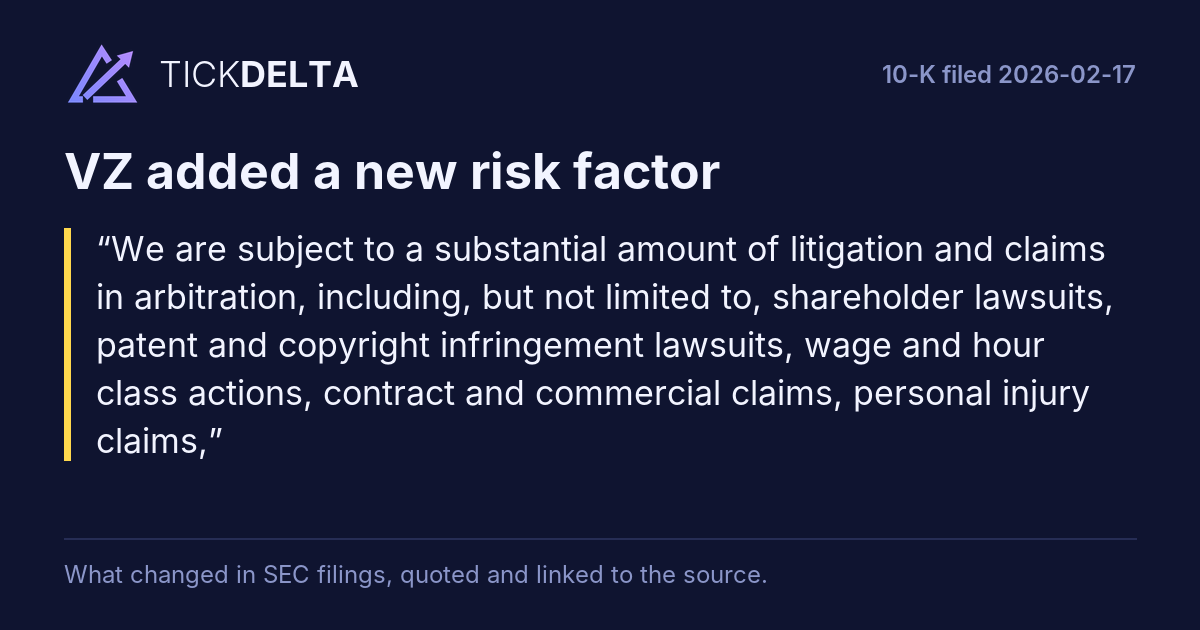
We are subject to a substantial amount of litigation and claims in arbitration, including, but not limited to, shareholder lawsuits, patent and copyright infringement lawsuits, wage and hour class actions, contract and commercial claims, personal injury claims,
Read in the 10-K ↗
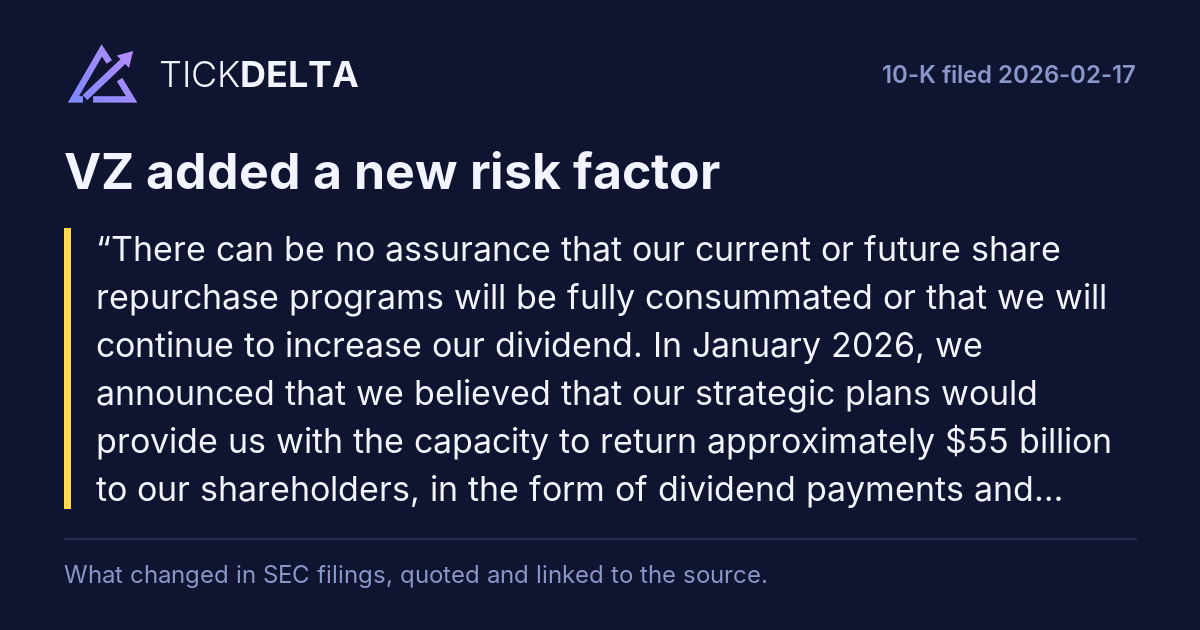
There can be no assurance that our current or future share repurchase programs will be fully consummated or that we will continue to increase our dividend.
In January 2026, we announced that we believed that our strategic plans would provide us with the capacity to return approximately $55 billion to our shareholders, in the form of dividend payments and share repurchases, through the end of 2028. At that time, the Board of Directors of the Company authorized a share repurchase program of up to $25 billion, as well as a dividend increase, and we stated that we expected to repurchase at least $3 billion of our common stock during 2026. We cannot guarantee that our intended share repurchase program will be fully consummated or that it will enhance long-term stockholder value.
Our share repurchase program does not obligate us to acquire any particular amount of common stock. The amount, timing, and frequency of repurchases will depend on prevailing stock prices, general economic and market conditions and various other factors, and may vary from our stated expectations. Share repurchases, if any, may be discontinued, suspended, or delayed at any time at our discretion.
Although historically we have announced regular cash dividends and annually increased our dividend, future dividend increases and payments are subject to declaration by the Company’s Board of Directors and could vary from our historical practices and stated expectations.
Additionally, share repurchases and changes to dividend practices could affect the trading price of our stock and increase volatility. Any future share repurchases or dividend payments will reduce our cash reserves, which may impact our ability to finance future growth and pursue strategic opportunities.
Read in the 10-K ↗
8 paragraphs in the 10-Q filed Oct 29, 2026 with nothing like them in the 10-Q filed Jul 31, 2026 (at least half the words must differ; new numbers alone do not count). Quoted exactly, grouped by the item heading above them. This is text that changed, not a judgement of how serious it is.
On September 14, 2026, Verizon entered into definitive agreements with AT&T Inc. and T-Mobile US, Inc., or their wholly owned subsidiaries, as applicable, to form a joint venture which aims to end wireless dead zones in the U.S. and expand satellite coverage for customers nationwide. We expect to license certain intellectual property to the joint venture, and to provide access to certain spectrum licenses to satellite providers who contract with the joint venture. The formation of this joint venture did not have a material impact to our condensed consolidated financial statements. We account for the joint venture under the equity method of accounting.
Read in the 10-Q ↗
(dollars in millions) Principal Repaid/Redeemed/ Repurchased Amount Paid(1) Three Months Ended March 31, 2026 ────────────────────────────────────────────────────────────────────────────────────────────────────────────────────────────────────────── Verizon floating rate notes due 2026 $ 206 $ 208 Open market repurchases of various Verizon notes 620 504 Three Months Ended March 31, 2026 total 712 Three Months Ended June 30, 2026 Verizon 2.100% notes due 2026 A$ 450 $ 313 Verizon 4.329% notes due 2028 $ 1,295 1,309 Open market repurchases of various Verizon notes 777 635 Three Months Ended June 30, 2026 total 2,257 Three Months Ended September 30, 2026 Verizon 4.329% notes due 2028 $ 1,250 $ 1,277 Open market repurchases of various Verizon notes 1,259 1,043 Three Months Ended September 30, 2026 total 2,320 Nine Months Ended September 30, 2026 total $ 5,289
Read in the 10-Q ↗
In October 2026, we repaid at maturity the U.S. dollar equivalent of $ 845 million of outstanding aggregate principal amount of 1.375 % Euro-denominated notes.
Read in the 10-Q ↗
applicable, which represent the rights to all funds not needed to make required payments on such asset-backed debt and other related payments and expenses.
Read in the 10-Q ↗
In September 2026, we amended our $ 12.0 billion revolving credit facility and extended its maturity to 2030.
Read in the 10-Q ↗
In September 2026, we amended our $12.0 billion revolving credit facility and extended its maturity to 2030.
Read in the 10-Q ↗
On September 14, 2026, Verizon entered into definitive agreements with AT&T Inc. and T-Mobile US, Inc., or their wholly owned subsidiaries, as applicable, to form a joint venture which aims to end wireless dead zones in the U.S. and expand satellite coverage for customers nationwide. We expect to license certain intellectual property to the joint venture, and to provide access to certain spectrum licenses to satellite providers who contract with the joint venture. The formation of this joint venture did not have a material impact to our condensed consolidated financial statements. We account for the joint venture under the equity method of accounting.
Read in the 10-Q ↗
10a Second Amendment to Employment Letter Agreement between Daniel H. Schulman and Verizon Communications Inc., dated as of July 23, 2026.*
Read in the 10-Q ↗
Item 1A of the 10-Q filed Oct 29, 2026 against Item 1A of the 10-K filed Feb 17, 2026.
A 10-Q repeats only the risks that changed, so a 10-K paragraph that is missing from it is not counted as removed.
Added is a paragraph with nothing like it in the 10-K, Reworded a sentence that is in both with several words changed,
Quiet changes a sentence in both where one to four words changed and one is a hedge or a modal
(cut words struck through, new words highlighted and underlined).
Text on the page, not a score; each links to the filing at sec.gov.
What the 10-Q itself says about its risk factors:
Read in the 10-Q ↗
There have been no material changes to our risk factors as previously disclosed in Part I, Item 1A included in our Annual Report on Form 10-K for the year ended December 31, 2025.