Paragraph 2 · 45% changed
Every version of it
Screener
/
SEC EDGAR
/CIK 0000936528
/10-K filed Nov 18, 2025, compared with Nov 20, 2024
/Numbers from the XBRL of the 10-Ks
The 10-K against last year's
128 changes: 27 added, 38 removed, 62 reworded, 1 quiet changes
10-K Nov 18, 2025 vs Nov 20, 2024
Risk Factors
29.3%
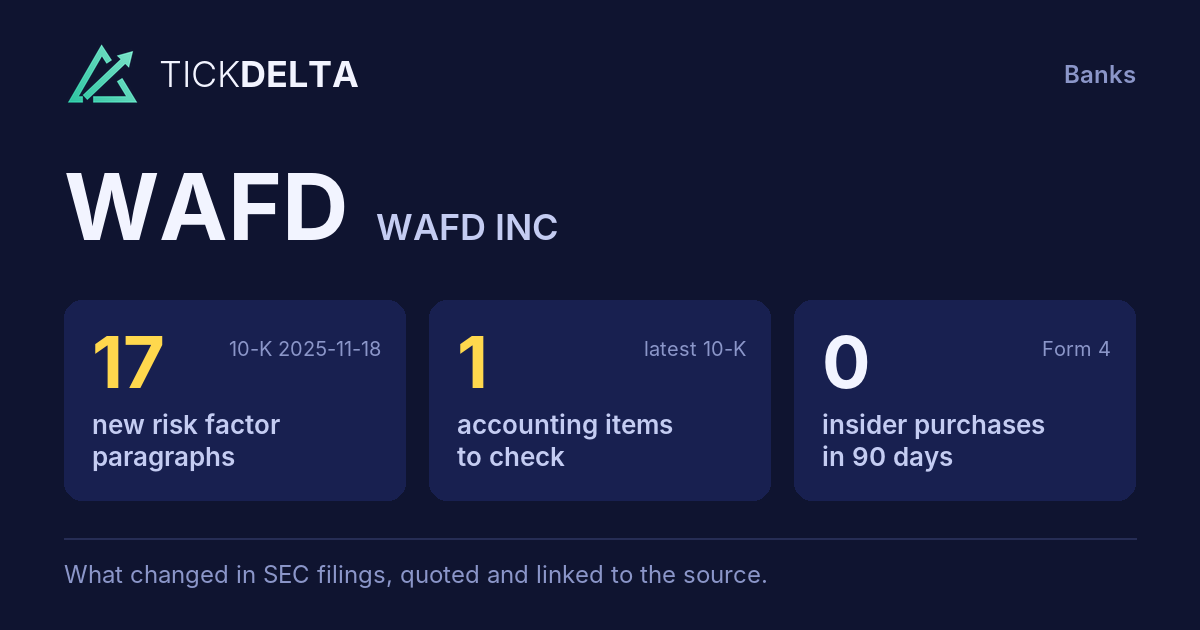
of the text changed · 11,560 words now · 17 new paragraphs, 29 gone
MD&A
19.8%
of the text changed · 5,371 words now · 10 new paragraphs, 9 gone
10-K 0000936528-25-000117 (Nov 18, 2025) vs 10-K 0000936528-24-000164 (Nov 20, 2024) Not compared: Legal Proceedings, Accounting Policies.
Every paragraph, and how much of it changed
One bar per paragraph, in the order of the 10-K. Height and colour show the share of its words not in the closest paragraph a year earlier; the tallest bars are new paragraphs.
Risk Factors
113 paragraphs · 17 new · 30 reworded · 29 gone · 10-K Nov 18, 2025 against Nov 20, 2024
New paragraph
Reworded (5% of its words or more)
Same or nearly
Paragraph 17 · 44% changed
Every version of it
Paragraph 55 · 43% changed
Every version of it
Non-Compliance with banking rules and regulations, including the USA PATRIOT Act, Bank Secrecy Act, Community Reinvestment Act, Fair Lending Laws, Real Estate Settlement Procedures Act, Truth-in-Lending Act, Flood Insurance Reform Act or other laws and regulations could result in fines or sanctions, and curtail our expansion opportunities.
Paragraph 33 · 40% changed
Every version of it
Paragraph 56 · 28% changed
Every version of it
Financial institutions are required under the USA PATRIOT Act of 2001 (the “Patriot Act”) and Bank Secrecy Act ("BSA") to develop programs to prevent financial institutions from being used for money-laundering and terrorist activities. Financial institutions are also obligated to file suspicious activity reports with the U.S. Treasury Department's Office of Financial Crimes Enforcement Network. These rules also require financial institutions to establish procedures for identifying and verifying the identity of customers seeking to open new financial accounts. Failure to comply with applicable laws and regulations can result in a range of sanctions and enforcement actions, including the imposition of civil money penalties, formal agreements and cease and desist orders. The Bank has in the past been subject to a Consent Order from the Office of the Comptroller of the Currency (“OCC”) for its BSA program, which required the Bank to incur significant expenses to implement an effective AML/CFT Program, including payment of a $2,500,000 civil money penalty. In addition, the Bank was previously subject to two Consent Orders for violations of the reporting requirements under the Home Mortgage Disclosure Act (“HMDA”) which included a total of $234,000 in civil money penalties. Our failure or our inability to comply with the Patriot Act and Act, BSA statutes and regulation, HMDA or other applicable regulations could have serious business, financial and reputational consequences for the Bank, and could result in enforcement actions, additional fines or penalties, curtailment of expansion opportunities, enforcement actions, restrictions on our ability to pay dividends, intervention or sanctions by regulators and costly litigation or expensive additional controls and systems.
Paragraph 87 · 28% changed
Every version of it
We rely on customer deposits, advances from the FHLB and other borrowings to fund our operations. Core deposits are a low cost and generally stable source of funding and a significant source of funds for our lending activities. Management has historically been able to replace maturing deposits, if desired; however, we may not be able to replace such funds at any given point in time if our financial condition or market conditions change or if the cost of doing so might adversely affect our business, financial condition and results of operations. If we are forced to seek other sources of funds, such as additional brokered deposits or borrowings from the FHLB, the interest expense associated with these other funding sources are now and may be higher than the rates we are currently paying on our deposits, which would adversely impact our net income, and such sources of funding may be more volatile and unavailable.
Paragraph 4 · 22% changed
Every version of it
We are currently anticipating that there will be further decreases operating in an environment in which the target federal funds rate Federal Reserve has shifted toward reducing interest rates, although modestly, with cuts implemented in 2025 but September and October 2025. However, the inflationary outlook remains uncertain. However, if interest rates do not decrease, or uncertain and if the Federal Reserve were to reverse course and rapidly increase the target federal funds rate, the increase in rates could continue to constrain our interest rate spread and may adversely affect our business forecasts. On the other hand, further rapid decreases in interest rates, may result in a change in the mix of noninterest and interest-bearing accounts. New appointments to the Board of Governors at the Federal Reserve could result in a change in monetary policy and interest rates. We are unable to predict changes in interest rates, which are affected by factors beyond our control, including inflation, deflation, recession, unemployment, money supply and other changes in financial markets.
Paragraph 3 · 21% changed
Every version of it
Paragraph 2 · 45% changed
Every version of it
10-K Nov 20, 2024Significant increases in market interest rates on loans, or the perception that an increase may occur, could adversely affect both our ability to originate new loans and our ability to grow. Beginning early in 2022, in response to growing signs of inflation, the Federal Reserve Bank increased interest rates rapidly, causing the federal funds rate to reach a 22-year high. Although the FRB reduced its benchmark rates in September 2024, the inflationary outlook in the United States is currently uncertain. Rapid changes in interest rates make it difficult for the Bank to balance its loan and deposit portfolios, which may adversely affect our results of operations by, for example, reducing asset yields or spreads, creating operating and system issues, or having other adverse impacts on our business. Persistent inflation could lead to higher interest rates, which could, in turn, increase the borrowing costs of our customers, making it more difficult for them to repay their loans or other obligations. High interest rates could also push down asset prices and weaken economic activity.
10-K Nov 18, 2025
Our earnings and cash flows are largely dependent upon our net interest income, which is significantly affected by interest rates. Interest rates are highly sensitive to factors beyond our control, such as general economic conditions and policies set by governmental and regulatory bodies. We principally manage interest rate risk by managing our volume and mix of our earning assets and funding liabilities. If we are unable to manage this risk effectively, our business, financial condition and results of operations could be materially affected. Rapid changes in interest rates make it difficult for the Bank to balance its loan and deposit portfolios, which may adversely affect our results of operations by, for example, reducing asset yields or spreads, or having other adverse impacts on our business. Higher than expected inflation could lead to higher interest rates, which could, in turn, increase the borrowing costs of our customers, making it more difficult for them to repay their loans or other obligations. High interest rates could also push down asset prices and weaken economic activity. Conversely, falling rates can initially reduce our net interest income as our floating-rate assets tend to be more immediately responsive to changes in market rates than most deposit liabilities. In addition, a decline in market interest rates could increase loan prepayments, leading to reinvestment in lower-yielding assets, reducing income.
Paragraph 17 · 44% changed
Every version of it
10-K Nov 20, 2024passed by Congress. Future deterioration in the U.S. credit and financial markets could result in losses or significant deterioration in the fair value of our U.S. government issued, sponsored or guaranteed investments. At September 30, 2024, we had $2.2 billion invested in U.S. government and agency obligations, and further downgrades could affect the stability of securities issued or guaranteed by the federal government and the valuation or liquidity of our portfolio of such investment securities.
10-K Nov 18, 2025
We are operating in an uncertain and rapidly changing economic environment. Global trade tensions, AI impacts, and inflation risks continue to affect the global economic environment. The recent U.S. government shutdown has negatively impacted U.S. economic growth, and the suspension of government data collection and publication left policymakers without access to the latest data on employment, inflation, and economic growth, increasing the risk that a wrong decision will be made. An unpredictable or volatile political environment in the United States could negatively impact business and market conditions, economic growth, financial stability, and business, consumer, investor, and regulatory sentiments, any one or more of which could have a material adverse impact on our financial condition and results of operations. Deterioration in the U.S. credit and financial markets could result in losses or significant deterioration in the fair value of our U.S. government issued, sponsored or guaranteed investments. At September 30, 2025, we had $3.5 billion invested in U.S. government and agency obligations, and further downgrades could affect the stability of securities issued or guaranteed by the federal government and the valuation or liquidity of our portfolio of such investment securities.
Paragraph 55 · 43% changed
Every version of it
10-K Nov 20, 2024
Non-Compliance with banking rules and regulations, including the USA PATRIOT Act, Bank Secrecy Act, Community Reinvestment Act, Fair Lending Laws, Real Estate Settlement Procedures Act, Truth-in-Lending Act, Flood Insurance Reform Act or other laws and regulations could result in fines or sanctions, and curtail our expansion opportunities.
10-K Nov 18, 2025
Non-Compliance with banking rules and regulations could result in fines or sanctions, and curtail our expansion opportunities.
Paragraph 33 · 40% changed
Every version of it
10-K Nov 20, 2024Many competitors, including fintech companies, offer the same types of loan and deposit services that the Company offers. These competitors include national and multinational banks, other regional banks, savings associations, community banks, credit unions, fintechs, and other financial intermediaries. In particular, our competitors include national banks and major financial companies whose greater resources may afford them a marketplace advantage by enabling them to maintain numerous banking locations, launch new technologies and mount extensive promotional and advertising campaigns. The effective use of technology increases efficiency and enables financial institutions to better serve customers and to reduce costs. Many of our competitors have substantially greater resources to invest in technological improvements than we do. Our future success will depend, in part, upon our ability to address the needs of our clients by using technology to provide products and services that will satisfy client demands for convenience, as well as to create additional efficiencies in our operations. We may not be able to effectively implement new technology-driven products and services or be successful in marketing these products and services to our customers. In addition, the implementation of technological changes and upgrades to maintain current systems and integrate new ones may also cause service interruptions, transaction processing errors and system conversion delays and may cause us to fail to comply with applicable laws. There can be no assurance that we will be able to successfully manage the risks associated with our increased dependency on technology. Additionally, recent technological breakthroughs have made it possible for other non-traditional competitors to enter the marketplace and compete for traditional banking services. Increased competition within our geographic market area may result in reduced loan originations and deposits. Ultimately, competition from current and future competitors may affect our business materially and adversely.
10-K Nov 18, 2025
The banking and financial services industry continually experiences technological changes, with frequent introductions of new technology-driven products and services, including recent and rapid developments in AI, including with agentic AI. Our future success will depend, in part, upon our ability to address the needs of our clients by using technology to provide products and services that will satisfy client demands for convenience, as well as to assess the proper operation of AI models and capabilities to create additional efficiencies in our operations. We may not be able to effectively implement new technology-driven products and services or be successful in marketing these products and services to our clients. In addition, the implementation of technological changes and upgrades to maintain current systems and integrate new ones may also create service interruptions, transaction processing errors, and system conversion delays and may cause us to fail to comply with applicable laws. There can be no assurance that we will be able to successfully manage the risks associated with our increased dependency on technology. Failure to successfully keep pace with technological change affecting the banking and financial services industry could negatively affect our revenue and profitability.
Paragraph 56 · 28% changed
Every version of it
10-K Nov 20, 2024
Financial institutions are required under the USA PATRIOT Act of 2001 (the “Patriot Act”) and Bank Secrecy Act ("BSA") to develop programs to prevent financial institutions from being used for money-laundering and terrorist activities. Financial institutions are also obligated to file suspicious activity reports with the U.S. Treasury Department's Office of Financial Crimes Enforcement Network. These rules also require financial institutions to establish procedures for identifying and verifying the identity of customers seeking to open new financial accounts. Our failure or our inability to comply with the Patriot Act and BSA statutes and regulations could result in fines or penalties, curtailment of expansion opportunities, enforcement actions, intervention or sanctions by regulators and costly litigation or expensive additional controls and systems.
10-K Nov 18, 2025
Financial institutions are required under the USA PATRIOT Act of 2001 (the “Patriot Act”) and Bank Secrecy Act ("BSA") to develop programs to prevent financial institutions from being used for money-laundering and terrorist activities. Financial institutions are also obligated to file suspicious activity reports with the U.S. Treasury Department's Office of Financial Crimes Enforcement Network. These rules also require financial institutions to establish procedures for identifying and verifying the identity of customers seeking to open new financial accounts. Failure to comply with applicable laws and regulations can result in a range of sanctions and enforcement actions, including the imposition of civil money penalties, formal agreements and cease and desist orders. The Bank has in the past been subject to a Consent Order from the Office of the Comptroller of the Currency (“OCC”) for its BSA program, which required the Bank to incur significant expenses to implement an effective AML/CFT Program, including payment of a $2,500,000 civil money penalty. In addition, the Bank was previously subject to two Consent Orders for violations of the reporting requirements under the Home Mortgage Disclosure Act (“HMDA”) which included a total of $234,000 in civil money penalties. Our failure or our inability to comply with the Patriot Act, BSA statutes and regulation, HMDA or other applicable regulations could have serious business, financial and reputational consequences for the Bank, and could result in enforcement actions, additional fines or penalties, curtailment of expansion opportunities, restrictions on our ability to pay dividends, intervention or sanctions by regulators and costly litigation or expensive additional controls and systems.
Paragraph 87 · 28% changed
Every version of it
10-K Nov 20, 2024
We rely on customer deposits, advances from the FHLB and other borrowings to fund our operations. Management has historically been able to replace maturing deposits, if desired; however, we may not be able to replace such funds at any given point in time if our financial condition or market conditions change or if the cost of doing so might adversely affect our business, financial condition and results of operations.
10-K Nov 18, 2025
We rely on customer deposits, advances from the FHLB and other borrowings to fund our operations. Core deposits are a low cost and generally stable source of funding and a significant source of funds for our lending activities. Management has historically been able to replace maturing deposits, if desired; however, we may not be able to replace such funds at any given point in time if our financial condition or market conditions change or if the cost of doing so might adversely affect our business, financial condition and results of operations. If we are forced to seek other sources of funds, such as additional brokered deposits or borrowings from the FHLB, the interest expense associated with these other funding sources are now and may be higher than the rates we are currently paying on our deposits, which would adversely impact our net income, and such sources of funding may be more volatile and unavailable.
Paragraph 4 · 22% changed
Every version of it
10-K Nov 20, 2024
We are currently anticipating that there will be further decreases in the target federal funds rate in 2025 but the inflationary outlook remains uncertain. However, if interest rates do not decrease, or if the Federal Reserve were to rapidly increase the target federal funds rate, the increase in rates could continue to constrain our interest rate spread and may adversely affect our business forecasts. On the other hand, decreases in interest rates, may result in a change in the mix of noninterest and interest-bearing accounts. We are unable to predict changes in interest rates, which are affected by factors beyond our control, including inflation, deflation, recession, unemployment, money supply and other changes in financial markets.
10-K Nov 18, 2025
We are currently operating in an environment in which the Federal Reserve has shifted toward reducing interest rates, although modestly, with cuts implemented in September and October 2025. However, the inflationary outlook remains uncertain and if the Federal Reserve were to reverse course and rapidly increase the target federal funds rate, the increase in rates could continue to constrain our interest rate spread and may adversely affect our business forecasts. On the other hand, further rapid decreases in interest rates, may result in a change in the mix of noninterest and interest-bearing accounts. New appointments to the Board of Governors at the Federal Reserve could result in a change in monetary policy and interest rates. We are unable to predict changes in interest rates, which are affected by factors beyond our control, including inflation, deflation, recession, unemployment, money supply and other changes in financial markets.
Paragraph 3 · 21% changed
Every version of it
10-K Nov 20, 2024As a result of the interest rate increases experienced in 2022 and 2023, our interest expense on both deposits and borrowings increased significantly. Because of the differences in maturities and repricing characteristics of our interest-earning assets and interest-bearing liabilities, changes in interest rates do not produce equivalent changes in interest income earned on interest-earning assets and interest paid on interest-bearing liabilities. Accordingly, fluctuations in interest rates could adversely affect our interest rate spread, and, in turn, our profitability. For example, if the interest rates on interest-bearing liabilities increase at a faster pace than the interest rates on interest-earning assets, the result could be a reduction in our net interest income and with it, a reduction in earnings. The same could be true if interest rates on interest-earning assets decline faster than the rates on interest-bearing liabilities. Net interest income and earnings would be similarly impacted if the interest rates on interest-earning assets decline more quickly than the interest rates on interest-bearing liabilities. In addition, changes in interest rates could affect the Bank's ability to originate loans and attract and retain deposits; the fair values of its securities and other financial assets; the fair values of its liabilities; and the average lives of its loan and securities portfolios. Additionally, decreases in interest rates could lead to increased loan refinancing activity, which, in turn, would alter the balance of our interest-earning assets and impact net interest income. Increases in interest rates could reduce loan refinancing activity, which could result in compression of the spread between loan yields and more quickly rising funding rates. We may also be exposed to movements in market rates to a degree not experienced by other financial institutions, as a result of our significant portfolio of fixed-rate single-family home loans, which are longer-term in nature than the customer accounts and borrowed money that constitute our liabilities.
10-K Nov 18, 2025
Our net interest income is the difference (or “spread”) between the interest earned on loans, securities and other interest-earning assets and the interest paid on deposits, borrowings, and other interest-bearing liabilities. The level of net interest income is a function of the average balances of interest-earning assets and interest-bearing liabilities and the spread between the amounts of the yield on such assets and the cost of such liabilities. These factors are influenced by both the pricing and the mix of interest-earning assets and interest-bearing liabilities which, in turn, are impacted by such external factors as the local economy, competition for loans and deposits, the monetary policy of the Federal Open Market Committee of the Federal Reserve Board of Governors (the “FOMC”) and market interest rates. Furthermore, movements in interest rates, the pace at which such movements occur and the volume and mix of our interest-bearing assets and liabilities influence the level of net interest income. The cost of customer deposits is largely based on short-term interest rates, the level of which is driven by the FOMC. However, the yields generated by long-term loans, such as single-family residential and multifamily mortgage loans, and securities are typically driven by longer-term (10 year) interest rates, which are set by the market and vary from day to day. Because of the differences in maturities and repricing characteristics of our interest-earning assets and interest-bearing liabilities, changes in interest rates do not produce equivalent changes in interest income earned on interest-earning assets and interest paid on interest-bearing liabilities. Accordingly, fluctuations in interest rates could adversely affect our interest rate spread, and, in turn, our profitability. For example, if interest rates on interest-earning assets decline more quickly than the rates on interest-bearing liabilities, as we saw in our recent fiscal year, the result is a reduction in our net interest income and with it, a reduction in earnings. The same could be true if the interest rates on interest-bearing liabilities increase at a faster pace than the interest rates on interest-earning assets. In addition, changes in interest rates could affect the Bank's ability to originate loans and attract and retain deposits; the fair values of its securities and other financial assets; the fair values of its liabilities; and the average lives of its loan and securities portfolios. Decreases in interest rates could lead to increased loan refinancing activity, which, in turn, would alter the balance of our interest-earning assets and impact net interest income. Increases in interest rates could reduce loan refinancing activity, which could result in compression of the spread between loan yields and more quickly rising funding rates. We may also be exposed to movements in market rates to a degree not experienced by other financial institutions, as a result of our significant portfolio of fixed-rate single-family home loans, which are longer-term in nature than the customer accounts and borrowed money that constitute our liabilities.
MD&A
94 paragraphs · 10 new · 27 reworded · 9 gone · 10-K Nov 18, 2025 against Nov 20, 2024
New paragraph
Reworded (5% of its words or more)
Same or nearly
Paragraph 39 · 48% changed
Cash and cash equivalents: Cash and cash equivalents increased decreased to $657,310,000 at September 30, 2025, as compared to $2,381,102,000 at September 30, 2024, as compared to $980,649,000 at September 30, 2023. This increase reflects cash received from LBC as a result of the Merger combined with 2024. The prior year end balances reflected cash received from the recent LBC Luther Burbank multi-family and LBC single-family residential loan portfolio sales, offset by pay-downs on borrowings. sales. The decrease in the current year reflects cash used to reduce borrowings and purchase investment securities during the year.
Paragraph 46 · 35% changed
Loans receivable: Loans receivable, net of related contra accounts, increased $3,439,804,000, decreased $827,736,000, or 19.7%, 4.0%, to $20,916,354,000 $20,088,618,000 at September 30, 2024, 2025, from $17,476,550,000 $20,916,354,000 one year earlier. The increase resulted primarily from the addition of loans obtained in the Merger. The balance change also reflects originations of $3,632,071,000, $3,956,199,000, a decrease to loans-in-process of $886,142,000 $236,192,000 and principal repayments of $4,302,359,000 $5,145,176,000 during the year ended September 30, 2024. 2025. Commercial loan originations accounted for 83.1% of total originations and consumer originations were 16.9% as the Bank exited the residential mortgage market mid-year. Management continues to focus on commercial lending, coupled with growing economies in all major markets in which we operate.
Paragraph 91 · 33% changed
The Company's cash and cash equivalents were $2,381,102,000 $657,310,000 at September 30, 2024, 2025, which is a 142.8% increase 72.4% decrease from the balance of $980,649,000 $2,381,102,000 as of September 30, 2023. 2024. The prior year end balances reflected cash received from the Luther Burbank multi-family and single-family residential loan portfolio sales. During the year, the Company completed the sale of approximately $2,800,000,000 in multifamily loans utilized cash to reduce borrowings and approximately $400,000,000 in single-family loans from the acquired LBC loan portfolio. The proceeds from the sales have increased liquidity adding approximately $1 billion in cash after paying down borrowings. purchase investments. See “Changes in Financial Condition” above and the “Statement of Cash Flows” included in the financial statements for additional details regarding this change.
Paragraph 40 · 28% changed
Available-for-sale (AFS) investment securities: Available-for-sale securities increased $577,612,000, $960,492,000, or 29.0%, 37.3%, during the year ended September 30, 2024, 2025, to $2,572,709,000, due to the addition $3,533,201,000, as a result of $516,308,000 in AFS investments obtained in the Merger securities purchases of $1,482,058,000 combined with normal investing activity. During this time, the Bank had purchases unrealized losses of $549,159,000 $9,237,000 and a reclassification of gain into earnings from AFS securities hedging derivatives of $15,452,000 partially offset by principal repayments and maturities of $386,564,000 $561,808,000 and sales of $182,682,000. As of September 30, 2024, the Company had a $797,000. The net unrealized loss on available-for-sale securities of $44,168,000, which the year ended September 30, 2025 is recorded net of tax within AOCI, and is decreased compared to an unrealized loss losses of $123,519,000 $44,168,000 as of September 30, 2023. 2024.
Paragraph 19 · 24% changed
The Company recorded a provision for credit losses of $17,500,000 $7,750,000 in 2024, 2025, compared to a provision of $41,500,000 $17,500,000 for 2023. 2024. These amounts are net of provision and recapture related to the unfunded commitments reserve. In 2025, provisioning reflected increasing trends in charge-offs and negative migration of delinquent and nonperforming loans combined with economic concerns. In 2024, provisioning included the initial provision of $16,000,000 recorded on LBC loans acquired, as well as adjustments resulting from qualitative considerations such as prolonged and intensified borrower sensitivity to high interest rates and operating costs due to inflationary pressures. For the year ended September 30, 2024, 2025, net charge-offs were $1,356,000, $11,783,000, compared to charge-offs of $45,101,000 $1,356,000 in the prior year. The ratio of the total ACL to total gross loans decreased increased to 1.04% as of September 30, 2025, as compared to 1.01% as of September 30, 2024, as compared to 1.03% as of September 30, 2023. The decrease was primarily related 2024. A shift toward commercial loan originations led to a shift in modified mix of loan types within the portfolio. Loan portfolios combined with lower historical losses, like multi-family and single family residential saw increased balances as a result of the Merger while those with higher historical losses, like construction, saw decreases. qualitative reserve adjustments resulted in this increase.
Paragraph 90 · 24% changed
To ensure ample contingent liquidity the Bank participates in the FRB of San Francisco Borrower-in-Custody program which collateralizes primary credit borrowings and serves as a backstop for the FHLB - DM credit line. Due to differing program requirements between the FHLB - DM and FRB of San Francisco, participating in both increases the amount of eligible collateral that may be pledged in support of contingent liquidity needs. The Bank is also eligible to borrow under the Federal Reserve Bank's primary credit program. The Bank elected to utilize the Federal Reserve's Bank Term Funding Program ("BTFP") to leverage its highly favorable terms to fortify the Bank's liquidity position. These borrowings are repayable at any time without penalty and are currently the lowest cost funding source available. The Federal Reserve ceased making new BTFP loans on March 11, 2024.
Paragraph 64 · 23% changed
Customer accounts: As of September 30, 2024, 2025, customer deposits totaled $21,373,970,000 $21,437,636,000 compared with $16,070,329,000 $21,373,970,000 at September 30, 2023, 2024, a $5,303,641,000, $63,666,000, or 33.0%, 0.3%, increase largely due to deposits obtained in the Merger. driven by transaction accounts. During 2024, 2025, transaction accounts increased by $1,051,872,000 $489,347,000 or 9.8% 4.1% while time deposits increased decreased by $4,251,769,000 $425,681,000 or 80.1% as 66% of the LBC customer accounts were time deposits. 4.5%.
Paragraph 5 · 20% changed
The preparation of consolidated financial statements in conformity with U.S. GAAP requires management to use judgment in making estimates and assumptions that affect the reported amounts within the consolidated financial statements. Actual results may differ from these estimates. While our significant accounting policies are described in more detail in Note A to the Consolidated Financial Statements, we believe that the accounting policies discussed below are critical for understanding our historical and future performance. Critical accounting policies and estimates are those that we consider the most important to the portrayal of our financial condition and results of operations because they require our most difficult, subjective or complex judgments, often as a result of the need to make estimates about the effect of the matters that are inherently uncertain. Allowance for Credit Losses. Management’s determination of the amount of the ACL is a critical accounting estimate as it requires significant reliance on the credit risk we ascribe to individual borrowers, the use of estimates and significant judgment as to the amount and timing of expected future cash flows on individually evaluated loans, significant reliance on historical loss rates on homogeneous portfolios, consideration of our quantitative and qualitative evaluation of past events, current conditions, and reasonable and supportable forecasts that affect the collectability of the reported amounts.
Paragraph 39 · 48% changed
10-K Nov 20, 2024
Cash and cash equivalents: Cash and cash equivalents increased to $2,381,102,000 at September 30, 2024, as compared to $980,649,000 at September 30, 2023. This increase reflects cash received from LBC as a result of the Merger combined with cash received from the recent LBC multi-family and LBC single-family residential loan portfolio sales, offset by pay-downs on borrowings.
10-K Nov 18, 2025
Cash and cash equivalents: Cash and cash equivalents decreased to $657,310,000 at September 30, 2025, as compared to $2,381,102,000 at September 30, 2024. The prior year end balances reflected cash received from the Luther Burbank multi-family and single-family residential loan portfolio sales. The decrease in the current year reflects cash used to reduce borrowings and purchase investment securities during the year.
Paragraph 46 · 35% changed
10-K Nov 20, 2024
Loans receivable: Loans receivable, net of related contra accounts, increased $3,439,804,000, or 19.7%, to $20,916,354,000 at September 30, 2024, from $17,476,550,000 one year earlier. The increase resulted primarily from the addition of loans obtained in the Merger. The balance change also reflects originations of $3,632,071,000, a decrease to loans-in-process of $886,142,000 and principal repayments of $4,302,359,000 during the year ended September 30, 2024. Commercial loan originations
10-K Nov 18, 2025
Loans receivable: Loans receivable, net of related contra accounts, decreased $827,736,000, or 4.0%, to $20,088,618,000 at September 30, 2025, from $20,916,354,000 one year earlier. The balance change reflects originations of $3,956,199,000, a decrease to loans-in-process of $236,192,000 and principal repayments of $5,145,176,000 during the year ended September 30, 2025. Commercial loan originations accounted for 83.1% of total originations and consumer originations were 16.9% as the Bank exited the residential mortgage market mid-year. Management continues to focus on commercial lending, coupled with growing economies in all major markets in which we operate.
Paragraph 91 · 33% changed
10-K Nov 20, 2024
The Company's cash and cash equivalents were $2,381,102,000 at September 30, 2024, which is a 142.8% increase from the balance of $980,649,000 as of September 30, 2023. During the year, the Company completed the sale of approximately $2,800,000,000 in multifamily loans and approximately $400,000,000 in single-family loans from the acquired LBC loan portfolio. The proceeds from the sales have increased liquidity adding approximately $1 billion in cash after paying down borrowings. See “Changes in Financial Condition” above and the “Statement of Cash Flows” included in the financial statements for additional details regarding this change.
10-K Nov 18, 2025
The Company's cash and cash equivalents were $657,310,000 at September 30, 2025, which is a 72.4% decrease from the balance of $2,381,102,000 as of September 30, 2024. The prior year end balances reflected cash received from the Luther Burbank multi-family and single-family residential loan portfolio sales. During the year, the Company utilized cash to reduce borrowings and purchase investments. See “Changes in Financial Condition” above and the “Statement of Cash Flows” included in the financial statements for additional details regarding this change.
Paragraph 40 · 28% changed
10-K Nov 20, 2024
Available-for-sale investment securities: Available-for-sale securities increased $577,612,000, or 29.0%, during the year ended September 30, 2024, to $2,572,709,000, due to the addition of $516,308,000 in AFS investments obtained in the Merger combined with normal investing activity. During this time, the Bank had purchases of $549,159,000 offset by principal repayments and maturities of $386,564,000 and sales of $182,682,000. As of September 30, 2024, the Company had a net unrealized loss on available-for-sale securities of $44,168,000, which is recorded net of tax within AOCI, compared to an unrealized loss of $123,519,000 as of September 30, 2023.
10-K Nov 18, 2025
Available-for-sale (AFS) investment securities: Available-for-sale securities increased $960,492,000, or 37.3%, during the year ended September 30, 2025, to $3,533,201,000, as a result of securities purchases of $1,482,058,000 combined with unrealized losses of $9,237,000 and a reclassification of gain into earnings from AFS securities hedging derivatives of $15,452,000 partially offset by principal repayments and maturities of $561,808,000 and sales of $797,000. The net unrealized loss the year ended September 30, 2025 is recorded net of tax within AOCI, and is decreased compared to unrealized losses of $44,168,000 as of September 30, 2024.
Paragraph 19 · 24% changed
10-K Nov 20, 2024
The Company recorded a provision for credit losses of $17,500,000 in 2024, compared to a provision of $41,500,000 for 2023. These amounts are net of provision and recapture related to the unfunded commitments reserve. In 2024, provisioning included the initial provision of $16,000,000 recorded on LBC loans acquired, as well as adjustments resulting from qualitative considerations such as prolonged and intensified borrower sensitivity to high interest rates and operating costs due to inflationary pressures. For the year ended September 30, 2024, net charge-offs were $1,356,000, compared to charge-offs of $45,101,000 in the prior year. The ratio of the total ACL to total gross loans decreased to 1.01% as of September 30, 2024, as compared to 1.03% as of September 30, 2023. The decrease was primarily related to a shift in mix of loan types within the portfolio. Loan portfolios with lower historical losses, like multi-family and single family residential saw increased balances as a result of the Merger while those with higher historical losses, like construction, saw decreases.
10-K Nov 18, 2025
The Company recorded a provision for credit losses of $7,750,000 in 2025, compared to a provision of $17,500,000 for 2024. These amounts are net of provision and recapture related to the unfunded commitments reserve. In 2025, provisioning reflected increasing trends in charge-offs and negative migration of delinquent and nonperforming loans combined with economic concerns. In 2024, provisioning included the initial provision of $16,000,000 recorded on LBC loans acquired, as well as adjustments resulting from qualitative considerations such as prolonged and intensified borrower sensitivity to high interest rates and operating costs due to inflationary pressures. For the year ended September 30, 2025, net charge-offs were $11,783,000, compared to charge-offs of $1,356,000 in the prior year. The ratio of the total ACL to total gross loans increased to 1.04% as of September 30, 2025, as compared to 1.01% as of September 30, 2024. A shift toward commercial loan originations led to a modified mix of loan types combined with increased qualitative reserve adjustments resulted in this increase.
Paragraph 90 · 24% changed
10-K Nov 20, 2024
To ensure ample contingent liquidity the Bank participates in the FRB of San Francisco Borrower-in-Custody program which collateralizes primary credit borrowings and serves as a backstop for the FHLB - DM credit line. Due to differing program requirements between the FHLB - DM and FRB of San Francisco, participating in both increases the amount of eligible collateral that may be pledged in support of contingent liquidity needs. The Bank is also eligible to borrow under the Federal Reserve Bank's primary credit program. The Bank elected to utilize the Federal Reserve's Bank Term Funding Program ("BTFP") to leverage its highly favorable terms to fortify the Bank's liquidity position. These borrowings are repayable at any time without penalty and are currently the lowest cost funding source available. The Federal Reserve ceased making new BTFP loans on March 11, 2024.
10-K Nov 18, 2025
To ensure ample contingent liquidity the Bank participates in the FRB of San Francisco Borrower-in-Custody program which collateralizes primary credit borrowings and serves as a backstop for the FHLB - DM credit line. Due to differing program requirements between the FHLB - DM and FRB of San Francisco, participating in both increases the amount of eligible collateral that may be pledged in support of contingent liquidity needs. The Bank is also eligible to borrow under the Federal Reserve Bank's primary credit program.
Paragraph 64 · 23% changed
10-K Nov 20, 2024
Customer accounts: As of September 30, 2024, customer deposits totaled $21,373,970,000 compared with $16,070,329,000 at September 30, 2023, a $5,303,641,000, or 33.0%, increase largely due to deposits obtained in the Merger. During 2024, transaction accounts increased by $1,051,872,000 or 9.8% while time deposits increased by $4,251,769,000 or 80.1% as 66% of the LBC customer accounts were time deposits.
10-K Nov 18, 2025
Customer accounts: As of September 30, 2025, customer deposits totaled $21,437,636,000 compared with $21,373,970,000 at September 30, 2024, a $63,666,000, or 0.3%, increase driven by transaction accounts. During 2025, transaction accounts increased by $489,347,000 or 4.1% while time deposits decreased by $425,681,000 or 4.5%.
Paragraph 5 · 20% changed
10-K Nov 20, 2024
The preparation of consolidated financial statements in conformity with U.S. GAAP requires management to use judgment in making estimates and assumptions that affect the reported amounts within the consolidated financial statements. Actual results may differ from these estimates. While our significant accounting policies are described in more detail in Note A to the Consolidated Financial Statements, we believe that the accounting policies discussed below are critical for understanding our historical and future performance. Critical accounting policies and estimates are those that we consider the most important to the portrayal of our financial condition and results of operations because they require our most difficult, subjective or complex judgments, often as a result of the need to make estimates about the effect of the matters that are inherently uncertain.
10-K Nov 18, 2025
The preparation of consolidated financial statements in conformity with U.S. GAAP requires management to use judgment in making estimates and assumptions that affect the reported amounts within the consolidated financial statements. Actual results may differ from these estimates. While our significant accounting policies are described in more detail in Note A to the Consolidated Financial Statements, we believe that the accounting policies discussed below are critical for understanding our historical and future performance. Critical accounting policies and estimates are those that we consider the most important to the portrayal of our financial condition and results of operations because they require our most difficult, subjective or complex judgments, often as a result of the need to make estimates about the effect of the matters that are inherently uncertain. Allowance for Credit Losses. Management’s determination of the amount of the ACL is a critical accounting estimate as it requires significant reliance on the credit risk we ascribe to individual borrowers, the use of estimates and significant judgment as to the amount and timing of expected future cash flows on individually evaluated loans, significant reliance on historical loss rates on homogeneous portfolios, consideration of our quantitative and qualitative evaluation of past events, current conditions, and reasonable and supportable forecasts that affect the collectability of the reported amounts.
A paragraph is matched with the one last year that shares the most of its words; under half in common makes it new. The paragraphs shown are the 8 reworded the most in each section.
The paragraph that changed most in each section
The redline
Marked against last year's 10-K: cut words struck through, new words highlighted.
Risk Factors290 words changed in this paragraph; it is 63% similar to last year's version.
Source: Item 1A, 10-K 0000936528-25-000117 vs Item 1A, 10-K 0000936528-24-000164
MD&A256 words changed in this paragraph; it is 38% similar to last year's version.
Non-interest Expense: Total non-interest expense was $427,463,000 for the year ended September 30, 2025, a decrease of $20,809,000, or 4.6%, from the $448,272,000 for the year ended September 30, 2024, an increase 2024. The 2024 results included $25,000,000 in Merger-related costs. Compensation and benefits costs decreased $12,002,000 or 5.1% year-over-year as a result of $72,237,000, or 19.2%, Merger-related retention, severance and change-in-control expenses booked in 2024 and $5,400,000 in restructuring costs arising from the $376,035,000 shift in strategy and exit from single family lending. Other non-interest expense also decreased as a result of Merger-related professional and legal fees recorded in 2024. Additionally, FDIC premiums decreased $8,670,000 in 2025 compared to the prior year resulting from several factors. The previous year's figures had included a special assessment and the decrease was further influenced by both the contraction of the balance sheet and a lower assessment rate in 2025. Offsetting these decreases, information technology costs increased by $6,795,000 in 2025 as compared to 2024 due to strategic investments in technology. The Company’s efficiency ratio was 58.9% for 2025 as compared to 62.1% for the prior year. The number of staff, including part-time employees on a full-time equivalent basis, was 1,979 and 2,208 at September 30, 2025 and 2024, respectively. Total operating expense for the years ended September 30, 2025 and 2024 were 1.58% and 1.71%, respectively, of average assets. Loss on Real Estate Owned: Loss on real estate owned, net was $627,000 for the year ended September 30, 2023. Compensation and benefits costs increased $37,614,000 or 19.1% year-over-year primarily due to Merger-related retention, severance and change-in-control expenses combined with a larger post-Merger workforce. FDIC premiums increased $8,845,000 in 2024 2025, compared to a net gain of $304,000 for the prior year as a result ended September 30, 2024. This amount includes ongoing maintenance expense, periodic valuation adjustments, and gains and losses on sales of both the FDIC's special assessment and the Company's increased size post-Merger. Information technology costs increased by $3,859,000 in 2024 as compared to 2023 due to increased telephone and data lines combined with conversion costs and termination fees related to the Merger. Other expense increased by $18,449,000 and included Merger-related expenses of $8,873,000, a $2,000,000 charitable donation and $6,626,000 in amortization expense related to the core deposit intangible asset created in the Merger. REO.
Source: Item 7, 10-K 0000936528-25-000117 vs Item 7, 10-K 0000936528-24-000164
Sentences and paragraphs added, removed or reworded
Every change, by type
Sentences and paragraphs of WAFD's Risk Factors and MD&A, 10-K Nov 18, 2025 against 10-K Nov 20, 2024. Each links to the text at sec.gov.
Quiet changes are sentences kept from last year with one to four words changed, at least one of them a hedge, a modal or a qualifier (may, could, will, not, significant, material…). A year or date rolling forward is not counted.
The full word list
adverse, adversely, all, although, anticipate, anticipates, any, approximately, believe, believes, can, cannot, certain, could, expect, expects, generally, however, if, intend, intends, largely, likely, many, material, materially, may, might, most, must, never, no, not, possible, primarily, probable, should, significant, significantly, some, substantial, substantially, unlikely, will, would
AddedRisk Factors
Changes in our business operations and divestitures of lines of business may not be successful, resulting in a negative impact on our operating results and financial condition.
Read it in 10-K Nov 18, 2025 at sec.gov
AddedRisk Factors
Our ability to compete depends on various factors, including our ability to develop and successfully execute strategic plans and initiatives. However, we may not achieve some or all of our strategic objectives. Expected cost savings and revenue growth from these initiatives may not materialize, and the costs of implementation may be greater than anticipated. Additionally, changes in economic conditions beyond our control, such as fluctuations in interest rates, may affect our ability to achieve our objectives. Failure to execute or achieve the anticipated outcomes of our strategic initiatives could negatively impact market perceptions of our company and impede our growth and profitability.
Read it in 10-K Nov 18, 2025 at sec.gov
AddedRisk Factors
In January 2025, we made a significant shift in focus to our business model and announced that WaFd Bank would be exiting the single-family mortgage lending market to focus on commercial loans, including small business and SBA loans. We made this determination for several reasons: first because home loans are seen as a commodity, with the majority of originations sold to US government sponsored enterprises like Freddie Mac and Fannie Mae, which has caused our profitability to decrease and credit risk to increase, and second, because technology has made it easy for consumers to refinance, increasing our interest rate risk. While we have estimated annual expense savings of approximately $17 million from our exit from the single-family mortgage business, this change involves a number of risks, including costs and expenses (including a $5.4 million restructuring charge), the potential loss of customer relationships, community goodwill and revenues and earnings. Exiting this business could impact future earnings if we are unable to offset the loss of revenue associated with the single-family mortgage business against the anticipated expense savings. In addition, the shift in business focus to commercial loans will require varying levels of management resources, which may divert our attention from other business operations. If we are unable to realize the expected benefits of these types of changes in our business operations, or execute on other strategic plans and initiatives, our consolidated financial position, results of operations and cash flows could be negatively impacted. Current uncertain economic conditions pose challenges, and could adversely affect our business, financial condition and results of operations.
Read it in 10-K Nov 18, 2025 at sec.gov
AddedRisk Factors
Climate change and related legislative and regulatory initiatives may materially affect the Company’s business and results of operations.
Read it in 10-K Nov 18, 2025 at sec.gov
AddedRisk Factors
The effects of climate change continue to raise significant concerns about the state of the environment. However, under the new administration, federal policy has shifted to reduce the emphasis on climate change initiatives and environmental regulations. This includes scaling back federal participation in international agreements, and reducing regulatory pressures on businesses, including banks, to address climate-related risks. Federal legislative and regulatory proposals aimed at combating climate change have and may continue to face greater scrutiny or diminished priority. However, state and local regulations or guidance relating to climate change, as well as changes in consumers’ and businesses’ behaviors and business preferences, continue to affect our business operations.
Read it in 10-K Nov 18, 2025 at sec.gov
AddedRisk Factors
Regardless of changes in federal policy, the effects of climate change and their unknown long-term impacts could still have a material adverse effect on our financial condition and results of operations. The physical effects of climate change, such as more frequent and severe weather disasters or other catastrophic events, could directly affect our business and those of our customers, damaging or destroying our property, or the real property and other assets securing loans in our portfolios. Such events may also interrupt the business operations of our customers, putting them in financial difficulty, and increasing the risk of default. If our borrowers’ insurance is insufficient to cover these losses or if insurance becomes unavailable, the value of the collateral securing our loans could be negatively affected, potentially impacting our financial condition and results of operations. Moreover, climate change may adversely affect regional and local economic activity, harming our customers and the communities in which we operate. In addition, our business, reputation and ability to attract and retain employees may also be harmed if our response to climate change is perceived to be ineffective or insufficient.
Read it in 10-K Nov 18, 2025 at sec.gov
AddedRisk Factors
Our business is subject to the risks of pandemics, earthquakes, tsunamis, floods, fires and other natural catastrophic events and other events beyond our control.
Read it in 10-K Nov 18, 2025 at sec.gov
AddedRisk Factors
A major catastrophe, such as an earthquake, tsunami, flood, fire, or other natural disaster, including those caused or exacerbated by climate change, public health issues such as the COVID-19 or other pandemics, or other events beyond our control, could result in a prolonged interruption of our business. For example, our headquarters is located in Seattle, Washington and we have operations throughout the western United States, a geographical region that has been or may be affected by earthquakes, wildfires, tsunamis, and flooding activity. Because we primarily serve individuals and businesses in our nine-state footprint, a natural disaster likely would have a greater impact on our business, operations, and financial condition than if our business were more geographically diverse throughout the United States. The occurrence of any of these natural disasters could negatively impact our performance by disrupting our operations or the operations of our customers, which could have a material adverse effect on our financial condition, results of operations, and cash flows.
Read it in 10-K Nov 18, 2025 at sec.gov
Show the other 60
AddedRisk Factors
Our “Needs to Improve” rating under the Community Reinvestment Act (“CRA”) may restrict our operations and limit our ability to pursue certain strategic opportunities.
Read it in 10-K Nov 18, 2025 at sec.gov
AddedRisk Factors
On December 27, 2024, the Bank received an overall CRA rating from the FDIC of “Needs to Improve” for the period covering June 3, 2020 to March 26, 2024. Based on its performance on the individual components of the CRA tests, the Bank received a “High Satisfactory” rating on both the Investment Test and the Service Test and a “Needs to Improve” rating on the Lending Test, which resulted in the overall “Needs to Improve” rating. The Bank disagrees with the overall CRA rating and has appealed. If our appeal is unsuccessful in changing the overall CRA rating, having a “Needs to Improve” rating will result in restrictions on certain expansionary activity, including mergers and acquisitions and the establishment and relocation of bank branches. This rating will also result in a loss of expedited processing of applications to undertake certain activities. It could also have an impact on our relationships with certain states, counties, municipalities or other public agencies to the extent applicable law, regulation or policy limits, restricts or influences whether such entity may do business with a company that has a below “Satisfactory” rating and, in general, could negatively affect our reputation, business, financial condition and results of operations. These restrictions, among others, will remain in place at least until the Bank’s next CRA rating is publicly released by the FDIC following a subsequent CRA examination which is likely to occur in 2026. As a result of these limitations and conditions, we may be unable or may fail to pursue, evaluate or complete transactions that might have been strategically or competitively significant.
Read it in 10-K Nov 18, 2025 at sec.gov
AddedRisk Factors
Changes in laws, regulations, government policy, oversight or increased enforcement activities by regulatory agencies may increase our costs and adversely affect our business and operations.
Read it in 10-K Nov 18, 2025 at sec.gov
AddedRisk Factors
New or amended laws, rules, regulations and policies to which we are subject, including those resulting from changes in U.S. Presidential administration, could impact our operations, increase our capital requirements or substantially restrict our growth and adversely affect our ability to operate profitably by making compliance more difficult or expensive, restricting our ability to originate or sell loans, or impacting the amount of interest or other charges or fees earned on loans or other products. New appointments to the Federal Reserve Board of Governors could also affect monetary policy and interest rates. Future legislation, regulation, and changes in trade and fiscal policy, including uncertainty surrounding the ongoing operations of the CFPB, could affect the banking industry as a whole, including our business and results of operations. It is difficult to predict future changes in regulation or the competitive impact that any such changes would have on our business. Any new laws, rules and regulations could make compliance more difficult, expensive, costly to implement or may otherwise adversely affect our business, financial condition or growth prospects. Other changes to statutes, regulations, or regulatory policies, including changes in interpretation or implementation of statutes, regulations, or policies, could affect us in substantial and unpredictable ways including subjecting us to additional costs, limiting the types of financial services and products we may offer, and increasing the ability of non-banks to offer competing financial services and products.
Read it in 10-K Nov 18, 2025 at sec.gov
RemovedRisk Factors
RemovedRisk Factors
RemovedRisk Factors
RemovedRisk Factors
RemovedRisk Factors
RemovedRisk Factors
RemovedRisk Factors
RemovedRisk Factors
RemovedRisk Factors
RemovedRisk Factors
RemovedRisk Factors
RemovedRisk Factors
RewordedRisk Factors
For example, if the interest rates on interest-bearing liabilities increase at a faster pace than the interest rates on interest-earning assets, assets decline more quickly than the rates on interest-bearing liabilities, as we saw in our recent fiscal year, the result could be is a reduction in our net interest income and with it, a reduction in earnings.
Read it in 10-K Nov 18, 2025 at sec.gov
RewordedRisk Factors
Our failure or our inability to comply with the Patriot Act and Act, BSA statutes and regulation, HMDA or other applicable regulations could have serious business, financial and reputational consequences for the Bank, and could result in enforcement actions, additional fines or penalties, curtailment of expansion opportunities, enforcement actions, restrictions on our ability to pay dividends, intervention or sanctions by regulators and costly litigation or expensive additional controls and systems.
Read it in 10-K Nov 18, 2025 at sec.gov
RewordedRisk Factors
Non-Compliance with banking rules and regulations, including the USA PATRIOT Act, Bank Secrecy Act, Community Reinvestment Act, Fair Lending Laws, Real Estate Settlement Procedures Act, Truth-in-Lending Act, Flood Insurance Reform Act or other laws and regulations could result in fines or sanctions, and curtail our expansion opportunities.
Read it in 10-K Nov 18, 2025 at sec.gov
RewordedRisk Factors
Our Board of Directors is authorized to cause the Company to issue one or more classes or series of preferred stock junior to our Series A Preferred Stock from time to time without any action on the part of our shareholders, and our Board of Directors also has the power, without shareholder approval, to set the terms of any such classes or series of preferred stock that may be issued, including voting rights, dividend rights, and preferences over the Common Stock with respect to dividends or upon our dissolution, winding up and liquidation and other terms.
Read it in 10-K Nov 18, 2025 at sec.gov
RewordedRisk Factors
We expect to see additional volatility in the financial markets due to the uncertainty caused by the continuing global conflicts, commodity shortages and price fluctuations, recent bank failures, uncertainty over the U.S. government debt ceiling, risks of government shutdowns trade policy, AI stock valuation corrections, interest rates and changing Federal Reserve policy. policies.
Read it in 10-K Nov 18, 2025 at sec.gov
RewordedRisk Factors
RewordedRisk Factors
The entry of the Bank into banking and financial services business in California presents us with different is highly competitive conditions, and we will be required to compete for loans, deposits and customers for financial services with other commercial banks, savings and loan associations, securities and brokerage companies, mortgage companies, insurance companies, finance companies, money market funds, credit unions, fintechs, and other nonbank financial service providers in California. providers.
Read it in 10-K Nov 18, 2025 at sec.gov
RewordedRisk Factors
Our failure to comply with data privacy laws could result in potentially significant regulatory or governmental investigations, litigation, fines, or sanctions, or cause damage to our reputation, which could have a material adverse effect on our business, financial condition or results of operations.
Read it in 10-K Nov 18, 2025 at sec.gov
RewordedRisk Factors
If inflationary pressures do not subside, heightened inflation continues, sustained higher interest rates by the Federal Reserve FOMC may be needed to tame persistent inflationary price pressures, needed, which could push down asset prices and weaken economic activity.
Read it in 10-K Nov 18, 2025 at sec.gov
RewordedRisk Factors
These activities strongly influence our rate of return on certain investments, our hedge effectiveness for mortgage servicing and our mortgage origination pipeline, as well as our costs of funds for lending and investing, all of which may adversely impact our liquidity, results of operations, financial condition and capital position. investing.
Read it in 10-K Nov 18, 2025 at sec.gov
RewordedRisk Factors
However, if interest rates do not decrease, or the inflationary outlook remains uncertain and if the Federal Reserve were to reverse course and rapidly increase the target federal funds rate, the increase in rates could continue to constrain our interest rate spread and may adversely affect our business forecasts.
Read it in 10-K Nov 18, 2025 at sec.gov
RewordedRisk Factors
The market price of our Common Stock has in the past fluctuated significantly, including in 2023 as a result of the high-profile bank failures. failures and in 2025 following the announcement of new tariff policies by the current administration.
Read it in 10-K Nov 18, 2025 at sec.gov
Quiet changesRisk Factors
A deterioration in economic conditions in the United States and our markets could result in a further increase in loan delinquencies and non-performing assets, decreases in loan collateral values and a decrease in demand for our products and services, all of which, in turn, would could adversely affect our business, financial condition and results of operations.
Read it in 10-K Nov 18, 2025 at sec.gov
AddedMD&A
Allowance Loans to Coverage Allowance Loans to Coverage Allowance Loans to Coverage Allowance Loans to Coverage Allowance Loans to Coverage
Read it in 10-K Nov 18, 2025 at sec.gov
AddedMD&A
September 30, Multi- Commercial Commercial Construction Land - Single - Construction - Land - Consumer HELOC Total
Read it in 10-K Nov 18, 2025 at sec.gov
AddedMD&A
September 30, Multi- Commercial Commercial Construction Land - Single - Construction - Land - Consumer HELOC Total
Read it in 10-K Nov 18, 2025 at sec.gov
AddedMD&A
September 30, Multi- Commercial Commercial Construction Land - Single - Construction - Land - Consumer HELOC
Read it in 10-K Nov 18, 2025 at sec.gov
AddedMD&A
($ in thousands) Deposit Account As a % of Weighted Deposit Account As a % of Weighted
Read it in 10-K Nov 18, 2025 at sec.gov
AddedMD&A
Increase (Decrease) Due to Increase (Decrease) Due to Increase (Decrease) Due to
Read it in 10-K Nov 18, 2025 at sec.gov
AddedMD&A
Non-interest Income: Non-interest income was $71,247,000 for the year ended September 30, 2025, an increase of $10,555,000, or 17.4%, from $60,692,000 for the year ended September 30, 2024. This increase was the result of increased MANAGEMENT'S DISCUSSION AND ANALYSIS OF FINANCIAL CONDITION AND RESULTS OF OPERATIONS
Read it in 10-K Nov 18, 2025 at sec.gov
AddedMD&A
prepayment fees earned on loans plus increased commission income from WaFd Insurance, the Company's insurance subsidiary.
Read it in 10-K Nov 18, 2025 at sec.gov
AddedMD&A
Non-interest Expense: Total non-interest expense was $427,463,000 for the year ended September 30, 2025, a decrease of $20,809,000, or 4.6%, from the $448,272,000 for the year ended September 30, 2024. The 2024 results included $25,000,000 in Merger-related costs. Compensation and benefits costs decreased $12,002,000 or 5.1% year-over-year as a result of Merger-related retention, severance and change-in-control expenses booked in 2024 and $5,400,000 in restructuring costs arising from the shift in strategy and exit from single family lending. Other non-interest expense also decreased as a result of Merger-related professional and legal fees recorded in 2024. Additionally, FDIC premiums decreased $8,670,000 in 2025 compared to the prior year resulting from several factors. The previous year's figures had included a special assessment and the decrease was further influenced by both the contraction of the balance sheet and a lower assessment rate in 2025. Offsetting these decreases, information technology costs increased by $6,795,000 in 2025 as compared to 2024 due to strategic investments in technology. The Company’s efficiency ratio was 58.9% for 2025 as compared to 62.1% for the prior year. The number of staff, including part-time employees on a full-time equivalent basis, was 1,979 and 2,208 at September 30, 2025 and 2024, respectively. Total operating expense for the years ended September 30, 2025 and 2024 were 1.58% and 1.71%, respectively, of average assets. Loss on Real Estate Owned: Loss on real estate owned, net was $627,000 for the year ended September 30, 2025, compared to a net gain of $304,000 for the year ended September 30, 2024. This amount includes ongoing maintenance expense, periodic valuation adjustments, and gains and losses on sales of REO.
Read it in 10-K Nov 18, 2025 at sec.gov
AddedMD&A
On July 4, 2025, the One Big Beautiful Bill Act, officially designated as H.R. 1, was enacted into law. This legislation includes significant changes to federal tax law and other regulatory provisions that may impact the Company. Key provisions include the permanent extension of several business tax benefits originally introduced under the 2017 Tax Cuts and Jobs Act. The Company is currently evaluating the provisions of the new law and the potential effects on its financial position, results of operations and cash flows. We believe the provisions of the new tax law will have no significant direct impact on our financial position and results of operation.
Read it in 10-K Nov 18, 2025 at sec.gov
RemovedMD&A
RemovedMD&A
RemovedMD&A
RemovedMD&A
RemovedMD&A
RemovedMD&A
RemovedMD&A
RemovedMD&A
RemovedMD&A
RewordedMD&A
RewordedMD&A
The decrease was the result of the combination of greater growth decrease in interest-bearing liabilities balances than in interest-paying the rate earned on assets and a larger increase in compared with the rate paid on those liabilities compared to the rates earned on interest-earning assets. liabilities.
Read it in 10-K Nov 18, 2025 at sec.gov
RewordedMD&A
Bank-owned life insurance increased to $275,159,000 as of September 30, 2025 from $267,633,000 as of September 30, 2024 from $242,919,000 as of September 30, 2023, 2024, primarily as a result of policies obtained increases in the Merger. cash surrender value of the policies.
Read it in 10-K Nov 18, 2025 at sec.gov
RewordedMD&A
As of September 30, 2024, 2025, customer deposits totaled $21,373,970,000 $21,437,636,000 compared with $16,070,329,000 $21,373,970,000 at September 30, 2023, 2024, a $5,303,641,000, $63,666,000, or 33.0%, 0.3%, increase largely due to deposits obtained in the Merger. driven by transaction accounts.
Read it in 10-K Nov 18, 2025 at sec.gov
RewordedMD&A
The increase decrease is largely the result of the Merger which amortization of the core deposit intangible balance created $104,707,000 in Goodwill and a Core Deposit Intangible balance of $37,022,000. the Merger.
Read it in 10-K Nov 18, 2025 at sec.gov
RewordedMD&A
The ratio of the total ACL to total gross loans decreased increased to 1.04% as of September 30, 2025, as compared to 1.01% as of September 30, 2024, as compared to 1.03% as of September 30, 2023. 2024.
Read it in 10-K Nov 18, 2025 at sec.gov
RewordedMD&A
During 2024, 2025, transaction accounts increased by $1,051,872,000 $489,347,000 or 9.8% 4.1% while time deposits increased decreased by $4,251,769,000 $425,681,000 or 80.1% as 66% of the LBC customer accounts were time deposits. 4.5%.
Read it in 10-K Nov 18, 2025 at sec.gov
RewordedMD&A
The Company's shareholders' equity at September 30, 2024, 2025, was $3,039,575,000, or 11.38% of total assets, as compared to $3,000,300,000, or 10.69% of total assets, as compared to $2,426,426,000, or 10.80% of total assets, at September 30, 2023. 2024.
Read it in 10-K Nov 18, 2025 at sec.gov
RewordedMD&A
Cash and cash equivalents increased decreased to $657,310,000 at September 30, 2025, as compared to $2,381,102,000 at September 30, 2024, as compared to $980,649,000 at September 30, 2023. 2024.
Read it in 10-K Nov 18, 2025 at sec.gov
RewordedMD&A
The weighted average rate for borrowings was 3.93% 2.50% as of September 30, 2024, 2025, versus 3.98% 3.93% at September 30, 2023, the decrease being primarily due to higher rates on new short-term borrowings. 2024.
Read it in 10-K Nov 18, 2025 at sec.gov
RewordedMD&A
The allowance for both consumer and commercial construction loans and land A&D loans decreased as projects were completed and paid off or transitioned to CRE and single-family loans which also contributed to increases. CRE.
Read it in 10-K Nov 18, 2025 at sec.gov
RewordedMD&A
As of September 30, 2024, 2025, the net unrealized loss on held-to-maturity securities was $35,926,000, $33,063,000, compared to $68,398,000 $35,926,000 the year prior, which management attributes to the change in interest rates since acquisition. prior.
Read it in 10-K Nov 18, 2025 at sec.gov
Sources
The two latest 10-Ks on EDGAR, section by section. Each change links to the text at sec.gov.
Also
New risk factors: paragraphs with nothing like them last year, quoted in full.
Work with it
Excel workbook · CSV. Google Sheet that stays up to date: paste =IMPORTDATA("https://tickdelta.com/company/WAFD/export.csv") into a cell.