Form 10-K
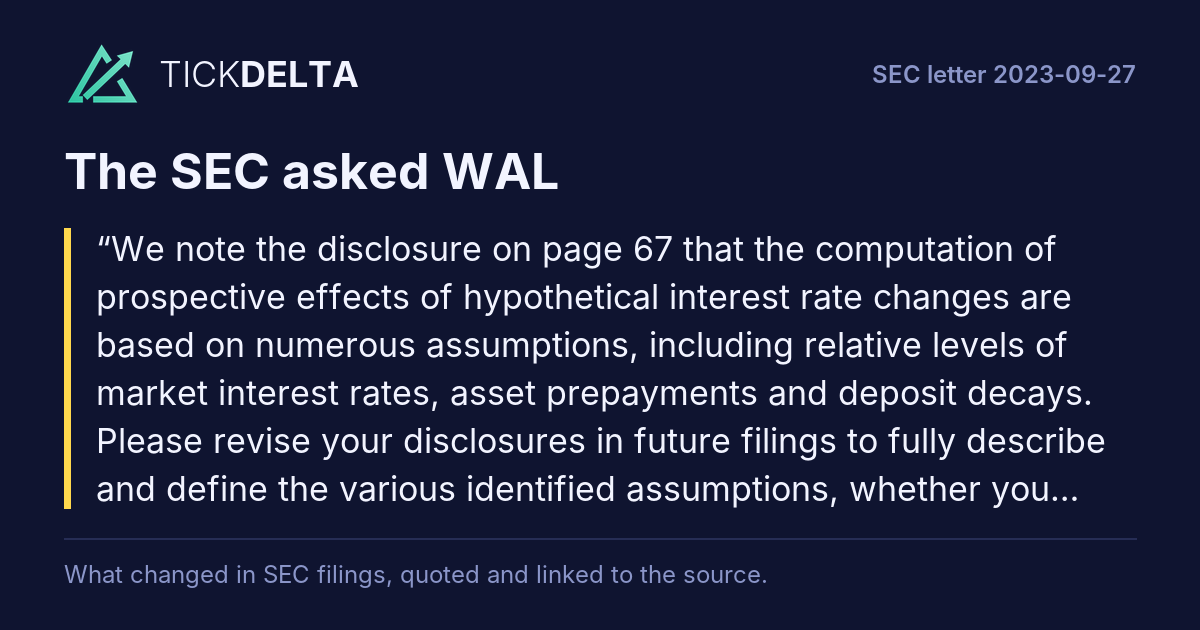
We note the disclosure on page 67 that the computation of prospective effects of hypothetical interest rate changes are based on numerous assumptions, including relative levels of market interest rates, asset prepayments and deposit decays.Rest of the question
Please revise your disclosures in future filings to fully describe and define the various identified assumptions, whether you use proprietary or third-party data, how the data are used in your modeling and any unique facts and circumstances about them, such as how they have or may respond to unknown facts and circumstances, such as exogenous events. Additionally, please disclose changes in any assumptions used for any comparative period, including changes to the data source used or significant changes in the actual assumption itself due to, and for example, internal data, market conditions or significant changes in the judgments and determinations made by management as you refine your modeling over time. Please see Item 305(a)(1)(ii)(B) of Regulation S-K.
The Company acknowledges the Staff’s comment and confirms that it will revise its disclosures in future filings as requested, including disclosure of any significant changes to data sources and assumptions or judgments and determinations of management, in each case whether due to management decisions or exogenous events.Read in the reply
First report after the company's reply of Oct 10, 2023: 10-Q filed Oct 31, 2023 ↗, against the 10-Q filed Aug 1, 2023 ↗.
Tickdelta does not hold the text of both reports, so they are not compared here.
We note your disclosure regarding derivative contracts, and the tabular presentation showing your outstanding derivative positions on page 68. Please provide a qualitative discussion of how derivatives are used to manage interest rate risk, including any changes in strategy during the periods presented. See Item 305(b)(1)(ii) of Regulation S-K.Rest of the question
Additionally, consider disclosing quantitative information about the impact the use of derivatives had on managing your interest rate risk and clarify whether the disclosed outputs from your net interest simulation analysis and Economic Value of Equity modeling reflect the impact of the derivatives used to manage interest rate risk.
Derivatives are used to minimize the exposure to changes in benchmark interest rates and volatility of net interest income and EVE to interest rate fluctuations. The impacts of derivatives are reflected in the interest rate simulation analysis results. Portfolio layer hedges were executed in the second quarter of 2023 to reduce the simulated EVE sensitivity in up rates scenarios and were primarily responsible for the reduction in interest rate sensitivity (i.e. EVE sensitivity in the Up 100 scenario went from (11.6%) in Q1 2023 to (6.8%) in Q2 2023).Read in the replyRest of the answer
These hedges allow the Company to execute a fair value hedge of the interest rate risk associated with a portfolio of similar pre-payable assets. WAL will provide further clarifications in its future filings regarding how derivatives are used and the relevant connection with interest rate risk management, including quantitative information as appropriate. The Company also notes that it included disclosure regarding these portfolio layer hedges, as well as additional qualitative discussion of how derivatives are used to manage interest rate risk, in the notes to its financial statements in the Form 10-Q (see Note 11 on page 40) and will reference such disclosure in the Market Risk section of its future filings.
First report after the company's reply of Oct 10, 2023: 10-Q filed Oct 31, 2023 ↗, against the 10-Q filed Aug 1, 2023 ↗.
Tickdelta does not hold the text of both reports, so they are not compared here.
We note the statement on page 67 that your non-term deposit products re-price concurrently with interest rate changes taken by the FOMC. Please tell us, and revise future filings to clarify, the assumptions made with respect to non-term deposit products re-pricing.Rest of the question
For example, it is unclear how, and the extent to which, deposit prices are assumed to change in response to changes in market interest rates, referred to as “deposit beta.”
The current assumptions for betas with respect to non-term deposit products repricing range between 20% to 90% depending on product. These assumptions are derived based on both observed and projected market rate and balance trends and are estimated separately by product: money market, interest bearing transaction accounts and savings. The Company regularly reviews and conducts sensitivity analysis for these assumptions to determine the impact on the interest rate risk position. The Company confirms that it will revise its disclosures in future filings as requested.Read in the reply
First report after the company's reply of Oct 10, 2023: 10-Q filed Oct 31, 2023 ↗, against the 10-Q filed Aug 1, 2023 ↗.
Tickdelta does not hold the text of both reports, so they are not compared here.
We note disclosure on page 141 that your ALCO manages interest rate risk “within BODapproved limits,” which you indicate are structured to preclude an interest rate risk profile that does not conform to both management and BOD risk tolerances without ALCO approval.Rest of the question
We also note disclosure on page 89 of the Form 10-Q for the quarter ended June 30, 2023 regarding measures taken in March 2023 in response to disruptions and volatility, and related risks associated with rapid increases in interest rates. Please revise future filings to provide a materially complete description of how you seek to manage risks due to changes in interest rates and other material impacts on your operational facts and circumstances, including any management or corporate government controls or procedures for identifying and responding to rapid increases and decreases in interest rates due to or as a result of exogenous or unknown factors. For example, please clarify the BOD-approved limits and, with a view to disclosure, advise us of the extent to which the ALCO has approved risk profiles that do not conform to management and BOD risk tolerances. Clarify the extent to which such limits and other policies and controls have been changed due to the economic and other developments referenced elsewhere.
The Company acknowledges the Staff’s comment and confirms that it will revise its disclosures in future filings as requested. Currently, all risk profiles conform to management and BOD risk tolerances, which have not changed since December 31, 2022. Except as described on page 67 of the Form 10-K and on page 83 of the Company’s Quarterly Report on Form 10-Q for the quarter ended March 31, 2023 (the “Q1 Form 10-Q”), there have been no instances of the ALCO approving risk profiles that do not conform to management and BOD risk tolerances since December 31, 2022.Read in the reply
First report after the company's reply of Oct 10, 2023: 10-Q filed Oct 31, 2023 ↗, against the 10-Q filed Aug 1, 2023 ↗.
Tickdelta does not hold the text of both reports, so they are not compared here.
Additionally, we note the statement on page 67 that there was a slight breach of your guideline of (10)% for the Up 100 rate scenario and that the Board and ALCO accepted the breach and believe that “as the Company continues to grow its balance sheet with an emphasis on deposits, the EVE exposure in the Up 100 rate scenario will be reduced.” In future filings, please clarify the pre-established guidelines whereRest of the question
material and, with a view to disclosure, advise us of the extent to which the Board or ALCO or other relevant committees approved risk profiles that did not conform to such pre-established guidelines. Tell us whether there were other instances where your simulation or model outputs fell outside of your pre-established limits during the year ended December 31, 2022 or six months ended June 30, 2023. In this regard, we note the Up 200 and Up 300 scenarios for December 31, 2022 show (19%)% and (24.4)%, respectively, and we note the (12.9)% and (17.2)% amounts for the same scenarios as of June 30, 2023. Please also tell us whether you made changes to the pre-established limits for purposes of evaluating your simulated net present value of equity and/or net interest income during the year ended December 31, 2022 or six months ended June 30, 2023. If so, disclose the nature of the changes and the factors driving the changes in future filings. Please provide draft We remind you that the company and its management are responsible for the accuracy and adequacy of their disclosures, notwithstanding any review, comments, action or absence of action by the staff.
The Company acknowledges the Staff’s comment and confirms that it will revise its disclosures in future filings as requested. Except as described on page 67 of the Form 10-K and on page 83 of the Q1 Form 10-Q, there have been no instances of the BOD, ALCO or other committee approving risk profiles that do conform to pre-established guidelines. Given the current assets and liabilities exposure, the guidelines for EVE focus on potential negative exposure from parallel shocks in market rates that will manifest especially under a simulated increase in rates.Read in the replyRest of the answer
The current guidelines are (20%) change from a simulated base EVE for Up 200 and (10%) for Up 100. As described on page 83 of the Q1 Form 10-Q, at March 31, 2023, the Company's EVE exposure related to these hypothetical changes in market interest rates was outside the Company's current guidelines for the Up 100 and Up 200 rate scenarios, where there was a breach on the Company's guideline of (10.0) % and (20.0) %, respectively. The Up 100 result was (11.7%) and the Up 200 result was (21.0%). Both results were within the guidelines as of June 30, 2023, and within the guidelines for all periods during the year ended December 31, 2022, except at December 31, 2022 as noted in the Staff’s comment and described on page 67 of the Form 10-K. No changes have been made to the Company guidelines since December 31, 2021.
The Company anticipates that disclosure with respect to future breaches would be similar to the disclosure on page 83 of the Q1 Form 10-Q, tailored to the specific circumstances at that time.
From the Q1 Form 10-Q: “At March 31, 2023, the Company's EVE exposure related to these hypothetical changes in market interest rates was within the Company's current guidelines, with the exception of the Up 100 and Up 200 rate scenarios, where there was a breach on the Company’s guideline of (10.0)% and (20.0)%, respectively. The breach is the result of a decline in duration of the Company's deposit liabilities from lower deposit balances and higher short-term borrowings. The BOD and ALCO have reviewed and approved the breach. It is the Company's belief that revised growth expectations with an emphasis on relationship deposits, the addition of short duration high-quality liquid assets, paydown of short-term borrowings and a strategic hedging strategy will reduce EVE exposure in the Up 100 and Up 200 rate scenarios and remediate both policy breaches.”
In future filings with respect to a period where a breach has occurred, the Company will also include disclosure clarifying the guidelines where material, such as: “The current guidelines are (20%) change from a simulated base EVE for Up 200 and (10%) for Up 100.” To the extent there are changes in the guidelines, the Company will disclose in such future filings the nature of such changes and any material factors driving such changes.
First report after the company's reply of Oct 10, 2023: 10-Q filed Oct 31, 2023 ↗, against the 10-Q filed Aug 1, 2023 ↗.
Tickdelta does not hold the text of both reports, so they are not compared here.
We note the tabular disclosure and discussion on page 75 detailing the composition of your gross loan portfolio, which includes commercial real estate (“CRE”). Given the significance of CRE in your total loan portfolio, please revise your disclosures, in future filings, to further discuss other CRE characteristics (e.g., current weighted average and/or range of loan-to-value ratios, updated vacancy rates, etc.), ifRest of the question
any. In addition, revise to describe the specific details of any risk management policies, procedures or other actions undertaken by management in response to the current environment.
The Company acknowledges the Staff’s comment and confirms that it will revise its disclosures in future filings as requested, including discussion of other CRE characteristics and risk management policies, procedures and actions as it relates to the current CRE environment.Read in the reply
First report after the company's reply of Feb 5, 2024: 10-K filed Feb 28, 2024 ↗, against the 10-K filed Feb 23, 2023 ↗.
Tickdelta does not hold the text of both reports, so they are not compared here.
Also in this review: closing letter, 2024-02-07