Screener / SEC EDGAR /CIK 0001990354 /10-K filed Feb 17, 2026, compared with Feb 18, 2025 /Numbers from the XBRL of the 10-Ks
Nasdaq Technology · IT Services

Waystar Holding Corp. WAY

Compare with peers Embed
The 10-K against last year's

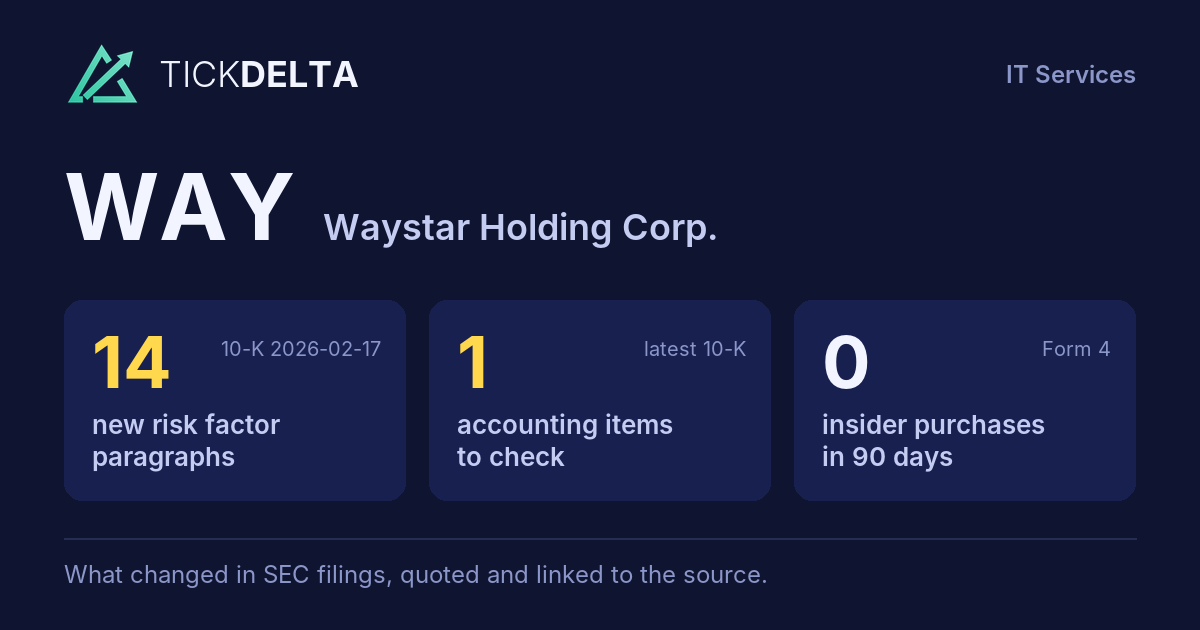
130 changes: 24 added, 22 removed, 83 reworded, 1 quiet changes

10-K Feb 17, 2026 vs Feb 18, 2025

10-K 0001990354-26-000011 (Feb 17, 2026) vs 10-K 0001410578-25-000148 (Feb 18, 2025) Not compared: Legal Proceedings.

Every paragraph, and how much of it changed

One bar per paragraph, in the order of the 10-K. Height and colour show the share of its words not in the closest paragraph a year earlier; the tallest bars are new paragraphs.

Risk Factors

259 paragraphs · 14 new · 99 reworded · 13 gone · 10-K Feb 17, 2026 against Feb 18, 2025
New paragraph Reworded (5% of its words or more) Same or nearly
Paragraph 91 · 48% changed Every version of it
We collect, create, receive, maintain, process, use, transmit, disclose, transfer, alter, and store (collectively, “Process”) significant amounts of patients' personal information of patients (including PHI) received in connection with the utilization of our platform and otherwise in connection with the operation of our business, and as well as other sensitive, confidential, and proprietary information such as payment data and PHI. data. Attacks on information technology systems are increasing in their frequency, levels of persistence, sophistication, and intensity, and they are being conducted by increasingly sophisticated and organized groups and individuals, including state- sponsored organizations, with a wide range of motives and expertise. In addition to extracting personal information and other sensitive or confidential information, such attacks could include the deployment of harmful malware, ransomware, denial-of-service attacks, social engineering, and other means to affect service reliability and threaten the confidentiality, integrity, security, and availability of our information or information technology systems. The prevalent use of mobile devices also increases the risk of data security incidents. Further, like all internet-based solutions, our solutions are vulnerable to software bugs, computer viruses, malware, internet worms, break-ins, phishing attacks, attempts to overload servers with denial-of- service, or other attacks or similar disruptions from unauthorized use of our and third-party computer systems, any of which could lead to system interruptions, delays, or shutdowns, causing loss of critical data, or the unauthorized acquisition of or access to data. While we believe we have taken reasonable steps to protect such data, techniques used to gain unauthorized access to or acquisitions of data and systems, disable or degrade service, or sabotage systems, are constantly evolving, and we may be unable to anticipate such techniques or implement adequate preventative measures to avoid unauthorized access, acquisitions of, or other adverse impacts to such data or our systems. The risk of state-supported and geopolitical-related cyber-attacks may increase in connection with the war in Ukraine and any related political or economic responses and counter-responses. In addition, competitors in our industry have suffered successful cyberattacks in the past, which may lead to us facing additional scrutiny, and we may face similar attacks ourselves. We may not discover all such incidents or activity or be able to respond or otherwise address them promptly, in sufficient respects or at all. Any specific interruption or attack, any failure to maintain performance, reliability, security, and availability of our products, or failure to prevent software bugs and other corruptants such as those listed above, to the satisfaction of our clients or their patients, may harm our reputation and our ability to retain existing clients, negatively affect our clients and their patients, and adversely impact our business, results of operations, and financial condition.
Paragraph 38 · 46% changed Every version of it
Many healthcare provider organizations are consolidating to create integrated healthcare delivery systems with greater market power. As provider networks and managed care organizations consolidate, thus decreasing the number of market participants, competition to provide products and solutions like ours will become more intense, and the importance of establishing and maintaining relationships with key industry participants will increase. These industry participants may try to use their market power to negotiate price reductions for our products and solutions. Further, consolidation of management and billing services through integrated delivery systems may decrease demand for our products. Such consolidation may also lead integrated delivery systems to require newly acquired physician practices to replace our product with that already in use in the larger enterprise. In addition, vertical integration whereby healthcare provider organizations acquire EHR, PM, revenue management cycle, or similar systems may make it more challenging to establish new relationships with such providers or may lead to such provider organizations replacing our solutions with those offered by systems that they acquire. Any of these factors could materially and adversely impact our business, financial condition, and operating results.
Paragraph 113 · 44% changed Every version of it
Our The development, deployment, and use of “open source” software AI in our products and solutions subjects us to risks that could adversely affect our ability to offer our products and solutions and subject us to possible litigation. business.
Paragraph 189 · 44% changed Every version of it
In addition, the Revolving Credit Facility requires us to maintain a first lien leverage ratio, to be tested on the last day of each fiscal quarter for which financial statements have been delivered, but only if, on the last day of such fiscal quarter, the aggregate amount of loans under the Revolving Credit Facility and certain letters of credit (in each case subject to certain exceptions specified therein) which are outstanding and/or issued, as applicable, exceeds 35% of the total amount of the commitments in respect of the Revolving Credit Facility.
Paragraph 152 · 42% changed Every version of it
We may be subject to revenue reductions or pricing pressures arising from various sources, including government actions and the trend of payors shifting to new reimbursement models and value-based care arrangements that incentivize healthcare providers to improve the health of their patients while managing medical expenses of a particular population. Value-based care reimbursement models implemented by government healthcare programs or private third-party payors could materially change the manner in which our clients are reimbursed. Our clients and other entities with which we have business relationships are also affected by other changes in statutes, regulations, and limitations on government spending for Medicare, Medicaid, and other programs. Recent and future government actions, including federal government cost-cutting, efficiency, and fraud and abuse initiatives may also result have a significant adverse impact on our business, and legislation or executive actions could limit or attempt to limit government spending for Medicare and Medicaid programs, limit payments to healthcare providers, initiate new and expanded value-based care reimbursement programs, impose price controls, and create other programs that potentially could have an adverse effect on our clients and the other entities with which we have a business relationship. If such actions or programs reduce the number of transactions, our revenues may decline along with our ability to absorb overhead costs, which may leave our business less profitable. Any failure to adequately implement strategic initiatives to adjust to these developments could have a material adverse impact on our business.
Paragraph 166 · 38% changed Every version of it
Current economic and political conditions make tax rates in any jurisdiction subject to significant change. Our future effective tax rates could also be affected by changes in the valuation of our deferred tax assets and liabilities, or changes in tax laws or their interpretation, including changes in tax laws affecting our products and solutions and the healthcare industry more generally. We are also subject to the examination of our tax returns and other documentation by the Internal Revenue Service and state tax authorities. We regularly assess the likelihood of an adverse outcome resulting from these examinations to determine the adequacy of our provision for taxes. There can be no assurance as to the outcome of these examinations or that our assessments of the likelihood of an adverse outcome will be correct. If our effective tax rates were to increase or if the ultimate determination of our taxes owed is for an amount in excess of amounts previously accrued, then this could materially and adversely impact our financial condition and results of operations.
Paragraph 158 · 36% changed Every version of it
We have been, and may in the future be, a party to legal and regulatory proceedings and investigations, and other proceedings and investigations arising in the ordinary course of business, such as claims brought by our clients in connection with commercial disputes and employment claims made by our current or former employees. Claims may also be asserted by or on behalf of a variety of other parties, including government agencies, patients or vendors of our clients, or stockholders. In addition, there are an increasing number of, and we may be subject to, investigations and proceedings in the healthcare industry generally that seek recovery under HIPAA, anti-kickback laws, false claims laws, civil monetary penalties laws, the Stark Law, state laws, and other statutes and regulations applicable to our business as described in more detail above. These and other similar statutory requirements impose statutory penalties for proven violations, which could be significant. We also may be subject to legal proceedings under non-healthcare federal and state laws affecting our business, such as the TCPA, the FDCPA, the Fair Credit Reporting Act, CAN-SPAM Act, Junk Fax Act, the CCPA, employment, banking and financial services, and USPS laws and regulations, as further detailed above and below. Such proceedings are inherently unpredictable, and the outcome can result in verdicts and/or injunctive relief that may affect how we operate our business or we may enter into settlements of claims for monetary payments. In some cases, substantial non-economic remedies or punitive damages may be sought. Governmental investigations, audits, and other reviews could also result in criminal penalties or other sanctions, including restrictions, changes in the way we conduct business, or exclusion from participation in government programs. We evaluate our exposure to these legal and regulatory proceedings and establish reserves for the estimated liabilities in accordance with GAAP. Assessing and predicting the outcome of these matters involves substantial uncertainties. Unexpected outcomes in these legal proceedings, or changes in management’s evaluations or predictions and accompanying changes in established reserves, could have a material adverse impact on our business, results of operations, or financial condition.
Paragraph 81 · 35% changed Every version of it
In addition, we and our clients are subject to card network rules that could subject us or our clients to a variety of fines or penalties that may be levied by card networks for certain acts or omissions by us or our clients. If a client or sales partner fails to comply with the applicable requirements of card networks, we could be subject to a variety of fines or penalties that may be levied by card networks. We may have to bear the cost of such fines or penalties if we cannot collect them from the applicable client or sales partner, resulting in lower earnings or losses for us. Our violation of the network rules may result in the termination or suspension of our registration with the affected network. The termination of our registration, including a card network barring us from acting as a payment facilitator, or any changes in card network rules that would impair our registration, could require us to stop providing payment solutions relating to the affected card network, which would adversely affect our ability to conduct our business.

MD&A

104 paragraphs · 10 new · 54 reworded · 9 gone · 10-K Feb 17, 2026 against Feb 18, 2025
New paragraph Reworded (5% of its words or more) Same or nearly
Paragraph 16 · 47% changed
Following the February 2024 cybersecurity incident involving one of our competitors, more than 30,000 providers, including a significant number of large health systems and ambulatory providers, began adopting our solutions, and we were able to implement our solutions for many of these new clients in as little as 48 hours. This incident and our response to it generated approximately $34 million in additional revenue in the year ended December 31, 2024 due to increased win rates above our historically competitive rates and associated accelerated implementation timeline.
Paragraph 76 · 40% changed
Borrowings under the First Lien Credit Agreement currently bear interest at a 1.00% for alternate base rate per annum equal to, at the option of the Borrower, either (i) (x) the ("ABR") loans and 2.00% for Adjusted Term SOFR rate for the applicable interest period, with a floor of 0.00%, plus (y) an applicable margin rate of, for loans under the first lien term loans, between 3.75% and 3.50% and, for loans loans. Borrowings under the revolving credit facility, First Lien Credit Agreement currently bear an interest rate per annum between 3.00% 1.50% and 2.25%, in each case, 2.25% plus SOFR under the Revolving Credit Facility, depending on the applicable first lien leverage ratio or (ii) (x) an alternate base rate (“ABR”), with a floor of 1.00%, plus (y) an applicable margin rate of, for the first lien term loans, between 2.75% and 2.50% and, for loans under the revolving credit facility, between 2.00% and 1.25%, in each case, depending on the applicable first lien leverage ratio (with the ABR determined as the greatest of (a) the prime rate, (b) the federal funds effective rate plus 0.50%, and (c) the Term SOFR rate plus 1.00%). ratio.
Paragraph 50 · 36% changed
We define non-GAAP net income as GAAP net income excluding the impact of stock-based compensation, acquisition and integration costs, asset and lease impairments, costs related to our IPO related costs, and Secondary Offerings, costs related to amended debt agreements and amortization of intangibles. We updated the definition of non-GAAP net income to include amortization of intangibles to align with a more common definition used by our peers. We have revised prior year disclosures to align with this updated definition. The tax effects of the adjustments are calculated using a management estimated annual effective non-GAAP tax rate of 21%. 21%, which is based on our statutory federal tax rate and provides consistency across reporting periods by eliminating the effects of non-recurring and period specific items. Due to the differences in the tax treatment of items excluded from non-GAAP net income/(loss), our estimated tax rate on non-GAAP net income/(loss) may differ from GAAP tax rate.
Paragraph 24 · 35% changed
Cost of revenue includes salaries, stock-based compensation, and benefits (“personnel costs”) for our team members who are focused on implementation, support, and other client-focused operations, as well as team members focused on enhancing and developing our platform. Cost of revenue also includes costs for third-party technology such as interchange fees and infrastructure related to the operations of our platform, including communicating and processing patient payments, and services to support the delivery of our solutions. Third-party costs for patient payments solutions are approximately 60% of the revenue generated from these solutions, while third-party costs for provider solutions are approximately 6% to 8% of the associated revenue, in each case, for the years ended December 31, 2024 and 2023.
Paragraph 83 · 34% changed
On August 13, 2021, the Borrower, as servicer, and Waystar RC LLC, a wholly-owned “bankruptcy remote” special purpose vehicle, as “Receivables Borrower”, entered into a receivables financing agreement (the “Receivables Financing Agreement”), providing for an aggregate borrowing Agreement”). As of up to $50 million. Loans under the December 31, 2025, Receivables Financing Agreement mature on August 13, 2024. Borrowings under the Receivables Financing Agreement accrue agreement has an interest at a rate of 1.61% per annum of, at the option of the Receivables Borrower, either Term SOFR or base rate plus 2.00%. above SOFR. All amounts outstanding under the Receivables Financing Agreement are collateralized by substantially all of the accounts receivables and unbilled revenue of the Receivables Borrower. On The current maturity date is October 31, 2023, the Borrower and Receivables Borrower amended the Receivables Financing Agreement to increase the aggregate borrowing availability to up to $80 million and extend the maturity date to October 30, 2026. On September 6, 2024, we drew $10.0 million on the Receivables Facility and used the proceeds to paydown $10.0 million on the First Lien Credit Facility.
Paragraph 8 · 33% changed
In June 2024, we completed an IPO of 45,000,000 shares of common stock at a price of $21.50 per share. After underwriting discounts and commissions of $53.2 million, we received total proceeds from the offering of $914.3 million. On July 5, 2024, pursuant to the option granted to the underwriters for a period of 30 days from the date of the prospectus to purchase up to 6,750,000 additional shares of common stock from us at the IPO price less the underwriting discount, the underwriters exercised the right to purchase 5,059,010 additional shares of common stock, resulting in additional net proceeds of $102.8 million, after deducting underwriting discounts and commissions of $6.0 million. The remaining option to purchase additional shares expired unexercised at the end of the 30-day period. See Part II, Item 8, “Financial Statements—Note 1 (Business)”, for more information.
Paragraph 69 · 31% changed
Our indirect wholly-owned subsidiary, Waystar Technologies, Inc., a Delaware corporation (the “Borrower”), is the Borrower under a first lien credit agreement, originally dated as of October 22, 2019 (as amended from time to time, the “First Lien Credit Agreement”), that initially provided for an $825.0 million senior secured first lien Agreement”). As of December 31, 2025, the agreement includes a term loans and commitments under totaling $1,401.2 million outstanding, as well as a revolving credit facility in an aggregate principal amount of $125.0 million, Revolving Credit Facility with a sub-commitment for issuance borrowing capacity of letters of credit of $25.0 $500.0 million. The initial first lien term loans are scheduled to mature on October 22, 2026 and commitments under the revolving credit facility and the loans thereunder were initially scheduled to terminate and mature on October 22, 2024.
Paragraph 98 · 31% changed
Goodwill is tested for impairment at the reporting unit level, which is defined as an operating segment or one level below an operating segment (referred to as a component). Our single operating segment is also our single reporting unit as we do not have segment managers and there is no discrete information reviewed at a level lower than the consolidated entity level. All of our assets and liabilities are assigned to this single reporting unit.

A paragraph is matched with the one last year that shares the most of its words; under half in common makes it new. The paragraphs shown are the 8 reworded the most in each section.

The paragraph that changed most in each section

The redline

Marked against last year's 10-K: cut words struck through, new words highlighted.

Risk Factors323 words changed in this paragraph; it is 43% similar to last year's version.
We collect, create, receive, maintain, process, use, transmit, disclose, transfer, alter, and store (collectively, “Process”) significant amounts of patients' personal information of patients (including PHI) received in connection with the utilization of our platform and otherwise in connection with the operation of our business, and as well as other sensitive, confidential, and proprietary information such as payment data and PHI. data. Attacks on information technology systems are increasing in their frequency, levels of persistence, sophistication, and intensity, and they are being conducted by increasingly sophisticated and organized groups and individuals, including state- sponsored organizations, with a wide range of motives and expertise. In addition to extracting personal information and other sensitive or confidential information, such attacks could include the deployment of harmful malware, ransomware, denial-of-service attacks, social engineering, and other means to affect service reliability and threaten the confidentiality, integrity, security, and availability of our information or information technology systems. The prevalent use of mobile devices also increases the risk of data security incidents. Further, like all internet-based solutions, our solutions are vulnerable to software bugs, computer viruses, malware, internet worms, break-ins, phishing attacks, attempts to overload servers with denial-of- service, or other attacks or similar disruptions from unauthorized use of our and third-party computer systems, any of which could lead to system interruptions, delays, or shutdowns, causing loss of critical data, or the unauthorized acquisition of or access to data. While we believe we have taken reasonable steps to protect such data, techniques used to gain unauthorized access to or acquisitions of data and systems, disable or degrade service, or sabotage systems, are constantly evolving, and we may be unable to anticipate such techniques or implement adequate preventative measures to avoid unauthorized access, acquisitions of, or other adverse impacts to such data or our systems. The risk of state-supported and geopolitical-related cyber-attacks may increase in connection with the war in Ukraine and any related political or economic responses and counter-responses. In addition, competitors in our industry have suffered successful cyberattacks in the past, which may lead to us facing additional scrutiny, and we may face similar attacks ourselves. We may not discover all such incidents or activity or be able to respond or otherwise address them promptly, in sufficient respects or at all. Any specific interruption or attack, any failure to maintain performance, reliability, security, and availability of our products, or failure to prevent software bugs and other corruptants such as those listed above, to the satisfaction of our clients or their patients, may harm our reputation and our ability to retain existing clients, negatively affect our clients and their patients, and adversely impact our business, results of operations, and financial condition.

Source: Item 1A, 10-K 0001990354-26-000011 vs Item 1A, 10-K 0001410578-25-000148

MD&A188 words changed in this paragraph; it is 32% similar to last year's version.
Adjusted EBITDA, adjusted EBITDA margin, non-GAAP net income / (loss), income, and non-GAAP net income / (loss) per share are not recognized terms under GAAP and should not be considered as an alternative to net income (loss) income/(loss), net income/(loss) per share or net income (loss) income/(loss) margin as measures of financial performance or cash provided by operating activities as a measure of liquidity, or any other performance measure derived in accordance with GAAP. Additionally, these measures are not intended to be a measure of free cash flow available for management’s discretionary use, as they do not consider certain cash requirements such as interest payments, tax payments, and debt service requirements. The presentations of these measures have limitations as analytical tools and should not be considered in isolation, or as a substitute for analysis of our results as reported under GAAP. Because not all companies use identical calculations, the presentations of these measures may not be comparable to other similarly titled measures of other companies and can differ significantly from company to company. A reconciliation is provided below for our non-GAAP financial measures to the most directly comparable financial measure stated in accordance with GAAP. Investors are encouraged to review the related GAAP financial measures and the reconciliation of non-GAAP financial measures to their most directly comparable GAAP financial measures, and not to rely on any single financial measure to evaluate our business.

Source: Item 7, 10-K 0001990354-26-000011 vs Item 7, 10-K 0001410578-25-000148

Accounting Policies137 words changed in this paragraph; it is 36% similar to last year's version.
In November 2024, December 2025, the ASB FASB issued ASU 2024-13, “Expense Disaggregation Disclosures.” The standard 2025-11, an update to improve the guidance in Topic 270, Interim Reporting, by improving the navigability of the required interim disclosures and clarifying when that guidance is intended to benefit investors by providing more detailed information about expenses that is critically important in understanding an entity’s performance, assessing an entity’s prospects for future cash flows, and comparing an entity’s performance over time and with that of other entities. applicable. For public companies, this ASU will be the update is effective for interim reporting periods within annual reporting periods beginning after December 15, 2026, and interim reporting periods beginning after December 15, 2027. Early adoption is permitted. The amendments in this Update should be applied either (1) prospectively to financial statements issued for reporting periods after the effective date of this Update or (2) retrospectively to any or all prior periods presented in the financial statements. We are currently evaluating the effect of the adoption of this amendment on our consolidated financial statements.

Source: Item 8, Note 2 – Summary of Significant Accounting Policies, 10-K 0001990354-26-000011 vs Item 8, Note 2 – Summary of Significant Accounting Policies, 10-K 0001410578-25-000148

Sentences and paragraphs added, removed or reworded

Every change, by type

Sentences and paragraphs of WAY's Risk Factors and MD&A, 10-K Feb 17, 2026 against 10-K Feb 18, 2025. Each links to the text at sec.gov.

Quiet changes are sentences kept from last year with one to four words changed, at least one of them a hedge, a modal or a qualifier (may, could, will, not, significant, material…). A year or date rolling forward is not counted.

The full word list

adverse, adversely, all, although, anticipate, anticipates, any, approximately, believe, believes, can, cannot, certain, could, expect, expects, generally, however, if, intend, intends, largely, likely, many, material, materially, may, might, most, must, never, no, not, possible, primarily, probable, should, significant, significantly, some, substantial, substantially, unlikely, will, would

AddedRisk Factors
Any adverse impact to the availability, integrity, or confidentiality of our information technology systems or data, or the information technology systems or data of third parties upon which we rely, could require us to expend significant resources to mitigate the breach of security, pay any applicable fines, and address matters related to any such breach, including notifying impacted individuals, the media, or regulators, making public disclosures, and addressing reputational harm.
Read it in 10-K Feb 17, 2026 at sec.gov
AddedRisk Factors
We have integrated AI and machine learning technologies into our products and solutions, and our future success will depend, in part, on our ability to leverage these technologies responsibly and effectively. The development and use of
Read it in 10-K Feb 17, 2026 at sec.gov
AddedRisk Factors
AI subjects us to risks that could adversely affect our business, financial condition and results of operations, and use of such technologies may not enhance our products or solutions, allow us to keep pace with competitors or benefit our business as intended. As these technologies are rapidly developing, it is not possible to predict all of the legal, operational, competitive, security, technological and other risks that may arise relating to the use of such technologies.
Read it in 10-K Feb 17, 2026 at sec.gov
AddedRisk Factors
Our AI-enabled solutions depend on the quality and completeness of training data, and deficiencies could result in inaccurate, misleading, unreliable, or biased outputs that could harm our clients or expose us to liability. AI technologies are inherently complex, and our AI systems may not perform as intended, or may degrade in performance over time due to changes in underlying data, payer requirements, market conditions or for other reasons. Validating AI outputs requires substantial resources and consistent, reliable performance across diverse client environments and use cases is difficult. Any actual or perceived failures of our AI-enabled solutions could result in client dissatisfaction, claims against us, regulatory scrutiny, or reputational harm.
Read it in 10-K Feb 17, 2026 at sec.gov
AddedRisk Factors
Our clients may impose contractual restrictions on our use of AI, or seek indemnification for AI-related errors, any of which could limit the value of our AI-enabled solutions or expose us to liability. Client reluctance to adopt AI features due to accuracy, liability, or regulatory concerns could also slow our ability to realize returns on our AI investments.
Read it in 10-K Feb 17, 2026 at sec.gov
AddedRisk Factors
Moreover, AI is subject to a dynamic and rapidly evolving legal and regulatory environment, and our efforts, including the introduction of new products or changes to existing products, may result in new or enhanced governmental or regulatory scrutiny, litigation, ethical concerns, or other complications and liabilities. We may not be able to successfully respond to these rapidly evolving frameworks, laws, regulations and other requirements, and we may need to expend significant resources to adjust our operations or offerings in response.
Read it in 10-K Feb 17, 2026 at sec.gov
AddedRisk Factors
The rapid advancement of generative and agentic AI also poses competitive risks. Large technology companies with significantly greater resources are deploying AI tools that could commoditize revenue cycle management functions core to our platform, and competitors may also adopt or deploy AI more quickly or effectively than we do. Agentic AI systems could automate workflows our clients currently rely on us to perform, and EHR and PM vendors may integrate AI capabilities directly into their platforms, reducing demand for our solutions. Generative AI may also lower barriers to entry, enabling new competitors to emerge more quickly. If we fail to keep pace with AI advancements or our AI-enabled solutions do not achieve market acceptance, our competitive position could be materially harmed.
Read it in 10-K Feb 17, 2026 at sec.gov
Show the other 60
AddedRisk Factors
We are a “covered entity” as defined under HIPAA when we provide our clearinghouse services, and we also are a “business associate” as defined under HIPAA for other covered entities when we provide revenue cycle management and other solutions. HHS OCR may impose civil penalties on both covered entities and business associates for their failure to
Read it in 10-K Feb 17, 2026 at sec.gov
AddedRisk Factors
expect even greater scrutiny by federal and state regulators, partners, and consumers of our Processing of health information, particularly with our AI-enabled solutions. Additionally, federal and state consumer protection laws are increasingly being applied by the FTC and states’ attorneys general to regulate the Processing of personal information, through websites or otherwise, and to regulate the presentation of website content.
Read it in 10-K Feb 17, 2026 at sec.gov
AddedRisk Factors
As a public company, we are subject to significant requirements for enhanced financial reporting and internal controls. The process of designing and maintaining effective internal controls is a time consuming, costly, and continuous effort that requires us to anticipate and react to changes in our business and the economic and regulatory environments. If
Read it in 10-K Feb 17, 2026 at sec.gov
RemovedRisk Factors
sale of these technologies, or their use by us or by our clients or partners, may also subject us to additional risks, including reputational harm, competitive harm, or legal liabilities.
Read it in 10-K Feb 18, 2025 at sec.gov
RemovedRisk Factors
We are an “emerging growth company” and we cannot be certain if the reduced disclosure requirements applicable to “emerging growth companies” will make our common stock less attractive to investors.
Read it in 10-K Feb 18, 2025 at sec.gov
RemovedRisk Factors
We are an “emerging growth company,” as defined in Section 2(a)(19) of the Securities Act, and we may take advantage of certain exemptions and relief from various reporting requirements that are applicable to other public companies that are not “emerging growth companies.” In particular, while we are an “emerging growth company,” among other exemptions:
Read it in 10-K Feb 18, 2025 at sec.gov
RemovedRisk Factors
we will not be required to engage an independent registered public accounting firm to report on our internal controls over financial reporting pursuant to Section 404(b) of the Sarbanes-Oxley Act,
Read it in 10-K Feb 18, 2025 at sec.gov
RemovedRisk Factors
we will not be required to comply with the requirement in Public Company Accounting Oversight Board Auditing Standard 3101, The Auditor’s Report on an Audit of Financial Statements When the Auditor Expresses an Unqualified Opinion, to communicate critical audit matters in the auditor’s report;
Read it in 10-K Feb 18, 2025 at sec.gov
RemovedRisk Factors
we will be permitted to present only two years of audited financial statements and only two years of related “Management’s Discussion and Analysis of Financial Condition and Results of Operations” in our periodic reports and registration statements;
Read it in 10-K Feb 18, 2025 at sec.gov
RemovedRisk Factors
we will not be required to disclose certain executive compensation related items such as the correlation between executive compensation and performance and comparisons of the chief executive officer’s compensation to median employee compensation; or
Read it in 10-K Feb 18, 2025 at sec.gov
RemovedRisk Factors
we will not be required submit certain executive compensation matters to stockholder advisory votes, such as “say-on-pay,” “say-on-frequency,” and “say-on-golden parachutes.”
Read it in 10-K Feb 18, 2025 at sec.gov
RemovedRisk Factors
In addition, Section 107 of the JOBS Act provides that an emerging growth company can take advantage of the extended transition period provided in Section 7(a)(2)(B) of the Securities Act for complying with new or revised accounting standards, meaning that we can delay the adoption of certain accounting standards until those standards would otherwise apply to private companies. We have elected to take advantage of this extended transition period, and as a result, our financial statements may not be comparable with similarly situated public companies.
Read it in 10-K Feb 18, 2025 at sec.gov
RemovedRisk Factors
We will remain an “emerging growth company” until the earliest to occur of (1) our reporting of $1.24 billion or more in annual gross revenue; (2) our becoming a “large accelerated filer,” with at least $700 million of equity securities held by non-affiliates; (3) our issuance, in any three year period, of more than $1.0 billion in non-convertible debt; and (4) the fiscal year end following the fifth anniversary of the completion of our initial public offering.
Read it in 10-K Feb 18, 2025 at sec.gov
RemovedRisk Factors
We cannot predict whether investors will find our common stock less attractive if we rely on the exemptions and relief granted by the JOBS Act. For example, if we do not adopt a new or revised accounting standard, our future results of operations may not be as comparable to the results of operations of certain other companies in our industry that adopted such standards. If some investors find our common stock less attractive as a result, there may be a less active trading market for our common stock, and our stock price may decline and/or become more volatile.
Read it in 10-K Feb 18, 2025 at sec.gov
RewordedRisk Factors
See Part I, Item 1A, “Risk Factors—Risks Related to Information Technology Systems, Cybersecurity, Data Privacy, and Intellectual Property—Privacy concerns or security breaches or incidents relating Property—Our business is subject to our platform could result in economic loss, damage to our reputation, deter users from using our products, expose us to legal penalties complex and liability, evolving laws and otherwise adversely affect our business” regulations regarding privacy, data protection, and cybersecurity and Part I, Item 1A, “Risk Factors—Risks Related to Legal and Governmental Regulation—We are subject to health care laws and data privacy and security laws and regulations governing our Processing of personal information, including PHI, personal health records, and payment card data.”
Read it in 10-K Feb 17, 2026 at sec.gov
RewordedRisk Factors
If we are determined to have violated any of these laws, we may be required to give our clients the right to terminate our services agreements with them and/or required to refund portions of our base fee revenues and incentive payment revenues, any of which could have a material adverse effect on our business and results of operations.
Read it in 10-K Feb 17, 2026 at sec.gov
RewordedRisk Factors
Any theft, loss, or misappropriation of, or access to, clients’, or other proprietary data, or other breach of our third-party service providers’ or vendors’ information technology systems Additionally, any such event could result in fines, legal claims, or proceedings, including regulatory investigations and class actions, or liability for failure to comply with privacy and information security laws, which could disrupt our operations, damage our reputation, and expose us to claims from clients, individuals, and others, any of which could have a material adverse effect on our business, financial condition, and results of operations.
Read it in 10-K Feb 17, 2026 at sec.gov
RewordedRisk Factors
Many other states, such as Colorado, Connecticut, Delaware, Indiana, Iowa, Kentucky, Maryland, Minnesota, Montana, Nebraska, New Hampshire, New Jersey, Oregon, Rhode Island, Tennessee, Texas, Utah, and Virginia states have since also passed enacted comprehensive state privacy laws that may impose additional obligations and requirements on our business.
Read it in 10-K Feb 17, 2026 at sec.gov
RewordedRisk Factors
In addition, the Revolving Credit Facility requires us to maintain a first lien leverage ratio, to be tested on the last day of each fiscal quarter for which financial statements have been delivered, but only if, on the last day of such fiscal quarter, the aggregate amount of loans under the Revolving Credit Facility and certain letters of credit (in each case subject to certain exceptions specified therein) which are outstanding and/or issued, as applicable, exceeds 35% of the total amount of the commitments in respect of the Revolving Credit Facility.
Read it in 10-K Feb 17, 2026 at sec.gov
RewordedRisk Factors
Bain has the right to nominate to our board of directors one nominee for so long as Bain beneficially owns 5% or greater of our then-outstanding common stock.Advent has the right to nominate to our board of directors one nominee for so long as Advent beneficially owns 5% or greater of our then-outstanding common stock.
Read it in 10-K Feb 17, 2026 at sec.gov
RewordedRisk Factors
Recent and future government actions, including federal government cost-cutting, efficiency, and fraud and abuse initiatives may also result have a significant adverse impact on our business, and legislation or executive actions could limit or attempt to limit government spending for Medicare and Medicaid programs, limit payments to healthcare providers, initiate new and expanded value-based care reimbursement programs, impose price controls, and create other programs that potentially could have an adverse effect on our clients and the other entities with which we have a business relationship.
Read it in 10-K Feb 17, 2026 at sec.gov
RewordedRisk Factors
While certain of these rules benefit us in that certain EHR vendors will no longer be permitted to interfere with our attempts at integration, they may also make it easier for other similar companies to enter the market, creating increased competition and reducing our market share. share.Changes to the legal, regulatory or political environment may require management’s attention, divert resources from other areas, and expose us to potential liability.
Read it in 10-K Feb 17, 2026 at sec.gov
RewordedRisk Factors
If providers of EHR or PM solutions amend, terminate, or fail to perform their obligations under their agreements with us, we may need to seek other ways of integrating our platform with the EHR and PM systems of our clients, which could be costly and time consuming, and could adversely affect our business results.
Read it in 10-K Feb 17, 2026 at sec.gov
RewordedRisk Factors
While we believe we have taken reasonable steps to protect such data, techniques Techniques used to gain unauthorized access to or acquisitions of data and systems, disable or degrade service, or sabotage systems, are constantly evolving, evolving (including through the use of AI), and we may be unable to anticipate such techniques or implement adequate preventative measures to avoid unauthorized access, acquisitions of, or other adverse impacts to such data or our systems.
Read it in 10-K Feb 17, 2026 at sec.gov
RewordedRisk Factors
Although we carry cybersecurity insurance, we cannot ensure our limits are sufficient to cover us against all potential losses for damages or fines in an amount exceeding our policy. policy, or that applicable insurance will be available to us in the future on economically reasonable terms or at all.
Read it in 10-K Feb 17, 2026 at sec.gov
RewordedRisk Factors
Healthcare laws and regulations are rapidly evolving evolving, including as a result of changes in the U.S. administration resulting in changes in federal law and enforcement, and may change significantly in the future, which could adversely affect our financial condition and results of operations.
Read it in 10-K Feb 17, 2026 at sec.gov
AddedMD&A
On February 24, 2025, the Institutional Investors closed an underwritten public offering of 23,000,000 shares of our common stock (inclusive of the underwriters’ option to purchase additional shares) (the “First Secondary Offering”). On May 15, 2025, the Institutional Investors closed another underwritten public offering of 14,375,000 shares of our common stock (inclusive of the underwriters' option to purchase additional shares) (the "Second Secondary Offering"). Additionally, on September 10, 2025, the Institutional Investors closed another underwritten public offering of 18,000,000 shares of our common stock (the "Third Secondary Offering"). We did not sell any shares in these offerings or receive any proceeds from these offerings. Pursuant to the terms of the Amended and Restated Registration Rights Agreement, dated as of June 10, 2024, by and among Waystar, the Institutional Investors, and certain other parties thereto, we paid $4.6 million in certain expenses on behalf of the selling stockholders related to these offerings for the year ended December 31, 2025, while the selling stockholders paid all applicable underwriting discounts and commissions.
Read it in 10-K Feb 17, 2026 at sec.gov
AddedMD&A
On July 23, 2025, we entered into an Agreement and Plan of Merger (the "Merger Agreement") to acquire Iodine through a series of mergers. Iodine is a trusted leader in AI-powered clinical intelligence, enhancing clinical documentation and accuracy, streamlining utilization management, and preventing revenue leakage before billing. This strategic move is expected to bolster our AI leadership, automate manual work, and improve financial performance for providers. The acquisition was completed on October 1, 2025 for a total purchase price of $1.26 billion. The consideration paid was approximately $638.9 million in cash consideration and 16,639,920 shares of common stock having a value of $37.31 per share, and certain adjustments as outlined in the Merger Agreement.
Read it in 10-K Feb 17, 2026 at sec.gov
AddedMD&A
The following discussion and analysis is for the year ended December 31, 2025, compared to the same period in 2024, unless otherwise stated. For a discussion and analysis of the year ended December 31, 2024, compared to the same period in 2023, please refer to the Management's Discussion and Analysis of Financial Condition and Results of Operations
Read it in 10-K Feb 17, 2026 at sec.gov
AddedMD&A
Adjusted EBITDA, adjusted EBITDA margin, non-GAAP net income, and non-GAAP net income per share are not recognized terms under GAAP and should not be considered as an alternative to net income/(loss), net income/(loss) per share or net income/(loss) margin as measures of financial performance or cash provided by operating activities as a
Read it in 10-K Feb 17, 2026 at sec.gov
AddedMD&A
Years ended December 31, ($in thousands) 2025 2024 Net income/(loss) $ 112,089 $ (19,125) Interest expense 77,542 146,270 Income tax expense/(benefit) 59,674 (3,420) Depreciation and amortization 140,548 186,631 Stock-based compensation expense 42,069 54,437 Acquisition and integration costs 21,074 859 Costs related to amended debt agreements 2,580 14,138 IPO and Secondary Offering related expenses 4,657 2,140 Other (a) 1,913 1,566 Adjusted EBITDA $ 462,146 $ 383,496 Revenue $ 1,099,278 $ 943,549 Net income/(loss) margin 10.2 % (2.0) % Adjusted EBITDA margin 42.0 % 40.6 %
Read it in 10-K Feb 17, 2026 at sec.gov
AddedMD&A
Years ended December 31, ($in thousands) 2025 2024 Net income/(loss) $ 112,089 $ (19,125) Stock-based compensation expense 42,069 54,437 Acquisition and integration costs 21,074 859 Costs related to amended debt agreements 2,580 14,138 IPO and Secondary Offering related expenses 4,657 2,140 Other (a) 1,913 19,445 Intangible amortization 118,609 147,887 Tax effect of adjustments (40,089) (50,170) Non-GAAP net income/(loss) $ 262,902 $ 169,611 Non-GAAP net income/(loss) per share: Basic $ 1.48 $ 1.13 Diluted $ 1.42 $ 1.09 Weighted-average shares outstanding: Basic 177,926,745 149,915,839 Diluted 184,783,285 155,677,094
Read it in 10-K Feb 17, 2026 at sec.gov
AddedMD&A
On October 1, 2025, we entered into the Twelfth Amendment to the First Lien Credit Agreement to increase our First Lien Credit Facility by $250.0 million. Additionally, the amendment increased the maximum borrowing capacity under the revolving credit facility from $400.0 million to $500.0 million and decreased the interest rate under the Revolving Credit Facility from 1.75% per annum above SOFR to 1.50% per annum above SOFR.
Read it in 10-K Feb 17, 2026 at sec.gov
AddedMD&A
The results of businesses acquired in business combinations are included in our consolidated financial statements from the date of the acquisition. Purchase accounting results in assets and liabilities of an acquired business being recorded at their estimated fair values on the acquisition date. Any excess consideration over the fair value of assets acquired and liabilities assumed is recognized as goodwill. The purchase price allocation process requires management to make significant judgment and estimates, including the selection of valuation methodologies, estimates of future expected cash flows, future revenue growth, margins, customer attrition rates, technology life, royalty rates, expected use of acquired assets, and discount rates. These factors are also considered in determining the useful life of the acquired intangible assets. These estimates are based in part on historical experience, market conditions and information obtained from management of the acquired companies and are inherently uncertain. We engage the assistance of valuation specialists in concluding on fair value measurements in connection with determining fair values of assets acquired and liabilities assumed in business combinations.
Read it in 10-K Feb 17, 2026 at sec.gov
RemovedMD&A
Included within the revenue increases over the period is an estimated $34 million increase due to our heightened win rates above our historically high rates and accelerated implementation timelines as well as increased volume-based revenue from existing clients related to the cybersecurity incident involving one of our competitors in February 2024.
Read it in 10-K Feb 18, 2025 at sec.gov
RemovedMD&A
On December 1, 2019, the Borrower and certain lenders amended the First Lien Credit Agreement to add 2019 first lien incremental term loans in the amount of $100.0 million to be used for certain acquisitions consummated substantially simultaneously with the closing of such amendment. The terms of such 2019 first lien incremental term loans were the same as the terms of the initial first lien term loans, including in respect of maturity, and were considered an increase in the aggregate principal amount of the initial first lien term loans outstanding under the First Lien Credit Agreement and were part of the initial first lien term loans.
Read it in 10-K Feb 18, 2025 at sec.gov
RemovedMD&A
On September 23, 2020, the Borrower and certain lenders amended the First Lien Credit Agreement to (i) add 2020 first lien incremental term loans in the amount of $620.0 million to be used for certain acquisitions consummated substantially simultaneously with the closing of such amendment and (ii) add revolving credit commitments in the amount of $75.0 million to increase the revolving credit commitments available under the First Lien Credit Agreement to $200.0 million. Such 2020 first lien incremental term loans constituted a separate class of first lien term loans from the initial first lien term loans but were otherwise on the same as the terms of the initial first lien term loans (other than with respect to the “LIBOR-floor” applicable thereto).
Read it in 10-K Feb 18, 2025 at sec.gov
RemovedMD&A
On March 24, 2021, the Borrower and certain lenders amended the First Lien Credit Agreement to (i) reduce the “LIBOR-floor” applicable to the 2020 first lien incremental term loans and (ii) in connection therewith, combine the initial first lien term loans with the 2020 first lien incremental term loans which thereafter then constituted one class of first lien term loans.
Read it in 10-K Feb 18, 2025 at sec.gov
RemovedMD&A
On August 24, 2021, the Borrower and certain lenders amended the First Lien Credit Agreement to add 2021 first lien incremental term loans in the amount of $247.0 million to be used for certain acquisitions consummated substantially simultaneously with the closing of such amendment. The terms of such 2021 first lien incremental term loans were the same as the terms of the initial first lien term loans outstanding at such time, including in respect of maturity, and were considered an increase in the aggregate principal amount of the initial first lien term loans outstanding under the First Lien Credit Agreement at such time and were part of the initial first lien term loans.
Read it in 10-K Feb 18, 2025 at sec.gov
RemovedMD&A
On October 6, 2023, the Borrower and certain lenders amended the First Lien Credit Agreement to, among others, (i) increase the revolving credit commitments under the First Lien Credit Agreement by $142.5 million to a total of $342.5 million, with a sub-commitment for issuance of letters of credit of $50.0 million, (ii) amend the applicable margin with respect thereto upon the consummation of a qualifying initial public offering, and (iii) extend the availability period of such revolving credit commitments and the maturity date of loans thereunder from October 22, 2024 to October 6, 2028; provided that if, prior to October 6, 2028, either (i) on the date that is 91 days prior to the maturity date of the first lien term loans (or any loans refinancing such first lien term loans), more than $150.0 million of such first lien term loans (or any such loans refinancing such first lien term loans) are outstanding or (ii) on the date that is 91 days prior to the maturity date of the second lien term loans under the Second Lien Credit Facility (or any loans refinancing such second lien term loans), any such second lien term loans (or any such loans refinancing such second lien term loans) are outstanding, the commitments under the revolving credit facility and the loans thereunder will terminate and mature on such date (the “Springing Maturity Condition”). The revolving credit commitments as increased by the amendment replaced the existing revolving credit commitments under the First Lien Credit Agreement.
Read it in 10-K Feb 18, 2025 at sec.gov
RemovedMD&A
We are currently an “emerging growth company,” as defined in the JOBS Act. Under the JOBS Act, emerging growth companies can delay adopting new or revised accounting standards until such time as those standards apply to private companies. We have elected to use this extended transition period for complying with new or revised accounting standards that have different effective dates for public and private companies until the earlier of the date we (i) are no longer an emerging growth company or (ii) affirmatively and irrevocably opt out of the extended transition period provided in the JOBS Act.
Read it in 10-K Feb 18, 2025 at sec.gov
RewordedMD&A
Revenue was $1,099.3 million for the year ended December 31, 2025 as compared to $943.5 million for the year ended December 31, 2024 as compared to $791.0 million for the year ended December 31, 2023, 2024, an increase of $152.5 $155.7 million, or 19.3%, 16.5%, of which $57.0 $100.4 million was attributed to subscription revenue from new and existing clients, with $54.8 million almost all of which is generated by provider solutions, and $2.2 million generated from patient payments solutions.
Read it in 10-K Feb 17, 2026 at sec.gov
RewordedMD&A
Our indirect wholly-owned subsidiary, Waystar Technologies, Inc., a Delaware corporation (the “Borrower”), is the Borrower under a first lien credit agreement, originally dated as of October 22, 2019 (as amended from time to time, the “First Lien Credit Agreement”), that initially provided for an $825.0 million senior secured first lien term loans and commitments under a revolving credit facility in an aggregate principal amount of $125.0 million, with a sub-commitment for issuance of letters of credit of $25.0 million. Agreement”).
Read it in 10-K Feb 17, 2026 at sec.gov
RewordedMD&A
For the year ended December 31, 2024, 2025, we generated revenue of $943.5 $1,099.3 million (reflecting a 19.3% 16.5% increase compared to revenue of $791.0 $943.5 million for the same period in the prior year), net loss income of $19.1 $$112.1 million (compared to net loss of $51.3 $19.1 million for the same period in the prior year), and Adjusted EBITDA of $383.5 $462.1 million (reflecting a 14.9% 20.5% increase compared to Adjusted EBITDA of $333.7 $383.5 million for the same period in the prior year).
Read it in 10-K Feb 17, 2026 at sec.gov
RewordedMD&A
Depreciation and amortization expense was $140.5 million for the year ended December 31, 2025, as compared to $186.6 million for the year ended December 31, 2024, as compared to $176.5 million for the year ended December 31, 2023, an increase a decrease of $10.2 $46.1 million, or 5.8%. 24.7%.
Read it in 10-K Feb 17, 2026 at sec.gov
RewordedMD&A
Sales and marketing expense was $178.0 million for the year ended December 31, 2025 as compared to $156.9 million for the year ended December 31, 2024 as compared to $124.4 million for the year ended December 31, 2023, 2024, an increase of $32.5 $21.1 million, or 26.1%. 13.4%.
Read it in 10-K Feb 17, 2026 at sec.gov
RewordedMD&A
(a) Adjustments (a)For the year ended December 31, 2025, adjustments relate to additional lease costs of $1.6 million and accelerated depreciation of $17.9 million due to the relocation of our Louisville office. office totaling $1.3 million and executive severance totaling $0.6 million.
Read it in 10-K Feb 17, 2026 at sec.gov
RewordedMD&A
(a) Adjustments (a)For the year ended December 31, 2025, adjustments relate to additional lease costs of $1.6 million and accelerated depreciation of $17.9 million due to the relocation of our Louisville office. office totaling $1.3 million and executive severance totaling $0.6 million.
Read it in 10-K Feb 17, 2026 at sec.gov
RewordedMD&A
Cash flows provided by financing activities were $243.5 million for the year ended December 31, 2025 as compared to $16.7 million for the year ended December 31, 2024 as compared to cash flows used of $17.2 million for the year ended December 31, 2023. 2024.
Read it in 10-K Feb 17, 2026 at sec.gov
RewordedMD&A
The tax effects of the adjustments are calculated using a management estimated annual effective non-GAAP tax rate of 21%. 21%, which is based on our statutory federal tax rate and provides consistency across reporting periods by eliminating the effects of non-recurring and period specific items.
Read it in 10-K Feb 17, 2026 at sec.gov
RewordedMD&A
Cash flows provided by operating activities were $309.7 million for the year ended December 31, 2025 as compared to $169.8 million for the year ended December 31, 2024 as compared to $51.5 million for the year ended December 31, 2023. 2024.
Read it in 10-K Feb 17, 2026 at sec.gov
RewordedMD&A
Cash flows used in investing activities were $680.9 million for the year ended December 31, 2025 as compared to $27.3 million for the year ended December 31, 2024 as compared to $61.5 million for the year ended December 31, 2023. 2024.
Read it in 10-K Feb 17, 2026 at sec.gov
RewordedMD&A
The increase was These increases were partially offset by a decrease due to the proceeds from our IPO net of third-party IPO issuance costs (see Part II, Item 8, “Financial Statements—Note 1”), 1”) during the year ended December 31, 2024, as well as the issuance of debt, net of creditor fees (see Part II, Item 8, “Financial Statements—Note 11). 13) in the prior period.
Read it in 10-K Feb 17, 2026 at sec.gov

Sources

The two latest 10-Ks on EDGAR, section by section. Each change links to the text at sec.gov.

Also

New risk factors: paragraphs with nothing like them last year, quoted in full.

Work with it

Excel workbook · CSV. Google Sheet that stays up to date: paste =IMPORTDATA("https://tickdelta.com/company/WAY/export.csv") into a cell.

Next:Related parties
Esc

Type a ticker such as AAPL, a name, an investor such as Buffett, or a topic such as tariffs. ↑ ↓ to move, Enter to open.