Screener / SEC EDGAR /CIK 0000105132 /10-K filed Oct 26, 2026, compared with Oct 27, 2025 /Numbers from the XBRL of the 10-Ks
Nasdaq Materials · Miscellaneous Chemical Products

WD 40 Co WDFC

Compare with peers Embed
The 10-K against last year's

100 changes: 22 added, 14 removed, 62 reworded, 2 quiet changes

10-K Oct 26, 2026 vs Oct 27, 2025

10-K 0000105132-26-000091 (Oct 26, 2026) vs 10-K 0000105132-25-000067 (Oct 27, 2025)

Every paragraph, and how much of it changed

One bar per paragraph, in the order of the 10-K. Height and colour show the share of its words not in the closest paragraph a year earlier; the tallest bars are new paragraphs.

Risk Factors

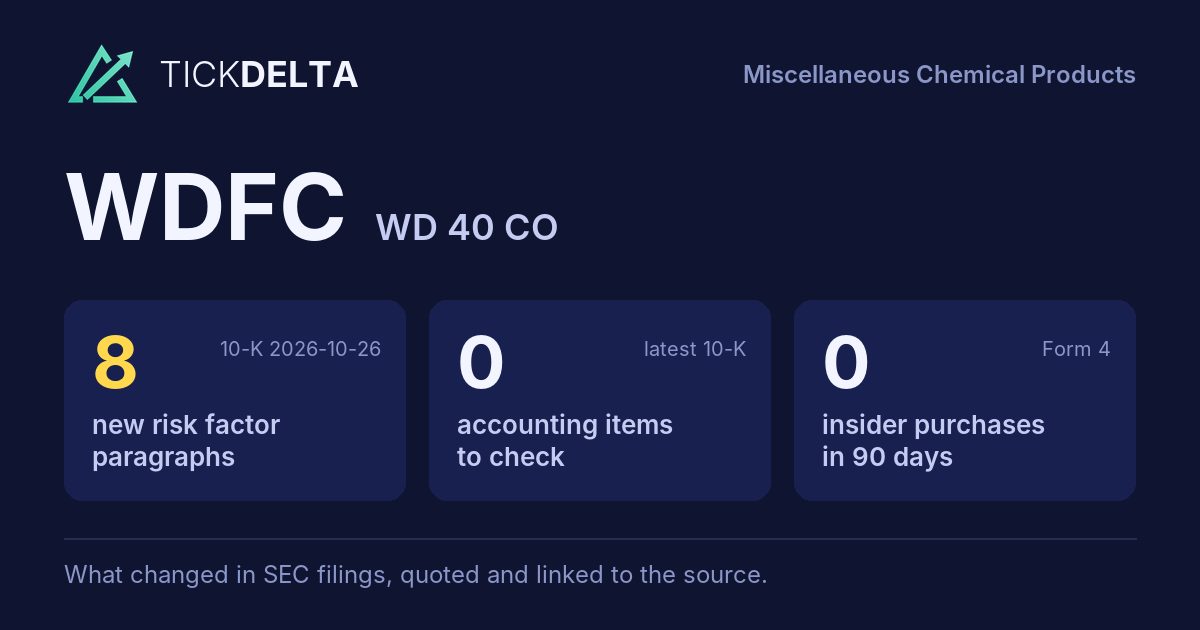
89 paragraphs · 8 new · 40 reworded · 6 gone · 10-K Oct 26, 2026 against Oct 27, 2025
New paragraph Reworded (5% of its words or more) Same or nearly
Paragraph 6 · 49% changed Every version of it
Global operations outside the U.S. expose us to uncertain conditions, foreign currency exchange rate risk additional risks and other risks in international markets. uncertainties that could affect our financial results.
Paragraph 13 · 45% changed Every version of it
Geopolitical instability, including the ongoing Russia-Ukrainian war as well as recent conflicts in the Middle East have disrupted global markets and contributed to increased market volatility. The conflict in the Middle East has caused supply chain disruptions within the EIMEA segment for our Middle East distribution network, impacting the sourcing of raw materials by certain of our third-party manufacturers as well as shipping routes to certain customers that supply to India and the Middle East. These supply chain constraints may impact our ability to service these areas, and demand for our products may be significantly impacted. These disruptions in our supply chain could damage our current and prospective customer relationships. Commodity markets remain subject to heightened levels of volatility, especially as they relate to the price of certain specialty chemicals. The duration and severity of such volatility in the price of certain specialty chemicals are highly unpredictable and may unfavorably impact our cost of products sold for as long as these conditions exist. These developments, as well as the risks outlined above, could have a material adverse effect on our business, financial condition and results of operations. Approximately 55% of our revenues in fiscal year 2026 were generated in currencies other than the U.S. Dollar, which is our reporting currency. In addition, all our foreign operating subsidiaries have functional currencies other than the U.S. Dollar, and our largest subsidiary is in the U.K. and generates significant sales in the Euro and Pounds Sterling. As a result, we are exposed to foreign currency exchange rate risk with respect to our sales, expenses, profits, cash and cash equivalents, other assets and liabilities denominated in currencies other than the U.S. Dollar. Our financial results are negatively impacted when the foreign currencies in which our subsidiary offices operate weaken relative to the U.S. Dollar. Conversely, a sustained weakening of the U.S. Dollar can have broad economic impacts that can include, but are not limited to, increased inflationary conditions in the U.S market that impacts the purchasing power of end users and could lower consumer demand. Although we use financial instruments to hedge certain foreign currency risks, primarily those associated with our U.K. subsidiary and net assets denominated in non-functional currencies, we are not fully protected against foreign currency fluctuations and, therefore, our reported earnings are affected by changes in foreign currency exchange rates. Moreover, any favorable impacts to profit margins or financial results from fluctuations in foreign currency exchange rates are likely to be unsustainable over time.
Paragraph 26 · 40% changed Every version of it
Volatility in the cost of finished goods, which may be are driven by cost volatility for components, raw materials and third-party manufacturing fees, as well as volatility changes in the cost of transportation raw materials, components, third-party manufacturing services, freight, logistics, and other supplies or services input costs, may harm negatively impact our financial condition and results of operations. Specialty chemicals and aerosol cans, which constitute a significant portion of the costs for many of our maintenance products, have experienced significant price volatility in the past, and may do so in the future. In particular, volatility in the price of oil indirectly impacts the cost of specialty chemicals, many of which are indexed to oil related refined products. The average price of oil increased during the second half of fiscal year 2026 in response to the geopolitical conflicts in the Middle East which increased our cost of goods sold. Fluctuations in gasoline and diesel fuel prices, driven in part by crude oil price volatility, fluctuations in costs of cans including those related to the impact of tariffs, increased regulations imposed on the freight industry, and higher demand for transportation services as e-commerce grows have impacted the cost of transporting our products, the loss of low-cost trucking companies that provide ground transport for our aerosol products, and additional macroeconomic factors which have resulted in increased freight costs. Our business operations could be adversely affected by labor disputes, strikes, or lockouts particularly those involving the employees of our suppliers and contractors. Any such disruptions could lead to delays in production, increased costs, and potential loss of revenue. For example, the COVID-19 pandemic resulted in global supply chain constraints growth of e-commerce and transportation disruptions that led to increased competition for freight resources, higher fees charged by our third-party manufacturers, increased raw material costs and other input costs that negatively impacted our results the loss of operations. In the past, other macroeconomic factors resulted in an inflationary environment that compounded these impacts and led to further increases in raw material costs, manufacturing and distribution costs, and other input costs. When there are significant increases in the costs of components, raw materials, third-party manufacturing fees and other expenses, and we are not able to increase the prices of our products or achieve other cost savings to an extent that they will offset such cost increases, our gross margin and operating results will be negatively impacted.
Paragraph 22 · 37% changed Every version of it
Some companies with products that compete against our homecare promotion. Product adoption or consumer acceptance often requires sustained advertising, promotional support and cleaning products have financial, management and operational resources greater than ours. These competitors may be able product improvements in order to spend more aggressively on advertising and promotional activities, introduce competing products more quickly and respond more effectively to changing business and economic conditions than us maintain or have better economies of scale than we do. gain its relative market position. In addition, although our maintenance products often hold strong positions in certain markets, larger diversified companies may enter this market and leverage substantial resources and brand recognition to offer new competing products, which could have an adverse effect on our business, financial condition and results of operations.
Paragraph 64 · 28% changed Every version of it
We may be unable to obtain and protect our own intellectual property rights or, where appropriate, license intellectual property rights necessary to support new product introductions or product lines dependent upon such licensed rights. These rights, if obtained, could be withdrawn, invalidated, circumvented or challenged and we could incur significant costs in connection with legal actions to defend and preserve our intellectual property rights. In addition, even if such rights are obtained in the U.S., other countries’ laws might not protect intellectual property rights to the same extent as the laws of the U.S., or they may be difficult or costly to enforce. Our failure to protect or successfully assert our intellectual property rights or failure to protect our other proprietary information could make us less competitive, which could have a material adverse effect on our business, financial condition and results of operations.
Paragraph 27 · 27% changed Every version of it
Volatility in the cost of finished goods, which may be driven by cost volatility for components, raw materials and third-party manufacturing fees, as well as volatility in the cost of transportation and other supplies or services may harm our financial condition and results of operations. Specialty chemicals and aerosol cans, which constitute a significant portion of the costs for many of our maintenance products, have experienced significant price volatility in the past, and may do so in the future. In particular, volatility in the price of oil indirectly impacts the cost of specialty chemicals, many of which are indexed to oil related refined products. Fluctuations in gasoline and diesel fuel prices, driven in part by crude oil price volatility, fluctuations in costs of cans including those related to the impact of tariffs, increased regulations imposed on the freight industry, and higher demand for transportation services as e-commerce grows have impacted the cost of transporting our products, the loss of low-cost trucking companies that provide ground transport for our aerosol products, and additional macroeconomic factors which products have resulted in increased freight costs. the cost of transporting our products. Our business operations could be adversely affected by labor disputes, strikes, or lockouts particularly those involving the employees of our suppliers and contractors. Any such disruptions could lead to delays in production, increased costs, and potential loss of revenue. For example, the COVID-19 pandemic resulted in global supply chain constraints and transportation disruptions that led to increased competition for freight resources, higher fees charged by our third-party manufacturers, increased raw material costs and other input costs that negatively impacted our results of operations. In the past, other macroeconomic factors resulted in an inflationary environment that compounded these impacts and led to further increases in raw material costs, manufacturing and distribution costs, and other input costs. When there are significant increases in the costs of components, raw materials, third-party manufacturing fees and other expenses, and we are not able to increase the prices of our products or achieve other cost savings to an extent that they will offset such cost increases, our gross margin and operating results will be negatively impacted.
Paragraph 63 · 27% changed Every version of it
We may be unable to obtain and protect our own intellectual property rights or, where appropriate, license intellectual property rights necessary to support new product introductions or product lines dependent upon such licensed rights. These rights, if obtained, could be withdrawn, invalidated, circumvented or challenged and we could incur significant costs in connection with legal actions to defend and preserve our intellectual property rights. In addition, even if such rights are obtained in the U.S., other countries’ laws might not protect intellectual property rights to the same extent as the laws of the U.S., or they may be difficult or costly to enforce. Our failure to protect or successfully assert our intellectual property rights or failure to protect our other proprietary information could make us less competitive, which could have a material adverse effect on our business, financial condition and results of operations.
Paragraph 74 · 26% changed Every version of it
Future acquisitions, joint ventures or strategic partnerships could also result in the incurrence of debt, potentially dilutive issuances of equity securities, contingent liabilities, amortization expenses related to certain intangible assets, unanticipated regulatory complications and/or increased operating expenses, all of which could materially adversely affect our results of operations and financial condition. In addition, to the extent that the economic benefits associated with any of our business development activities not materialize or diminish in the future, we may be required to record impairments to goodwill, intangible assets or other assets associated with such activities, which could also materially adversely affect our business, financial condition and results of operations. In addition, we may consider divesting businesses or brands that do not meet our strategic objectives or do not meet our growth or profitability targets. For example, we are pursuing the sale of certain of our homecare and cleaning product brands. We may not be able to complete desired divestitures or close divestiture transactions on terms favorable to us. If we do complete such desired divestitures, gains or losses on the sales of, or lost operating income from, those businesses or brands may harm our profitability and margins. We may not be able to effectively deploy the proceeds from a divestiture in a manner that is accretive to our earnings. If we are unable to identify and execute on suitable investment opportunities, or if the investments we make do not perform as expected, our financial condition and results of operations could be adversely affected. Additionally, the failure to effectively reinvest such proceeds could result in lower returns on investment and diminished stockholder value.

MD&A

120 paragraphs · 14 new · 52 reworded · 8 gone · 10-K Oct 26, 2026 against Oct 27, 2025
New paragraph Reworded (5% of its words or more) Same or nearly
Paragraph 25 · 50% changed
•WD-40 Multi-Use Product sales increased $8.0 $29.7 million, or 4%, 13%, primarily due to increases in U.S. and Latin America and U.S. of $6.2 $21.6 million and $2.4 $6.8 million, respectively. Sales in Brazil increased $6.7 million primarily due to operating under a direct model for the full fiscal year. In the third quarter of fiscal year 2024, we acquired a Brazilian distributor and shifted from an indirect distribution model to a direct model. In addition, U.S. sales in other Latin American markets increased $1.0 million due to improved economic conditions in certain regions as well as a higher level of promotional activities. Sales in U.S. increased primarily due to growth in online retail sales, new distribution and increased promotional programs, which included a higher level significant promotional program for the sale of promotional programs. These increases in limited-edition cans involving Disney Entertainment, The Home Depot, and WD-40 Brand. Latin America and U.S. were partially offset by lower sales in Mexico of $2.5 million increased primarily due to unfavorable favorable period to period changes in foreign currency exchange rates. rates as well as expanded distribution and successful promotional activities, most significantly in Mexico and Brazil. Latin America distributor markets, such as Argentina and Ecuador, increased most significantly in the fourth quarter of fiscal year 2026 as a result of enhanced inventory sourcing and distribution.
Paragraph 61 · 50% changed
Favorable (unfavorable) Explanations 80 bps Lower costs of specialty chemicals used in the formulation of our products 60 bps Lower costs of aerosol cans 50 bps Increases in average selling prices (50) (80) bps Higher warehousing, distribution Other raw materials and freight costs, primarily in the Americas segment components costs
Paragraph 108 · 50% changed
Net cash used in investing activities decreased $7.3 increased $4.3 million to $2.4 $6.7 million for fiscal year 2025 2026 primarily due to the prior year acquisition of a Brazilian distributor for $6.2 million as we shifted from an indirect distribution model to a direct model in the fiscal year 2024. In addition, proceeds of $1.7 million from the sale renovation and equipping of our homecare and cleaning product business in the EIMEA segment Australia office building that was completed in fiscal year 2025 decreased net cash used in investing activities. 2026. In addition, the U.S. had a higher level of manufacturing-related capital expenditures period over period.
Paragraph 28 · 50% changed
•Homecare and cleaning product sales decreased $1.1 $1.3 million, or 7%, primarily due 10%. Our HCCP products are considered harvest brands, which continue to changes in distribution provide positive returns but have become a smaller part of the business as well as we continue to emphasize focus on sales growth of maintenance products. We have continued to sell HCCP brand products but with a reduced demand in the U.S. as a result of a lower level of advertising and promotional activities associated with these brands, as we focus on increasing sales of maintenance products in support of our four-by-four strategic framework. marketing investment over time.
Paragraph 97 · 49% changed
During the first quarter of fiscal year 2025, we reclassified certain (2) Certain assets of our the Company’s homecare and cleaning product businesses in the Americas and EIMEA segments were reclassified from held for sale to held for sale. Gross margin excluding these products would have been 0.5% higher use during the third quarter of fiscal year ended August 31, 2025. 2026. Refer to Note 3 — Assets Held for Sale for additional information and related amortization thereof.
Paragraph 8 · 48% changed
Net income was $91.0 million, or $6.69 per common share on •Gross profit as a fully diluted basis, percentage of net sales increased to 55.3% for fiscal year 2025 2026 compared to $69.6 million, or $5.11 per common share on a fully diluted basis, 55.1% for the prior fiscal year.
Paragraph 51 · 48% changed
•Homecare and cleaning product sales increased $0.4 $0.6 million or 4%, 6%, primarily due to increased higher sales volume as a result of in Australia attributable to successful relaunch of the Solvol soap bar in Australia. Our homecare promotional activities, improved packaging and cleaning businesses in the Asia-Pacific segment are not held for sale. new product releases.
Paragraph 31 · 47% changed
•During (1)During the fourth quarter of fiscal year 2025, we completed the sale of the Company’s business pertaining to homecare and cleaning products that are sold in EIMEA. EIMEA HCCP businesses.

A paragraph is matched with the one last year that shares the most of its words; under half in common makes it new. The paragraphs shown are the 8 reworded the most in each section.

The paragraph that changed most in each section

The redline

Marked against last year's 10-K: cut words struck through, new words highlighted.

Risk Factors301 words changed in this paragraph; it is 43% similar to last year's version.
Geopolitical instability, including the ongoing Russia-Ukrainian war as well as recent conflicts in the Middle East have disrupted global markets and contributed to increased market volatility. The conflict in the Middle East has caused supply chain disruptions within the EIMEA segment for our Middle East distribution network, impacting the sourcing of raw materials by certain of our third-party manufacturers as well as shipping routes to certain customers that supply to India and the Middle East. These supply chain constraints may impact our ability to service these areas, and demand for our products may be significantly impacted. These disruptions in our supply chain could damage our current and prospective customer relationships. Commodity markets remain subject to heightened levels of volatility, especially as they relate to the price of certain specialty chemicals. The duration and severity of such volatility in the price of certain specialty chemicals are highly unpredictable and may unfavorably impact our cost of products sold for as long as these conditions exist. These developments, as well as the risks outlined above, could have a material adverse effect on our business, financial condition and results of operations. Approximately 55% of our revenues in fiscal year 2026 were generated in currencies other than the U.S. Dollar, which is our reporting currency. In addition, all our foreign operating subsidiaries have functional currencies other than the U.S. Dollar, and our largest subsidiary is in the U.K. and generates significant sales in the Euro and Pounds Sterling. As a result, we are exposed to foreign currency exchange rate risk with respect to our sales, expenses, profits, cash and cash equivalents, other assets and liabilities denominated in currencies other than the U.S. Dollar. Our financial results are negatively impacted when the foreign currencies in which our subsidiary offices operate weaken relative to the U.S. Dollar. Conversely, a sustained weakening of the U.S. Dollar can have broad economic impacts that can include, but are not limited to, increased inflationary conditions in the U.S market that impacts the purchasing power of end users and could lower consumer demand. Although we use financial instruments to hedge certain foreign currency risks, primarily those associated with our U.K. subsidiary and net assets denominated in non-functional currencies, we are not fully protected against foreign currency fluctuations and, therefore, our reported earnings are affected by changes in foreign currency exchange rates. Moreover, any favorable impacts to profit margins or financial results from fluctuations in foreign currency exchange rates are likely to be unsustainable over time.

Source: Item 1A, 10-K 0000105132-26-000091 vs Item 1A, 10-K 0000105132-25-000067

MD&A208 words changed in this paragraph; it is 45% similar to last year's version.
•Consolidated net sales increased $29.4 $68.0 million, or 5%, 11%, for fiscal year 2025 2026 compared to the prior fiscal year. Changes in foreign currency exchange rates from period to period had a favorable impact of $21.8 million on consolidated net sales for the fiscal year 2026. On a constant currency basis, net sales would have increased by $46.2 million, or 7%, from period to period. This favorable impact from changes in foreign currency exchange rates mainly came from our EIMEA segment, which accounted for 38% of our consolidated sales for the twelve months ended August 31, 2026. Increases in sales volume favorably impacted net sales by approximately $25.2 $38.2 million from period to period. period, which includes an unfavorable impact of approximately $6.2 million related to reduced sales volume driven by the sale of our HCCP business in EIMEA during fiscal year 2025. Sales volume would have increased $44.4 million for the twelve months of fiscal year 2026 on a comparable basis to prior year excluding these HCCP sales in EIMEA from the prior fiscal year. Increases in the average selling price of our products positively impacted net sales by approximately $5.6 $8.0 million from period to period, primarily due to sales price increases implemented in certain regions during the prior fiscal year. period. Changes to net sales attributable to volumes and average selling price of our products are impacted by differences in sales mix related to products, markets and distribution channels from period to period. In addition, changes in foreign currency exchange rates from period to period had a unfavorable impact of $1.4 million on consolidated net sales for the fiscal year 2025. Gross profit as a percentage of net sales increased to 55.1% for fiscal year 2025 compared to 53.4% for the prior fiscal year.

Source: Item 7, 10-K 0000105132-26-000091 vs Item 7, 10-K 0000105132-25-000067

Accounting Policies90 words changed in this paragraph; it is 63% similar to last year's version.
The Company does not currently grant stock options. The fair values of restricted stock unit awards and performance share unit awards are based on the fair value of the Company’s common stock on the date that such awards are granted. The fair value of market share unit awards is determined using a Monte Carlo simulation model. For the performance share unit awards, the Company adjusts the compensation expense over the service period based upon the expected achievement level of the applicable performance condition. As the grant date fair value of market share unit awards reflects the probabilities of the actual number of such awards expected to vest, compensation expense for such awards is not adjusted based on the expected achievement level of the applicable performance condition. The Company records any excess tax benefits or deficiencies from settlements of its stock-based equity awards within the provision for income taxes on the Company’s consolidated statements of operations in the reporting periods in which the settlement of the equity awards occur.

Source: 10-K text, Note 2 – Basis of Presentation and Summary of Significant Accounting Policies, 10-K 0000105132-26-000091 vs 10-K text, Note 2 – Basis of Presentation and Summary of Significant Accounting Policies, 10-K 0000105132-25-000067

Legal Proceedings27 words changed in this paragraph; it is 85% similar to last year's version.
The Company has ongoing relationships with various suppliers, third-party contract manufacturers that manufacture the Company’s products, and third-party distribution centers that warehouse and ship the Company’s products to customers. The contract manufacturers maintain title and control of certain raw materials and components, materials utilized in finished products, and the finished products themselves until shipment to the Company’s third-party distribution centers or customers in accordance with agreed-upon shipment terms. The Company has contractual agreements with certain manufacturers that require minimum purchase obligations with certain contract manufacturers. The Company’s minimum purchase obligations primarily consist of contractual volume commitments with certain third-party packagers. volumes.

Source: Item 3, via Note 14 – Commitments and Contingencies, 10-K 0000105132-26-000091 vs Item 3, via Note 14 – Commitments and Contingencies, 10-K 0000105132-25-000067

Sentences and paragraphs added, removed or reworded

Every change, by type

Sentences and paragraphs of WDFC's Risk Factors and MD&A, 10-K Oct 26, 2026 against 10-K Oct 27, 2025. Each links to the text at sec.gov.

Quiet changes are sentences kept from last year with one to four words changed, at least one of them a hedge, a modal or a qualifier (may, could, will, not, significant, material…). A year or date rolling forward is not counted.

The full word list

adverse, adversely, all, although, anticipate, anticipates, any, approximately, believe, believes, can, cannot, certain, could, expect, expects, generally, however, if, intend, intends, largely, likely, many, material, materially, may, might, most, must, never, no, not, possible, primarily, probable, should, significant, significantly, some, substantial, substantially, unlikely, will, would

AddedRisk Factors
These risks could have a significant impact on our ability to sell our products on a competitive basis in global markets outside the United States. There is uncertainty about the future relationship between the U.S. and various other countries with respect to trade policies, tariffs, tax policies and government regulations. The U.S. government has imposed significant tariffs in recent years that impact a wide variety of goods across multiple countries, including the costs of our products sold, and additional tariffs could be imposed in the future. The extent and duration of these tariffs, any retaliatory measures adopted by other countries, and their impact on economic conditions, supply chain stability, inflation, and consumer demand could adversely affect our business, financial condition, and results of operations.
Read it in 10-K Oct 26, 2026 at sec.gov
AddedRisk Factors
We rely on information technology systems to conduct our business. We are migrating our IT operations to common software as a service (“SaaS”) and cloud-based solutions, which includes a phased transition of our enterprise resource planning (“ERP”) framework. The initial and most significant phase of this cloud-based implementation in the U.S. was completed in fiscal year 2024 and other countries have since been completed as part of this multi-year plan, including Canada and Japan. This will shift the risk to these larger SaaS and cloud-based organizations who have greater levels of resources to combat cyber attacks.
Read it in 10-K Oct 26, 2026 at sec.gov
AddedRisk Factors
The modernizing of our internal infrastructure could create vulnerability in the technical and cybersecurity capabilities of our third-party operational vendors. We depend on these external partners to manufacture, package, warehouse, and ship our products to customers. System failures, malfunctions, or data breaches within these third-party systems, or our legacy
Read it in 10-K Oct 26, 2026 at sec.gov
AddedRisk Factors
systems still maintained by third parties, could disrupt our supply chain, delay product shipments, and impede our ability to timely process transactions and produce key financial reports.
Read it in 10-K Oct 26, 2026 at sec.gov
AddedRisk Factors
These third-party and internal risks are further heightened by the rapidly evolving threat landscape in which cybercriminals have growing access to sophisticated tools that make the systems and partnerships we rely on increasingly difficult to defend. Cybercriminals are increasingly utilizing newer AI models to thwart security systems. These technologies could enable threats to creatively exploit vulnerabilities, executing highly sophisticated attacks that would have historically required significantly more time and technical skill. The prevention, detection, and mitigation of cyber-attacks, including ransomware and the unauthorized release of sensitive data, have become increasingly difficult. We employ business continuity plans and corporate policies governing the timely investigation and disclosure of cybersecurity incidents that safeguards against unauthorized access to confidential information. There is no guarantee these measures will prevent breaches or provide alternative operational processes in a timely manner. A material cybersecurity incident or prolonged IT failure, whether internal or external, could severely harm our business, financial condition, and results of operations. While we maintain cyber insurance, actual losses may exceed our coverage, and there is no certainty that adequate insurance will remain available on economically reasonable terms in the future.
Read it in 10-K Oct 26, 2026 at sec.gov
AddedRisk Factors
we could be required to recall the product, which could result in significant expenses, adverse publicity and loss of revenues. Even if we are successful in defending ourselves against such claims, litigation could result in substantial cost and be a distraction to our management and employees.
Read it in 10-K Oct 26, 2026 at sec.gov
Show the other 52
RemovedRisk Factors
Approximately 51% of our revenues in fiscal year 2025 were generated in currencies other than the U.S. Dollar, which is our reporting currency. In addition, all our foreign operating subsidiaries have functional currencies other than the U.S. Dollar, and our largest subsidiary is in the U.K. and generates significant sales in Euros and Pounds Sterling. As a result, we are exposed to foreign currency exchange rate risk with respect to our sales, expenses, profits, cash and cash equivalents, other assets and liabilities denominated in currencies other than the U.S. Dollar. Our financial results are negatively impacted when the foreign currencies in which our subsidiary offices operate weaken relative to the U.S. Dollar.
Read it in 10-K Oct 27, 2025 at sec.gov
RemovedRisk Factors
To conduct our business, we extensively rely on information technology systems, networks and services, many of which are managed, hosted and provided by third-party service providers. There is no guarantee that our security measures will prevent cyberattacks resulting in breaches of our own or our third-party service providers’ databases and systems. Techniques used in these attacks change frequently and may be difficult to detect for periods of time. Although we have policies and procedures in place governing (i) the timely investigation of cybersecurity incidents, (ii) the timely disclosure of any related material nonpublic information resulting from a material cybersecurity incident, and (iii) the safeguarding against insider trading by directors, officers, and other corporate insiders between the period of investigation and the public disclosure of such an incident; cybersecurity incidents themselves, such as the release of sensitive data from our databases and systems, could adversely affect our business, financial condition and results of operations. The increasing number of information technology security threats and the development of more sophisticated cyberattacks, which includes the adoption of emerging technologies such as AI and machine learning, as well as other techniques such as ransomware, pose significant potential risks to the security of our information technology systems and networks, as well as to the confidentiality, availability and integrity of our data. Increased integration of AI into our operations could significantly increase cybersecurity and privacy risks, including the risk of unauthorized or misuse of AI tools. In addition, threat actors may leverage these tools to attack our systems. The continued use of remote work infrastructures also increases cybersecurity risks. These emerging risks could materially increase the costs that we incur to protect against such risks. Although we maintain cyber insurance, our coverage may not be adequate for actual losses incurred, and an insurer may deny coverage of a future claim. There is no certainty that such insurance will continue to be available to us on economically reasonable terms, if at all, in the future.
Read it in 10-K Oct 27, 2025 at sec.gov
RemovedRisk Factors
In addition, system failure, malfunction or loss of data that is housed in our critical information systems or our third-party service providers’ critical information systems could disrupt our ability to ship products to our customers, timely and accurately process transactions and produce key financial reports, including information on our operating results, financial position and cash flows. Our information systems could be damaged or cease to function properly due to a number of other reasons, including catastrophic events and power outages. Although we have business continuity plans in place to address such service interruptions, there is no guarantee that these business continuity plans will provide alternative processes in a timely manner. As a result, we may experience interruptions in our ability to manage our daily operations, which could harm our business, financial condition and results of operations.
Read it in 10-K Oct 27, 2025 at sec.gov
RemovedRisk Factors
We are currently implementing new information systems within our enterprise resource planning framework at certain offices in a phased manner. The first and most significant phase, implementation in the U.S., was completed in fiscal year 2024. We are strategically implementing these new information systems at certain other offices to better align with the U.S. system environment. In addition, the company that owns and supports the legacy systems used at these other offices may not be able to provide the same level of support as that of larger information systems companies. If the company that owns and supports the legacy systems were to cease operations or were unable to provide support for this application prior to the implementation of our new information systems, it could adversely affect our daily operations or our business, financial condition and results of operations. If we encounter difficulties in executing and completing the implementation of these new critical information systems at our other offices, or if the implementation takes longer than intended, we may experience interruptions in our ability to manage our daily operations and report financial results timely and we may
Read it in 10-K Oct 27, 2025 at sec.gov
RemovedRisk Factors
Significant judgment is required in determining our effective income tax rate and in evaluating tax positions, particularly those related to uncertain tax positions. We provide liabilities for uncertain tax positions when such tax positions do not
Read it in 10-K Oct 27, 2025 at sec.gov
RewordedRisk Factors
Fluctuations in gasoline and diesel fuel prices, driven in part by crude oil price volatility, fluctuations in costs of cans including those related to the impact of tariffs, increased regulations imposed on the freight industry, and higher demand for transportation services as e-commerce grows have impacted the cost of transporting our products, the loss of low-cost trucking companies that provide ground transport for our aerosol products, and additional macroeconomic factors which have resulted in increased freight costs.
Read it in 10-K Oct 26, 2026 at sec.gov
RewordedRisk Factors
Volatility in the cost of finished goods, which may be are driven by cost volatility for components, raw materials and third-party manufacturing fees, as well as volatility changes in the cost of transportation raw materials, components, third-party manufacturing services, freight, logistics, and other supplies or services input costs, may harm negatively impact our financial condition and results of operations.
Read it in 10-K Oct 26, 2026 at sec.gov
RewordedRisk Factors
Although the SEC attempted to end its defense of the rules in 2025, the litigation remains unsettled and additional Additional or other climate-related disclosure rules could be proposed in the future by the SEC.
Read it in 10-K Oct 26, 2026 at sec.gov
RewordedRisk Factors
EPR fees have been in place in EIMEA and Canada for several years and are beginning to be established within began rolling out in certain states in the U.S. in calendar year 2025. 2025, with reporting and fee compliance expanded in 2026.
Read it in 10-K Oct 26, 2026 at sec.gov
RewordedRisk Factors
If one of our products were determined to be noncompliant or mislabeled, we could be required to recall the product, which could result in significant expenses, adverse publicity and loss of revenues.
Read it in 10-K Oct 26, 2026 at sec.gov
RewordedRisk Factors
We are subject to an SEC rule mandated by Section 1502 of the Dodd-Frank Wall Street Reform and Consumer Protection Act that requires management to conduct annual due diligence to determine whether certain minerals and metals, known as “conflict minerals”, are contained in our products and, if so, whether they originate from the Democratic Republic of Congo or adjoining countries. products.
Read it in 10-K Oct 26, 2026 at sec.gov
RewordedRisk Factors
The increased attention directed towards publicly traded companies surrounding ESG matters includes previously included the release of rules by the SEC requiring registrants to enhance and standardize disclosures related to climate change, but these change; however, those rules have since been were stayed and remain stayed due to litigation.
Read it in 10-K Oct 26, 2026 at sec.gov
RewordedRisk Factors
In 2023, California enacted Senate Bill (“SB”) 253 and SB 261, which require large businesses conducting business in the state to report on greenhouse gas emissions in conformance with the Greenhouse Gas Protocol and climate-related financial risks in accordance with the Task Force on Climate-Related Financial Disclosures framework. framework, respectively.
Read it in 10-K Oct 26, 2026 at sec.gov
RewordedRisk Factors
Our future performance and growth depend, in part, on our ability to successfully develop, introduce and/or establish develop and commercialize new products as both brand extensions and/or and line extensions.
Read it in 10-K Oct 26, 2026 at sec.gov
RewordedRisk Factors
The availability of counterfeits and other infringing products, particularly in China as well as emerging markets in Asia and other emerging markets, Central Europe, could adversely impact our sales and potentially damage the value and reputation of our brands.
Read it in 10-K Oct 26, 2026 at sec.gov
RewordedRisk Factors
We distribute our products throughout the world in one of two ways: the direct distribution model, in which products are sold directly by us to wholesalers and retailers in the U.S., Canada, Mexico, Brazil, Australia, China, the U.K. U.K., France and a number of many other countries, including those countries throughout Europe; and the marketing distributor model, in which products are sold to marketing distributors who in turn sell to wholesalers and retailers.
Read it in 10-K Oct 26, 2026 at sec.gov
Quiet changesRisk Factors
We monitor partnerships with our third-party manufacturers and onboard new third-party manufacturers, if as necessary, in order to allow for capacity and flexibility of our supply chain.
Read it in 10-K Oct 26, 2026 at sec.gov
AddedMD&A
In order to show the impact of changes in foreign currency exchange rates on our results of operations, we have included constant currency disclosures, where necessary, in the Overview and Results of Operations sections which follow. Constant currency disclosures represent the translation of our current fiscal year revenues, expenses and net income from the functional currencies of our subsidiaries to U.S. Dollars using the exchange rates in effect for the corresponding period of the prior fiscal year. Results on a constant currency basis are not in accordance with accounting principles generally accepted in the United States of America (“non-GAAP”) and should be considered in addition to, not as a substitute for, results prepared in accordance with U.S. GAAP. We use results on a constant currency basis as one of the measures to understand our operating results and evaluate our performance in comparison to prior periods in order to enhance the visibility of the underlying business trends, excluding the impact of translation arising from foreign currency exchange rate fluctuations. Management believes this non-GAAP financial measure provides investors with additional financial information that should be considered when assessing our underlying business performance and trends. However, reference to constant currency basis should not be considered in isolation or as a substitute for other financial measures calculated and presented in accordance with U.S. GAAP.
Read it in 10-K Oct 26, 2026 at sec.gov
AddedMD&A
•Diluted earnings per common share for fiscal year 2026 were $6.08 versus $6.69 in the prior fiscal year. Refer to Performance Measures and Non-GAAP Reconciliations below for non-GAAP financial measures, including adjusted EPS, and their reconciliations to the most directly comparable GAAP measures. Adjusted EPS increased 6% from period to period.
Read it in 10-K Oct 26, 2026 at sec.gov
AddedMD&A
(1)Prior fiscal year net sales include sales related to our EIMEA HCCP business, which was sold at the end of fiscal year 2025 and is no longer included in current year results. The divestiture resulted in approximately $6.2 million reduction in net sales for the twelve months ended August 31, 2026. Therefore, on a non-GAAP basis, sales would have increased 13%.
Read it in 10-K Oct 26, 2026 at sec.gov
AddedMD&A
•WD-40 Multi-Use Product sales increased $19.1 million, or 10%. Net sales were positively impacted by favorable changes in foreign currency exchange rates. On a constant currency basis, sales would have increased by approximately 4% period over period. Sales increased most significantly in our direct markets most notably in France, Italy and Iberia, primarily due to successful promotional activities and merchandising efforts, particularly in our hardware stores and value retailers. Our distributor markets, particularly India, increased primarily due to increased sales volume from enhanced inventory sourcing and distribution, successful promotional activity, as well as slight volume increases from customers purchasing in anticipation of price increases. These increases in sales were slightly offset by decreased volumes in the Middle East, particularly Saudi Arabia and the UAE region, due to timing of customer orders as a result of strategic distribution changes we made in the first half of fiscal year 2026.
Read it in 10-K Oct 26, 2026 at sec.gov
AddedMD&A
•WD-40 Specialist sales increased $8.9 million, or 25%. Net sales were positively impacted by favorable changes in foreign currency exchange rates. On a constant currency basis, sales would have increased by approximately 18% period over period. Net sales increased most significantly in France and Iberia direct markets which increased $3.8 million and $1.5 million, respectively. Sales growth in France and Iberia benefited from strong sales volume growth due to increased promotional activities as well as new product launches.
Read it in 10-K Oct 26, 2026 at sec.gov
AddedMD&A
•Other maintenance product sales increased $1.1 million, or 9%, primarily due to favorable changes in foreign currency exchange rates. On a constant currency basis, sales would have increased by approximately 2% period over period.
Read it in 10-K Oct 26, 2026 at sec.gov
AddedMD&A
•During fiscal year 2026, the conflict in the Middle East resulted in an increase in the costs of oil and related petroleum-based specialty chemicals used in our maintenance products. Due to inventory life cycles mentioned above, these increased costs most significantly affected our cost of products sold in the fourth quarter of fiscal year 2026. These increased costs impacted our gross margin by 370 basis points in the fourth quarter of fiscal year 2026 compared to the fourth quarter of the prior fiscal year. We have implemented price increases in certain regions to mitigate the impact of these cost increases in fiscal year 2027.
Read it in 10-K Oct 26, 2026 at sec.gov
AddedMD&A
A&P expenses were unfavorably impacted by changes in foreign currency exchange rates. On a constant currency basis, A&P expenses would have increased by $6.0 million, or 16% period to period. The increase in A&P expenses was primarily due to a higher level of advertising and promotional programs in the U.S. as a result of royalty expenses associated with a licensing agreement for the sale of limited-edition promotional cans sold to one of our large customers and a higher level of promotional programs and marketing support in the EIMEA segment.
Read it in 10-K Oct 26, 2026 at sec.gov
AddedMD&A
Unallocated Corporate expenses increased to $49.8 million, up $5.1 million, or 11% primarily due to higher employee-related costs as a result of increased headcount and annual compensation increases, as well as higher incentive compensation costs and stock-based compensation expense.
Read it in 10-K Oct 26, 2026 at sec.gov
AddedMD&A
Results for these performance measures may fluctuate from period to period as a result of various factors, including macroeconomic conditions such as the inflationary environment experienced in recent fiscal years, and investments associated with structural changes undertaken in recent periods such as those related to technology, sustainability, innovation, research and development, legal risk management, quality assurance, regulatory compliance and intellectual property protection in order to safeguard our WD-40 brand.
Read it in 10-K Oct 26, 2026 at sec.gov
RemovedMD&A
•WD-40 Multi-Use Product sales increased $13.2 million, or 8%, primarily due to higher sales volume across nearly all regions. Sales in direct markets increased significantly in France, Iberia, Benelux, and Italy which were up $3.3 million, $2.0 million, $2.0 million, and $1.7 million, respectively. Sales to our marketing distributors in various regions, increased $1.5 million, most predominately in areas such as India, Croatia, and Romania, primarily due to increased distribution, higher levels of demand and timing of customer orders. Most regions in EIMEA have experienced continued increases in sales volumes after a temporary reduction in demand from customer reactions to price increases we implemented during fiscal year 2023. While most of this volume recovery was experienced in fiscal year 2024 after customers adjusted to those price increases, this volume recovery has continued into fiscal year 2025 and has resulted in higher sales levels from period to period.
Read it in 10-K Oct 27, 2025 at sec.gov
RemovedMD&A
premiumization efforts in support of our strategic framework. Other contributing factors include increased promotional activities in many regions of our direct markets such as DACH and France.
Read it in 10-K Oct 27, 2025 at sec.gov
RemovedMD&A
The increase in A&P expenses was primarily due to a higher level of promotional programs and marketing support, particularly in certain countries in the EIMEA segment as well as U.S. and China.
Read it in 10-K Oct 27, 2025 at sec.gov
RemovedMD&A
We target our gross margin to be 55% of net sales, our cost of doing business to be 30% of net sales, and our Adjusted EBITDA to be 25% of net sales. Results for these performance measures may vary from period to period depending on
Read it in 10-K Oct 27, 2025 at sec.gov
RemovedMD&A
various factors, including economic conditions such as the inflationary environment we have experienced in the last several fiscal years, and our level of investment in activities for the future such as those related to quality assurance, regulatory compliance, information technology, sustainability, and intellectual property protection in order to safeguard our WD-40 brand. Our targets for gross margin, cost of doing business and Adjusted EBITDA are long-term in nature. We expect to make progress towards our cost of doing business and Adjusted EBITDA targets over time. Progression towards our cost of doing business and Adjusted EBITDA targets may be challenged as we continue to divest certain of our homecare and cleaning product businesses, due to the low level of operating expenses associated with these businesses. Despite these potential challenges, we intend to focus our resources and proceeds from the sale of those brands on growing our higher growth and higher gross margin core business.
Read it in 10-K Oct 27, 2025 at sec.gov
RemovedMD&A
On June 16, 2025, the Board approved the extension of the expiration date to August 31, 2026 for the 2023 Repurchase Plan, which became effective on September 1, 2023 and was set to expire August 31, 2025. We are authorized to acquire up to $50.0 million of our outstanding shares through August 31, 2026, of which $29.6 million remained available for the repurchase of shares of common stock as of August 31, 2025.
Read it in 10-K Oct 27, 2025 at sec.gov
RemovedMD&A
These unfavorable changes in working capital were partially offset by favorable changes in trade and other accounts receivable balances of $15.8 million primarily due to the timing of collection of payments from customers in the United States.
Read it in 10-K Oct 27, 2025 at sec.gov
RewordedMD&A
Change from Prior Year First Second Quarter Third Quarter Fourth Quarter Fiscal Year Quarter Decrease in average selling price (1) $ (0.2) $ (0.5) $ (0.6) $ 3.0 $ 1.7 Decrease in sales volume due to sale of HCCP (2) (1.6) (1.5) (1.1) (2.0) (6.2) Increase (decrease) in average selling price(1) $ 0.5 $ (1.1) $ sales volume (1) (0.2) — $ 0.8 $ 0.2 (Decrease) increase in sales volume(1) (2.1) 1.3 1.7 4.4 7.2 5.3 12.3 Currency impact on current period – non-GAAP 0.6 (0.5) (0.2) (0.1) (0.2) (Decrease) increase 3.2 7.3 4.4 0.1 15.0 Increase in net sales $ (1.0) $ (0.3) $ 1.5 $ 5.1 1.2 $ 5.3 $ 9.9 $ 6.4 $ 22.8
Read it in 10-K Oct 26, 2026 at sec.gov
RewordedMD&A
Fiscal Year Ended August 31, 2026 2025 2024 2023 Diluted EPS Net Income - GAAP $ 6.69 $5.11 $4.83 82,346 $90,994 $69,644 Release of Uncertain Tax Position - Tax Cut and Jobs Act (1) (0.87) — (11,929) — Amortization related to reclassification of held for sale assets (2) 1,343 — — Adjusted diluted Net Income - non-GAAP $ 83,689 $79,065 $69,644 Diluted EPS - Non-GAAP GAAP $ 5.82 6.08 $6.69 $5.11 $4.83 Impact of non-GAAP adjustments (1)(2) 0.10 (0.87) — Adjusted Diluted EPS - non-GAAP $ 6.18 $5.82 $5.11
Read it in 10-K Oct 26, 2026 at sec.gov
RewordedMD&A
Our primary source of operating cash flows for fiscal year ended August 31, 2025 was net income of $91.0 million, which increased $21.4 million from period to In the prior period, primarily due to the release of the we released an uncertain tax position in the second quarter of fiscal year 2025 that resulted in a net benefit of $11.9 million, as which is discussed in Note 15 — Income Taxes, incorporated by reference to Part IV—Item 15, “Exhibits, Financial Statement Schedules” to the consolidated financial statements.
Read it in 10-K Oct 26, 2026 at sec.gov
RewordedMD&A
Change from Prior Year First Second Quarter Third Quarter Fourth Quarter Fiscal Year Quarter Increase (decrease) in average selling price(1) $ 0.5 0.6 $ (1.1) 2.2 $ 0.4 $ — $ 0.8 $ 0.2 (Decrease) increase 3.2 Increase in sales volume(1) (2.1) 1.3 1.7 4.4 5.3 1.4 2.8 21.1 2.9 28.2 Currency impact on current period – non-GAAP 0.6 (0.5) (0.2) (0.1) (0.2) (Decrease) increase 0.4 1.3 1.6 0.9 4.2 Increase in net sales $ (1.0) 2.4 $ (0.3) 6.3 $ 1.5 23.1 $ 5.1 3.8 $ 5.3 35.6
Read it in 10-K Oct 26, 2026 at sec.gov
RewordedMD&A
Change from Prior Year First Second Quarter Third Quarter Fourth Quarter Fiscal Year Quarter Increase in average selling price(1) $ 1.3 $ 1.1 $ 0.2 $ 0.3 0.5 $ 2.4 $ 0.3 $ 3.2 3.1 Increase (decrease) in sales volume(1) 6.3 3.1 2.4 (1.6) 10.2 (3.8) 2.2 3.8 1.7 3.9 Currency impact on current period – non-GAAP (1.1) (1.4) (1.8) (0.4) (4.7) (0.2) 0.7 1.2 0.9 2.6 Increase (decrease) in net sales $ 5.4 (2.7) $ 2.0 4.0 $ 3.0 5.2 $ (1.7) 3.1 $ 8.7 9.6
Read it in 10-K Oct 26, 2026 at sec.gov
RewordedMD&A
Net income was $82.3 million, or $6.08 per common share on a fully diluted basis, for fiscal year 2026 compared to $91.0 million, or $6.69 per common share on a fully diluted basis, for fiscal year 2025 compared to $69.6 million, or $5.11 per common share on a fully diluted basis, for the prior fiscal year.
Read it in 10-K Oct 26, 2026 at sec.gov
RewordedMD&A
Gross margin for the EIMEA segment increased slightly from 54.7% 57.3% to 57.3% 57.7% primarily due to the favorable impact of increases in average selling price and prices, decreases in the cost costs of aerosol cans and lower fill fees, partially offset by increases in the costs of petroleum-based specialty chemicals, higher warehousing fees and other input costs.
Read it in 10-K Oct 26, 2026 at sec.gov
RewordedMD&A
Increases in sales volume favorably impacted net sales by approximately $25.2 $38.2 million from period to period. period, which includes an unfavorable impact of approximately $6.2 million related to reduced sales volume driven by the sale of our HCCP business in EIMEA during fiscal year 2025.
Read it in 10-K Oct 26, 2026 at sec.gov
RewordedMD&A
Gross margin for the EIMEA Americas segment increased from 54.7% 52.1% to 57.3% 53.0% primarily due to the favorable impact of increases in average selling price and prices, decreases in the cost costs of aerosol cans and other input costs. lower fill fees, partially offset by increases in the costs of petroleum-based specialty chemicals.
Read it in 10-K Oct 26, 2026 at sec.gov
RewordedMD&A
For the Americas segment, 72% of sales came from the U.S., and 28% of sales came from Canada and Latin America combined for both the fiscal year ended August 31, 2025 compared to the prior fiscal year when 73% of sales came from the U.S., 2026 and 27% of sales came from Canada and Latin America combined. 2025.
Read it in 10-K Oct 26, 2026 at sec.gov
RewordedMD&A
Operating expenses increased $2.6 $3.4 million from period to period primarily due to higher employee-related costs. costs as a result of annual compensation increases, higher fringe benefits, higher accrued incentive compensation costs as well as increased costs associated with higher headcount.
Read it in 10-K Oct 26, 2026 at sec.gov
RewordedMD&A
Sales in Asia distributor markets China increased due to higher increased sales volume from successful promotional programs and marketing activities. activities, including the use of online influencers, as well as increased distribution through our online retailers and industrial channels.
Read it in 10-K Oct 26, 2026 at sec.gov

Sources

The two latest 10-Ks on EDGAR, section by section. Each change links to the text at sec.gov.

Also

New risk factors: paragraphs with nothing like them last year, quoted in full.

Work with it

Excel workbook · CSV. Google Sheet that stays up to date: paste =IMPORTDATA("https://tickdelta.com/company/WDFC/export.csv") into a cell.

Next:Related parties
Esc

Type a ticker such as AAPL, a name, an investor such as Buffett, or a topic such as tariffs. ↑ ↓ to move, Enter to open.