Marked against last year's 10-K:
cut words struck through, new words highlighted and underlined.
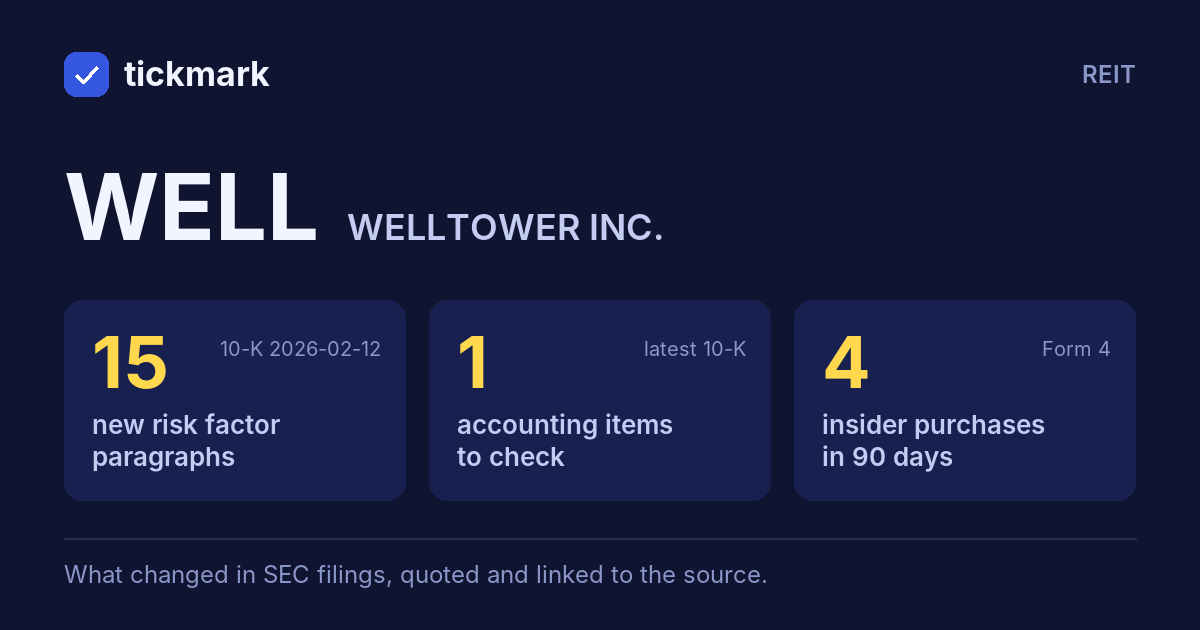
Risk Factors 406 words changed in this paragraph; it is 48% similar to last year's version.
Some We have made and expect to continue to make significant acquisitions and investments as part of our acquisitions may not prove to be successful. We could encounter unanticipated difficulties and expenditures relating to any acquired properties, including contingent liabilities and acquired properties might require significant management attention that would otherwise be devoted to our ongoing business, including, in each case, as a result of downturns in local economies, changes in local real estate conditions, changing demographics, increased construction and competition or decreased demand for our properties or regional climate events. If we agree to provide construction funding to an operator/tenant and the project is not completed, we may need to take steps to ensure completion of the project. Such expenditures may result in significant costs and negatively affect our results of operations, including as a result of volatility in the price of construction materials or labor. overall business strategy. Investments in and acquisitions of seniors housing and healthcare properties entail risks associated with real estate investments generally, including risks that the investment will not achieve expected returns, that the cost estimates for necessary property improvements will prove inaccurate or that the tenant, operator or manager will fail to meet performance expectations. We could encounter unanticipated difficulties and expenditures relating to acquired properties, including contingent liabilities and acquired properties might require significant management attention that would otherwise be devoted to our ongoing business, including, in each case, as a result of downturns in local economies, changes in local real estate conditions, changing demographics, increased construction costs, decreased demand for our properties or regional climate events. If we agree to provide construction funding to an operator/tenant and the project is not completed, we may incur unanticipated expenditures to ensure completion of the project. Such expenditures may be significant, including as a result of volatility in the price of construction materials or labor. Furthermore, there can be no assurance that our anticipated acquisitions and investments, the completion of which is subject to various conditions, will be consummated in accordance with anticipated timing, on anticipated terms, or at all. We may be unable to obtain or assume financing for acquisitions on favorable terms or at all. Healthcare properties are often highly customizable, and the development or redevelopment of such properties may require costly tenant-specific improvements. The actual costs of development or redevelopment may be greater than our estimates. We have experienced delays and disruptions to property redevelopment as a result of supply chain issues and construction material and labor shortages shortages, and may experience additional or more significant such delays in the future. We also may be unable to quickly and efficiently integrate new acquisitions, particularly acquisitions of portfolios of properties, into our existing operations, and this could have an adverse effect on our results of operations and financial condition. Acquired properties may be located in new markets, either within or outside the U.S., where we may face risks associated with a lack of market knowledge or understanding of the local economy, lack of business relationships in the area, costs associated with opening a new regional office, hiring and retaining key personnel and unfamiliarity with local governmental and permitting procedures. These risks may be exacerbated by the volume and complexity of such activity, as well as by geopolitical tension or instability, political and social conditions, inflationary pressures, interest rate fluctuations, climate and weather-related risks and supply chain disruptions. As a result, we cannot assure you that we will achieve the economic benefit we expect from acquisitions, investment, development and redevelopment opportunities and may lead to impairment of such assets. operations.
Source: Item 1A, 10-K 0000766704-26-000010 vs Item 1A, 10-K 0000766704-25-000009
MD&A 289 words changed in this paragraph; it is 32% similar to last year's version.
In connection with the filing of the Shelf Form S-3, Welltower also filed with the SEC a The second such prospectus supplement that will continue continued an offering that was previously covered by a prior registration statement relating to the registration of up to 475,327 shares of common stock of Welltower Inc. (the "DownREIT II Shares") that may be issued from time to time if, and to the extent that, certain holders of Class A units (the "DownREIT II Units") of HCN G&L DownREIT II LLC, a Delaware limited liability company (the "DownREIT II"), tender such DownREIT II Units for redemption by the DownREIT II, and HCN DownREIT Member, LLC, a majority-owned indirect subsidiary of Welltower (including its permitted successors and assigns, the "Managing Member"), or a designated affiliate of the Managing Member, elects to assume the redemption obligations of the DownREIT II and to satisfy all or a portion of the redemption consideration by issuing DownREIT II Shares to the holders instead of or in addition to paying a cash amount. On July 22, 2022, Welltower filed with the SEC a prospectus supplement relating to the registration of up to 300,026 shares of common stock of Welltower Inc. that may be issued from time to time if, and to the extent that, certain holders of Class A Common Units (the "OP Units") of Welltower OP tender the OP Units for redemption by Welltower OP, and Welltower Inc. elects to assume the redemption obligations of Welltower OP and to satisfy all or a portion of the redemption consideration by issuing shares of its common stock to the holders instead of or in addition to paying a cash amount. On October 8, 2024, Welltower filed with the SEC a prospectus supplement relating to the registration possible issuance of up to 23,471,419 shares of common stock of Welltower Inc. (the "Exchanged Shares") “Exchangeable Shares”) that may, under certain circumstances, be issuable upon exchange of the 2.750% exchangeable senior notes due 2028 or 3.125% exchangeable senior notes due 2029 of Welltower OP OP, and the resale from time to time by the recipients of the Exchanged such Exchangeable Shares.
Source: Item 7, 10-K 0000766704-26-000010 vs Item 7, 10-K 0000766704-25-000009
Accounting Policies 159 words changed in this paragraph; it is 53% similar to last year's version.
The allowance for credit losses on loans receivable is maintained at a level believed adequate to absorb potential losses in our loans receivable. The determination of the credit allowance is based on a quarterly evaluation of all outstanding loans, including general economic conditions and estimated collectability of loan payments. We evaluate the collectability of our loans receivable based on a combination of credit quality indicators, including, but not limited to, payment status, historical loan charge-offs, financial strength of the borrower and guarantors and nature, extent and value of the underlying collateral. A loan is considered to have deteriorated credit quality when, based on current information and events, it is probable that we will be unable to collect all amounts due as scheduled according to the contractual terms of the loan agreement. For those loans we identified as having deteriorated credit quality, we determine the amount of credit loss on an individual basis. Placement on non-accrual status may be required. Consistent with this definition, all loans on non-accrual status are deemed to have deteriorated credit quality. To the extent circumstances improve and the risk of collectability is diminished, we may return these loans to income accrual status. While a loan is on non-accrual status, any cash receipts are applied against the outstanding principal balance. For the remaining loans, we assess credit loss on a collective pool basis and use our historical loss experience for similar loans and expectations of future performance of the borrowers to determine the reserve for credit losses.
Source: Item 8, Note 2 – Accounting Policies and Related Matters, 10-K 0000766704-26-000010 vs Item 8, Note 2 – Accounting Policies and Related Matters, 10-K 0000766704-25-000009