Paragraph 60 · 38% changed
Every version of it
Screener
/
SEC EDGAR
/CIK 0001603923
/10-K filed Feb 4, 2026, compared with Feb 6, 2025
/Numbers from the XBRL of the 10-Ks
Nasdaq
Industrials · Oilfield Equipment
Weatherford International plc WFRD
The 10-K against last year's
104 changes: 16 added, 19 removed, 68 reworded, 1 quiet changes
10-K Feb 4, 2026 vs Feb 6, 2025
Risk Factors
13.0%
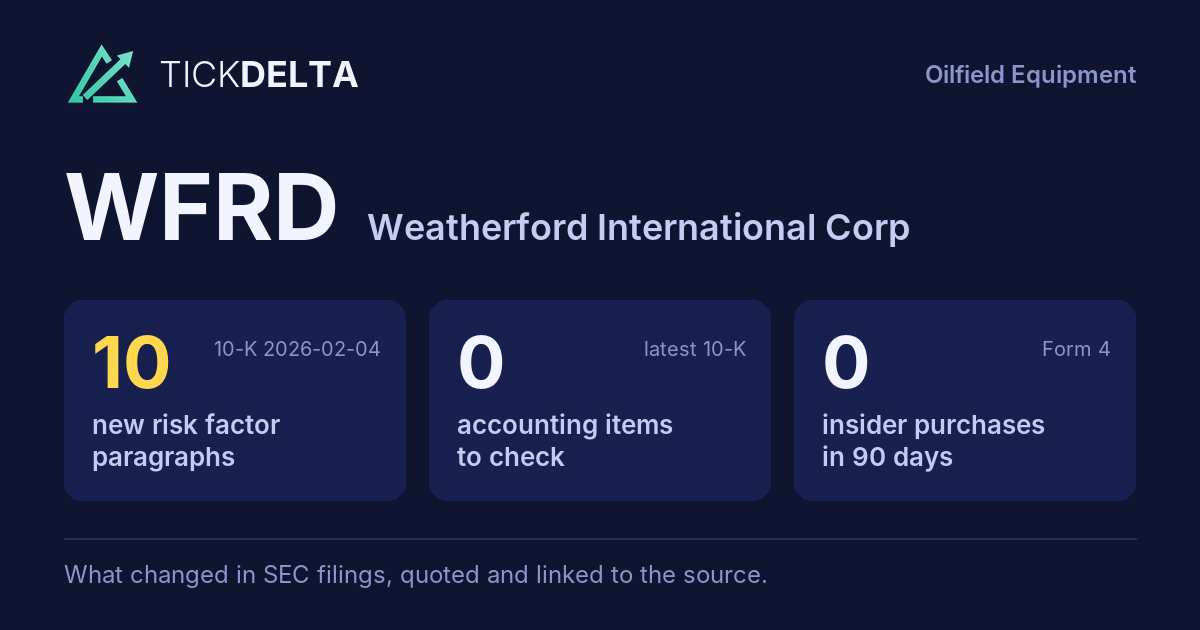
of the text changed · 8,302 words now · 10 new paragraphs, 13 gone
MD&A
22.8%
of the text changed · 8,390 words now · 6 new paragraphs, 6 gone
Accounting Policies
4.2%
of the text changed · 2,957 words now
10-K 0001603923-26-000014 (Feb 4, 2026) vs 10-K 0001603923-25-000050 (Feb 6, 2025) Not compared: Legal Proceedings.
Every paragraph, and how much of it changed
One bar per paragraph, in the order of the 10-K. Height and colour show the share of its words not in the closest paragraph a year earlier; the tallest bars are new paragraphs.
Risk Factors
114 paragraphs · 10 new · 27 reworded · 13 gone · 10-K Feb 4, 2026 against Feb 6, 2025
New paragraph
Reworded (5% of its words or more)
Same or nearly
Paragraph 49 · 37% changed
Every version of it
Paragraph 101 · 37% changed
Every version of it
Paragraph 79 · 30% changed
Every version of it
Failure to make timely investments in technology and to utilize artificial intelligence appropriately and safely could adversely affect our ability to successfully compete with other companies in our industry. industry, and challenges with properly managing such technologies could result in reputational harm and legal liability that could adversely affect our business, financial condition or results of operations.
Paragraph 80 · 25% changed
Every version of it
The business in which we operate is highly competitive and rapidly evolving. Our business may be adversely affected if we fail to make timely investments in new technology and to utilize technology, such as artificial intelligence in our internal-facing systems and processes, as well as in our external-facing environment, in response (“AI”), or if we fail to changes in the market. manage such technologies appropriately.
Paragraph 29 · 23% changed
Every version of it
There have been significant business consolidations within the oil and gas industry in recent years. These and any future consolidations Continuing consolidation within the industry may result in our reduced market share and reduced capital spending by some of our customers or the acquisition of one or more of our primary customers, which may lead to a lower decreased demand for our products and services.
Paragraph 59 · 18% changed
Every version of it
Our indemnification arrangements may not protect us in every case. For example, our indemnity arrangements may be held to be overly broad in some courts and/or contrary to public policy in some jurisdictions, and to that extent may be unenforceable. Additionally, some jurisdictions which permit indemnification nonetheless limit its scope by applicable law, rule, order or statute. We may be subject to claims brought by third parties or government agencies with respect to which we are not indemnified. Furthermore, the parties from which we seek indemnity may not be solvent, may become bankrupt, may lack resources or insurance to honor their indemnities or may not otherwise be able to satisfy their indemnity obligations to us. The lack of enforceable indemnification could expose us to significant potential losses.
Paragraph 46 · 17% changed
Every version of it
The occurrence of a cybersecurity incident can go unnoticed for a period of time despite efforts to detect and respond in a timely manner. Any investigation of a cybersecurity incident is inherently unpredictable, and it takes time before the completion of any investigation and before there is availability of full and reliable information. Even when an attack has been detected, it is not always immediately apparent what the full nature and scope of any potential harm may be, or how best to remediate it, and certain errors or actions could be repeated or compounded before they are discovered and remediated, all or any of which further increase the risks, costs and consequences of a cybersecurity event or other technology disruption. As cybersecurity incidents and attacks continue to evolve, we may be required to expend significant additional resources and incur significant expenses to continue to modify or enhance our protective measures or to investigate, respond to or remediate any information security vulnerabilities.
Paragraph 60 · 38% changed
Every version of it
10-K Feb 6, 2025Our indemnification arrangements may not protect us in every case. For example, our indemnity arrangements may be held to be overly broad in some courts and/or contrary to public policy in some jurisdictions, and to that extent may be unenforceable. Additionally, some jurisdictions which permit indemnification nonetheless limit its scope by applicable law, rule, order or statute. We may be subject to claims brought by third parties or government agencies with respect to which we are not indemnified. Furthermore, the parties from which we seek indemnity may not be solvent, may become bankrupt, may lack resources or insurance to honor their indemnities or may not otherwise be able to satisfy their indemnity obligations to us. The lack of enforceable indemnification could expose us to significant potential losses.
10-K Feb 4, 2026
Furthermore, the parties from which we seek indemnity may not be solvent, may become bankrupt, may lack resources or insurance to honor their indemnities or may not otherwise be able to satisfy their indemnity obligations to us. The lack of enforceable indemnification could expose us to significant potential losses.
Paragraph 49 · 37% changed
Every version of it
10-K Feb 6, 2025Pandemics, such as the COVID-19 pandemic, have caused and could again cause volatile regional and global economic conditions that exacerbate the potential negative impact from many of the other risks we face. We believe that a future pandemic may result in impacts including but not limited to:
10-K Feb 4, 2026
Pandemics have caused and could again cause volatile regional and global economic conditions that exacerbate the potential negative impact from many of the other risks we face. We believe that a future pandemic may result in significant reduction in the demand for oil and gas, instability in the global work force, increased cybersecurity vulnerability from remote work and the heightening of geopolitical tensions. Our insurance policies may not cover losses associated with pandemics or similar global health threats.
Paragraph 101 · 37% changed
Every version of it
10-K Feb 6, 2025The Organization of Economic Cooperation and Development (“OECD”), which represents a coalition of member countries, issued various white papers addressing Tax Base Erosion and Jurisdictional Profit Shifting. The recommendations in these white papers are generally aimed at combating what they believe is tax avoidance. Numerous jurisdictions in which we operate have been influenced by these white papers as well as other factors and are increasingly active in evaluating changes to their tax laws. In addition, the OECD has advanced reforms focused on global profit allocation and implementing a global minimum tax rate of at least 15% for large multinational corporations on a jurisdiction-by-jurisdiction basis, known as “Pillar Two.” On October 8, 2021, the OECD announced an accord endorsing and providing an implementation plan for Pillar Two agreed upon by 136 nations. On December 15, 2022, the European Council formally adopted a European Union directive on the implementation of the plan by January 1, 2024. Numerous countries, including Ireland have enacted legislation implementing Pillar Two effective January 1, 2024. This is not expected to materially increase the taxes we owe; however, if future legislation is enacted to implement the accord in some or all the jurisdictions in which we have operations, it could materially increase the amount of taxes we owe, thereby negatively affecting our results of operations and our cash flows from operations.
10-K Feb 4, 2026
In October 2021, the Organization of Economic Cooperation and Development (“OECD”), which represents a coalition of member countries, advanced reforms focused on global profit allocation and implementing a global minimum tax rate of at least 15% for large multinational corporations on a jurisdiction-by-jurisdiction basis, known as “Pillar Two.” The reform has been agreed upon by the majority of OECD members. The OECD has since issued administrative guidance providing transition and safe harbor rules around the implementation of the Pillar Two Global Minimum Tax. In December 2022, the European Council formally adopted a European Union directive on the implementation of the plan by January 1, 2024. Numerous countries, including Ireland, have enacted legislation implementing Pillar Two effective January 1, 2024. However, the OECD and countries are continuing to evaluate and adjust the Global Minimum Tax rules through administrative guidance, including legislative updates and adoption by additional countries, which could result in an increase in our effective tax rate.
Paragraph 79 · 30% changed
Every version of it
10-K Feb 6, 2025
Failure to make timely investments in technology and to utilize artificial intelligence appropriately and safely could adversely affect our ability to successfully compete with other companies in our industry.
10-K Feb 4, 2026
Failure to make timely investments in technology and to utilize artificial intelligence appropriately and safely could adversely affect our ability to successfully compete with other companies in our industry, and challenges with properly managing such technologies could result in reputational harm and legal liability that could adversely affect our business, financial condition or results of operations.
Paragraph 80 · 25% changed
Every version of it
10-K Feb 6, 2025
The business in which we operate is highly competitive and rapidly evolving. Our business may be adversely affected if we fail to make timely investments in new technology and to utilize artificial intelligence in our internal-facing systems and processes, as well as in our external-facing environment, in response to changes in the market.
10-K Feb 4, 2026
The business in which we operate is highly competitive and rapidly evolving. Our business may be adversely affected if we fail to make timely investments in new technology, such as artificial intelligence (“AI”), or if we fail to manage such technologies appropriately.
Paragraph 29 · 23% changed
Every version of it
10-K Feb 6, 2025
There have been significant business consolidations within the oil and gas industry in recent years. These and any future consolidations may result in our reduced market share and reduced capital spending by our customers which may lead to a lower demand for our products and services.
10-K Feb 4, 2026
There have been significant business consolidations within the oil and gas industry in recent years. Continuing consolidation within the industry may result in reduced capital spending by some of our customers or the acquisition of one or more of our primary customers, which may lead to decreased demand for our products and services.
Paragraph 59 · 18% changed
Every version of it
10-K Feb 6, 2025
Our indemnification arrangements may not protect us in every case. For example, our indemnity arrangements may be held to be overly broad in some courts and/or contrary to public policy in some jurisdictions, and to that extent may be unenforceable. Additionally, some jurisdictions which permit indemnification nonetheless limit its scope by applicable law, rule, order or statute. We may be subject to claims brought by third parties or government agencies with respect to which we are not indemnified. Furthermore, the parties from which we seek indemnity may not be solvent, may become bankrupt, may lack resources or insurance to honor their indemnities or may not otherwise be able to satisfy their indemnity obligations to us. The lack of enforceable indemnification could expose us to significant potential losses.
10-K Feb 4, 2026
Our indemnification arrangements may not protect us in every case. For example, our indemnity arrangements may be held to be overly broad in some courts and/or contrary to public policy in some jurisdictions, and to that extent may be unenforceable. Additionally, some jurisdictions which permit indemnification nonetheless limit its scope by applicable law, rule, order or statute. We may be subject to claims brought by third parties or government agencies with respect to which we are not indemnified.
Paragraph 46 · 17% changed
Every version of it
10-K Feb 6, 2025
The occurrence of a cybersecurity incident can go unnoticed for a period of time despite efforts to detect and respond in a timely manner. Any investigation of a cybersecurity incident is inherently unpredictable, and it takes time before the completion of any investigation and before there is availability of full and reliable information. Even when an attack has been detected, it is not always immediately apparent what the full nature and scope of any potential harm may be, or how best to remediate it, and certain errors or actions could be repeated or compounded before they are discovered and remediated, all or any of which further
10-K Feb 4, 2026
The occurrence of a cybersecurity incident can go unnoticed for a period of time despite efforts to detect and respond in a timely manner. Any investigation of a cybersecurity incident is inherently unpredictable, and it takes time before the completion of any investigation and before there is availability of full and reliable information. Even when an attack has been detected, it is not always immediately apparent what the full nature and scope of any potential harm may be, or how best to remediate it, and certain errors or actions could be repeated or compounded before they are discovered and remediated, all or any of which further increase the risks, costs and consequences of a cybersecurity event or other technology disruption. As cybersecurity incidents and attacks continue to evolve, we may be required to expend significant additional resources and incur significant expenses to continue to modify or enhance our protective measures or to investigate, respond to or remediate any information security vulnerabilities.
MD&A
114 paragraphs · 6 new · 60 reworded · 6 gone · 10-K Feb 4, 2026 against Feb 6, 2025
New paragraph
Reworded (5% of its words or more)
Same or nearly
Paragraph 12 · 48% changed
Operating income of $756 million in the twelve months ended December 31, 2025, decreased 19% compared to $938 million in the twelve months ended December 31, 2024, increased 14% compared primarily due to $820 million the decline in revenue, with a partial offset from lower cost of products and services, lower selling general, administrative and research and development costs and a gain on the twelve months ended December 31, 2023, primarily driven by improved operational efficiencies from increased resource utilization, sale of our pressure pumping business in addition to cost reduction initiatives implemented by the Company in the second half of 2024 and the impact of lower employee incentive compensation. Argentina. Cost of products and services of $3.61 $3.38 billion increased $210 decreased $221 million, or 6%, in 2024 2025 compared to 2023, 2024, primarily due to support the increased overall activity across our segments. decline in product sales and a reduction in headcount leading to lower personnel costs. Our cost of products and services as a percentage of revenues was 69% in 2025 compared to 65% in 2024, an improvement compared 2024. The higher cost ratio was primarily due to 66% in 2023. fixed costs decreasing at a slower rate than revenues.
Paragraph 73 · 47% changed
On April 22, 2024, additional lenders joined the Credit Agreement, providing an increase in total commitments from $550 million to $680 million (performance letters of credit increased from $250 million to $309 million and borrowings or additional performance or financial letters of credit increased from $300 million to $371 million). On June 6, 2024, an additional lender joined the Credit Agreement, providing an increase in total commitments from $680 million to $720 million (performance letters of credit increased to $327 million and revolving loan borrowings or additional performance or financial letters of credit increased to $393 million). In addition, September 18, 2025, we amended the Credit Agreement to (i) allow for future increases an increase in total commitment amount from $720 million to $1 billion comprised of $600 million to be used either for revolving loans or financial letters of credit and $400 million to be used for performance letters of credit, (ii) extend the maturity date to the earlier of September 18, 2030 or January 29, 2030 if more than $200 million of 2030 Senior Notes or Permitted Refinancing Indebtedness are outstanding on that date and (iii) include an accordion feature that will allow for further increases of commitments of up to $1 $1.15 billion.
Paragraph 25 · 45% changed
For the year ended December 31, 2024, income tax expense was higher than 2023, primarily driven by increased activity and operating profits, profit mix in various jurisdictions that we operate, and lower valuation allowance releases. During the year ended December 31, 2023, 2025, income tax expense was lower than 2024, primarily driven by $115 million, due to the release of valuation allowances and the recognition of $70 million in benefits from previously uncertain tax positions. Those benefits were positions due audit settlements and lapses in the statute of limitations, partially offset by a decrease in the establishment amount of valuation allowance of approximately $50 million against the sale of Blue Chip Swap securities and currency devaluation in Argentina (see Note 17 – Blue Chip Swap Securities - Argentina). releases as compared to 2024.
Paragraph 62 · 43% changed
Paragraph 94 · 42% changed
Paragraph 10 · 42% changed
In addition, there may be future impacts and effects on our industry relating to the new U.S. Presidential administration and Congress in areas relating to global trade policy and tariffs, global conflicts and resulting sanctions, environmental regulation and others. The As tariffs and trade policies continue to develop, the Company continues actively monitors for changes and adjusts operations to monitor these developments, but mitigate impacts. While they created some degree of margin dilution, tariffs did not have a material impact on the impact and timing of these changes on our business is uncertain. Company during the year ended December 31, 2025.
Paragraph 44 · 41% changed
Paragraph 11 · 41% changed
Revenues totaled $5.51 billion $4,918 million in 2024, an increase 2025, a decrease of $378 $595 million, or 7% 11% compared to 2023. 2024. Year-over-year in 2024, 2025, product revenues increased 8% decreased 9% and service revenues increased 7%. decreased 12%. DRE, PRI and WCC were responsible for 52%, 19% and DRE contributed to 47% and 39% 17% of the increase decrease in revenues, respectively, with the remainder remaining decrease from higher lower activity in integrated services and projects. This was partially offset Geographically, each region saw a decrease in revenue, with Latin America responsible for 83% of the decline, North America 11%, Europe/Sub-Sahara Africa/Russia 5% and Middle East/North Africa/Asia 1%. Year-over-year revenue decreases were primarily caused by a decrease from PRI. Geographically, growth in 2024 was led by improvements in the Middle East/North Africa/Asia, Europe/Sub-Sahara Africa/Russia and Latin America regions which contributed to 81%, 23% and 2% softening of the increase, respectively, partly offset by overall market which drove a revenue decline in North America. Approximately 90% of our revenue increase in 2024 was due to increased customer demand including as a result of business acquisitions during the year, with the remainder primarily from pricing activity across segments and market share improvements. geographies.
Paragraph 12 · 48% changed
10-K Feb 6, 2025
Operating income of $938 million in the twelve months ended December 31, 2024, increased 14% compared to $820 million in the twelve months ended December 31, 2023, primarily driven by improved operational efficiencies from increased resource utilization, in addition to cost reduction initiatives implemented by the Company in the second half of 2024 and the impact of lower employee incentive compensation. Cost of products and services of $3.61 billion increased $210 million, or 6%, in 2024 compared to 2023, to support the increased overall activity across our segments. Our cost of products and services as a percentage of revenues was 65% in 2024, an improvement compared to 66% in 2023.
10-K Feb 4, 2026
Operating income of $756 million in the twelve months ended December 31, 2025, decreased 19% compared to $938 million in the twelve months ended December 31, 2024, primarily due to the decline in revenue, with a partial offset from lower cost of products and services, lower selling general, administrative and research and development costs and a gain on the sale of our pressure pumping business in Argentina. Cost of products and services of $3.38 billion decreased $221 million, or 6%, in 2025 compared to 2024, primarily due to the decline in product sales and a reduction in headcount leading to lower personnel costs. Our cost of products and services as a percentage of revenues was 69% in 2025 compared to 65% in 2024. The higher cost ratio was primarily due to fixed costs decreasing at a slower rate than revenues.
Paragraph 73 · 47% changed
10-K Feb 6, 2025
On April 22, 2024, additional lenders joined the Credit Agreement, providing an increase in total commitments from $550 million to $680 million (performance letters of credit increased from $250 million to $309 million and borrowings or additional performance or financial letters of credit increased from $300 million to $371 million). On June 6, 2024, an additional lender joined the Credit Agreement, providing an increase in total commitments from $680 million to $720 million (performance letters of credit increased to $327 million and revolving loan borrowings or additional performance or financial letters of credit increased to $393 million). In addition, we amended the Credit Agreement to allow for future increases in total commitments of up to $1 billion.
10-K Feb 4, 2026
On September 18, 2025, we amended the Credit Agreement to (i) allow for an increase in total commitment amount from $720 million to $1 billion comprised of $600 million to be used either for revolving loans or financial letters of credit and $400 million to be used for performance letters of credit, (ii) extend the maturity date to the earlier of September 18, 2030 or January 29, 2030 if more than $200 million of 2030 Senior Notes or Permitted Refinancing Indebtedness are outstanding on that date and (iii) include an accordion feature that will allow for further increases of commitments up to $1.15 billion.
Paragraph 25 · 45% changed
10-K Feb 6, 2025
For the year ended December 31, 2024, income tax expense was higher than 2023, primarily driven by increased activity and operating profits, profit mix in various jurisdictions that we operate, and lower valuation allowance releases. During the year ended December 31, 2023, income tax expense was lower by $115 million, due to the release of valuation allowances and the recognition of benefits from previously uncertain tax positions. Those benefits were offset by the establishment of valuation allowance of approximately $50 million against the sale of Blue Chip Swap securities and currency devaluation in Argentina (see Note 17 – Blue Chip Swap Securities - Argentina).
10-K Feb 4, 2026
For the year ended December 31, 2025, income tax expense was lower than 2024, primarily driven by the release of $70 million in benefits from previously uncertain tax positions due audit settlements and lapses in the statute of limitations, partially offset by a decrease in the amount of valuation allowance releases as compared to 2024.
Paragraph 62 · 43% changed
10-K Feb 6, 2025•Standard and Poor (“S&P) and Fitch Ratings (“Fitch”) upgraded our issuer credit ratings from ‘B+’ to ‘BB-’, S&P maintained a positive outlook and Fitch maintained a stable outlook
10-K Feb 4, 2026
•Fitch Ratings upgraded our issuer credit ratings from ‘BB-’ to ‘BB;’ with a stable outlook
Paragraph 94 · 42% changed
10-K Feb 6, 2025update or revise any forward-looking statement, whether as a result of new information, future events, or otherwise, except to the extent required under federal securities laws. The following, together with disclosures under “Part I – Item 1A. Risk Factors”, sets forth certain risks and uncertainties relating to our forward-looking statements that may cause actual results to be materially different from our present expectations or projections:
10-K Feb 4, 2026
forth certain risks and uncertainties relating to our forward-looking statements that may cause actual results to be materially different from our present expectations or projections:
Paragraph 10 · 42% changed
10-K Feb 6, 2025
In addition, there may be future impacts and effects on our industry relating to the new U.S. Presidential administration and Congress in areas relating to global trade policy and tariffs, global conflicts and resulting sanctions, environmental regulation and others. The Company continues to monitor these developments, but the impact and timing of these changes on our business is uncertain.
10-K Feb 4, 2026
In addition, there may be future impacts and effects on our industry in areas relating to global trade policy and tariffs, global conflicts and resulting sanctions, environmental regulation and others. As tariffs and trade policies continue to develop, the Company actively monitors for changes and adjusts operations to mitigate impacts. While they created some degree of margin dilution, tariffs did not have a material impact on the Company during the year ended December 31, 2025.
Paragraph 44 · 41% changed
10-K Feb 6, 2025Growth and spending in the energy services industry is highly dependent on many external factors. These include but are not limited to; the impact from geopolitical conflicts; our customers’ capital expenditures; environmental, social and governance and other sustainability policies and initiatives; world economic, political, trade, and weather conditions; the price of oil, natural gas, and alternatives; and, member-country quota compliance within the Organization of Petroleum Exporting Countries and the expanded alliance (OPEC+); non-OPEC+ investments and project timing. Imbalance across geographies driven by geopolitical conflicts, investment variances and supply disruptions are driving a greater focus on energy security and resiliency, which in turn is creating a shift towards national oil companies and diversification across multiple energy sources (oil, gas, coal, renewables, etc.) to meet domestic and global demand. In the short term, we see increased focus on capital discipline and efficiencies, particularly in our Latin American and North American regions, which we expect to negatively impact demand for our services and products in 2025, as our customers regulate activity timing and services spending, relative to macro-driven factors listed above. We also expect a decline in activity in Russia in 2025. However, we remain constructive on our activity profile over the next several years, as we expect positive macroeconomic conditions coupled with our focus on technology adoption and market penetration, to provide a pathway to multi-year energy demand expansion. The mix of customer spending related to regional and operating environment factors (short-cycle vs. long-cycle projects, offshore vs onshore, reservoir and well development cycles) may also influence the timing, type, and intensity of demand for products and services within our portfolio. We continue to closely monitor macroeconomic conditions, potential supply chain disruptions, inflationary factors, and other labor and logistical constraints that could impact our operations and results.
10-K Feb 4, 2026
We remain constructive on our activity profile over the next several years, as we expect positive macroeconomic conditions coupled with our focus on technology adoption and market penetration, to provide a pathway to multi-year energy demand expansion. The mix of customer spending related to regional and operating environment factors (short-cycle vs. long-cycle projects, offshore vs onshore, reservoir and well development cycles) may also influence the timing, type, and intensity of demand for products and services within our portfolio. We continue to closely monitor macroeconomic conditions, potential supply chain disruptions, inflationary factors, and other labor and logistical constraints that could impact our operations and results. Unpredictable developments—such as the potential opening of Venezuela to foreign oil companies—may increase activity levels in the mid to long term.
Paragraph 11 · 41% changed
10-K Feb 6, 2025
Revenues totaled $5.51 billion in 2024, an increase of $378 million, or 7% compared to 2023. Year-over-year in 2024, product revenues increased 8% and service revenues increased 7%. WCC and DRE contributed to 47% and 39% of the increase in revenues, respectively, with the remainder from higher activity in integrated services and projects. This was partially offset by a decrease from PRI. Geographically, growth in 2024 was led by improvements in the Middle East/North Africa/Asia, Europe/Sub-Sahara Africa/Russia and Latin America regions which contributed to 81%, 23% and 2% of the increase, respectively, partly offset by a revenue decline in North America. Approximately 90% of our revenue increase in 2024 was due to increased customer demand including as a result of business acquisitions during the year, with the remainder primarily from pricing and market share improvements.
10-K Feb 4, 2026
Revenues totaled $4,918 million in 2025, a decrease of $595 million, or 11% compared to 2024. Year-over-year in 2025, product revenues decreased 9% and service revenues decreased 12%. DRE, PRI and WCC were responsible for 52%, 19% and 17% of the decrease in revenues, respectively, with the remaining decrease from lower activity in integrated services and projects. Geographically, each region saw a decrease in revenue, with Latin America responsible for 83% of the decline, North America 11%, Europe/Sub-Sahara Africa/Russia 5% and Middle East/North Africa/Asia 1%. Year-over-year revenue decreases were primarily caused by a softening of the overall market which drove a decline in activity across segments and geographies.
A paragraph is matched with the one last year that shares the most of its words; under half in common makes it new. The paragraphs shown are the 8 reworded the most in each section.
The paragraph that changed most in each section
The redline
Marked against last year's 10-K: cut words struck through, new words highlighted.
Risk Factors206 words changed in this paragraph; it is 46% similar to last year's version.
Source: Item 1A, 10-K 0001603923-26-000014 vs Item 1A, 10-K 0001603923-25-000050
MD&A201 words changed in this paragraph; it is 57% similar to last year's version.
Growth and spending in the energy services industry is highly dependent on many external factors. These include but are not limited to; the impact from geopolitical conflicts; our customers’ capital expenditures; environmental, social and governance and other sustainability policies and initiatives; world economic, political, trade, and weather conditions; the price of oil, natural gas, and alternatives; and, member-country quota compliance within the Organization of Petroleum Exporting Countries and the expanded alliance (OPEC+); non-OPEC+ investments and project timing. Imbalance across geographies driven by geopolitical conflicts, investment variances and demand growth alignment with supply disruptions stability are driving a greater focus on energy security and resiliency, which in turn is creating a shift towards national oil companies and diversification across multiple energy sources (oil, gas, coal, renewables, etc.) to meet domestic and global demand. markets balance. In the short term, we see increased continued focus on capital discipline and efficiencies, particularly in our Latin American and North American regions, efficiencies across all geographies, which we expect to negatively impact demand result in muted activity for our services and products products, particularly in 2025, the first half of 2026, as our customers regulate activity timing and services spending, relative to macro-driven factors listed above. We also expect activity to improve in the second half of 2026, resulting in a decline full year that is slightly lower to in activity in Russia in line with 2025. However, we remain constructive on our activity profile over the next several years, as we expect positive macroeconomic conditions coupled with our focus on technology adoption and market penetration, to provide a pathway to multi-year energy demand expansion. The mix of customer spending related to regional and operating environment factors (short-cycle vs. long-cycle projects, offshore vs onshore, reservoir and well development cycles) may also influence the timing, type, and intensity of demand for products and services within our portfolio. We continue to closely monitor macroeconomic conditions, potential supply chain disruptions, inflationary factors, and other labor and logistical constraints that could impact our operations and results.
Source: Item 7, 10-K 0001603923-26-000014 vs Item 7, 10-K 0001603923-25-000050
Accounting Policies42 words changed in this paragraph; it is 73% similar to last year's version.
We account for share-based payment awards by recognizing the grant date fair value as an expense, net of forfeitures, over the service period, which is usually the vesting period. period, and account for forfeitures as they occur. The fair value and associated expense is adjusted when the published price of our stock changes updated at each reporting date for share-based awards we intend to settle in cash. cash and for awards where performance targets are established or modified during the performance period. We record share-based compensation in “Selling, General and Administrative” on the accompanying Consolidated Statements of Operations.
Source: Item 8, Note 1 – Summary of Significant Accounting Policies, 10-K 0001603923-26-000014 vs Item 8, Note 1 – Summary of Significant Accounting Policies, 10-K 0001603923-25-000050
Sentences and paragraphs added, removed or reworded
Every change, by type
Sentences and paragraphs of WFRD's Risk Factors and MD&A, 10-K Feb 4, 2026 against 10-K Feb 6, 2025. Each links to the text at sec.gov.
Quiet changes are sentences kept from last year with one to four words changed, at least one of them a hedge, a modal or a qualifier (may, could, will, not, significant, material…). A year or date rolling forward is not counted.
The full word list
adverse, adversely, all, although, anticipate, anticipates, any, approximately, believe, believes, can, cannot, certain, could, expect, expects, generally, however, if, intend, intends, largely, likely, many, material, materially, may, might, most, must, never, no, not, possible, primarily, probable, should, significant, significantly, some, substantial, substantially, unlikely, will, would
AddedRisk Factors
The imposition and enforcement of stringent greenhouse gas emissions reduction requirements could severely and adversely impact the oil and natural gas industry and therefore significantly reduce the value of our business.
Read it in 10-K Feb 4, 2026 at sec.gov
AddedRisk Factors
Changes in trade policy and uncertainties related to tariffs could adversely affect our business.
Read it in 10-K Feb 4, 2026 at sec.gov
AddedRisk Factors
Tariffs imposed by the United States and retaliatory measures from other countries have and may continue to lead to higher prices for, or reduced availability of, raw materials and finished goods, making products less attractive to customers and potentially reducing demand. Further, these actions have and may continue to create uncertainty in financial markets, impact capital spending, and result in operational disruptions, inflation, and diminished profitability. The unpredictable nature of tariff changes and trade restrictions makes it difficult to anticipate and mitigate risks, which could materially affect our business operations, financial condition, and results of operations. While they created some degree of margin dilution, tariffs did not have a material impact on the Company during the year ended December 31, 2025.
Read it in 10-K Feb 4, 2026 at sec.gov
AddedRisk Factors
We are integrating AI tools into our systems and certain products, and many of our third-party service providers, as well as our competitors, are also developing and using such tools. AI may become increasingly important to our operations or to our future growth over time. There can be no assurance that we will realize the desired or anticipated benefits, or any benefits, and we may fail to properly implement such technology.
Read it in 10-K Feb 4, 2026 at sec.gov
AddedRisk Factors
In addition, our, and our third-party service providers’, AI tools may not meet existing or rapidly evolving regulatory or industry standards with respect to privacy and data protection, compliance, and transparency, among others, which could inhibit our or our service providers’ ability to maintain an adequate level of functionality or service. AI tools used by us or by our service providers could produce inaccurate or unexpected results or behaviors that could harm our business, customers, or reputation. Furthermore, the deployment of AI systems could expose us to increased cybersecurity threats, such as data breaches and unauthorized access leading to financial losses, legal liabilities, and reputational damage.
Read it in 10-K Feb 4, 2026 at sec.gov
AddedRisk Factors
Our competitors may incorporate AI in their business operations and products more rapidly or more successfully than we do. Additionally, the complex and rapidly evolving legal and regulatory landscape around AI may expose us to claims, inquiries, demands and proceedings by private parties and global regulatory authorities or subject us to legal liability as well as reputational harm and compliance may impose significant operational costs and may limit our ability to develop, deploy or use AI tools.
Read it in 10-K Feb 4, 2026 at sec.gov
AddedRisk Factors
not consistent and may change over time, which could result in significant revisions to our current goals, reported progress in achieving such goals, or ability to achieve such goals in the future.
Read it in 10-K Feb 4, 2026 at sec.gov
AddedRisk Factors
A failure of our information systems, including the implementation of our new enterprise resource planning system, or other issues with our systems could have a material adverse affect on our business, financial condition, results of operations and cash flows and could adversely impact the effectiveness of our internal control over financial reporting.
Read it in 10-K Feb 4, 2026 at sec.gov
Show the other 51
AddedRisk Factors
We have begun a multi-year process of implementing a cloud-based enterprise resource planning (“ERP”) system that will assist with the collection, storage, management and interpretation of data from our business activities to support future growth and to integrate significant processes.
Read it in 10-K Feb 4, 2026 at sec.gov
AddedRisk Factors
ERP system implementations are complex and time-consuming and involve substantial expenditures on system software and implementation activities, as well as changes to business processes and internal control over financial reporting. The implementation of the ERP system may prove to be more difficult, costly, or time consuming than expected, and there can be no assurance that this system will continue to be beneficial to the extent anticipated. Any disruptions, delays or deficiencies in the design and implementation of our new ERP system, particularly ones that impact our financial reporting and accounting systems or our ability to provide services, send invoices, track payments or fulfill contractual obligations, could adversely affect our business, financial condition, results of operations and cash flows. Additionally, if the ERP system does not operate as intended, the effectiveness of our internal control over financial reporting could be adversely affected or our ability to assess it adequately could be impacted, which could cause us to fail to meet our reporting obligations.
Read it in 10-K Feb 4, 2026 at sec.gov
RemovedRisk Factors
RemovedRisk Factors
RemovedRisk Factors
RemovedRisk Factors
RemovedRisk Factors
RemovedRisk Factors
RemovedRisk Factors
RemovedRisk Factors
RemovedRisk Factors
RemovedRisk Factors
RemovedRisk Factors
RemovedRisk Factors
RewordedRisk Factors
Our business may be adversely affected if we fail to make timely investments in new technology and to utilize technology, such as artificial intelligence in our internal-facing systems and processes, as well as in our external-facing environment, in response (“AI”), or if we fail to changes in the market. manage such technologies appropriately.
Read it in 10-K Feb 4, 2026 at sec.gov
RewordedRisk Factors
RewordedRisk Factors
Failure to make timely investments in technology and to utilize artificial intelligence appropriately and safely could adversely affect our ability to successfully compete with other companies in our industry. industry, and challenges with properly managing such technologies could result in reputational harm and legal liability that could adversely affect our business, financial condition or results of operations.
Read it in 10-K Feb 4, 2026 at sec.gov
RewordedRisk Factors
As a result of heightened public awareness and attention to these issues as well as continued political and regulatory initiatives to reduce the reliance upon oil and natural gas, result, demand for hydrocarbons may be reduced, which could have an adverse effect on our business, financial condition, and results of operations.
Read it in 10-K Feb 4, 2026 at sec.gov
RewordedRisk Factors
Approximately 10% of our 2024 revenue and approximately 26% 24% of our December 31, 2024 2025 accounts receivables were related to our largest customer in Mexico. Mexico, which comprised 5% of our revenue during the twelve months ended December 31, 2025.
Read it in 10-K Feb 4, 2026 at sec.gov
RewordedRisk Factors
In addition, October 2021, the OECD has Organization of Economic Cooperation and Development (“OECD”), which represents a coalition of member countries, advanced reforms focused on global profit allocation and implementing a global minimum tax rate of at least 15% for large multinational corporations on a jurisdiction-by-jurisdiction basis, known as “Pillar Two.
Read it in 10-K Feb 4, 2026 at sec.gov
RewordedRisk Factors
Also, certain parts and equipment that we use in our operations may be available only from a small number of suppliers, manufacturers or service providers, or in some cases may be sourced through a single supplier, manufacturer or service provider. providers.
Read it in 10-K Feb 4, 2026 at sec.gov
RewordedRisk Factors
Even when an attack has been detected, it is not always immediately apparent what the full nature and scope of any potential harm may be, or how best to remediate it, and certain errors or actions could be repeated or compounded before they are discovered and remediated, all or any of which further increase the risks, costs and consequences of a cybersecurity event or other technology disruption.
Read it in 10-K Feb 4, 2026 at sec.gov
RewordedRisk Factors
Continuing political and social attention to these issues has resulted in both existing and pending international agreements and national, regional and local legislation, regulatory measures, reporting obligations and policy changes. changes, including to reduce the reliance upon oil and natural gas.
Read it in 10-K Feb 4, 2026 at sec.gov
RewordedRisk Factors
The Credit Agreement and the indentures governing our 6.75% Senior Notes maturing October 2033 (the “2033 Senior Notes”) and 8.625% Senior Notes maturing April 30, 2030 (the “2030 Senior Notes”), contain certain restrictive or limiting covenants that may impose significant operating and financial restrictions on us and may limit our ability to engage in acts that we may believe to be in our long-term best interest, including the following:
Read it in 10-K Feb 4, 2026 at sec.gov
RewordedRisk Factors
In addition, the transition of the global energy sector from primarily a fossil fuel-based system to renewable energy sources could affect our customers' levels of expenditures. expenditures on products and services related to fossil fuels.
Read it in 10-K Feb 4, 2026 at sec.gov
RewordedRisk Factors
Additional regulations on deepwater drilling in the Gulf of Mexico and elsewhere in the world could be imposed, and those regulations could limit our business where they are imposed.
Read it in 10-K Feb 4, 2026 at sec.gov
AddedMD&A
Lower oil and natural gas prices and lower rig count generally correlate to lower exploration and production spending, and higher oil and natural gas prices and higher rig count generally correlate to higher exploration and production spending. Therefore, our financial results are significantly affected by oil and natural gas prices as well as rig counts. As shown in the following tables, as of December 31, 2025 oil prices and rig counts were notably lower than at December 31, 2024. The drop in oil prices and rig counts since December 31, 2024 has coincided with reduced activity levels across our industry. Henry Hub natural gas prices increased as of December 31, 2025 compared to December 31, 2024, driven by both U.S. domestic gas demand and investment decisions on adding new export liquified natural gas capacity. Gas production additions, largely driven by positive liquified natural gas sentiment ahead of actual capacity additions, were sourced from a backlog of drilled but uncompleted wells and deferred start-ups.
Read it in 10-K Feb 4, 2026 at sec.gov
AddedMD&A
Year Ended December 31, 2025 2024 North America 738 786 International (1) 1,080 1,162 Worldwide 1,818 1,948 (1) Prior period international rig count figures were retroactively adjusted by Baker Hughes in the third quarter of 2025.
Read it in 10-K Feb 4, 2026 at sec.gov
AddedMD&A
Gain on sale of business was $70 million in 2025 due to the sale of our pressure pumping business in Argentina during the second quarter of 2025. No sale of business occurred in 2024.
Read it in 10-K Feb 4, 2026 at sec.gov
AddedMD&A
Restructuring charges were $58 million in 2025 and $42 million in 2024. The increase was driven by reductions to facility footprint and headcount as part of optimization and efficiency initiatives implemented in light of softening market conditions. See “Note 4 – Restructuring Charges” for additional information.
Read it in 10-K Feb 4, 2026 at sec.gov
AddedMD&A
The loss on extinguishment of debt was for charges on unamortized debt issuance costs and bond redemption premiums, both upon the early redemption of debt. During 2025, we issued $1.2 billion in aggregate principal on our 2033 Senior Notes and we repaid $1.36 billion in principal of our 2030 Senior Notes. As such, we recognized a $39 million loss, comprised of an $8 million loss on extinguishment of debt and $31 million bond redemption premium. During 2024, we repaid in full our 6.5% Senior Secured Notes due 2028 (“2028 Senior Secured Notes”) and $4 million in principal of our 2030 Senior Notes, resulting in a bond redemption premium of $9 million. During 2023, we repaid the remaining $125 million in principal on our Exit Notes and made $243 million in repayments and repurchases of our 2028 Senior Secured Notes, and incurred a $5 million bond redemption premium.
Read it in 10-K Feb 4, 2026 at sec.gov
AddedMD&A
Cash provided by operating activities was $676 million in 2025 and $792 million in 2024. The primary operating source of cash in each year was collections related to our sales of products and services, partly offset by operating spend. The year-over-year decrease was primarily due to a decrease in collections as a result of decreased revenue, partially offset by lower employee costs and an increase in cash proceeds from factoring arrangements (see “Liquidity and Capital Resources - Accounts Receivable Factoring” below).
Read it in 10-K Feb 4, 2026 at sec.gov
RemovedMD&A
RemovedMD&A
RemovedMD&A
RemovedMD&A
RemovedMD&A
RemovedMD&A
RewordedMD&A
Year Ended December 31, 2024 2025 Reportable Segments All (Dollars in millions) DRE WCC PRI Other Total Revenue $ 1,682 1,371 $ 1,976 1,875 $ 1,452 1,340 $ 403 332 $ 5,513 4,918 Direct Costs(a) (1,007) (1,174) (955) (876) (1,127) (913) Other Expense(b) (208) (238) (178) (186) (233) (170) DRE Segment Adjusted EBITDA 467 467 309 309 WCC Segment Adjusted EBITDA 564 564 515 515 PRI Segment Adjusted EBITDA 319 319 257 257 All Other 84 42 Corporate (52) (56) Depreciation and Amortization (343) (267) Share-based Compensation Expense (c) (45) (38) Gain on Sale of Business 70 Restructuring Charges (58) Other Credits (Charges) (56) Charges, Net (18) Operating Income $ 938 756
Read it in 10-K Feb 4, 2026 at sec.gov
RewordedMD&A
Year Ended December 31, 2024 2023 Reportable Segments All (Dollars in millions) DRE WCC PRI Other Total Revenue $ 1,682 1,536 $ 1,976 1,800 $ 1,452 1,472 $ 403 327 $ 5,513 5,135 Direct Costs(a) (1,007) (1,174) (955) (920) (1,091) (953) Other Expense(b) (208) (238) (178) (194) (254) (196) DRE Segment Adjusted EBITDA 467 467 422 422 WCC Segment Adjusted EBITDA 564 564 455 455 PRI Segment Adjusted EBITDA 319 319 323 323 All Other 84 38 Corporate (52) Depreciation and Amortization (343) (327) Share-based Compensation Expense (c) (45) (35) Gain on Sale of Business 2 Restructuring Charges (16) Other Credits (Charges) (56) Credits, Net 10 Operating Income $ 938 820
Read it in 10-K Feb 4, 2026 at sec.gov
RewordedMD&A
The primary uses of cash in financing activities were for repayments and repurchases of long-term debt of $386 million $1.4 billion (see “Note 8 9 – Borrowings and Other Debt Obligations”) and $56 Obligations”), $101 million for share repurchases (see “Note 15 – Shareholders’ Equity”), $72 million for dividend payments (see “Note 15 – Shareholders’ Equity”), bond redemption premium of $31 million resulting from early redemptions, distributions to noncontrolling interests of $29 million, $21 million in tax remittances on equity awards. awards and $18 million in debt issuance costs.
Read it in 10-K Feb 4, 2026 at sec.gov
RewordedMD&A
RewordedMD&A
RewordedMD&A
Other charges of $56 million charges, net increased $52 million in 2024 compared to 2023, primarily due to an increase in severance acquisition and restructuring costs, and divestiture related expenditures offset by lower fees to third-party financial institutions related to collections of certain receivables from our largest customer in Mexico. Mexico in 2025.
Read it in 10-K Feb 4, 2026 at sec.gov
RewordedMD&A
The uses of cash were offset by proceeds from sale of investments of $41 million from our marketable securities in Argentina, Blue Chip Swap proceeds of $40 million, million and $31 million in proceeds from the disposition of assets and $36 million of other investing activities that primarily consisted of sales of short-term investments. assets.
Read it in 10-K Feb 4, 2026 at sec.gov
RewordedMD&A
In the short term, we see increased continued focus on capital discipline and efficiencies, particularly in our Latin American and North American regions, efficiencies across all geographies, which we expect to negatively impact demand result in muted activity for our services and products products, particularly in 2025, the first half of 2026, as our customers regulate activity timing and services spending, relative to macro-driven factors listed above.
Read it in 10-K Feb 4, 2026 at sec.gov
RewordedMD&A
Other charges of $56 million increased $52 million in 2024 compared to 2023, charges, net primarily due to an increase in severance and restructuring costs, and included fees to third-party financial institutions related to collections of certain receivables from our largest customer in Mexico. Mexico and other miscellaneous items.
Read it in 10-K Feb 4, 2026 at sec.gov
RewordedMD&A
The primary uses of cash in investing activities were for capital expenditures of $209 million, $226 million and the purchase of Blue Chip Swap securities in Argentina for $110 $117 million (see “Note 17 18 – Blue Chip Swap Securities - Argentina”), and $47 million of other investing activities that primarily consisted of purchases of short-term investments. Argentina”).
Read it in 10-K Feb 4, 2026 at sec.gov
RewordedMD&A
The forward-looking statements included herein are only made as of the date of this report, or if earlier, as of the date they were made, and we undertake no obligation to correct, update or revise any forward-looking statement, whether as a result of new information, future events, or otherwise, except to the extent required under federal securities laws.
Read it in 10-K Feb 4, 2026 at sec.gov
RewordedMD&A
All other revenues of $403 $332 million, increased $76 decreased $71 million or 23%, 18%, in 2024 2025 compared to 2023, primarily 2024 due to higher a decline in international activity for integrated services and projects resulting in project efficiencies. projects.
Read it in 10-K Feb 4, 2026 at sec.gov
Quiet changesMD&A
Sources
The two latest 10-Ks on EDGAR, section by section. Each change links to the text at sec.gov.
Also
New risk factors: paragraphs with nothing like them last year, quoted in full.
Work with it
Excel workbook · CSV. Google Sheet that stays up to date: paste =IMPORTDATA("https://tickdelta.com/company/WFRD/export.csv") into a cell.