Paragraph 150 · 48% changed
Every version of it
Screener
/
SEC EDGAR
/CIK 0001818331
/10-K filed Feb 23, 2026, compared with Feb 20, 2025
/Numbers from the XBRL of the 10-Ks
Nasdaq
Health care · Health Services
GeneDx Holdings Corp. WGS
The 10-K against last year's
133 changes: 24 added, 44 removed, 64 reworded, 1 quiet changes
10-K Feb 23, 2026 vs Feb 20, 2025
Risk Factors
14.1%
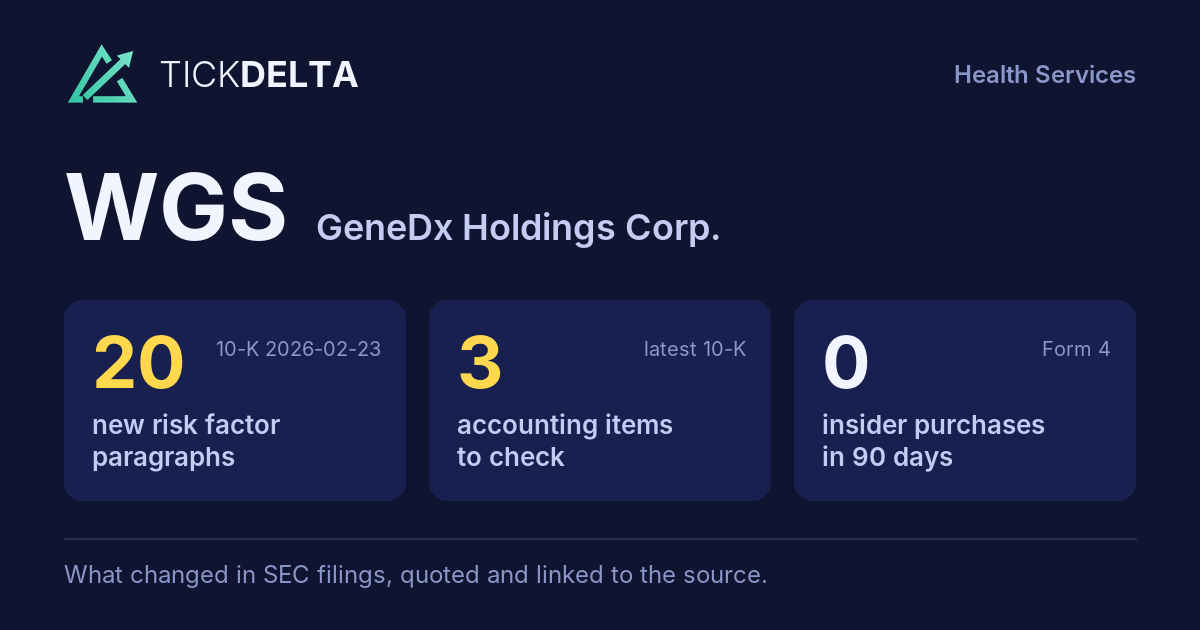
of the text changed · 29,319 words now · 20 new paragraphs, 30 gone
MD&A
27.8%
of the text changed · 4,932 words now · 4 new paragraphs, 14 gone
Legal Proceedings
34.8%
of the text changed · 980 words now
Accounting Policies
25.3%
of the text changed · 4,112 words now
10-K 0001818331-26-000015 (Feb 23, 2026) vs 10-K 0001818331-25-000021 (Feb 20, 2025)
Every paragraph, and how much of it changed
One bar per paragraph, in the order of the 10-K. Height and colour show the share of its words not in the closest paragraph a year earlier; the tallest bars are new paragraphs.
Risk Factors
346 paragraphs · 20 new · 84 reworded · 30 gone · 10-K Feb 23, 2026 against Feb 20, 2025
New paragraph
Reworded (5% of its words or more)
Same or nearly
Paragraph 149 · 48% changed
Every version of it
As of December 31, 2024, our 2025, we had total gross deferred tax assets were of approximately $318 million. Future $342 million, including net operating loss carryforwards (“NOLs”) and tax credit carryforwards. The realization of the these deferred tax benefits of existing temporary differences and carryforwards ultimately assets depends on the existence of our ability to generate sufficient taxable income within the applicable carryforward period. As of December 31, 2024 and December 31, 2023, the Company performed an evaluation to determine whether a valuation allowance was needed. periods. Based on the Company’s analysis, which considered all our evaluation of available evidence, both positive and negative, the Company determined that it is more likely than not that a significant portion of its deferred tax assets will not be realized. Accordingly, the Company maintained negative evidence, we have recorded a full valuation allowance against our deferred tax assets as of December 31, 2024 2025 and December 31, 2023. 2024. If we are unable to generate sustained taxable income in future periods, we may be unable to realize some or all of these tax benefits.
Paragraph 158 · 46% changed
Every version of it
From time to time, we may consider additional opportunities to acquire other products or technologies that may enhance our product platform or technology, expand the breadth of our markets or customer base, or advance our business strategies. In addition, For example, in May of 2025, we exited both completed the acquisition of Fabric Genomics. The integration of acquired businesses involves significant risks and uncertainties, including difficulties in integrating operations, technologies, systems, realizing anticipated synergies or strategic benefits and managing increased operational complexity. If we are unable to successfully integrate acquired businesses or realize the expected benefits of such transactions, our reproductive business, financial condition, and women's health testing business and our somatic tumor testing business, which involves the divestiture results of these businesses, and we may consider disposing other assets or businesses in the future. operations could be adversely affected.
Paragraph 314 · 45% changed
Every version of it
Paragraph 240 · 40% changed
Every version of it
We will be able to protect our proprietary rights from unauthorized use by third parties only to the extent that our proprietary technologies are covered by valid and enforceable patents or are effectively maintained as trade secrets. In this regard, we have applied, and we intend to continue applying, for patents covering such aspects of our technologies as we deem appropriate. However, we expect that potential patent coverage we may obtain will not be sufficient to prevent substantial competition. In this regard, we believe it is probable that others will independently develop similar or alternative technologies or design around those technologies for which we may obtain patent protection. In addition, any patent applications we file may be rejected during examination and may not result in issued patents, or may be invalidated or narrowed in scope after they are issued. Questions as to inventorship or ownership may also arise. Any finding that our patents or applications are unenforceable could harm our ability to prevent others from practicing the related technology, and a finding that others have inventorship or ownership rights to our patents and applications could require us to obtain certain rights to practice related technologies, which may not be available on favorable terms, if at all. It would be expensive, if we initiate lawsuits to protect or enforce our patents or trade secrets, or defend against third-party IP claims, and if we lose, we may lose some of our intellectual property rights. Furthermore, these lawsuits may divert the attention of our management and technical personnel.
Paragraph 279 · 40% changed
Every version of it
Paragraph 297 · 39% changed
Every version of it
Paragraph 70 · 36% changed
Every version of it
Failure to comply with applicable clinical laboratory licensure requirements or standards may result in a range of enforcement actions, including license suspension, limitation, or revocation, directed plan of action, onsite monitoring, civil monetary penalties, criminal sanctions, and cancellation of the laboratory’s approval to receive Medicare and Medicaid payment for our services, as well as significant adverse publicity. Any sanction imposed under CLIA, its implementing regulations, or state or foreign laws or regulations governing clinical laboratory licensure, or our failure to renew our CLIA certifications, a state or foreign license, or accreditation, could have a material adverse effect on our business, financial condition and results of operations. Even if we were able to bring our laboratory back into compliance, we could incur significant expenses and potentially lose revenue in doing so.
Paragraph 150 · 48% changed
Every version of it
10-K Feb 20, 2025Furthermore, under Section 382 of the Internal Revenue Code of 1986, as amended (the “Internal Revenue Code”), if a corporation undergoes an “ownership change,” the corporation’s ability to use its pre-change net operating loss carryforwards (“NOLs”) and other pre-change tax attributes (such as research tax credits) to offset its future taxable income may be limited. In general, an “ownership change” occurs if there is a cumulative change in its ownership by “5% shareholders” that exceeds 50 percentage points over a rolling three-year period. Our existing NOLs and tax credit carryovers may be subject to limitations arising from previous ownership changes, and if we undergo one or more ownership changes in connection with completed acquisitions, including the Business Combination or the Acquisition, or future transactions in our stock, our ability to utilize NOLs and tax credit carryovers could be further limited by Section 382 of the Internal Revenue Code. As a result, if we earn future taxable income, our ability to use our pre-change net operating loss and tax credit carryforwards to offset U.S. federal taxable income may be subject to limitations, which could potentially result in increased future tax liability to us. In addition, the Tax Cuts and Jobs Act limits the deduction for NOLs to 80% of current year taxable income and eliminates NOL carrybacks. Further, there may also be periods during which the use of NOLs is suspended or otherwise limited, which could accelerate or permanently increase state liability.
10-K Feb 23, 2026
In addition, our ability to utilize NOLs and certain other tax attributes may be limited under Section 382 of the Internal Revenue Code of 1986, as amended (the “Code”), if we experience an “ownership change.” An ownership change generally occurs if the percentage of our stock owned by one or more 5% shareholders increases by more than 50 percentage points over a rolling three-year period. We may have experienced ownership changes in the past, and future transactions involving our equity, including acquisitions such as the Business Combination or the Acquisition, financings, or other changes in our stock ownership, could result in additional ownership changes. If an ownership change occurs, our ability to utilize pre-change NOLs and other tax attributes could be subject to annual limitations, which could materially reduce or eliminate the benefit of these tax assets.
Paragraph 149 · 48% changed
Every version of it
10-K Feb 20, 2025
As of December 31, 2024, our total gross deferred tax assets were approximately $318 million. Future realization of the tax benefits of existing temporary differences and carryforwards ultimately depends on the existence of sufficient taxable income within the carryforward period. As of December 31, 2024 and December 31, 2023, the Company performed an evaluation to determine whether a valuation allowance was needed. Based on the Company’s analysis, which considered all available evidence, both positive and negative, the Company determined that it is more likely than not that a significant portion of its deferred tax assets will not be realized. Accordingly, the Company maintained a full valuation allowance as of December 31, 2024 and December 31, 2023.
10-K Feb 23, 2026
As of December 31, 2025, we had total gross deferred tax assets of approximately $342 million, including net operating loss carryforwards (“NOLs”) and tax credit carryforwards. The realization of these deferred tax assets depends on our ability to generate sufficient taxable income within the applicable carryforward periods. Based on our evaluation of available positive and negative evidence, we have recorded a full valuation allowance against our deferred tax assets as of December 31, 2025 and December 31, 2024. If we are unable to generate sustained taxable income in future periods, we may be unable to realize some or all of these tax benefits.
Paragraph 158 · 46% changed
Every version of it
10-K Feb 20, 2025
From time to time, we may consider additional opportunities to acquire other products or technologies that may enhance our product platform or technology, expand the breadth of our markets or customer base, or advance our business strategies. In addition, we exited both our reproductive and women's health testing business and our somatic tumor testing business, which involves the divestiture of these businesses, and we may consider disposing other assets or businesses in the future.
10-K Feb 23, 2026
From time to time, we may consider additional opportunities to acquire other products or technologies that may enhance our product platform or technology, expand the breadth of our markets or customer base, or advance our business strategies. For example, in May of 2025, we completed the acquisition of Fabric Genomics. The integration of acquired businesses involves significant risks and uncertainties, including difficulties in integrating operations, technologies, systems, realizing anticipated synergies or strategic benefits and managing increased operational complexity. If we are unable to successfully integrate acquired businesses or realize the expected benefits of such transactions, our business, financial condition, and results of operations could be adversely affected.
Paragraph 314 · 45% changed
Every version of it
10-K Feb 20, 2025Our internal controls over financial reporting may not be effective which could have a significant and adverse effect on our business and reputation.
10-K Feb 23, 2026
We have identified a material weakness in our internal control over information technology general controls, or “ITGCs”. If remediation of the material weakness is not effective, or if we fail to maintain effective internal control over financial reporting, we could have material misstatements in our financial statements, which could have a significant and adverse effect on our business and reputation.
Paragraph 240 · 40% changed
Every version of it
10-K Feb 20, 2025
We will be able to protect our proprietary rights from unauthorized use by third parties only to the extent that our proprietary technologies are covered by valid and enforceable patents or are effectively maintained as trade secrets. In this regard, we have applied, and we intend to continue applying, for patents covering such aspects of our technologies as we deem appropriate. However, we expect that potential patent coverage we may obtain will not be sufficient to prevent substantial competition. In this regard, we believe it is probable that others will independently develop similar or alternative technologies or design around those technologies for which we may obtain patent protection. In addition, any patent applications we file may be rejected during examination and may not result in issued patents, or may be invalidated or narrowed in scope after they are issued. Questions as to inventorship or ownership may also arise. Any finding that our patents or applications are unenforceable could harm our ability to prevent others from practicing the related technology, and a finding that others have inventorship or ownership rights to our patents and applications could require us to obtain certain rights to practice related technologies, which may not be available on favorable terms, if at all. It would be expensive, if we initiate lawsuits to protect or enforce our patents or trade secrets, or defend against third-party IP claims, and if we lose, we may lose some of our intellectual property rights. Furthermore, these lawsuits may divert the attention of our management and technical personnel.
10-K Feb 23, 2026
We will be able to protect our proprietary rights from unauthorized use by third parties only to the extent that our proprietary technologies are covered by valid and enforceable patents or are effectively maintained as trade secrets. In this regard, we have applied, and we intend to continue applying, for patents covering such aspects of our technologies as we deem appropriate. However, we expect that potential patent coverage we may obtain will not be sufficient to prevent substantial competition. In this
Paragraph 279 · 40% changed
Every version of it
10-K Feb 20, 2025As noted above, in addition to HIPAA, we are subject to myriad federal, state, and local requirements pertaining to the collection, retention, and disclosure of genetic material. While we endeavor to remain current with such requirements, we can provide no assurance that we are, or will remain, in compliance with all applicable requirements. Failure to comply with privacy and data security requirements could result in a variety of consequences, including significant fines and penalties as well as damage to our reputation, any of which could have a material adverse effect on our business.
10-K Feb 23, 2026
security requirements in all of the jurisdictions in which we do business. Failure to comply with privacy and data security requirements could result in a variety of consequences, or damage to our reputation, any of which could have a material adverse effect on our business.
Paragraph 297 · 39% changed
Every version of it
10-K Feb 20, 2025Broad market and industry factors may materially harm the market price of our securities irrespective of our operating performance. The stock market in general and Nasdaq have experienced price and volume fluctuations that have often been unrelated or disproportionate to the operating performance of the particular companies affected. The trading prices and valuations of these stocks, and of our securities, may not be predictable. A loss of investor confidence in the market for the stocks of other
10-K Feb 23, 2026
The trading price and valuation of life sciences companies, including ours, have been and may continue to be highly volatile, which has often been unrelated or disproportionate to the operating performance of the particular companies affected. The trading prices and valuations of these stocks, and of our securities, may not be predictable.
Paragraph 70 · 36% changed
Every version of it
10-K Feb 20, 2025
Failure to comply with applicable clinical laboratory licensure requirements or standards may result in a range of enforcement actions, including license suspension, limitation, or revocation, directed plan of action, onsite monitoring, civil monetary penalties, criminal sanctions, and cancellation of the laboratory’s approval to receive Medicare and Medicaid payment for our services, as well as significant adverse publicity. Any sanction imposed under CLIA, its implementing regulations, or state or foreign laws or regulations governing clinical laboratory licensure, or our failure to renew our CLIA certifications, a state or foreign license, or accreditation, could have a material adverse effect on our business, financial condition and results of operations. Even if we were able to bring our laboratory back into compliance, we could incur significant expenses and potentially lose revenue in doing so.
10-K Feb 23, 2026
Failure to comply with applicable clinical laboratory licensure requirements or standards may result in a range of enforcement actions, including license suspension, limitation, or revocation, directed plan of action, onsite monitoring, civil monetary penalties, criminal sanctions, and cancellation of the laboratory’s approval to receive Medicare and Medicaid payment for our
MD&A
73 paragraphs · 4 new · 35 reworded · 14 gone · 10-K Feb 23, 2026 against Feb 20, 2025
New paragraph
Reworded (5% of its words or more)
Same or nearly
Paragraph 72 · 50% changed
We also generate recognize revenue from collaboration service agreements with biopharma companies and other third parties, parties pursuant to which we provide health information and patient identification support services. Certain For Fabric Genomics, Other Revenue consists of these contracts provide non-refundable payments, which we record as contract liabilities, clinical services billed directly to institutions, including virtual care, AI-enabled patient engagement, and variable payments based upon the achievement of certain milestones during the contract term. genomic analysis services. Revenue is recognized when performance obligations are satisfied and collection is reasonably assured.
Paragraph 47 · 47% changed
Paragraph 31 · 43% changed
Paragraph 56 · 42% changed
Net cash used in provided by operating activities during the year ended December 31, 2023 2025 was $180.1 $33.3 million, which was primarily driven by improved gross margin profitability in the current year and favorable net working capital attributable to a net loss the timing of $175.8 million collections and unfavorable working capital payments associated with the wind down of the Legacy Sema4 accounts payable, primarily during the second half of 2023, which was partially offset by the release of a third-party payor reserve. operating assets and liabilities.
Paragraph 50 · 40% changed
Paragraph 33 · 39% changed
Paragraph 30 · 36% changed
Diagnostic test revenue increased by $106.5 $114.5 million, or 54%, 38%, to $416.7 million for the year ended December 31, 2025, from $302.2 million for the year ended December 31, 2024, from $195.7 million for the year ended December 31, 2023. 2024. The increase was attributable to a $109.2 $126.8 million increase in exome and genome sequencing revenues driven by a 30% increase in test revenue volumes and an 18% increase in other panel revenue of $5.0 million, which average reimbursement rates. This increase was partially offset by a $2.7 million decrease in lower revenue from non‑core hereditary cancer test revenue and a $5.0 million decrease in legacy Sema4 revenues. The increase in exome and genome revenue was driven tests, which were phased out by a 51% increase in test volume coupled with higher reimbursement rates resulting from lower denial rates and improved collections. Full year and fourth quarter 2024 revenues includes $6.8 million the end of discrete benefit in connection with a multi-year appeal recovery from a single third-party payor. The fourth quarter benefit is composed of $5.8 million to exome genome revenues and $1.0 million to other test lines. 2025.
Paragraph 62 · 34% changed
Net cash provided by financing activities during the year ended December 31, 2024 2025 was $44.2 $48.0 million, which included $46.5 million in primarily reflected proceeds from our prior at-the-market offering (“prior ATM offering, offering”) of $46.7 million, net of issuance costs, partially offset by $2.7 million of finance lease payments and $0.5 million of principal payments on the DECD loan. costs.
Paragraph 72 · 50% changed
10-K Feb 20, 2025
We also generate revenue from collaboration service agreements with biopharma companies and other third parties, pursuant to which we provide health information and patient identification support services. Certain of these contracts provide non-refundable payments, which we record as contract liabilities, and variable payments based upon the achievement of certain milestones during the contract term.
10-K Feb 23, 2026
We also recognize revenue from collaboration service agreements with biopharma companies and other third parties pursuant to which we provide health information and patient identification support services. For Fabric Genomics, Other Revenue consists of clinical services billed directly to institutions, including virtual care, AI-enabled patient engagement, and genomic analysis services. Revenue is recognized when performance obligations are satisfied and collection is reasonably assured.
Paragraph 47 · 47% changed
10-K Feb 20, 2025(6)For the year ended December 31, 2024, represents a legal settlement for a certain litigation matter. See Note 10, “Purchase Commitments and Contingencies” to our consolidated financial statements for further information. For the year ended December 31, 2023, represents contract termination costs associated with the now discontinued Legacy Sema4 business.
10-K Feb 23, 2026
(2)For the year ended December 31, 2025, represents transaction costs associated with the Merger Agreement, a reserve for a certain litigation matter and a sales-and-use tax refund. For the year ended December 31, 2024, represents reserves net of insurance for a certain litigation matter. For the year ended December 31, 2023, represents a gain recognized on the sale of certain assets sold as a result of an auction, principal loan forgiveness under the amendment to the DECD loan, and contract termination costs associated with the now discontinued Legacy Sema4 business.
Paragraph 31 · 43% changed
10-K Feb 20, 2025Total revenue increased by $102.9 million, or 51%, to $305.5 million for the year ended December 31, 2024, from $202.6 million for the year ended December 31, 2023.
10-K Feb 23, 2026
Other revenue increased by $7.6 million, to $10.9 million for the year ended December 31, 2025, from $3.3 million for the year ended December 31, 2024. The increase reflects $3.4 million of non-testing revenue from the recently acquired Fabric Genomics operating segment and the continued expansion of data and bio pharma programs.
Paragraph 56 · 42% changed
10-K Feb 20, 2025
Net cash used in operating activities during the year ended December 31, 2023 was $180.1 million, which was primarily attributable to a net loss of $175.8 million and unfavorable working capital associated with the wind down of the Legacy Sema4 accounts payable, primarily during the second half of 2023, which was partially offset by the release of a third-party payor reserve.
10-K Feb 23, 2026
Net cash provided by operating activities during the year ended December 31, 2025 was $33.3 million, driven by improved gross margin profitability in the current year and favorable net working capital attributable to the timing of collections and payments associated with operating assets and liabilities.
Paragraph 50 · 40% changed
10-K Feb 20, 2025We have an effective shelf registration statement that we filed with the SEC in August of 2022, registering $300 million of shares of our Class A common stock and other securities. As of December 31, 2024, approximately $102 million of securities remained available under this registration statement. Further, we have entered into a sales agreement (the “Sales Agreement”) with TD Securities (USA) LLC (“TD Cowen”) pursuant to which we may, but are not obligated to, offer and sell, from time to time, shares of our Class A common stock with an aggregate offering price up to $75.0 million through TD Cowen, as sales agent, subject to the terms and conditions described in the Sales Agreement and SEC rules and regulations (our “ATM offering”). As of December 31, 2024, approximately $26.8 million of capacity remained available under this ATM offering.
10-K Feb 23, 2026
In October 2025, we filed an automatic universal shelf registration statement that provides for the sale of our Class A common stock and other securities, and up to an aggregate of $100.0 million of our Class A common stock that may be issued from time to time under a Sales Agreement (the “Sales Agreement”) with TD Securities (USA) LLC (“TD Cowen”). The Sales Agreement was implemented following the use in full of a prior sales agreement for up to $75.0 million of Class A common stock with TD Cowen. As of December 31, 2025, approximately $78.2 million of capacity remained available under this Sales Agreement.
Paragraph 33 · 39% changed
10-K Feb 20, 2025Selling and marketing expenses increased by $6.4 million, or 11%, to $67.4 million for the year ended December 31, 2024, from $61.0 million for the year ended December 31, 2023. The increase reflects our investment to support growth in our commercial team as well as incremental variable billing and selling cost
10-K Feb 23, 2026
Research and development expenses increased by $26.3 million, or 58%, to $72.0 million for the year ended December 31, 2025, from $45.7 million for the year ended December 31, 2024. The increase was primarily attributable to compensation related costs of $24.3 million, which reflects an investment to expand our product development team and the inclusion of research and development costs of Fabric Genomics.
Paragraph 30 · 36% changed
10-K Feb 20, 2025
Diagnostic test revenue increased by $106.5 million, or 54%, to $302.2 million for the year ended December 31, 2024, from $195.7 million for the year ended December 31, 2023. The increase was attributable to a $109.2 million increase in exome and genome test revenue and an increase in other panel revenue of $5.0 million, which was partially offset by a $2.7 million decrease in hereditary cancer test revenue and a $5.0 million decrease in legacy Sema4 revenues. The increase in exome and genome revenue was driven by a 51% increase in test volume coupled with higher reimbursement rates resulting from lower denial rates and improved collections. Full year and fourth quarter 2024 revenues includes $6.8 million of discrete benefit in connection with a multi-year appeal recovery from a single third-party payor. The fourth quarter benefit is composed of $5.8 million to exome genome revenues and $1.0 million to other test lines.
10-K Feb 23, 2026
Diagnostic test revenue increased by $114.5 million, or 38%, to $416.7 million for the year ended December 31, 2025, from $302.2 million for the year ended December 31, 2024. The increase was attributable to a $126.8 million increase in exome and genome sequencing revenues driven by a 30% increase in test volumes and an 18% increase in average reimbursement rates. This increase was partially offset by lower revenue from non‑core hereditary cancer tests, which were phased out by the end of 2025.
Paragraph 62 · 34% changed
10-K Feb 20, 2025
Net cash provided by financing activities during the year ended December 31, 2024 was $44.2 million, which included $46.5 million in proceeds from our ATM offering, net of issuance costs, partially offset by $2.7 million of finance lease payments and $0.5 million of principal payments on the DECD loan.
10-K Feb 23, 2026
Net cash provided by financing activities during the year ended December 31, 2025 was $48.0 million, which primarily reflected proceeds from our prior at-the-market offering (“prior ATM offering”) of $46.7 million, net of issuance costs.
A paragraph is matched with the one last year that shares the most of its words; under half in common makes it new. The paragraphs shown are the 8 reworded the most in each section.
The paragraph that changed most in each section
The redline
Marked against last year's 10-K: cut words struck through, new words highlighted.
Risk Factors264 words changed in this paragraph; it is 30% similar to last year's version.
Source: Item 1A, 10-K 0001818331-26-000015 vs Item 1A, 10-K 0001818331-25-000021
MD&A161 words changed in this paragraph; it is 33% similar to last year's version.
Source: Item 7, 10-K 0001818331-26-000015 vs Item 7, 10-K 0001818331-25-000021
Accounting Policies135 words changed in this paragraph; it is 31% similar to last year's version.
Source: Item 8, Note 2 – Summary of Significant Accounting Policies, 10-K 0001818331-26-000015 vs Item 8, Note 2 – Summary of Significant Accounting Policies, 10-K 0001818331-25-000021
Legal Proceedings97 words changed in this paragraph; it is 43% similar to last year's version.
During the second first quarter of 2024, 2026, the parties in the Helo putative class action reached an agreement in principle through mediation to resolve all claims for approximately $21 $4.8 million, and during the third quarter of 2024, the parties executed intend to execute a formal stipulation of settlement reflecting such agreement in principle. The To be finalize, the settlement was paid into escrow on November 12, 2024 and was funded must first be approved by the Company (based on its indemnification obligations), available insurance United States District Court for the District of approximately $10 million and proceeds of approximately $1.4 million from the insurance of a third-party defendant. The Delaware Court of Chancery approved the settlement on December 2, 2024. As of December 31, 2024, remaining unpaid litigation and indemnification costs were nominal. Connecticut.
Source: Item 3, via Note 11 – Purchase Commitments and Contingencies, 10-K 0001818331-26-000015 vs Item 3, via Note 10 – Purchase Commitments and Contingencies, 10-K 0001818331-25-000021
Sentences and paragraphs added, removed or reworded
Every change, by type
Sentences and paragraphs of WGS's Risk Factors and MD&A, 10-K Feb 23, 2026 against 10-K Feb 20, 2025. Each links to the text at sec.gov.
Quiet changes are sentences kept from last year with one to four words changed, at least one of them a hedge, a modal or a qualifier (may, could, will, not, significant, material…). A year or date rolling forward is not counted.
The full word list
adverse, adversely, all, although, anticipate, anticipates, any, approximately, believe, believes, can, cannot, certain, could, expect, expects, generally, however, if, intend, intends, largely, likely, many, material, materially, may, might, most, must, never, no, not, possible, primarily, probable, should, significant, significantly, some, substantial, substantially, unlikely, will, would
AddedRisk Factors
•A breakthrough device designation by the FDA, even though granted, may not lead to a faster development, regulatory review or authorization, nor a designation increase the likelihood that any of our product candidates will receive regulatory authorization in the United States.
Read it in 10-K Feb 23, 2026 at sec.gov
AddedRisk Factors
expected. Any failure to achieve our projected operating results could harm the trading price of our securities and our financial position.
Read it in 10-K Feb 23, 2026 at sec.gov
AddedRisk Factors
Furthermore, under the Tax Cuts and Jobs Act, NOLs generated in taxable years beginning after December 31, 2017 may offset only up to 80% of current-year taxable income and generally may not be carried back to prior years. State tax laws may impose similar or additional restrictions, and in certain jurisdictions the use of NOLs may be suspended or otherwise limited. As a result of these limitations, we could incur increased federal and state income tax liabilities in future periods, which could materially and adversely affect our results of operations and cash flows.
Read it in 10-K Feb 23, 2026 at sec.gov
AddedRisk Factors
Declines in the future expected cash flows for the Company’s businesses or changes to underlying assumptions used to calculate fair value could result in impairment charges which could have a material adverse effect on the Company’s financial results of operations.
Read it in 10-K Feb 23, 2026 at sec.gov
AddedRisk Factors
Our total assets reflect goodwill and amortizable intangible assets, including developed technology, tradenames and trademarks and customer relationships. The Company is required under U.S. GAAP to review its long-lived assets for impairment when events or changes in circumstances indicate the carrying value may not be recoverable, and is also required to conduct impairment tests on goodwill annually or more frequently, if circumstances indicate that the carrying value may not be recoverable or that an other-than-temporary impairment exists.
Read it in 10-K Feb 23, 2026 at sec.gov
AddedRisk Factors
Future events or factors may occur that could adversely affect the fair value of the Company’s assets and require impairment charges, including, but not limited to, divestitures of certain businesses or product lines, strategic decisions made in response to changes in economic and competitive conditions, the impact of the economic environment on the Company’s sales and customer base, a material adverse change in the Company’s relationship with significant customers or business partners, or a sustained decline in the Company’s stock price. In the event any such impairment indicators become known or are present, the Company may be required to perform impairment tests based on changes in the economic environment and other factors, and these tests could result in impairment charges in the future.
Read it in 10-K Feb 23, 2026 at sec.gov
AddedRisk Factors
On April 29, 2024, the FDA published a final rule on LDTs, in which the FDA outlined its plans to end enforcement discretion for many LDTs in five stages over a four-year period. In response, multiple lawsuits were filed challenging the FDA’s authority to regulate LDTs as medical devices under the Federal Food, Drug, and Cosmetic Act (FDCA). On March 31, 2025, the U.S. District Court for the Eastern District of Texas struck down the 2024 final rule on the grounds that the FDA exceeded its authority under the FDCA. The FDA did not appeal the court’s ruling. As a result, clinical laboratories offering LDTs are not required to comply with any of the phases of the final rule.
Read it in 10-K Feb 23, 2026 at sec.gov
AddedRisk Factors
A breakthrough device designation by the FDA, even though granted, may not lead to a faster development, regulatory review or authorization, nor a designation increase the likelihood that any of our product candidates will receive regulatory authorization in the United States.
Read it in 10-K Feb 23, 2026 at sec.gov
Show the other 57
AddedRisk Factors
In October 2025, we received Breakthrough Device Designation from the FDA for the “Breakthrough Device Designation Indications” using our ExomeDxTM and GenomeDxTM tests. Breakthrough Device Designation provides certain benefits, including more interactive and timely communications with FDA staff, potential use of post-market data collection to facilitate expedited development and review, opportunities for more efficient and flexible clinical study design, and prioritized review of premarket submissions. However, there can be no guarantee that these benefits will materialize or significantly impact our development and regulatory authorization process. We may not experience a faster development process, review, or authorization compared to conventional FDA procedures. Breakthrough Device Designation does not alter the regulatory standards for marketing authorization or guarantee that we will ultimately obtain FDA authorization for the Breakthrough Device Designation Indications using our ExomeDxTM and GenomeDxTM tests. Furthermore, the FDA may rescind Breakthrough Device Designation if it believes that the designation is no longer supported by data from our clinical development program. As with all FDA marketing authorizations, we will need to continue to comply with applicable regulations and standards, which may change over time.
Read it in 10-K Feb 23, 2026 at sec.gov
AddedRisk Factors
and foreign requirements for laboratory certification may be costly or difficult to meet and could affect our ability to receive specimens from certain states or foreign countries.
Read it in 10-K Feb 23, 2026 at sec.gov
AddedRisk Factors
portfolio will not be negatively impacted by the decisions described above, rulings in other cases or changes in guidance or procedures issued by the USPTO.
Read it in 10-K Feb 23, 2026 at sec.gov
AddedRisk Factors
Information technology and telecommunications systems are vulnerable to damage from a variety of sources, including telecommunications or network failures, malicious internal or external human acts and natural disasters. Moreover, despite network security and back-up measures, some of our servers are potentially vulnerable to physical or electronic break-ins,
Read it in 10-K Feb 23, 2026 at sec.gov
RemovedRisk Factors
RemovedRisk Factors
RemovedRisk Factors
RemovedRisk Factors
RemovedRisk Factors
RemovedRisk Factors
RemovedRisk Factors
RemovedRisk Factors
RemovedRisk Factors
RemovedRisk Factors
RemovedRisk Factors
RemovedRisk Factors
RewordedRisk Factors
If the FDA were ultimately regulates certain LDTs, or we voluntarily choose to determine that submit certain tests offered by us as LDTs are no longer eligible test(s) for enforcement discretion for any reason, including new rules, policies or guidance, or due to changes in statute, FDA review, our tests may become subject to extensive FDA requirements or and our business may otherwise be adversely affected.
Read it in 10-K Feb 23, 2026 at sec.gov
RewordedRisk Factors
RewordedRisk Factors
RewordedRisk Factors
The stock market in general and Nasdaq have experienced trading price and volume fluctuations that valuation of life sciences companies, including ours, have been and may continue to be highly volatile, which has often been unrelated or disproportionate to the operating performance of the particular companies affected.
Read it in 10-K Feb 23, 2026 at sec.gov
RewordedRisk Factors
If an author or other third party that distributes such open-source software were to allege that we had not complied with the conditions of one or more of these licenses, we could be required to incur significant legal expenses defending against such allegations.
Read it in 10-K Feb 23, 2026 at sec.gov
RewordedRisk Factors
The sale and use of our solutions, products and services could lead to product or professional liability claims, including class action lawsuits. lawsuits, and the growth in the sale and use of our solutions, products and services could lead to greater exposure to product or professional liability claims.
Read it in 10-K Feb 23, 2026 at sec.gov
RewordedRisk Factors
While these guidelines may be subject to review and modification by the USPTO over time, we cannot assure you that our intellectual property strategy or patent portfolio will not be negatively impacted by the decisions described above, rulings in other cases or changes in guidance or procedures issued by the USPTO.
Read it in 10-K Feb 23, 2026 at sec.gov
RewordedRisk Factors
Because EKRA is a relatively new law, there is no agency guidance and only two a few courts have addressed the application of EKRA and those courts reached opposite conclusions. conclusions on the issue of whether laboratory payments to employees for sales and marketing activities implicate or violate EKRA.
Read it in 10-K Feb 23, 2026 at sec.gov
RewordedRisk Factors
The use of AI applications has resulted in, and may in the future may result in, cybersecurity incidents that implicate the personal medical and genetic data of patients analyzed within in
Read it in 10-K Feb 23, 2026 at sec.gov
RewordedRisk Factors
The taxes imposed by new legislation, cost reduction measures and the expansion in the government’s role in the U.S. healthcare industry may result in decreased profits to us, which may adversely affect our business, financial condition and results of operations.
Read it in 10-K Feb 23, 2026 at sec.gov
RewordedRisk Factors
As of December 31, 2024, our 2025, we had total gross deferred tax assets were of approximately $318 million. $342 million, including net operating loss carryforwards (“NOLs”) and tax credit carryforwards.
Read it in 10-K Feb 23, 2026 at sec.gov
RewordedRisk Factors
Casdin, one of our directors, is affiliated with Casdin Partners and CMLS Holdings, LLC (“CMLS Holdings”), which owned approximately 1% of our outstanding shares of our Class A common stock as of December 31, 2024, Holdings”) and Mr.
Read it in 10-K Feb 23, 2026 at sec.gov
Quiet changesRisk Factors
Any finding that our patents or applications are unenforceable could or invalid would harm our ability to prevent others from practicing the related technology, and a finding that others have inventorship or ownership rights to our patents and applications could require us to obtain certain rights to practice related technologies, which may not be available on favorable terms, if at all.
Read it in 10-K Feb 23, 2026 at sec.gov
AddedMD&A
In addition, with the acquisition of Fabric Genomics, we generate revenues through software and interpretation services related to rare disease, hereditary risk, and cancer testing. Our customers include clinical laboratories, hospitals, and research institutions. Our ability to increase this revenue will depend on our ability to expand our customer base among hospitals and genomic centers, along with increased adoption of whole genome sequencing and AI-enabled interpretation in clinical workflows.
Read it in 10-K Feb 23, 2026 at sec.gov
AddedMD&A
A discussion regarding our financial condition and results of operations for the year ended December 31, 2025 compared to the year ended December 31, 2024 is presented below. A discussion regarding our financial condition and results of operations for the year ended December 31, 2024 compared to the year ended December 31, 2023 can be found in “Management's Discussion and Analysis of Financial Condition and Results of Operations” in our Annual Report on Form 10-K for the fiscal year ended December 31, 2024, which was filed with the SEC on February 20, 2025.
Read it in 10-K Feb 23, 2026 at sec.gov
AddedMD&A
General and administrative expenses increased by $46.3 million, or 44%, to $150.8 million for the year ended December 31, 2025, from $104.5 million for the year ended December 31, 2024. The increase was primarily attributable to increased compensation related costs of $33.0 million, higher legal, compliance and consultant related costs of $9.5 million, higher IT software and infrastructure costs of $6.1 million and increased amortization expense for acquired intangible assets established in connection with purchase accounting. These increases were partially offset by a one-time sales-and-use tax refund of $8.4 million.
Read it in 10-K Feb 23, 2026 at sec.gov
AddedMD&A
We account for acquisitions of entities that include inputs and processes and have the ability to create outputs as business combinations. The tangible and identifiable intangible assets acquired and liabilities assumed in a business combination are recorded based on their estimated fair values as of the business combination date, including identifiable intangible assets which either arise from a contractual or legal right or are separable from goodwill. The estimated fair value of identifiable intangible assets acquired in a business combination is based on third-party valuations that use information and assumptions provided by the Company’s management, which consider estimates of inputs and assumptions that a market participant would use. Any excess purchase price over the estimated fair value assigned to the net tangible and identifiable intangible assets acquired and liabilities assumed is recorded to goodwill. The use of alternative valuation assumptions, including estimated revenue projections, growth rates, royalty rate, estimated cost savings, cash flows, discount rates, estimated useful lives and probabilities surrounding the achievement of contingent milestones could result in different purchase price allocations and amortization expense in current and future periods.
Read it in 10-K Feb 23, 2026 at sec.gov
RemovedMD&A
RemovedMD&A
RemovedMD&A
RemovedMD&A
RemovedMD&A
RemovedMD&A
RemovedMD&A
RemovedMD&A
RemovedMD&A
RemovedMD&A
RemovedMD&A
RemovedMD&A
RewordedMD&A
Net cash used in investing activities during the year ended December 31, 2023 2025 was $43.7 $61.5 million, which included purchases of marketable securities of $47.7 million, $12.1 $32.9 million in consideration held in escrow paid for the Acquisition and $5.3 million in acquisition of Fabric Genomics, purchases of property and equipment, which was offset partially by $17.8 million in proceeds from maturities equipment of $19.0 million, and net marketable securities and $4.0 million in proceeds from the sale activity of assets. $9.6 million.
Read it in 10-K Feb 23, 2026 at sec.gov
RewordedMD&A
Net cash used in investing activities during the year ended December 31, 2023 was $43.7 million, which included net marketable securities activity of $29.9 million, purchases of marketable securities property and equipment of $47.7 $5.3 million, and $12.1 million in consideration held in escrow paid for the Acquisition and $5.3 million in purchases of property and equipment, Acquisition, which was partially offset partially by $17.8 million in proceeds from maturities of marketable securities and $4.0 million in of proceeds from the sale of assets.
Read it in 10-K Feb 23, 2026 at sec.gov
RewordedMD&A
Net cash provided by financing activities during the year ended December 31, 2024 2025 was $44.2 $48.0 million, which included $46.5 million in primarily reflected proceeds from our prior at-the-market offering (“prior ATM offering, offering”) of $46.7 million, net of issuance costs, partially offset by $2.7 million of finance lease payments and $0.5 million of principal payments on the DECD loan. costs.
Read it in 10-K Feb 23, 2026 at sec.gov
RewordedMD&A
Non-operating expense, net of $29.4 $8.1 million for the year ended December 31, 2024 2025 primarily reflected a legal settlement, net settlement of insurance, of $12.8 million, a non-cash charge of $10.1 $4.8 million associated with the exercise of the Perceptive warrant and a non-cash charge of $3.3 $1.2 million to account for the increase in fair value of our warrant financial liabilities.
Read it in 10-K Feb 23, 2026 at sec.gov
RewordedMD&A
The increase was primarily attributable to higher compensation related costs of $16.5 million, which reflects our investment to support growth in our commercial team team, as well as incremental variable billing the inclusion of selling and selling cost marketing costs of Fabric Genomics.
Read it in 10-K Feb 23, 2026 at sec.gov
RewordedMD&A
For the year ended December 31, 2023, represents a gain recognized on the sale of certain assets sold as a result of an auction, principal loan forgiveness under the amendment to the DECD loan, and contract termination costs associated with the now discontinued Legacy Sema4 business.
Read it in 10-K Feb 23, 2026 at sec.gov
RewordedMD&A
Net cash used in investing activities during the year ended December 31, 2024 was $30.1 million which included purchases of net marketable securities activity of $66.3 $24.6 million and $5.5 million in purchases of property and equipment, partially offset by $41.7 million in proceeds from the sales and maturities equipment of marketable securities. $5.5 million.
Read it in 10-K Feb 23, 2026 at sec.gov
RewordedMD&A
Diagnostic test revenue increased by $106.5 $114.5 million, or 54%, 38%, to $416.7 million for the year ended December 31, 2025, from $302.2 million for the year ended December 31, 2024, from $195.7 million for the year ended December 31, 2023. 2024.
Read it in 10-K Feb 23, 2026 at sec.gov
RewordedMD&A
Selling and marketing expenses increased by $6.4 $21.0 million, or 11%, 31%, to $88.4 million for the year ended December 31, 2025, from $67.4 million for the year ended December 31, 2024, from $61.0 million for the year ended December 31, 2023. 2024.
Read it in 10-K Feb 23, 2026 at sec.gov
RewordedMD&A
Adjusted net income (loss) is a non-GAAP financial measure that we define as net income (loss) adjusted for depreciation and amortization, stock-based compensation expenses, restructuring costs, impairment loss, restructuring and business exit related charges, change in fair market value of financial liabilities, transaction costs interest expense (income), net, income tax expense (benefit), net, and other (income) expense, net.
Read it in 10-K Feb 23, 2026 at sec.gov
RewordedMD&A
RewordedMD&A
The timing of these future payments, by year, can be found in Note 11, “Purchase Commitments and Contingencies” to our consolidated financial statements in Note 10, “Purchase Commitments and Contingencies”, included within this Annual Report. statements.
Read it in 10-K Feb 23, 2026 at sec.gov
Sources
The two latest 10-Ks on EDGAR, section by section. Each change links to the text at sec.gov.
Also
New risk factors: paragraphs with nothing like them last year, quoted in full.
Work with it
Excel workbook · CSV. Google Sheet that stays up to date: paste =IMPORTDATA("https://tickdelta.com/company/WGS/export.csv") into a cell.