Screener / SEC EDGAR /CIK 0000106640 /10-K filed Feb 11, 2026, compared with Feb 13, 2025 /Numbers from the XBRL of the 10-Ks
NYSE Consumer discretionary · Household Appliances

Whirlpool Corp WHR

Compare with peers Embed
New in the 10-K 6 paragraphs with nothing like them in the 10-K filed Feb 13, 2025 New in the 10-Q 6 paragraphs not in the 10-Q filed Aug 4, 2026 10-Q against the 10-K 23 risk factor paragraphs and sentences added or reworded

New risk paragraphs, branching off last year

Each branch is a paragraph in Risk Factors with nothing like it in the 10-K filed Feb 13, 2025. A box jumps to the paragraph as filed, below.

6 new

Paragraphs with nothing like them in last year's 10-K

Quoted exactly

6 paragraphs in Risk Factors of the 10-K filed Feb 11, 2026 with nothing like them in the 10-K filed Feb 13, 2025. Quoted exactly. Paragraphs that were only edited are under 10-K change.

other characterizations of future events or circumstances, including any underlying assumptions, are forward-looking statements. Those statements are not guarantees and are subject to risks, uncertainties, and assumptions that are difficult to predict. Therefore, actual results could differ materially and adversely from these forward-looking statements.

Read in the 10-K

difficulties, including bankruptcy and financial restructuring, by these trade customers could have a material adverse effect on our financial statements.

Read in the 10-K

Our credit ratings were downgraded below investment grade in 2025 and our access to certain types of financing and borrowing costs have been and may continue to be negatively impacted.

Read in the 10-K

During the second quarter of 2025, Moody’s downgraded our senior unsecured debt rating to Ba1, with a negative outlook; in February 2026, Moody's downgraded our senior unsecured debt to Ba2 with a negative outlook. In 2025, S&P downgraded our unsecured debt rating to BB+, with a stable outlook, since revised to BB, with a negative outlook. In 2025, Fitch downgraded our unsecured debt rating to BB+, with a negative outlook. As a result of these downgrades, our debt currently carries a non-investment-grade rating from each of Moody’s, S&P, and Fitch, which has partially reduced access to and increased the costs associated with accessing certain types of financing typically reserved for investment-grade companies (e.g., commercial paper).

Read in the 10-K

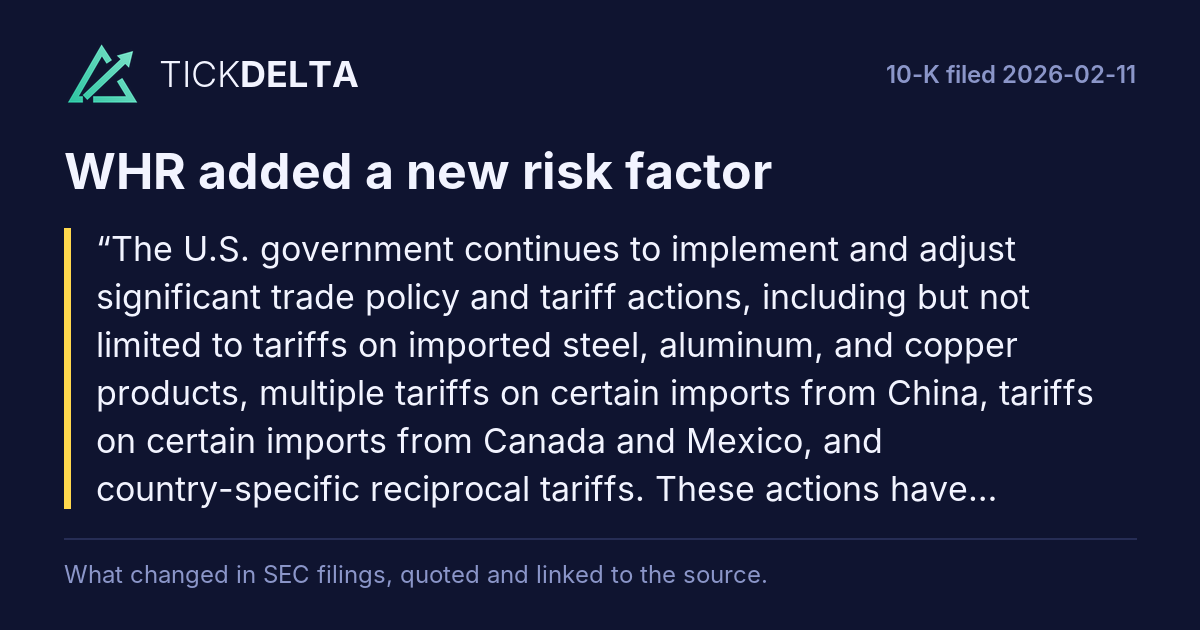
The U.S. government continues to implement and adjust significant trade policy and tariff actions, including but not limited to tariffs on imported steel, aluminum, and copper products, multiple tariffs on certain imports from China, tariffs on certain imports from Canada and Mexico, and country-specific reciprocal tariffs. These actions have increased the cost of certain raw materials and components, led to "pre-loading" of finished product inventories by foreign competitors in advance of tariff implementation, and created significant uncertainty and potential risks for our business. Pre-loading by competitors can delay expected positive impacts of tariffs on finished appliances and impact competitors’ go-to-market actions. Certain countries have announced or may announce retaliatory tariffs in response to U.S. trade policy actions. We continue to take actions to mitigate the impact of tariffs and retaliatory tariffs on our business, including but not limited to component sourcing changes, supply chain modifications, product sourcing transitions, tariff refund claim monetization, addressing suspected tariff evasion by competitors, and executing broader cost-takeout goals. The U.S. government may increase enforcement activity around tariffs and customs compliance, including evolving guidance, increased audits and more aggressive investigations, which could impact our mitigation strategies and lead to increased costs and legal risks. The U.S. government may also propose and implement additional changes to international trade agreements, tariffs, taxes, and other government rules and regulations. While the future financial impact of these actions and potential additional U.S. tariff actions and retaliatory actions by other countries remains unknown, the impacts could have a material adverse effect on our financial statements in any particular reporting period.

Read in the 10-K
Show the other 1

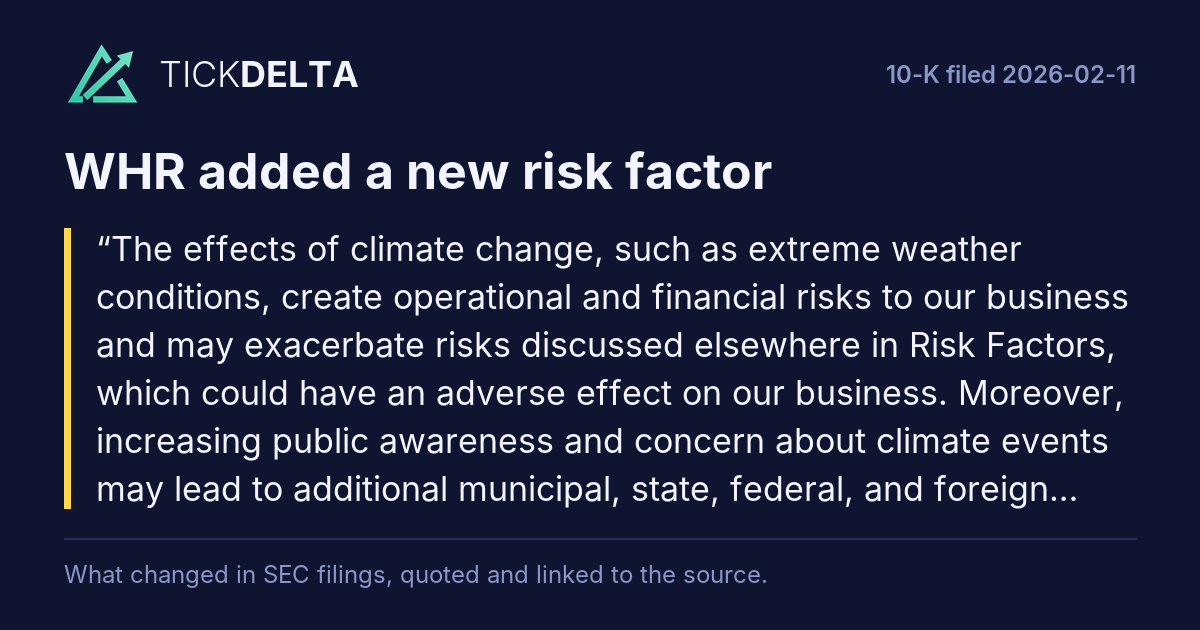
The effects of climate change, such as extreme weather conditions, create operational and financial risks to our business and may exacerbate risks discussed elsewhere in Risk Factors, which could have an adverse effect on our business. Moreover, increasing public awareness and concern about climate events may lead to additional municipal, state, federal, and foreign rules and regulations, including regulations on appliances that utilize natural gas. Currently, there continues to be a lack of consistent climate change legislation and standards, which creates economic and regulatory uncertainty. The entire major home appliance industry, including Whirlpool Corporation, must contend with the adoption of stricter government energy and related standards for selected major appliances. Violations of applicable environmental, health and safety laws are subject to civil, and in some cases, criminal sanctions. Compliance with these various standards is expected to increase costs or require some product redesign.

Read in the 10-K

Paragraphs in the 10-Q filed Oct 27, 2026 that were not in the one before

New in the latest 10-Q

6 paragraphs in the 10-Q filed Oct 27, 2026 with nothing like them in the 10-Q filed Aug 4, 2026 (at least half the words must differ; new numbers alone do not count). Quoted exactly, grouped by the item heading above them. This is text that changed, not a judgement of how serious it is.

Financial statements and notes

As of September 30, 2026, the fair value of our investment in Whirlpool India was $ 471 million based on the quoted market price on the National Stock Exchange of India (Level 1 input). Primarily due to prolonged market price compression, the Company concluded that the decline in market value below carrying value was other-than-temporary. Consequently, during the third quarter of 2026, the Company recorded a non-cash impairment charge of $ 124 million to write down the carrying value of the investment to its fair value. The impairment charge is recognized within Equity method investment loss, net of tax in the Consolidated Condensed Statements of Comprehensive Income. The impairment reduced the difference between the carrying amount of the equity method investment and the Company's proportionate share of assets at the deconsolidation date. As a result, the equity method goodwill was reduced to $ 212 million.

Read in the 10-Q

(1) During the third quarter of 2026, the Company recorded a charge of $ 46 million related to a guarantee resulting from the bankruptcy reorganization of a significant trade customer in Latin America. For additional information please see Note 6 of the Consolidated Condensed Financial Statements.

Read in the 10-Q

During the third quarter of 2026, Whirlpool amended the Receivables Purchase Agreement which eliminated the deferred purchase price receivable on all future trade receivable sales. Under the amended agreement, eligible trade receivables are sold and derecognized from the balance sheet in accordance with ASC 860, Transfers and Servicing, with a program capacity of up to $ 250 million. In connection with the amended agreement, Wells Fargo has a first-priority security interest in the unsold trade receivables subject to the program.

Read in the 10-Q

During the third quarter of 2026, the Company recorded a charge of $54 million related to the bankruptcy reorganization of a significant trade customer in Latin America, Casas Bahia, which is not indicative of ongoing operational performance. This charge includes $46 million of trade customer credit losses, net of expected credit insurance recoveries (reflecting $157 million of gross accounts receivable impairments, net of $112 million of expected credit insurance recoveries), and $8 million of other direct charges resulting from the event. We believe the Casas Bahia bankruptcy could have a near-term impact on our results of operations as consumers, retailers, and competitors adjust to Casas Bahia's reorganization, and we work through the impact of accounts receivable, including any partial recovery through applicable insurance arrangements; furthermore, we do not believe that the bankruptcy reorganization will materially impact our financial results over the long term. In the past, when faced with a potential volume reduction from any one particular segment of our trade distribution network, we generally have been able to offset such declines through increased sales throughout our broad distribution network.

Read in the 10-Q

Risk Factors

A loss of or substantial decline in volume of sales to any of our key trade customers, major buying groups, and/or builders could adversely affect our financial performance.

Read in the 10-Q
Show the other 1

We sell to a sophisticated customer base of large trade customers, including large domestic and international trade customers, that have significant leverage as buyers over their suppliers. Most of our products are not sold through long-term contracts, allowing trade customers to change volume among suppliers like us. As the trade customers continue to become larger through merger, consolidation or organic growth, they have sought and may seek to use their position to improve their profitability by various means, including improved efficiency, lower pricing, and increased promotional programs. As has occurred in the past, if we are unable to meet their demand requirements, our volume growth and financial results could be adversely affected. We also continue to pursue direct-to-consumer sales globally, which may impact our relationships with existing trade customers. The loss or substantial decline in volume of sales to our key trade customers, major buying groups, builders, or any other trade customers to which we sell a significant amount of products, has adversely affected and in the future could adversely affect our financial performance. As discussed elsewhere in this Form 10-Q, we recorded a charge of $54 million related to net impact of the bankruptcy reorganization of a significant trade customer in Latin America, and we may experience future financial impacts based on developments in the bankruptcy reorganization process. Loss of share with our trade customers, or additional financial difficulties, including bankruptcy and financial restructuring, by our trade customers could have a material adverse effect on our financial statements.

Read in the 10-Q

The 10-Q's risk factors against the 10-K

Item 1A of the 10-Q filed Oct 27, 2026 against Item 1A of the 10-K filed Feb 11, 2026. A 10-Q repeats only the risks that changed, so a 10-K paragraph that is missing from it is not counted as removed. Added is a paragraph with nothing like it in the 10-K, Reworded a sentence that is in both with several words changed, Quiet changes a sentence in both where one to four words changed and one is a hedge or a modal (cut words struck through, new words highlighted). Text on the page, not a score; each links to the filing at sec.gov.

What the 10-Q itself says about its risk factors:There have been no material changes in our risk factors from those disclosed in Part I, Item 1A to our Annual Report on Form 10-K for the fiscal year ended December 31, 2025, as updated by our Quarterly Report on Form 10-Q for the quarter ended June 30, 2026, other than as set forth below.

Read in the 10-Q
Added10-Q Oct 27, 2026 vs 10-K Feb 11, 2026
In February 2026, the U.S. Supreme Court issued a decision invalidating tariffs imposed under the International Emergency Economic Powers Act (“IEEPA”). Subsequent lower court rulings allow for recovery of IEEPA tariff amounts previously paid, and we recognized approximately $50 million in tariff recovery and mitigation actions in Q1 2026. The timing and administration of IEEPA tariff refunds may be subject to further legal and regulatory developments. Subsequent to the U.S. Supreme Court’s ruling, an executive order was issued imposing a new global tariff under Section 122, which went into effect in February 2026 and expired in July 2026. Additional Section 301 tariffs were imposed and effective in July 2026. Both the Section 122 tariffs and the Section 301 forced labor tariffs are subject to legal challenges. In April 2026, an executive order modified previously implemented Section 232 tariffs so that global home appliance imports are now subject to a 25% tariff on the product’s full import value.

Read it in the 10-Q at sec.gov

Added10-Q Oct 27, 2026 vs 10-K Feb 11, 2026
The payment of cumulative dividends on our Preferred Stock may create liquidity risk to the Company and dividend payment and dilution risks to shareholders.

Read it in the 10-Q at sec.gov

Added10-Q Oct 27, 2026 vs 10-K Feb 11, 2026
We depend, in part, on our ability to successfully access the capital and financial markets to fund our operations and contractual commitments. On February 27, 2026, we closed our Common Stock Offering and Depositary Shares Offering. Each depositary share represents a 1/20th interest in a share of 8.50% Series A Mandatory Convertible Preferred Stock (the “Preferred Stock”). We expect to require approximately $50 million annually for the payment of dividends on the outstanding shares of our Preferred Stock, through the mandatory conversion date of February 15, 2029. The Preferred Stock dividends, if declared, can be paid in cash, or subject to certain limitations, in shares of our common stock, or a combination of both. Any unpaid dividends will continue to accumulate. Any cumulative dividends that we choose to pay in cash will reduce our liquidity for operations and other capital allocation priorities, and any cumulative dividends that we choose to pay in shares of common stock will result in dilution to existing shareholders.

Read it in the 10-Q at sec.gov

Added10-Q Oct 27, 2026 vs 10-K Feb 11, 2026
In addition, if we require additional capital to support our operations, pay off existing debt, address impacts to our business related to market developments, fund dividend payments or outstanding financing commitments or meet other business requirements, we may need to refinance or restructure our debt beyond the refinancing activities completed in the second quarter of 2026, reduce or delay capital investments, or issue equity, equity-linked or debt securities, and these activities could have terms that are

Read it in the 10-Q at sec.gov

Added10-Q Oct 27, 2026 vs 10-K Feb 11, 2026
unfavorable or could be dilutive. If we are unable to access the capital or financial markets at competitive rates, on terms acceptable to us or in sufficient amounts, or if we experience an increase in our borrowing costs or otherwise fail to manage our liquidity effectively, our business, financial position and results of operations could be materially adversely affected.

Read it in the 10-Q at sec.gov

Show the other 11
Added10-Q Oct 27, 2026 vs 10-K Feb 11, 2026
The issuance of stock in our Preferred Stock and Common Stock Offerings, and the possibility of the issuance of our common stock in the future, has and will cause dilution to the interests of our existing shareholders.

Read it in the 10-Q at sec.gov

Added10-Q Oct 27, 2026 vs 10-K Feb 11, 2026
Unless earlier converted, each outstanding share of Preferred Stock will automatically convert on or about February 15, 2029, to shares of common stock, subject to customary anti-dilution adjustments. Collectively, these issuances or potential future issuances of common stock could be significant and will dilute the interests of our existing shareholders. The conversion of some or all of our shares of Preferred Stock, or the payment of dividends on our Preferred Stock in the form of common stock will dilute the ownership interest of the holders of our common stock.

Read it in the 10-Q at sec.gov

Added10-Q Oct 27, 2026 vs 10-K Feb 11, 2026
Our common stock ranks junior to the Preferred Stock with respect to dividends and amounts payable in the event of our liquidation, dissolution or winding-up of our affairs.

Read it in the 10-Q at sec.gov

Added10-Q Oct 27, 2026 vs 10-K Feb 11, 2026
Our common stock ranks junior to the Preferred Stock with respect to the payment of dividends and amounts payable in the event of our liquidation, dissolution or winding-up of our affairs. This means that, unless accumulated dividends have been paid or set aside for payment on all the outstanding Preferred Stock through the most recently completed dividend period, no dividends may be declared or paid on our common stock subject to limited exceptions. Likewise, in the event of our voluntary or involuntary liquidation, dissolution or winding-up of our affairs, no distribution of our assets may be made to holders of our common stock until we have paid to holders of the Preferred Stock a liquidation preference equal to $1,000 per share plus accumulated and unpaid dividends.

Read it in the 10-Q at sec.gov

Added10-Q Oct 27, 2026 vs 10-K Feb 11, 2026
The previously announced Private Placement of our common stock did not achieve required regulatory approvals, which prevented us from receiving $30 million in expected gross proceeds.

Read it in the 10-Q at sec.gov

Added10-Q Oct 27, 2026 vs 10-K Feb 11, 2026
On February 24, 2026, we entered into a Private Placement Common Stock Purchase Agreement with Guangdong Whirlpool Electrical Appliances Co., Ltd, a wholly-owned subsidiary of Whirlpool (China) Co. Ltd. (“Whirlpool China”), for the sale of 434,782 shares of our common stock at a price per share of $69, for an aggregate purchase price of approximately $30 million (the “Private Placement”). Although shareholder approval of the purchaser was successfully obtained, the transaction did not achieve necessary regulatory approvals, and as a result, the Private Placement has been terminated. Because we were unable to complete the Private Placement transaction, we did not receive the $30 million in expected gross proceeds.

Read it in the 10-Q at sec.gov

Added10-Q Oct 27, 2026 vs 10-K Feb 11, 2026
Our $2.0 billion ABL Credit Facility contains borrowing base requirements and springing financial covenants that may constrain our liquidity and operational flexibility.

Read it in the 10-Q at sec.gov

Reworded10-Q Oct 27, 2026 vs 10-K Feb 11, 2026
The U.S. government continues to implement and adjust significant trade policy and tariff actions, including but not limited to tariffs on imported steel, aluminum, and copper products, multiple tariffs on certain imports from China, global tariffs on certain imports from Canada under Section 301, and Mexico, and country-specific reciprocal multiple ongoing investigations that could lead to additional tariffs.

Read it in the 10-Q at sec.govThe 10-K sentence

Reworded10-Q Oct 27, 2026 vs 10-K Feb 11, 2026
We continue to take have taken actions to mitigate the impact of tariffs and retaliatory tariffs on our business, including but not limited to component sourcing changes, supply chain modifications, product sourcing transitions, tariff refund claim monetization, addressing suspected tariff evasion by competitors, and executing broader cost-takeout goals. goals, and may continue to take such actions in the future.

Read it in the 10-Q at sec.govThe 10-K sentence

Reworded10-Q Oct 27, 2026 vs 10-K Feb 11, 2026
The current domestic and international political environment, including changes in administrations, government shutdowns, shutdowns and changes to trade laws, regulations and policies, including tariffs, sanctions, and export controls, has resulted in uncertainty surrounding the future state of the global economy.

Read it in the 10-Q at sec.govThe 10-K sentence

The first 16 of 23 are shown (at most 12 of each type).

Phrases used for the first time

Two-word phrases in Risk Factors of the 10-K filed Feb 11, 2026 that are in none of the 1 earlier 10-Ks stored, back to Feb 13, 2025

unsecured debt ×5negative outlook ×4whirlpool india ×3senior unsecured ×3debt rating ×3trade policy ×3equity stake ×2fully recover ×2recorded million ×2million impairment ×2trade name ×2periodic review ×2policy actions ×2tariff actions ×2
Where each one is used
  • unsecured debt: During the second quarter of 2025, Moody’s downgraded our senior unsecured debt rating to Ba1, with a negative outlook; in February 2026, Moody's downgraded our senior unsecured debt to Ba2 with a negative outlook. In 2025, S&P downgraded our unsecured debt rating to BB+, with a stable outlook, since revised to BB,...
  • negative outlook: During the second quarter of 2025, Moody’s downgraded our senior unsecured debt rating to Ba1, with a negative outlook; in February 2026, Moody's downgraded our senior unsecured debt to Ba2 with a negative outlook. In 2025, S&P downgraded our unsecured debt rating to BB+, with a stable outlook, since revised to BB,...
  • whirlpool india: The highly competitive nature of our industry requires that we effectively execute and manage our business objectives, including key strategic priorities and initiatives. In 2022, we announced a strategic portfolio transformation initiative with a goal of focusing our portfolio on higher-growth, higher-margin...
  • senior unsecured: During the second quarter of 2025, Moody’s downgraded our senior unsecured debt rating to Ba1, with a negative outlook; in February 2026, Moody's downgraded our senior unsecured debt to Ba2 with a negative outlook. In 2025, S&P downgraded our unsecured debt rating to BB+, with a stable outlook, since revised to BB,...
  • debt rating: During the second quarter of 2025, Moody’s downgraded our senior unsecured debt rating to Ba1, with a negative outlook; in February 2026, Moody's downgraded our senior unsecured debt to Ba2 with a negative outlook. In 2025, S&P downgraded our unsecured debt rating to BB+, with a stable outlook, since revised to BB,...
  • trade policy: The current domestic and international political environment, including changes in administrations, government shutdowns, and changes to trade laws, regulations and policies, including tariffs, sanctions, and export controls, has resulted in uncertainty surrounding the future state of the global economy. Many of...
  • equity stake: The highly competitive nature of our industry requires that we effectively execute and manage our business objectives, including key strategic priorities and initiatives. In 2022, we announced a strategic portfolio transformation initiative with a goal of focusing our portfolio on higher-growth, higher-margin...
  • fully recover: Our operations and those of our suppliers are subject to disruption for a variety of unexpected reasons, including, but not limited to, sudden changes in business conditions, plant shutdowns or slowdowns, transportation delays due to port delays or any disruption on the supply chain, work stoppages, epidemics and...

The 10-K at sec.gov

Used at least twice, small words left out. Counted, not picked: a phrase can be new because the company renamed something.

What was taken out

12 paragraphs of last year's Risk Factors with nothing like them now. The longest are quoted.

Across all companies
The effects of climate change, whether involving physical risks (such as extreme weather events, long-term changes in temperature levels, water availability and sea levels) or transition risks, could have an impact on our business and have in the past and could in the future impact our business and cause us to incur capital and other expenditures to comply with various laws and regulations, especially relating to the protection of the environment, human health and safety, and water and energy efficiency, and may also exacerbate other risks discussed elsewhere in Item 1A. Risk Factors in...
In the 10-K filed Feb 13, 2025
The entire major home appliance industry, including Whirlpool Corporation, must contend with the adoption of stricter government energy and related standards for selected major appliances, including recently issued U.S. Department of Energy appliance efficiency standards. We also must contend with various state-level regulatory standards, the volume and complexity of which may increase in the future. Compliance with these various standards, as they become effective, is expected to increase costs or require some product redesign. We are also subject to global regulations related to chemical...
In the 10-K filed Feb 13, 2025
In addition, various municipal, state, and federal regulators have discussed, proposed, or sought to enact new regulations or bans on appliances that utilize natural gas citing climate change and other concerns and other material and/or chemical restrictions, which would impose transition costs and impact our product mix and product offerings, among other impacts. We recognize that making changes to our supply chain, manufacturing processes and product offerings can and does introduce transition risks. Among these are the risk that our more efficient product offerings are not competitive...
In the 10-K filed Feb 13, 2025
governmental metrics utilized to objectively measure success, or the perception that we have failed to act responsibly regarding climate change could result in negative publicity and adversely affect our reputation as well as our relationships with customers, investors and other stakeholders, which could in turn adversely affect our business operations, reputation, including a reduction in customer and consumer sentiment and negatively impact our financial condition, including our access to capital and cost of debt. In addition, not all of our competitors may seek to establish climate or...
In the 10-K filed Feb 13, 2025

Sources

Item 1A of each 10-K and 10-Q on EDGAR, quoted exactly. Each paragraph links to the filing at sec.gov.

Also

10-K change: what was reworded or cut, section by section.

Work with it

Excel workbook · CSV. Google Sheet that stays up to date: paste =IMPORTDATA("https://tickdelta.com/company/WHR/export.csv") into a cell.

Next:10-K change
Esc

Type a ticker such as AAPL, a name, an investor such as Buffett, or a topic such as tariffs. ↑ ↓ to move, Enter to open.