Paragraph 21 · 46% changed
Every version of it
Screener
/
SEC EDGAR
/CIK 0000106640
/10-K filed Feb 11, 2026, compared with Feb 13, 2025
/Numbers from the XBRL of the 10-Ks
NYSE
Consumer discretionary · Household Appliances
Whirlpool Corp WHR
The 10-K against last year's
126 changes: 11 added, 40 removed, 73 reworded, 2 quiet changes
10-K Feb 11, 2026 vs Feb 13, 2025
Risk Factors
20.3%
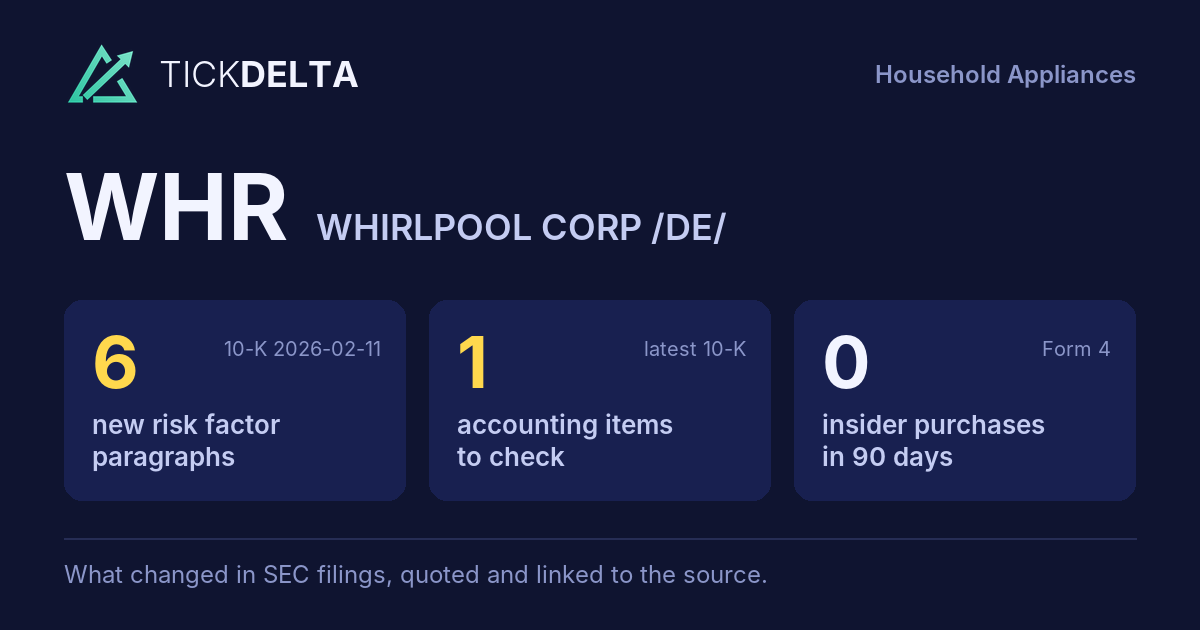
of the text changed · 9,150 words now · 6 new paragraphs, 12 gone
MD&A
30.8%
of the text changed · 7,314 words now · 5 new paragraphs, 28 gone
10-K 0000106640-26-000009 (Feb 11, 2026) vs 10-K 0000106640-25-000011 (Feb 13, 2025) Not compared: Legal Proceedings, Accounting Policies.
Every paragraph, and how much of it changed
One bar per paragraph, in the order of the 10-K. Height and colour show the share of its words not in the closest paragraph a year earlier; the tallest bars are new paragraphs.
Risk Factors
89 paragraphs · 6 new · 38 reworded · 12 gone · 10-K Feb 11, 2026 against Feb 13, 2025
New paragraph
Reworded (5% of its words or more)
Same or nearly
Paragraph 70 · 44% changed
Every version of it
Our costs of borrowing and ability to access the capital markets are affected not only by market conditions but also by the short- and long-term credit ratings assigned are subject to periodic review by Moody’s, S&P, and Fitch, and may be subject to rating and periodic review by additional independent credit rating agencies in the future. Further developments or downgrades to our debt by the major credit rating agencies. These ratings, including any announcement that our ratings are based, in significant part, on our financial performance as measured by metrics such as profitability, interest coverage and leverage ratios, as well as economic conditions in the geographies in which we operate. During 2024, we received credit ratings downgrades by three major credit rating agencies. A under further review for an additional downgrade of our credit rating by any of the major credit rating agencies agencies, could result in additional increased borrowing costs costs, and could adversely affect our liquidity, competitive position and access to the capital markets, including restricting, in whole or in part, access to the commercial paper market. An inability to access the capital markets which could have an adverse effect on our cash flow, results of operations and financial condition. In addition, further increased borrowing costs and/or reduced EBITDA performance could result in non-compliance with the interest coverage ratio in our credit facility, which could further restrict our access to capital and increase costs associated with our financing activities.
Paragraph 55 · 43% changed
Every version of it
Like many other companies, we are subject to fluctuations in the availability of qualified labor in certain key positions. A shortage of key employees can jeopardize our ability to implement our business objectives and execute our portfolio transformation, and changes in key executives can result in loss of continuity, loss of accumulated knowledge, departures of other key employees, disruptions to our operations and inefficiencies during transition periods. In addition, if we are unable to enforce certain non-compete covenants and confidentiality provisions when key employees leave for a competitor, we may lose a competitive advantage arising from confidential and proprietary company information known to such former employees. An inability to hire, develop, transfer retained knowledge, engage and retain a sufficient number of qualified employees could materially hinder our business by, for example, delaying our ability to bring new products and services to market or impairing the success of our operations, which could adversely affect our results of operations.
Paragraph 84 · 37% changed
Every version of it
Paragraph 20 · 33% changed
Every version of it
We have applied for intellectual property protection in the U.S. and other key jurisdictions with respect to certain innovations and new products, design patents, product features, and processes. We cannot be assured that the U.S. Patent and Trademark Office or any similar authority in other jurisdictions will approve any of our patent applications. Our intellectual property has been subject to infringement by certain parties in the past and we may experience such infringement in the future. We have also sought and are seeking to enforce our intellectual property rights through litigation against parties that we believe are infringing on certain of our patents and trademarks, and we may be unsuccessful in such litigation or, if successful, the outcome of such litigation may be inadequate to redress the infringement at issue. Additionally, the patents we own could be challenged or invalidated, others could design around our patents or the patents may not be of sufficient scope or strength to provide us with any meaningful protection or commercial advantage. Further, the laws of certain foreign countries in which we do business do not recognize intellectual property rights or protect them to the same extent as U.S. law. These factors could weaken our competitive advantage with respect to our products, services, and brands in foreign jurisdictions, which could adversely affect our financial performance.Moreover, performance. Moreover, while we do not believe that any of our products infringe on enforceable intellectual property rights of third parties, others have in the past and may in the future assert intellectual property rights that cover some of our technology, brands, products, or services. Any litigation regarding patents or other intellectual property could be costly and time-consuming and could divert the attention of our management and key personnel from our business operations. Claims of intellectual property infringement might also require us to enter into costly license agreements or modify our products or services. We also may be subject to significant damages, injunctions against the development and sale of certain products or services, or limited in the use of our brands.In addition, advances in and growing adoption of AI technology may exacerbate intellectual property risks, including the risk that existing intellectual property laws and rights may not provide adequate protection given advances in AI technology. AI may also increase the risk of inadvertent disclosure of Whirlpool's trade secrets and other confidential information as well as the risk that Whirlpool inadvertently infringes upon others' intellectual property rights.
Paragraph 73 · 32% changed
Every version of it
Paragraph 72 · 28% changed
Every version of it
We are or may in the future become subject to a variety of litigation and legal compliance risks relating to, among other things: products; intellectual property rights; income and indirect taxes; environmental matters (including matters related to climate change); corporate matters; commercial matters; credit matters; competition laws; distribution, marketing and trade practice matters; customs and duties; occupational health and safety (including matters related to pandemics), industrial accidents, anti–bribery and anti–corruption regulations; energy regulations; data privacy and cybersecurity regulations; financial and securities regulations; and employment and benefit matters. For example, we are currently disputing certain income and indirect tax related assessments issued by the Brazilian authorities; and we are disputing certain income and indirect tax assessments in various legal proceedings globally. For additional information about certain income and indirect tax related assessments issued by the Brazilian authorities, see Note 7 to the Consolidated Financial Statements. Unfavorable outcomes regarding these assessments could have a material adverse effect on our financial statements in any particular reporting period. Results of legal and regulatory proceedings cannot be predicted with certainty and for some matters, such as class actions, no insurance is cost-effectively available. Regardless of merit, legal and regulatory proceedings may be both time-consuming and disruptive to our operations and could divert the attention of our management and key personnel from our business operations. Such proceedings could also generate significant negative publicity and have a negative impact on our reputation and brand image, regardless of the existence or amount of liability. Actual results may significantly vary from our reserves.
Paragraph 68 · 26% changed
Every version of it
Our costs of borrowing and ability to access the capital markets are affected not only by market conditions but also by the short- and long-term credit ratings assigned to our debt by the major credit rating agencies. These ratings are based, in significant part, on our financial performance as measured by metrics such as profitability, interest coverage and leverage ratios, as well as economic conditions in the geographies in which we operate. During 2024, we received credit ratings downgrades by three major credit rating agencies. A further downgrade of our credit rating by any of the major credit rating agencies could result in increased borrowing costs and could adversely affect our liquidity, competitive position and access to the capital markets, including restricting, in whole or in part, access to the commercial paper market. An inability to access the capital markets could have an adverse effect on our cash flow, results of operations and financial condition.
Paragraph 21 · 46% changed
Every version of it
10-K Feb 13, 2025property rights or protect them to the same extent as U.S. law. These factors could weaken our competitive advantage with respect to our products, services, and brands in foreign jurisdictions, which could adversely affect our financial performance.Moreover, while we do not believe that any of our products infringe on enforceable intellectual property rights of third parties, others have in the past and may in the future assert intellectual property rights that cover some of our technology, brands, products, or services. Any litigation regarding patents or other intellectual property could be costly and time-consuming and could divert the attention of our management and key personnel from our business operations. Claims of intellectual property infringement might also require us to enter into costly license agreements or modify our products or services. We also may be subject to significant damages, injunctions against the development and sale of certain products or services, or limited in the use of our brands.In addition, advances in and growing adoption of AI technology may exacerbate intellectual property risks, including the risk that existing intellectual property laws and rights may not provide adequate protection given advances in AI technology. AI may also increase the risk of inadvertent disclosure of Whirlpool's trade secrets and other confidential information as well as the risk that Whirlpool inadvertently infringes upon others' intellectual property rights.
10-K Feb 11, 2026
limited in the use of our brands. In addition, advances in and growing adoption of AI technology may exacerbate intellectual property risks, including the risk that existing intellectual property laws and rights may not provide adequate protection given advances in AI technology. AI may also increase the risk of inadvertent disclosure of Whirlpool's trade secrets and other confidential information as well as the risk that Whirlpool inadvertently infringes upon others' intellectual property rights.
Paragraph 70 · 44% changed
Every version of it
10-K Feb 13, 2025
Our costs of borrowing and ability to access the capital markets are affected not only by market conditions but also by the short- and long-term credit ratings assigned to our debt by the major credit rating agencies. These ratings are based, in significant part, on our financial performance as measured by metrics such as profitability, interest coverage and leverage ratios, as well as economic conditions in the geographies in which we operate. During 2024, we received credit ratings downgrades by three major credit rating agencies. A further downgrade of our credit rating by any of the major credit rating agencies could result in increased borrowing costs and could adversely affect our liquidity, competitive position and access to the capital markets, including restricting, in whole or in part, access to the commercial paper market. An inability to access the capital markets could have an adverse effect on our cash flow, results of operations and financial condition.
10-K Feb 11, 2026
Our credit ratings are subject to periodic review by Moody’s, S&P, and Fitch, and may be subject to rating and periodic review by additional independent credit rating agencies in the future. Further developments or downgrades to our credit ratings, including any announcement that our ratings are under further review for an additional downgrade by any of the major credit rating agencies, could result in additional increased borrowing costs, and could adversely affect our liquidity, competitive position and access to the capital markets, which could have an adverse effect on our cash flow, results of operations and financial condition. In addition, further increased borrowing costs and/or reduced EBITDA performance could result in non-compliance with the interest coverage ratio in our credit facility, which could further restrict our access to capital and increase costs associated with our financing activities.
Paragraph 55 · 43% changed
Every version of it
10-K Feb 13, 2025
Like many other companies, we are subject to fluctuations in the availability of qualified labor in certain key positions. A shortage of key employees can jeopardize our ability to implement our business objectives and execute our portfolio transformation, and changes in key executives can result in loss of continuity, loss of accumulated knowledge, departures of other key employees, disruptions to our operations and inefficiencies during transition periods. In addition, if we are unable to enforce certain non-compete covenants and confidentiality provisions when key employees leave for a competitor, we may lose a competitive advantage arising from confidential and proprietary company information known to such former employees. An inability to hire, develop, transfer retained knowledge, engage and retain a sufficient number of qualified employees could materially hinder our business by, for example, delaying our ability to bring new products and services to market or impairing the success of our operations, which could adversely affect our results of operations.
10-K Feb 11, 2026
Like many other companies, we are subject to fluctuations in the availability of qualified labor in certain key positions. A shortage of key employees can jeopardize our ability to implement our business objectives and execute our portfolio transformation, and changes in key executives can result in loss of continuity, loss of accumulated knowledge, departures of other key employees,
Paragraph 84 · 37% changed
Every version of it
10-K Feb 13, 2025Increasingly, different stakeholder groups have divergent views on sustainability and ESG matters, which increases the risk that any action or lack thereof with respect to sustainability or ESG matters will be perceived negatively by at least some stakeholders and adversely impact our reputation and business. Anti-ESG sentiment has gained some momentum across the U.S., with several states having enacted or proposed "anti-ESG" policies or legislation. If we do not successfully manage ESG-related expectations across stakeholders, it could erode stakeholder trust, impact our reputation and adversely affect our business.
10-K Feb 11, 2026
We have set various sustainability goals, including emission reduction targets with the Science Based Targets initiative (SBTi) . These targets could prove more costly or difficult to achieve than we expect, and we may be unable to achieve them at all. Failure to achieve our sustainability goals could result in negative publicity and adversely affect our reputation. Additionally, different stakeholder groups have divergent views on sustainability and ESG matters, which increases the risk that our sustainability measures will be perceived negatively by at least some stakeholders. If we do not successfully manage ESG-related expectations across stakeholders, it could erode stakeholder trust, impact our reputation and adversely affect our business.
Paragraph 20 · 33% changed
Every version of it
10-K Feb 13, 2025
property rights or protect them to the same extent as U.S. law. These factors could weaken our competitive advantage with respect to our products, services, and brands in foreign jurisdictions, which could adversely affect our financial performance.Moreover, while we do not believe that any of our products infringe on enforceable intellectual property rights of third parties, others have in the past and may in the future assert intellectual property rights that cover some of our technology, brands, products, or services. Any litigation regarding patents or other intellectual property could be costly and time-consuming and could divert the attention of our management and key personnel from our business operations. Claims of intellectual property infringement might also require us to enter into costly license agreements or modify our products or services. We also may be subject to significant damages, injunctions against the development and sale of certain products or services, or limited in the use of our brands.In addition, advances in and growing adoption of AI technology may exacerbate intellectual property risks, including the risk that existing intellectual property laws and rights may not provide adequate protection given advances in AI technology. AI may also increase the risk of inadvertent disclosure of Whirlpool's trade secrets and other confidential information as well as the risk that Whirlpool inadvertently infringes upon others' intellectual property rights.
10-K Feb 11, 2026
We have applied for intellectual property protection in the U.S. and other key jurisdictions with respect to certain innovations and new products, design patents, product features, and processes. We cannot be assured that the U.S. Patent and Trademark Office or any similar authority in other jurisdictions will approve any of our patent applications. Our intellectual property has been subject to infringement by certain parties in the past and we may experience such infringement in the future. We have also sought and are seeking to enforce our intellectual property rights through litigation against parties that we believe are infringing on certain of our patents and trademarks, and we may be unsuccessful in such litigation or, if successful, the outcome of such litigation may be inadequate to redress the infringement at issue. Additionally, the patents we own could be challenged or invalidated, others could design around our patents or the patents may not be of sufficient scope or strength to provide us with any meaningful protection or commercial advantage. Further, the laws of certain foreign countries in which we do business do not recognize intellectual property rights or protect them to the same extent as U.S. law. These factors could weaken our competitive advantage with respect to our products, services, and brands in foreign jurisdictions, which could adversely affect our financial performance. Moreover, while we do not believe that any of our products infringe on enforceable intellectual property rights of third parties, others have in the past and may in the future assert intellectual property rights that cover some of our technology, brands, products, or services. Any litigation regarding patents or other intellectual property could be costly and time-consuming and could divert the attention of our management and key personnel from our business operations. Claims of intellectual property infringement might also require us to enter into costly license agreements or modify our products or services. We also may be subject to significant damages, injunctions against the development and sale of certain products or services, or
Paragraph 73 · 32% changed
Every version of it
10-K Feb 13, 2025We are or may in the future become subject to a variety of litigation and legal compliance risks relating to, among other things: products; intellectual property rights; income and indirect taxes; environmental matters (including matters related to climate change); corporate matters; commercial matters; credit matters; competition laws; distribution, marketing and trade practice matters; customs and duties; occupational health and safety (including matters related to pandemics), industrial accidents, anti–bribery and anti–corruption regulations; energy regulations; data privacy and cybersecurity regulations; financial and securities regulations; and employment and benefit matters. For example, we are currently disputing certain income and indirect tax related assessments issued by the Brazilian authorities; and we are disputing certain income and indirect tax assessments in various legal proceedings globally. For additional information about certain income and indirect tax related assessments issued by the Brazilian authorities, see Note 7 to the Consolidated Financial Statements. Unfavorable outcomes regarding these assessments could have a material adverse effect on our financial statements in any particular reporting period. Results of legal and regulatory proceedings cannot be predicted with certainty and for some matters, such as class actions, no insurance is cost-effectively available. Regardless of merit, legal and regulatory proceedings may be both time-consuming and disruptive to our operations and could divert the attention of our management and key personnel from our business operations. Such proceedings could also generate significant negative publicity and have a negative impact on our reputation and brand image, regardless of the existence or amount of liability. Actual results may significantly vary from our reserves.
10-K Feb 11, 2026
Consolidated Financial Statements. Unfavorable outcomes regarding these assessments could have a material adverse effect on our financial statements in any particular reporting period. Results of legal and regulatory proceedings cannot be predicted with certainty and for some matters, such as class actions, no insurance is cost-effectively available. Regardless of merit, legal and regulatory proceedings may be both time-consuming and disruptive to our operations and could divert the attention of our management and key personnel from our business operations. Such proceedings could also generate significant negative publicity and have a negative impact on our reputation and brand image, regardless of the existence or amount of liability. Actual results may significantly vary from our reserves.
Paragraph 72 · 28% changed
Every version of it
10-K Feb 13, 2025
We are or may in the future become subject to a variety of litigation and legal compliance risks relating to, among other things: products; intellectual property rights; income and indirect taxes; environmental matters (including matters related to climate change); corporate matters; commercial matters; credit matters; competition laws; distribution, marketing and trade practice matters; customs and duties; occupational health and safety (including matters related to pandemics), industrial accidents, anti–bribery and anti–corruption regulations; energy regulations; data privacy and cybersecurity regulations; financial and securities regulations; and employment and benefit matters. For example, we are currently disputing certain income and indirect tax related assessments issued by the Brazilian authorities; and we are disputing certain income and indirect tax assessments in various legal proceedings globally. For additional information about certain income and indirect tax related assessments issued by the Brazilian authorities, see Note 7 to the Consolidated Financial Statements. Unfavorable outcomes regarding these assessments could have a material adverse effect on our financial statements in any particular reporting period. Results of legal and regulatory proceedings cannot be predicted with certainty and for some matters, such as class actions, no insurance is cost-effectively available. Regardless of merit, legal and regulatory proceedings may be both time-consuming and disruptive to our operations and could divert the attention of our management and key personnel from our business operations. Such proceedings could also generate significant negative publicity and have a negative impact on our reputation and brand image, regardless of the existence or amount of liability. Actual results may significantly vary from our reserves.
10-K Feb 11, 2026
We are or may in the future become subject to a variety of litigation and legal compliance risks relating to, among other things: products; intellectual property rights; income and indirect taxes; environmental matters (including matters related to climate change); corporate matters; commercial matters; credit matters; competition laws; distribution, marketing and trade practice matters; customs and duties; occupational health and safety (including matters related to pandemics), industrial accidents, anti–bribery and anti–corruption regulations; energy regulations; data privacy and cybersecurity regulations; financial and securities regulations; and employment and benefit matters. For example, we are currently disputing certain income and indirect tax related assessments issued by the Brazilian authorities; and we are disputing certain income and indirect tax assessments in various legal proceedings globally. For additional information about certain income and indirect tax related assessments issued by the Brazilian authorities, see Note 7 to the
Paragraph 68 · 26% changed
Every version of it
10-K Feb 13, 2025
Our costs of borrowing and ability to access the capital markets are affected not only by market conditions but also by the short- and long-term credit ratings assigned to our debt by the major credit rating agencies. These ratings are based, in significant part, on our financial performance as measured by metrics such as profitability, interest coverage and leverage ratios, as well as economic conditions in the geographies in which we operate. During 2024, we received credit ratings downgrades by three major credit rating agencies. A further downgrade of our credit rating by any of the major credit rating agencies could result in increased borrowing costs and could adversely affect our liquidity, competitive position and access to the capital markets, including restricting, in whole or in part, access to the commercial paper market. An inability to access the capital markets could have an adverse effect on our cash flow, results of operations and financial condition.
10-K Feb 11, 2026
Our costs of borrowing and ability to access the capital markets are affected not only by market conditions but also by the short- and long-term credit ratings assigned to our debt by the major credit rating agencies. These ratings are based, in significant part, on our financial performance as measured by metrics such as profitability, interest coverage and leverage ratios, as well as economic conditions in the geographies in which we operate.
MD&A
115 paragraphs · 5 new · 56 reworded · 28 gone · 10-K Feb 11, 2026 against Feb 13, 2025
New paragraph
Reworded (5% of its words or more)
Same or nearly
Paragraph 13 · 48% changed
In 2023 and 2022, 2023, our operating segments were based on geographical region and were defined as North America, EMEA, Latin America and Asia. These regions also represented our reportable segments. Beginning January 1, 2024, we began conducting our business through five operating segments, which consist consisted of Major Domestic Appliances (“MDA”) North America; MDA Europe (deconsolidated as of April 1, 2024), MDA Latin America; MDA Asia; and Small Domestic Appliances (“SDA”) Global. The chief operating decision maker (CODM), who is the Company's Chairman and Chief Executive Officer, evaluates operational performance based on each segment's earnings (loss) before interest and taxes (EBIT). We define EBIT as operating profit less interest and sundry (income) expense and excluding restructuring costs, asset impairment charges and certain other items, if any, that management believes are not indicative of the region's ongoing performance. Cost of products sold is the significant expense regularly reviewed by the CODM. It consists of variable costs associated with products sold, including but not limited to raw materials, direct labor, and variable freight and warehousing. Other segment expenses/ (income) primarily include selling, general and administrative items. See Note 15 to the Consolidated Financial Statements for additional information.
Paragraph 50 · 47% changed
On February 20, 2024, Whirlpool's wholly-owned subsidiary, Whirlpool Mauritius Limited, Limited ("Seller"), executed the sale of 30.4 million equity shares of Whirlpool India via an on-market trade. a market transaction. The transaction reduced Whirlpool's ownership in Whirlpool India from 75% to 51%, and generated sales proceeds of approximately $462 million on settlement. The Company used transaction proceeds to reduce debt. In January October 2025, we announced our intent to reduce our ownership stake in signed certain brand license, technology license, and transition services agreements with Whirlpool India. On November 27, 2025, the Seller executed the sale of 14.3 million equity shares of Whirlpool India via a market transaction. The transaction reduced Seller's ownership of Whirlpool India from 51% to ~20% in 2025 via market sale, approximately 40%, and generated gross sales proceeds of approximately $166 million on settlement, which is expected occurred on November 28, 2025. We are pleased with our retained position and will continue to be complete by mid-to-late 2025. Transaction proceeds are expected evaluate all options to further reduce debt. Sale of Whirlpool India shares is subject to Company board approval, our debt throughout 2026 in line with our guidance and we have not recorded any impact relating to this announcement as of December 31, 2024. capital allocation priorities.
Paragraph 33 · 46% changed
Paragraph 41 · 42% changed
Income tax expense was $142 million, $10 million, $77 million and $265 $77 million for the years ended December 31, 2024, 2023 2025, 2024 and 2022, 2023, respectively. The decrease increase in tax expense in 2024 2025 compared to 2023 includes lower 2024 is the result of higher earnings in 2025 and an increase in valuation allowances that resulted from business disposal and restructuring transactions in 2025. These negative impacts were partially offset by tax benefits that were the result of continued legal entity restructuring simplification and the release of unrecognized tax benefits related to simplifying our legal entity structure audit settlements in 2024 to reduce administrative costs associated with the prior structure. The completion of the restructuring in 2024 created a tax deductible loss which was recognized in 2024 and resulted in a $721 million net tax benefit partially offset by increases in valuation allowances and the divestiture tax impact. 2025.
Paragraph 6 · 41% changed
Paragraph 64 · 33% changed
Cash used in investing activities in 2024 increased 2025 decreased compared to 2023. 2024. The increase decrease was primarily driven by increased proceeds year-over-year from the contribution sale of $245 million of cash Whirlpool India and cash equivalents held in MDA Europe, lower capital expenditures, partially offset by lower capital expenditures. the cash held by divested businesses.
Paragraph 7 · 31% changed
Cash provided by operating activities of $835 were $470 million, compared to $915 million in 2023, alongside free cash flow (non-GAAP) of $385 $835 million in 2024, compared to $366 million in 2023, primarily driven by lower capital expenditures earnings and improved higher working capital efficiency, partially offset by lower earnings. requirement to support product transitions. Capital expenditures were $389 million in 2025 and $451 million in 2024.
Paragraph 97 · 28% changed
Our InSinkErator Maytag trademark is at risk at December 31, 2024. The InSinkErator business was acquired in the fourth quarter of 2022 and is included in our MDA North America operating segment. 2025. The fair value of the InSinkErator Maytag trademark exceeded its carrying value of $1,300 $640 million by approximately 30%. 20%.
Paragraph 13 · 48% changed
10-K Feb 13, 2025
In 2023 and 2022, our operating segments were based on geographical region and were defined as North America, EMEA, Latin America and Asia. These regions also represented our reportable segments. Beginning January 1, 2024, we began conducting our business through five operating segments, which consist of Major Domestic Appliances (“MDA”) North America; MDA Europe (deconsolidated as of April 1, 2024), MDA Latin America; MDA Asia; and Small Domestic Appliances (“SDA”) Global. The chief operating decision maker (CODM), who is the Company's Chairman and Chief Executive Officer, evaluates operational performance based on each segment's earnings (loss) before interest and taxes (EBIT). We define EBIT as operating profit less interest and sundry (income) expense and excluding restructuring costs, asset impairment charges and certain other items, if any, that management believes are not indicative of the region's ongoing performance. Cost of products sold is the significant expense regularly reviewed by the CODM. It consists of variable costs associated with products sold, including but not limited to raw materials, direct labor, and variable freight and warehousing. Other segment expenses/ (income) primarily include selling, general and administrative items. See Note 15 to the Consolidated Financial Statements for additional information.
10-K Feb 11, 2026
In 2023, our operating segments were based on geographical region and were defined as North America, EMEA, Latin America and Asia. These regions also represented our reportable segments. Beginning January 1, 2024, we began conducting our business through five operating segments, which consisted of Major Domestic Appliances (“MDA”) North America; MDA Europe (deconsolidated as of April 1, 2024), MDA Latin America; MDA Asia; and Small Domestic Appliances (“SDA”) Global.
Paragraph 50 · 47% changed
10-K Feb 13, 2025
On February 20, 2024, Whirlpool's wholly-owned subsidiary, Whirlpool Mauritius Limited, executed the sale of 30.4 million equity shares of Whirlpool India via an on-market trade. The transaction reduced Whirlpool's ownership in Whirlpool India from 75% to 51%, and generated sales proceeds of approximately $462 million on settlement. The Company used transaction proceeds to reduce debt. In January 2025, we announced our intent to reduce our ownership stake in Whirlpool India to ~20% in 2025 via market sale, which is expected to be complete by mid-to-late 2025. Transaction proceeds are expected to further reduce debt. Sale of Whirlpool India shares is subject to Company board approval, and we have not recorded any impact relating to this announcement as of December 31, 2024.
10-K Feb 11, 2026
On February 20, 2024, Whirlpool's wholly-owned subsidiary, Whirlpool Mauritius Limited ("Seller"), executed the sale of 30.4 million equity shares of Whirlpool India via a market transaction. The transaction reduced Whirlpool's ownership in Whirlpool India from 75% to 51%, and generated sales proceeds of approximately $462 million on settlement. In October 2025, we signed certain brand license, technology license, and transition services agreements with Whirlpool India. On November 27, 2025, the Seller executed the sale of 14.3 million equity shares of Whirlpool India via a market transaction. The transaction reduced Seller's ownership of Whirlpool India from 51% to approximately 40%, and generated gross sales proceeds of approximately $166 million on settlement, which occurred on November 28, 2025. We are pleased with our retained position and will continue to evaluate all options to further reduce our debt throughout 2026 in line with our guidance and capital allocation priorities.
Paragraph 33 · 46% changed
10-K Feb 13, 2025We recorded a gain of $34 million during the third quarter of 2024 related to the sale of the our Brastemp-branded water filtration subscription business related to our portfolio transformation.
10-K Feb 11, 2026
During the fourth quarter of 2025, we recorded a gain of $251 million related to the sale of an 11% ownership interest in Whirlpool India. During the third quarter of 2025, we recorded a gain of $30 million for a release of previously accrued tax related indemnity related to the divestiture of our European major domestic appliance business.
Paragraph 41 · 42% changed
10-K Feb 13, 2025
Income tax expense was $10 million, $77 million and $265 million for the years ended December 31, 2024, 2023 and 2022, respectively. The decrease in tax expense in 2024 compared to 2023 includes lower earnings and legal entity restructuring tax benefits related to simplifying our legal entity structure in 2024 to reduce administrative costs associated with the prior structure. The completion of the restructuring in 2024 created a tax deductible loss which was recognized in 2024 and resulted in a $721 million net tax benefit partially offset by increases in valuation allowances and the divestiture tax impact.
10-K Feb 11, 2026
Income tax expense was $142 million, $10 million and $77 million for the years ended December 31, 2025, 2024 and 2023, respectively. The increase in tax expense in 2025 compared to 2024 is the result of higher earnings in 2025 and an increase in valuation allowances that resulted from business disposal and restructuring transactions in 2025. These negative impacts were partially offset by tax benefits that were the result of continued legal entity simplification and the release of unrecognized tax benefits related to audit settlements in 2025.
Paragraph 6 · 41% changed
10-K Feb 13, 2025On a GAAP basis, net earnings margins benefited from strong cost take out actions of approximately $300 million, including organization simplification actions following the European transaction and manufacturing and supply chain efficiencies, more than offset by negative product mix, Maytag trade name impairment, non-cash charges related to the European transaction, currency, and continued marketing and technology investments. On an ongoing basis, Whirlpool's results were impacted primarily by the same drivers of strong cost take out actions, more than offset by negative price/mix, currency and increased marketing and technology investments.
10-K Feb 11, 2026
Net earnings margins benefited from strong cost take out actions of approximately $200 million, including product and supply chain cost efficiencies and the gain related to the ownership stake reduction in Whirlpool India, partially offset by the incremental cost of tariffs, JennAir trade name impairment, currency, and continued marketing and technology investments.
Paragraph 64 · 33% changed
10-K Feb 13, 2025
Cash used in investing activities in 2024 increased compared to 2023. The increase was primarily driven by the contribution of $245 million of cash and cash equivalents held in MDA Europe, offset by lower capital expenditures.
10-K Feb 11, 2026
Cash used in investing activities in 2025 decreased compared to 2024. The decrease was primarily driven by increased proceeds year-over-year from the sale of Whirlpool India and lower capital expenditures, partially offset by the cash held by divested businesses.
Paragraph 7 · 31% changed
10-K Feb 13, 2025
Cash provided by operating activities of $835 million, compared to $915 million in 2023, alongside free cash flow (non-GAAP) of $385 million in 2024, compared to $366 million in 2023, primarily driven by lower capital expenditures and improved working capital efficiency, partially offset by lower earnings.
10-K Feb 11, 2026
Cash provided by operating activities were $470 million, compared to $835 million in 2024, primarily driven by lower earnings and higher working capital requirement to support product transitions. Capital expenditures were $389 million in 2025 and $451 million in 2024.
Paragraph 97 · 28% changed
10-K Feb 13, 2025
Our InSinkErator trademark is at risk at December 31, 2024. The InSinkErator business was acquired in the fourth quarter of 2022 and is included in our MDA North America operating segment. The fair value of the InSinkErator trademark exceeded its carrying value of $1,300 million by approximately 30%.
10-K Feb 11, 2026
Our Maytag trademark is at risk at December 31, 2025. The fair value of the Maytag trademark exceeded its carrying value of $640 million by approximately 20%.
A paragraph is matched with the one last year that shares the most of its words; under half in common makes it new. The paragraphs shown are the 8 reworded the most in each section.
The paragraph that changed most in each section
The redline
Marked against last year's 10-K: cut words struck through, new words highlighted.
Risk Factors258 words changed in this paragraph; it is 53% similar to last year's version.
We have applied for intellectual property protection in the U.S. and other key jurisdictions with respect to certain innovations and new products, design patents, product features, and processes. We cannot be assured that the U.S. Patent and Trademark Office or any similar authority in other jurisdictions will approve any of our patent applications. Our intellectual property has been subject to infringement by certain parties in the past and we may experience such infringement in the future. We have also sought and are seeking to enforce our intellectual property rights through litigation against parties that we believe are infringing on certain of our patents and trademarks, and we may be unsuccessful in such litigation or, if successful, the outcome of such litigation may be inadequate to redress the infringement at issue. Additionally, the patents we own could be challenged or invalidated, others could design around our patents or the patents may not be of sufficient scope or strength to provide us with any meaningful protection or commercial advantage. Further, the laws of certain foreign countries in which we do business do not recognize intellectual property rights or protect them to the same extent as U.S. law. These factors could weaken our competitive advantage with respect to our products, services, and brands in foreign jurisdictions, which could adversely affect our financial performance.Moreover, performance. Moreover, while we do not believe that any of our products infringe on enforceable intellectual property rights of third parties, others have in the past and may in the future assert intellectual property rights that cover some of our technology, brands, products, or services. Any litigation regarding patents or other intellectual property could be costly and time-consuming and could divert the attention of our management and key personnel from our business operations. Claims of intellectual property infringement might also require us to enter into costly license agreements or modify our products or services. We also may be subject to significant damages, injunctions against the development and sale of certain products or services, or limited in the use of our brands.In addition, advances in and growing adoption of AI technology may exacerbate intellectual property risks, including the risk that existing intellectual property laws and rights may not provide adequate protection given advances in AI technology. AI may also increase the risk of inadvertent disclosure of Whirlpool's trade secrets and other confidential information as well as the risk that Whirlpool inadvertently infringes upon others' intellectual property rights.
Source: Item 1A, 10-K 0000106640-26-000009 vs Item 1A, 10-K 0000106640-25-000011
MD&A157 words changed in this paragraph; it is 41% similar to last year's version.
On February 20, 2024, Whirlpool's wholly-owned subsidiary, Whirlpool Mauritius Limited, Limited ("Seller"), executed the sale of 30.4 million equity shares of Whirlpool India via an on-market trade. a market transaction. The transaction reduced Whirlpool's ownership in Whirlpool India from 75% to 51%, and generated sales proceeds of approximately $462 million on settlement. The Company used transaction proceeds to reduce debt. In January October 2025, we announced our intent to reduce our ownership stake in signed certain brand license, technology license, and transition services agreements with Whirlpool India. On November 27, 2025, the Seller executed the sale of 14.3 million equity shares of Whirlpool India via a market transaction. The transaction reduced Seller's ownership of Whirlpool India from 51% to ~20% in 2025 via market sale, approximately 40%, and generated gross sales proceeds of approximately $166 million on settlement, which is expected occurred on November 28, 2025. We are pleased with our retained position and will continue to be complete by mid-to-late 2025. Transaction proceeds are expected evaluate all options to further reduce debt. Sale of Whirlpool India shares is subject to Company board approval, our debt throughout 2026 in line with our guidance and we have not recorded any impact relating to this announcement as of December 31, 2024. capital allocation priorities.
Source: Item 7, 10-K 0000106640-26-000009 vs Item 7, 10-K 0000106640-25-000011
Sentences and paragraphs added, removed or reworded
Every change, by type
Sentences and paragraphs of WHR's Risk Factors and MD&A, 10-K Feb 11, 2026 against 10-K Feb 13, 2025. Each links to the text at sec.gov.
Quiet changes are sentences kept from last year with one to four words changed, at least one of them a hedge, a modal or a qualifier (may, could, will, not, significant, material…). A year or date rolling forward is not counted.
The full word list
adverse, adversely, all, although, anticipate, anticipates, any, approximately, believe, believes, can, cannot, certain, could, expect, expects, generally, however, if, intend, intends, largely, likely, many, material, materially, may, might, most, must, never, no, not, possible, primarily, probable, should, significant, significantly, some, substantial, substantially, unlikely, will, would
AddedRisk Factors
other characterizations of future events or circumstances, including any underlying assumptions, are forward-looking statements. Those statements are not guarantees and are subject to risks, uncertainties, and assumptions that are difficult to predict. Therefore, actual results could differ materially and adversely from these forward-looking statements.
Read it in 10-K Feb 11, 2026 at sec.gov
AddedRisk Factors
difficulties, including bankruptcy and financial restructuring, by these trade customers could have a material adverse effect on our financial statements.
Read it in 10-K Feb 11, 2026 at sec.gov
AddedRisk Factors
Our credit ratings were downgraded below investment grade in 2025 and our access to certain types of financing and borrowing costs have been and may continue to be negatively impacted.
Read it in 10-K Feb 11, 2026 at sec.gov
AddedRisk Factors
During the second quarter of 2025, Moody’s downgraded our senior unsecured debt rating to Ba1, with a negative outlook; in February 2026, Moody's downgraded our senior unsecured debt to Ba2 with a negative outlook. In 2025, S&P downgraded our unsecured debt rating to BB+, with a stable outlook, since revised to BB, with a negative outlook. In 2025, Fitch downgraded our unsecured debt rating to BB+, with a negative outlook. As a result of these downgrades, our debt currently carries a non-investment-grade rating from each of Moody’s, S&P, and Fitch, which has partially reduced access to and increased the costs associated with accessing certain types of financing typically reserved for investment-grade companies (e.g., commercial paper).
Read it in 10-K Feb 11, 2026 at sec.gov
AddedRisk Factors
The U.S. government continues to implement and adjust significant trade policy and tariff actions, including but not limited to tariffs on imported steel, aluminum, and copper products, multiple tariffs on certain imports from China, tariffs on certain imports from Canada and Mexico, and country-specific reciprocal tariffs. These actions have increased the cost of certain raw materials and components, led to "pre-loading" of finished product inventories by foreign competitors in advance of tariff implementation, and created significant uncertainty and potential risks for our business. Pre-loading by competitors can delay expected positive impacts of tariffs on finished appliances and impact competitors’ go-to-market actions. Certain countries have announced or may announce retaliatory tariffs in response to U.S. trade policy actions. We continue to take actions to mitigate the impact of tariffs and retaliatory tariffs on our business, including but not limited to component sourcing changes, supply chain modifications, product sourcing transitions, tariff refund claim monetization, addressing suspected tariff evasion by competitors, and executing broader cost-takeout goals. The U.S. government may increase enforcement activity around tariffs and customs compliance, including evolving guidance, increased audits and more aggressive investigations, which could impact our mitigation strategies and lead to increased costs and legal risks. The U.S. government may also propose and implement additional changes to international trade agreements, tariffs, taxes, and other government rules and regulations. While the future financial impact of these actions and potential additional U.S. tariff actions and retaliatory actions by other countries remains unknown, the impacts could have a material adverse effect on our financial statements in any particular reporting period.
Read it in 10-K Feb 11, 2026 at sec.gov
AddedRisk Factors
The effects of climate change, such as extreme weather conditions, create operational and financial risks to our business and may exacerbate risks discussed elsewhere in Risk Factors, which could have an adverse effect on our business. Moreover, increasing public awareness and concern about climate events may lead to additional municipal, state, federal, and foreign rules and regulations, including regulations on appliances that utilize natural gas. Currently, there continues to be a lack of consistent climate change legislation and standards, which creates economic and regulatory uncertainty. The entire major home appliance industry, including Whirlpool Corporation, must contend with the adoption of stricter government energy and related standards for selected major appliances. Violations of applicable environmental, health and safety laws are subject to civil, and in some cases, criminal sanctions. Compliance with these various standards is expected to increase costs or require some product redesign.
Read it in 10-K Feb 11, 2026 at sec.gov
RemovedRisk Factors
RemovedRisk Factors
Show the other 53
RemovedRisk Factors
RemovedRisk Factors
RemovedRisk Factors
RemovedRisk Factors
RemovedRisk Factors
RemovedRisk Factors
RemovedRisk Factors
RemovedRisk Factors
RemovedRisk Factors
RemovedRisk Factors
RewordedRisk Factors
RewordedRisk Factors
These factors could weaken our competitive advantage with respect to our products, services, and brands in foreign jurisdictions, which could adversely affect our financial performance.Moreover, while we do not believe that any of our products infringe on enforceable intellectual property rights of third parties, others have in the past and may in the future assert intellectual property rights that cover some of our technology, brands, products, or services. performance.
Read it in 10-K Feb 11, 2026 at sec.gov
RewordedRisk Factors
RewordedRisk Factors
The actual costs incurred as a result of any future such issues could have a material adverse effect on our financial statements. statements, and to the extent that one or more suppliers are responsible for such issues, we may be unable to fully recover such amounts from the supplier.
Read it in 10-K Feb 11, 2026 at sec.gov
RewordedRisk Factors
RewordedRisk Factors
RewordedRisk Factors
Many of our most significant competitors are foreign companies with varying global companies, production footprints, and in an escalating global trade conflict or the imposition of conflict, tariffs, sanctions or other trade restrictions their policy actions by various governments could be favorable to our competitors.
Read it in 10-K Feb 11, 2026 at sec.gov
RewordedRisk Factors
RewordedRisk Factors
Additionally, the loss of share with these trade customers, or financial difficulties, including bankruptcy and financial restructuring, by these trade customers could have a material adverse effect on our financial statements.
Read it in 10-K Feb 11, 2026 at sec.gov
RewordedRisk Factors
The use of generative AI technologies could lead to the unauthorized disclosure of sensitive, proprietary, or confidential information, inadvertent infringement of intellectual property owned by third parties, and could lead to new potential cyberattack methods for third parties.
Read it in 10-K Feb 11, 2026 at sec.gov
RewordedRisk Factors
Since that time, we have divested our operations in Russia and the Middle East and North Africa (MENA), contributed our Europe major appliance business to a newly formed entity with Arcelik (“Beko Europe”), acquired InSinkErator, and increased reduced our equity stake in Whirlpool India’s ownership in Elica PB India. India to less than a majority.
Read it in 10-K Feb 11, 2026 at sec.gov
RewordedRisk Factors
In addition, because our consolidated financial results are reported in U.S. dollars, as we generate sales or earnings in other currencies, the translation of those results into U.S. dollars
Read it in 10-K Feb 11, 2026 at sec.gov
Quiet changesRisk Factors
During 2025, we will further evolve evolved our business services model, transitioning certain functional processes to a third-party provider.
Read it in 10-K Feb 11, 2026 at sec.gov
AddedMD&A
(1)Other includes the previously reported MDA Asia segment that was deconsolidated as of December 31, 2025
Read it in 10-K Feb 11, 2026 at sec.gov
AddedMD&A
The current domestic and international political environment have contributed to uncertainty surrounding the future state of the global economy. We have experienced raw material inflation in certain prior years based on the impact of U.S. tariffs and other global macroeconomic factors.
Read it in 10-K Feb 11, 2026 at sec.gov
AddedMD&A
The recent imposition of significant trade policy and tariff actions by the U.S. government, including but not limited to tariffs on imported steel, aluminum and copper products, multiple tariffs on certain imports from China, tariffs on certain imports from Canada and Mexico, and country-specific reciprocal tariffs, are creating significant uncertainty and potential risks for our business. These actions have increased the cost of certain raw materials and components, impacting our cost of products sold, and have led to "pre-loading" of finished product inventories by foreign competitors. Pre-loading by competitors can delay expected positive impacts of tariffs on appliances and impact competitors' go-to-market actions. These actions have also created significant uncertainty and potential risks for our business.
Read it in 10-K Feb 11, 2026 at sec.gov
AddedMD&A
During the second quarter, home appliance imports were added as derivative steel products under Section 232, effective June 23, 2025. This action, coupled with other tariff and trade policy actions taken by the U.S. government, is expected to help close long-standing loopholes and help support a level playing field for domestic producers.
Read it in 10-K Feb 11, 2026 at sec.gov
AddedMD&A
While we continue to actively explore and implement opportunities to mitigate certain increased costs, as further set forth in "Risk Factors," there can be no guarantee that we will be able to fully offset the impact of these tariffs. The U.S. government may increase enforcement activity around tariffs and customs compliance, including evolving guidance, increased audits and more aggressive investigations, which could impact our mitigation strategies and lead to increased costs and legal risks. The imposition of retaliatory tariffs from other countries on our exported products could negatively affect our sales and marketplace access in those countries. The long-term effects of these tariffs and any future trade policy changes on the global economy and our industry remain uncertain and could have a material adverse effect on our financial statements in any particular reporting period.
Read it in 10-K Feb 11, 2026 at sec.gov
RemovedMD&A
RemovedMD&A
RemovedMD&A
RemovedMD&A
RemovedMD&A
RemovedMD&A
RemovedMD&A
RemovedMD&A
RemovedMD&A
RemovedMD&A
RemovedMD&A
RemovedMD&A
RewordedMD&A
RewordedMD&A
December 31, Consolidated - In Millions (except per share data) 2025 Better/(Worse) % 2024 Better/(Worse) % 2023 Better/(Worse) % 2022 Net sales $ 15,524 (6.5)% $ 16,607 (14.6)% $ 19,455 (1.4)% $ 19,724 Gross margin 2,386 (7.6) 2,581 (18.6) 3,170 3.2 3,073 Selling, general and administrative 1,633 3.0 1,684 15.5 1,993 (9.5) 1,820 Restructuring costs 63 20.5 79 nm 16 23.8 21 Impairment of goodwill and other intangibles 106 nm 381 nm — nm 384 (Gain) loss on sale and disposal of businesses (280) nm 264 nm 106 nm 1,869 Interest and sundry (income) expense (20) (25.9) (27) nm 71 nm (19) Interest expense 341 4.7 358 (2.0) 351 (84.7) 190 Income tax expense 142 nm 10 87.0 77 70.9 265 Net earnings (loss) available to Whirlpool 318 nm (323) nm 481 nm (1,519) Diluted net earnings available to Whirlpool per share $ 5.66 nm $ (5.87) nm $ 8.72 nm $ (27.18)
Read it in 10-K Feb 11, 2026 at sec.gov
RewordedMD&A
RewordedMD&A
Earnings available to Whirlpool saw GAAP was $318 million (net earnings margin of 2.2%), or $5.66 per share, compared to net earnings (loss) available to Whirlpool of $(323) million (net earnings (loss) margin of (1.9)%), or $(5.87) per share, compared to GAAP net earnings available to Whirlpool of $481 (net earnings margin of 2.5%), or $8.72 per share in the same prior-year period, primarily due to non-cash charges related to the European transaction and Maytag trade name impairment. impairment in the prior period.
Read it in 10-K Feb 11, 2026 at sec.gov
RewordedMD&A
For the full-year 2025, 2026, we have incorporated our latest expectations of the following key trends in our guidance: continued subdued discretionary demand alongside strong replacement demand, and margin expansion from previously announced promotional pricing actions, recent and new product launches, as well as strong net cost takeout actions delivering expected to deliver over $200 $150 million of benefit, previously announced promotion and pricing action carryover, and new product launches. benefit.
Read it in 10-K Feb 11, 2026 at sec.gov
RewordedMD&A
We had $250 million (representing amounts on the Amended Long-Term Facility) and $1.5 billion and $2.0 billion drawn (representing amounts outstanding on the term loan facility) drawn on the committed credit facilities at December 31, 2024 2025 and December 31, 2023, 2024, respectively.
Read it in 10-K Feb 11, 2026 at sec.gov
RewordedMD&A
Key Assumptions Excess/ (Deficit) of FV Fair Value to Carrying Value Asset Discount Rate Royalty Rate Decrease of 10% in Forecasted Revenues Decrease of 0.5% in Royalty Rate Increase of 0.5% in Discount Rate Maytag 12.5% 11.5% 4.0% (50) (70) (25) 48 31 84 InSinkErator 7.0% 8.0% 12.0% 134 328 230 (112) (35) (104) JennAir 10.5% 6.0% (19) (16) (12)
Read it in 10-K Feb 11, 2026 at sec.gov
RewordedMD&A
Additionally, we expect to generate cash from operating activities of approximately $1 billion and free cash flow of approximately $500 to $600 $850 million, including restructuring cash outlays of approximately $(75) million and, $50 million, and expect capital expenditures of approximately $(450) $400 million.
Read it in 10-K Feb 11, 2026 at sec.gov
RewordedMD&A
(Gain) loss on sale and disposal of businesses was $264 $(280) million for the twelve months ended December 31, 2024 2025, compared to $264 million and $106 million for the twelve months ended December 31, 2023. same periods in 2024 and 2023, respectively.
Read it in 10-K Feb 11, 2026 at sec.gov
RewordedMD&A
Cost of products sold for 2024 2025 increased 3.0% 0.4% compared to 2023 2024 primarily driven by increased volume, the unfavorable impact of tariff cost, partially offset by cost productivity. take out.
Read it in 10-K Feb 11, 2026 at sec.gov
RewordedMD&A
We also regularly review our capital allocation structure and liquidity priorities, which include funding innovation and growth through capital and research and development expenditures; opportunistic mergers and acquisitions; debt repayment; returns to shareholders through dividends and/or share repurchases; and debt repayment. opportunistic mergers and acquisitions.
Read it in 10-K Feb 11, 2026 at sec.gov
RewordedMD&A
Net sales for 2023 2025 decreased 9.6% 0.8% compared to 2022 2024 primarily due to decreased driven by lower volume and the unfavorable impact of product price/mix. price/mix in Canada.
Read it in 10-K Feb 11, 2026 at sec.gov
Quiet changesMD&A
Such statements can be identified by the use of terminology such as "may," "could," "will," "should," "possible," "plan," "predict," "forecast," "potential," "anticipate," "estimate," "expect," "project," "intend," "believe," "may impact," "on track," "guarantee," "seek," "target," "would," "committed," "undertake," and the negative of these words and words and terms of similar substance.
Read it in 10-K Feb 11, 2026 at sec.gov
Sources
The two latest 10-Ks on EDGAR, section by section. Each change links to the text at sec.gov.
Also
New risk factors: paragraphs with nothing like them last year, quoted in full.
Work with it
Excel workbook · CSV. Google Sheet that stays up to date: paste =IMPORTDATA("https://tickdelta.com/company/WHR/export.csv") into a cell.