Paragraph 104 · 49% changed
Every version of it
Screener
/
SEC EDGAR
/CIK 0001262823
/10-K filed Feb 26, 2026, compared with Feb 25, 2025
/Numbers from the XBRL of the 10-Ks
NYSE
Materials · Chemicals
Westlake Corp WLK
The 10-K against last year's
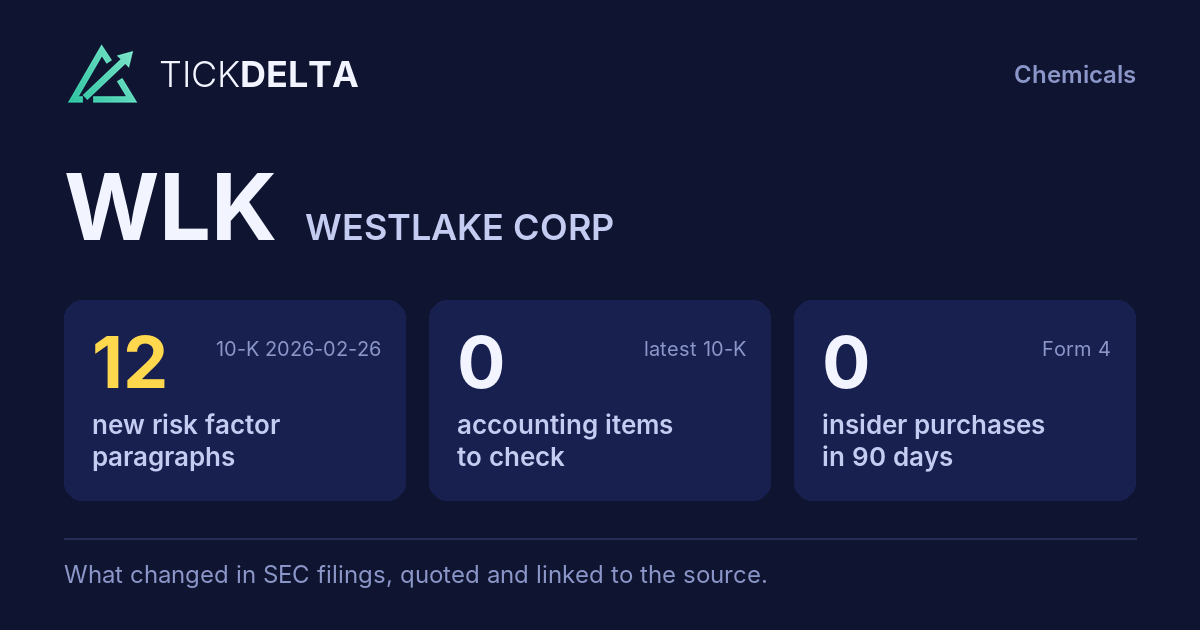
213 changes: 37 added, 57 removed, 114 reworded, 5 quiet changes
10-K Feb 26, 2026 vs Feb 25, 2025
Risk Factors
28.3%
of the text changed · 12,329 words now · 12 new paragraphs, 27 gone
MD&A
43.5%
of the text changed · 10,459 words now · 25 new paragraphs, 30 gone
Legal Proceedings
72.2%
of the text changed · 1,913 words now
Accounting Policies
20.1%
of the text changed · 3,901 words now
10-K 0001262823-26-000016 (Feb 26, 2026) vs 10-K 0001262823-25-000011 (Feb 25, 2025)
Every paragraph, and how much of it changed
One bar per paragraph, in the order of the 10-K. Height and colour show the share of its words not in the closest paragraph a year earlier; the tallest bars are new paragraphs.
Risk Factors
150 paragraphs · 12 new · 55 reworded · 27 gone · 10-K Feb 26, 2026 against Feb 25, 2025
New paragraph
Reworded (5% of its words or more)
Same or nearly
Paragraph 64 · 46% changed
Every version of it
We have manufacturing sites in North America, Europe and Asia. Our operations are subject to the usual hazards associated with chemical, plastics, housing and infrastructure products manufacturing and the related use, storage, transportation and disposal of feedstocks, products and wastes, and litigation arising as a result of such hazards, including: including, among other things, pipeline leaks and ruptures, explosions, fires, severe weather and natural disasters, mechanical failure, transportation accidents involving our products, remediation complications, chemical spills, discharges or releases of toxic or hazardous substances or gases, sabotage and terrorist attacks. All of these hazards can cause personal injury and loss of life, catastrophic damage to or destruction of property and equipment and environmental damage, and may result in a suspension of operations and the imposition of civil or criminal penalties. A loss or shutdown over an extended period of operations at any one of our chemical manufacturing facilities would have a material adverse effect on us.
Paragraph 58 · 43% changed
Every version of it
Paragraph 89 · 42% changed
Every version of it
Paragraph 117 · 41% changed
Every version of it
In November 2024, we announced that we successfully met our publicly disclosed target to reduce our Scope 1 and Scope 2 CO2 equivalent emissions intensity per ton of production by 20% from a 2016 baseline. Having reached our initial 2030 emissions target, we announced a new target to further reduce our Scope 1 and Scope 2 CO2 equivalent emissions intensity per ton of production by an additional 5% by 2030, using a 2024 baseline. Our ability to achieve this target depends on many factors, many of which are beyond our control. Our selection of methodology and disclosure frameworks that seek to align with various reporting standards may change from time to time and may result in a lack of comparative data from period to period. In addition, our processes, controls and calculation methodology may not always align with evolving standards for identifying, measuring and reporting GHG emissions, which could result in significant revisions to our goals or reported progress in achieving such goals. We believe that our expected allocation of growth capital into lower-carbon projects is consistent with such targets; however, our analysis and plan for execution requires us to make a number of assumptions. Should one or more of our underlying assumptions prove incorrect, our actual results and ability to achieve our GHG emissions reduction goal could differ materially from our expectations. Developing and implementing plans for compliance with voluntary climate commitments can lead to additional capital, personnel, operations and maintenance expenditures and could significantly affect the economic position of existing facilities and proposed projects. Our failure or perceived failure to pursue or fulfill our sustainability-focused goals, targets and objectives within the timelines we announce, or at all, could adversely affect our business or reputation, as well as expose us to potential government enforcement actions and private litigation. We cannot predict the ultimate impact that our emissions reduction goal, or the various implementation aspects, will have on our financial condition and results of operations.
Paragraph 103 · 38% changed
Every version of it
On May 6, 2022, the EPA finalized rules amending (i) the NESHAPs for mercury emissions from mercury cell chlor-alkali plants and (ii) the 2003 NESHAPs for mercury cell chlor-alkali plants residual risk and technology review. Among other things, the amendments require improvements in work practices to reduce fugitive mercury emissions and work practice standards for the cell rooms and instrumental monitoring of cell room fugitive emissions, modify regulatory provisions regarding startup, shutdown, and malfunctions, and add standards for fugitive chlorine emissions from mercury cell chlor-alkali plants, which are not currently regulated under the NESHAP. The final rules also include a requirement to cease all mercury emissions from the operation of mercury cell chlor-alkali facilities by May 6, 2025. We operate As a result, we ceased operations of a mercury cell production unit at our Natrium facility. Compliance with the final rules resulted facility in additional restrictions on our operations, increased compliance May 2025 and expect to continue incurring decommissioning and demolition costs and will result in the cessation of operation of the mercury cell production unit. 2026.
Paragraph 37 · 37% changed
Every version of it
In April 2024, the U.S. Epoxy Resin Producers Ad Hoc Coalition (the "Coalition"), of which we are a member, filed petitions with the U.S. Department of Commerce and the U.S. International Trade Commission requesting the initiation of antidumping investigations regarding imports of certain epoxy resins from China, India, South Korea, Taiwan, and Thailand and countervailing duty investigations regarding imports of the same products from China, India, South Korea, and Taiwan. In September 2024, May 2025, the U.S. Department of Commerce published its preliminary countervailing duty determination and imposed provisional duties. In November 2024, the U.S. Department of Commerce published its preliminary antidumping determination of dumping margins. The U.S. Department of Commerce is continuing its antidumping and countervailing duty investigations, orders on imports of epoxy resins from South Korea and Taiwan and an antidumping order on imports of epoxy resins from Thailand. In June 2024, the Coalition confidentially lodged an antidumping complaint with the European Commission requesting the initiation of an antidumping investigation concerning imports of epoxy resins into the European Union market originating in China, South Korea, Taiwan and Thailand. The European Commission imposed definitive duties in late July 2025 on imports of epoxy resins from China, Taiwan, and Thailand. However, the ultimate effect of such measures is uncertain and the U.S. International Trade Commission is conducting its final phase injury investigation. The investigations are expected revocation thereof by domestic or foreign authorities could adversely affect our ability to conclude compete in May 2025. global markets.
Paragraph 82 · 31% changed
Every version of it
The vast majority of our employees in Europe and Asia, and some of our employees in North America, are represented by labor unions and works councils. Our operations may be adversely affected by strikes, work stoppages and other labor disputes. For example, on November 1, 2024, bargaining unit employees of Local Lodge No. 2781 of the International Association of Machinists and Aerospace Workers (IAM) began a strike at our Calvert City, Kentucky, facility, after the IAM members, who work in the facility's ethylene and chlorine units, did not accept past we have experienced strikes at certain of our final offer for a new facilities in connection with the negotiation of collective bargaining agreement. The strike ended on November 8, 2024, after the IAM accepted our offer for a new collective bargaining agreement. agreements. Any future strikes or work stoppages could be significant and have an adverse effect on our financial condition and results of operations.
Paragraph 104 · 49% changed
Every version of it
10-K Feb 25, 2025Similarly, the Toxic Substances Control Act ("TSCA") imposes reporting, record-keeping and testing requirements, and restrictions relating to the production, handling, and use of chemical substances. The TSCA reform legislation enacted in June 2016 expanded the EPA's authority to review and regulate new and existing chemicals. Under the reform legislation, the EPA is required to, among other things, undertake rule making within statutory time frames related to: (1) chemical risk evaluation, designation and management; (2) reporting of mercury supply, use and trade; and (3) management of persistent, bioaccumulative, and toxic chemical substances ("PBTs"). In response to this mandate, the EPA issued rules establishing the EPA's process and criteria for identifying high priority chemicals for risk evaluation and setting the EPA's approach for determining whether these high priority chemicals present an unreasonable risk to health or the environment. Pursuant to its rules, the EPA designated certain chemical substances as high priority for risk evaluation. We manufacture several of these chemical substances. On December 14, 2023, the EPA announced that it would prioritize vinyl chloride (used to make PVC) for evaluation and potential regulation under TSCA as a High Priority Substance and in July 2024, the EPA announced it would move forward with the designation of vinyl chloride as a High Priority Substance. In November 2023, the European Chemicals Agency ("ECHA") sent its investigation results of the risks from PVC and PVC additives to the European Commission for further consideration. In December 2024, the EPA finalized risk management rules which phase out the manufacturing, processing and distribution of trichloroethylene (TCE) completely and perchloroethylene (PCE) for consumer and most industrial and commercial uses. The TCE rule, however, has been stayed by the Fifth and Third Circuit Courts of Appeal and, as a result, is subject to the January 2025 Trump Administration executive order freezing those regulations not yet in effect pending review. Under the risk management rule process established by the TSCA, the EPA has also issued several Test Orders for chemical substances that we manufacture or import, including EDC. In July 2024, EPA issued a draft TSCA human health hazard assessment for EDC for public comment and peer review. EPA will use this draft risk assessment to inform the draft risk evaluation. Although we cannot predict with certainty the extent of our future liabilities and costs at this time, we do not anticipate that the Test Order requirements or risk evaluation and management rules of these chemical substances will have a material adverse effect on our business, financial condition, operating results or cash flows.
10-K Feb 26, 2026
The Toxic Substances Control Act ("TSCA") imposes reporting, record-keeping and testing requirements, and restrictions relating to the production, handling, and use of chemical substances. Under the TSCA, the EPA has designated certain of the chemical substances that we manufacture as high priority for risk evaluation. In December 2024, the EPA designated vinyl chloride as a High Priority Substance and is undertaking risk evaluation under the TSCA. In December 2019, the EPA designated EDC as a High Priority Substance and on November 19, 2025, the EPA published its draft risk evaluation for EDC for public comment. In December 2024, the EPA issued a final rule which phases out the manufacturing, processing and distribution of trichloroethylene (TCE) completely and perchloroethylene (PCE) for consumer and most industrial and commercial uses. The TCE rule, however, has been stayed by the Fifth and Third Circuit Courts of Appeal and, as a result, the EPA has postponed effective dates for certain portions of the TCE rule, with the most recent effective date postponed until February 17, 2026. In addition, the TSCA inventory reset rule requires U.S. chemical manufacturers and processors to notify and obtain approval from the EPA before reintroducing inactive chemicals into commerce. We cannot predict the effects of these actions, or their ultimate cost to or impact on us.
Paragraph 64 · 46% changed
Every version of it
10-K Feb 25, 2025
We have manufacturing sites in North America, Europe and Asia. Our operations are subject to the usual hazards associated with chemical, plastics, housing and infrastructure products manufacturing and the related use, storage, transportation and disposal of feedstocks, products and wastes, and litigation arising as a result of such hazards, including:
10-K Feb 26, 2026
We have manufacturing sites in North America, Europe and Asia. Our operations are subject to the usual hazards associated with chemical, plastics, housing and infrastructure products manufacturing and the related use, storage, transportation and disposal of feedstocks, products and wastes, and litigation arising as a result of such hazards, including, among other things, pipeline leaks and ruptures, explosions, fires, severe weather and natural disasters, mechanical failure, transportation accidents involving our products, remediation complications, chemical spills, discharges or releases of toxic or hazardous substances or gases, sabotage and terrorist attacks. All of these hazards can cause personal injury and loss of life, catastrophic damage to or destruction of property and equipment and environmental damage, and may result in a suspension of operations and the imposition of civil or criminal penalties. A loss or shutdown over an extended period of operations at any one of our chemical manufacturing facilities would have a material adverse effect on us.
Paragraph 58 · 43% changed
Every version of it
10-K Feb 25, 2025We may reduce production at or idle a facility for an extended period of time or exit a business because of high raw material prices, an oversupply of a particular product and/or a lack of demand for that particular product, which makes production uneconomical. Temporary outages sometimes last for several quarters or, in certain cases, longer, and cause us to incur costs, including the expenses of maintaining and restarting these facilities. Factors such as increases in raw material costs or lower demand in the future may cause us to further reduce operating rates, idle facilities or exit uncompetitive businesses.
10-K Feb 26, 2026
Temporary outages as a result of the above factors sometimes last for several quarters or, in certain cases, longer, and cause us to incur costs, including the expenses of maintaining and restarting these facilities.
Paragraph 89 · 42% changed
Every version of it
10-K Feb 25, 2025Under the accounting principles generally accepted in the United States ("GAAP"), we review goodwill for impairment on an annual basis or more frequently if events or circumstances indicate that the carrying amount may not be recoverable. Long-lived assets, including tangible assets and intangible assets with finite lives, are reviewed if events or circumstances indicate that their carrying amount may not be recoverable. Our balance sheet includes significant goodwill and long-lived assets.
10-K Feb 26, 2026
Our balance sheet includes significant goodwill and long-lived assets. We periodically review goodwill and long-lived assets for impairment in accordance with accounting principles generally accepted in the United States ("GAAP") and record charges for impairment if events or circumstances indicate that their carrying amount may not be recoverable. For example, in the third quarter of 2025, we performed impairment assessments for our North American Chlorovinyls asset group and the reporting units within the PEM and HIP segments, which resulted in a non-cash goodwill impairment charge of $727 million taken in the third quarter of 2025, representing all of the goodwill associated with the North American Chlorovinyls reporting unit.
Paragraph 117 · 41% changed
Every version of it
10-K Feb 25, 2025
Developing and implementing plans for compliance with voluntary climate commitments can lead to additional capital, personnel, operations and maintenance expenditures and could significantly affect the economic position of existing facilities and proposed projects. Our failure or perceived failure to pursue or fulfill our sustainability-focused goals, targets and objectives within the timelines we announce, or at all, could adversely affect our business or reputation, as well as expose us to potential government enforcement actions and private litigation. We cannot predict the ultimate impact that our emissions reduction goal, or the various implementation aspects, will have on our financial condition and results of operations.
10-K Feb 26, 2026
In November 2024, we announced that we successfully met our publicly disclosed target to reduce our Scope 1 and Scope 2 CO2 equivalent emissions intensity per ton of production by 20% from a 2016 baseline. Having reached our initial 2030 emissions target, we announced a new target to further reduce our Scope 1 and Scope 2 CO2 equivalent emissions intensity per ton of production by an additional 5% by 2030, using a 2024 baseline. Our ability to achieve this target depends on many factors, many of which are beyond our control. Our selection of methodology and disclosure frameworks that seek to align with various reporting standards may change from time to time and may result in a lack of comparative data from period to period. In addition, our processes, controls and calculation methodology may not always align with evolving standards for identifying, measuring and reporting GHG emissions, which could result in significant revisions to our goals or reported progress in achieving such goals. We believe that our expected allocation of growth capital into lower-carbon projects is consistent with such targets; however, our analysis and plan for execution requires us to make a number of assumptions. Should one or more of our underlying assumptions prove incorrect, our actual results and ability to achieve our GHG emissions reduction goal could differ materially from our expectations. Developing and implementing plans for compliance with voluntary climate commitments can lead to additional capital, personnel, operations and maintenance expenditures and could significantly affect the economic position of existing facilities and proposed projects. Our failure or perceived failure to pursue or fulfill our sustainability-focused goals, targets and objectives within the timelines we announce, or at all, could adversely affect our business or reputation, as well as expose us to potential government enforcement actions and private litigation. We cannot predict the ultimate impact that our emissions reduction goal, or the various implementation aspects, will have on our financial condition and results of operations.
Paragraph 103 · 38% changed
Every version of it
10-K Feb 25, 2025
On May 6, 2022, the EPA finalized rules amending (i) the NESHAPs for mercury emissions from mercury cell chlor-alkali plants and (ii) the 2003 NESHAPs for mercury cell chlor-alkali plants residual risk and technology review. Among other things, the amendments require improvements in work practices to reduce fugitive mercury emissions and work practice standards for the cell rooms and instrumental monitoring of cell room fugitive emissions, modify regulatory provisions regarding startup, shutdown, and malfunctions, and add standards for fugitive chlorine emissions from mercury cell chlor-alkali plants, which are not currently regulated under the NESHAP. The final rules also include a requirement to cease all mercury emissions from the operation of mercury cell chlor-alkali facilities by May 6, 2025. We operate a mercury cell production unit at our Natrium facility. Compliance with the final rules resulted in additional restrictions on our operations, increased compliance costs and will result in the cessation of operation of the mercury cell production unit.
10-K Feb 26, 2026
On May 6, 2022, the EPA finalized rules amending (i) the NESHAPs for mercury emissions from mercury cell chlor-alkali plants and (ii) the 2003 NESHAPs for mercury cell chlor-alkali plants residual risk and technology review. Among other things, the amendments include a requirement to cease all mercury emissions from the operation of mercury cell chlor-alkali facilities by May 6, 2025. As a result, we ceased operations of a mercury cell production unit at our Natrium facility in May 2025 and expect to continue incurring decommissioning and demolition costs in 2026.
Paragraph 37 · 37% changed
Every version of it
10-K Feb 25, 2025
In April 2024, the U.S. Epoxy Resin Producers Ad Hoc Coalition (the "Coalition"), of which we are a member, filed petitions with the U.S. Department of Commerce and the U.S. International Trade Commission requesting the initiation of antidumping investigations regarding imports of certain epoxy resins from China, India, South Korea, Taiwan, and Thailand and countervailing duty investigations regarding imports of the same products from China, India, South Korea, and Taiwan. In September 2024, the U.S. Department of Commerce published its preliminary countervailing duty determination and imposed provisional duties. In November 2024, the U.S. Department of Commerce published its preliminary antidumping determination of dumping margins. The U.S. Department of Commerce is continuing its antidumping and countervailing duty investigations, and the U.S. International Trade Commission is conducting its final phase injury investigation. The investigations are expected to conclude in May 2025.
10-K Feb 26, 2026
In April 2024, the U.S. Epoxy Resin Producers Ad Hoc Coalition (the "Coalition"), of which we are a member, filed petitions with the U.S. Department of Commerce and the U.S. International Trade Commission requesting the initiation of antidumping investigations regarding imports of certain epoxy resins from China, India, South Korea, Taiwan, and Thailand and countervailing duty investigations regarding imports of the same products from China, India, South Korea, and Taiwan. In May 2025, the U.S. Department of Commerce imposed antidumping and countervailing duty orders on imports of epoxy resins from South Korea and Taiwan and an antidumping order on imports of epoxy resins from Thailand. In June 2024, the Coalition confidentially lodged an antidumping complaint with the European Commission requesting the initiation of an antidumping investigation concerning imports of epoxy resins into the European Union market originating in China, South Korea, Taiwan and Thailand. The European Commission imposed definitive duties in late July 2025 on imports of epoxy resins from China, Taiwan, and Thailand. However, the ultimate effect of such measures is uncertain and the revocation thereof by domestic or foreign authorities could adversely affect our ability to compete in global markets.
Paragraph 82 · 31% changed
Every version of it
10-K Feb 25, 2025
The vast majority of our employees in Europe and Asia, and some of our employees in North America, are represented by labor unions and works councils. Our operations may be adversely affected by strikes, work stoppages and other labor disputes. For example, on November 1, 2024, bargaining unit employees of Local Lodge No. 2781 of the International Association of Machinists and Aerospace Workers (IAM) began a strike at our Calvert City, Kentucky, facility, after the IAM members, who work in the facility's ethylene and chlorine units, did not accept our final offer for a new collective bargaining agreement. The strike ended on November 8, 2024, after the IAM accepted our offer for a new collective bargaining agreement. Any future strikes or work stoppages could be significant and have an adverse effect on our financial condition and results of operations.
10-K Feb 26, 2026
The vast majority of our employees in Europe and Asia, and some of our employees in North America, are represented by labor unions and works councils. Our operations may be adversely affected by strikes, work stoppages and other labor disputes. For example, in the past we have experienced strikes at certain of our facilities in connection with the negotiation of collective bargaining agreements. Any future strikes or work stoppages could be significant and have an adverse effect on our financial condition and results of operations.
MD&A
107 paragraphs · 25 new · 54 reworded · 30 gone · 10-K Feb 26, 2026 against Feb 25, 2025
New paragraph
Reworded (5% of its words or more)
Same or nearly
Paragraph 53 · 48% changed
Income (loss) from Operations. Income from operations for the Performance and Essential Materials PEM segment increased decreased by $70 $2,229 million to a loss of $2,100 million in 2025 from income from operations of $129 million in 2024 from $59 million 2024. This decrease in 2023. The results for the twelve months ended December 31, 2023 were negatively impacted by a non-cash impairment charge of $475 million related to Westlake Epoxy goodwill and long-lived assets of our epoxy base resin business in the Netherlands, and a litigation charge of approximately $150 million related to a final settlement to fully resolve lawsuits involving certain liability claims, both of which were recorded in the fourth quarter of 2023. Excluding the impact of these charges in 2023, the income from operations was lower for the twelve months ended December 31, 2024 as compared to the twelve months ended December 31, 2023, primarily due to lower sales prices for most of our major products in this segment, particularly PVC resin, caustic soda, chlorine polyethylene and epoxy resin. These decreases were partially offset by higher chlorine, lower sales volumes for PVC resin, epoxy resin, polyethylene, caustic soda and chlorine chlorine, and lower the impact of the Petro 1 and other planned turnaround activities, offset by the impact of fewer unplanned plant outages in 2025 and higher natural gas and feedstock costs. costs in 2025. The 2024 results were decrease in income from operations was also impacted by an unplanned outage at due to the LACC joint venture ethylene production plant during recognition of a North American Chlorovinyls non-cash goodwill impairment charge of $727 million in the third quarter of 2024, resulting 2025, the recognition of closure costs of $393 million relating to the chlor-alkali and VCM plants at our Lake Charles facilities, the PVC plant at our Aberdeen facility and the styrene plant at our Lake Charles facility, and the recognition of closure costs of $247 million related to our Pernis facility located in lower operating rates the Netherlands and higher maintenance costs. the PVC unit at the Suzhou Huasu Plastics plant located in China.
Paragraph 41 · 47% changed
Amortization of Intangibles. Amortization expense remained relatively consistent at $117 million was slightly higher in 2024 2025 as compared to $122 million 2024 due to an increase in 2023. technology related capitalized costs.
Paragraph 33 · 44% changed
For the year ended December 31, 2023, 2025, net income loss attributable to Westlake Corporation was $479 $1,508 million, or $3.70 $11.70 per diluted share, on net sales of $12,548 $11,170 million. This represents These results represent a decrease in net income attributable to Westlake Corporation of $1,768 $2,110 million, or $13.64 $16.34 per diluted share, compared to 2022 2024 net income attributable to Westlake Corporation of $2,247 $602 million, or $17.34 $4.64 per diluted share, on net sales of $15,794 $12,142 million. Income Loss from operations was $729 $1,578 million for the year ended December 31, 2023, 2025, as compared to $3,050 income from operations of $875 million for the year ended December 31, 2022, 2024, a decrease of $2,321 $2,453 million. The decrease in net income and income from operations was primarily due to lower sales prices and volumes for most many of our products across both segments as a result of weaker global demand, a non-cash impairment charge of $475 million that comprised of Westlake Epoxy goodwill segments, including PVC resin, polyethylene, chlorine and long-lived assets of our pipe and fittings, lower sales volumes for PVC resin, epoxy base resin business resin, polyethylene, caustic soda, chlorine, compounds and building products and higher energy and feedstock costs in the Netherlands in the fourth quarter of 2023, and a pre-tax litigation charge of approximately $150 million related to a final settlement to fully resolve lawsuits involving certain liability claims. year ended December 31, 2025. The decreases decrease in net income and income from operations in 2023 the year ended December 31, 2025 was also due to the recognition of a non-cash impairment charge of $727 million related to North American Chlorovinyls goodwill, the recognition of closure costs of $393 million related to the chlor-alkali and VCM plants at our Lake Charles facilities, the PVC plant at our Aberdeen facility and the styrene plant at our Lake Charles facility, the recognition of closure costs of $247 million related to the base epoxy resins and intermediate resin units at our Pernis facility located in the Netherlands and closure costs of $9 million related to the PVC unit at the Suzhou Huasu Plastics plant located in China, all under the PEM segment. These decreases were partially slightly offset by lower natural gas higher compounds sales prices and feedstock costs higher pipe and lower amortization of intangibles. fittings sales volumes. Net sales decreased by $3,246 $972 million to $12,548 $11,170 million in 2023 2025 from $15,794 $12,142 million in 2022, 2024, primarily due to lower sales prices for PVC resin, polyethylene, chlorine and pipe and fittings, and lower sales volumes for most of our products across both segments. PVC resin, epoxy resin, polyethylene, caustic soda, chlorine, compounds and building products, which were partially offset by higher compounds sales prices and pipe and fittings sales volumes.
Paragraph 16 · 44% changed
Paragraph 45 · 41% changed
Other Income, Net. Other income, net of $136 million decreased in 2023 was higher than other income, net of $73 million in 2022, substantially 2025 as compared to 2024 primarily due to higher a reduction of $53 million of interest income attributable to a higher resulting from the Company's lower average cash and cash equivalents balance and higher equivalent balances as well as lower interest rates in 2025 as compared to 2024 and the current period and recognition of higher insurance recoveries in 2023. 2024 as compared to 2025, partially offset by a gain of $32 million recognized in 2025, resulting from settlement of a portion of the Company's pension benefits liability.
Paragraph 54 · 40% changed
Operating activities provided cash of $1,314 $465 million in 2024 as 2025 compared to cash provided by operating activities of $2,336 $1,314 million in 2023. 2024. The $1,022 $849 million decrease in cash flow from operating activities was mainly due to unfavorable changes in working capital and lower prices and demand for most of our products resulting and cash used in lower operating income. Changes connection with the turnaround of the Petro 1 ethylene facility in components of Lake Charles, partially offset by a favorable change in working capital, which we define for purposes of this cash flow discussion as accounts receivable, inventories, prepaid expenses and other current assets, less accounts payable and accrued and other liabilities, used cash of $278 million capital in 2024, as compared to $600 million of cash provided 2025. The favorable change in 2023, an unfavorable change of $878 million. The unfavorable changes working capital in 2024 were 2025 was substantially driven by the higher accrued and other liabilities which were due to the accrual of North American Chlorovinyls and Styrene facilities closure costs and Pernis facility closure costs in 2025 and lower inventory at the end of 2024, levels in 2025 as compared to 2023 and 2024, partially offset by the cash outflows in 2024 related to a payment to Triad Hunter, LLC, which was accrued in 2023, to resolve litigation in the 2023 litigation accrual. third quarter of 2025.
Paragraph 55 · 40% changed
Net cash used for investing activities during 2024 2025 was $1,001 $1,223 million as compared to net cash used of $1,037 $1,001 million in 2023. 2024. The decrease increase in cash used for investing activities during in 2025 as compared to 2024 was primarily because related to the purchase of the lower capital $272 million of investments comprising corporate bonds and U.S. government debt securities, offset by redemptions and paydowns of $68 million, among others. Capital expenditures were $995 million in 2024 2025 as compared to 2023. Capital expenditures were $1,008 million during 2024 as compared to $1,034 million during 2023. Capital expenditures in 2024 were primarily related to projects to increase production capacity or reduce costs, maintenance and safety projects and environmental projects at our various facilities. 2024.
Paragraph 37 · 38% changed
Selling, General and Administrative Expenses. Selling, The increase in selling, general and administrative expenses increased by $9 million in 2025 as compared to $874 million in 2024 from $865 million in 2023. This increase was mainly primarily due to higher professional consulting, selling legal and technology related other consulting costs and higher technology-related expenses, which was partially offset by lower employee benefit payroll and related benefits costs.
Paragraph 53 · 48% changed
10-K Feb 25, 2025
Income from Operations. Income from operations for the Performance and Essential Materials segment increased by $70 million to $129 million in 2024 from $59 million in 2023. The results for the twelve months ended December 31, 2023 were negatively impacted by a non-cash impairment charge of $475 million related to Westlake Epoxy goodwill and long-lived assets of our epoxy base resin business in the Netherlands, and a litigation charge of approximately $150 million related to a final settlement to fully resolve lawsuits involving certain liability claims, both of which were recorded in the fourth quarter of 2023. Excluding the impact of these charges in 2023, the income from operations was lower for the twelve months ended December 31, 2024 as compared to the twelve months ended December 31, 2023, primarily due to lower sales prices for most of our major products in this segment, particularly PVC resin, caustic soda, chlorine and epoxy resin. These decreases were partially offset by higher sales volumes for PVC resin, polyethylene, caustic soda and chlorine and lower natural gas and feedstock costs. The 2024 results were also impacted by an unplanned outage at the LACC joint venture ethylene production plant during the third quarter of 2024, resulting in lower operating rates and higher maintenance costs.
10-K Feb 26, 2026
Income (loss) from Operations. Income from operations for the PEM segment decreased by $2,229 million to a loss of $2,100 million in 2025 from income from operations of $129 million in 2024. This decrease in income from operations was due to lower sales prices for most of our major products in this segment, particularly PVC resin, polyethylene and chlorine, lower sales volumes for PVC resin, epoxy resin, polyethylene, caustic soda and chlorine, and the impact of the Petro 1 and other planned turnaround activities, offset by the impact of fewer unplanned plant outages in 2025 and higher natural gas and feedstock costs in 2025. The decrease in income from operations was also due to the recognition of a North American Chlorovinyls non-cash goodwill impairment charge of $727 million in the third quarter of 2025, the recognition of closure costs of $393 million relating to the chlor-alkali and VCM plants at our Lake Charles facilities, the PVC plant at our Aberdeen facility and the styrene plant at our Lake Charles facility, and the recognition of closure costs of $247 million related to our Pernis facility located in the Netherlands and the PVC unit at the Suzhou Huasu Plastics plant located in China.
Paragraph 41 · 47% changed
10-K Feb 25, 2025
Amortization of Intangibles. Amortization expense remained relatively consistent at $117 million in 2024 as compared to $122 million in 2023.
10-K Feb 26, 2026
Amortization of Intangibles. Amortization expense was slightly higher in 2025 as compared to 2024 due to an increase in technology related capitalized costs.
Paragraph 33 · 44% changed
10-K Feb 25, 2025
For the year ended December 31, 2023, net income attributable to Westlake Corporation was $479 million, or $3.70 per diluted share, on net sales of $12,548 million. This represents a decrease in net income attributable to Westlake Corporation of $1,768 million, or $13.64 per diluted share, compared to 2022 net income attributable to Westlake Corporation of $2,247 million, or $17.34 per diluted share, on net sales of $15,794 million. Income from operations was $729 million for the year ended December 31, 2023, as compared to $3,050 million for the year ended December 31, 2022, a decrease of $2,321 million. The decrease in net income and income from operations was primarily due to lower sales prices and volumes for most of our products across both segments as a result of weaker global demand, a non-cash impairment charge of $475 million that comprised of Westlake Epoxy goodwill and long-lived assets of our epoxy base resin business in the Netherlands in the fourth quarter of 2023, and a pre-tax litigation charge of approximately $150 million related to a final settlement to fully resolve lawsuits involving certain liability claims. The decreases in net income and income from operations in 2023 were partially offset by lower natural gas and feedstock costs and lower amortization of intangibles. Net sales decreased by $3,246 million to $12,548 million in 2023 from $15,794 million in 2022, primarily due to lower sales prices and volumes for most of our products across both segments.
10-K Feb 26, 2026
For the year ended December 31, 2025, net loss attributable to Westlake Corporation was $1,508 million, or $11.70 per diluted share, on net sales of $11,170 million. These results represent a decrease in net income attributable to Westlake Corporation of $2,110 million, or $16.34 per diluted share, compared to 2024 net income attributable to Westlake Corporation of $602 million, or $4.64 per diluted share, on net sales of $12,142 million. Loss from operations was $1,578 million for the year ended December 31, 2025, as compared to income from operations of $875 million for the year ended December 31, 2024, a decrease of $2,453 million. The decrease in net income and income from operations was primarily due to lower sales prices for many of our products across both segments, including PVC resin, polyethylene, chlorine and pipe and fittings, lower sales volumes for PVC resin, epoxy resin, polyethylene, caustic soda, chlorine, compounds and building products and higher energy and feedstock costs in the year ended December 31, 2025. The decrease in net income and income from operations in the year ended December 31, 2025 was also due to the recognition of a non-cash impairment charge of $727 million related to North American Chlorovinyls goodwill, the recognition of closure costs of $393 million related to the chlor-alkali and VCM plants at our Lake Charles facilities, the PVC plant at our Aberdeen facility and the styrene plant at our Lake Charles facility, the recognition of closure costs of $247 million related to the base epoxy resins and intermediate resin units at our Pernis facility located in the Netherlands and closure costs of $9 million related to the PVC unit at the Suzhou Huasu Plastics plant located in China, all under the PEM segment. These decreases were slightly offset by higher compounds sales prices and higher pipe and fittings sales volumes. Net sales decreased by $972 million to $11,170 million in 2025 from $12,142 million in 2024, primarily due to lower sales prices for PVC resin, polyethylene, chlorine and pipe and fittings, and lower sales volumes for PVC resin, epoxy resin, polyethylene, caustic soda, chlorine, compounds and building products, which were partially offset by higher compounds sales prices and pipe and fittings sales volumes.
Paragraph 16 · 44% changed
10-K Feb 25, 2025Global demand for most of our products started to recover from the effects of the COVID-19 pandemic in the second half of 2020 and remained strong through the first half of 2022. However, since the second half of 2022 and during the early part of 2023, we saw significant volatility in natural gas and electricity costs, particularly in Europe, as well as in ethane and ethylene prices. We have experienced a decline in natural gas and electricity costs since the second half of 2023 through the third quarter of 2024 and seasonal price increase in the fourth quarter of 2024. Since the first half of 2022, we have continued to experience lower prices and weak demand for most of our products globally. The ongoing conflict between Russia and Ukraine since Russia's invasion of Ukraine in 2022, the conflict in the Middle East, slow economic growth in China, increase in bisphenol-A, epichlorohydrin and base epoxy resin exports out of Asia into European and North American markets, disruption of trade flows due to enactment of duties and tariffs, timing of certain new ethylene and polyethylene capacity additions in North America, Asia, and the Middle East, volatility in natural gas and electricity prices and volatility in crude oil prices could have a continuing negative impact on the performance of Performance and Essential Materials businesses.
10-K Feb 26, 2026
Our PEM segment manufactures products such as ethylene, PE, chlor-alkali, chlorinated derivative products, ethylene dichloride, VCM and PVC, many of which are used in our integrated vinyls production chain. The chlor-alkali and petrochemical industries exhibit cyclical commodity characteristics, and margins are influenced by changes in the balance between global supply and demand and the resulting operating rates, the level of general economic activity, turnaround activities and the price of raw materials. Since the second half of 2022, we have continued to experience lower prices, increased supply and weaker demand for most of our performance and essential materials products globally. The ongoing conflict between Russia and Ukraine, the conflict in the Middle East, slow economic growth in China and Europe, increases in base epoxy resin exports out of Asia into European and North American markets, lower margins in Europe due to increases in conversion costs, disruption of trade flows due to enactment of duties and tariffs and related uncertainties, overcapacity of PVC resin, polyethylene, chlor-alkali and epoxy, and volatility in natural gas, electricity and crude oil prices could have a continuing negative impact on the performance of PEM businesses.
Paragraph 45 · 41% changed
10-K Feb 25, 2025
Other Income, Net. Other income, net of $136 million in 2023 was higher than other income, net of $73 million in 2022, substantially due to higher interest income attributable to a higher average cash and cash equivalents balance and higher interest rates in the current period and insurance recoveries in 2023.
10-K Feb 26, 2026
Other Income, Net. Other income, net decreased in 2025 as compared to 2024 primarily due to a reduction of $53 million of interest income resulting from the Company's lower average cash and cash equivalent balances as well as lower interest rates in 2025 as compared to 2024 and the recognition of higher insurance recoveries in 2024 as compared to 2025, partially offset by a gain of $32 million recognized in 2025, resulting from settlement of a portion of the Company's pension benefits liability.
Paragraph 54 · 40% changed
10-K Feb 25, 2025
Operating activities provided cash of $1,314 million in 2024 as compared to cash provided by operating activities of $2,336 million in 2023. The $1,022 million decrease in cash flow from operating activities was mainly due to unfavorable changes in working capital and lower prices for most of our products resulting in lower operating income. Changes in components of working capital, which we define for purposes of this cash flow discussion as accounts receivable, inventories, prepaid expenses and other current assets, less accounts payable and accrued and other liabilities, used cash of $278 million in 2024, as compared to $600 million of cash provided in 2023, an unfavorable change of $878 million. The unfavorable changes in 2024 were substantially driven by the higher inventory at the end of 2024, as compared to 2023 and cash outflows in 2024 related to the 2023 litigation accrual.
10-K Feb 26, 2026
Operating activities provided cash of $465 million in 2025 compared to cash provided by operating activities of $1,314 million in 2024. The $849 million decrease in cash flow from operating activities was mainly due to lower prices and demand for most of our products and cash used in connection with the turnaround of the Petro 1 ethylene facility in Lake Charles, partially offset by a favorable change in working capital in 2025. The favorable change in working capital in 2025 was substantially driven by the higher accrued and other liabilities which were due to the accrual of North American Chlorovinyls and Styrene facilities closure costs and Pernis facility closure costs in 2025 and lower inventory levels in 2025 as compared to 2024, partially offset by the cash outflows related to a payment to Triad Hunter, LLC, which was accrued in 2023, to resolve litigation in the third quarter of 2025.
Paragraph 55 · 40% changed
10-K Feb 25, 2025
Net cash used for investing activities during 2024 was $1,001 million as compared to net cash used of $1,037 million in 2023. The decrease in investing activities during 2024 was primarily because of the lower capital expenditures in 2024 as compared to 2023. Capital expenditures were $1,008 million during 2024 as compared to $1,034 million during 2023. Capital expenditures in 2024 were primarily related to projects to increase production capacity or reduce costs, maintenance and safety projects and environmental projects at our various facilities.
10-K Feb 26, 2026
Net cash used for investing activities during 2025 was $1,223 million compared to net cash used of $1,001 million in 2024. The increase in cash used for investing activities in 2025 as compared to 2024 was primarily related to the purchase of $272 million of investments comprising corporate bonds and U.S. government debt securities, offset by redemptions and paydowns of $68 million, among others. Capital expenditures were $995 million in 2025 as compared to $1,008 million in 2024.
Paragraph 37 · 38% changed
10-K Feb 25, 2025
Selling, General and Administrative Expenses. Selling, general and administrative expenses increased by $9 million to $874 million in 2024 from $865 million in 2023. This increase was mainly due to higher professional consulting, selling and technology related expenses, which was partially offset by lower employee benefit costs.
10-K Feb 26, 2026
Selling, General and Administrative Expenses. The increase in selling, general and administrative expenses in 2025 as compared to 2024 was primarily due to higher legal and other consulting costs and higher technology-related expenses, partially offset by lower payroll and related benefits costs.
A paragraph is matched with the one last year that shares the most of its words; under half in common makes it new. The paragraphs shown are the 8 reworded the most in each section.
The paragraph that changed most in each section
The redline
Marked against last year's 10-K: cut words struck through, new words highlighted.
Legal Proceedings483 words changed in this paragraph; it is 31% similar to last year's version.
PVC Pipe Antitrust. The Company and other manufacturers of PVC pipe and fittings have been named as defendants in five ten putative class action civil lawsuits, all lawsuits filed in the U.S. District Court for the Northern District of Illinois between August 2024 and January 2025. These lawsuits are: Bavolak, et al. v. Atkore, Inc., et al.; Wrobbel, et al. v. Atkore, Inc., et al.; TC Construction, Inc., et al. v. Atkore, Inc., et al.; Bill Wagner & Son, Inc., et al. v. Atkore, Inc., et al.; Erie County Water Authority, et al. v. Atkore, Inc., et al.; Baumeister, et al. v. Atkore, Inc., et al.; June 2025 and Barnett, et al. v. Atkore, Inc., et al. Other defendants named in one or more of the lawsuits are Atkore, Inc.; Cantex, Inc.; Diamond Plastics Corporation; IPEX USA LLC; J-M Manufacturing Company, Inc. (d/b/a JM Eagle); National Pipe & Plastics, Inc.; Northern Pipe Products, Inc.; Oil Price Information Service, LLC ("OPIS"); Otter Tail Corporation; PipeLife Jetstream, Inc.; Prime Conduit, Inc.; Sanderson Pipe Corporation; Southern Pipe, Inc.; Westlake Pipe & Fittings Corporation; and Vinyltech Corporation. The plaintiffs lawsuit in the Bavolak, Wrobbel, and TC Construction lawsuits filed a single consolidated amended complaint British Columbia, Canada in October 2024 and September 2025 which generally allege that PVC pipe and fittings manufacturers conspired with each other, other and an industry publication (OPIS), and certain PVC pipe distributors (OPIS) to fix, raise, maintain and stabilize the domestic prices of PVC pipe. These pipe and fittings in the United States and Canada, resulting in the plaintiffs also allege they paid paying artificially high prices for PVC pipe purchased from pipe distributors as a result and fittings. The plaintiffs in these cases assert violations of the alleged conspiracy. These plaintiffs assert various claims under Section 1 of the Sherman Act U.S. federal and the state competition and consumer protection laws of multiple states, and Canadian competition and common laws, and seek relief including injunctive relief, treble damages of undisclosed amounts, and equitable relief, plus attorneys' fees. The plaintiff in the Bill Wagner & Son, Inc. suit purports to represent direct purchasers of PVC pipe from pipe manufacturers and alleges the manufacturers conspired with each other and OPIS to fix, raise, maintain and stabilize the domestic prices of PVC pipe. The Bill Wagner complaint, which was also amended in October 2024, also alleges direct purchasers paid artificially high prices for PVC pipe as a result of the alleged conspiracy and asserts a single claim under Section 1 of the Sherman Act for injunctive relief, treble damages of undisclosed amounts, and equitable relief, plus attorneys' fees and costs. The plaintiffs In October 2025, the U.S. Department of Justice intervened and was granted a partial stay of discovery in the Erie County, Baumeister, U.S. litigation for six months due to its ongoing antitrust investigation of manufacturers of PVC pipe and Barnett lawsuits allege others. A class certification hearing has not yet been scheduled in the same general conspiracy as the other plaintiffs and also seek to represent a separate end user class of indirect purchasers. These plaintiffs assert two claims under Section 1 of the Sherman Act and violations of various state competition and consumer protection laws, and seek injunctive relief, treble damages of undisclosed amounts, equitable relief, attorneys' fees, and costs. British Columbia proceeding. At this time, the Company is not able to estimate the impact, if any, impact that the PVC Pipe Antitrust these lawsuits could have on the Company's consolidated financial statements either in the current period or in future periods. statements.
Source: Item 3, via Note 21 – Commitments and Contingencies, 10-K 0001262823-26-000016 vs Item 3, via Note 21 – Commitments and Contingencies, 10-K 0001262823-25-000011
Risk Factors414 words changed in this paragraph; it is 35% similar to last year's version.
Source: Item 1A, 10-K 0001262823-26-000016 vs Item 1A, 10-K 0001262823-25-000011
MD&A312 words changed in this paragraph; it is 36% similar to last year's version.
Source: Item 7, 10-K 0001262823-26-000016 vs Item 7, 10-K 0001262823-25-000011
Accounting Policies193 words changed in this paragraph; it is 32% similar to last year's version.
In November 2024, 2025, the FASB issued an accounting standards update to clarify and improve the disclosures about a public business entity's expenses and address requests from investors for more detailed information about the types certain aspects of expenses hedge accounting guidance in commonly presented expense captions (such as cost of sales; selling, general, and administrative expenses; and research and development). ASC 815. The amendments require that an entity disclose detailed amounts address five specific areas: (1) similar risk assessment for inventory purchases, employee compensation, depreciation, amortization cash flow hedges, (2) hedging interest payments on choose-your-rate debt, (3) cash flow hedges of intangible assets, nonfinancial forecasted transactions, (4) net written options as hedging instruments, and depletion expenses, categorizing them under appropriate income statement captions. Additionally, they should provide (5) foreign currency-denominated debt designated as both a qualitative description for amounts not disaggregated hedging instrument and disclose total selling expenses along with their definition in annual reports. hedged item. The amendments in this ASU more closely align hedge accounting with the economics of an entity's risk management activities. The amendments are effective for annual reporting periods beginning after December 15, 2026, and are to be applied on a prospective basis. Retrospective application is also for public business entities with early adoption permitted. Entities should apply the new guidance prospectively. The Company is currently in the process of evaluating the impact of the update this standard on the Company's consolidated financial statements.
Source: Item 8, Note 1 – Description of Business and Significant Accounting Policies, 10-K 0001262823-26-000016 vs Item 8, Note 1 – Description of Business and Significant Accounting Policies, 10-K 0001262823-25-000011
Sentences and paragraphs added, removed or reworded
Every change, by type
Sentences and paragraphs of WLK's Risk Factors and MD&A, 10-K Feb 26, 2026 against 10-K Feb 25, 2025. Each links to the text at sec.gov.
Quiet changes are sentences kept from last year with one to four words changed, at least one of them a hedge, a modal or a qualifier (may, could, will, not, significant, material…). A year or date rolling forward is not counted.
The full word list
adverse, adversely, all, although, anticipate, anticipates, any, approximately, believe, believes, can, cannot, certain, could, expect, expects, generally, however, if, intend, intends, largely, likely, many, material, materially, may, might, most, must, never, no, not, possible, primarily, probable, should, significant, significantly, some, substantial, substantially, unlikely, will, would
AddedRisk Factors
•If we are unable to execute our cost reduction plans successfully, our total operating costs may be greater than expected, which may adversely affect our profitability.
Read it in 10-K Feb 26, 2026 at sec.gov
AddedRisk Factors
•We are subject to laws and regulations regarding greenhouse gas emissions and climate-related matters.
Read it in 10-K Feb 26, 2026 at sec.gov
AddedRisk Factors
•technological innovations, including the transition to lower greenhouse gas emissions technology;
Read it in 10-K Feb 26, 2026 at sec.gov
AddedRisk Factors
Changes in the competitive environment could have a material adverse effect on our business and our operations. These changes could include the emergence of new domestic and international competitors, the rate of capacity additions by competitors, changes in the cost or availability of raw materials and utilities, the additions of export storage facilities for natural gas liquids, ethane and ethylene, changes in customer base due to mergers or customer plant closures, the intensification of price competition in our markets, the introduction of new or substitute products by competitors and the technological innovations of competitors.
Read it in 10-K Feb 26, 2026 at sec.gov
AddedRisk Factors
From time to time we undertake capital expansion projects at certain of our facilities. Expansion projects may be subject to delays or cost overruns, including delays or cost overruns resulting from shortages of or delays in receiving key equipment, parts or materials; shortages of skilled labor and other personnel necessary to perform the work; delays and performance issues; failures or delays of third-party vendors or service providers; increases in the cost of equipment, labor and raw materials; work stoppages and other labor disputes; unanticipated actual or purported change orders; disputes with contractors and suppliers; design and engineering problems; latent damages or deterioration to equipment and machinery in excess of engineering estimates and assumptions; financial or other difficulties of our contractors and suppliers; sabotage; adverse weather conditions; and difficulties in obtaining necessary permits or in meeting permit conditions. Significant cost overruns or delays could cause actual capital expenditures to materially exceed our planned capital expenditures and materially affect our financial condition and results of operations.
Read it in 10-K Feb 26, 2026 at sec.gov
AddedRisk Factors
If we are unable to execute our cost reduction plans successfully, our total operating costs may be greater than expected, which may adversely affect our profitability.
Read it in 10-K Feb 26, 2026 at sec.gov
AddedRisk Factors
Our PEM business has experienced and may continue to experience adverse market conditions, pricing pressures and significant competition from low-cost producers outside of the United States. In response, we have announced plans that include a number of cost saving measures, including plans to close certain of our production facilities. For example, in June 2025, we ceased operation of the units at our site in Pernis, the Netherlands, and in December 2025, we closed certain of our North American chlorovinyl production assets located in Louisiana and Mississippi and our styrene production plant located in Louisiana. Should adverse market conditions, pricing pressures or significant competition persist, we may in the future seek additional cost saving measures, including closing additional production facilities. While we continue to search for opportunities to reduce our costs and expenses to improve operating profitability, our success in achieving targeted cost and expense reductions depends upon a number of factors such as timing of execution, market condition, and regulatory and local requirements and approvals. If we do not successfully execute on our cost reduction initiatives or if we experience delays in completing the implementation of these initiatives, our results of operations or financial condition could be adversely affected.
Read it in 10-K Feb 26, 2026 at sec.gov
AddedRisk Factors
Our cost-saving initiatives, including rationalizing our businesses, closing plants and reducing headcount have been and will continue to be complex, time-consuming and expensive. For example, the cessation of operations at our facilities has, and may in the future result in, environmental remediation, employee separation and other expenses. Although we have implemented initiatives to reduce costs, there is no assurance that our efforts will yield all of the anticipated benefits.
Read it in 10-K Feb 26, 2026 at sec.gov
Show the other 69
AddedRisk Factors
We are subject to laws and regulations regarding greenhouse gas emissions and climate-related matters.
Read it in 10-K Feb 26, 2026 at sec.gov
AddedRisk Factors
Various jurisdictions have considered or adopted laws and regulations on GHG emissions, with the general aim of reducing such emissions. The EPA currently requires certain industrial facilities to report their GHG emissions, and to obtain permits with stringent control requirements before constructing or modifying new facilities with significant GHG emissions. On July 29, 2025, EPA released a pre-publication proposed rule which would rescind EPA's 2009 final rule under the Clean Air Act finding that GHGs endanger the public health and welfare of current and future generations ("Endangerment Finding") and that emissions of GHGs from new motor vehicles contribute to GHG pollution that threatens the public health and welfare. On September 16, 2025, the EPA announced a proposal to end the Greenhouse Gas Reporting Program ("GHGRP") for all sectors except petroleum and natural gas systems (excluding reporting for natural gas distribution, which would also be eliminated under the proposal).
Read it in 10-K Feb 26, 2026 at sec.gov
AddedRisk Factors
Many governments have also proposed or adopted regulations that impose disclosure obligations with respect to various climate-related matters and other sustainability-related matters. For example, in March 2024, the SEC adopted sweeping disclosure obligations with respect to GHG emissions reporting, which are currently stayed pending litigation. In addition, in October 2023, California adopted a host of broad and far-reaching climate-related disclosure obligations, including with respect to GHG emissions, climate-related financial-risk reporting, and statements regarding GHG emissions reductions. Canada and the European Union ("EU") have also passed laws requiring various disclosures related to various environmental, climate, social, supply chain, human rights, and other sustainability-related matters. These include, among others, the EU's Corporate Sustainability Reporting Directive ("CSRD") and its Corporate Sustainability Due Diligence Directive ("CSDDD"). The CSDDD requires EU Member States to transpose its obligations into national law by July 2028, and such transposed law could result in additional risks to our business operations and our financial position, including through potential enforcement actions, which could include potential fines up to multiple percentage points of worldwide revenue in accordance with the Directive's provisions Negotiations and further proposals may continue, contributing to substantial uncertainty regarding the final scope of applicability and obligations. As our chemical manufacturing processes result in GHG emissions, these and other GHG laws and regulations could increase our costs of doing business.
Read it in 10-K Feb 26, 2026 at sec.gov
AddedRisk Factors
The Credit Agreement and the indenture governing certain of our senior notes impose operating and financial restrictions on us, including restrictions that limit our ability to incur additional indebtedness, create liens, sell all or substantially all of our assets or consolidate or merge with or into other companies and engage in sale-leaseback transactions. The Credit Agreement also requires us to maintain a quarterly total leverage ratio.
Read it in 10-K Feb 26, 2026 at sec.gov
RemovedRisk Factors
RemovedRisk Factors
RemovedRisk Factors
RemovedRisk Factors
RemovedRisk Factors
RemovedRisk Factors
RemovedRisk Factors
RemovedRisk Factors
RemovedRisk Factors
RemovedRisk Factors
RemovedRisk Factors
RemovedRisk Factors
RewordedRisk Factors
For example, we recognized goodwill and/or long-lived asset impairment charges in the fourth quarter of 2023, we recognized a goodwill impairment charge 2023 and the fourth quarter of $128 million 2025 in connection with facility shutdowns in Europe and a non-cash long-lived asset impairment charge related to Epoxy Netherlands base epoxy resin business assets of $347 million due, North America in response, in part, to lower sales volumes and prices driven by record exports of certain commodity products out of Asia into Europe and North America.
Read it in 10-K Feb 26, 2026 at sec.gov
RewordedRisk Factors
Cyber-attacks could include, but are not limited to, ransomware attacks, malicious software, attempts to gain unauthorized access to our systems or data or other electronic security breaches that could also lead to disruptions in critical systems, unauthorized release, corruption or loss of data including protected information such as personal information of our employees, interruptions in communication, loss of our intellectual property or theft of our sensitive or proprietary technology, loss or damage to our data delivery systems or other cybersecurity and infrastructure information technology systems, including our property and equipment, diversion of management or work force attention, or increased costs required to prevent, respond to or mitigate the incident.
Read it in 10-K Feb 26, 2026 at sec.gov
RewordedRisk Factors
Our operations are subject to the usual hazards associated with chemical, plastics, housing and infrastructure products manufacturing and the related use, storage, transportation and disposal of feedstocks, products and wastes, and litigation arising as a result of such hazards, including: including, among other things, pipeline leaks and ruptures, explosions, fires, severe weather and natural disasters, mechanical failure, transportation accidents involving our products, remediation complications, chemical spills, discharges or releases of toxic or hazardous substances or gases, sabotage and terrorist attacks.
Read it in 10-K Feb 26, 2026 at sec.gov
RewordedRisk Factors
The TCE rule, however, has been stayed by the Fifth and Third Circuit Courts of Appeal and, as a result, is subject to the January 2025 Trump Administration executive order freezing those regulations not yet in effect pending review. EPA has postponed effective dates for certain portions of the TCE rule, with the most recent effective date postponed until February 17, 2026.
Read it in 10-K Feb 26, 2026 at sec.gov
RewordedRisk Factors
These factors could cause consumers to delay or decline to pursue home ownership, make consumers more price conscious, make consumers more reluctant to invest in their existing homes or cause them to delay investments, including repair and remodel projects, or make it more difficult for consumers to conduct major home renovations. renovations, which could have an adverse effect on our financial condition, results of operations or cash flows, including, but not limited to, the amount of revenues or profits we generate in our Housing and Infrastructure Products segment.
Read it in 10-K Feb 26, 2026 at sec.gov
RewordedRisk Factors
RewordedRisk Factors
Various factors may have favorable or unfavorable effects on our effective income tax rate, changes in tax rates, changes in apportionment rates, future levels of research and development spending, changes in accounting standards, changes in the mix of earnings in the various tax jurisdictions in which we operate, the outcome of examinations by the U.S. IRS and other tax authorities, the accuracy of our estimates for unrecognized tax benefits and realization of deferred tax assets and changes in overall levels of pre-tax earnings.
Read it in 10-K Feb 26, 2026 at sec.gov
RewordedRisk Factors
RewordedRisk Factors
The total net underfunded status of the pension obligations calculated on a projected benefit obligation basis as of December 31, 2024 2025 was $223 $196 million, including the Westlake Defined Benefit Plan and the Vinnolit Pension Plan (locally known as 'Grund- "Grund- und Zusatzversorgung' Zusatzversorgung" in Germany), Germany) and Epoxy Pension Plan (PSR and Non-PSR), which were underfunded by $27 $129 million and $125 $97 million, respectively, on an individual plan basis.
Read it in 10-K Feb 26, 2026 at sec.gov
RewordedRisk Factors
RewordedRisk Factors
RewordedRisk Factors
If we or our securities are unable to sustainability disclosures and efforts do not meet the sustainability standards or investment criteria set by these investors and funds, we may lose investors or investors may allocate all or a portion of their capital away from us, our cost of capital may increase, and our stock price may be negatively impacted.
Read it in 10-K Feb 26, 2026 at sec.gov
Quiet changesRisk Factors
New capacity additions, principally of ethylene, polyethylene, chlorine, caustic soda and PVC in North America, Asia and the Middle East and in the epoxy value chain in Asia, a number of which have been recently completed, may lead have led to periods of over-supply and lower profitability.
Read it in 10-K Feb 26, 2026 at sec.gov
Quiet changesRisk Factors
Any increase in trade barriers would likely could negatively impact our ability to export our products outside of the United States and increased tariffs, duties or other taxes would increase the costs of our products and reduce demand for our products outside of the United States.
Read it in 10-K Feb 26, 2026 at sec.gov
Quiet changesRisk Factors
Our insurance carriers generally maintain certain policy exclusions for losses from terrorism from our property insurance policies.
Read it in 10-K Feb 26, 2026 at sec.gov
Quiet changesRisk Factors
Pursuant to the terms of the Paris Agreement, the withdrawal will take took effect in January 2026.
Read it in 10-K Feb 26, 2026 at sec.gov
Quiet changesRisk Factors
The Credit Agreement and the indenture governing certain of our senior notes impose significant operating and financial restrictions, which may prevent us from capitalizing on business opportunities and taking some certain actions.
Read it in 10-K Feb 26, 2026 at sec.gov
AddedMD&A
The following discussion and analysis is management's perspective of our current financial condition and results of operations and should be read in conjunction with "Items 1A. "Risk Factors" and "Item 8. Financial Statements and Supplementary Data" included in this report. This discussion and analysis includes the years ended December 31, 2025 and 2024 and comparison between such years. The discussion for the year ended December 31, 2023 and comparison between the years ended December 31, 2024 and 2023 have been omitted from this Annual Report on Form 10-K for the year ended December 31, 2025, as such information can be found in Part II, "Item 7. Management's Discussion and Analysis of Financial Condition and Results of Operations" of our Annual Report on Form 10-K for the year ended December 31, 2024 which was filed with the Securities and Exchange Commission on February 25, 2025. The following discussion includes forward-looking statements that involve certain risks and uncertainties. See "Cautionary Statement Regarding Forward-Looking Statements" included within this report.
Read it in 10-K Feb 26, 2026 at sec.gov
AddedMD&A
On January 5, 2026, we completed the acquisition of the ACI/Perplastic Group (collectively, "ACI"), a global compounding solutions businesses, for a preliminary purchase price of approximately €92.4 million, subject to certain adjustments. ACI is a Portugal-based international manufacturer of specialty compound materials serving primarily the wire and cable sectors with manufacturing locations in Portugal, Mexico, Tunisia and Romania.
Read it in 10-K Feb 26, 2026 at sec.gov
AddedMD&A
Closures of Certain North American Chlorovinyls Facilities and Styrene Plant Facility
Read it in 10-K Feb 26, 2026 at sec.gov
AddedMD&A
In the fourth quarter of 2025, under our asset optimization initiative, we ceased operation of certain of our North American chlorovinyl production facilities, including (i) our PVC plant at the Aberdeen, Mississippi site (ii) our vinyl chloride monomer ("VCM") plant at the Lake Charles, Louisiana North site, and (iii) one of our diaphragm chlor-alkali units at the Lake Charles, Louisiana South site, as well as (iv) our styrene production plant located at the Lake Charles, Louisiana site. We plan to continue supplying customers with PVC, VCM and chlor-alkali products from our seven other North American chlorovinyl facilities. The total costs recognized in the fourth quarter of 2025 and reflected in the PEM segment operating results as a result of these closures was $393 million, of which $386 million was included in restructuring, transaction and integration-related costs and $7 million related to write-downs of inventory that was included in costs of sales in the Company's consolidated statements of operations. The total cost of $393 million included a non-cash charge of $317 million representing accelerated depreciation, accelerated amortization and assets write-offs, asset retirement obligation costs of $52 million, employee severance and separation costs of $17 million and other plant shutdown related costs of $7 million. We expect to incur additional costs of approximately $25 million in the future in connection with the shutdown, which we expect to complete in 2027. Asset retirement obligations and plant shutdown costs recorded represent management's best estimate based on information currently available and are subject to change as additional information becomes available.
Read it in 10-K Feb 26, 2026 at sec.gov
AddedMD&A
In November 2025, we completed the registered public offering of $600 million aggregate principal amount of 5.550% senior notes due 2035 and $600 million aggregate principal amount of 6.375% senior notes due 2055. We used a portion of the net proceeds from the offering to fund the repurchase of a portion of our outstanding 3.60% 2026 Senior Notes pursuant to a concurrent tender offer for any and all of such notes and to fund the purchase price of the ACI acquisition. See "Liquidity and Capital Resources—Debt" below.
Read it in 10-K Feb 26, 2026 at sec.gov
AddedMD&A
In the third quarter of 2025, as part of the Company's continuous assessment of changes in the macroeconomic environment of our PEM business and associated industry and recent operating performance and updated forecasts in the third quarter of 2025, we identified triggering factors associated with the North American Chlorovinyls reporting unit which comprises PVC, VCM, caustic soda, chlorine and related derivatives assets in North America. Due to the recent operating losses and downward revision of forecasts for the North American Chlorovinyls reporting unit along with negative chlorovinyls industry trends, we performed a quantitative assessment to determine if the fair value of this reporting unit had been reduced below its carrying value. Based on the quantitative tests performed during the third quarter of 2025, we determined that the fair value of the North American Chlorovinyls reporting unit did not exceed its carrying amount. This resulted in a non-cash goodwill impairment charge of $727 million taken in the third quarter of 2025, representing all the goodwill associated with the North American Chlorovinyls reporting unit and recognized within the PEM segment.
Read it in 10-K Feb 26, 2026 at sec.gov
AddedMD&A
In July 2025, President Trump signed into law the One Big Beautiful Bill Act ("OBBBA"), which includes a broad range of tax reform provisions affecting corporations. Among other changes, the OBBBA permanently reinstates the "bonus" depreciation provisions that allow for the immediate expensing of 100% of the cost of certain qualified property, permanently reinstates the elective immediate expensing of domestic research and experimental expenditures paid or incurred, and permanently relaxes the limitation on the deductibility of business interest. The OBBBA also modifies certain international tax provisions. We evaluated the impact of these tax law changes and recognized the associated income tax effects in the consolidated financial statements beginning in the third quarter of 2025. At this time, we expect these tax law changes to reduce our cash tax without materially impacting our effective income tax rate.
Read it in 10-K Feb 26, 2026 at sec.gov
AddedMD&A
In the second and third quarter of 2025, due to the sustained deterioration of Westlake Epoxy sales volumes and prices in recent years, we permanently ceased operations of the allyl chloride (AC), epichlorohydrin (ECH), bisphenol A (BPA), liquid epoxy resin (LER) and solid epoxy resin (SER) units at our site in Pernis, the Netherlands. We continue to operate our epoxy units in the U.S., other European locations, and in Asia in order to serve our customers globally. The total costs recognized in 2025 of $247 million consisted of charges for asset retirement obligations of $98 million, contract termination and other plant closure costs of $111 million and employee severance and separation costs of $23 million, which are included in the restructuring, transaction and integration-related costs, and the write-down of inventory of $15 million, which is included as a component of cost of sales in our consolidated statement of operations. These expenses are reflected in the PEM segment operating results. We expect to incur additional costs of approximately $10 million in the future in connection with the shutdown, which we expect to complete in 2030. Asset retirement obligations and plant shutdown costs recorded represent management's best estimate based on information currently available and are subject to change as additional information becomes available.
Read it in 10-K Feb 26, 2026 at sec.gov
AddedMD&A
In October 2025, our 95% owned joint venture Suzhou Huasu Plastics approved the shutdown of its PVC resin unit located at its plant in Suzhou, Jiangsu, China. The decision was driven by the unit's lack of long-term economic viability. We continue to operate the PVC calendar products unit at Suzhou Huasu Plastics facility. We recognized expenses of $9 million in 2025 relating to the closure, which is included in restructuring, transaction and integration-related costs.
Read it in 10-K Feb 26, 2026 at sec.gov
AddedMD&A
In 2025, the U.S. government announced new and expanded tariffs on products imported from other countries, with an emphasis on the countries with which the United States has the largest trade deficits, including China. Increased tariffs by the United States have led and may continue to lead to the imposition of retaliatory tariffs by other countries. Additionally, the U.S. government has threatened, announced and modified, delayed or rescinded multiple tariffs on several foreign jurisdictions, which has increased uncertainty regarding the ultimate effect of the tariffs on economic conditions. Current uncertainties about tariffs and their effects on trading relationships may affect the costs for and availability of raw materials or contribute to inflation in the markets in which we operate. Although we continue to monitor the economic effects of such announcements, as well as opportunities to mitigate their related impacts, costs and other effects associated with the tariffs remain uncertain.
Read it in 10-K Feb 26, 2026 at sec.gov
AddedMD&A
Period Single and Multi-family Housing Starts % Change From Prior Year (in thousands of units) 2023 1,420 (9)% 2024 1,367 (4)% 2025 1,359 (1)% 2026 Outlook 1,333 2027 Outlook 1,351
Read it in 10-K Feb 26, 2026 at sec.gov
AddedMD&A
Year Ended December 31, Change 2025 2024 $ % Selling, general and administrative expenses $ 900 $874 $ 26 3%
Read it in 10-K Feb 26, 2026 at sec.gov
RemovedMD&A
RemovedMD&A
RemovedMD&A
RemovedMD&A
RemovedMD&A
RemovedMD&A
RemovedMD&A
RemovedMD&A
RemovedMD&A
RemovedMD&A
RemovedMD&A
RemovedMD&A
RewordedMD&A
Year Ended December 31, 2025 2024 2023 2022 (In millions of dollars, except per share data) Net external sales Housing and Infrastructure Products Housing Products $ 3,513 $ 3,644 Infrastructure Products 635 673 Total Housing and Infrastructure Products 4,148 4,317 Performance and Essential Materials Performance Materials $ 4,018 4,626 $ 4,656 $ 6,964 Essential Materials 3,004 3,199 3,680 4,044 Total Performance and Essential Materials 7,022 7,825 8,336 11,008 Housing and Infrastructure Products Housing Products 3,644 3,494 3,864 Infrastructure Products 673 718 922 Total Housing and Infrastructure Products 4,317 4,212 4,786 Total net external sales $ 11,170 $ 12,142 $ 12,548 $ 15,794 Income (loss) from operations Housing and Infrastructure Products $ 587 $ 807 Performance and Essential Materials $ (2,100) 129 $ 59 $ 2,416 Housing and Infrastructure Products 807 710 675 Corporate and other (65) (61) (40) (41) Total income (loss) from operations (1,578) 875 729 3,050 Interest expense (171) (159) (165) (177) Other income, net 152 222 136 73 Provision for income taxes Income tax provision (benefit) (126) 291 178 649 Net income (loss) (1,471) 647 522 2,297 Net income attributable to noncontrolling interests 37 45 43 50 Net income (loss) attributable to Westlake Corporation $ (1,508) $ 602 $ 479 $ 2,247 Diluted earnings (loss) per share $ (11.70) $ 4.64 $ 3.70 $ 17.34 EBITDA (1) $ (248) $ 2,211 $ 1,962 $ 4,179 Free Cash Flow (2) $ (530) $ 306 $ 1,302 $ 2,287
Read it in 10-K Feb 26, 2026 at sec.gov
RewordedMD&A
The ongoing conflict between Russia and Ukraine since Russia's invasion of Ukraine in 2022, Ukraine, the conflict in the Middle East, slow economic growth in China, increase China and Europe, increases in bisphenol-A, epichlorohydrin and base epoxy resin exports out of Asia into European and North American markets, lower margins in Europe due to increases in conversion costs, disruption of trade flows due to enactment of duties and tariffs, timing tariffs and related uncertainties, overcapacity of certain new ethylene PVC resin, polyethylene, chlor-alkali and polyethylene capacity additions in North America, Asia, epoxy, and the Middle East, volatility in natural gas gas, electricity and electricity prices and volatility in crude oil prices could have a continuing negative impact on the performance of Performance and Essential Materials PEM businesses.
Read it in 10-K Feb 26, 2026 at sec.gov
RewordedMD&A
The decline decrease in gross margin percentage for the year ended December 31, 2023 2025 as compared to the year ended December 31, 2022 2024 was primarily due to lower sales volumes and prices for most of our products across both segments and the litigation charge, as discussed above, partially offset lower natural gas higher energy and feedstock costs. costs for the year ended December 31, 2025 as compared to the year ended December 31, 2024.
Read it in 10-K Feb 26, 2026 at sec.gov
RewordedMD&A
The $1,022 $849 million decrease in cash flow from operating activities was mainly due to unfavorable changes in working capital and lower prices and demand for most of our products resulting and cash used in lower operating income. connection with the turnaround of the Petro 1 ethylene facility in Lake Charles, partially offset by a favorable change in working capital in 2025.
Read it in 10-K Feb 26, 2026 at sec.gov
RewordedMD&A
Average sales prices for the Housing and Infrastructure Products HIP segment decreased by 6% 1% in 2024 2025 as compared to 2023, 2024, primarily due to lower sales prices for most of our products in this segment, primarily resulting from the competitive commercial environment. pipe and fittings, partially offset by higher compounds sales prices.
Read it in 10-K Feb 26, 2026 at sec.gov
RewordedMD&A
Sales volumes for the Housing and Infrastructure Products HIP segment increased decreased by 8% 3% in 2024, 2025 as compared to 2023 2024, primarily due to lower compounds and building products sales volumes, partially offset by higher sales of pipe and fittings and siding and trim. sales volumes.
Read it in 10-K Feb 26, 2026 at sec.gov
RewordedMD&A
Sales volumes increased decreased by 6% 5% in 2024 2025 as compared to 2023, 2024, primarily due to increased lower sales volumes for PVC resin, polyethylene, epoxy resin, polyethylene, caustic soda, chlorine, compounds and building products, which were partially offset by higher pipe and fittings and siding and trim. sales volumes.
Read it in 10-K Feb 26, 2026 at sec.gov
RewordedMD&A
Average sales prices for 2024 2025 decreased by 10% 3% as compared to 2023 2024, primarily as a result of weaker demand lower sales prices for PVC resin, epoxy resin, caustic soda, polyethylene, chlorine and pipe and fittings. fittings, which were partially offset by higher compounds sales prices.
Read it in 10-K Feb 26, 2026 at sec.gov
RewordedMD&A
Income from operations for the Performance and Essential Materials PEM segment increased decreased by $70 $2,229 million to a loss of $2,100 million in 2025 from income from operations of $129 million in 2024 from $59 million in 2023. 2024.
Read it in 10-K Feb 26, 2026 at sec.gov
RewordedMD&A
Year Ended December 31, 2025 2024 2023 Average Sales Volume Average Sales Volume Price Price Net sales percentage change from prior-year due to average sales price and volume Housing and Infrastructure Products -1% -3% -6% +8% Performance and Essential Materials -4% -6% -12% +5% -21% -3% Housing and Infrastructure Products -6% +8% -3% -9% Company average -3% -5% -10% +6% -16% -5%
Read it in 10-K Feb 26, 2026 at sec.gov
RewordedMD&A
See Note 1 "Description of Business and Significant Accounting Policies" and Note 7 "Goodwill and Other Intangible Assets" in the notes Notes to the consolidated financial statements Consolidated Financial Statements for further details.
Read it in 10-K Feb 26, 2026 at sec.gov
RewordedMD&A
Additional information on asset retirement obligations appears in Note 1, under Asset Retirement Obligations, 1 "Description of Business and Significant Accounting Policies" and Note 18 "Supplemental Informations" to the consolidated financial statements Consolidated Financial Statements appearing elsewhere in this Form 10-K.
Read it in 10-K Feb 26, 2026 at sec.gov
Sources
The two latest 10-Ks on EDGAR, section by section. Each change links to the text at sec.gov.
Also
New risk factors: paragraphs with nothing like them last year, quoted in full.
Work with it
Excel workbook · CSV. Google Sheet that stays up to date: paste =IMPORTDATA("https://tickdelta.com/company/WLK/export.csv") into a cell.