Screener / SEC EDGAR /CIK 0001604028 /10-K filed May 21, 2026, compared with May 15, 2025 /Numbers from the XBRL of the 10-Ks
NYSE Materials · Plastics Foam Products

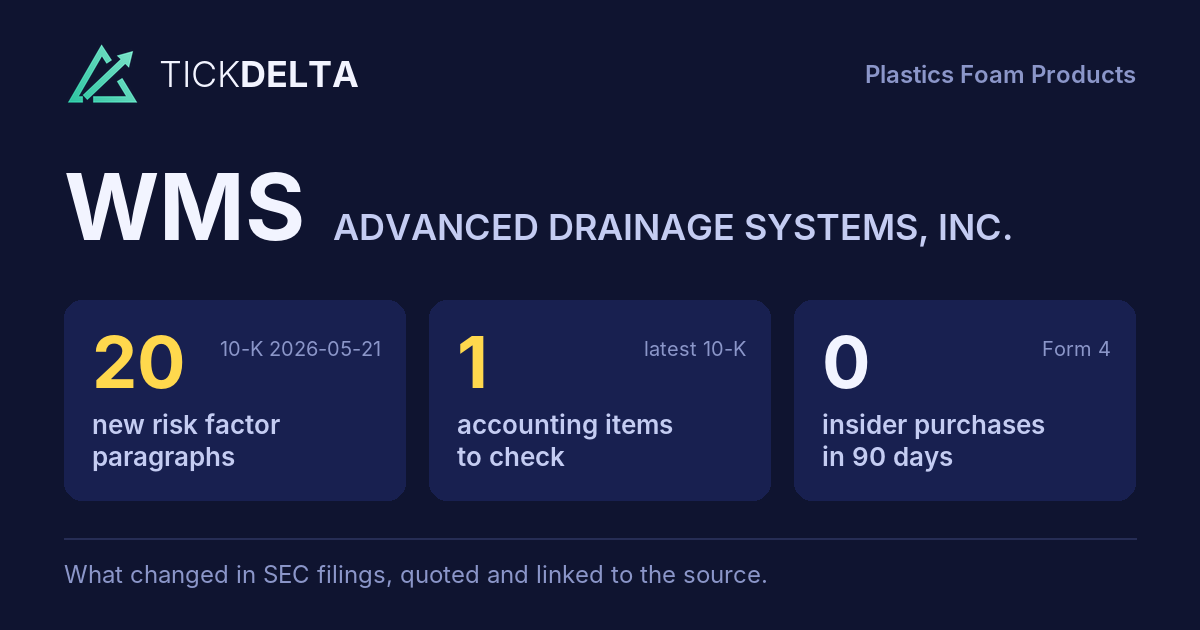
Advanced Drainage Systems, Inc. WMS

Compare with peers Embed
SEC comment letters, last 20 years

3 reviews of WMS's filings by SEC staff

UPLOAD and CORRESP
Reviews 3 latest letter Dec 15, 2020
Questions asked 6 each answered in the company's own letter
No closing letter 0 reviews without a letter saying the staff completed it

When the SEC's staff reviews a filing, it writes to the company with numbered questions, and the company answers each one in a letter. SEC publishes the exchange once the review is over, at least 20 business days later. A question is not an accusation; most reviews end with the company adding detail to its next filing.

How the reviews went

Every review on EDGAR, from the first staff letter to the letter that closes it

  1. 1. Staff letters 3 UPLOAD
  2. 2. Questions in them 6 numbered comments
  3. 3. Company replies 4 CORRESP
  4. 4. Reviews closed 3 of 3 closing letter

Half the closed reviews took 19 days or less from the first letter to the closing letter.

Form 10-K For the Year Ended March 31, 2020

2020-12-15 to 2020-12-29 · 1 question · 1 letter from the SEC, 1 from the company
Review closed 2020-12-29
RevenueSegments
Notes to Consolidated Financial Statements · Note 12 – Business Segment Information, page F-55
SEC asked
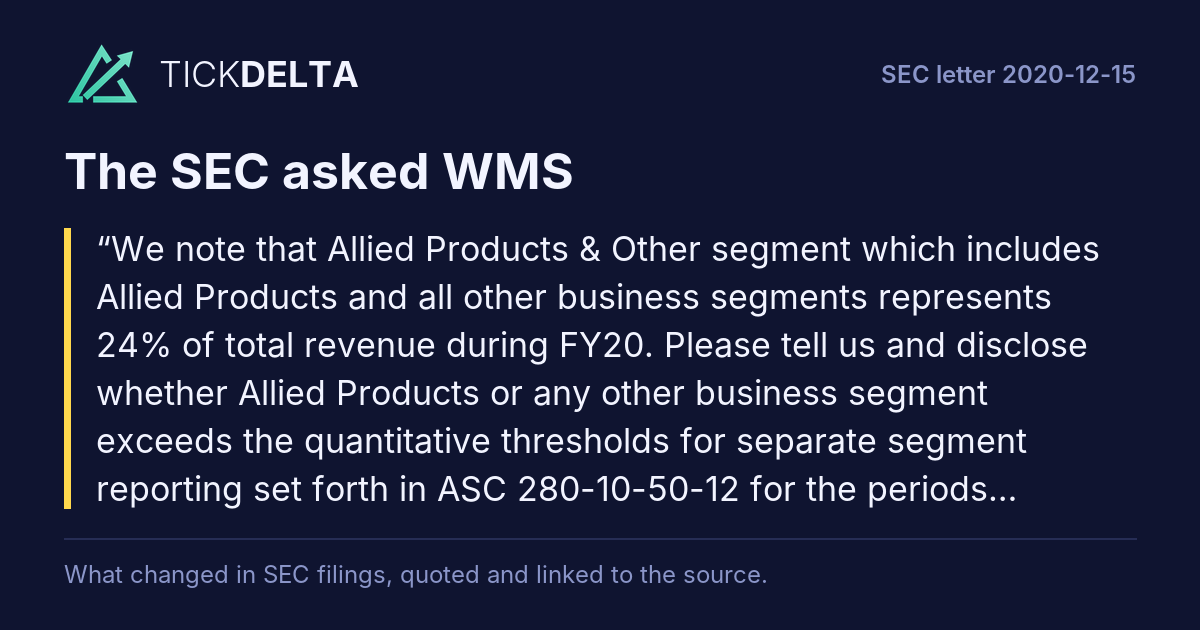
We note that Allied Products & Other segment which includes Allied Products and all other business segments represents 24% of total revenue during FY20. Please tell us and disclose whether Allied Products or any other business segment exceeds the quantitative thresholds for separate segment reporting set forth in ASC 280-10-50-12 for the periods presented.
WMS answered
Our Allied Products & Other segment consists of a range of products which offer adjacent technologies to our core Pipe offerings, providing our customers with a complete drainage solution. The product offerings included within the Allied Products & Other segment consist of our Storm and Septic Chambers, Structures, Fittings and other products.

Our Allied Products & Other segment is an aggregation of separate operating segments.
Rest of the answer

In order to determine whether any operating segments individually, or when aggregated with others, have met the quantitative thresholds for separate segment reporting, we considered guidance in ASC 280-10-50-12.

None of our operating segments within our Allied Products & Other disclosure exceeded more than 10% of reported revenue or reported profit or loss. The largest individual operating segment within Allied Products & Other did not exceed 8% of reported revenue and reported profit. The measure of assets to total operating segment assets is not applicable, as segment assets are not regularly reviewed by the CODM.

In future filings we will disclose the following:

“We aggregate operating segments within our Allied Products & Other segment disclosure. None of our operating segments within our Allied Products & Other businesses segment disclosure exceeds the quantitative thresholds for separate segment reporting.”

Read in the reply
In its next report

First report after the company's reply of Dec 22, 2020: 10-Q filed Feb 4, 2021 ↗, against the 10-Q filed Nov 5, 2020 ↗.

Tickdelta does not hold the text of both reports, so they are not compared here.

Also in this review: closing letter, 2020-12-29

Form 10-K

2018-02-27 to 2018-04-24 · 1 question · 1 letter from the SEC, 2 from the company
Review closed 2018-04-24
Non-GAAP measures
Non-GAAP Financial Measures, page 38 · Adjusted Earnings Per Fully Converted Share, page 38
SEC asked
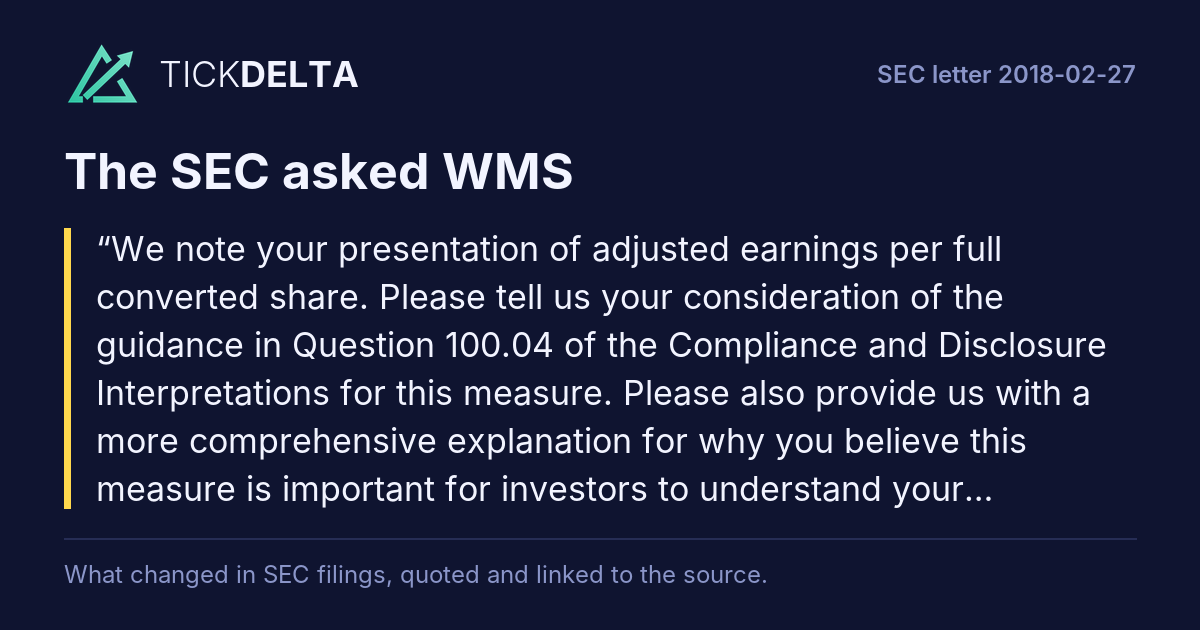
We note your presentation of adjusted earnings per full converted share. Please tell us your consideration of the guidance in Question 100.04 of the Compliance and Disclosure Interpretations for this measure. Please also provide us with a more comprehensive explanation for why you believe this measure is important for investors to understand your performance.
WMS answered
Adjusted Earnings Per Fully Converted Share is a key non-GAAP measure used by management and our Board of Directors to assess our financial performance on a per share basis assuming all shares of the Company’s redeemable convertible preferred stock held by the Company’s tax-qualified Employee Stock Ownership Plan’s trust (“ESOP”) are converted into common stock.
Rest of the answer

We believe this is an important measure that provides investors with meaningful information necessary to understand the impact on the Company’s financial statements once all redeembable convertible preferred stock are converted and distributed.

We have historically utilized this measure in a consistent manner and reviewed its use when the updated C&DI regarding non-GAAP measures, including question 100.04, was released by the SEC. Based on our assessment, we

ADVANCED DRAINAGE SYSTEMS, INC. 4640 TRUEMAN BOULEVARD, HILLIARD, OH 43026 TEL: 614 / 658-0050 800 / 733-7473

HTTP://WWW.ADS-PIPE.COM do not believe Adjusted Earnings Per Fully Converted Share is misleading. Rather, we are providing supplemental information to investors and analysts to assist in evaluating our performance assuming the full conversion of the Company’s redeemable convertible preferred stock. Without access to this information, we believe investors will have difficulty evaluating our performance given our complex capital structure.

The ESOP’s conversion of the redeemable convertible preferred stock into common stock will have a meaningful impact to the Company’s net income per share. Given that this conversion event is certain to occur no later than the 2023 loan maturity date; the Company uses Adjusted Earnings per Fully Converted Share to assess the Company’s financial performance on an assumed post conversion basis.

To provide additional background, the ESOP was established in 1993 and was originally funded with a 30-year term loan from the Company as well as a transfer of assets from the Company’s profit sharing retirement plan, both of which were used to purchase 44.7 million shares of the Company’s redeemable convertible preferred stock. The loan is secured by a pledge of unallocated convertible preferred stock purchased by the ESOP in 1993 with loan proceeds that has not yet been released from the pledge and allocated to ESOP accounts. The ESOP operates as a leveraged ESOP and was designed to enable eligible employees to acquire stock ownership interests in their accounts under the ESOP.

As each year’s ESOP loan payment is made, a portion of the redeemable convertible preferred stock are allocated to the current employees’ retirement accounts within the ESOP from the ESOP’s unallocated ESOP loan suspense account. All redeemable convertible preferred shares held in the ESOP must be allocated to ESOP participants’ accounts upon the maturity date of the ESOP loan in 2023. Upon the ESOP loan maturing in 2023 and the allocation of all shares to the ESOP participant accounts, the ESOP will, within 30 days following the final ESOP loan payment, convert all redeemable convertible preferred shares into common stock.

The Company considered Question 100.04 of the Compliance and Disclosure Interpretations and Rule 100(b) of Regulation G. We do not believe Adjusted Earnings Per Fully Converted Share is misleading, as we believe it is important for the Company’s investors to understand the impact of the conversion of the redeemable convertible preferred stock on common stockholders. We further believe the omission of this measure would make it difficult for investors to evaluate our performance on a post conversion basis, given the Company’s complex capital structure by virtue of the ESOP. We understand from discussions with analysts and investors that they regularly utilize the Adjusted Earnings Per Fully Converted Share measure in their investment analysis and reports in lieu of GAAP earnings per share, and disclose diluted shares outstanding in a manner that is consistent with our fully converted shares outstanding. In addition, we understand that those analysts provide research coverage for the Company regularly add back the expenses related to our ESOP in their investment analysis and published research reports, similar to the disclosures we present in our periodic filings. Given the prominence of Adjusted Earnings per Fully Converted Shares by investors and analysts, we believe it would be detrimental to the investment community to omit this performance measure and place us at a disadvantage to our peers who have a different equity structure.

The Company will expand its current disclosure in future filings (additions are in italics) to clarify the calculation of this measure and how this measure is useful to investors:

Adjusted Earnings Per Fully Converted Share (Non-GAAP) is a key metric used by management and our Board of Directors to assess our financial performance on a per share basis assuming all shares held by the ESOP and all shares of redeemable common stock are converted to common stock. Management and our Board of Directors assess the Company’s financial performance on an assumed post conversion basis. This information is useful to investors as the preferred shares held by the ESOP are required to be distributed to our employees over time, which is done in the form of common stock after the conversion of the preferred shares. This measure also provides investors with meaningful supplemental information to compare the Company’s results with peers which may have a different equity structure. All preferred stock will convert into common stock no later than 30 days following the maturity date of the ESOP. As such, this measure is included in this report to provide the investors with information to understand the impact of the conversion of the redeemable convertible preferred stock on common stockholders. Adjusted Earnings Per Fully Converted Share (Non-GAAP) is not necessarily comparable to other similarly titled captions of other companies due to different methods of calculation.
Read in the reply
In its next report

First report after the company's reply of Mar 12, 2018: 10-K filed May 30, 2018 ↗, against the 10-K filed May 30, 2017 ↗.

Tickdelta does not hold the text of both reports, so they are not compared here.

Also in this review: company letter, Apr 24, 2018, closing letter, 2018-04-24

Form 10-K for the year ended March 31, 2016

2017-03-15 to 2017-04-03 · 4 questions · 1 letter from the SEC, 1 from the company
Review closed 2017-04-03
Results discussion (MD&A)DebtLiquidity and cash
Selling expenses, page 56
SEC asked (1)
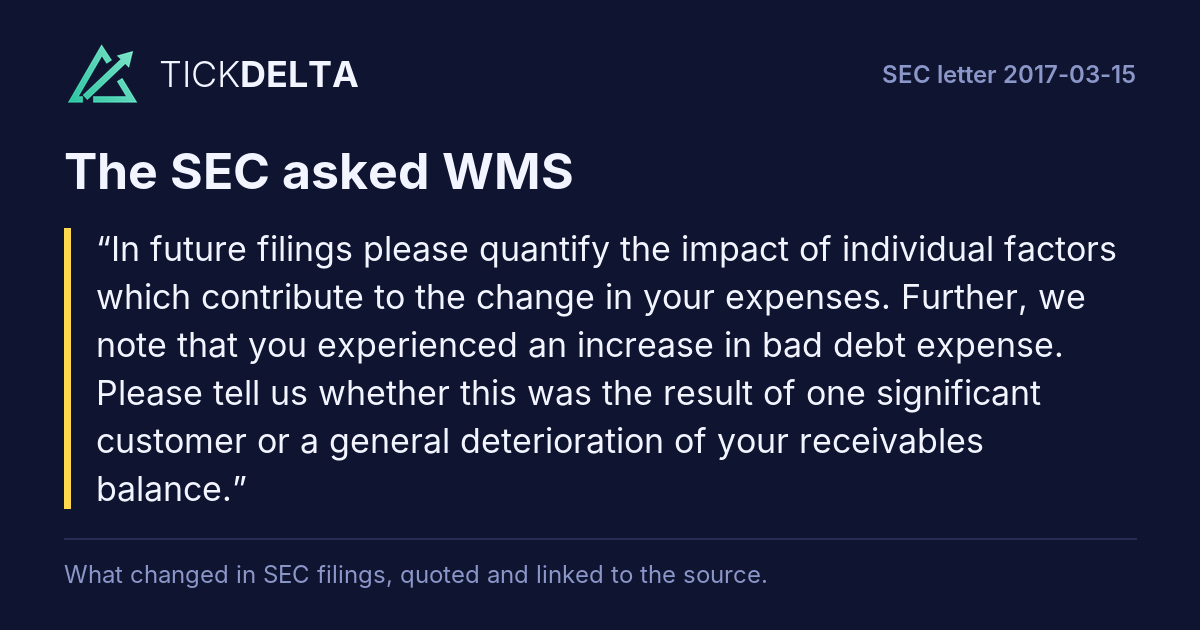
In future filings please quantify the impact of individual factors which contribute to the change in your expenses. Further, we note that you experienced an increase in bad debt expense. Please tell us whether this was the result of one significant customer or a general deterioration of your receivables balance.
WMS answered
The Company acknowledges the Staff’s comment and in future filings the Company will quantify the impact of individual factors which contribute to the change in our expenses. Additionally, the Company advises the Staff that the primary reason for the increase in bad debt expense was related to a write off of a receivable from an unconsolidated affiliate.

The following is a draft of the relevant portion from our 2016 Form 10-K/A that will be revised in future filings, with appropriate revisions for facts and circumstances at that time (changes from disclosure in the 2016 Form 10-K/A are
Rest of the answer

underlined):

ADVANCED DRAINAGE SYSTEMS,

INC. 4640 TRUEMAN BOULEVARD, HILLIARD, OH 43026 TEL: 614 / 658-0050 800 / 733-7473

HTTP://WWW.ADS-PIPE.COM

“Selling expenses for fiscal year ended 2016 increased $8.0 million, or 9.9% over fiscal year 2015. The increase as a percentage of net sales for fiscal year 2016 was primarily driven by bad debt expense and stock-based compensation. Fiscal 2016 included a benefit of $0.5 million from stock-based compensation as compared to expense of $1.5 million for the comparable period, which was primarily the result of the impact that the decrease in the Company’s stock price had on its accounting for liability-classified stock awards. The increase in bad debt expense of $1.6 million was primarily a result of a write off of a receivable from an unconsolidated affiliate.

Read in the reply
In its next report

First report after the company's reply of Mar 29, 2017: 10-K filed May 30, 2017 ↗, against the 10-K filed Sep 15, 2016 ↗.

Tickdelta does not hold the text of both reports, so they are not compared here.

General and administrative expenses, page 57
SEC asked (2)
We note you state that the increase in your general and administrative expenses was primarily the result of significant increases in professional fees for accounting, audit, tax, legal and other professional fees incurred in connection with the restatement of your previously filed financial statements as part of the preparation of your Fiscal 2015 Form 10-K/A.
Rest of the question

It does not appear that you filed an amended Form 10-K for the year ended March 31, 2015. Please explain this disclosure to us or otherwise revise in future filings.

WMS answered
The Company respectfully advises the Staff that the reference to Fiscal 2015 Form 10-K/A in our disclosure relating to the increase in general and administrative expenses was a typographical error. The reference to Fiscal 2015 Form 10-K/A should have instead referred to Fiscal 2015 Form 10-K. The Company will revise this typographical error in future filings.

The following is a draft of the relevant portion from our 2016 Form 10-K/A that will be revised in future filings, with appropriate revisions for facts and circumstances at that time (changes from disclosure in the 2016 Form 10-K/A are
Rest of the answer

underlined):

“General and administrative expenses for the year ended

March 31, 2016 increased $16.6 million, or 21.9%, over fiscal year 2015. The increase was primarily the result of significant increases in professional fees for accounting, audit, tax, legal and other professional fees incurred in connection with the restatement of previously filed quarterly and annual financial statements as part of the preparation of our Fiscal 2015 Form 10-K.”

Read in the reply
In its next report

First report after the company's reply of Mar 29, 2017: 10-K filed May 30, 2017 ↗, against the 10-K filed Sep 15, 2016 ↗.

Tickdelta does not hold the text of both reports, so they are not compared here.

Working Capital, page 63
SEC asked (3)
Your discussion of changes in working capital and operating cash flows is a recitation of information found on the balance sheet. Please revise future disclosures to provide a more complete discussion explaining why the components of working capital and operating cash flows changed from period to period.
WMS answered
acknowledges the Staff’s comment and in future filings the Company will provide more complete discussion explaining why the components of working capital and operating cash flows changed from period to period.

The following is a draft of the relevant portion from our 2016 Form 10-K/A that will be revised in future filings, with appropriate revisions for facts and circumstances at that time (changes from disclosure in the 2016 Form 10-K/A are underlined):

“Working capital decreased to $187.4 million as of March 31, 2016, from $228.9 million as of March 31, 2015, primarily due to a decrease
Rest of the answer

in inventories of $30.1 million, which was a result of increased fourth quarter sales in fiscal 2016 compared to the comparable period. Additionally, our working capital was impacted by an increase in the current maturities of debt obligations of $25.0 million due to a tranche of our Senior Notes becoming due within a year, partially offset by an increase in refundable income taxes included in accounts receivable of

$17.9 million due to increase in our anticipated tax refund.”

“During the fiscal year 2016, cash provided by operating activities was $135.3 million as compared with cash provided by operating activities of $74.4 million for the fiscal year 2015. Cash flows from operating activities during fiscal year 2016 was primarily impacted by higher earnings which was the result of higher sales and increased gross profit from lower raw material costs.”

Read in the reply
In its next report

First report after the company's reply of Mar 29, 2017: 10-K filed May 30, 2017 ↗, against the 10-K filed Sep 15, 2016 ↗.

Tickdelta does not hold the text of both reports, so they are not compared here.

Capital Expenditures, page 64
SEC asked (4)
Please revise future disclosures to identify and discuss the areas or product lines where you have made capital expenditures to increase capacity.
WMS answered
The Company acknowledges the Staff’s comment and in future filings the Company will include additional disclosures which identify and discuss the areas or product lines where they have made capital expenditures to increase capacity.

relevant portion from our 2016 Form 10-K/A that will be revised in future filings, with appropriate revisions for facts and circumstances at that time (changes from disclosure in the 2016 Form 10-K/A are underlined):

“Capital expenditures totaled $44.9 million for fiscal

2016.
Rest of the answer

Our capital expenditures were used primarily for major plant equipment replacements, new equipment to provide capacity additions, facility expansions and yard upgrades, our recycled resin initiatives and capitalized software. Our most significant capital expenditures specifically for increased capacity were $7.9 million in 2016, primarily for tooling for the Midwest and South regions.”

Read in the reply
In its next report

First report after the company's reply of Mar 29, 2017: 10-K filed May 30, 2017 ↗, against the 10-K filed Sep 15, 2016 ↗.

Tickdelta does not hold the text of both reports, so they are not compared here.

Also in this review: closing letter, 2017-04-03

SEC enforcement releases naming WMS

Litigation releases and accounting and auditing enforcement releases (AAER) · sec.gov

1

A release is listed only when SEC's list names ADVANCED DRAINAGE SYSTEMS, INC. (or a name it had before) among those the action is against. The page does not say what the release found: open it on sec.gov. A release against a person at the company, or one that names the company under another spelling, is not matched, so this list can be shorter than SEC's.

Letters without questions

Other letters

UPLOAD and CORRESP
2 other letters: notices that a filing will not be reviewed, requests to declare a registration effective, and the like
  • Aug 12, 2019 · SEC: will not review the filing · Advanced Drainage Systems, Inc. · Registration Statement on Form S-3 · Filed August 1,...
  • Aug 12, 2019 · WMS: letter to the SEC · Advanced Drainage Systems, Inc. · Registration Statement on Form S-3 · File No. 333-232958

From the SEC's correspondence on EDGAR: staff letters (form UPLOAD) and company letters (form CORRESP), 12 letters filed since 2017-03-15. Questions and answers are matched by their numbers; topics come from words in each question. The reports are compared word for word (same form, before the first SEC letter against the first report after the company's reply). No AI.

Sources

The SEC's correspondence on EDGAR: staff letters (form UPLOAD) and company letters (form CORRESP), matched question by question. No AI.

Also

Filings: the letters in the filing list.

Work with it

Excel workbook · CSV. Google Sheet that stays up to date: paste =IMPORTDATA("https://tickdelta.com/company/WMS/export.csv") into a cell.

Next in Owners and insiders:Insider trades
Esc

Type a ticker such as AAPL, a name, an investor such as Buffett, or a topic such as tariffs. ↑ ↓ to move, Enter to open.