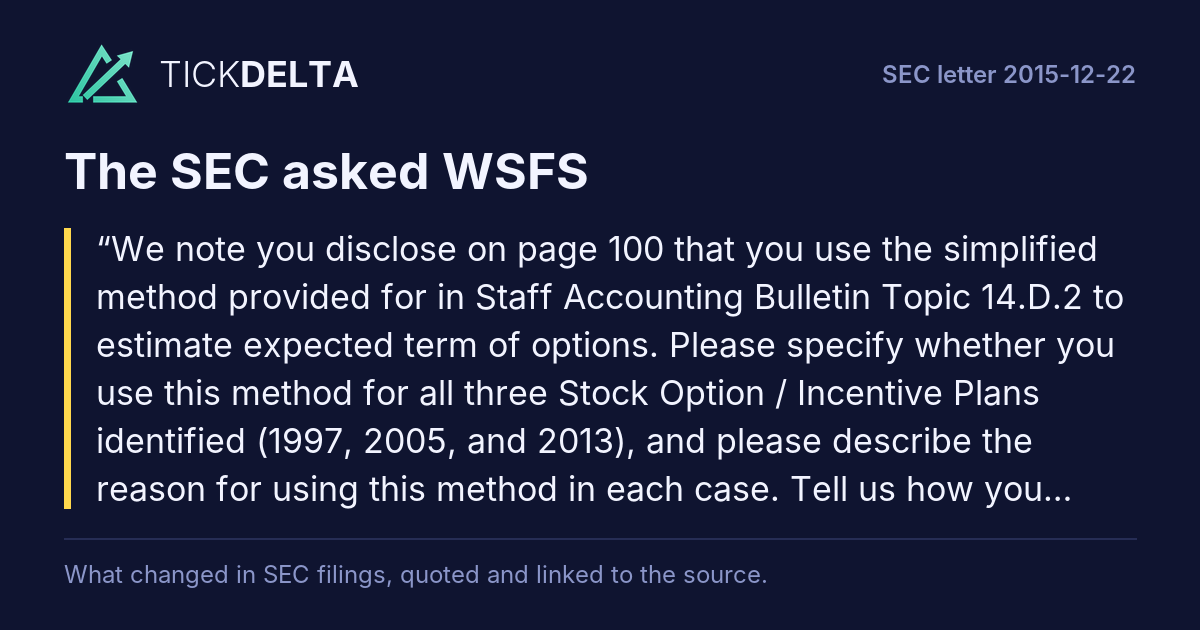
The Company has used the simplified method provided for in Staff Accounting Bulletin (“SAB”) Topic 14.D.2 for all three plans referenced in the Form
. Management has considered the guidance outlined in SAB Topic 14.D.2 including the examples given in which the staff indicated it is appropriate to use this approach.
Further, the options granted under all three plans meet the definition of “plain-vanilla” under the guidance promulgated under SAB Topic 14.D.2 including fixed strike prices and expiration dates,
Rest of the answer
exercisability is based on performance through the vesting date (as termination prior to vesting date results in forfeiture of the options) and a limited time to exercise vested options after termination.
The Company has considered the guidance and reviewed the facts and circumstances for each plan and has determined that its historical share option exercise experience is not sufficient to provide a reasonable basis upon which to estimate the expected term, as outlined in greater detail below.
A.
1997 Plan –The Company initially granted options under this plan to a small group of senior executives with only 15 and 39 participants in 1997 and 1998, respectively. These options were granted following a prolonged period of underperformance by the Company. The Company experienced financial difficulty during the early 1990’s and as a result the stock price was at historically low levels. As the Company hired new management, changed the Board of
Directors, restructured, began to improve and grow, and the stock price increased, options were granted under this plan to a larger and broader level of employees than in previous years, reaching 79 participants in 2004, or a 427% increase from the first year of the plan.
As a result of the factors above, including the structural changes at the Company, the variability in the pool of option holders and option exercise price, management does not feel the historical stock option exercise experience under the 1997 Plan provides a reasonable basis to determine the expected life of the options granted under this plan.
Please note: as of December 31, 2015, there were no outstanding options remaining under the 1997 Plan.
B.
2005 Plan – This plan was approved by shareholders in 2005. Similar to the 1997 Plan, the pool of employees granted options under this plan grew significantly from 79 participants in 2005 to 113 participants in
2013, or an increase of more than 40%. Additionally, options granted under this plan have a term of 5 years, which was a significant reduction from the 10 year term for options granted under the 1997 Plan. Further, in 2002 and 2003, the Company restructured and sold several eclectic and volatile businesses and portfolios of assets to concentrate on a new strategic direction focused on more traditional, steady community banking. Lastly, during the term of the 2005 Plan, the United States went through a financial crisis and a long and protracted recession/recovery. As a result, the Company’s stock price decreased substantially and produced several years in which nearly all of the stock options granted under this plan were
“under-water” (strike prices were above the current stock price at that time). Subsequently, later in the term of this plan, the Company’s stock price experienced significant appreciation. Since 2010, the Company’s stock price has increased from a low of approximately $8 per share to its current trading levels of approximately $31 per share, or an increase of nearly 300% (on a split-adjusted basis). This variable stock price experience does not allow for a reasonable basis to estimate expected term.
As a result of the factors above, management does not feel the historical stock option exercise experience under the 2005 Plan provides a reasonable basis to determine the expected life of the options granted under this plan.
C.
2013 Plan – This plan was approved by shareholders in 2013. Under this plan, the Company has granted options to a significantly smaller group of employees than previous plans with an average of only 13 participants. Further, options granted under this plan have a term of 7 years, which is a significant increase from the 5 year term for options granted under the 2005 Plan, as well as separate vesting and out-of-the-money performance schedules
(strike price above stock price at issuance) for certain options granted under the plan. The Company profile over the previous years had again changed and restructured to grow geographically, add wealth and trust services and focus more intently on fee-based businesses and Return on Asset/Equity performance. Lastly, throughout the term of the 2013 Plan, the Company’s stock price has predominantly experienced significant increases at a relatively consistent pace, and therefore resulted in a lack of variety of price paths to use in determining historical stock option exercise experience.
As a result of the factors above, management does not feel the historical stock option exercise experience under the 2013 Plan provides a reasonable basis to determine the expected life of the options issued under this plan.
Accordingly, under all three plans, based on the Company’s experience with the options granted under such plans as described above, management has determined it is appropriate to follow the simplified method allowed under SAB Topic 14.D.2, as it provides a reasonable basis for estimating the expected term on the options granted under these plans.
The Company will continue to evaluate its historical exercise experience as well as consider the guidance outlined in SAB Topic 14.D.2 in future periods.
Additionally, the Company will ensure it continues to disclose the method it uses to calculate historical exercise experience including the reasons why the method is appropriate in its future filings.