Screener / SEC EDGAR /CIK 0000105016 /Numbers from the XBRL of the 10-Ks
NYSE Industrials · Industrial Distribution

Watsco Inc WSO

Compare with peers Embed
SEC comment letters, last 20 years

2 reviews of WSO's filings by SEC staff

UPLOAD and CORRESP
Reviews 2 latest letter Apr 17, 2019
Questions asked 18 each answered in the company's own letter
No closing letter 0 reviews without a letter saying the staff completed it

When the SEC's staff reviews a filing, it writes to the company with numbered questions, and the company answers each one in a letter. SEC publishes the exchange once the review is over, at least 20 business days later. A question is not an accusation; most reviews end with the company adding detail to its next filing.

How the reviews went

Every review on EDGAR, from the first staff letter to the letter that closes it

  1. 1. Staff letters 2 UPLOAD
  2. 2. Questions in them 18 numbered comments
  3. 3. Company replies 4 CORRESP
  4. 4. Reviews closed 2 of 2 closing letter

Half the closed reviews took 65 days or less from the first letter to the closing letter.

Form 8-K

2019-04-17 to 2019-05-01 · 2 questions · 1 letter from the SEC, 1 from the company
Review closed 2019-05-01
Results discussion (MD&A)Non-GAAP measuresRevenue
After reviewing your response to these comments, we may have additional comments. Exhibit 99.1, page 2
SEC asked (1)
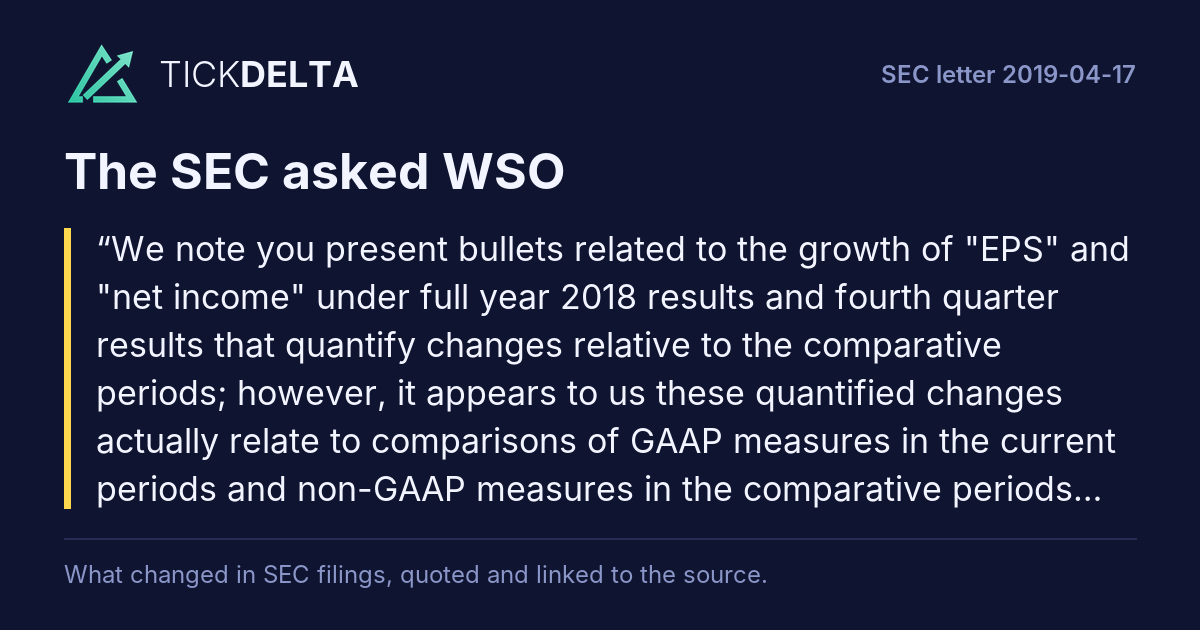
We note you present bullets related to the growth of "EPS" and "net income" under full year 2018 results and fourth quarter results that quantify changes relative to the comparative periods; however, it appears to us these quantified changes actually relate to comparisons of GAAP measures in the current periods and non-GAAP measures in the comparative periods, as indicated in the related footnotes.
Rest of the question

It appears to us these bullets are not accurate and do not appear to comply with our response to Question 102.10 of the C&DIs related to Non-GAAP Financial Measures. To the extent applicable, please revise future filings to ensure your disclosures are accurate and comply with our response to Question 102.10 or explain why you believe the current presentation is appropriate.

WSO answered
We acknowledge the Staff’s comment and respectfully advise the Staff that non-GAAP measures in future filings will be presented with the most directly comparable GAAP measure, which will be given equal or greater prominence to ensure our disclosures comply with the Staff’s response to Question 102.10 of the C&DIs related to Non-GAAP Financial Measures.

Form 10-K for the Fiscal Year Ended

December 31, 2018

Exhibit 13 – Management’s Discussion and Analysis of Financial Condition and

Results of Operations

Results of Operations,
Read in the reply
Operations · Results of Operations, page 5
SEC asked (2)
We note you disclosed that the increase in same-store revenues from 2017 to 2018 was “primarily due to realization of price increases, demand for the replacement of residential and commercial HVAC equipment and a higher mix of high-efficiency air conditioning and heating systems, which sell at higher unit prices”.
Rest of the question

We also note you disclosed in your 2018 annual earnings release that sales growth in 2018 reflects HVAC equipment unit growth, price increases and a richer mix of high-efficiency systems as well as margin expansion in several markets offset by a profit decline in Florida-based locations on slower sales growth and a profit decline in Latin America on lower sales. To the extent applicable, please revise future filings to: • Quantify the impacts of changes in price, changes in volume, and changes in sales mix on revenues during each period presented; and • Quantify and discuss the reasons for differences in changes in regional sales within the United States, to the extent material and necessary to fully understand changes in revenues during each period presented.

WSO answered
We acknowledge the Staff’s comment and respectfully advise the Staff that, to the extent applicable, in our future filings we will quantify the impacts of changes in price, volume, and sales mix on revenues during each period presented and quantify and discuss the reasons for differences in changes in regional sales within the United States, in each case to the to the extent material and necessary to fully understand changes in revenues during each period presented.

If you or any other member of the Staff should have any further comments or questions regarding this response, please do not
Rest of the answer

hesitate to contact the undersigned at (305) 714-4115.
Read in the reply

Also in this review: closing letter, 2019-05-01
Form 10-K for the Fiscal Year Ended December 31, 2009

2010-06-21 to 2013-08-09 · 16 questions · 1 letter from the SEC, 3 from the company
Review closed 2010-08-25
Executive payLiquidity and cashGoodwill and impairmentCritical estimatesResults discussion (MD&A)ControlsRevenueInventory
Form 10-K for the Fiscal Year End December 31, 2009 · Item 9A. Controls and Procedures, page 14
SEC asked (1)
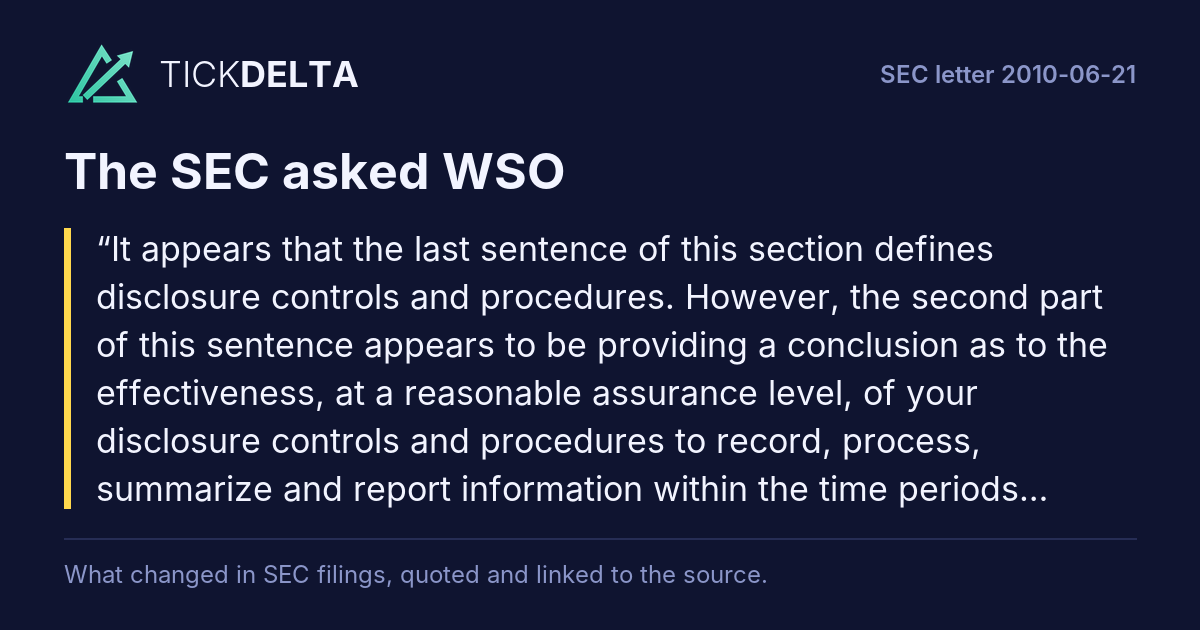
It appears that the last sentence of this section defines disclosure controls and procedures. However, the second part of this sentence appears to be providing a conclusion as to the effectiveness, at a reasonable assurance level, of your disclosure controls and procedures to record, process, summarize and report information within the time periods specified in the Commission’s rules and forms. Please advise.
Rest of the question

Further, to the extent your disclosure controls and procedures are designed to provide reasonable assurance, please confirm to us that with respect to the conclusion disclosed in the second sentence of this section, your principal executive officer and principal financial officer concluded that your disclosure controls and procedures are effective at the reasonable assurance level. Please also respond to this comment with respect to the similar disclosure in your Form 10-Q for the quarter ended March 31, 2010.

WSO answered
The Company supplementally advises the Staff that (i) the second part of the last sentence set forth under the heading “Evaluation of Disclosure

Controls and Procedures” contained in each of the referenced Items expressed management’s (inclusive of the Company’s principal executive officer and principal financial officer) conclusion that the Company’s disclosure controls and procedures were effective, at a reasonable assurance level, at and as of the end of the respective fiscal periods covered by such reports, and (ii) in future filings with the Commission, in order to eliminate any
Rest of the answer

ambiguity, the Company intends to revise its disclosure to read substantially as follows (assuming management’s conclusion that the Company’s disclosure controls and procedures are effective, at a reasonable assurance level, at and as of the end of the periods covered by such future filings):

“We maintain disclosure controls and procedures (as defined in Rule 13a-15(e) under the

Securities Exchange Act of 1934, as amended (“the Exchange Act”)) that are, among other things, designed to ensure that information required to be disclosed by us under the Exchange Act is accumulated and communicated to management, including our Chief Executive Officer (“CEO”), Senior Vice President (“SVP”) and Chief Financial Officer (“CFO”), to allow for timely decisions regarding required disclosure and appropriate SEC filings.

Our management, with the participation of our CEO, SVP and CFO, has evaluated the effectiveness of our disclosure controls and procedures as of the end of the period covered by this report, and, based on that evaluation, our CEO, SVP and CFO have concluded that our disclosure controls and procedures were effective, at a reasonable assurance level, at and as of such date.”

Read in the reply
In its next report

First report after the company's reply of Jul 6, 2010: 10-Q filed Aug 6, 2010 ↗, against the 10-Q filed May 7, 2010 ↗.

Tickdelta does not hold the text of both reports, so they are not compared here.

Item 15. Exhibits and Financial Statement Schedules, page 15
SEC asked (2)
We note that you have not filed on EDGAR the exhibits and schedules to the revolving credit agreement filed as exhibit 10.12 to the Form 10-K. We also note that you incorporate this agreement by reference to a Form 8-K filed on August 6, 2007. Please amend this Form 8-K to file a complete, executed copy of this agreement, including all exhibits and schedules.
WSO answered
The Company supplementally advises the Staff that it will amend the subject Form 8-K to include a complete, executed copy of the revolving credit agreement, together with all exhibits and schedules thereto.
Read in the reply
In its next report

First report after the company's reply of Jul 6, 2010: 10-Q filed Aug 6, 2010 ↗, against the 10-Q filed May 7, 2010 ↗.

Tickdelta does not hold the text of both reports, so they are not compared here.

Item 15. Exhibits and Financial Statement Schedules, page 15
SEC asked (3)
We note that you have not filed on EDGAR the schedules to your credit agreement filed as exhibit 10.17 to the Form 10-K. We also note that you incorporate this agreement by reference to a Form 8-K filed on July 8, 2009. Please amend this Form 8-K to file a complete, executed copy of this agreement, including all schedules.
WSO answered
The Company supplementally advises the Staff that it will amend the subject Form 8-K to include a complete, executed copy of the credit agreement, together with all exhibits and schedules thereto.
Read in the reply
In its next report

First report after the company's reply of Jul 6, 2010: 10-Q filed Aug 6, 2010 ↗, against the 10-Q filed May 7, 2010 ↗.

Tickdelta does not hold the text of both reports, so they are not compared here.

Item 15. Exhibits and Financial Statement Schedules, page 15
SEC asked (4)
We note the revolving credit agreement filed as exhibit 10.18 to the Form 10-K and have the following comments: • It does not appear that you have filed on EDGAR the exhibits and schedules to this agreement. Please file with your next periodic report or with a current report on Form 8-K a complete, executed copy of this agreement, including all exhibits and schedules.
Rest of the question

• The exhibit 10.18 description references Amendment No. 1. However, it does not appear that this amendment has been filed on EDGAR. Please file with your next periodic report or with a current report on Form 8-K a complete, executed copy of this amendment, including all exhibits and schedules.

WSO answered
supplementally advises the Staff that it will file a complete, executed copy of the revolving credit agreement, together with all exhibits and schedules thereto in a current report on Form 8-K.

The exhibit 10.18 description references Amendment No. 1. However, it does not appear that this amendment has been filed on

EDGAR. Please file with your next periodic report or with a current report on Form 8-K a complete, executed copy of this amendment, including all exhibits and schedules.

supplementally advises the Staff that it will file a complete, executed copy of Amendment No.
Rest of the answer

1, together with all exhibits and schedules thereto in a current report on Form 8-K. The Company did not file on EDGAR the actual Amendment No. 1 to Revolving Credit Agreement as its contents are contained in the revolving credit agreement filed as exhibit 10.18 to the Form 10-K.

Read in the reply
In its next report

First report after the company's reply of Jul 6, 2010: 10-Q filed Aug 6, 2010 ↗, against the 10-Q filed May 7, 2010 ↗.

Tickdelta does not hold the text of both reports, so they are not compared here.

Critical Accounting Policies · Valuation of Goodwill and Indefinite Lived Intangible Assets
SEC asked (5)
Please tell us and disclose in future filings whether you have multiple reporting units that are subject to goodwill impairment testing, and supplementally provide us with your analysis that supports this determination. See FASB ASC 350-20-35-34 through 35-38 for guidance.
WSO answered
The Company supplementally advises the Staff that the Company has only one reporting unit that is subject to goodwill impairment testing.

Goodwill is tested for impairment at the consolidated company level because we have determined that we have one operating segment, and the components of that segment meet the criteria for aggregation. Our conclusion is based in part on the guidance provided by FASB ASC 350-20-35-33 through 35-38 and FASB ASC 280-10-50-1 through 50-11.

Our single operating segment and single reportable segment is Distribution.
Rest of the answer

The Distribution segment is a network of locations that distribute air conditioning, heating, and refrigeration equipment and related parts and supplies (“HVAC/R”). We currently distribute HVAC/R products through a network of 505 locations in 36 states, Puerto Rico, Latin America and the Caribbean, and we conduct our business through four subsidiaries, which we have acquired in several transactions since entering HVAC/R distribution in 1989.

Although the subsidiaries have discrete financial information that is reviewed by management, and therefore meet the definition of “components,” they have similar economic traits and characteristics and are therefore aggregated. We continuously consider a number of factors in determining whether the aggregation of our subsidiaries into one reporting unit for the testing of goodwill impairment is appropriate, including the following:

a.

Similar economic traits and characteristics – Financial results for all of our locations follow similar trends and are affected similarly by, among other things, general economic conditions, fluctuations in certain commodity costs, supplier concentration, new housing starts and completions, capital spending in the commercial construction market, the seasonal nature of our product sales, weather conditions and government regulations impacting our industry and products. Additionally, selling margins on our products are consistent across all of our locations and subsidiaries.

b.

Nature of the products – Similar HVAC/R products are distributed at each of our locations, and product knowledge and vendor relationships are shared

Company-wide. In addition, we have centralized vendor relationship management and product procurement whereby we negotiate vendor programs on a consolidated basis.

c.

Nature of the production processes – The selling, distribution and warehousing processes are similar across all of our locations. Our senior management requires common business practices, operating dynamics, logistics and fulfillment processes and entity-level controls and procedures.

d.

Type or class of customer for products – All of our locations focus on the same customers – licensed air conditioning contractors and dealers – and many customers are shared in overlapping markets.

e.

Methods used to distribute products – Product distribution is handled consistently at each of our locations through a combination of direct delivery

(primarily on our fleet of trucks), customer pickups and direct delivery from our vendors to the customers’ jobsites.

f.

Nature of the regulatory environment – All of our locations are subject to the same federal, state and local laws and regulations impacting our industry and products.

g.

Common functions – All credit, human resources, accounting, strategic and financial planning, treasury, tax, working capital management, risk management, safety and internal audit activities are supported by corporate vice presidents, directors or managers located at a our corporate offices in Coconut Grove, Florida. Also, we have company-wide employee benefit programs, insurance coverage and banking relationships.

Further, the following additional items addressed in FASB ASC 350-20-55-6 through 55-7 were considered:

The manner in which an entity operates its business and the nature of those operations – Please see items a. through g. above.

Whether goodwill is recoverable from the separate operations of each component business or from two or more component businesses working in concert (which might be the case if the components are economically interdependent) – Our subsidiaries operate and report alike as components of the Company as described above rather than economically independent businesses; therefore, goodwill benefits are shared across the Company. Also, as discussed above, our vendor relationships and vendor-related programs are shared across all locations; consequently, each location benefits from the purchasing synergies created by our other subsidiaries.

The extent to which the component businesses share assets and other resources, as might be evidenced by extensive transfer pricing mechanisms – Our subsidiaries and locations share resources as noted in item g. above.

Whether the components support and benefit from common research and development projects – Our distribution business does not lend itself to research and development projects, however, as described above, our subsidiaries share resources, “know-how” and assets; and key functions, including vendor relationships, credit and cash management, are centrally managed also as described above.

Based on the above, we have determined that our components (i.e., subsidiaries) meet the criteria for aggregation into one reporting unit for the testing of goodwill impairment.

We supplementally advise the Staff that, in our future filings, we will disclose that we have only one reporting unit that is subject to goodwill impairment testing.

Read in the reply
In its next report

First report after the company's reply of Jul 6, 2010: 10-Q filed Aug 6, 2010 ↗, against the 10-Q filed May 7, 2010 ↗.

Tickdelta does not hold the text of both reports, so they are not compared here.

Critical Accounting Policies · Valuation of Goodwill and Indefinite Lived Intangible Assets
SEC asked (6)
To the extent that any of your reporting units have estimated fair values that are not substantially in excess of their carrying value, and goodwill for these reporting units, in the aggregate or individually, could materially impact your operating results, please revise future filings to provide the following disclosures for each reporting unit: • The percentage by which fair value exceeds carrying value as of the
Rest of the question

most-recent stepone test. • The amount of goodwill allocated to the reporting unit. • A description of the assumptions that drive the estimated fair value. • A discussion of any uncertainties associated with the key assumptions. For example, to the extent that you have included assumptions in your discounted cash flow model that deviate from your historical results, please include a discussion of these assumptions. • A discussion of any potential events, trends and/or circumstances that could have a negative effect on estimated fair value. • Any other material and useful information you gather and analyze regarding the risks of recoverability of your goodwill. If you have determined that estimated fair values substantially exceed carrying values for your reporting units, please disclose that determination in future filings. Refer to Item 303 of Regulation S-K and Sections 216 and 501.14 of the Codification of Financial Reporting Policies for guidance.

WSO answered
We advise the Staff that in our future filings we will disclose the determination that the estimated fair value of our sole reporting unit substantially exceeds its carrying value.
Read in the reply
In its next report

First report after the company's reply of Jul 6, 2010: 10-Q filed Aug 6, 2010 ↗, against the 10-Q filed May 7, 2010 ↗.

Tickdelta does not hold the text of both reports, so they are not compared here.

Results of Operations · General
SEC asked (7)
In your discussion of revenue, gross profit and selling, general and administrative expenses, you refer to “same-store basis” when discussing fluctuations between periods. In future filings, please consider quantifying the amount of stores that are included in your baseline of “same-store basis,” as well as providing a rollfoward that indicates additions and reductions to this amount during the year.
Rest of the question

We believe this presentation will enhance your current disclosures by providing context to the information you have provided.

WSO answered
We advise the Staff that in our future filings we will quantify the number of stores that are included in the baseline of “same-store basis” and provide a rollforward that indicates additions and reductions to this number during the year to enhance our current disclosures.
Read in the reply
Liquidity and Capital Resources · Operating Activities
SEC asked (8)
In future annual filings, please discuss the primary reason(s) for the material fluctuations to your working capital items, to the extent applicable (for example, the reason for lower reductions in inventories). See Section 501.13.b.1 of the Codification of Financial
WSO answered
We advise the Staff that in our future annual filings, we will disclose the primary reason(s) for material fluctuations in our working capital items, to the extent applicable.
Read in the reply
In its next report

First report after the company's reply of Jul 6, 2010: 10-Q filed Aug 6, 2010 ↗, against the 10-Q filed May 7, 2010 ↗.

Tickdelta does not hold the text of both reports, so they are not compared here.

Consolidated Financial Statements · Note 15 – Supplemental Cash Flow Information
SEC asked (9)
In future filings, please revise your disclosure to include the non-cash consideration issued to Carrier for the 60% controlling interest in the joint venture. See FASB ASC 230-10-50-3 for guidance.
WSO answered
We advise the Staff that in our future filings we will revise our footnote disclosure of supplemental cash flow information to include the non-cash consideration issued to Carrier for our 60% controlling interest in the joint venture.
Read in the reply
In its next report

First report after the company's reply of Jul 6, 2010: 10-Q filed Aug 6, 2010 ↗, against the 10-Q filed May 7, 2010 ↗.

Tickdelta does not hold the text of both reports, so they are not compared here.

Risk Considerations in our Compensation Programs, page 19
SEC asked (10)
We note your disclosure in response to Item 402(s) of Regulation S-K. Please describe the process you undertook to reach the conclusion.
WSO answered
The Company supplementally advises the Staff that its Compensation Committee (the “Committee”), which determines the compensation of the Company’s CEO, reviews the compensation of the Company’s other executive officers and administers benefit plans and policies, determined that such plans and policies do not create risks that are reasonably likely to have a material adverse effect on the Company. The Committee believes that the Company’s incentive compensation plan is designed to promote the creation of long-term value and thereby discourage behavior that leads to excessive risk.
Rest of the answer

For example, the Committee noted that stock options become exercisable over a three to four year period and remain exercisable for up to five years (ten years for options issued prior to June 2004) from the date of grant, encouraging employees to look to long-term appreciation in equity values. In addition, awards of non-vested (restricted) stock generally vest upon attainment of the employee’s retirement age. On average, this vesting date is nine years from now. The Committee believes that the longer vesting periods encourage employees to attain sustained success over several years, without encouraging excessive risk taking to achieve short-term results.

The Committee noted that, with respect to our named executive officers and our subsidiary presidents, key attributes of our compensation philosophy, which are implemented by the Committee, are risk sharing and the creation of value over a primarily long-term time horizon. Variable compensation, which is tied to Company performance, comprises the largest portion of the named executive officers’ compensation and subjects such persons to reduced compensation in the event the Company’s results suffer. Additionally, short-term compensation incentives represented just 2% of variable compensation whereas long-term incentives represented 98% of variable compensation for the year ended December 31, 2009.

The overall compensation policies and practices of the Company generally encourage innovation and appropriate levels of risk taking. However, the Company noted that the HVAC/R distribution business is not particularly conducive to risk-taking by employees seeking greater compensation. Common business practices are used at each of our subsidiaries in structuring compensation programs for employees that are primarily variable in nature and are tied to Company’s performance. Additionally, the financial results of our subsidiaries follow similar trends including profitability and compensation expense as a percentage of revenues.

In light of the foregoing, and in connection with its review of the Company’s compensation policies, taking into account that the Company’s compensation policies do not incentivize its employees, at any level, to engage in fiscally risky behavior in a quest for greater remuneration, the

Company concluded that its compensation programs do not create or encourage the taking of risks that are reasonably likely to have a material adverse effect on the Company.

Read in the reply
In its next report

First report after the company's reply of Jul 6, 2010: 10-Q filed Aug 6, 2010 ↗, against the 10-Q filed May 7, 2010 ↗.

Tickdelta does not hold the text of both reports, so they are not compared here.

Compensation Discussion and Analysis, page 20 · Financial and Non-Financial Metrics Used in Compensation Programs, page 21
SEC asked (11)
In future filings, please revise to clearly explain how you consider each financial and non-financial performance metric in your determination of each named executive officer’s compensation. Please also explain whether you assign a particular weight to each metric in your consideration and identify the performance metrics used in your determination regarding each element of compensation.
WSO answered
We advise the Staff that in our future filings we will clearly explain how we consider cash financial and non-financial performance metric in our determination of each named executive officer’s compensation. Also, we will explain whether we assign a particular weight to each metric in our consideration and identify the performance metric used in our determination regarding each element of compensation.
Read in the reply
In its next report

First report after the company's reply of Jul 6, 2010: 10-Q filed Aug 6, 2010 ↗, against the 10-Q filed May 7, 2010 ↗.

Tickdelta does not hold the text of both reports, so they are not compared here.

Review of Named Executive Officers and Subsidiary Presidents Performance, page 22
SEC asked (12)
In future filings, please revise to further explain how the Committee balances each compensation element against competitive salary levels. For example, does the Committee use general compensation survey data or does it benchmark its compensation to selected peer companies?
WSO answered
We advise the Staff that in our future filings we will further explain how the Committee balances each compensation element against competitive salary levels.
Read in the reply
In its next report

First report after the company's reply of Jul 6, 2010: 10-Q filed Aug 6, 2010 ↗, against the 10-Q filed May 7, 2010 ↗.

Tickdelta does not hold the text of both reports, so they are not compared here.

Elements of Compensation, page 22 · Base Salary, page 23
SEC asked (13)
We note that the base salary amounts for each named executive officer decreased from 2008 to 2009. In future filings, please provide a materially complete description of the reasons why you determined to change base salary amounts.
WSO answered
We advise the Staff that in our future filings we will provide a materially complete description of the reasons why we determined to change base salary amounts for each named executive officer.
Read in the reply
In its next report

First report after the company's reply of Jul 6, 2010: 10-Q filed Aug 6, 2010 ↗, against the 10-Q filed May 7, 2010 ↗.

Tickdelta does not hold the text of both reports, so they are not compared here.

Annual Cash Incentives, page 23
SEC asked (14)
In future filings, please provide a materially complete description of the compensation decisions relating to annual cash incentives. For example, explain why the committee determined not to pay cash incentives, such as failure to meet specified and disclosed performance targets.
Rest of the question

Please also identify the specific company and individual performance expectations you evaluate in determining whether each named executive officer will receive an annual incentive payment. See Items 402(b)(2)(v) and 402(b)(2)(vii) of Regulation S-K.

WSO answered
We advise the Staff that in our future filings we will provide a materially complete description of the compensation decisions relating to annual cash incentives.
Read in the reply
In its next report

First report after the company's reply of Jul 6, 2010: 10-Q filed Aug 6, 2010 ↗, against the 10-Q filed May 7, 2010 ↗.

Tickdelta does not hold the text of both reports, so they are not compared here.

Long-Term Share-Based Compensation, page 23
SEC asked (15)
In future filings, please revise to explain how you determine the allocation of nonqualified options and non-vested (restricted) stock awards. See Item 402(b)(2)(iii) of Regulation S-K.
WSO answered
We advise the Staff that in our future filings we will revise to explain how we determine the allocation of non-qualified stock options and non-vested (restricted) stock awards.
Read in the reply
In its next report

First report after the company's reply of Jul 6, 2010: 10-Q filed Aug 6, 2010 ↗, against the 10-Q filed May 7, 2010 ↗.

Tickdelta does not hold the text of both reports, so they are not compared here.

Chief Executive Officer, page 24
SEC asked (16)
In future filings, please explain why your chief executive officer’s incentive compensation is structured in a different manner than that of your other named executive officers.
WSO answered
We advise the Staff that in future filings we will explain why our chief executive officer’s incentive compensation is structured in a different manner than that of our other named executive officers.

In responding to your comments, we acknowledge that:

the Company is responsible for the adequacy and accuracy of the disclosures in its filings;

staff comments or changes to disclosure in response to staff comments do not foreclose the Commission from taking any action with respect to the filing; and the Company may not assert staff comments as a defense in any proceeding initiated by the
Rest of the answer

Commission or any person under the federal securities laws of the United States.

If you or any other member of the Staff should have any further comments or questions regarding this response, please do not hesitate to contact the undersigned at (305) 714-4115.

Read in the reply
In its next report

First report after the company's reply of Jul 6, 2010: 10-Q filed Aug 6, 2010 ↗, against the 10-Q filed May 7, 2010 ↗.

Tickdelta does not hold the text of both reports, so they are not compared here.

Also in this review: company letter, Aug 6, 2010, company letter, Aug 9, 2013, closing letter, 2010-08-25

Letters without questions

Other letters

UPLOAD and CORRESP
6 other letters: notices that a filing will not be reviewed, requests to declare a registration effective, and the like
  • Oct 29, 2024 · WSO: letter to the SEC · Form 10-K for the Fiscal Year Ended December 31, 2023 · Filed February 23, 2024 · File...
  • Aug 29, 2022 · SEC: review completed · WATSCO INC · Form 10-K for the Fiscal Year Ended December 31, 2021 · Filed February...
  • Aug 26, 2022 · WSO: letter to the SEC · Form 10-K for the Fiscal Year Ended December 31, 2021 · Filed February 25, 2022 · Form...
  • Jul 19, 2017 · SEC: review completed · Watsco, Inc. · Form 10-K for the Year Ended December 31, 2016 · Filed February 21,...
  • Jul 17, 2017 · WSO: letter to the SEC · Form 10-K for the Year Ended · December 31, 2016 · Filed February 21, 2017 · Form 8-K...
  • Aug 20, 2013 · SEC: review completed · Watsco, Inc. · Form 10-K for the Fiscal Year Ended December 31, 2012 · Filed February...

From the SEC's correspondence on EDGAR: staff letters (form UPLOAD) and company letters (form CORRESP), 14 letters filed since 2010-06-21. Questions and answers are matched by their numbers; topics come from words in each question. The reports are compared word for word (same form, before the first SEC letter against the first report after the company's reply). No AI.

Sources

The SEC's correspondence on EDGAR: staff letters (form UPLOAD) and company letters (form CORRESP), matched question by question. No AI.

Also

Filings: the letters in the filing list.

Work with it

Excel workbook · CSV. Google Sheet that stays up to date: paste =IMPORTDATA("https://tickdelta.com/company/WSO/export.csv") into a cell.

Next in Owners and insiders:Insider trades
Esc

Type a ticker such as AAPL, a name, an investor such as Buffett, or a topic such as tariffs. ↑ ↓ to move, Enter to open.