Screener / SEC EDGAR /CIK 0001015328 /10-K filed Feb 26, 2026, compared with Feb 28, 2025 /Numbers from the XBRL of the 10-Ks
Nasdaq Financials · Banks

Wintrust Financial Corp WTFC

Compare with peers Embed
The 10-K against last year's

213 changes: 11 added, 19 removed, 183 reworded

10-K Feb 26, 2026 vs Feb 28, 2025

10-K 0001015328-26-000007 (Feb 26, 2026) vs 10-K 0001015328-25-000093 (Feb 28, 2025) Not compared: Legal Proceedings, Accounting Policies.

Every paragraph, and how much of it changed

One bar per paragraph, in the order of the 10-K. Height and colour show the share of its words not in the closest paragraph a year earlier; the tallest bars are new paragraphs.

Risk Factors

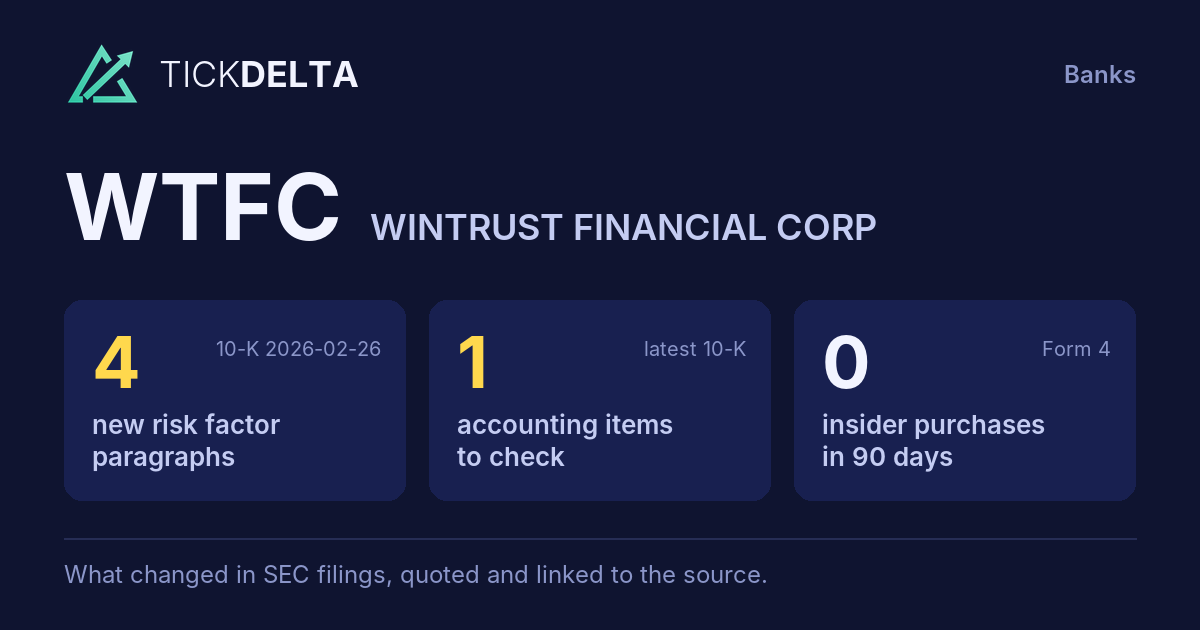
185 paragraphs · 4 new · 47 reworded · 1 gone · 10-K Feb 26, 2026 against Feb 28, 2025
New paragraph Reworded (5% of its words or more) Same or nearly
Paragraph 162 · 44% changed Every version of it
We, our customers, regulators and other third parties, including other financial services institutions and companies engaged in data processing, have been subject to, and are likely to continue to be the target of, cyber-attacks, information or security breaches, and other similar incidents. These may include, among other things, computer viruses, malicious or destructive code, phishing attacks, denial of service or information, ransomware, malfeasance or improper access by employees or vendors, attacks on personal email of employees, hacking, terrorist activities, identity theft, social engineering, credential stuffing, account takeovers, insider threats, human error, fraud, or other similar incidents that could result in the unauthorized release, gathering, monitoring, misuse, misappropriation, loss, disclosure or destruction of confidential, personal, proprietary and other information of ours, our employees, our customers or of third parties, damage to our systems and networks or other material disruption of our or our customers’ or other third parties’ network access or business operations. As cyber threats continue to evolve, we may be required to expend significant additional resources to continue to modify or enhance our protective measures or to investigate and remediate any information security vulnerabilities or incidents. Despite efforts to ensure the integrity of our systems and implement controls, processes, policies and other protective measures, we may not be able to anticipate all security breaches, nor may we be able to implement guaranteed preventive measures against such security breaches. Cyber threats are rapidly evolving and we may not be able to anticipate or prevent all such attacks and could be held liable for any security breach or loss.
Paragraph 6 · 43% changed Every version of it
Changes interpretation of existing laws, changes in accounting policies or accounting standards and changes in U.S. trade policies, including the imposition of tariffs and retaliatory tariffs, may adversely impact our business, financial condition and results of operations. tariffs.
Paragraph 167 · 41% changed Every version of it
Although we believe that we have appropriate information security procedures and controls designed to prevent or limit the effects of a cyber-attack, information security breach or other similar incident, our or our customers’ and/or third parties’ computers, systems or systems, networks and infrastructure may be the target of cyber-attacks, information security breaches or other similar incidents that could result in the unauthorized release, accessing, gathering, monitoring, loss, destruction, modification, acquisition, transfer, use or other processing of our or our customers’ confidential, personal, proprietary and other information. Additionally, we may not be insured against all types of losses as a result of cyber-attacks, information security breaches and other similar incidents, and our insurer may deny coverage as to any future claim or insurance coverage may not be available on reasonable terms, or at all, or may be inadequate to cover all losses resulting from such incidents.
Paragraph 39 · 39% changed Every version of it
Wintrust’s ability to engage in routine funding transactions could be adversely affected by the actions and commercial soundness of other financial institutions. Financial services institutions are interrelated as a result of trading, clearing, counterparty or other relationships. We have exposure to many different industries and counterparties and routinely execute transactions with counterparties in the financial services industry, including the Federal Home Loan Bank (“FHLB”), commercial banks, brokers and dealers, investment banks and other institutional clients. Many of these transactions expose us to credit risk as well as market and liquidity risk in the event of a default by a counterparty or client. In addition, our credit risk
Paragraph 99 · 37% changed Every version of it
Although we believe our allowance for credits losses is adequate to absorb estimated credit losses in our loan portfolio, if our estimates are inaccurate and our actual credit losses exceed the amount that is anticipated, or if the forecasts and assumptions used in calculating our reserves are significantly different from those we actually experience, our financial condition and liquidity could be materially adversely affected.
Paragraph 79 · 37% changed Every version of it
The U.S. Basel III Rule, as well as other aspects of current or proposed regulatory or legislative changes to laws applicable to banking organizations, have increased our compliance costs, impacted the profitability of our business activities and may change certain of our business practices, including the ability to offer new products, obtain financing, attract deposits, make loans, and achieve satisfactory interest spreads, and could expose us to additional costs, including increased compliance costs. These changes also may require us to invest significant management attention and resources to make any necessary changes to operations in order to comply, and could therefore also materially and adversely affect our business, financial condition and results of operations.
Paragraph 65 · 34% changed Every version of it
We are subject to extensive federal and state regulation and supervision. The cost of compliance with such laws and regulations can be substantial and adversely affect our ability to operate profitably. Changes in the U.S. presidential administration and Congress have led and will likely continue to lead to changes in law or policy. In addition, changes in key personnel at the agencies that regulate us, including the federal banking regulators, may result in differing interpretations of existing rules and guidelines. Although the current presidential administration has indicated an intent to pursue the regulation of the financial services industry differently than was the case under the previous administration, there is significant uncertainty regarding the direction this administration will continue to take and its ability to implement its policies and objectives, as well as the ultimate impact on potential new regulatory initiatives and the enforcement of existing laws and regulations. While we are unable to predict the scope or impact of any potential legislation or regulatory action until it becomes final, action, it is possible that changes in applicable laws, regulations or interpretations thereof could significantly increase our regulatory compliance costs, impede the efficiency of our internal business processes, negatively impact the recoverability of certain of our recorded assets, require us to increase our regulatory capital, interfere with our executive compensation plans, or limit our ability to pursue business opportunities in an efficient manner including our plan for de novo growth and growth through acquisitions. It is also possible the expected changes in regulation do not occur or are reversed by a subsequent administration, or the regulatory measures that are ultimately enacted deliver significant competitive advantages to financial services that are structured differently or serve different markets than us.
Paragraph 83 · 33% changed Every version of it
Non-compliance with the USA PATRIOT Act, BSA or Bank Secrecy Act and its implementing regulations, and other applicable anti-money laundering laws and regulations could result in fines or sanctions.

MD&A

251 paragraphs · 7 new · 88 reworded · 18 gone · 10-K Feb 26, 2026 against Feb 28, 2025
New paragraph Reworded (5% of its words or more) Same or nearly
Paragraph 60 · 44% changed
CRE Price Dow Jones Total Stock Market Index Increases Decreases Commercial Real Estate: Construction Decreases estimate by 35%-40% 5%-10% Increases estimate by 130%-135% Non-Construction Decreases estimate by 25%-30% Increases estimate by 45%-50% 5%-10%
Paragraph 95 · 42% changed
Service charges on deposit accounts increased in 2024 2025 compared to 2023 2024 primarily as a result of higher fees associated with commercial account analysis fees. Service charges on deposit accounts include fees charged to deposit customers for various services, including account analysis services, and are based on factors such as the size and type of customer, type of product and number of transactions. The fees are based on a standard schedule of fees and, depending on the nature of the service performed, the service is performed at a point in time or over a period of a month.
Paragraph 45 · 42% changed
The primary drivers of profitability of the wealth management business can be associated with the level of commission received related to the trading performed by the brokerage customers for their accounts and the amount of assets under management in which the unit receives a management fee for advisory, administrative and custodial services. As such, revenues are influenced by a rise or fall in the debt and equity markets and the resulting increase or decrease in the value of our client accounts on which our fees are based. The commissions received by the brokerage unit are not as directly influenced by the directionality of the debt and equity markets but rather the desire of our customers to engage in trading based on their particular situations and outlooks of the market or particular stocks and bonds.
Paragraph 67 · 41% changed
Net income for the year ended December 31, 2024, 2025, totaled $823.8 million, or $11.40 per diluted common share, compared to $695.0 million, or $10.31 per diluted common share, compared to in 2024, and $622.6 million, or $9.58 per diluted common share, in 2023, and $509.7 million, or $8.02 per diluted common share, in 2022. 2023. During 2024, 2025, net income increased by $72.4 $128.8 million and earnings per diluted common share increased by $0.73. $1.09. Net interest income increased in 2024 2025 compared to 2023 2024 primarily as a result of growth in average earning assets in 2024. 2025. Non-interest income increased primarily due to a $20.0 million gain recognized in the first quarter of 2024 related to the sale of the Company’s RBA division within its wealth management business and an increase in mortgage banking revenue service charges on deposit accounts, gains on investment securities, and fees from covered call options in 2024 2025 as compared 2023 primarily as a result of favorable fair value adjustments of MSRs, net of servicing hedge, and an increase in loans originated for sale, partially offset by unfavorable adjustments to the Company’s held-for-sale portfolio of EBOs guaranteed by U.S. government agencies, which are held at fair value. 2024.
Paragraph 12 · 40% changed
The Company recorded net income of $695.0 $823.8 million for the year of 2024 2025 compared to $622.6 $695.0 million and $509.7 $622.6 million for the years of 2023 2024 and 2022, 2023, respectively. The results for 2024 demonstrate 2025 were driven by increased net interest income primarily due to increased growth in earning assets, as well as increased wealth management revenue and mortgage banking revenues as a result of a favorable fair value adjustments of MSRs, net of servicing hedge, and an increase in loans originated for sale, partially offset by payoffs, paydowns and repurchases of the existing portfolio. assets.
Paragraph 248 · 40% changed
Our remaining commitment to fund community investments totaled $94.1 million, which includes future cash outlays for the construction and development of properties for low-income housing, support for small businesses, and historic tax credit projects that qualify for CRA purposes. These commitments are not included in the commitments table above, as the timing and amounts are based upon the financing arrangements provided in each project’s partnership or operating agreement and could change due to variances in the construction schedule, project revisions, or the cancellation of the project.
Paragraph 167 · 40% changed
The following table sets forth the Company’s non-performing assets, and for the years prior to 2023, the troubled debt restructurings (“TDRs”) performing under the contractual terms of the loan agreement as of the dates shown. Reporting periods prior to the adoption of ASU 2022-02 as of January 1, 2023 present information on loan modifications representing TDRs under the prior accounting standards and related disclosure requirements. Prior to January 1, 2020, Purchased Credit-Impaired (“PCI”) loans were aggregated into pools by common risk characteristics for accounting purposes, including recognition of interest income on a pool basis. As a result of the implementation of CECL, beginning in the first quarter of 2020, PCI loans transitioned to a classification of Purchased Credit Deteriorated (“PCD”) loans, which no longer maintains the prior pools and related accounting concepts. Recognition of interest income on PCD loans is considered at the individual asset level following the Company’s accrual policies, instead of based upon the entire pool of loans. Due to the adoption of CECL, the Company included $22.6 million of PCD loans in total non-performing loans as of December 31, 2020.
Paragraph 228 · 39% changed
In January, April, July January and October April of 2024 and 2023, 2025, Wintrust declared a quarterly cash dividend of $0.41 dividends aggregating $0.82 per share and $429.69 $859.38 per share of Series D and Series E Preferred Stock, respectively. In connection with the redemption of the Series D and Series E Preferred Stock, no further dividends were declared on these series following their redemption. In July and October of 2025, Wintrust declared cash dividends aggregating $1,274.22 per share of Series F Preferred Stock.

A paragraph is matched with the one last year that shares the most of its words; under half in common makes it new. The paragraphs shown are the 8 reworded the most in each section.

The paragraph that changed most in each section

The redline

Marked against last year's 10-K: cut words struck through, new words highlighted.

Risk Factors263 words changed in this paragraph; it is 65% similar to last year's version.
The potential for operational risk exposure exists throughout our business and, as a result of our interactions with, and reliance on, third parties, is not limited to our own internal operational functions. Our operational and security systems, networks and infrastructure, including our computer systems and networks, data management, and internal processes, as well as those of third parties, are integral to our performance. We rely on our employees and third parties in our day-to-day and ongoing operations, who may, as a result of human error, misconduct, malfeasance or failure, or breach of our or of third-party systems systems, networks or infrastructure, expose us to risk. For example, our ability to conduct business may be adversely affected by any significant disruptions to us or to third parties with whom we interact or upon whom we rely. In addition, our ability to implement backup systems and other safeguards with respect to third-party systems systems, networks and infrastructure is more limited than with respect to our own systems. systems, networks and infrastructure. Moreover, technological or financial difficulties of one of our third-party vendors or service providers or their subcontractors could adversely affect our business to the extent those difficulties results result in the interruption or discontinuation of products or services provided by an affected vendor. vendor or service provider. Our financial, accounting, data processing, backup or other operating or security systems, networks and infrastructure, or those of third parties, may fail to operate properly or become disabled or damaged as a result of a number of factors, including events that are wholly or partially beyond our control, which could adversely affect our ability to process transactions or provide services. Such events may include sudden increases in customer transaction volume; electrical, telecommunications or other major physical infrastructure outages; natural disasters such as earthquakes, tornadoes, wildfires, hurricanes and floods; disease pandemics; and events arising from local or larger scale political or social matters, including wars and terrorist acts. In addition, we may need to take our systems, networks or infrastructure offline if they become infected with malware or a computer virus or as a result of another form of cyber-attack, information security breach or other similar incident. In the event that backup systems are utilized, they may not process data as quickly as our primary systems, networks or infrastructure and some data might not have been saved to backup systems, potentially resulting in a temporary or permanent loss of such data. Our business recovery plan may not be adequate and may not prevent significant interruptions of our operations or substantial losses. We frequently update our systems, network and infrastructure in an effort to support our operations and growth and remain compliant with all applicable laws, regulations, rules and standards. This updating entails significant costs and creates risks associated with implementing new systems, networks and infrastructure and integrating them with existing ones, including business interruptions. Implementation and testing of controls related to our computer systems, networks and infrastructure, security monitoring and retaining and training personnel required to operate our systems, networks and infrastructure also entail significant costs.

Source: Item 1A, 10-K 0001015328-26-000007 vs Item 1A, 10-K 0001015328-25-000093

MD&A167 words changed in this paragraph; it is 61% similar to last year's version.
Fair A portion of the Company’s assets and liabilities are carried at fair value is generally defined on the Consolidated Statements of Condition, with changes in fair value recorded either through earnings or other comprehensive income in accordance with GAAP. Certain asset and liability fair value estimates require significant management judgment and are disclosed as Level 3 in the amount at which an asset or liability could be exchanged in fair value hierarchy. Level 3 includes a current transaction between willing, unrelated parties, other than in a forced or liquidation sale. Fair value is based on quoted market prices in an active market, or if portion of the following portfolios: municipal securities, mortgage loans held-for-sale, loans held-for-investment, MSRs, and derivative assets. Since market prices are not available, is Level 3 fair values are estimated using models employing techniques such as matrix pricing or discounting expected cash flows. The significant assumptions used in the models, which models include assumptions for interest rates, discount rates, prepayments and credit losses, are independently verified against observable market data where possible. Where observable market data is not available, the estimate of fair value becomes more subjective and involves a high degree of judgment. losses. In this circumstance, fair value is estimated based on management’s judgment regarding the value that market participants would assign to the asset or liability. liability because there are no observable markets to compare the assumptions to. This valuation process takes into consideration factors such as market illiquidity. Imprecision in estimating these factors can impact the amount recorded on the balance sheet for a particular asset or liability with related impacts to earnings or other comprehensive income. See Note (22) “Fair Value of Assets and Liabilities” to the Consolidated Financial Statements in Item 8 for a further discussion of fair value measurements.

Source: Item 7, 10-K 0001015328-26-000007 vs Item 7, 10-K 0001015328-25-000093

Sentences and paragraphs added, removed or reworded

Every change, by type

Sentences and paragraphs of WTFC's Risk Factors and MD&A, 10-K Feb 26, 2026 against 10-K Feb 28, 2025. Each links to the text at sec.gov.

Quiet changes are sentences kept from last year with one to four words changed, at least one of them a hedge, a modal or a qualifier (may, could, will, not, significant, material…). A year or date rolling forward is not counted.

The full word list

adverse, adversely, all, although, anticipate, anticipates, any, approximately, believe, believes, can, cannot, certain, could, expect, expects, generally, however, if, intend, intends, largely, likely, many, material, materially, may, might, most, must, never, no, not, possible, primarily, probable, should, significant, significantly, some, substantial, substantially, unlikely, will, would

AddedRisk Factors
The standards by which bank and financial institution acquisitions will be evaluated may be subject to change. For example, the OCC adopted a final rule in September 2024 amending its procedures for reviewing applications under the BMA and adding a policy statement on the OCC’s substantive approach to evaluating bank mergers under the BMA but in May 2025 reversed these 2024 issuances. Concurrent with the OCC’s 2024 issuance, the DOJ withdrew its 1995 Bank Merger Guidelines and issued the 2024 Banking Addendum to the 2023 Merger Guidelines. Unlike the OCC, the DOJ has not reinstated the guidance that was in effect prior to 2024.
Read it in 10-K Feb 26, 2026 at sec.gov
AddedRisk Factors
The use of artificial intelligence (“AI”) in the banking industry is increasing. Our future success will depend, in part, upon our ability to invest in and use appropriate technology, which may include AI. We may selectively incorporate AI technology in certain business processes, fraud detection, services or products, including technologies that process sensitive financial and/or personal data. Additionally, our third-party vendors, clients or counterparties may develop or incorporate AI technology in their business processes, services or products. As with many developing technologies, AI presents risks and challenges that could affect its further development, adoption, and use, and therefore could adversely affect our business. We may not be able to implement the use of AI in an effective or timely way, thus adversely impacting our operations and our ability to compete with financial institutions which successfully and timely implement AI. The use of AI, particularly generative AI, may produce output or take action that is incorrect, that results in the release of private, confidential or proprietary information, that reflects biases or perceived biases included in the data on which AI models are trained, that produces output that is, or is perceived to be, discriminatory or unfair, that infringes on the intellectual property rights of others, or that is otherwise harmful. The legal and regulatory environment relating to these emerging technologies is uncertain and rapidly evolving and includes regulatory schemes targeted specifically at AI as well as provisions in intellectual property, privacy, consumer protection, employment, and other laws applicable to the use of these technologies. These evolving laws and regulations could require changes in our implementation of these emerging technologies and increase our compliance costs and the risk of non-compliance. While we have policies governing the use of AI applications or websites on the Company’s network, there can be no assurances that such policies will be effective in mitigating the risks associated with using AI technology. Furthermore, employees may intentionally or inadvertently violate our policies by using personally identifiable or nonpublic information, including sensitive client information, with AI technologies. Any of these risks relating to our use of AI, or its use by third parties with which we do business, could expose us to liability or adverse legal or regulatory consequences, competitive harm and brand or reputational harm, which could have an adverse effect on our business, financial condition or results of operations.
Read it in 10-K Feb 26, 2026 at sec.gov
RemovedRisk Factors
The standards by which bank and financial institution acquisitions will be evaluated are currently in flux and some banking organizations are experiencing delays in the processing of applications. For example, the OCC adopted a final rule in September 2024 amending its procedures for reviewing applications under the Bank Merger Act (the “BMA”) and adding a policy statement on the OCC’s substantive approach to evaluating bank mergers under the BMA. The policy statement outlines the general principles the OCC will apply when reviewing bank merger applications and clarifies how the OCC would consider the statutory factors under the BMA. The policy statement also identifies certain indicators that are more likely to withstand scrutiny and be approved expeditiously and those that would raise supervisory or regulatory concerns. Indicators generally consistent with timely approval include, among others, appropriate capital and supervisory ratings, lack of enforcement or fair lending actions, lack of significant CRA or consumer compliance concerns or significant adverse effect on competition and that the resulting institution would have total assets less than $50 billion.
Read it in 10-K Feb 28, 2025 at sec.gov
RewordedRisk Factors
Wintrust competes with banks and other financial institutions institutions, including financial technology companies, for deposits (see the above risk factor “Risks Related to Economic Conditions and Operating Environment - The financial services industry is very competitive, and if we are not able to compete effectively, we may lose market share and our business could suffer”) and as a result, Wintrust could lose deposits in the future, clients may shift their deposits into higher cost products or Wintrust may need to raise interest rates to avoid deposit attrition.
Read it in 10-K Feb 26, 2026 at sec.gov
RewordedRisk Factors
Although we believe that we have appropriate information security procedures and controls designed to prevent or limit the effects of a cyber-attack, information security breach or other similar incident, our or our customers’ and/or third parties’ computers, systems or systems, networks and infrastructure may be the target of cyber-attacks, information security breaches or other similar incidents that could result in the unauthorized release, accessing, gathering, monitoring, loss, destruction, modification, acquisition, transfer, use or other processing of our or our customers’ confidential, personal, proprietary and other information.
Read it in 10-K Feb 26, 2026 at sec.gov
RewordedRisk Factors
A successful penetration cyber-attack, information security breach or circumvention of system security other similar incident could cause us serious negative consequences, including our loss of customers and business opportunities, significant disruption to our operations and business, misappropriation or destruction of our confidential, personal, proprietary or other information and/or that of our customers or other third parties, or damage to our or our customers’ and/or third parties’ computers, systems systems, networks or networks, infrastructure, and could result in a violation of applicable data privacy and cybersecurity laws and regulations and other laws laws, regulations, rules, standards and regulations, contractual obligations, litigation exposure, regulatory fines, penalties or intervention, remediation costs, loss of confidence in our security measures, reputational damage, reimbursement or other compensatory costs, remediation costs, additional compliance costs, and could adversely impact our results of operations, liquidity and financial condition.
Read it in 10-K Feb 26, 2026 at sec.gov
Show the other 40
RewordedRisk Factors
The Bank Secrecy Act, as amended by the USA PATRIOT Act (the “BSA”), and the BSA its implementing regulations require financial institutions to develop risk-based anti-money laundering compliance programs designed to to, among other things, prevent financial institutions from being used for money laundering, the funding of terrorist activities financing or other illicit finance activities.
Read it in 10-K Feb 26, 2026 at sec.gov
RewordedRisk Factors
Despite efforts to ensure the integrity of our systems systems, networks and infrastructure and implement controls, processes, policies and other protective measures, we may not be able to anticipate all cyber-attacks, information security breaches, breaches and other similar incidents, nor may we be able to implement guaranteed preventive preventive, mitigating or remedial measures against such cyber-attacks, information security breaches. breaches and other similar incidents.
Read it in 10-K Feb 26, 2026 at sec.gov
RewordedRisk Factors
In addition to various data privacy and cybersecurity laws laws, regulations, rules and regulations standards already in place, U.S. states are increasingly adopting laws laws, regulations, rules and regulations standards imposing comprehensive data privacy and cybersecurity obligations, which may be more stringent, broader in scope, or offer greater individual rights, with respect to personal information than federal or other state laws laws, regulations, rules and regulations, standards and such laws laws, regulations, rules and regulations standards may differ from each other, which may complicate compliance efforts and increase compliance costs.
Read it in 10-K Feb 26, 2026 at sec.gov
RewordedRisk Factors
Although we believe our allowance for credits losses is adequate to absorb estimated credit losses in our loan portfolio, if our estimates are inaccurate and our actual credit losses exceed the amount that is anticipated, or if the forecasts and assumptions used in calculating our reserves are significantly different from those we actually experience, our financial condition and liquidity could be materially adversely affected.
Read it in 10-K Feb 26, 2026 at sec.gov
RewordedRisk Factors
For example, There could be new tailoring regulations, similar to the implementing regulations of the Economic Growth Act and its implementing regulations Act, that significantly reduce the regulatory burden of certain large BHCs and raise the asset thresholds at which more onerous requirements apply, which could cause certain large BHCs to become more competitive or to more aggressively pursue expansion.
Read it in 10-K Feb 26, 2026 at sec.gov
RewordedRisk Factors
In response to inflationary forces, the The Federal Reserve has maintained a restrictive monetary policy stance, despite lowering lowered rates at the end of 2024. 2024 and during 2025.
Read it in 10-K Feb 26, 2026 at sec.gov
RewordedRisk Factors
Additionally, to recoup losses to the DIF resulting from the bank failures of 2023, the FDIC also adopted a special assessment that became effective in 2024 and will be collected over an initial eight quarterly assessment periods, which with the FDIC currently projects will eighth quarter to be extended for an additional two quarters collected at a lower rate, subject to certain adjustments.
Read it in 10-K Feb 26, 2026 at sec.gov
RewordedRisk Factors
Non-compliance with the USA PATRIOT Act, BSA or Bank Secrecy Act and its implementing regulations, and other applicable anti-money laundering laws and regulations could result in fines or sanctions.
Read it in 10-K Feb 26, 2026 at sec.gov
RewordedRisk Factors
The absence of of, or differences in, regulatory requirements may give non-bank financial companies a competitive advantage over over, or encourage additional entrants to become competitors of, Wintrust.
Read it in 10-K Feb 26, 2026 at sec.gov
AddedMD&A
Years Ended December 31, (Dollars and shares in thousands, except per share data) 2025 2024 2023 Reconciliation of Non-GAAP Net Income per Common Share: Net income $823,844 $ 695,045 $ 622,626 Preferred stock dividends 35,644 27,964 27,964 Preferred stock redemption 14,046 — — (R) Net income applicable to common shares $774,154 $ 667,081 $ 594,662 (S) Weighted average common shares outstanding 66,896 63,685 61,149 Dilutive potential common shares 998 1,016 938 (T) Average common shares and dilutive common shares 67,894 64,701 62,087 Net income per common share - Basic (R/S) $11.57 $ 10.47 $ 9.72 Net income per common share - Diluted (R/T) $11.40 $ 10.31 $ 9.58 Preferred stock series F excess one-time extended first dividend $4,927 $ — $ — Preferred stock redemption 14,046 — — (U) Total non-recurring preferred stock offering impact (non-GAAP) $18,973 $ — $ — Net income per common share - Basic (non-GAAP) (R+U)/S $11.86 $ 10.47 $ 9.72 Net income per common share - Diluted (non-GAAP) (R+U)/T $11.68 $ 10.31 $ 9.58
Read it in 10-K Feb 26, 2026 at sec.gov
AddedMD&A
derivative contracts held as an economic hedge and by changes in the fair value of early buy-out loans guaranteed by the U.S. government held-for-sale. Mortgage originations for sale totaled $2.6 billion in both 2025 and 2024, respectively.
Read it in 10-K Feb 26, 2026 at sec.gov
AddedMD&A
require the most subjective and complex judgments, and as such could be most subject to revision as new information becomes available. These estimates were reviewed by the Audit Committee of the Company’s Board of Directors and are discussed in further detail below.
Read it in 10-K Feb 26, 2026 at sec.gov
AddedMD&A
Operating lease income totaled $62.3 million in 2025 compared to $58.7 million in 2024. The increase in 2025 was primarily related to growth in business from the Company’s leasing divisions.
Read it in 10-K Feb 26, 2026 at sec.gov
AddedMD&A
(1)Excludes cash flow hedges with future effective starting dates and those that have matured as of December 31, 2025. The $6.15 billion of cash flow hedging derivatives includes receive fixed swaps, collars and floors of which $5.2 billion were impacting the cash flows of loans indexed to one-month SOFR as of December 31, 2025.
Read it in 10-K Feb 26, 2026 at sec.gov
AddedMD&A
On July 15, 2025, the Company redeemed all 5,000,000 issued and outstanding shares of the Fixed-to-Floating Rate Non-Cumulative Perpetual Preferred Stock, Series D (the “Series D Preferred Stock”), for a redemption price of $25.00 per share or $125.0 million. Also, the Company redeemed all 11,500 issued and outstanding shares of 6.875% Fixed-Rate Reset Non-Cumulative Perpetual Preferred Stock, Series E (the “Series E Preferred Stock”), and all of the related 11,500,000 issued and outstanding depositary shares (the “Depositary Shares”), each representing a 1/1,000th interest in a share of Series E Preferred Stock, for a redemption price of $25,000 per share of Series E Preferred Stock (or $25.00 per Depositary Share) or $287.5 million. The regular quarterly dividends on the Series D Preferred Stock and the Series E Preferred Stock represented by the Depositary Shares were paid separately on July 15, 2025 to holders of record on July 1, 2025. Accordingly, the redemption price did not include any accrued and unpaid dividends.
Read it in 10-K Feb 26, 2026 at sec.gov
AddedMD&A
In May 2025, the Company issued 17,000 shares of fixed-rate reset non-cumulative perpetual preferred stock, Series F, liquidation preference $25,000 per share (the “Series F Preferred Stock”) as part of a $425 million public offering of 17,000,000 depository shares, each representing a 1/1000th interest in a share of Series F Preferred Stock. When, as and if declared, dividends on the Series F Preferred Stock are payable quarterly in arrears at a fixed rate of 7.875% per annum starting October 15, 2025. The redemption of the Series D Preferred Stock and Series E Preferred Stock in July 2025 was funded with a portion of the net proceeds from the issuance of the Series F Preferred Stock.
Read it in 10-K Feb 26, 2026 at sec.gov
RemovedMD&A
The Company has continued its practice of writing call options against certain investment securities to economically hedge the securities positions and receive fee income to compensate for net interest margin compression. In 2024, the Company recognized $10.2 million in fees on covered call options compared to $21.9 million in 2023.
Read it in 10-K Feb 28, 2025 at sec.gov
RemovedMD&A
The Company utilizes “back to back” interest rate derivative transactions, primarily interest rate swaps, to receive floating rate interest payments related to customer loans. In these arrangements, the Company makes a floating rate loan to a borrower who prefers to pay a fixed rate. To accommodate the risk management strategy of certain qualified borrowers, the Company enters a swap with its borrower to effectively convert the borrower's variable rate loan to a fixed rate. However, in order to minimize the Company's exposure on these transactions and continue to receive a floating rate, the Company simultaneously executes an offsetting mirror-image swap with various third parties.
Read it in 10-K Feb 28, 2025 at sec.gov
RemovedMD&A
real estate loans made by the Company. The Company uses its multi-chartered structure and local management knowledge to analyze and manage the local market conditions at each of its banks.
Read it in 10-K Feb 28, 2025 at sec.gov
RemovedMD&A
On April 3, 2023, the Company completed its acquisition of Rothschild & Co Asset Management US Inc. and Rothschild & Co Risk Based Investments LLC from Rothschild & Co North America Inc. As of the acquisition date, the Company acquired approximately $12.6 million in net assets. As the transaction was determined to be a business combination, the Company recorded goodwill of approximately $2.6 million on the purchase.
Read it in 10-K Feb 28, 2025 at sec.gov
RemovedMD&A
A portion of the Company’s assets and liabilities are carried at fair value on the Consolidated Statements of Condition, with changes in fair value recorded either through earnings or other comprehensive income in accordance with applicable accounting principles generally accepted in the United States. These include the Company’s trading account securities, available-for-sale debt securities, equity securities with a readily determinable fair value, derivatives, mortgage loans held-for-sale, certain loans held-for-investment and mortgage servicing rights (“MSRs”). The determination of fair value is important for certain other assets, including goodwill and other intangible assets, loans individually assessed when measuring a related allowance for credit loss, and other real estate owned that are periodically evaluated for impairment using fair value estimates.
Read it in 10-K Feb 28, 2025 at sec.gov
RemovedMD&A
The Company performs impairment testing of goodwill for each of its reporting units on an annual basis or more frequently when events warrant, using a qualitative or quantitative approach. Using a qualitative approach, the Company reviews any
Read it in 10-K Feb 28, 2025 at sec.gov
RemovedMD&A
recent events or circumstances that would indicate it is more likely than not that the fair value of a reporting unit is less than its carrying amount. These events and circumstances include the performance of the Company, the condition of the related industry in which the reporting unit operates and general economic environment and other factors. If the Company determines it is not more likely than not that there is impairment based on an evaluation of these events and circumstances, the Company may forgo the quantitative approach.
Read it in 10-K Feb 28, 2025 at sec.gov
RemovedMD&A
Using a quantitative approach, the Company compares each reporting unit’s fair value to its carrying value. If the carrying value of a reporting unit was determined to have been higher than its fair value, the Company would measure and recognize an impairment loss for the amount by which the carrying value exceeds the fair value of the reporting unit. Any impairment loss would not exceed the total amount of goodwill allocated to the reporting unit. Valuations are estimated in good faith by management through the use of publicly available valuations of comparable entities and discounted cash flow models using internal financial projections in the reporting unit’s business plan.
Read it in 10-K Feb 28, 2025 at sec.gov
RemovedMD&A
Under both a qualitative and quantitative approach, the goodwill impairment analysis requires management to make subjective judgments in determining if an indicator of impairment has occurred. Events and factors that may significantly affect the analysis include: a significant decline in the Company’s expected future cash flows, a substantial increase in the discount rate, a sustained, significant decline in the Company’s stock price and market capitalization, a significant adverse change in legal factors or in the business climate. Other factors might include changing competitive forces, customer behaviors and attrition, revenue trends, cost structures, along with specific industry and market conditions. Adverse change in these factors could have a significant impact on the recoverability of intangible assets and could have a material impact on the Company’s consolidated financial statements.
Read it in 10-K Feb 28, 2025 at sec.gov
RemovedMD&A
As of December 31, 2024, the Company had three reporting units: Community Banking, Specialty Finance and Wealth Management. Based on the Company’s 2024 annual goodwill impairment testing, which was performed quantitatively, the Company concluded that the fair value of each reporting unit more likely than not exceeded the carrying amounts of the respective reporting units.
Read it in 10-K Feb 28, 2025 at sec.gov
RemovedMD&A
The Company is subject to the income tax laws of the United States, its states, Canada and other jurisdictions where it conducts business. These laws are complex and subject to potentially different interpretations by the taxpayer and the various taxing authorities. In determining the provision for income taxes, management must make judgments and estimates about the application of these inherently complex laws, related regulations and case law. In the process of preparing the Company’s tax returns, management attempts to make reasonable interpretations of the tax laws. These interpretations are subject to challenge by the tax authorities upon audit or to reinterpretation based on management’s ongoing assessment of facts and evolving case law. Management reviews its uncertain tax positions and recognition of the benefits of such positions on a regular basis.
Read it in 10-K Feb 28, 2025 at sec.gov
RewordedMD&A
The increase This was offset by a decrease in other non-interest income in 2024 compared to 2023 was primarily attributable to which included a $20.0 million gain recognized in the first quarter of 2024 related to the sale of the Company’s Retirement Benefits Advisors (“RBA”) RBA division within its wealth management business and an increase a slight decrease in mortgage banking revenues as a result of favorable fair value adjustments of MSRs, net of servicing hedge, and an increase in loans originated for sale, partially offset by payoffs, paydowns and repurchases of the existing portfolio (see “Non-Interest Income” section later in this Item 7 for further detail).
Read it in 10-K Feb 26, 2026 at sec.gov
RewordedMD&A
(1) Residential mortgage-backed securities — — — — 3.52 4.05 — 3.52 4.05 Commercial (multi-family) mortgage-backed securities — — — — 5.57 6.37 — 5.57 6.37 Collateralized mortgage obligations — — — — 4.83 4.84 — 4.83 4.84 Total available-for-sale securities 4.64% 4.37% 4.22% 4.11% 3.61% 0.32% 3.68% 4.06% 4.21% 4.25% 4.21% 4.23% —% 4.23% Held-to-maturity securities U.S. government agencies —% 3.22% —% 2.84% 2.43% 2.62% 2.68% 2.86% —% —% 2.84% Municipal 4.16 4.20 4.36 4.35 4.11 4.26 4.30 4.31 — — 4.27 4.26 Corporate notes:
Read it in 10-K Feb 26, 2026 at sec.gov
RewordedMD&A
(A) Interest Income (GAAP) $ 3,728,033 $ 3,477,597 $ 2,893,114 $ 1,747,443 Taxable-equivalent adjustment: -Loans 8,694 9,377 7,827 3,619 -Liquidity management assets 2,706 2,501 2,249 1,977 -Other earning assets 3 12 10 5 (B) Interest Income (non-GAAP) $ 3,739,436 $ 3,489,487 $ 2,903,200 $ 1,753,044 (C) Interest Expense (GAAP) 1,503,981 1,515,062 1,055,250 252,081 (D) Net Interest Income (GAAP) (A minus C) 2,224,052 1,962,535 1,837,864 1,495,362 (E) Net interest Income, fully taxable-equivalent (non-GAAP) (B minus C) 2,235,455 1,974,425 1,847,950 1,500,963 Net interest margin (GAAP) 3.52 % 3.51 % 3.66 % 3.15 % Net interest margin, fully taxable-equivalent (non-GAAP) 3.53 3.53 3.68 3.17 (F) Non-interest income $ 501,940 $ 488,325 $ 434,106 $ 461,053 (G) Losses Gains (losses) on investment securities, net 8,323 (2,602) 1,525 (20,427) (H) Non-interest expense 1,512,032 1,402,724 1,312,499 1,177,271 Efficiency ratio (H/(D+F-G)) 55.64 % 57.17 % 57.81 % 59.55 % Efficiency ratio (non-GAAP) (H/(E+F-G)) 55.40 56.90 57.55 59.38 Reconciliation of Non-GAAP Tangible Common Equity Ratio:
Read it in 10-K Feb 26, 2026 at sec.gov
RewordedMD&A
Net charge-offs increased decreased to $72.3 million in 2025 (of which $56.9 million related to commercial and commercial real estate loans), compared to $94.4 million in 2024 (of which $67.8 million related to commercial and commercial real estate loans), compared to loans) and $45.5 million in 2023 (of which $27.8 million related to commercial and commercial real estate loans) and $20.3 million in 2022 (of which $10.1 million related to commercial and commercial real estate loans).
Read it in 10-K Feb 26, 2026 at sec.gov
RewordedMD&A
During 2024, the fair value of the MSRs portfolio increased due to a favorable fair value adjustment of $4.4 million and 2025, retained servicing rights which led to capitalization of $30.0 $26.0 million, partially offset by a reduction in value of $23.0 $23.7 million due to payoffs and paydowns of the existing portfolio. portfolio, as well as an unfavorable fair value adjustment of $11.1 million.
Read it in 10-K Feb 26, 2026 at sec.gov
RewordedMD&A
Years Ended December 31, 2025 2024 2023 Average Percent Average Percent (Dollars in thousands) Balance of Total Balance of Total Federal Home Loan Bank advances $ 3,164,460 74% $ 3,042,052 72% $ 2,316,722 64% Subordinated notes 298,441 7 360,802 8 437,604 12 Notes payable 126,953 3 160,396 4 188,900 5 Short-term borrowings — — 6,207 0 17,893 0 Secured borrowings 401,723 9 379,194 9 363,173 10 Other 55,861 1 58,071 1 60,149 2 Total other borrowings 584,537 13 603,868 14 630,115 17 Junior subordinated debentures 253,566 6 253,566 7 6 Total other funding sources $ 4,301,004 100% $ 4,260,288 100% $ 3,638,007 100%
Read it in 10-K Feb 26, 2026 at sec.gov
RewordedMD&A
In 2024, 2025, the Company's Company’s net interest margin decreased increased to 3.51% 3.52% (3.53% on a fully tax-equivalent basis, non-GAAP) as compared to 3.66% (3.68% 3.51% (3.53% on a fully tax-equivalent basis, non-GAAP) in 2023, primarily due 2024, as the Company was able to increased deposit competition following bank failures in 2023. reprice deposits to offset the impact of earning asset repricing.
Read it in 10-K Feb 26, 2026 at sec.gov
RewordedMD&A
These increases to total shareholders’ equity were partially offset by $78.9 million in net unrealized losses from investment securities, net of tax, $43.3 million of net unrealized losses on cash flow hedges, net of tax, $24.9 million of foreign currency translation adjustments, net of tax, common stock dividends of $115.3 $133.8 million and preferred stock dividends of $28.0 $35.6 million.
Read it in 10-K Feb 26, 2026 at sec.gov
RewordedMD&A
At December 31, 2024, 2025, management views critical accounting estimates to include the determination of the allowance for credit losses, estimations of fair value, the valuations required for impairment testing of goodwill, and the valuation and accounting for derivative instruments and income taxes instruments, as the accounting areas that require the most subjective and complex judgments, and as such could be most subject to revision as new information becomes available.
Read it in 10-K Feb 26, 2026 at sec.gov
RewordedMD&A
Mortgage banking revenue increased decreased in 2024 2025 as compared 2023 2024 primarily as a result of a favorable an unfavorable fair value adjustments adjustment of MSRs, net of servicing hedge, and a increase in loans originated for sale, MSRs partially offset by payoffs, paydowns and repurchases of the existing portfolio. favorable hedge performance.
Read it in 10-K Feb 26, 2026 at sec.gov
RewordedMD&A
(In thousands) 2025 2024 2023 Balance at beginning of period $ 170,823 $ 139,030 $ 100,697 Additions from becoming non-performing in the respective period 157,375 150,784 123,377 Additions from assets acquired in the respective period — 189 — Return to performing status (14,439) (2,872) (27,011) Payments received (63,353) (41,060) (34,063) Transfers to OREO and or other repossessed assets (2,881) (29,903) (8,252) Charge-offs, net (58,858) (49,306) (16,346) Net change for niche loans (1) premium finance receivables (2,859) 3,961 628 Balance at period end $ 185,808 $ 170,823 $ 139,030
Read it in 10-K Feb 26, 2026 at sec.gov
RewordedMD&A
The average yield on loans was 6.43% in 2025, 6.82% in 2024, 2024 and 6.32% in 2023 2023, reflecting a decrease of 39 basis points in 2025 and 4.12% in 2022, reflecting an increase of 50 basis points in 2024 and an increase of 220 basis points in 2023. 2024.
Read it in 10-K Feb 26, 2026 at sec.gov

Sources

The two latest 10-Ks on EDGAR, section by section. Each change links to the text at sec.gov.

Also

New risk factors: paragraphs with nothing like them last year, quoted in full.

Work with it

Excel workbook · CSV. Google Sheet that stays up to date: paste =IMPORTDATA("https://tickdelta.com/company/WTFC/export.csv") into a cell.

Next:Related parties
Esc

Type a ticker such as AAPL, a name, an investor such as Buffett, or a topic such as tariffs. ↑ ↓ to move, Enter to open.