Screener / SEC EDGAR /CIK 0000776867 /10-K filed Feb 27, 2026, compared with Feb 28, 2025 /Numbers from the XBRL of the 10-Ks
NYSE Financials · Property & Casualty Insurance

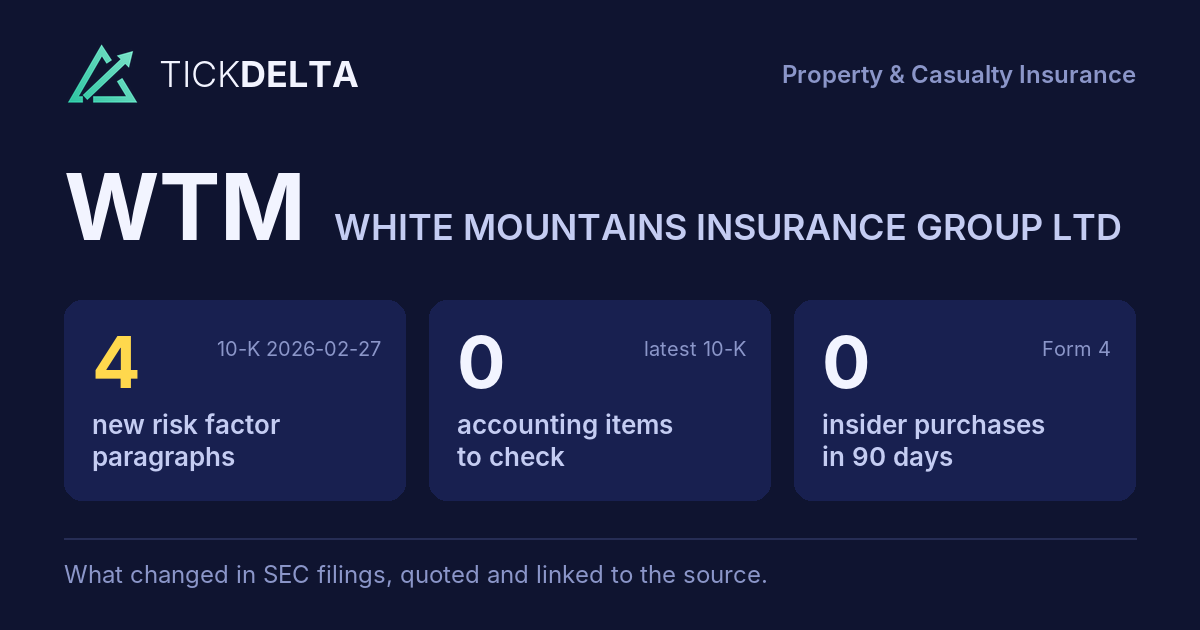
White Mountains Insurance Group Ltd WTM

Compare with peers Embed
SEC comment letters, last 20 years

5 reviews of WTM's filings by SEC staff

UPLOAD and CORRESP
Reviews 5 latest letter May 28, 2020
Questions asked 16 each answered in the company's own letter
No closing letter 1 reviews without a letter saying the staff completed it

When the SEC's staff reviews a filing, it writes to the company with numbered questions, and the company answers each one in a letter. SEC publishes the exchange once the review is over, at least 20 business days later. A question is not an accusation; most reviews end with the company adding detail to its next filing.

How the reviews went

Every review on EDGAR, from the first staff letter to the letter that closes it

  1. 1. Staff letters 5 UPLOAD
  2. 2. Questions in them 16 numbered comments
  3. 3. Company replies 7 CORRESP
  4. 4. Reviews closed 4 of 5 closing letter

Half the closed reviews took 44 days or less from the first letter to the closing letter.

Form 10-K for the Fiscal Year Ended December 31, 2019

2020-05-28 to 2020-06-17 · 1 question · 1 letter from the SEC, 1 from the company
Review closed 2020-06-17
Risk factors
Item 1A. Risk Factors · We may be deemed to be an investment company under U.S. federal securities law., page 22
SEC asked
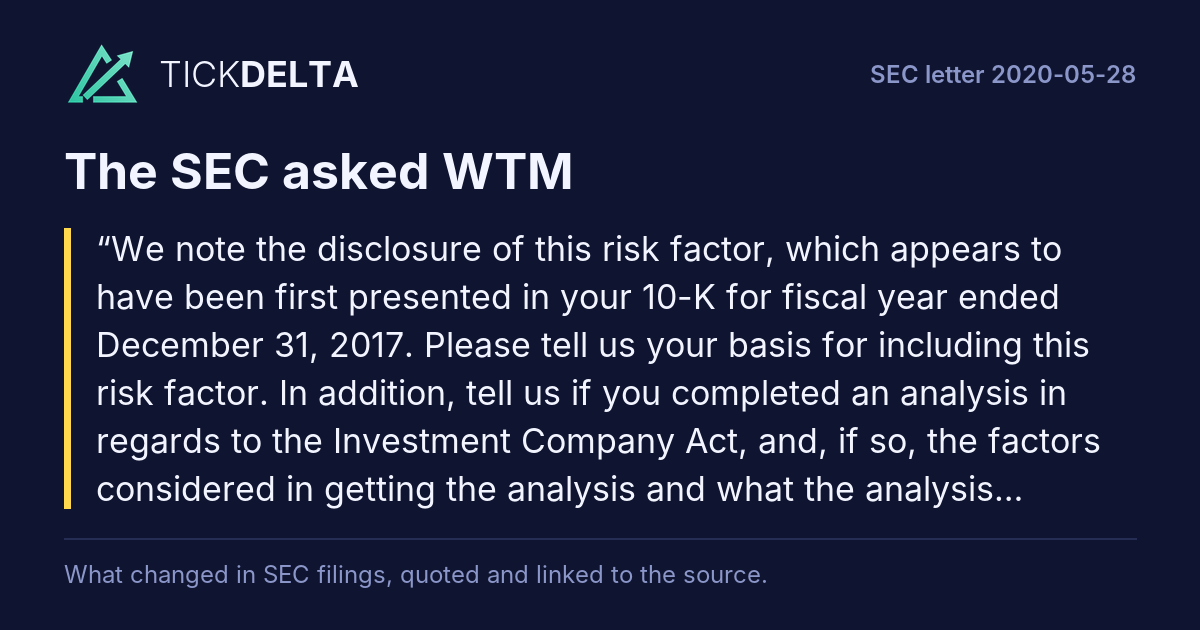
We note the disclosure of this risk factor, which appears to have been first presented in your 10-K for fiscal year ended December 31, 2017. Please tell us your basis for including this risk factor. In addition, tell us if you completed an analysis in regards to the Investment Company Act, and, if so, the factors considered in getting the analysis and what the analysis concluded.
Rest of the question

If applicable, please include in your response discussion of legal opinions and analysis you obtained.

WTM answered
We believe that we are not an investment company because we meet the requirement under Section 3(a) (1)(C) under the Investment Company Act of 1940 (the “1940 Act”) that the issuer not be engaged nor propose to engage in “the business of investing, reinvesting, owning, holding, or trading in securities”.
Rest of the answer

However, for the reasons described below, we included this risk factor out of an abundance of caution, as the Company has been distributing and redeploying a significant amount of capital from recent dispositions.

The Company is an exempted Bermuda limited liability company whose principal businesses are conducted through its subsidiaries and affiliates (the Company, together with these subsidiaries and affiliates, are collectively referred to in this letter as “White Mountains”). Over the course of our 35-year history, White Mountains has been engaged in the business of making opportunistic and value-oriented acquisitions of businesses and assets in the insurance, financial services and related sectors, operating these businesses and assets through its subsidiaries and, if and when attractive exit valuations become available, disposing of these businesses and assets. As of December 31, 2019, White Mountains employed roughly 1,200 people at its consolidated subsidiaries and the Company’s management is primarily responsible for overseeing the operations of these subsidiaries.

During the period from 2015 through 2017, as buyers made compelling offers, White Mountains sold two of its largest and long-held consolidated operating businesses: its reinsurance operations, Sirius International Insurance Group (owned for 20 years, “Sirius Group”) and its specialty insurance operations, OneBeacon Insurance Group (owned for 16 years, “OneBeacon”). Total proceeds from these and other dispositions in the period were $4.2 billion with transaction gains of $1.4 billion.

As a result of these sales, the Company entered a transitional period during which we have worked to intelligently distribute and/or redeploy the transaction proceeds. As of May 31, 2017, on a pro forma basis for the OneBeacon sale, the Company had undeployed capital of $3.1 billion on a capital base of $4.2 billion. Over the next three years, we returned $1.3 billion of capital to our shareholders and completed a series of acquisitions, reducing undeployed capital to $0.8 billion on a capital base of $3.4 billion as of March 31, 2020.

Today, we are approaching the end of this transitional period. White Mountains presently conducts its business primarily in four areas: municipal bond reinsurance, specialty insurance distribution, capital solutions for asset management firms, and other operations. White Mountains’s municipal bond insurance business is conducted through its subsidiary HG Global Ltd. and its reinsurance subsidiary HG Re Ltd. White Mountains’s specialty insurance distribution business is conducted through its subsidiary NSM Insurance HoldCo, LLC and its subsidiaries. White Mountains provides capital solutions for asset management firms through its subsidiary Kudu Investment Management, LLC and its subsidiaries.

We believe that White Mountains is not, and has not been, an investment company under both a plain reading of the definition contained in the 1940 Act and the limited case law interpreting this definition, including the five-factor test articulated by the Commission in Tonopah Mining Co. (26 S.E.C. 426 (1947)), and the 2007 decision from the U.S. Court of Appeals for the Seventh Circuit in SEC v. National Presto Industries, Inc. However, we included this risk factor in our 2017 annual report because we had recently entered into a transitional period following the significant dispositions described above and there could be no assurance that these interpretations of the definition investment company would remain consistent in the future.

Read in the reply
In its next report

First report after the company's reply of Jun 10, 2020: 10-Q filed Aug 7, 2020 ↗, against the 10-Q filed May 8, 2020 ↗.

Tickdelta does not hold the text of both reports, so they are not compared here.
Also in this review: closing letter, 2020-06-17
Form 10-K

2012-11-30 to 2013-02-22 · 3 questions · 1 letter from the SEC, 3 from the company
Review closed 2013-02-22
Liquidity and cashDebt
Consolidated Financial Statements · Note 13. Statutory Capital and Surplus, page F-57
SEC asked (1)
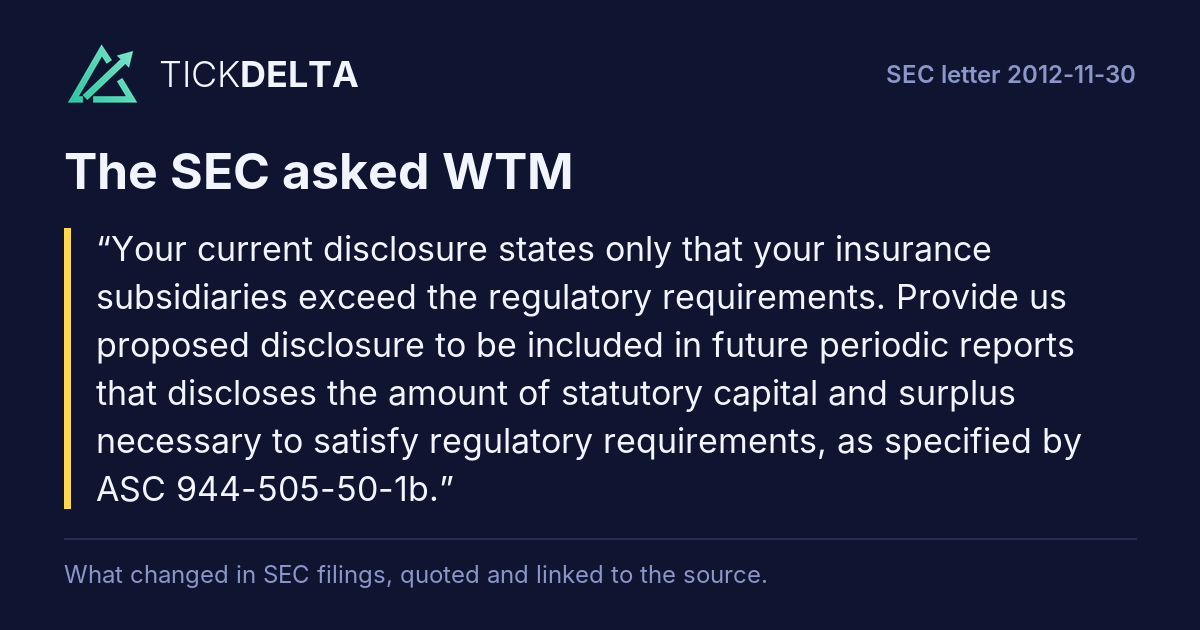
Your current disclosure states only that your insurance subsidiaries exceed the regulatory requirements. Provide us proposed disclosure to be included in future periodic reports that discloses the amount of statutory capital and surplus necessary to satisfy regulatory requirements, as specified by ASC 944-505-50-1b.
WTM answered
We will comply with your request by including additional disclosure in our December 31, 2012 Form 10-K filing. An example of this disclosure has been included as Exhibit A to this letter.

Comment 2:
Read in the reply
In its next report

First report after the company's reply of Dec 14, 2012: 10-K filed Mar 1, 2013 ↗, against the 10-K filed Feb 28, 2012 ↗.

Tickdelta does not hold the text of both reports, so they are not compared here.

Financial Statement Schedules · Schedule II Condensed Financial Information of the Registrant, page FS-2
SEC asked (2)
The condensed balance sheet shows an increased in fixed maturity investments from $5.8 million at December 31, 2010 to $1,334.5 million at December 31, 2011. Tell us what caused this increase and why it does not appear to be entirely reported on the statement of cash flows or disclosed as a noncash item.
WTM answered
The increase primarily relates to the November 2011 liquidation of Lone Tree Insurance Group Ltd., a direct wholly-owned subsidiary, into the Registrant. We will include additional disclosure in our December 31, 2012 Form 10-K filing to describe this noncash item. An example of this disclosure, which has been edited from the disclosure contained on page FS-2 of our December 31, 2011 Form 10-K, has been included as Exhibit B to this letter.

Comment 3:
Read in the reply
In its next report

First report after the company's reply of Dec 14, 2012: 10-K filed Mar 1, 2013 ↗, against the 10-K filed Feb 28, 2012 ↗.

Tickdelta does not hold the text of both reports, so they are not compared here.

Financial Statement Schedules · Schedule II Condensed Financial Information of the Registrant, page FS-2
SEC asked (3)
With regard to the condensed statement of cash flows, reconcile for us:  The $267.3 million net decrease in short-term investments in 2011 to the change in that caption on the balance sheet; and  The $192.5 million repayment of debt from subsidiaries in 2011 to the balance sheet.
WTM answered
We have provided a reconciliation of the changes in the Registrant’s short-term investment and payable to subsidiary balances from December 31, 2010 to December 31, 2011 as part of Exhibit C to this letter. As noted in Exhibit C, these balances were impacted by the liquidation of Lone Tree Insurance Group Ltd. into the Registrant described above in comment response #2. We will include additional disclosure in our December 31, 2012 Form 10-K filing to describe this noncash item.
Rest of the answer

An example of this disclosure, which has been edited from the disclosure contained on page FS-2 of our December 31, 2011 Form 10-K, has been included as Exhibit B to this letter.

Read in the reply
In its next report

First report after the company's reply of Dec 14, 2012: 10-K filed Mar 1, 2013 ↗, against the 10-K filed Feb 28, 2012 ↗.

Tickdelta does not hold the text of both reports, so they are not compared here.

Also in this review: company letter, Jan 18, 2013, company letter, Feb 19, 2013, closing letter, 2013-02-22

Form 10-K for the Fiscal Year Ended December 31, 2010

2011-12-13 to 2012-01-11 · 2 questions · 1 letter from the SEC, 1 from the company
Review closed 2012-01-11
Critical estimatesLiquidity and cashLegal and contingencies
Critical Accounting Estimates · Invested Assets, page 87
SEC asked (1)
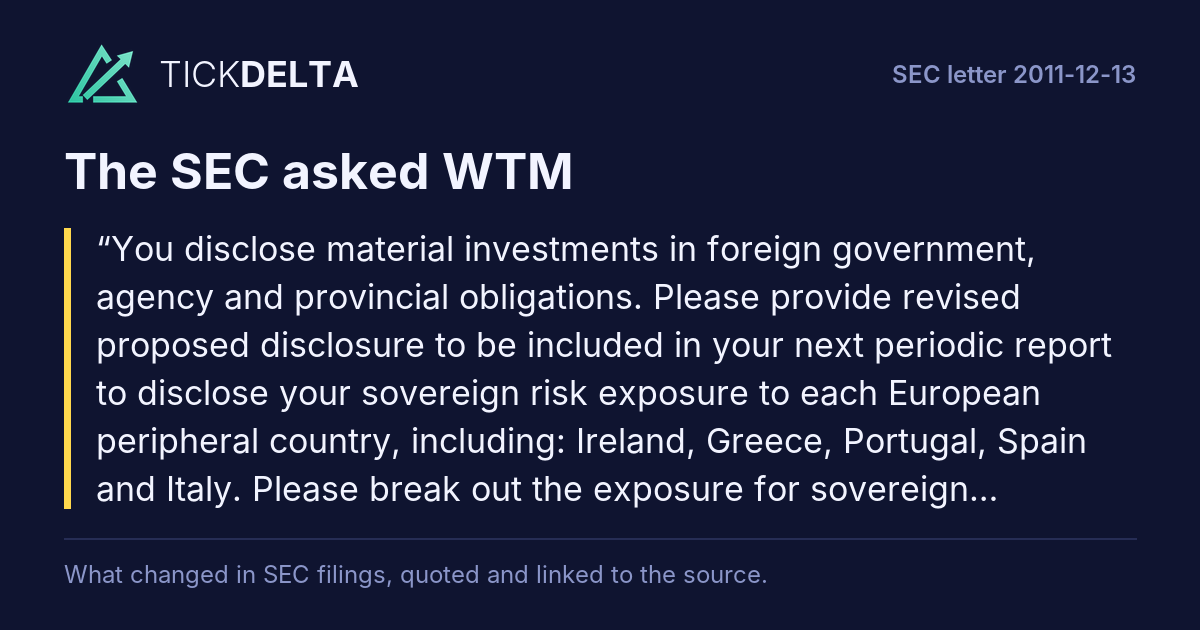
You disclose material investments in foreign government, agency and provincial obligations. Please provide revised proposed disclosure to be included in your next periodic report to disclose your sovereign risk exposure to each European peripheral country, including: Ireland, Greece, Portugal, Spain and Italy.
Rest of the question

Please break out the exposure for sovereign entities, financial institutions, non-financial institutions and other individual/entities by country of origin.

WTM answered
We will comply with your requests by including additional disclosure in our December 31, 2011 Form 10-K filing. An example of this disclosure has been included as Exhibit A to this letter.

Comment 2:
Read in the reply
In its next report

First report after the company's reply of Jan 3, 2012: 10-K filed Feb 28, 2012 ↗, against the 10-K filed Feb 28, 2011 ↗.

Tickdelta does not hold the text of both reports, so they are not compared here.

Notes to Consolidated Financial Statements · Legal contingencies, page F-74
SEC asked (2)
You state that none of your legal contingencies is expected by management to have a material adverse effect on your financial condition and/or cash flows. Your disclosures do not appear to be in compliance with ASC 450-20-50.
Rest of the question

If there is at least a reasonable possibility that a loss exceeding amounts already recognized may have been incurred, provide us proposed disclosure to be included in your next periodic filing to either disclose an estimate (or, if true, state that the amount is not material in lieu of providing quantified amounts) of the additional loss or range of loss, or state that such an estimate cannot be made.

WTM answered
We will comply with your requests by including additional disclosure in our December 31, 2011 Form 10-K filing. An example of this disclosure, which has been edited from the disclosure contained on page F-74 of our December 31, 2010 Form 10-K, has been included as Exhibit B to this letter.
Read in the reply
In its next report

First report after the company's reply of Jan 3, 2012: 10-K filed Feb 28, 2012 ↗, against the 10-K filed Feb 28, 2011 ↗.

Tickdelta does not hold the text of both reports, so they are not compared here.

Also in this review: closing letter, 2012-01-11

Schedule TO

2011-08-24 to 2011-08-26 · 7 questions · 1 letter from the SEC, 1 from the company
No closing letter
Legal and contingencies
Offer to Purchase · Is the Offer Conditioned On the Closing of the Previously Announced Sale…, page iii
SEC asked (1)
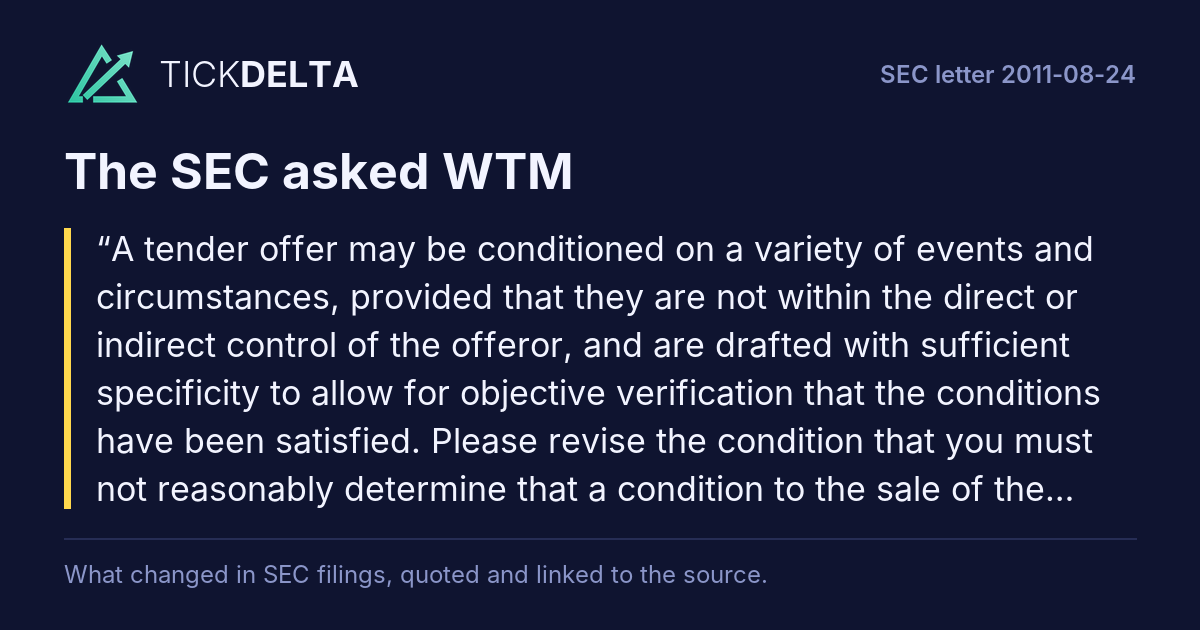
A tender offer may be conditioned on a variety of events and circumstances, provided that they are not within the direct or indirect control of the offeror, and are drafted with sufficient specificity to allow for objective verification that the conditions have been satisfied.
Rest of the question

Please revise the condition that you must not reasonably determine that a condition to the sale of the Esurance and Answer Financial businesses is unlikely to be satisfied since it is not apparent that shareholders will understand what unsatisfied sale conditions would “trigger” the condition, allowing you to abandon the offer.

WTM answered
The Company respectfully submits to the Staff that, as originally drafted, the disclosure in the Offer to Purchase, including the information incorporated therein by reference, did permit holders to understand the meaning of the conditions related to the sale of the Esurance and Answer Financial businesses. The full text of the Stock Purchase Agreement, dated as of May 17, 2011, between White Mountains Holdings (Luxembourg) S.á r.l. and The Allstate Corporation (the “Purchase Agreement”) is publicly available as Exhibit 10.1 to the Company’s Current Report on Form 8-K filed on May 18, 2011.
Rest of the answer

That information is incorporated into the Offer to Purchase pursuant to “Section 9. Certain Information Concerning the Company” of the Offer to Purchase. The conditions to the sale are set forth in Article VI of the Purchase Agreement. The Company respectfully submits that shareholders may determine which unsatisfied sale conditions would trigger the condition by reviewing the Purchase Agreement. However, in response to the Staff’s comment and for the convenience of shareholders, the Company has amended the Schedule TO by revising “Section 8. Conditions to the Offer” of the Offer to Purchase to include a list of conditions to the sale of the Esurance and Answer Financial businesses that would trigger the condition to the Offer (see Item 1 of the Amendment).

Read in the reply
Forward-Looking Statements, page vii
SEC asked (2)
In future filings, please revise to omit the reference to the Private Securities Litigation Reform Act of 1995, since the safe harbor is not available for statements made in connection with a tender offer. Refer to Section 27A(b)(2)(C) of the Securities Act and Section 21E(b)(2)(C) of the Exchange Act.
Rest of the question

Please also refrain from making further references to the PLSRA or its safe harbor provision in any future press releases or other communications relating to this offer.

WTM answered
to the Staff’s comment, the Company has amended the Schedule TO by revising page vii of the Offer to Purchase to omit references to Section 27A of the Securities Act of 1933 and Section 21E of the Exchange Act of 1934 (see Item 2 of the Amendment).
Read in the reply
Acceptance for Payment and Payment for Shares, page 5
SEC asked (3)
We note that you do not expect to be able to announce the final results of any proration and commence payment until approximately five business days after the expiration date. Please tell us how you are complying with the prompt payment requirement of Rules 13e-4(f)(5) and 14e-1(c). Refer to the discussion of prompt payment in Section II.D. of SEC Release 34-43069.
WTM answered
The prompt payment provisions of Rule 13-4(f)(5) and Rule 14e-1(c) of the Securities Exchange Act of 1934, as amended (the “Exchange Act”) require that the Company pay the consideration offered, or return the tendered securities, promptly after the termination or withdrawal of the tender offer. In construing the word “promptly” in this context, the court in Pryor v. United States Steel Corp., 591 F. Supp. 942 (S.D.N.Y.
Rest of the answer

1984) held that prompt payment for tendered shares is a question of fact to be determined in light of the facts and circumstances of the transaction and the customary practices of the financial community. Furthermore, the Commission’s Release No. 34-43069, section II.D states that “promptly” may be determined by the practices of the financial community, including current settlement practices.

Computershare Trust Company, N.A., the depositary for the Offer, has advised the Company that five business days is a reasonable period of time for it to complete the review and calculation needed to determine the final proration factor for the Offer. Assuming, as is likely, that some shareholders take advantage of the guaranteed delivery procedures provided by the Offer, the Depositary will not be able to determine the number of Shares validly tendered into the Offer until three business days after the Expiration Date. The Depositary must then finalize the determination of the applicable Purchase Price and also complete the document review and calculations necessary to effectuate the odd lot procedure of the Offer before it can finalize the proration factor. We respectfully submit that a two business day period to complete this review after the end of the period to deliver Certificates following the delivery of a Notice of Guaranteed Delivery is reasonably prompt under the facts and circumstances. We believe this period is consistent with recent precedent transactions. See e.g., LMP Capital and Income Fund Inc. Tender Offer Statement on Schedule TO, filed on June 1, 2011; Credit Acceptance Corporation Tender Offer Statement on Schedule TO, filed on February 9, 2011.

We note that the disclosure in the Offer to Purchase sets forth the Company’s expectation as to the timing of the commencement of payment. The Offer does not permit the Company to delay payment for five business days if the Depositary completes its review and calculation of the final proration factor earlier. The Company will instruct the Depositary to complete its work as promptly as practicable and will commence payment as soon as the Depositary has done so.

Accordingly, the Company respectfully submits to the Staff that given the facts and circumstances specific to this transaction, the payment procedures for the Offer comply with Rules 13e-4(f)(5) and 14e-1(c) and the guidance in the Commission’s Release No. 34-43069, section II.D.

Read in the reply
Determination of Validity, page8
SEC asked (4)
Please explain to us the purpose of the language that your interpretation of the terms of the offer will be final and binding. Please disclose that only a court of competent jurisdiction can make a determination that will be final and binding upon the parties. In addition, please disclose that security holders may challenge your determinations.
WTM answered
to the Staff’s comment, the Company has amended the Schedule TO by revising “Section 2. Procedures for Tendering Shares—Determination of Validity” of the Offer to Purchase to include the following language: “Any determination by the Company as to the validity, form, eligibility and acceptance of Shares for payment, or any interpretation by the Company as to the terms and conditions of the Offer, is subject to applicable law and, if challenged by shareholders in a lawsuit, to the judgment of a court of competent jurisdiction” (see Item 3 of the Amendment).
Read in the reply
Conditions to the Offer, page 17
SEC asked (5)
Please refer to disclosure relating to the offeror’s failure to exercise any of the rights described in the last paragraph under this section. This language implies that once a condition is triggered, the offeror must decide whether or not to assert it.
Rest of the question

Please note that when a condition is triggered and the offeror decides to proceed with the offer anyway, the staff believes that this constitutes a waiver of the triggered condition. Depending on the materiality of the waived condition and the number of days remaining in the offer, the offeror may be required to extend the offer and redisseminate new disclosure to security holders. The offeror may not, as this language suggests, simply fail to assert a triggered condition and effectively waive it without officially doing so. Please confirm your understanding supplementally, or revise your disclosure.

WTM answered
The Company acknowledges the Staff’s position that the Company must expressly assert or expressly waive a triggered condition and confirms that if a triggering event occurs, the Company will either expressly assert or expressly waive such triggered condition.
Read in the reply
Conditions to the Offer, page 17
SEC asked (6)
We note that you state that once the offer has expired, then all conditions other than those requiring necessary governmental approval, must have been satisfied or waived. Please revise to clarify that all conditions to the tender offer, other than those requiring necessary governmental approval to consummate the offer, must be satisfied or waived at or before the expiration of the offer.
WTM answered
The Company respectfully submits that the wording in the Offer to Purchase was intended to have the same substantive effect as the Staff’s comment. However, for clarity, in response to the Staff’s comment, the Company has amended the Schedule TO to revise page 19 of the Offer to Purchase to reflect that the offer conditions must be satisfied or waived “at or before” the expiration of the tender offer (see Item 4 of the Amendment).
Read in the reply
Exhibit 99(A)(1)(E)
SEC asked (7)
We note that in the instruction form you require security holders to represent that they have read the Offer. Please revise to omit the term “read” since it implies that security holders may waive their rights under the federal securities laws.
WTM answered
The Company believes that as a matter of contract law it is appropriate for tendering shareholders to acknowledge that he, she or it has read the Offer to Purchase. The Company did not intend for this acknowledgment to constitute a waiver of such tendering shareholders’ rights under the federal securities laws.
Rest of the answer

However, in response to the Staff’s comment, the Company has amended the Schedule TO by revising the Instruction Form in the Letter to Clients for use by Brokers, Dealers, Commercial Banks, Trust Companies and Other Nominees to omit the acknowledgment that a tendering shareholder has read the Offer to Purchase (see Item 5 of the Amendment).

Company Acknowledgment

The Company has advised us that they acknowledge that (i) the Company is responsible for the adequacy and accuracy of the disclosure in the filing; (ii) Staff comments or changes to disclosure in response to Staff comments do not foreclose the Commission from taking action with respect to the filing and (iii) the Company may not assert Staff comments as a defense in any proceeding initiated by the Commission or any person under the federal securities laws of the United States.

Read in the reply

Form 10-K for the Fiscal Year Ended December 31, 2009

2010-09-21 to 2010-11-04 · 3 questions · 1 letter from the SEC, 1 from the company
Review closed 2010-11-04
Results discussion (MD&A)SegmentsReserves and insuranceLiquidity and cash
Management’s Discussion and Analysis of Financial Condition and Results of Operations · Summary of Operations by Segment, page 51
SEC asked (1)
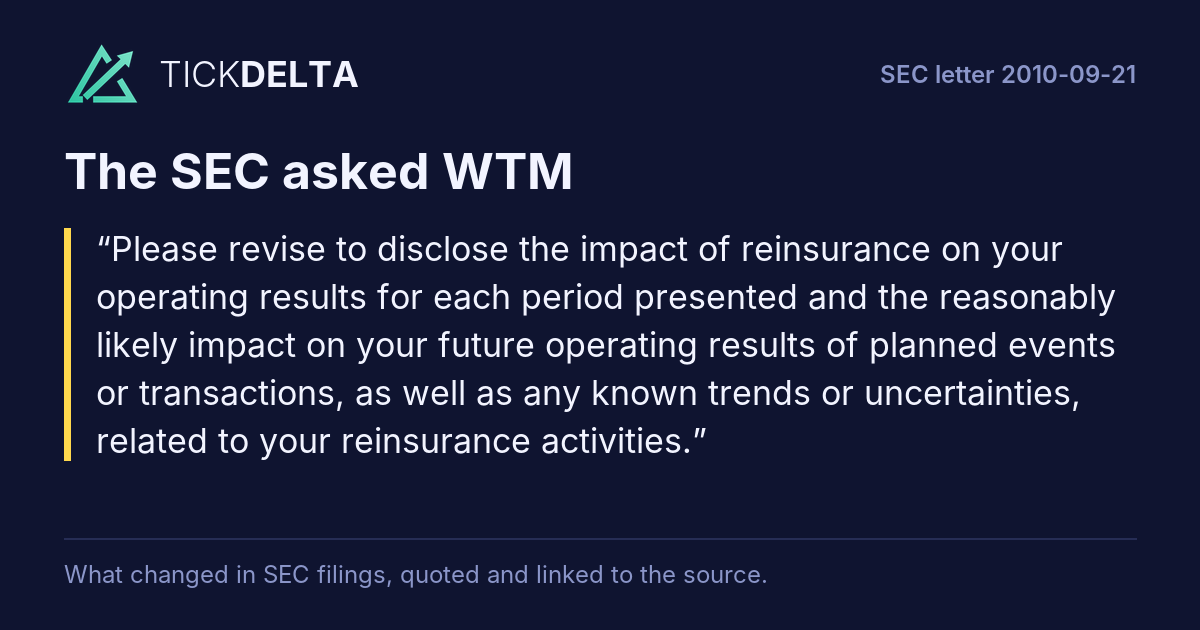
Please revise to disclose the impact of reinsurance on your operating results for each period presented and the reasonably likely impact on your future operating results of planned events or transactions, as well as any known trends or uncertainties, related to your reinsurance activities.
WTM answered
We will comply with your requests by including additional disclosure in our future Form 10-K and 10-Q filings where appropriate. An example of this disclosure, which has been edited from the disclosure contained on pages

52-58 of our December 31, 2009 Form 10-K, has been included as Exhibit A to this letter.

Comment 2:

Liquidity and Capital Resources,
Read in the reply
In its next report

First report after the company's reply of Oct 22, 2010: 10-Q filed Oct 29, 2010 ↗, against the 10-Q filed Jul 30, 2010 ↗.

Tickdelta does not hold the text of both reports, so they are not compared here.

Liquidity and Capital Resources, page 65
SEC asked (2)
Your cash flows from operations decreased from $345.8 million provided from operations in 2007 to $46.7 million used for operations in 2009. Please revise to disclose the operational reasons for this trend, focusing upon the material changes in operating cash flows underlying the major captions reported in your consolidated statement of cash flows.
Rest of the question

Disclose the impact of this trend on your future liquidity and your ability to meet future cash requirements, particularly the contractual obligations and commitments, shown on page 69. Refer to SEC Release No. 33-8350, IV, B.

WTM answered
71-73 of our December 31, 2009 Form 10-K, has been included as Exhibit B to this letter.

Comment 3:
Read in the reply
In its next report

First report after the company's reply of Oct 22, 2010: 10-Q filed Oct 29, 2010 ↗, against the 10-Q filed Jul 30, 2010 ↗.

Tickdelta does not hold the text of both reports, so they are not compared here.

Insurance Float, page 67
SEC asked (3)
You state that insurance float is an important aspect of your insurance operations. Please disclose the factors underlying the decrease in insurance float from $6.7 billion at January 1, 2005 to $4.6 billion at December 31, 2009 and the reasonably likely impact of this decrease on your future operating results and financial condition.
Rest of the question

Also, disclose any known trends, demands, events or uncertainties that you expect may materially impact the level of your insurance float in future periods.

WTM answered
this disclosure, which has been edited from the disclosure contained on page 67 of our December 31, 2009 Form 10-K, has been included as Exhibit C to this letter.
Read in the reply
In its next report

First report after the company's reply of Oct 22, 2010: 10-Q filed Oct 29, 2010 ↗, against the 10-Q filed Jul 30, 2010 ↗.

Tickdelta does not hold the text of both reports, so they are not compared here.

Also in this review: closing letter, 2010-11-04

Letters without questions

Other letters

UPLOAD and CORRESP
1 other letter: notices that a filing will not be reviewed, requests to declare a registration effective, and the like

From the SEC's correspondence on EDGAR: staff letters (form UPLOAD) and company letters (form CORRESP), 17 letters filed since 2010-09-27. Questions and answers are matched by their numbers; topics come from words in each question. The reports are compared word for word (same form, before the first SEC letter against the first report after the company's reply). No AI.

Sources

The SEC's correspondence on EDGAR: staff letters (form UPLOAD) and company letters (form CORRESP), matched question by question. No AI.

Also

Filings: the letters in the filing list.

Work with it

Excel workbook · CSV. Google Sheet that stays up to date: paste =IMPORTDATA("https://tickdelta.com/company/WTM/export.csv") into a cell.

Next in Owners and insiders:Insider trades
Esc

Type a ticker such as AAPL, a name, an investor such as Buffett, or a topic such as tariffs. ↑ ↓ to move, Enter to open.