Paragraph 116 · 48% changed
Every version of it
Screener
/
SEC EDGAR
/CIK 0000078128
/10-K filed Feb 26, 2026, compared with Feb 27, 2025
/Numbers from the XBRL of the 10-Ks
NYSE
Utilities · Water Utilities
Essential Utilities, Inc. WTRG
The 10-K against last year's
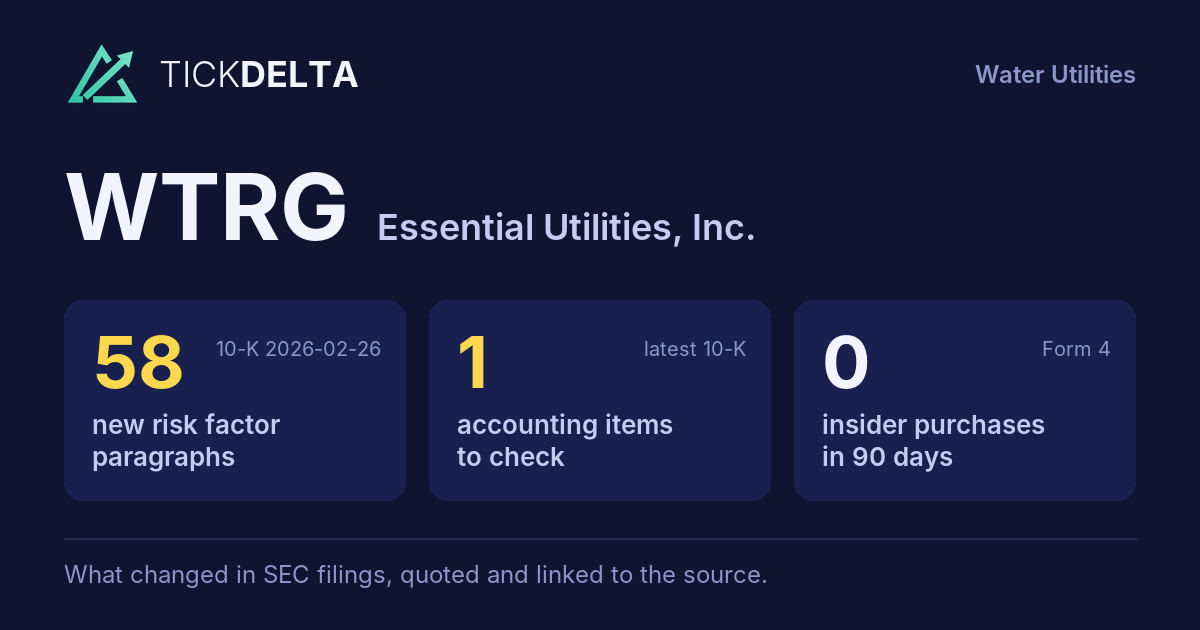
142 changes: 80 added, 14 removed, 48 reworded
10-K Feb 26, 2026 vs Feb 27, 2025
Risk Factors
19.2%
of the text changed · 14,980 words now · 58 new paragraphs, 0 gone
MD&A
23.0%
of the text changed · 12,683 words now · 22 new paragraphs, 14 gone
Legal Proceedings
28.7%
of the text changed · 1,613 words now
Accounting Policies
10.8%
of the text changed · 5,651 words now
10-K 0000078128-26-000050 (Feb 26, 2026) vs 10-K 0001562762-25-000036 (Feb 27, 2025)
Every paragraph, and how much of it changed
One bar per paragraph, in the order of the 10-K. Height and colour show the share of its words not in the closest paragraph a year earlier; the tallest bars are new paragraphs.
Risk Factors
236 paragraphs · 58 new · 23 reworded · 0 gone · 10-K Feb 26, 2026 against Feb 27, 2025
New paragraph
Reworded (5% of its words or more)
Same or nearly
Paragraph 175 · 40% changed
Every version of it
The Peoples’ regulated companies purchase their natural gas supply primarily through a combination of requirements contracts, some of which contain minimum purchase obligations, monthly spot purchase contracts, and forward purchase contracts. The price paid for natural gas acquired under forward purchase contracts is fixed prior to the delivery of the natural gas. Additionally, a portion of natural gas purchases is injected into natural gas storage facilities in the non-heating months and withdrawn from storage for delivery to customers during the heating months.
Paragraph 129 · 35% changed
Every version of it
In addition, over time, average customer gas consumption has declined, as more energy efficient appliances and furnaces have been installed, and conservation programs have been implemented. If we are unable to compete effectively or if customers further reduce their gas needs, we may lose existing customers, sell less gas to our customers and/or fail to acquire new customers, which could have a material adverse effect on our business, financial condition, and results of operations.
Paragraph 138 · 31% changed
Every version of it
Our water, wastewater, and natural gas services are governed by various federal and state environmental protection and health and safety laws and regulations, including the federal Safe Drinking Water Act, the Clean Water Act, Clean Air Act, Resource Conservation and Recovery Act and similar state laws, and federal and state regulations issued under these laws by the EPA and state environmental regulatory agencies. These laws and regulations establish, among other things, criteria and standards for drinking water and for discharges into the waters of the U.S. as well as dam safety, air emissions, and residuals management. Pursuant to these laws, we are required to obtain various environmental permits from environmental regulatory agencies for our operations. The Company routinely seeks to acquire wastewater systems, some of which may have combined wastewater and stormwater systems which may overflow and be subject to increased regulation by the U.S. EPA. We cannot assure you that we will be at all times in total compliance with these laws, regulations and permits. If we fail to comply with these laws, regulations, or permits, we could be fined or otherwise sanctioned by regulators and such noncompliance could result in civil suits. Environmental laws and regulations are complex and change frequently. These laws, and the enforcement thereof, have tended to become more stringent over time. While we have budgeted for future capital and operating expenditures to comply with these laws and our permits, it is possible that new or stricter standards could be imposed that will require additional capital expenditures or raise our operating costs. Although these expenditures and costs may be recovered in the form of higher rates, there can be no assurance that the various state utility commissions that regulate our business would approve rate increases to enable us to recover such expenditures and costs. In summary, we cannot assure you that our costs of complying with, current and future environmental and health and safety laws will not harm our business, financial condition, and results of operations.
Paragraph 149 · 30% changed
Every version of it
Although we believe our income tax estimates, including any tax reserves for uncertain tax positions or valuation allowances on deferred tax assets are appropriate, there is no assurance that the final determination of our income tax liability will not be materially different; either higher or lower, from what is reflected in our income tax provision. In the event we are assessed additional income taxes, our business, financial condition, and results of operations could be harmed.
Paragraph 130 · 24% changed
Every version of it
Paragraph 150 · 23% changed
Every version of it
Paragraph 139 · 22% changed
Every version of it
Paragraph 116 · 48% changed
Every version of it
10-K Feb 27, 2025Although we do not believe that our systems are at a materially greater risk of cybersecurity attacks than other similar organizations, our information technology systems may be vulnerable to damage or interruption from the types of cybersecurity attacks or other events listed above or other similar actions, and such incidents may go undetected for a period of time. Such cybersecurity attacks or other events may result in:
10-K Feb 26, 2026
In addition, our information technology systems may be vulnerable to damage or interruption from the following types of cybersecurity attacks or other events:
Paragraph 175 · 40% changed
Every version of it
10-K Feb 27, 2025
The Peoples’ regulated companies purchase their natural gas supply primarily through a combination of requirements contracts, some of which contain minimum purchase obligations, monthly spot purchase contracts, and forward purchase contracts. The price paid for natural gas acquired under forward purchase contracts is fixed prior to the delivery of the natural gas. Additionally, a portion of natural gas purchases is injected into natural gas storage facilities in the non-heating months and withdrawn from storage for delivery to customers during the heating months.
10-K Feb 26, 2026
The Peoples’ regulated companies purchase their natural gas supply primarily through a combination of requirements contracts, some of which contain minimum purchase obligations, monthly spot purchase contracts,
Paragraph 129 · 35% changed
Every version of it
10-K Feb 27, 2025
In addition, over time, average customer gas consumption has declined, as more energy efficient appliances and furnaces have been installed, and conservation programs have been implemented. If we are unable to compete effectively or if customers further reduce their gas needs, we may lose existing customers, sell less gas to our customers and/or fail to acquire new customers, which could have a material adverse effect on our business, financial condition, and results of operations.
10-K Feb 26, 2026
In addition, over time, average customer gas consumption has declined, as more energy efficient appliances and furnaces have been installed, and conservation programs have been implemented. If we are unable to compete
Paragraph 138 · 31% changed
Every version of it
10-K Feb 27, 2025
Our water, wastewater, and natural gas services are governed by various federal and state environmental protection and health and safety laws and regulations, including the federal Safe Drinking Water Act, the Clean Water Act, Clean Air Act, Resource Conservation and Recovery Act and similar state laws, and federal and state regulations issued under these laws by the EPA and state environmental regulatory agencies. These laws and regulations establish, among other things, criteria and standards for drinking water and for discharges into the waters of the U.S. as well as dam safety, air emissions, and residuals management. Pursuant to these laws, we are required to obtain various environmental permits from environmental regulatory agencies for our operations. The Company routinely seeks to acquire wastewater systems, some of which may have combined wastewater and stormwater systems which may overflow and be subject to increased regulation by the U.S. EPA. We cannot assure you that we will be at all times in total compliance with these laws, regulations and permits. If we fail to comply with these laws, regulations, or permits, we could be fined or otherwise sanctioned by regulators and such noncompliance could result in civil suits. Environmental laws and regulations are complex and change frequently. These laws, and the enforcement thereof, have tended to become more stringent over time. While we have budgeted for future capital and operating expenditures to comply with these laws and our permits, it is possible that new or stricter standards could be imposed that will require additional capital expenditures or raise our operating costs. Although these expenditures and costs may be recovered in the form of higher rates, there can be no assurance that the various state utility commissions that regulate our business would approve rate increases to enable us to recover such expenditures and costs. In summary, we cannot assure you that our costs of complying with, current and future environmental and health and safety laws will not harm our business, financial condition, and results of operations.
10-K Feb 26, 2026
Our water, wastewater, and natural gas services are governed by various federal and state environmental protection and health and safety laws and regulations, including the federal Safe Drinking Water Act, the Clean Water Act, Clean Air Act, Resource Conservation and Recovery Act and similar state laws, and federal and state regulations issued under these laws by the EPA and state environmental regulatory agencies. These laws and regulations establish, among other things, criteria and standards for drinking water and for discharges into the waters of the U.S. as well as dam safety, air emissions, and residuals management. Pursuant to these laws, we are required to obtain various environmental permits from environmental regulatory agencies for our operations. The Company routinely seeks to acquire wastewater systems, some of which may have combined wastewater and stormwater systems which may overflow and be subject to increased regulation by the U.S. EPA. We cannot assure you that
Paragraph 149 · 30% changed
Every version of it
10-K Feb 27, 2025
Although we believe our income tax estimates, including any tax reserves for uncertain tax positions or valuation allowances on deferred tax assets are appropriate, there is no assurance that the final determination of our income tax liability will not be materially different; either higher or lower, from what is reflected in our income tax provision. In the event we are assessed additional income taxes, our business, financial condition, and results of operations could be harmed.
10-K Feb 26, 2026
Although we believe our income tax estimates, including any tax reserves for uncertain tax positions or valuation allowances on deferred tax assets are appropriate, there is no assurance that the final determination of our income
Paragraph 130 · 24% changed
Every version of it
10-K Feb 27, 2025In addition, over time, average customer gas consumption has declined, as more energy efficient appliances and furnaces have been installed, and conservation programs have been implemented. If we are unable to compete effectively or if customers further reduce their gas needs, we may lose existing customers, sell less gas to our customers and/or fail to acquire new customers, which could have a material adverse effect on our business, financial condition, and results of operations.
10-K Feb 26, 2026
effectively or if customers further reduce their gas needs, we may lose existing customers, sell less gas to our customers and/or fail to acquire new customers, which could have a material adverse effect on our business, financial condition, and results of operations.
Paragraph 150 · 23% changed
Every version of it
10-K Feb 27, 2025Although we believe our income tax estimates, including any tax reserves for uncertain tax positions or valuation allowances on deferred tax assets are appropriate, there is no assurance that the final determination of our income tax liability will not be materially different; either higher or lower, from what is reflected in our income tax provision. In the event we are assessed additional income taxes, our business, financial condition, and results of operations could be harmed.
10-K Feb 26, 2026
tax liability will not be materially different; either higher or lower, from what is reflected in our income tax provision. In the event we are assessed additional income taxes, our business, financial condition, and results of operations could be harmed.
Paragraph 139 · 22% changed
Every version of it
10-K Feb 27, 2025Our water, wastewater, and natural gas services are governed by various federal and state environmental protection and health and safety laws and regulations, including the federal Safe Drinking Water Act, the Clean Water Act, Clean Air Act, Resource Conservation and Recovery Act and similar state laws, and federal and state regulations issued under these laws by the EPA and state environmental regulatory agencies. These laws and regulations establish, among other things, criteria and standards for drinking water and for discharges into the waters of the U.S. as well as dam safety, air emissions, and residuals management. Pursuant to these laws, we are required to obtain various environmental permits from environmental regulatory agencies for our operations. The Company routinely seeks to acquire wastewater systems, some of which may have combined wastewater and stormwater systems which may overflow and be subject to increased regulation by the U.S. EPA. We cannot assure you that we will be at all times in total compliance with these laws, regulations and permits. If we fail to comply with these laws, regulations, or permits, we could be fined or otherwise sanctioned by regulators and such noncompliance could result in civil suits. Environmental laws and regulations are complex and change frequently. These laws, and the enforcement thereof, have tended to become more stringent over time. While we have budgeted for future capital and operating expenditures to comply with these laws and our permits, it is possible that new or stricter standards could be imposed that will require additional capital expenditures or raise our operating costs. Although these expenditures and costs may be recovered in the form of higher rates, there can be no assurance that the various state utility commissions that regulate our business would approve rate increases to enable us to recover such expenditures and costs. In summary, we cannot assure you that our costs of complying with, current and future environmental and health and safety laws will not harm our business, financial condition, and results of operations.
10-K Feb 26, 2026
we will be at all times in total compliance with these laws, regulations and permits. If we fail to comply with these laws, regulations, or permits, we could be fined or otherwise sanctioned by regulators and such noncompliance could result in civil suits. Environmental laws and regulations are complex and change frequently. These laws, and the enforcement thereof, have tended to become more stringent over time. While we have budgeted for future capital and operating expenditures to comply with these laws and our permits, it is possible that new or stricter standards could be imposed that will require additional capital expenditures or raise our operating costs. Although these expenditures and costs may be recovered in the form of higher rates, there can be no assurance that the various state utility commissions that regulate our business would approve rate increases to enable us to recover such expenditures and costs. In summary, we cannot assure you that our costs of complying with, current and future environmental and health and safety laws will not harm our business, financial condition, and results of operations.
MD&A
167 paragraphs · 22 new · 64 reworded · 14 gone · 10-K Feb 26, 2026 against Feb 27, 2025
New paragraph
Reworded (5% of its words or more)
Same or nearly
Paragraph 158 · 49% changed
Paragraph 14 · 46% changed
Paragraph 117 · 46% changed
On June 12, 2024, 3, 2025, Aqua Pennsylvania and Peoples Natural Gas Companies amended the terms of its and restated their respective $100,000 and $300,000 revolving credit agreements, extending the maturity date by another 364-day period. The funds borrowed under these revolving credit agreements by extending the maturity dates are classified as loans payable and are used to June 10, 2025 and revised the interest rate index from the Bloomberg Short-Term Bank Yield Index (BSBY) to the Secured Overnight Financing Rate (SOFR). provide working capital.
Paragraph 58 · 44% changed
Provision for income tax – The - Our effective income tax rate for our Regulated Water segment was an expense of 16.4% 0.6% in 2024, 2025, compared to an expense a benefit of 14.4% 3.8% in 2023. 2024. The increase in the effective income tax rate expense in 2025 is primarily attributed to the result decreases in both the state tax benefit and amortization of changes tax repairs surcredit in the jurisdictional earnings mix, decrease Regulated Natural Gas segment based on a rate order received in September 2024, offset in part by the release of $22,575 of income tax reserve regulatory liability in the amortization of certain regulatory liabilities associated with deferred taxes, and decrease Regulated Water segment based on the rate order received by Aqua Pennsylvania in the income tax benefit associated with the repairs tax deduction for qualifying utility infrastructure investments. February 2025.
Paragraph 53 · 44% changed
Taxes other than income taxes decreased by $861 $1,862 or 3.6% mainly 2.0% in 2025 as compared to 2024 largely due to lower a favorable adjustment on sales and use taxes tax accruals of our Regulated Natural Gas segment as a result of the closure of a sales and use tax audit during the period. second quarter of 2025.
Paragraph 153 · 44% changed
Paragraph 78 · 43% changed
Provision for income tax – The effective income tax rate for our Regulated Water segment was an expense of 16.4% 11.7% in 2024, 2025, compared to an expense of 14.4% 16.4% in 2023. 2024. The increase decrease in the effective tax rate is primarily largely attributed to the result release of changes in the jurisdictional earnings mix, decrease in the amortization $22,575 of certain regulatory liabilities associated with deferred taxes, and decrease in the income tax benefit associated with reserve regulatory liability based on the repairs tax deduction for qualifying utility infrastructure investments. rate order received by Aqua Pennsylvania in February 2025.
Paragraph 90 · 42% changed
an increase in labor and employee benefits of $5,719 $11,859 resulting from merit increases, higher salary costs, incentive compensation, and higher healthcare costs, and contributions to the Company’s defined contribution plan, offset by lower pension cost. costs;
Paragraph 158 · 49% changed
10-K Feb 27, 2025We test the goodwill attributable to each of our reporting units for impairment at least annually, or more often, if circumstances indicate a possible impairment may exist. When testing goodwill for impairment, we may assess qualitative factors, including macroeconomic conditions, industry and market considerations, changes to regulatory environment, recent regulatory and legislative proceedings, cost factors, overall financial performance, and entity specific events, for some or all of our reporting units to determine whether it’s more likely than not that the fair value of a reporting unit is less than its carrying amount. Based on our assessment of the qualitative factors previously noted, or at our discretion, we may perform a quantitative goodwill impairment test by determining the fair value of a reporting unit by weighting the results from the income approach and the market approach. These valuation approaches consider a number of factors that include, but are not limited to, prospective financial information (which includes projected operating income, expected future capital expenditures, and projected regulatory rate base, among others), growth rates, terminal value, discount rates, and comparable multiples from publicly traded companies in our industry and require us to make certain assumptions and estimates regarding industry economic factors and future profitability of our business. If we perform a quantitative test and determine that the fair value of a reporting unit is less than its carrying amount, we would record an impairment loss for the amount by which a reporting unit’s carrying amount exceeds its fair value, not to exceed the carrying amount of goodwill. The assessment requires significant management judgment and estimates that are based on budgets, general strategic business plans, historical trends and other data and relevant factors. If changes in circumstances or events occur, or estimates and assumptions that were used in our impairment test change, we may be required to record an impairment charge for goodwill. Refer to Note 1 – Summary of Significant Accounting Policies – Goodwill in this Annual Report for further information.
10-K Feb 26, 2026
goodwill. The assessment requires significant management judgment and estimates that are based on budgets, general strategic business plans, historical trends and other data and relevant factors. If changes in circumstances or events occur, or estimates and assumptions that were used in our impairment test change, we may be required to record an impairment charge for goodwill. Refer to Note 1 – Summary of Significant Accounting Policies – Goodwill in this Annual Report for further information.
Paragraph 14 · 46% changed
10-K Feb 27, 2025The mission of the regulated utility industry is to provide quality and reliable utility service at reasonable rates to customers, while earning a fair return for shareholders. We strive to achieve the industry’s mission by effective planning, efficient investments, and productive use of our resources. We maintain a rate case management capability to pursue timely and adequate returns on the capital investments that we make in improving our distribution system, treatment plants, information technology systems, and other infrastructure. This capital investment creates assets that are used and useful in providing utility service and is commonly referred to as rate base. In pursuing our rate case strategy, we consider the amount of net utility plant additions and replacements made since the previous rate decision, the changes in the cost of capital, changes in our capital structure, and changes in operating and other costs. Based on these assessments, our utility operations periodically file rate increase requests with their respective state utility commissions or local regulatory authorities. In general, as a regulated enterprise, our utility rates are established to provide full recovery of utility operating costs, taxes, interest on debt used to finance capital investments, and a return on equity used to finance capital investments. There may be a regulatory lag between the time when operating costs increases, customer usage changes, and capital investments occur and when those items are incorporated into rates. On occasion, our regulated utility companies may enter into rate settlement agreements, which require us to wait for a period of time to file the next base rate increase request.
10-K Feb 26, 2026
on debt used to finance capital investments, and a return on equity used to finance capital investments. There may be a regulatory lag between the time when operating costs increases, customer usage changes, and capital investments occur and when those items are incorporated into rates. On occasion, our regulated utility companies may enter into rate settlement agreements, which require us to wait for a period of time to file the next base rate increase request.
Paragraph 117 · 46% changed
10-K Feb 27, 2025
On June 12, 2024, Aqua Pennsylvania and Peoples Natural Gas Companies amended the terms of its respective $100,000 and $300,000 364-day revolving credit agreements by extending the maturity dates to June 10, 2025 and revised the interest rate index from the Bloomberg Short-Term Bank Yield Index (BSBY) to the Secured Overnight Financing Rate (SOFR).
10-K Feb 26, 2026
On June 3, 2025, Aqua Pennsylvania and Peoples Natural Gas Companies amended and restated their respective $100,000 and $300,000 revolving credit agreements, extending the maturity date by another 364-day period. The funds borrowed under these revolving credit agreements are classified as loans payable and are used to provide working capital.
Paragraph 58 · 44% changed
10-K Feb 27, 2025
Provision for income tax – The effective income tax rate for our Regulated Water segment was an expense of 16.4% in 2024, compared to an expense of 14.4% in 2023. The increase in the effective tax rate is primarily the result of changes in the jurisdictional earnings mix, decrease in the amortization of certain regulatory liabilities associated with deferred taxes, and decrease in the income tax benefit associated with the repairs tax deduction for qualifying utility infrastructure investments.
10-K Feb 26, 2026
Provision for income tax - Our effective income tax rate was an expense of 0.6% in 2025, compared to a benefit of 3.8% in 2024. The increase in the income tax expense in 2025 is attributed to the decreases in both the state tax benefit and amortization of tax repairs surcredit in the Regulated Natural Gas segment based on a rate order received in September 2024, offset in part by the release of $22,575 of income tax reserve regulatory liability in the Regulated Water segment based on the rate order received by Aqua Pennsylvania in February 2025.
Paragraph 53 · 44% changed
10-K Feb 27, 2025
Taxes other than income taxes decreased by $861 or 3.6% mainly due to lower sales and use taxes during the period.
10-K Feb 26, 2026
Taxes other than income taxes decreased by $1,862 or 2.0% in 2025 as compared to 2024 largely due to a favorable adjustment on sales and use tax accruals of our Regulated Natural Gas segment as a result of the closure of a sales and use tax audit during the second quarter of 2025.
Paragraph 153 · 44% changed
10-K Feb 27, 2025Revenue Recognition ─ Our utility revenues recognized in an accounting period include amounts billed to customers on a cycle basis and unbilled amounts based on estimated usage from the last billing to the end of the accounting period. The estimated usage is based on our judgment and assumptions; our actual results could differ from these estimates, which would result in operating revenues being adjusted in the period that the revision to our estimates is determined.
10-K Feb 26, 2026
from these estimates, which would result in operating revenues being adjusted in the period that the revision to our estimates is determined.
Paragraph 78 · 43% changed
10-K Feb 27, 2025
Provision for income tax – The effective income tax rate for our Regulated Water segment was an expense of 16.4% in 2024, compared to an expense of 14.4% in 2023. The increase in the effective tax rate is primarily the result of changes in the jurisdictional earnings mix, decrease in the amortization of certain regulatory liabilities associated with deferred taxes, and decrease in the income tax benefit associated with the repairs tax deduction for qualifying utility infrastructure investments.
10-K Feb 26, 2026
Provision for income tax – The effective income tax rate for our Regulated Water segment was an expense of 11.7% in 2025, compared to an expense of 16.4% in 2024. The decrease in the effective tax rate is largely attributed to the release of $22,575 of income tax reserve regulatory liability based on the rate order received by Aqua Pennsylvania in February 2025.
Paragraph 90 · 42% changed
10-K Feb 27, 2025
an increase in labor and employee benefits of $5,719 resulting from higher salary costs, healthcare costs, and contributions to the Company’s defined contribution plan, offset by lower pension cost.
10-K Feb 26, 2026
an increase in labor and employee benefits of $11,859 resulting from merit increases, higher incentive compensation, and higher healthcare costs;
A paragraph is matched with the one last year that shares the most of its words; under half in common makes it new. The paragraphs shown are the 8 reworded the most in each section.
The paragraph that changed most in each section
The redline
Marked against last year's 10-K: cut words struck through, new words highlighted.
Risk Factors180 words changed in this paragraph; it is 63% similar to last year's version.
Our water, wastewater, and natural gas services are governed by various federal and state environmental protection and health and safety laws and regulations, including the federal Safe Drinking Water Act, the Clean Water Act, Clean Air Act, Resource Conservation and Recovery Act and similar state laws, and federal and state regulations issued under these laws by the EPA and state environmental regulatory agencies. These laws and regulations establish, among other things, criteria and standards for drinking water and for discharges into the waters of the U.S. as well as dam safety, air emissions, and residuals management. Pursuant to these laws, we are required to obtain various environmental permits from environmental regulatory agencies for our operations. The Company routinely seeks to acquire wastewater systems, some of which may have combined wastewater and stormwater systems which may overflow and be subject to increased regulation by the U.S. EPA. We cannot assure you that we will be at all times in total compliance with these laws, regulations and permits. If we fail to comply with these laws, regulations, or permits, we could be fined or otherwise sanctioned by regulators and such noncompliance could result in civil suits. Environmental laws and regulations are complex and change frequently. These laws, and the enforcement thereof, have tended to become more stringent over time. While we have budgeted for future capital and operating expenditures to comply with these laws and our permits, it is possible that new or stricter standards could be imposed that will require additional capital expenditures or raise our operating costs. Although these expenditures and costs may be recovered in the form of higher rates, there can be no assurance that the various state utility commissions that regulate our business would approve rate increases to enable us to recover such expenditures and costs. In summary, we cannot assure you that our costs of complying with, current and future environmental and health and safety laws will not harm our business, financial condition, and results of operations.
Source: Item 1A, 10-K 0000078128-26-000050 vs Item 1A, 10-K 0001562762-25-000036
MD&A159 words changed in this paragraph; it is 57% similar to last year's version.
Source: Item 7, 10-K 0000078128-26-000050 vs Item 7, 10-K 0001562762-25-000036
Legal Proceedings119 words changed in this paragraph; it is 83% similar to last year's version.
During a portion of 2019, the Company initiated a do not consume advisory for some of its customers in one division served by the Company’s Illinois subsidiary. The do not consume advisory was lifted in 2019, and, in 2022, the water system was determined to be in compliance with the federal Lead and Copper Rule. The Company has accrued for the penalty and other fees that will be paid as a result of a settlement that was reached with the state and local regulators and approved by the Illinois court with jurisdiction over this matter in July 2024. In addition, on September 3, 2019, two individuals, on behalf of themselves and those similarly situated, commenced an action against the Company’s Illinois subsidiary in the State court in Will County, Illinois related to this do not consume advisory. The complaint seeks class action certification, attorney's fees, and "damages, including, but not limited to, out of pocket damages, and discomfort, aggravation, and annoyance” based upon the water provided by the Company’s subsidiary to a discrete service area in University Park, Illinois. The complaint contains allegations of damages as a result of supplied water. In December, 2024, the State court in Will County, Illinois dismissed the case against the Company, and plaintiffs have filed an appeal of that decision. In addition, plaintiffs commenced similar actions in federal court and in front of two state agencies. The Company has an accrual for the amount of loss asserted in the complaint that we determined to be probable and estimable of being incurred. The Company is vigorously defending against this claim. While the final outcome of this claim cannot be predicted with certainty, and unfavorable outcomes could negatively impact the Company, at this time in the opinion of management, the final resolution of this matter is not expected to have a material adverse effect on the Company’s financial position, results of operations or cash flows. Further, the Company submitted a claim for the expenses incurred to its insurance carrier for potential recovery of a portion of these costs and is currently in litigation with one of its carriers seeking to enforce its claims, and recently prevailed in the Third Circuit Court of Appeals which held that the insurance carrier possessed a duty to defend. In February 2025, the Company received $5,602 in related insurance proceeds for a portion of expenses incurred by the Company. The Company continues to assess the potential loss contingency on this matter.
Source: Item 3, via Note 10 – Commitments and Contingencies, 10-K 0000078128-26-000050 vs Item 3, via Note 9 – Commitments and Contingencies, 10-K 0001562762-25-000036
Accounting Policies111 words changed in this paragraph; it is 73% similar to last year's version.
Regulation ─ Most of the operating companies that are regulated public utilities are subject to regulation by the utility commissions of the states in which they operate. The respective utility commissions have jurisdiction with respect to rates, service, accounting procedures, issuance of securities, acquisitions and other matters. Some of the operating companies that are regulated public utilities are subject to rate regulation by county or city government. Regulated public utilities follow the Financial Accounting Standards Board’s (“FASB”) accounting guidance for regulated operations, which provides for the recognition of regulatory assets and liabilities as allowed by regulators for costs or credits that are reflected in current rates or are considered probable of being included in future rates. Costs, for which the Company has received or expects to receive prospective rate recovery, are deferred as a regulatory asset and amortized over the period of rate recovery in accordance with the FASB’s accounting guidance for regulated operations. Conversely, excess recovery of costs or amounts collected in rates to recover costs expected to be incurred in the future or to be refunded in the future are recorded as regulatory liabilities. The regulatory assets or liabilities are then relieved as the cost or credit is reflected in Company’s rates charged for utility service. If, as a result of a change in circumstances, it is determined that a regulated operating company no longer meets the criteria to apply regulatory accounting, the operating company would have to discontinue regulatory accounting and write-off the respective regulatory assets and liabilities. See Note 6 - Regulatory Assets and Liabilities for further information.
Source: Item 8, Note 1 – Summary of Significant Accounting Policies, 10-K 0000078128-26-000050 vs Item 8, Note 1 – Summary of Significant Accounting Policies, 10-K 0001562762-25-000036
Sentences and paragraphs added, removed or reworded
Every change, by type
Sentences and paragraphs of WTRG's Risk Factors and MD&A, 10-K Feb 26, 2026 against 10-K Feb 27, 2025. Each links to the text at sec.gov.
Quiet changes are sentences kept from last year with one to four words changed, at least one of them a hedge, a modal or a qualifier (may, could, will, not, significant, material…). A year or date rolling forward is not counted.
The full word list
adverse, adversely, all, although, anticipate, anticipates, any, approximately, believe, believes, can, cannot, certain, could, expect, expects, generally, however, if, intend, intends, largely, likely, many, material, materially, may, might, most, must, never, no, not, possible, primarily, probable, should, significant, significantly, some, substantial, substantially, unlikely, will, would
AddedRisk Factors
expected timing and likelihood of completion of our proposed Merger with American Water;
Read it in 10-K Feb 26, 2026 at sec.gov
AddedRisk Factors
the impairment of goodwill or decline in the value of its other assets resulting in a non-cash charge to earnings;
Read it in 10-K Feb 26, 2026 at sec.gov
AddedRisk Factors
our ability to operate our business successfully while closing of the Merger is pending, including operating within the restrictions imposed on our business by the Merger Agreement and retaining key business partners and management personnel;
Read it in 10-K Feb 26, 2026 at sec.gov
AddedRisk Factors
the success in the closing of, and the profitability of the Merger and any future acquisitions;
Read it in 10-K Feb 26, 2026 at sec.gov
AddedRisk Factors
our ability to control operating expenses, achieve operating efficiencies, support programs that promote affordability of our services, and manage the expansion of our business;
Read it in 10-K Feb 26, 2026 at sec.gov
AddedRisk Factors
in addition to the foregoing, various risks and other uncertainties associated with the Merger Agreement.
Read it in 10-K Feb 26, 2026 at sec.gov
AddedRisk Factors
The market price of shares of our common stock or American Water Common Stock will fluctuate and the Exchange Ratio will not be adjusted to reflect such fluctuations, and as a result, the Merger Consideration at the date of the closing of the Merger may vary significantly from the date the Merger Agreement was executed.
Read it in 10-K Feb 26, 2026 at sec.gov
AddedRisk Factors
Upon completion of the Merger, each outstanding share of our common stock will be converted into the right to receive 0.305 shares of American Water Common Stock. The number of shares of American Water Common Stock to be issued pursuant to the Merger Agreement for each share of our common stock will not change to reflect changes in the market price of American Water Common Stock or Essential’s Common Stock. The market price of our common stock and American Water Common Stock at the time of completion of the Merger may vary significantly from the price on the date the Merger Agreement was executed and February 10, 2026, the date of the special shareholder meetings. Because we may not complete the Merger until a significant period of time has passed after these dates, the market value of American Water Common Stock issued in connection with the Merger and our common stock surrendered in connection with the Merger may be higher or lower than the values of those shares on earlier dates. Stock price changes may result from market assessment of the likelihood that the Merger will be completed, changes in our or American Water’s business, operations, or prospects prior to or following the Merger, litigation or regulatory considerations, reactions from the financial markets or analysts, general business, market, industry, or economic conditions and other factors both within and beyond our and American Water’s control, including the risks, uncertainties and other factors described in this Risk Factors section of our Annual Report on Form 10-K, and in our other SEC filings, and those described in American Water’s SEC filings. Neither we nor American Water may terminate the Merger Agreement solely because of changes in the market price of either company’s common stock.
Read it in 10-K Feb 26, 2026 at sec.gov
Show the other 45
AddedRisk Factors
The Merger is subject to various remaining closing conditions, including the receipt of consents and approvals from various governmental and regulatory entities and third parties, and a failure to obtain all such remaining consents or approvals or to satisfy such other closing conditions could prevent or delay the completion of the Merger or impose conditions that could have a material adverse effect on us or the combined company.
Read it in 10-K Feb 26, 2026 at sec.gov
AddedRisk Factors
We anticipate that, subject to the receipt of all required regulatory and other consents and approvals and the satisfaction or waiver of all other closing conditions, the Merger will be completed in the first quarter of 2027. Among other closing conditions that remain, completion of the Merger is conditioned upon the receipt of such required consents, orders, and approvals from various governmental and regulatory entities and other third parties, including public utility commissions in certain states in which either or both companies operate, including without limitation the Pennsylvania Public Utility Commission. The Merger is also subject to review under the Hart-Scott-Rodino Antitrust Improvements Act of 1976, and the expiration or earlier termination of the waiting period (and any extension of the waiting period) applicable to the Merger is a condition to closing the Merger.
Read it in 10-K Feb 26, 2026 at sec.gov
AddedRisk Factors
We and American Water cannot provide any assurance that all of the remaining required consents, orders, and approvals will be obtained or that these consents, orders, or approvals will not be conditioned on terms, conditions, or restrictions that would be detrimental to the combined company after the completion of the Merger, including requiring one or both companies to dispose of certain assets. The Merger Agreement allows, subject to certain conditions, limitations, and exclusions, each party to terminate the Merger Agreement (and generally without the
Read it in 10-K Feb 26, 2026 at sec.gov
AddedRisk Factors
payment of a termination fee to the non-terminating party) if the final terms of any of the required regulatory consents, orders or approvals would result in or require an undertaking of efforts or the taking of action that would reasonably be expected to have, individually or in the aggregate, a “Burdensome Effect” (as defined in the Merger Agreement). Any substantial delay in obtaining satisfactory consents, orders, or approvals, or the imposition of any requirements, terms, or conditions in connection with a party’s obtaining such consents, orders, or approvals, could be on terms that we or American Water do not believe to be reasonable or could cause a material reduction in the expected benefits of the Merger and/or an impairment or deterioration in our or American Water’s relationships with their respective applicable public utility commissions. If any such delays or conditions are significant enough, one or both parties may decide to abandon the Merger and terminate the Merger Agreement, subject to its terms. If the Merger is not completed, our ongoing businesses may be adversely affected, including, as follows:
Read it in 10-K Feb 26, 2026 at sec.gov
RewordedRisk Factors
If we are unable to maintain access to a reliable and adequate natural gas supply or sufficient pipeline capacity to deliver that supply, we may be unable to meet our customers’ requirements, resulting in a loss of customers and an adverse effect on our financial conditions and results of operations.
Read it in 10-K Feb 26, 2026 at sec.gov
RewordedRisk Factors
Although we believe our income tax estimates, including any tax reserves for uncertain tax positions or valuation allowances on deferred tax assets are appropriate, there is no assurance that the final determination of our income tax liability will not be materially different; either higher or lower, from what is reflected in our income tax provision.
Read it in 10-K Feb 26, 2026 at sec.gov
RewordedRisk Factors
Another potential risk related to climate change could be more frequent and more severe weather events, which could increase our costs to repair damaged facilities and restore service to our customers.
Read it in 10-K Feb 26, 2026 at sec.gov
RewordedRisk Factors
The Company performed its analysis of the NPDWR and estimated an investment of at least $450,000,000 of capital expenditures to install additional treatment facilities over the Compliance Period in order to comply (i.e., 2029 pending no delays due to lawsuits).
Read it in 10-K Feb 26, 2026 at sec.gov
RewordedRisk Factors
Inflation, and the potential impact of proposed new or sustained changes to tariffs, could adversely impact our ability to control costs, including operating expenses and capital costs.
Read it in 10-K Feb 26, 2026 at sec.gov
AddedMD&A
On October 26, 2025, American Water Works Company, Inc. (“American Water”), Alpha Merger Sub, Inc., a direct wholly owned subsidiary of American Water (“Merger Sub”), and the Company, entered into an Agreement and Plan of Merger (the “Merger Agreement”). The Merger Agreement provides that upon the terms and subject to the conditions set forth in the Merger Agreement, Merger Sub will merge with and into the Company (the “Merger”), with the Company surviving the Merger as a wholly owned subsidiary of American Water. Subject to the terms and conditions of the Merger Agreement, at the time at which the Merger becomes effective (the “Effective Time”), each share of the Company’s common stock, par value $0.50 per share (“Essential Common Stock”), issued and outstanding immediately prior to the Effective Time, other than any shares of Essential Common Stock owned by American Water or Merger Sub or by the Company as treasury stock (in each case, other than restricted shares), will be converted into the right to receive 0.305 shares of validly issued, fully paid and nonassessable shares of common stock, par value $0.01 per share, of American Water (“American Water Common Stock”) (the aggregate number of such shares of American Water Common Stock to be issued in the Merger). On February 10, 2026, at the respective special shareholder meetings of the Company and American Water, each company’s shareholders approved the merger-related proposals, satisfying certain of the conditions to closing.
Read it in 10-K Feb 26, 2026 at sec.gov
AddedMD&A
Consummation of the Merger is subject to certain remaining customary conditions, including the receipt of certain governmental approvals, including (a) the expiration or termination of the applicable waiting period under the Hart-Scott-Rodino Antitrust Improvements Act of 1976, and (b) the approval of certain public utility commissions, in each case on such terms and conditions that would not, individually or in the aggregate, result in a “Burdensome Effect” (as defined in the Merger Agreement). There can be no guarantee that all of the remaining closing conditions and approvals will be satisfied, and the failure to complete the proposed Merger on a timely basis or at
Read it in 10-K Feb 26, 2026 at sec.gov
AddedMD&A
all may adversely affect the Company’s financial condition and results of operations. The Company currently estimates that the closing of the proposed Merger will occur by the end of the first quarter of 2027.
Read it in 10-K Feb 26, 2026 at sec.gov
AddedMD&A
The Merger Agreement provides that American Water will retain its current name, maintain its headquarters and principal corporate office in Camden, New Jersey, and maintain substantial operations in Pennsylvania.
Read it in 10-K Feb 26, 2026 at sec.gov
AddedMD&A
On August 27, 2025, the Company, through its wholly owned subsidiary, Aqua Infrastructure, entered into a convertible promissory note purchase agreement with IEP Hummingbird Energy LLC (“IEP”) whereby the Company agreed to purchase convertible notes (“Convertible Note Investment”) in the aggregate principal amount of $26,000 through January 2026. IEP, a subsidiary of International Electric Power III, LLC, shall use the proceeds for the development of a gas-fired plant to power a data center being developed Greene County, PA (the “Project”). The Convertible Note Investment bears zero interest, includes a fixed $16,500 loan fee concurrently payable to the Company at maturity with the principal amount of the notes on September 30, 2026, and contains conversion rights into equity at any time on or after maturity or upon certain triggering events, such as a project financial closing or equity financing, as defined in the agreement. The agreement also grants the Company the right of first refusal to certain water and gas business opportunities and additional equity kickers upon the occurrence of a financing event or change of control. As of December 31, 2025, the fair value of the Convertible Note receivable amounts to $25,125.
Read it in 10-K Feb 26, 2026 at sec.gov
AddedMD&A
Due to a change in Project scope to focus on grid provided power, on January 20, 2026, the Company received $20,000, representing the reimbursement of the deposit paid to the gas turbine manufacturer. The Company continues to be an investor in the Project via its remaining convertible notes holdings and continues to have a right of first refusal to certain water and gas business opportunities. The Company’s involvement in this Project underscores its commitment to innovation, sustainability, and regional economic development. As of December 31, 2025, $20,000 of the Convertible Note Investment is presented within Prepayments and other current assets, and the remaining $5,125 is classified as a long-term asset in the accompanying consolidated balance sheets.
Read it in 10-K Feb 26, 2026 at sec.gov
AddedMD&A
A number of the Company’s water and wastewater subsidiaries are parties to a multi-district litigation (the “MDL”) lawsuit in the United States District Court for the District of South Carolina against manufacturers of certain per- and polyfluoroalkyl substances or compounds (“PFAS”) for damages, contribution and reimbursement of costs incurred and continuing to be incurred to address the presence of such PFAS in public water supply systems. One such suit to which the Company is a party is a multi-district litigation (the “MDL”) lawsuit which commenced on December 7, 2018, in the United States District Court for the District of South Carolina. Several defendants in such lawsuit have agreed to settle. During the second half of 2025, the Company received a portion of the settlement payments from 3M and DuPont totaling $46,166, net of legal fees and administrative costs. The Company recorded $84 as a credit to claims expense and $9,739 of the proceeds allocated to its North Carolina and Virginia water and wastewater subsidiaries as a regulatory liability, pursuant to regulatory orders issued by the public utility commissions from such states regarding the treatment of PFAS settlement costs. The remaining proceeds that were allocated to the Company’s other water and wastewater subsidiaries totaling $36,343 were recorded within Deferred Credits and Other Non-current liabilities in the accompanying consolidated balance sheets, pending recommendation or order from the respective public utility commissions on treatment of the amounts. The Company anticipates receiving additional settlement payments from the MDL lawsuit defendants over the next ten years.
Read it in 10-K Feb 26, 2026 at sec.gov
AddedMD&A
The Company expects insurance and claims expenses to continue to be volatile over the long term. In order to mitigate a portion of increased insurance costs, on October 1, 2025, the Company established a wholly-owned captive insurance company, Utility Insurance LLC, incorporated in the State of Utah, whose principal activity at this time is to provide insurance and reinsurance coverage for a portion of the Company’s general liability, property, workers compensation, auto liability, cyber, and management liability risks.
Read it in 10-K Feb 26, 2026 at sec.gov
AddedMD&A
State Segment Effective Date Annualized Revenue Increase Ohio Wastewater 7/1/2025 $ 550 Kentucky Natural Gas 7/1/2025 7,700 Pennsylvania Water 2/22/2025 58,400 North Carolina* Water 1/1/2025 2,821 Ohio** Water 1/1/2025 1,690 Wastewater 2/22/2025 14,600 Wastewater 1/1/2025 1,310 Total Base Rate Case Authorizations in 2025 $ 87,071
Read it in 10-K Feb 26, 2026 at sec.gov
AddedMD&A
an increase in bad debt expense of $361, which is net of a favorable regulatory asset adjustment of $5,889 in our Regulated Water segment in the first quarter of 2025; offset by
Read it in 10-K Feb 26, 2026 at sec.gov
AddedMD&A
an increase in capitalization in our Regulated Natural Gas segment of $9,812 in the current period as compared to the prior period due to higher capital spend and increasing pool of eligible capitalizable costs;
Read it in 10-K Feb 26, 2026 at sec.gov
AddedMD&A
a decrease in insurance expense of $8,392 primarily due to an insurance recovery of $5,602 during the first quarter of 2025 for a portion of expenses incurred by the Company associated with remediating an advisory for some of our Illinois water utility customers; and
Read it in 10-K Feb 26, 2026 at sec.gov
RemovedMD&A
RemovedMD&A
RemovedMD&A
RemovedMD&A
RemovedMD&A
RemovedMD&A
RemovedMD&A
RemovedMD&A
RemovedMD&A
RemovedMD&A
RemovedMD&A
RemovedMD&A
RewordedMD&A
Taxes other than income taxes decreased by $861 $3,007 or 3.6% 13.1% mainly due to lower a favorable adjustment on sales and use taxes tax accruals as a result of the closure of a sales and use tax audit during the period. second quarter of 2025.
Read it in 10-K Feb 26, 2026 at sec.gov
RewordedMD&A
Our overall 2025 2026 capital program along with $142,807 $21,822 of debt repayments and $454,049 $443,478 of other contractual cash obligations, as reported in the section captioned “Management’s Discussion and Analysis of Financial Condition and Results of Operations – Contractual Obligations”, has been, or is expected to be, financed through internally-generated funds, our revolving credit facilities, and the issuance of long-term debt and equity.
Read it in 10-K Feb 26, 2026 at sec.gov
RewordedMD&A
The decrease increase in 2024 2025 is the result of the impact of lower higher average cost of gas of $55,236, lower $76,944 and higher gas usage of $11,380 $50,250 due to warmer colder weather conditions, and a offset by decrease of $8,681 $386 from the sale of Peoples West Virginia in October 2023 and our three non-utility local microgrid and distributed energy projects in January 2024.
Read it in 10-K Feb 26, 2026 at sec.gov
RewordedMD&A
The decrease increase is the result of lower higher average cost of gas of $44,044, $75,449, and lower higher gas usage of $10,761 $42,522 due to warmer colder weather conditions and $5,517 offset by a decrease of $386 due to the sale of Peoples West Virginia in October 2023 and our three non-utility local microgrid and distributed energy projects in January 2024.
Read it in 10-K Feb 26, 2026 at sec.gov
RewordedMD&A
Gain on sale of assets was $0 for the year ended December 31, 2025 and $91,581 for the year ended December 31, 2024 and a loss on sale of assets was $559 for the year ended December 31, 2023. 2024.
Read it in 10-K Feb 26, 2026 at sec.gov
RewordedMD&A
Depreciation and amortization expense increased by $25,857 $47,919 or 7.5%, 13.0%, in 2024 2025 over 2023, 2024, principally due to continued capital expenditures to expand and improve our utility facilities, upgrade our information systems, our acquisitions of new utility systems, the implementation of new depreciation rates, and additional rate case filings. higher regulatory asset amortizations.
Read it in 10-K Feb 26, 2026 at sec.gov
RewordedMD&A
Depreciation and amortization increased by $14,745 $22,534 or 6.8% 16.6% primarily due to continued capital investment to expand and improve our utility facilities and our acquisitions the implementation of new utility systems. depreciation rates following a recently completed rate case.
Read it in 10-K Feb 26, 2026 at sec.gov
RewordedMD&A
RewordedMD&A
The estimated usage is based on our judgment and assumptions; our actual results could differ from these estimates, which would result in operating revenues being adjusted in the period that the revision to our estimates is determined.
Read it in 10-K Feb 26, 2026 at sec.gov
RewordedMD&A
Provision for income tax – The - Our effective income tax rate for our Regulated Water segment was an expense of 16.4% 0.6% in 2024, 2025, compared to an expense a benefit of 14.4% 3.8% in 2023. 2024.
Read it in 10-K Feb 26, 2026 at sec.gov
RewordedMD&A
(1)Includes current portion, as well as our commercial paper borrowings and borrowings under a variable rate revolving credit agreement of $568,000 and $0 at December 31, 2025, and $0 and $413,000 at December 31, 2024, and $720,000 at December 31, 2023. respectively.
Read it in 10-K Feb 26, 2026 at sec.gov
RewordedMD&A
One consideration we may undertake in evaluating on which states to focus our growth and investment strategy is whether a state provides for consolidated rates, fully-projected test years, a surcharge for replacing and rehabilitating infrastructure, fair value treatment of acquired utility systems, and other regulatory policies that promote infrastructure investment and efficiency in processing rate cases.
Read it in 10-K Feb 26, 2026 at sec.gov
Sources
The two latest 10-Ks on EDGAR, section by section. Each change links to the text at sec.gov.
Also
New risk factors: paragraphs with nothing like them last year, quoted in full.
Work with it
Excel workbook · CSV. Google Sheet that stays up to date: paste =IMPORTDATA("https://tickdelta.com/company/WTRG/export.csv") into a cell.