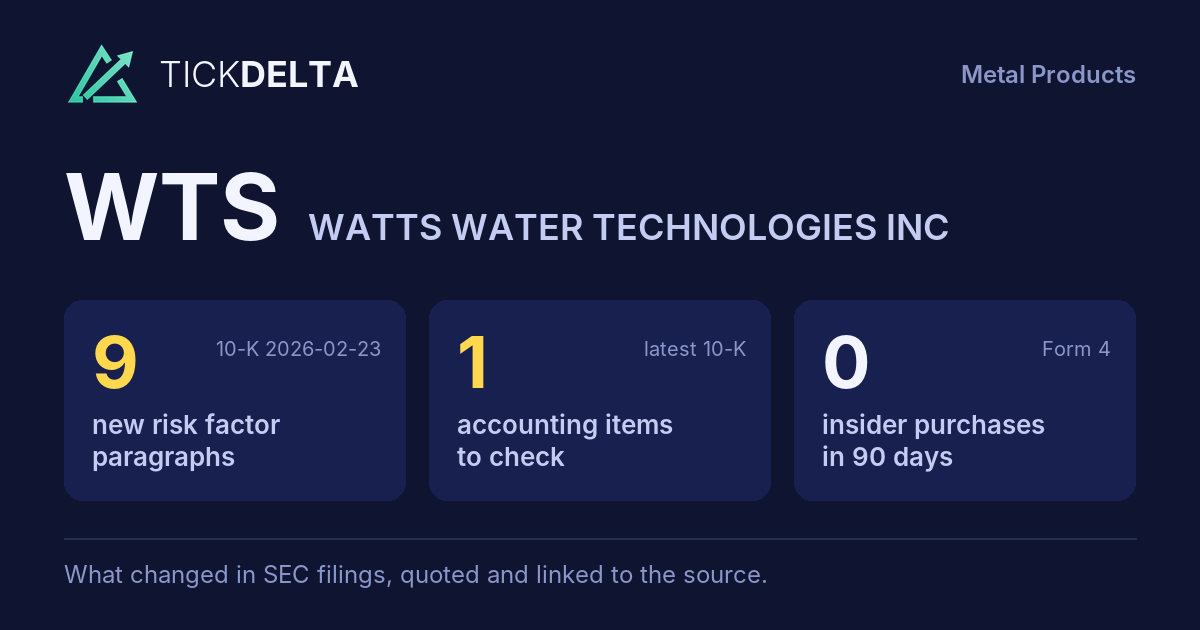
Screener / SEC EDGAR /CIK 0000795403 /10-K filed Feb 23, 2026, compared with Feb 18, 2025 /Numbers from the XBRL of the 10-Ks
NYSE Industrials · Metal Products

Watts Water Technologies Inc WTS

Compare with peers Embed
The 10-K against last year's

106 changes: 22 added, 8 removed, 74 reworded, 2 quiet changes

10-K Feb 23, 2026 vs Feb 18, 2025

10-K 0001104659-26-018541 (Feb 23, 2026) vs 10-K 0001558370-25-001102 (Feb 18, 2025) Not compared: Legal Proceedings, Accounting Policies.

Every paragraph, and how much of it changed

One bar per paragraph, in the order of the 10-K. Height and colour show the share of its words not in the closest paragraph a year earlier; the tallest bars are new paragraphs.

Risk Factors

91 paragraphs · 9 new · 29 reworded · 0 gone · 10-K Feb 23, 2026 against Feb 18, 2025
New paragraph Reworded (5% of its words or more) Same or nearly
Paragraph 68 · 39% changed Every version of it
requirements, may also affect demand for our products or our ability to source key materials. We may incur significant costs to adapt our portfolio to comply with these changing regulations and maintain competitiveness in different markets, including, but not limited to, redesigning existing products, developing new climate compliant offerings, and managing the mix of products sold in affected markets. We may at times also establish our own goals with respect to reducing our impact on the environment. Any failure to achieve our own goals, or any perception of a failure to act responsibly with respect to the environment or to effectively respond to regulatory requirements concerning climate change, or failure to accurately report on our progress toward achieving our goal or in environmental and sustainability programs can lead to adverse publicity or litigation, resulting in an adverse effect on our business or damage to our reputation. Moreover, if we are effective at addressing such matters, we may also attract negative attention from stakeholders and regulators with diverging views on sustainability.
Paragraph 34 · 37% changed Every version of it
If we need to address multiple vulnerabilities simultaneously, we may also need to make prioritization decisions in determining prioritize which vulnerabilities or security defects to fix first, and the timing of these fixes, which could result in compromised security. These vulnerabilities and security defects could expose us or our customers to a risk of loss, disclosure, or misuse of data; adversely affect our operating results; result in litigation (including class actions), liability, or regulatory action (including under laws related to privacy, data protection, data security, network security, and consumer protection); deter customers or sellers from using our products, services and solutions; result in significant incident response, system restoration or remediation costs; and otherwise harm our business and reputation. We maintain a cybersecurity risk management program and have adopted measures and incurred costs with the intention of mitigating potential risks associated with information technology disruptions and cybersecurity threats; however, there is no assurance that these measures will be fully implemented, complied with or effective at preventing or detecting cyber-attacks or security breaches, or other vulnerabilities, which may allow them to persist in the environment over long periods of time. Further, customers and third-party providers increasingly demand rigorous contractual provisions regarding privacy, cybersecurity, data protection, confidentiality, and intellectual property, which may also increase our overall compliance burden and related costs. Finally, we cannot guarantee that any costs and liabilities incurred in relation to an attack or incident will be covered by our existing insurance policies or that applicable insurance will be available to us in the future on economically reasonable terms or at all.
Paragraph 70 · 36% changed Every version of it
Companies are facing increasing, evolving and conflicting scrutiny expectations related to ESG practices and disclosures from certain investors, government entities, customers, employees, and other stakeholders or third parties. With this increased focus, public Public reporting regarding ESG practices is becoming more broadly expected by some stakeholders, which could lead to increased scrutiny of our ESG practices or lack thereof. Such increased scrutiny may result in increased costs, increased risk of litigation or reputational damage relating to our ESG practices or performance, enhanced compliance, or disclosure obligations, or other adverse impacts on our business, financial condition, or results of operations. We may become subject to conflicting laws and regulations related to sustainability and ESG matters. For instance, in January 2025, President Trump signed an executive order directing the U.S. Attorney General and all federal agencies to identify and discourage diversity, equity and inclusion initiatives in the private sector. On the other hand, in March 2024, the SEC finalized climate-related disclosure rules that require reporting on issues including greenhouse gas emissions and certain climate-related risks. We are still evaluating our response to these rules given the subsequent litigation challenging these rules (as well as the SEC’s stay on its climate rules) and the new Trump Administration’s climate policy. Additionally, we may be subject to the State of California’s disclosure laws regarding greenhouse gas emissions and climate-related financial risks. On November 18, 2025, the U.S. Court of Appeals for the Ninth Circuit granted a motion for an injunction on California’s SB 261, enjoining the California Air Resources Board’s from enforcing SB 261 and scheduled a hearing for January 9, 2026. This decision does not impact SB 253, which is still in effect. The court has yet to decide post-hearing whether to issue a preliminary injunction against SB 261 and/or SB 253, and the case will return to the Central District of California for further proceedings, with summary judgment briefing planned for the summer. Other US states have proposed laws similar to California’s to which we may be subject if they take effect. We expect to may be subject to the European Union’s Corporate Sustainability Reporting Directive (“CSRD”) for the first time for fiscal year 2025, with our first report due to be published in 2026, (“CSRD”), Corporate Sustainability Due Diligence Directive (“CSDDD”), and related EU Taxonomy Regulation, along with implementing regulations, to be consolidated into an “omnibus simplification package” expected Regulation. The CSRD’s initial reporting requirements have been delayed for introduction as early as February 2025 . two years and the CSDDD’s transposition deadline for one year, following the European Parliament’s approval of the Omnibus I package on December 16, 2025. Moreover, we may be subject to the International Sustainability Standards Board’s climate and sustainability disclosure requirements, as such may be or have been adopted into law by countries jurisdictions including the United Kingdom, Canada, Australia, China, Hong Kong, and Singapore. Such standards may change over time, which could result in changes to our current goals, reported progress in achieving such goals, or ability to achieve such goals in the future.
Paragraph 30 · 29% changed Every version of it
Cybersecurity attacks, in particular, are evolving and are expected to accelerate on a global basis in frequency and magnitude as threat actors become increasingly sophisticated in using techniques and tools (including artificial intelligence) to circumvent security controls, evade detection and remove forensic evidence. We face numerous cybersecurity risks that threaten the confidentiality, integrity and availability of our IT Systems and information, including from diverse threat actors, such as state-sponsored organizations, opportunistic hackers and hacktivists, and as a result of malicious software, misconfigurations, bugs, attempts to gain unauthorized access to data (including through social engineering/phishing or the use of malware/ransomware), other electronic security breaches that could lead to disruptions in systems, unauthorized release of confidential or otherwise protected information and corruption of data, sophisticated cyberattacks, system vulnerabilities, third-party failures and other vulnerabilities in commercial software that is integrated into our (or our suppliers’ or service providers’) IT Systems, products or services. Cybersecurity may also be breached through diverse attack vectors, such as social engineering/phishing, engineering/phishing or other impersonation attacks, including those enhanced by artificial intelligence, malware (including ransomware), human error, malfeasance by insiders, system errors or vulnerabilities, including vulnerabilities of our customers, distributors, vendors, suppliers, and their products. We have been impacted by certain Additionally, any integration of artificial intelligence in our or any third party’s operations, products or services is expected to pose new or unknown cybersecurity attacks, either directly or indirectly via our supply chain or third-party vendors, risks and may continue to experience them going forward, potentially with more frequency. While to date no attacks have had a material impact on our operations or financial results, we cannot guarantee that material attacks will not occur in the future. We also have a portion of our workforce working remotely, which heightens these risks. challenges.
Paragraph 91 · 28% changed Every version of it
The U.S. enacted the Inflation Reduction Act of 2022 (“IRA”) in August 2022, which, among other provisions, created a new corporate alternative minimum tax (CAMT) (“CAMT”) of at least 15% for certain large corporations that have at least an average of $1 billion in adjusted financial statement income over a consecutive three-year period, and became effective in tax years beginning after December 31, 2022. The IRA also includes a 1% excise tax on new corporate stock repurchases that became effective in 2023. We do not expect In addition, the One Big Beautiful Bill Act (“OBBBA”), enacted on July 4, 2025, significantly changed the U.S. tax landscape by implementing revisions to meet key business tax provisions, including through the CAMT threshold expansion of rules related to deductibility of executive compensation, the reinstatement of bonus depreciation deductions for acquisitions of qualified property, the restoration of EBITDA-based business interest expense limitation and the implementation of changes relating to the computation of certain taxes in the near term nor expect the IRA to have a material impact on our financial statements. However, respect of non-U.S. activities. In addition, it is possible that the U.S. Congress could advance other tax legislation proposals in the future that could have a material impact on our financial statements.
Paragraph 35 · 23% changed Every version of it
If we need to address multiple vulnerabilities simultaneously, we may also need to make prioritization decisions in determining which vulnerabilities or security defects to fix first, and the timing of these fixes, which could result in compromised security. These vulnerabilities and security defects could expose us or our customers to a risk of loss, disclosure, or misuse of data; adversely affect our operating results; result in litigation (including class actions), liability, or regulatory action (including under laws related to privacy, data protection, data security, network security, and consumer protection); deter customers or sellers from using our products, services and solutions; result in significant incident response, system restoration or remediation costs; and otherwise harm our business and reputation. We maintain a cybersecurity risk management program and have adopted measures and incurred costs with the intention of mitigating potential risks associated with information technology disruptions and cybersecurity threats; however, there is no assurance that these measures will be fully implemented, complied with or effective at preventing or detecting cyber-attacks cyberattacks or security breaches, or other vulnerabilities, which may allow them such risks to persist in the environment over long periods of time. Further, customers and third-party providers increasingly demand rigorous contractual provisions regarding privacy, cybersecurity, data protection, confidentiality, and intellectual property, which may also increase our overall compliance burden and related costs. Finally, we cannot guarantee that any costs and liabilities incurred in relation to an attack or incident will be covered by our existing insurance policies or that applicable insurance will be available to us in the future on economically reasonable terms or at all.
Paragraph 75 · 18% changed Every version of it
As of December 31, 2024, 2025, our balance sheet included goodwill, indefinite-lived intangible assets, amortizable intangible assets and property, plant and equipment of $715.0 $859.0 million, $70.4 $79.4 million, $164.6 $215.2 million and $254.8 $297.1 million, respectively. In lieu of amortization, we are required to perform an annual impairment review of both goodwill and indefinite-lived intangible assets. In 2024, 2023 2025, 2024 and 2022, 2023, none of our goodwill reporting units or our indefinite lived tradenames were impaired. We are also required to perform an impairment review of our long-lived assets if indicators of impairment exist. In 2022, we recognized a pre-tax non-cash impairment charge of $1.3 million related to a technology intangible asset. This impairment was due to market value expectations indicating the carrying amounts of these assets were in excess of the fair value. In 2025, 2024 and 2023 2023, none of our long-lived assets were impaired.
Paragraph 90 · 15% changed Every version of it
In October 2021, the Organization for Economic Co-operation and Development (“OECD”) issued model rules for a new global minimum tax framework, commonly referred to as “Pillar Two,” which included the introduction of a 15% global minimum tax effective beginning January 1, 2024. To date, approximately 140 countries have tentatively signed a framework agreeing in principle to this initiative. A number of countries in which we do business have implemented Pillar Two proposals into local tax legislation. On January 5, 2026, the OECD released a “side-by-side” package (the “SbS Package”) that generally establishes an exemption for U.S. multinationals from the 15% global minimum tax. However, the implementation of the SbS Package depends on domestic legislation and regulation in OECD member countries and is subject to subsequent review. Details around the proposals are still uncertain as the OECD and local jurisdictions continue to issue the technical guidance. Our effective tax rate and cash tax payments could increase in future years as a result of these changes.

MD&A

112 paragraphs · 13 new · 47 reworded · 8 gone · 10-K Feb 23, 2026 against Feb 18, 2025
New paragraph Reworded (5% of its words or more) Same or nearly
Paragraph 13 · 50% changed
Global The trade policy environment has created uncertainty which may result in reduced economic activity. However, gross domestic product (“GDP”) remains is expected to remain positive and is generally a leading indicator for our repair and replacement business. New construction indicators are mixed. Multi-family and single-family housing, office, retail and recreation verticals are expected to be down, but light industrial, including data centers, is growing and institutional verticals remain steady. The European economy remains weak and geo-political geopolitical uncertainties continue. Elevated interest rates continue, all of which may impact new construction. Tariffs on foreign imports into the United States, particularly from Canada, China and Mexico, should they be implemented, will increase the cost of adversely affect our products and could adversely impact the gross margin we earn on our products. We believe we are prepared to proactively work with our supply chain to mitigate the cost impact, seek alternative supply sources when necessary and pass increases in costs to our customers, to the extent possible, when they occur. We also continue to experience inflation across our labor and overhead costs. Despite these anticipated challenges and uncertainties, we continue to invest in our business, including new products, our smart and connected solutions and our growth and productivity initiatives. We remain focused on our customers’ needs and executing on our long-term strategy. future financial results.
Paragraph 91 · 49% changed
We have made numerous performing our impairment tests. Changes in our management structure or business acquisitions over the years and have recognized a significant amount of goodwill. Goodwill is tested for impairment annually or more frequently if an event or circumstance indicates that an impairment loss may have been incurred. Application of the goodwill impairment test requires judgment, including the identification of result in changes to our reporting units, assignment of assets and liabilities to reporting units, and determination of the fair value of each reporting unit when a quantitative analysis is performed. units. We estimate the fair value of our reporting units using an a weighting of fair value derived from income approach based on the present value of estimated future cash flows, flows and when appropriate, guideline public company and guideline transaction market approaches.
Paragraph 81 · 46% changed
Free cash flow improved in 2024 2025 when compared to 2023 2024 primarily driven by higher net income including contributions from our acquisitions. income, partially offset by higher working capital investments related to the timing of accounts receivable collections and higher inventory primarily related to increased tariff costs.
Paragraph 39 · 43% changed
Operating income increased $39.5 $57.7 million, or 11.3%, 14.8%, in 2025 compared to 2024. Operating income was unfavorably impacted by $16.5 million of incremental restructuring charges in 2025 compared to 2024, primarily related to the 2025 French restructuring program, as well as gains of $7.8 million on the settlement of Bradley’s frozen pension plan and $4.4 million of gain on the sale of buildings in 2024 compared to 2023. Operating income increased due to higher segment earnings that did not repeat in the Americas of $47.5 million, or 13.6%, and in APMEA of $5.2 million, or 1.5%, 2025, partially offset by lower segment earnings in Europe of $19.2 million, or 5.5%. acquisition-related costs. The increase in organic segment earnings operating income of $7.8 $76.3 million, or 2.2%, 16.8%, was primarily due to higher price, favorable product mix, productivity, price realization, higher volume in the Americas and APMEA, and productivity and savings from prior restructuring actions, partially offset by volume deleverage in Europe, inflation, lower volume in Europe tariffs and incremental investments. Total segment earnings were positively impacted by $25.5 million, or 7.3%, from acquisitions and positively impacted by $0.2 million, or 0.1%, of foreign currency translation compared to 2023.
Paragraph 102 · 42% changed
In 2024, 2025, we had eight reporting units. One Haws, Superior and Saudi Cast were acquired in the fourth quarter of 2025, after the eight reporting units, Water Quality, had no goodwill. goodwill testing date (October 26, 2025). We performed a qualitative analysis for each of the remaining seven reporting units, which include Blücher, Bradley, Front-of-the-Wall, US Drains, Fluid Solutions-Europe, Water Quality, Fluid Solutions-Americas, Heating and Hot Water Solutions (“HHWS”) and APMEA. We performed a quantitative analysis for the Fluid Solutions - Europe reporting unit in connection with the annual strategic plan and due to the underperformance to prior year and budget, primarily caused by the challenging European economic environment in 2025.
Paragraph 6 · 40% changed
Water quality—includes point of use point-of-use, point-of-entry, closed loop, cooling tower, and point of entry other water applications used for water filtration, monitoring, conditioning and scale prevention systems for commercial, marine marine, light industrial and residential applications.
Paragraph 44 · 38% changed
Net Income. Net income for 2024 2025 was $291.2 $340.8 million, or $8.69 $10.17 per share of common share stock on a diluted basis, compared to $262.1 $291.2 million, or $7.82 $8.69 per share of common share stock on a diluted basis, for 2023. 2024. Results for 2024 2025 included after-tax charges of $10.7 $17.8 million, or $0.32 $0.53 per share of common share, stock, for restructuring and $4.5 million, or $0.13 per share of common stock, for acquisition-related costs and $5.4 million, or $0.16 per common share, for restructuring, costs, partially offset by an after-tax benefits benefit of $5.8 $8.3 million, or $0.17 $0.25 per share of common share, stock, for an income tax adjustment related to a gain on the settlement of the Bradley pension plan, $3.5 million, or $0.11 per common share, for a gain on sale of assets and $1.0 million, or $0.03 per common share, for other investment gains. lapsed statute tax year liability, as noted above in ‘Income Taxes’.
Paragraph 46 · 35% changed
We generated $361.1 $402.0 million of net cash from operating activities in 2024 2025 as compared to $310.8 $361.1 million in 2023. 2024. The increase in cash generated was primarily due related to higher net income, improved income and lower tax payments as a result of the OBBBA, partially offset by higher working capital investment related to timing of accounts receivable collections and cash flows generated from acquisitions. higher inventory primarily related to strategic inventory investment and incremental tariffs.

A paragraph is matched with the one last year that shares the most of its words; under half in common makes it new. The paragraphs shown are the 8 reworded the most in each section.

The paragraph that changed most in each section

The redline

Marked against last year's 10-K: cut words struck through, new words highlighted.

Risk Factors302 words changed in this paragraph; it is 57% similar to last year's version.
Companies are facing increasing, evolving and conflicting scrutiny expectations related to ESG practices and disclosures from certain investors, government entities, customers, employees, and other stakeholders or third parties. With this increased focus, public Public reporting regarding ESG practices is becoming more broadly expected by some stakeholders, which could lead to increased scrutiny of our ESG practices or lack thereof. Such increased scrutiny may result in increased costs, increased risk of litigation or reputational damage relating to our ESG practices or performance, enhanced compliance, or disclosure obligations, or other adverse impacts on our business, financial condition, or results of operations. We may become subject to conflicting laws and regulations related to sustainability and ESG matters. For instance, in January 2025, President Trump signed an executive order directing the U.S. Attorney General and all federal agencies to identify and discourage diversity, equity and inclusion initiatives in the private sector. On the other hand, in March 2024, the SEC finalized climate-related disclosure rules that require reporting on issues including greenhouse gas emissions and certain climate-related risks. We are still evaluating our response to these rules given the subsequent litigation challenging these rules (as well as the SEC’s stay on its climate rules) and the new Trump Administration’s climate policy. Additionally, we may be subject to the State of California’s disclosure laws regarding greenhouse gas emissions and climate-related financial risks. On November 18, 2025, the U.S. Court of Appeals for the Ninth Circuit granted a motion for an injunction on California’s SB 261, enjoining the California Air Resources Board’s from enforcing SB 261 and scheduled a hearing for January 9, 2026. This decision does not impact SB 253, which is still in effect. The court has yet to decide post-hearing whether to issue a preliminary injunction against SB 261 and/or SB 253, and the case will return to the Central District of California for further proceedings, with summary judgment briefing planned for the summer. Other US states have proposed laws similar to California’s to which we may be subject if they take effect. We expect to may be subject to the European Union’s Corporate Sustainability Reporting Directive (“CSRD”) for the first time for fiscal year 2025, with our first report due to be published in 2026, (“CSRD”), Corporate Sustainability Due Diligence Directive (“CSDDD”), and related EU Taxonomy Regulation, along with implementing regulations, to be consolidated into an “omnibus simplification package” expected Regulation. The CSRD’s initial reporting requirements have been delayed for introduction as early as February 2025 . two years and the CSDDD’s transposition deadline for one year, following the European Parliament’s approval of the Omnibus I package on December 16, 2025. Moreover, we may be subject to the International Sustainability Standards Board’s climate and sustainability disclosure requirements, as such may be or have been adopted into law by countries jurisdictions including the United Kingdom, Canada, Australia, China, Hong Kong, and Singapore. Such standards may change over time, which could result in changes to our current goals, reported progress in achieving such goals, or ability to achieve such goals in the future.

Source: Item 1A, 10-K 0001104659-26-018541 vs Item 1A, 10-K 0001558370-25-001102

MD&A292 words changed in this paragraph; it is 36% similar to last year's version.
Global gross domestic product (“GDP”) remains positive and is generally a leading indicator for our repair and replacement business. New construction indicators are mixed. Multi-family housing, office, retail and recreation verticals are expected to be down, but light industrial, including data centers, is growing and institutional verticals remain steady. The European economy remains weak and geo-political uncertainties continue. Elevated interest rates may impact new construction. Tariffs imposed on foreign imports into the United States, particularly from Canada, China and Mexico, should they be implemented, will increase States have increased the cost of our products and could adversely impact the gross margin profit we earn on our products. We believe we are prepared to proactively work managing changes in tariffs by leveraging our global sourcing strategy, driving incremental productivity within our operations and implementing pricing actions as appropriate. We expect that our significant degree of vertical integration, with our supply chain to mitigate the cost impact, seek alternative supply sources when necessary and pass increases in costs manufacturing close to our customers, will be an advantage for us in the current environment. We have a proven track record of successfully navigating through periods of disruption and we are committed to continuing our strong execution. However, there can be no assurance that we will be able to fully mitigate the extent possible, when they occur. impact of new or increased tariffs and actions taken by the United States or other countries could have a material adverse effect on our business, financial condition or results of operations. On February 20, 2026, the U.S. Supreme Court rendered a decision invalidating tariffs imposed under the International Emergency Economic Powers Act. This decision introduces uncertainty regarding future trade policy actions and could affect our cost structure and supply chain planning. We will continue to monitor developments around the Supreme Court’s decision and evaluate its potential impact on our future financial results and business. We also continue to experience inflation across in our material, labor and overhead costs. Despite these anticipated challenges and uncertainties, we continue to invest in our business, including new products, our smart and connected solutions and our growth and productivity initiatives. We remain focused on our customers’ needs and on executing on our long-term strategy.

Source: Item 7, 10-K 0001104659-26-018541 vs Item 7, 10-K 0001558370-25-001102

Sentences and paragraphs added, removed or reworded

Every change, by type

Sentences and paragraphs of WTS's Risk Factors and MD&A, 10-K Feb 23, 2026 against 10-K Feb 18, 2025. Each links to the text at sec.gov.

Quiet changes are sentences kept from last year with one to four words changed, at least one of them a hedge, a modal or a qualifier (may, could, will, not, significant, material…). A year or date rolling forward is not counted.

The full word list

adverse, adversely, all, although, anticipate, anticipates, any, approximately, believe, believes, can, cannot, certain, could, expect, expects, generally, however, if, intend, intends, largely, likely, many, material, materially, may, might, most, must, never, no, not, possible, primarily, probable, should, significant, significantly, some, substantial, substantially, unlikely, will, would

AddedRisk Factors
Geopolitical tensions and trade disputes can disrupt supply chains and increase the cost of our products. This could cause our products to be more expensive for customers, which could reduce the demand for, or attractiveness of, such products. In addition, a geopolitical conflict in a region where we operate could disrupt our ability to conduct business operations in that region. Countries also could adopt restrictive trade measures, such as tariffs, laws and regulations concerning investments and limitations on foreign ownership of businesses, taxation, foreign exchange controls, capital controls, employment regulations and the repatriation of earnings and controls on imports or exports of goods, technology, or data, any of which could adversely affect our operations and supply chain and limit our ability to offer our products and services as intended. Changes in laws or policies governing the terms of foreign trade, and in particular increased trade restrictions, tariffs or taxes on imports from countries where we manufacture products or from which we import products or raw materials (either directly or through our suppliers) could have an impact on our competitive position, business operations and financial results. For example, the U.S., China and other countries continue to implement restrictive trade actions, including tariffs, export controls, sanctions, legislation favoring domestic investment and other actions impacting the import and export of goods, foreign investment and foreign operations in jurisdictions in which we operate. The U.S. has also previously proposed significant tariffs on products imported from European countries, which if implemented could have similar impacts on our operations and adversely affect our financial results.
Read it in 10-K Feb 23, 2026 at sec.gov
AddedRisk Factors
The United States has announced tariffs and reciprocal tariffs on a wide range of products manufactured or produced worldwide, including Canada, China, the European Union, and Mexico, among others. Several countries have similarly announced reciprocal or other tariffs impacting products manufactured or produced in the United States. The United States has paused, reimposed or increased tariffs, and may do so again in the future, and countries subject to such tariffs have imposed and, in the future, may impose reciprocal tariffs or other restrictive trade measures in response to the imposition of tariffs by the United States. We maintain operations worldwide, including jurisdictions impacted by enacted and contemplated tariffs. If the actual and potential tariffs and reciprocal tariffs are implemented, we expect that such actions could negatively impact our revenue growth and margins in future periods through increased costs, decreased demand and other adverse economic impacts. The net effect of these actions will depend on our ability to successfully mitigate and offset their impact, which may not be effective. On February 20, 2026, the U.S. Supreme Court rendered a decision invalidating tariffs imposed under the International Emergency Economic Powers Act. This decision introduces uncertainty regarding future trade policy actions and could affect our cost structure and supply chain planning. We will continue to monitor developments around the Supreme Court’s decision and evaluate its potential impact on our future financial results and business.
Read it in 10-K Feb 23, 2026 at sec.gov
AddedRisk Factors
Trade restrictions could be adopted with little to no advance notice, and we may not be able to effectively mitigate the adverse impacts from such measures. Political uncertainty surrounding trade or other international disputes also could have a negative impact on customer confidence and willingness to invest capital, which could impair our future growth. Geopolitical volatility and trade uncertainty may also affect our long-term strategic planning and investment decisions, including capital allocation, manufacturing footprint, and supply chain design. Monitoring and complying with evolving geopolitical and trade-related requirements may increase our compliance costs and require additional operational resources. Any of these events could increase the cost of our products, create disruptions to our supply chain and impair our ability to effectively operate and compete in the countries where we do business.
Read it in 10-K Feb 23, 2026 at sec.gov
AddedRisk Factors
We have experienced cybersecurity incidents, directly and through third parties, and may continue to experience them going forward, potentially with more frequency. While to date no attacks have had a material impact on our operations or financial results, we cannot guarantee that material attacks will not occur in the future. We also have a portion of our workforce working remotely, which heightens these risks.
Read it in 10-K Feb 23, 2026 at sec.gov
AddedRisk Factors
Our growth strategy includes acquisitions, and we may acquire businesses that operate on different and potentially outdated information technology and operational technology environments. As such, we may acquire companies with cybersecurity vulnerabilities and/or unsophisticated security measures. Despite diligent efforts, we may not identify all cybersecurity or data security risks at the time of acquisition. Until acquired businesses are integrated and aligned with our standards, we may face increased risk of cybersecurity incidents, business interruption, or unauthorized access to confidential information.
Read it in 10-K Feb 23, 2026 at sec.gov
AddedRisk Factors
The phased implementation and coexistence of new and legacy ERP systems may increase complexity in identity and access management, data conversion, logging and monitoring, and segregation of duties, and may introduce new vulnerabilities, misconfigurations, or control gaps. These issues could increase the risk of cybersecurity incidents, processing errors, or operational disruption during and after implementation.
Read it in 10-K Feb 23, 2026 at sec.gov
AddedRisk Factors
Companies acquired recently and in the future may not achieve anticipated revenues, cost synergies, profitability or cash flows that justify our investment, or divestitures may not realize the expected benefits or synergies of such transactions. In addition, acquisitions may involve a number of risks, including, but not limited to:
Read it in 10-K Feb 23, 2026 at sec.gov
Show the other 47
AddedRisk Factors
Cross-border transactions—in particular those in higher-risk or less familiar jurisdictions—can involve additional challenges, such as in integrating operations, technology, and internal controls across multiple jurisdictions and cultures. We may encounter unfamiliar or evolving legal, tax, employment, data protection, intellectual property, and procurement regimes. We also may face heightened compliance risks under anticorruption, anti-money laundering, sanctions, export control, and anti-boycott laws. Any of the foregoing may adversely impact our ability to recognize the benefits of such transactions and adversely impact our business and results of operations.
Read it in 10-K Feb 23, 2026 at sec.gov
RewordedRisk Factors
We face numerous cybersecurity risks that threaten the confidentiality, integrity and availability of our IT Systems and information, including from diverse threat actors, such as state-sponsored organizations, opportunistic hackers and hacktivists, and as a result of malicious software, misconfigurations, bugs, attempts to gain unauthorized access to data (including through social engineering/phishing or the use of malware/ransomware), other electronic security breaches that could lead to disruptions in systems, unauthorized release of confidential or otherwise protected information and corruption of data, sophisticated cyberattacks, system vulnerabilities, third-party failures and other vulnerabilities in commercial software that is integrated into our (or our suppliers’ or service providers’) IT Systems, products or services.
Read it in 10-K Feb 23, 2026 at sec.gov
RewordedRisk Factors
We expect to may be subject to the European Union’s Corporate Sustainability Reporting Directive (“CSRD”) for the first time for fiscal year 2025, with our first report due to be published in 2026, (“CSRD”), Corporate Sustainability Due Diligence Directive (“CSDDD”), and related EU Taxonomy Regulation, along with implementing regulations, to be consolidated into an “omnibus simplification package” expected for introduction as early as February 2025 . Regulation.
Read it in 10-K Feb 23, 2026 at sec.gov
RewordedRisk Factors
If we are unable to be agile and responsive to disruption in the development of new products, services and technologies, including artificial intelligence, machine learning and other advanced digital technologies such as artificial intelligence that are increasingly central to product development, manufacturing efficiency, and machine learning, customer engagement, our business, financial condition, results of operations and cash flows could be adversely affected.
Read it in 10-K Feb 23, 2026 at sec.gov
RewordedRisk Factors
Concern over climate change change, in addition to political debates over the need for additional regulation, has and may continue to result in new or increased amended legal and regulatory requirements to respond to or mitigate the effects of climate change, including limitations on greenhouse gas emissions, which could increase our costs or require additional investments in our facilities and equipment, or to disclose efforts and progress regarding such matters, which could require us to make significant new disclosures regarding the climate-related impacts of our business.
Read it in 10-K Feb 23, 2026 at sec.gov
RewordedRisk Factors
Cybersecurity may also be breached through diverse attack vectors, such as social engineering/phishing, engineering/phishing or other impersonation attacks, including those enhanced by artificial intelligence, malware (including ransomware), human error, malfeasance by insiders, system errors or vulnerabilities, including vulnerabilities of our customers, distributors, vendors, suppliers, and their products.
Read it in 10-K Feb 23, 2026 at sec.gov
RewordedRisk Factors
Unfavorable ratings or scores of us or our industry may lead to negative investor sentiment and the diversion of investment to other companies or industries, reduced investment, which could have a negative impact on our stock price and our access to and cost of capital.
Read it in 10-K Feb 23, 2026 at sec.gov
RewordedRisk Factors
As of December 31, 2024, 2025, our balance sheet included goodwill, indefinite-lived intangible assets, amortizable intangible assets and property, plant and equipment of $715.0 $859.0 million, $70.4 $79.4 million, $164.6 $215.2 million and $254.8 $297.1 million, respectively.
Read it in 10-K Feb 23, 2026 at sec.gov
RewordedRisk Factors
The availability of components and finished goods from international sources could be adversely impacted by a range of factors, such as a public health crisis, crises, extreme weather events, suppliers’ allocations to other purchasers, threats of wars and global geo-political geopolitical instability, and new laws, tariffs or regulations that might cause short-term / short or long-term supply chain disruptions.
Read it in 10-K Feb 23, 2026 at sec.gov
RewordedRisk Factors
We depend heavily on the confidentiality, integrity and availability of our and third-party information technology, networks infrastructure and systems (collectively, “IT Systems”), Systems”) and third-party IT Systems, including third-party data centers and third-party cloud services, to manage our business objectives and operations, support our customers’ requirements and protect proprietary and other sensitive information, including personal information.
Read it in 10-K Feb 23, 2026 at sec.gov
RewordedRisk Factors
Increased scrutiny of, and evolving Evolving and conflicting expectations regarding, regarding sustainability and ESG matters could increase our costs, harm our reputation and adversely impact our financial results.
Read it in 10-K Feb 23, 2026 at sec.gov
RewordedRisk Factors
With this increased focus, public Public reporting regarding ESG practices is becoming more broadly expected by some stakeholders, which could lead to increased scrutiny of our ESG practices or lack thereof.
Read it in 10-K Feb 23, 2026 at sec.gov
AddedMD&A
Tariffs imposed on foreign imports into the United States have increased the cost of our products and could adversely impact the gross profit we earn on our products. We are proactively managing changes in tariffs by leveraging our global sourcing strategy, driving incremental productivity within our operations and implementing pricing actions as appropriate. We expect that our significant degree of vertical integration, with manufacturing close to our customers, will be an advantage for us in the current environment. We have a proven track record of successfully navigating through periods of disruption and we are committed to continuing our strong execution. However, there can be no assurance that we will be able to fully mitigate the impact of new or increased tariffs and actions taken by the United States or other countries could have a material adverse effect on our business, financial condition or results of operations. On February 20, 2026, the U.S. Supreme Court rendered a decision invalidating tariffs imposed under the International Emergency Economic Powers Act. This decision introduces uncertainty regarding future trade policy actions and could affect our cost structure and supply chain planning. We will continue to monitor developments around the Supreme Court’s decision and evaluate its potential impact on our future financial results and business. We also continue to experience inflation in our material, labor and overhead costs. Despite these challenges and uncertainties, we continue to invest in our business, including new products, our smart and connected solutions and our growth and productivity initiatives. We remain focused on our customers’ needs and on executing on our long-term strategy.
Read it in 10-K Feb 23, 2026 at sec.gov
AddedMD&A
On November 29, 2025, we completed the acquisition of The Industrial Company for Castings and Sanitary Fittings (“Saudi Cast”) in a share purchase transaction funded with cash on hand. Saudi Cast is a leading manufacturer of cast iron and stainless steel drainage solutions, located in Riyadh, Saudi Arabia, offering high quality, specified drainage solutions serving the non-residential and industrial markets. Saudi Cast’s operating results since the date of acquisition are included in the APMEA segment.
Read it in 10-K Feb 23, 2026 at sec.gov
AddedMD&A
On November 14, 2025, we completed the acquisition of Superior Boiler (“Superior”) in an equity purchase transaction funded with cash on hand. The aggregate net purchase price was $88.7 million. Superior is headquartered in Hutchinson, Kansas, and is a designer and manufacturer of a wide range of customized steam and hot water boiler systems for commercial, institutional and industrial applications. Superior’s operating results since the date of acquisition are included in the Americas segment.
Read it in 10-K Feb 23, 2026 at sec.gov
AddedMD&A
On November 4, 2025, we completed the acquisition of Haws Corporation (“Haws”) in a share purchase transaction funded with cash on hand. Haws is headquartered in Sparks, Nevada and is a leading global brand providing emergency safety and hydration solutions serving industrial, institutional and non-residential end markets for more than 120 years. Haws’ operating results since the date of acquisition are included in the Americas segment.
Read it in 10-K Feb 23, 2026 at sec.gov
AddedMD&A
On June 13, 2025, we completed the acquisition of substantially all of the assets of Freije Treatment Systems, Inc. (“EasyWater”) funded with cash on hand. EasyWater is a leading provider of water quality solutions, and designer and manufacturer of innovative, chemical-free technologies for treating water in residential and commercial applications. The acquisition of EasyWater aligns with our continued focus on growth, innovation and expanding our portfolio of high-value water quality solutions. EasyWater’s operating results since the date of acquisition are included in the Americas segment.
Read it in 10-K Feb 23, 2026 at sec.gov
AddedMD&A
Gross profit and gross margin increased primarily from higher price realization, productivity and contributions from our acquisitions including lower inventory related acquisition adjustments, partially offset by inflation and tariffs.
Read it in 10-K Feb 23, 2026 at sec.gov
AddedMD&A
Income Taxes. Our effective income tax rate decreased to 23.5% in 2025 from 24.6% in 2024. The decrease was primarily due to a reversal of a tax liability during the first quarter of 2025 relating to a prior tax year for which we determined the statute of limitations had lapsed. The tax liability reversal resulted in a decrease in our foreign tax credit carryforwards and the release of an associated valuation allowance. This decrease was slightly offset by an increase related to the changes from the One Big Beautiful Bill Act (“OBBBA”).
Read it in 10-K Feb 23, 2026 at sec.gov
AddedMD&A
On July 4, 2025, the OBBBA was enacted into law, introducing major changes to U.S. tax regulations, with staggered effective dates. Key provisions affecting our income taxes include an increase in bonus depreciation deductions, accelerated expensing of research and development costs and updates to international tax rules. We have included the effects of these changes in our 2025 consolidated financial statements. In 2025, OBBBA had minimal impact on our effective income tax rate, however it generated significant cash tax savings due to accelerated tax deductions.
Read it in 10-K Feb 23, 2026 at sec.gov
AddedMD&A
If the qualitative assessment is not conclusive, or at our election, we quantitatively assess the fair value of a reporting unit to test goodwill for impairment. This assessment uses a weighting of fair values derived from the income approach and the market approach. We weight the fair value derived from the market approach commensurate with the level of comparability of these publicly traded companies to the reporting unit. The income and market approaches consider both entity-specific and observable market information under the fair value hierarchy in ASC Topic 820 and changes in, or additions to, available information may affect the assumptions we use in estimating fair value.
Read it in 10-K Feb 23, 2026 at sec.gov
AddedMD&A
1) The income approach uses a discounted cash flow (“DCF”) model, which requires us to make a number of significant assumptions to produce an estimate of future cash flows. These assumptions include projections of future revenue, costs, capital expenditures, working capital, long-term growth rates and the cost of capital. During periods of time in which macroeconomic conditions are uncertain or volatile, these assumptions are subject to a greater degree of uncertainty. We are also required to make assumptions relating to our overall business and operating strategy, and the regulatory and market environment. Changes in any of our assumptions could significantly impact the fair value of one or more of our reporting units. The projections that we use in our DCF model are updated annually, or more often if necessary, and will change over time based on the historical performance and changing business conditions for each of our reporting units. The discount rate used is based on the weighted-average cost of capital of comparable public companies adjusted for the relevant risk associated with business specific characteristics and the uncertainty related to the reporting unit's ability to execute on the projected cash flows.
Read it in 10-K Feb 23, 2026 at sec.gov
AddedMD&A
2) The market approach uses observable market data of comparable public companies to estimate fair value utilizing financial metrics (such as operating value to earnings before interest and tax, depreciation and amortization). We apply judgment to select appropriate comparison companies based on the business operations, size and operating results of our reporting units. Changes to our selection of comparable companies or market multiples may result in changes to the estimates of fair value of our reporting units.
Read it in 10-K Feb 23, 2026 at sec.gov
RemovedMD&A
Effective January 1, 2024, we completed the acquisition of Josam Company following its conversion into Josam Industries, LLC (“Josam”) in a share purchase transaction funded with cash on hand. The aggregate net purchase price was approximately $98.9 million, net of cash acquired of $4.6 million. The final post-closing working capital adjustment was immaterial and adjusted in the second quarter of 2024, resulting in a final purchase price of $99.0 million, net of cash acquired. Josam is based in Michigan City, Indiana, and is a leading provider and manufacturer of drainage and plumbing products, serving commercial, industrial, and multi-family end markets for over 100 years. We accounted for the transaction as a business combination in 2024.
Read it in 10-K Feb 18, 2025 at sec.gov
RemovedMD&A
On February 3, 2025, our Board of Directors authorized a restructuring program with respect to our operating facility in Hautvillers, France (the “2025 French restructuring”). The restructuring program includes the shutdown of the foundry at our manufacturing facility in Hautvillers, France and the relocation of the facility’s other production activities primarily to our other facilities in France and other locations in Europe. The program is expected to include pre-tax charges totaling approximately $22 million, including costs for severance, relocation, facility exit and clean-up and certain asset write-downs, and result in the elimination of approximately 96 positions at the Hautvillers, France facility. Severance costs make up the majority of the program costs and are estimated to approximate $18 million. As a result of the facility consolidations, the net headcount reduction in France is expected to be approximately 68 positions. Total net after-tax charges for this restructuring program are expected to be approximately $16 million, of which non-cash charges are immaterial, with costs being incurred through the end of 2026, at which time the restructuring program is expected to be completed. We expect to spend approximately $1 million in capital expenditures to consolidate operations. Annual pre-tax savings are estimated to be approximately $3 million, which we expect to fully realize by the end of 2026.
Read it in 10-K Feb 18, 2025 at sec.gov
RemovedMD&A
Gross profit increased primarily due to contribution from our acquisitions, higher price realization and productivity, partially offset by inflation, lower volume in our Europe segment, and the amortization of the fair value step-up adjustments for inventory purchased as part of the Bradley and Josam acquisitions. Gross profit includes the impact of the Bradley and Josam acquisitions completed in the fourth quarter of 2023 and first quarter of 2024, respectively. Gross margin was also impacted by the overall dilutive impact of the Bradley acquisition.
Read it in 10-K Feb 18, 2025 at sec.gov
RemovedMD&A
Operating income was positively impacted by $5.0 million, or 1.4%, of decreased Corporate costs, primarily due to the $4.1 million, or 1.2%, decrease in Corporate special items in 2024 compared to 2023, due to decreased acquisition-related expenses within Corporate.
Read it in 10-K Feb 18, 2025 at sec.gov
RemovedMD&A
Income Taxes. Our effective income tax rate decreased to 24.6% in 2024 from 24.9% in 2023. The decrease is primarily due to 2023 having additional foreign withholding taxes associated with the repatriation of funds and was partially offset by a lower tax benefit from the vesting of stock compensation awards and incremental foreign taxes related to the final settlement of a foreign tax audit in 2024.
Read it in 10-K Feb 18, 2025 at sec.gov
RemovedMD&A
​ ​ ​ ​ ​ ​ ​ ​ ​ ​ Next Beyond Contractual Obligations Total 12 Months 12 Months ​ (in millions) Long-term debt obligations, including current maturities(a) $ 200.0 $ — $ 200.0 Operating lease obligations(b) 57.8 12.9 44.9 Finance lease obligations(c) 4.6 2.7 1.9 Pension contributions(d) 9.0 0.4 8.6 Interest(e) 17.1 9.9 ​ 7.2 2017 Tax Act Toll Tax payable(f) ​ 8.4 ​ 8.4 ​ — Capital expenditures(g) ​ 4.4 ​ 4.4 ​ — Purchase obligations(h) 52.0 49.8 2.2 Total $ 353.3 $ 88.5 $ 264.8
Read it in 10-K Feb 18, 2025 at sec.gov
RemovedMD&A
​ ​ ​ ​ ​ ​ ​ ​ ​ ​ ​ Year Ended ​ December 31, December 31, ​ 2024 2023 ​ ​ ​ ​ ​ Net sales $ 2,252.2 $ 2,056.3 ​ ​ ​ ​ ​ Operating income ​ 390.4 ​ 350.9 Operating margin % ​ 17.3% ​ 17.1% ​ ​ ​ ​ ​ Adjustments for special items: ​ ​ Restructuring ​ 7.2 ​ 5.5 Acquisition-related costs ​ 14.2 ​ 11.3 Contingent consideration adjustment ​ — ​ (2.5) Gain on sale of asset ​ (4.4) ​ — Pension settlement ​ (7.8) ​ — ​ ​ ​ ​ ​ Total adjustments for special items $ 9.2 $ 14.3 ​ ​ ​ ​ ​ Adjusted operating income $ 399.6 $ 365.2 Adjusted operating margin % ​ 17.7% ​ 17.8% ​ ​ ​ ​ ​ Net income $ 291.2 $ 262.1 ​ ​ ​ ​ ​ Adjustments for special items - tax effected: ​ ​ ​ ​ Restructuring ​ 5.4 ​ 4.1 Acquisition-related costs ​ 10.7 ​ 8.3 Contingent consideration adjustment ​ — ​ (2.5) Gain on sale of asset ​ (3.5) ​ — Pension settlement ​ (5.8) ​ — Other investment gain ​ (1.0) ​ — Discrete tax items ​ — ​ 5.3 ​ ​ ​ ​ ​ Total adjustments for special items - tax effected: $ 5.8 $ 15.2 ​ ​ ​ ​ ​ Adjusted net income $ 297.0 $ 277.3 ​ ​ ​ ​ ​ Diluted earnings per share $ 8.69 $ 7.82 Restructuring 0.16 0.12 Acquisition-related costs 0.32 0.25 Contingent consideration adjustment — (0.08) Gain on sale of asset (0.11) — Pension settlement (0.17) — Other investment gain (0.03) — Discrete tax items — 0.16 Adjusted diluted earnings per share $ 8.86 $ 8.27
Read it in 10-K Feb 18, 2025 at sec.gov
RewordedMD&A
The decrease was primarily due to volume declines in the OEM channel which was impacted by reduced government energy incentives and the related heat pump destocking, as well as destocking primarily in the first half of 2025, while the wholesale channel was primarily impacted by reduced volume declines in wholesale of plumbing product sales into France and Benelux, partially offset by increased sales of our Benelux and drains products. product sales.
Read it in 10-K Feb 23, 2026 at sec.gov
RewordedMD&A
The net decrease increase in net sales due to foreign exchange was mostly due to the favorable impact of the depreciation of the U.S. dollar against the euro, partially offset by the unfavorable impact of the appreciation of the U.S. dollar against the Chinese yuan Australian dollar and Canadian dollar, partially offset by the favorable impact of the depreciation of the U.S. dollar against the euro in 2024. 2025.
Read it in 10-K Feb 23, 2026 at sec.gov
RewordedMD&A
The increase in organic segment earnings operating income of $7.8 $76.3 million, or 2.2%, 16.8%, was primarily due to higher price, favorable product mix, productivity, price realization, higher volume in the Americas and APMEA, and productivity and savings from prior restructuring actions, partially offset by volume deleverage in Europe, inflation, lower volume in Europe tariffs and incremental investments.
Read it in 10-K Feb 23, 2026 at sec.gov
RewordedMD&A
Borrowings outstanding under the Revolving Credit Facility bear interest at a fluctuating rate per annum equal to an applicable percentage defined as (i) in the case of Term Benchmark loans, the Term Benchmark rate plus an applicable percentage, ranging from 1.075% to 1.325%, or (ii) in the case of alternate base rate loans and swing line loans, interest (which at all times will not be less than 1.00%) at the greatest of (a) the Prime Rate in effect on such day, (b) the FRBNY Rate in effect on such day plus 0.50% and (c) the Term Benchmark rate plus 1.00% for a one month interest period, in each case, determined by reference to our consolidated leverage ratio.
Read it in 10-K Feb 23, 2026 at sec.gov
RewordedMD&A
Interest expense increased $6.5 decreased $3.9 million, or 79.3%, 26.5%, in 2024 2025 as compared to 2023 2024 primarily due to a higher lower principal balance of debt outstanding due to the acquisition of Bradley in the fourth quarter of 2023 and an increase in interest rates. outstanding.
Read it in 10-K Feb 23, 2026 at sec.gov
RewordedMD&A
The change in net sales was negatively impacted by $0.9 $2.0 million, or 0.8%, 1.5%, of foreign currency translation, which was more than offset by $8.1 million, or 7.0%, of acquired sales related to the Enware acquisition completed in the second quarter of 2023. translation.
Read it in 10-K Feb 23, 2026 at sec.gov
RewordedMD&A
The organic sales decrease increase was primarily driven by lower volumes in our Europe segment, partially offset by incremental price across all of our operating segments. segments, higher volumes in our Americas and APMEA segments, partially offset by lower volumes in our Europe segment.
Read it in 10-K Feb 23, 2026 at sec.gov
RewordedMD&A
The change in net sales was negatively positively impacted by $0.9 $2.0 million, or 0.8%, of foreign currency translation, which was more than offset by $8.1 million, or 7.0%, 1.5%, of acquired sales related to the Enware Saudi Cast acquisition completed in the second fourth quarter of 2023. 2025.
Read it in 10-K Feb 23, 2026 at sec.gov
RewordedMD&A
The reported sales increase included acquired sales of 10.4%, 2.3%, or $214.7 $52.4 million, with $206.6 $50.4 million reported within the Americas segment and $8.1 $2.0 million reported within APMEA, and the unfavorable favorable impact of foreign exchange of $0.8 million. $14.8 million, primarily due to the depreciation of the U.S. dollar against the euro.
Read it in 10-K Feb 23, 2026 at sec.gov
RewordedMD&A
The decrease increase in special items SG&A costs expenses was primarily due to a $7.8 million gain on the settlement of Bradley’s frozen pension plan and $4.4 million gain on sale of buildings. buildings in 2024 that did not repeat in 2025, partially offset by decreased acquisition-related costs of $3.9 million compared to 2024.
Read it in 10-K Feb 23, 2026 at sec.gov
RewordedMD&A
The change in net sales was positively impacted by $206.6 $50.4 million, or 14.5%, 3.0%, of acquired sales related to the Bradley and Josam four acquisitions completed in the fourth quarter of 2023 and first quarter of 2024, respectively. during 2025.
Read it in 10-K Feb 23, 2026 at sec.gov
RewordedMD&A
Water quality—includes point of use point-of-use, point-of-entry, closed loop, cooling tower, and point of entry other water applications used for water filtration, monitoring, conditioning and scale prevention systems for commercial, marine marine, light industrial and residential applications.
Read it in 10-K Feb 23, 2026 at sec.gov
Quiet changesMD&A
Our revenue for product sales is primarily recognized on a point in time model, at the point control transfers to the customer, which is generally when products are shipped from the Company’s manufacturing or distribution facilities or when delivered to the customer’s named location.
Read it in 10-K Feb 23, 2026 at sec.gov

Sources

The two latest 10-Ks on EDGAR, section by section. Each change links to the text at sec.gov.

Also

New risk factors: paragraphs with nothing like them last year, quoted in full.

Work with it

Excel workbook · CSV. Google Sheet that stays up to date: paste =IMPORTDATA("https://tickdelta.com/company/WTS/export.csv") into a cell.

Next:Related parties
Esc

Type a ticker such as AAPL, a name, an investor such as Buffett, or a topic such as tariffs. ↑ ↓ to move, Enter to open.