Paragraph 140 · 50% changed
Every version of it
Screener
/
SEC EDGAR
/CIK 0001693256
/10-K filed Feb 18, 2026, compared with Feb 19, 2025
/Numbers from the XBRL of the 10-Ks
NYSE
Energy · Oilfield Services
Select Water Solutions, Inc. WTTR
The 10-K against last year's
171 changes: 42 added, 33 removed, 95 reworded, 1 quiet changes
10-K Feb 18, 2026 vs Feb 19, 2025
Risk Factors
17.8%
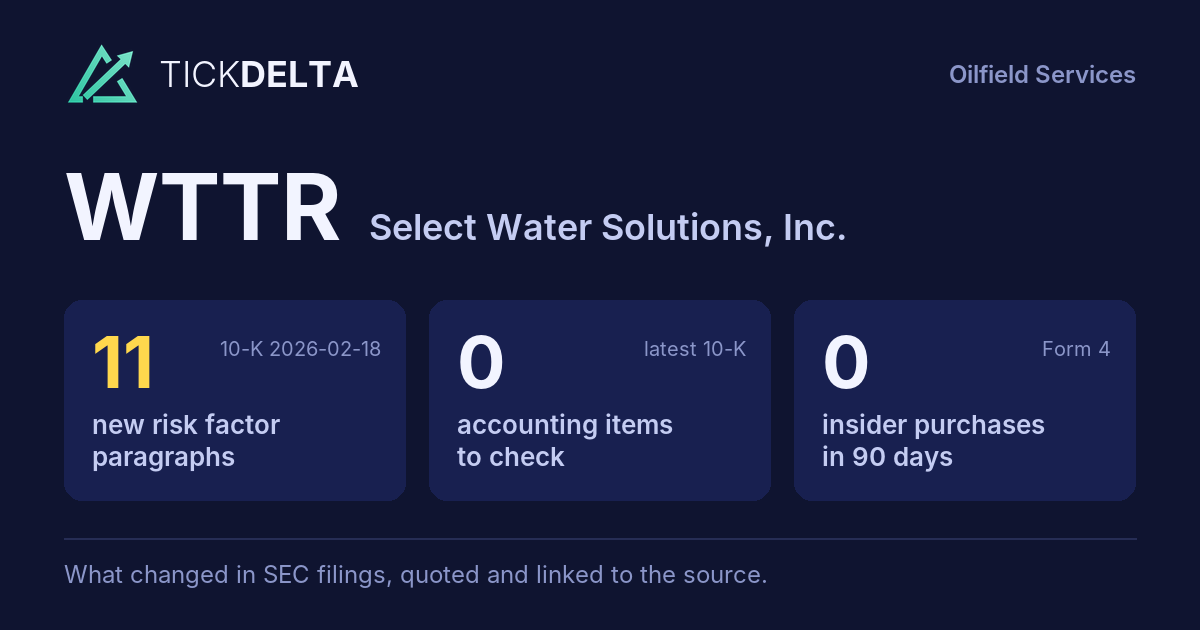
of the text changed · 17,077 words now · 11 new paragraphs, 9 gone
MD&A
41.8%
of the text changed · 11,638 words now · 31 new paragraphs, 24 gone
Accounting Policies
33.4%
of the text changed · 5,710 words now
10-K 0001104659-26-017085 (Feb 18, 2026) vs 10-K 0001558370-25-001154 (Feb 19, 2025) Not compared: Legal Proceedings.
Every paragraph, and how much of it changed
One bar per paragraph, in the order of the 10-K. Height and colour show the share of its words not in the closest paragraph a year earlier; the tallest bars are new paragraphs.
Risk Factors
158 paragraphs · 11 new · 52 reworded · 9 gone · 10-K Feb 18, 2026 against Feb 19, 2025
New paragraph
Reworded (5% of its words or more)
Same or nearly
Paragraph 38 · 49% changed
Every version of it
Although we take precautions to enhance the safety of our operations and minimize the risk of disruptions, our operations are subject to hazards inherent in the manufacturing and marketing of chemical and other products. These hazards include chemical spills, pipeline leaks and ruptures, storage tank leaks, discharges or releases of toxic or hazardous substances or gases and other hazards incident to the manufacturing, processing, handling, transportation and storage of hazardous chemicals. We are also potentially subject to other hazards, including natural disasters and severe weather; explosions and fires; transportation problems, including interruptions, spills and leaks; mechanical failures; unscheduled downtimes; labor difficulties; remediation complications; and other risks. Many potential hazards can cause bodily injury and loss of life, severe damage to or destruction of property and equipment and environmental damage, and may result in suspension of operations and the imposition of civil or criminal penalties and liabilities. Furthermore, we are subject to present and future claims with respect to workplace exposure, exposure of contractors on our premises as well as other persons located nearby, workers’ compensation and other matters.
Paragraph 145 · 46% changed
Every version of it
While we do not believe that the acquisitions of Rockwater, Nuverra or Buckhorn resulted in an ownership change under Section 382 of the Code with respect to us, future issuances, sales and/or exchanges of our stock (including in connection with an exercise of the Exchange Right or other transactions beyond our control), taken together with prior transactions with respect to our stock, could cause us to undergo an ownership change. As a result, we cannot assure you that we will not undergo an ownership change (as described in the future. We believe that the acquisitions of Rockwater, Nuverra and Buckhorn resulted in ownership changes with respect to each of Rockwater, Nuverra and Buckhorn, respectively. Accordingly, as described above, some or all of our U.S. federal or state or non-U.S. NOLs could expire before they can be used. In addition, future ownership changes or changes Note 1 to the U.S. tax laws could limit our ability to utilize our NOLs. To the extent we are not able to offset our future income with our NOLs, this would adversely affect our operating results and cash flows. consolidated financial statements) or
Paragraph 23 · 44% changed
Every version of it
Paragraph 153 · 43% changed
Every version of it
Paragraph 102 · 43% changed
Every version of it
Effective internal controls are necessary for us to provide reliable financial reports, prevent fraud and operate successfully as a public company. We are subject to Section 404 of the Sarbanes-Oxley Act of 2002 (“Sarbanes-Oxley”) and therefore are required to make a formal assessment of the effectiveness of our internal controls over financial reporting for that purpose. We cannot be certain that our efforts to maintain and enhance our internal controls will be successful, that we will be able to maintain adequate controls over our financial processes and reporting in the future or that we will be able to comply with our obligations under Sections 302 and 404 of Sarbanes-Oxley. Any failure to maintain effective internal controls, or difficulties encountered in implementing or improving our internal controls, could harm our operating results or cause us to fail to meet our reporting obligations. Ineffective internal controls could also cause investors to lose confidence in our reported financial information, which would likely have a negative effect on the trading price of our Class A common stock.
Paragraph 81 · 39% changed
Every version of it
Paragraph 28 · 32% changed
Every version of it
In August 2022, IRA 2022 was signed into law and it contains hundreds of billions of dollars in incentives that a could accelerate the transition from the use of fossil fuels to alternative energy sources, which could decrease demand for oil and gas and consequently adversely affect the business of our customers, thereby reducing demand for our services. In addition, However, certain of these initiatives have been paused, repealed or otherwise modified by the IRA 2022 imposes Trump Administration and the first ever federal fee on passage of the emission of GHGs through a methane emission charge. The OBBBA in July 2025. For example, the IRA 2022 amended the Clean Air Act CAA to impose a fee on the emission Waste Emission Charge for methane emissions in excess of methane statutory thresholds from sources required to report their GHG emissions to the EPA, including those sources in the onshore petroleum and natural gas production and gathering and boosting source categories. A However, in February 2025, Congress repealed the Waste Emissions Charge rule to implement using the methane fee was finalized by Congressional Review Act, and the OBBBA delayed implementation of the charge until 2034. While the EPA cannot reissue its rule implementing the Waste Emissions Charge (either in February 2024. However, it is uncertain what actions, substantially the same form or in a new rule), the underlying requirement in the IRA 2022 remains unchanged. We cannot predict if any, the Trump Administration or and/or Congress may take with respect action to the methane fee repeal or other provisions of revise this requirement in the IRA 2022. The methane emissions charge To the extent similar initiatives or other air pollution control and permitting requirements are implemented in the future, such initiatives could increase our customers’ operating costs and adversely affect their businesses, thereby reducing demand for our services.
Paragraph 140 · 50% changed
Every version of it
10-K Feb 19, 2025Payments under the Tax Receivable Agreements will be based on the tax reporting positions that we will determine. The TRA Holders will not reimburse us for any payments previously made under the Tax Receivable Agreements if any tax benefits that have given rise to payments under the Tax Receivable Agreements are subsequently disallowed, except that excess payments made to the TRA Holders will be netted against payments that would otherwise be made to the TRA Holders, if any, after our determination of such excess. As a result, in such circumstances, we could make payments that are greater than our actual cash tax savings, if any, and may not be able to recoup those payments, which could adversely affect our liquidity. See Part III, Item 13. “Certain Relationships and Related Transactions, and Director Independence.”
10-K Feb 18, 2026
any, and may not be able to recoup those payments, which could adversely affect our liquidity. See Part III, Item 13. “Certain Relationships and Related Transactions, and Director Independence.”
Paragraph 38 · 49% changed
Every version of it
10-K Feb 19, 2025
Although we take precautions to enhance the safety of our operations and minimize the risk of disruptions, our operations are subject to hazards inherent in the manufacturing and marketing of chemical and other products. These hazards include chemical spills, pipeline leaks and ruptures, storage tank leaks, discharges or releases of toxic or hazardous substances or gases and other hazards incident to the manufacturing, processing, handling, transportation and storage of hazardous chemicals. We are also potentially subject to other hazards, including natural disasters and severe weather; explosions and fires; transportation problems, including interruptions, spills and leaks; mechanical failures; unscheduled downtimes; labor difficulties; remediation complications; and other risks. Many potential hazards can cause bodily injury and loss of life, severe damage to or destruction of property and equipment and environmental damage, and may result in suspension of operations and the imposition of civil or criminal penalties and liabilities. Furthermore, we are subject to present and future claims with respect to workplace exposure, exposure of contractors on our premises as well as other persons located nearby, workers’ compensation and other matters.
10-K Feb 18, 2026
Although we take precautions to enhance the safety of our operations and minimize the risk of disruptions, our operations are subject to hazards inherent in the manufacturing and marketing of chemical and other products. These hazards include chemical spills, pipeline leaks and ruptures, storage tank leaks, discharges or releases of toxic or
Paragraph 145 · 46% changed
Every version of it
10-K Feb 19, 2025
While we do not believe that the acquisitions of Rockwater, Nuverra or Buckhorn resulted in an ownership change under Section 382 of the Code with respect to us, future issuances, sales and/or exchanges of our stock (including in connection with an exercise of the Exchange Right or other transactions beyond our control), taken together with prior transactions with respect to our stock, could cause us to undergo an ownership change. As a result, we cannot assure you that we will not undergo an ownership change in the future. We believe that the acquisitions of Rockwater, Nuverra and Buckhorn resulted in ownership changes with respect to each of Rockwater, Nuverra and Buckhorn, respectively. Accordingly, as described above, some or all of our U.S. federal or state or non-U.S. NOLs could expire before they can be used. In addition, future ownership changes or changes to the U.S. tax laws could limit our ability to utilize our NOLs. To the extent we are not able to offset our future income with our NOLs, this would adversely affect our operating results and cash flows.
10-K Feb 18, 2026
While we do not believe that the acquisitions of Rockwater, Nuverra or Buckhorn resulted in an ownership change under Section 382 of the Code with respect to us, future issuances, sales and/or exchanges of our stock (including in connection with an exercise of the Exchange Right (as described in Note 1 to the consolidated financial statements) or
Paragraph 23 · 44% changed
Every version of it
10-K Feb 19, 2025Our business includes water transfer for use in our customers’ oil and gas E&P activities. Our access to the water we supply may be limited due to prolonged drought or our inability to acquire or maintain water sourcing permits or other rights. In addition, some state and local governmental authorities have begun to monitor or restrict the use of water subject to their jurisdiction for hydraulic fracturing to ensure adequate local water supply. For instance, some states require E&P companies to report certain information regarding the water they use for hydraulic fracturing and to monitor the quality of groundwater surrounding some wells stimulated by hydraulic fracturing. Any such decrease in the availability of water, or demand for water services, could adversely affect our business and results of operations.
10-K Feb 18, 2026
monitor the quality of groundwater surrounding some wells stimulated by hydraulic fracturing. Any such decrease in the availability of water, or demand for water services, could adversely affect our business and results of operations.
Paragraph 153 · 43% changed
Every version of it
10-K Feb 19, 2025As a component of our business strategy, we intend to pursue selected, accretive acquisitions of complementary assets, businesses and technologies. Acquisitions involve numerous risks, including: unanticipated costs and assumption of liabilities and exposure to unforeseen liabilities of the acquired business, including but not limited to environmental liabilities and plug and abandonment obligations; difficulties in integrating the operations and assets of the acquired business and the acquired personnel; limitations on our ability to properly assess and maintain an effective internal control environment over an acquired business; potential losses of key employees and customers of the acquired business; risks of entering markets in which we have limited prior experience; and increases in our expenses and working capital requirements.
10-K Feb 18, 2026
control environment over an acquired business; potential losses of key employees and customers of the acquired business; risks of entering markets in which we have limited prior experience; and increases in our expenses and working capital requirements.
Paragraph 102 · 43% changed
Every version of it
10-K Feb 19, 2025
Effective internal controls are necessary for us to provide reliable financial reports, prevent fraud and operate successfully as a public company. We are subject to Section 404 of the Sarbanes-Oxley Act of 2002 (“Sarbanes-Oxley”) and therefore are required to make a formal assessment of the effectiveness of our internal controls over financial reporting for that purpose. We cannot be certain that our efforts to maintain and enhance our internal controls will be successful, that we will be able to maintain adequate controls over our financial processes and reporting in the future or that we will be able to comply with our obligations under Sections 302 and 404 of Sarbanes-Oxley. Any failure to maintain effective internal controls, or difficulties encountered in implementing or improving our internal controls, could harm our operating results or cause us to fail to meet our reporting obligations. Ineffective internal controls could also cause investors to lose confidence in our reported financial information, which would likely have a negative effect on the trading price of our Class A common stock.
10-K Feb 18, 2026
Effective internal controls are necessary for us to provide reliable financial reports, prevent fraud and operate successfully as a public company. We are subject to Section 404 of the Sarbanes-Oxley Act of 2002 (“Sarbanes-Oxley”) and therefore are required to make a formal assessment of the effectiveness of our internal controls over financial
Paragraph 81 · 39% changed
Every version of it
10-K Feb 19, 2025We are subject to a wide array of laws and regulations governing chemicals, including the regulation of chemical substances and inventories, such as the TSCA. These laws and regulations change frequently and have the potential to limit or ban altogether the types of chemicals we may use in our products, as well as result in increased costs related to testing, storing, and transporting our products prior to providing them to our customers. Any new restrictions on the development of new products or use of existing products, increases in regulation of those products, or disclosure of confidential, competitive information relating to the products could have an adverse effect on our operations and our cost of doing business. Furthermore, governmental, regulatory and societal demands for increasing levels of product safety and environmental protection could result in increased pressure for more stringent regulatory control with respect to the chemical industry. See Part I, Item 1. “Business – Environmental and Occupational Safety and Health Matters” for more discussion on chemical product use and safety.
10-K Feb 18, 2026
cost of doing business. Furthermore, governmental, regulatory and societal demands for increasing levels of product safety and environmental protection could result in increased pressure for more stringent regulatory control with respect to the chemical industry. See Part I, Item 1. “Business – Environmental and Occupational Safety and Health Matters” for more discussion on chemical product use and safety.
Paragraph 28 · 32% changed
Every version of it
10-K Feb 19, 2025
In August 2022, IRA 2022 was signed into law and it contains hundreds of billions of dollars in incentives that a could accelerate the transition from the use of fossil fuels to alternative energy sources, which could decrease demand for oil and gas and consequently adversely affect the business of our customers, thereby reducing demand for our services. In addition, the IRA 2022 imposes the first ever federal fee on the emission of GHGs through a methane emission charge. The IRA 2022 amended the Clean Air Act to impose a fee on the emission of methane from sources required to report their GHG emissions to the EPA, including those sources in the onshore petroleum and natural gas production and gathering and boosting source categories. A rule to implement the methane fee was finalized by the EPA in February 2024. However, it is uncertain what actions, if any, the Trump Administration or Congress may take with respect to the methane fee or other provisions of the IRA 2022. The methane emissions charge could increase our customers’ operating costs and adversely affect their businesses, thereby reducing demand for our services.
10-K Feb 18, 2026
In August 2022, IRA 2022 was signed into law and it contains hundreds of billions of dollars in incentives that a could accelerate the transition from the use of fossil fuels to alternative energy sources, which could decrease demand for oil and gas and consequently adversely affect the business of our customers, thereby reducing demand for our services. However, certain of these initiatives have been paused, repealed or otherwise modified by the Trump Administration and the passage of the OBBBA in July 2025. For example, the IRA 2022 amended the CAA to impose a Waste Emission Charge for methane emissions in excess of statutory thresholds from sources required to report their GHG emissions to the EPA, including those sources in the onshore petroleum and natural gas production and gathering and boosting source categories. However, in February 2025, Congress repealed the Waste Emissions Charge rule using the Congressional Review Act, and the OBBBA delayed implementation of the charge until 2034. While the EPA cannot reissue its rule implementing the Waste Emissions Charge (either in substantially the same form or in a new rule), the underlying requirement in the IRA 2022 remains unchanged. We cannot predict if the Trump Administration and/or Congress may take action to repeal or revise this requirement in the IRA 2022. To the extent similar initiatives or other air pollution control and permitting requirements are implemented in the future, such initiatives could increase our customers’ operating costs and adversely affect their businesses, thereby reducing demand for our services.
MD&A
119 paragraphs · 31 new · 63 reworded · 24 gone · 10-K Feb 18, 2026 against Feb 19, 2025
New paragraph
Reworded (5% of its words or more)
Same or nearly
Paragraph 58 · 50% changed
Paragraph 78 · 49% changed
Paragraph 4 · 48% changed
Paragraph 81 · 48% changed
Paragraph 69 · 48% changed
Chemical Technologies. Revenue decreased $63.0 increased $48.1 million, or 19.5%, 18.5%, to $307.6 million for the year ended December 31, 2025 compared to $259.5 million for the year ended December 31, 2024 compared to $322.5 million for the year ended December 31, 2023. 2024. The decrease increase in revenues was primarily driven by macroeconomic factors stemming from lower frac crew deployments and associated price reductions impacted by competitor price cuts. continued success in new product development, which has supported market share gains across key customer segments, as well as improved sales team execution.
Paragraph 67 · 46% changed
Water Infrastructure. Revenue increased by $60.9 $22.3 million, or 26.5%, 7.7%, to $313.2 million for the year ended December 31, 2025, compared to $290.9 million for the year ended December 31, 2024, compared to $230.0 million for the year ended December 31, 2023. 2024. The increase was primarily driven by additional revenue from acquisitions, which contributed to higher recycling revenue, supported by long-term contracts and the continued organic buildout of our recycling infrastructure, as well as higher disposal and landfill revenue earned during 2024, and organic growth in our recycling business line, solids revenues reflecting contributions from recently acquired assets. These gains were partially offset by lower pipeline distribution volumes. a combination of macroeconomic factors, including a reduction in hydraulic fracturing crews impacting activity and key customer activity timing and reduced activity levels in the Bakken.
Paragraph 109 · 46% changed
Impairment of goodwill, long-lived assets and intangible assets: Long-lived assets, such as property and equipment and finite-lived intangible assets, are evaluated for impairment whenever events or changes in circumstances indicate that their carrying value may not be recoverable. Recoverability is measured by a comparison of their carrying amount to the estimated undiscounted cash flows to be generated by those assets. If the undiscounted cash flows are less than the carrying amount, we record impairment losses for the excess of their carrying value over the estimated fair value. Fair value is determined, in part, by the estimated cash flows to be generated by those assets. Our cash flow estimates are based upon, among other things, historical results adjusted to reflect our best estimate of future market rates, utilization levels, and operating performance. Development of future cash flows also requires management to make assumptions and to apply judgment, including the timing of future expected cash flows, using the appropriate discount rates and determining salvage values. The estimate of fair value represents our best estimates of these factors based on current industry trends and reference to market transactions and is subject to variability. Assets are generally grouped at the lowest level of identifiable cash flows. We operate within the oilfield service industry, and the cyclical nature of the oil and gas industry that we serve and our estimates of the period over which future cash flows will be generated, as well as the predictability of these cash flows, can have a significant impact on the estimated fair value of these assets and, in periods of prolonged down cycles, may result in impairment charges. Changes to our key assumptions related to future performance, market conditions and other economic factors could adversely affect our impairment valuation.
Paragraph 79 · 45% changed
For the years year ended December 31, 2024 2025, we recognized $6.2 million in impairments and abandonments, consisting of $4.4 million in the Water Infrastructure segment primarily associated with SWD abandonments and the termination of a disposal lease, $1.2 million in Other related to abandonment of back-office software development costs previously classified as Other long-term assets and $0.6 million in the Water Services segment related to the relocation of operations from a leased facility. For the year ended December 31, 2023, 2024, we recorded $1.2 million and $1.4 million of abandonment that was primarily attributable to abandoned property and equipment, respectively. For the year ended December 31, 2023, we recorded $11.1 million of trademark abandonment in the Chemical Technologies segment as well as $0.1 million of impairment in our Water Services segment to write-off the remaining value of a cost-method investment. equipment.
Paragraph 58 · 50% changed
10-K Feb 19, 2025The following table sets forth our reconciliation of EBITDA and Adjusted EBITDA to our net (loss) income, which is the most directly comparable GAAP measure, for the years ended December 31, 2024 and 2023.
10-K Feb 18, 2026
EBITDA” for more information and a reconciliation of EBITDA and Adjusted EBITDA to net income, the most directly comparable financial measure calculated and presented in accordance with GAAP.
Paragraph 78 · 49% changed
10-K Feb 19, 2025Gross profit was $219.5 million for the year ended December 31, 2024 compared to $231.7 million for the year ended December 31, 2023. The decrease was due primarily to lower revenue and gross profit in our Water Services and Chemical Technologies segments, partially offset by higher revenue and gross profit in our Water Infrastructure segment. Gross profit increased by $61.5 million in our Water Infrastructure segment, decreased by $37.5 million in our Water Services segment and decreased by $21.5 million in our Chemical Technologies segment. Also contributing to the decrease in gross profit was a $14.7 million increase in depreciation, amortization and accretion expense. Gross margin as a percentage of revenue was 15.1% and 14.6% during the years ended December 31, 2024 and December 31, 2023, respectively.
10-K Feb 18, 2026
During the year ended December 31, 2025, we recognized $10.3 million in gains on sales of property and equipment and divestitures, primarily consisting of $6.4 million in underutilized or obsolete property and equipment in our Water Services segment, $2.9 million in our Water Infrastructure segment comprised of a $4.7 million gain from the sale of excess land in the Haynesville/East Texas region partially offset by $1.8 million of losses on sales of obsolete and underutilized property and equipment, and $1.0 million of obsolete property and equipment in our Chemical Technologies segment. During the year ended December 31, 2024, amounts recognized were due primarily to sales of underutilized or obsolete property and equipment.
Paragraph 4 · 48% changed
10-K Feb 19, 2025In many regions of the country, there has been growing concern about the volumes of water required for new oil and gas well completions, as well as volumes of water injected into subterranean zones where seismicity can be triggered. Working with our customers and local communities, we strive to be an industry leader in the development of sustainable cost-effective alternatives to fresh water. Specifically, we offer solutions through our infrastructure networks that enable our E&P customers to gather, treat and reuse produced water, thereby reducing the demand for freshwater while also reducing the volumes of saltwater that must be disposed by injection. In many areas, we have also acquired sources of non-potable water, such as brackish water or municipal or industrial effluent. Through our expertise in chemical technologies and our FluidMatch™ design solutions, we provide water profiling and fluid assessment services for our customers to support the optimization of their fluid systems, enabling the economic use of these alternative sources. We also work with our E&P customers to lower their emissions through methane combustion technology, and reduce the environmental footprint of their operations through the use of temporary hose and permanent pipeline systems, which are supported by extensive monitoring and automation technology solutions that provide safer and more efficient water resource management. These solutions significantly reduce the demand for trucking operations, thereby reducing gasoline and diesel exhaust emissions, increasing safety and decreasing traffic congestion in nearby communities.
10-K Feb 18, 2026
Across many of the regions in which we operate, there is growing concern surrounding the volumes of water required for new well completions, as well as the volumes of produced water injected into subterranean formations where induced seismicity may occur. In response, we are working collaboratively with our customers and local communities to advance more sustainable, cost-effective water management solutions that reduce both freshwater consumption and disposal volumes. Through our integrated infrastructure networks, we provide permanent and mobile solutions that enable the gathering, treatment, and reuse of produced water, which in turn reduces demand for freshwater resources and limits reliance on saltwater disposal wells. In select regions, we have also secured access to non-potable alternative water sources, including brackish groundwater and municipal or industrial effluent, to further support water reuse and reduce competition for freshwater. Leveraging our in-house chemical expertise and proprietary FluidMatch™ design platform, we provide tailored water profiling, treatment assessment, and fluid system optimization to enable the economic use of these alternative sources without compromising well performance. Additionally, we help our customers lower emissions and minimize environmental impact through the deployment of combustion solutions for field-based methane control and the use of temporary layflat hose systems and permanent pipeline infrastructure. These water delivery systems are supported by our real-time automation and remote monitoring technologies, including leak detection, pressure monitoring, and volume tracking, which enhance the safety, reliability, and efficiency of our operations. By reducing the reliance on trucked water logistics, these solutions materially reduce greenhouse gas emissions, improve public safety, and help limit traffic congestion and road damage in the local communities where we operate.
Paragraph 81 · 48% changed
10-K Feb 19, 2025For the years ended December 31, 2024 and December 31, 2023, we recorded $1.2 million and $1.4 million of abandonment that was primarily attributable to abandoned property and equipment, respectively. For the year ended December 31, 2023, we recorded $11.1 million of trademark abandonment in the Chemical Technologies segment as well as $0.1 million of impairment in our Water Services segment to write-off the remaining value of a cost-method investment.
10-K Feb 18, 2026
For the year ended December 31, 2025, a remeasurement gain of $14.9 million was recognized in connection with Water Services property and equipment that was part of the purchase consideration transferred to Omni.
Paragraph 69 · 48% changed
10-K Feb 19, 2025
Chemical Technologies. Revenue decreased $63.0 million, or 19.5%, to $259.5 million for the year ended December 31, 2024 compared to $322.5 million for the year ended December 31, 2023. The decrease in revenues was primarily driven by macroeconomic factors stemming from lower frac crew deployments and associated price reductions impacted by competitor price cuts.
10-K Feb 18, 2026
Chemical Technologies. Revenue increased $48.1 million, or 18.5%, to $307.6 million for the year ended December 31, 2025 compared to $259.5 million for the year ended December 31, 2024. The increase in revenues was primarily driven by continued success in new product development, which has supported market share gains across key customer segments, as well as improved sales team execution.
Paragraph 67 · 46% changed
10-K Feb 19, 2025
Water Infrastructure. Revenue increased by $60.9 million, or 26.5%, to $290.9 million for the year ended December 31, 2024, compared to $230.0 million for the year ended December 31, 2023. The increase was primarily driven by additional revenue from acquisitions, which contributed to higher disposal and landfill revenue earned during 2024, and organic growth in our recycling business line, offset by lower pipeline distribution volumes.
10-K Feb 18, 2026
Water Infrastructure. Revenue increased by $22.3 million, or 7.7%, to $313.2 million for the year ended December 31, 2025, compared to $290.9 million for the year ended December 31, 2024. The increase was primarily driven by higher recycling revenue, supported by long-term contracts and the continued organic buildout of our recycling infrastructure, as well as higher disposal and solids revenues reflecting contributions from recently acquired assets. These gains were partially offset by a combination of macroeconomic factors, including a reduction in hydraulic fracturing crews impacting activity and key customer activity timing and reduced activity levels in the Bakken.
Paragraph 109 · 46% changed
10-K Feb 19, 2025
Impairment of goodwill, long-lived assets and intangible assets: Long-lived assets, such as property and equipment and finite-lived intangible assets, are evaluated for impairment whenever events or changes in circumstances indicate that their carrying value may not be recoverable. Recoverability is measured by a comparison of their carrying amount to the estimated undiscounted cash flows to be generated by those assets. If the undiscounted cash flows are less than the carrying amount, we record impairment losses for the excess of their carrying value over the estimated fair value. Fair value is determined, in part, by the estimated cash flows to be generated by those assets. Our cash flow estimates are based upon, among other things, historical results adjusted to reflect our best estimate of future market rates, utilization levels, and operating performance. Development of future cash flows also requires management to make assumptions and to apply judgment, including the timing of future expected cash flows, using the appropriate discount rates and determining salvage values. The estimate of fair value represents our best estimates of these factors based on current industry trends and reference to market transactions and is subject to variability. Assets are generally grouped at the lowest level of identifiable cash flows. We operate within the oilfield service industry, and the cyclical nature of the oil and gas industry that we serve and our estimates of the period over which future cash flows will be generated, as well as the predictability of these cash flows, can have a significant impact on the estimated fair value of these assets and, in periods of prolonged down cycles, may result in impairment charges. Changes to our key assumptions related to future performance, market conditions and other economic factors could adversely affect our impairment valuation.
10-K Feb 18, 2026
Impairment of goodwill, long-lived assets and intangible assets: Long-lived assets, such as property and equipment and finite-lived intangible assets, are evaluated for impairment whenever events or changes in circumstances indicate that their carrying value may not be recoverable. Recoverability is measured by a comparison of their carrying amount to the estimated undiscounted cash flows to be generated by those assets. If the undiscounted cash flows are less than the carrying amount, we record impairment losses for the excess of their carrying value over the estimated fair
Paragraph 79 · 45% changed
10-K Feb 19, 2025
For the years ended December 31, 2024 and December 31, 2023, we recorded $1.2 million and $1.4 million of abandonment that was primarily attributable to abandoned property and equipment, respectively. For the year ended December 31, 2023, we recorded $11.1 million of trademark abandonment in the Chemical Technologies segment as well as $0.1 million of impairment in our Water Services segment to write-off the remaining value of a cost-method investment.
10-K Feb 18, 2026
For the year ended December 31, 2025, we recognized $6.2 million in impairments and abandonments, consisting of $4.4 million in the Water Infrastructure segment primarily associated with SWD abandonments and the termination of a disposal lease, $1.2 million in Other related to abandonment of back-office software development costs previously classified as Other long-term assets and $0.6 million in the Water Services segment related to the relocation of operations from a leased facility. For the year ended December 31, 2024, we recorded $1.2 million of abandonment that was primarily attributable to abandoned property and equipment.
A paragraph is matched with the one last year that shares the most of its words; under half in common makes it new. The paragraphs shown are the 8 reworded the most in each section.
The paragraph that changed most in each section
The redline
Marked against last year's 10-K: cut words struck through, new words highlighted.
Accounting Policies374 words changed in this paragraph; it is 42% similar to last year's version.
related reasonably certain option exercise assessments, the incremental borrowing rate for leases and the fair value of asset retirement obligations (“AROs”). The Company bases its estimates on historical and other pertinent information that are believed to be reasonable under the circumstances. The accounting estimates used in the preparation of the consolidated financial statements may change as new events occur, as more experience is acquired, as additional information is obtained and as the Company’s operating environment changes. Cash and cash equivalents: The Company considers all highly liquid investments with an original maturity of three months or less to be cash equivalents. Accounts receivable : Accounts receivable are stated at the invoiced amount, or the earned but not yet invoiced amount, net of an allowance for credit losses. Allowance for credit losses: The Company’s allowance for credit losses relates to trade accounts receivable. The Company treats trade accounts receivable as one portfolio and records an initial allowance calculated as a percentage of revenue recognized based on a combination of historical information and future expectations. Additionally, the Company adjusts this allowance based on specific information in connection with aged receivables. Historically, credit losses have been incurred when a customer’s financial condition significantly deteriorates, which in some cases leads to bankruptcy. Market volatility is highly uncertain and, as such, the impact on expected losses is subject to judgment and may cause variability in the Company’s allowance for credit losses in future periods. The change in the allowance for credit losses is as follows: For the year ended December 31, 2025 2024 2023 (in thousands) ────────────────────────────────────────────────────────────────────────────────────────────────────────────────────────────────────────────────────────── Balance at beginning of year $ 4,543 $ 5,318 $ 4,918 Increase to allowance based on a percentage of revenue 2,845 2,929 3,174 Adjustment based on aged receivable analysis (1,500) (2,200) 1,515 Charge-offs (1,118) (1,552) (4,350) Recoveries 31 48 61 Balance at end of year $ 4,801 $ 4,543 $ 5,318 Concentrations of credit and customer risk: Financial instruments that potentially subject the Company to concentrations of credit risk consist principally of cash and cash equivalents and trade accounts receivable. The amounts held in financial institutions periodically exceed the federally insured limit. Management believes that the financial institutions are financially sound and the risk of loss is minimal. The Company minimizes its exposure to counterparty credit risk by performing credit evaluations and ongoing monitoring of the financial stability of its customers. There was one customer that accounted for 10% of the Company’s consolidated revenue in 2025. There were no customers that accounted for 10% or more than 10% of the Company’s consolidated revenues for the years ended December 31, 2024, 2023 2024 and 2022. 2023. There was one customer that accounted for 11% of the Company’s consolidated receivables as of December 31, 2025 and one customer that accounted for 14% of the Company’s consolidated receivables as of December 31, 2024. There were no customers that accounted Inventories: The Company values its inventories at lower of cost or net realizable value. Inventory costs are determined under the weighted-average method. Inventory costs primarily consist of chemicals and materials available for more than 10% of the Company’s consolidated receivables as of December 31, 2023. resale.
Source: 10-K text, Note 2 – SIGNIFICANT ACCOUNTING POLICIES, 10-K 0001104659-26-017085 vs 10-K text, Note 2 – SIGNIFICANT ACCOUNTING POLICIES, 10-K 0001558370-25-001154
MD&A296 words changed in this paragraph; it is 41% similar to last year's version.
Source: Item 7, 10-K 0001104659-26-017085 vs Item 7, 10-K 0001558370-25-001154
Risk Factors176 words changed in this paragraph; it is 60% similar to last year's version.
In August 2022, IRA 2022 was signed into law and it contains hundreds of billions of dollars in incentives that a could accelerate the transition from the use of fossil fuels to alternative energy sources, which could decrease demand for oil and gas and consequently adversely affect the business of our customers, thereby reducing demand for our services. In addition, However, certain of these initiatives have been paused, repealed or otherwise modified by the IRA 2022 imposes Trump Administration and the first ever federal fee on passage of the emission of GHGs through a methane emission charge. The OBBBA in July 2025. For example, the IRA 2022 amended the Clean Air Act CAA to impose a fee on the emission Waste Emission Charge for methane emissions in excess of methane statutory thresholds from sources required to report their GHG emissions to the EPA, including those sources in the onshore petroleum and natural gas production and gathering and boosting source categories. A However, in February 2025, Congress repealed the Waste Emissions Charge rule to implement using the methane fee was finalized by Congressional Review Act, and the OBBBA delayed implementation of the charge until 2034. While the EPA cannot reissue its rule implementing the Waste Emissions Charge (either in February 2024. However, it is uncertain what actions, substantially the same form or in a new rule), the underlying requirement in the IRA 2022 remains unchanged. We cannot predict if any, the Trump Administration or and/or Congress may take with respect action to the methane fee repeal or other provisions of revise this requirement in the IRA 2022. The methane emissions charge To the extent similar initiatives or other air pollution control and permitting requirements are implemented in the future, such initiatives could increase our customers’ operating costs and adversely affect their businesses, thereby reducing demand for our services.
Source: Item 1A, 10-K 0001104659-26-017085 vs Item 1A, 10-K 0001558370-25-001154
Sentences and paragraphs added, removed or reworded
Every change, by type
Sentences and paragraphs of WTTR's Risk Factors and MD&A, 10-K Feb 18, 2026 against 10-K Feb 19, 2025. Each links to the text at sec.gov.
Quiet changes are sentences kept from last year with one to four words changed, at least one of them a hedge, a modal or a qualifier (may, could, will, not, significant, material…). A year or date rolling forward is not counted.
The full word list
adverse, adversely, all, although, anticipate, anticipates, any, approximately, believe, believes, can, cannot, certain, could, expect, expects, generally, however, if, intend, intends, largely, likely, many, material, materially, may, might, most, must, never, no, not, possible, primarily, probable, should, significant, significantly, some, substantial, substantially, unlikely, will, would
AddedRisk Factors
Though a comprehensive trade agreement was signed in 2020 between the U.S. and China, a trade war has rapidly escalated in the first half of 2025, with current tariffs on goods imported from China into the U.S. at a blended average tariff rate of approximately 48% and goods from the U.S. imported into China at an average tariff rate of approximately 32%. Approximately 8% of the raw material feedstock for our chemicals we produced in 2025 originated in China and were sold to us by our supplier partners. As a result, tariffs incurred by our supplier partners could increase our costs significantly and reduce profitability. Such elevated tariff rates may substantially increase the costs for certain products Select sources and, more importantly, our customers source from China, while also effectively pricing out U.S. oil, natural gas and NGLs from the Chinese market, which may adversely affect our customers as China is a major importer of oil, natural gas and NGLs globally. The continuation, expansion or worsening of these tariffs may adversely affect the industry in which we operate and reduce demand for our services. Further, the escalating trade war has resulted in a suspension of China’s imports of U.S. natural gas. As the world’s largest importer of natural gas, the loss of access to the market could have an adverse effect on our customers’ operations and the demand for their products.
Read it in 10-K Feb 18, 2026 at sec.gov
AddedRisk Factors
In addition to tariffs on Chinese imports, the U.S. administration has announced sweeping tariffs against a majority of other nations, with a universal 10% base tariff and a schedule of reciprocal tariffs. The U.S. is a major exporter of oil, gas and NGLs and may no longer be able to compete with global prices due to the tariffs on oil, gas and NGLs if other nations retaliate with their own tariffs, and such tariffs may reduce the demand for our customers’ products.
Read it in 10-K Feb 18, 2026 at sec.gov
AddedRisk Factors
Consolidation of our customers and competitors may impact our results of operations.
Read it in 10-K Feb 18, 2026 at sec.gov
AddedRisk Factors
In recent years, the oil and gas industry has undergone rapid consolidation, which may result in reduced capital spending by some of our customers, the acquisition of one or more of our primary customers or competitors or consolidated entities using size and purchasing power to seek pricing or other concessions, which may lead to decreased demand for our products and services. In addition, recent, ongoing and future mergers, combinations and consolidations in our industry could result in existing competitors increasing their market share. As a result, industry consolidation may have a significant negative impact on our results of operations, financial position or cash flows. We are unable to predict what effect industry consolidations may have on the pricing of our products and services, capital spending by our customers, our selling strategies, our competitive position, our ability to retain customers or our ability to negotiate favorable agreements with our customer and suppliers.
Read it in 10-K Feb 18, 2026 at sec.gov
AddedRisk Factors
continue to grow, if we experience high employee turnover or labor shortage, or add inexperienced personnel. See Part I, Item 1. “Business – Environmental and Occupational Safety and Health Matters” for more discussion on worker safety matters.
Read it in 10-K Feb 18, 2026 at sec.gov
AddedRisk Factors
Increasing attention to sustainability and environmental matters may impact our business.
Read it in 10-K Feb 18, 2026 at sec.gov
AddedRisk Factors
energy commodities may result in increased costs, reduced demand for our customers’ hydrocarbon products and our products and services, reduced profits, increased investigations and litigation, and negative impacts on our stock price and access to capital markets, or ability to attract and retain a talented workforce. Increasing attention to climate change, for example, may result in demand shifts for our customers’ hydrocarbon products and additional governmental investigations and private litigation against those customers.
Read it in 10-K Feb 18, 2026 at sec.gov
AddedRisk Factors
Also, despite any aspirational goals, we may receive pressure from investors, lenders or other groups to adopt more aggressive climate-, sustainability- or other environmental-related goals, but we cannot guarantee that we will be able to implement such goals because of changes in activity levels, potential costs or technical or operational obstacles. Certain statements or initiatives with respect to sustainability and environmental matters that we may pursue or assert are increasingly subject to heightened scrutiny from the public and governmental authorities, as well as other parties. Regulators, such as the SEC and various state agencies, as well as non-governmental organizations and other private actors have filed lawsuits under various securities and consumer protection laws alleging that certain sustainability or environmental statements, goals or standards were misleading, false or otherwise deceptive. Certain employment practices and social initiatives are the subject of scrutiny by both those calling for the continued advancement of such policies, as well as those who believe they should be curbed, including government actors, and the complex regulatory and legal frameworks applicable to such initiatives continue to evolve. More recent political developments could result in increased criticism or litigation risks from certain “anti-ESG” parties, including various governmental agencies. Such sentiment may focus on our environmental or social commitments (such as reducing GHG emissions) or our potential pursuit of certain employment practices or social initiatives that are alleged to be political or polarizing in nature or are alleged to violate laws based, in part, on changing priorities of, or interpretations by, federal agencies or state governments. Consideration of sustainability- or environmental-related factors in our decision-making could be subject to increasing scrutiny and objection from such parties. As a result, we may be subject to pressure in the media or through other means, such as governmental investigations, enforcement actions, or other proceedings, all of which could adversely affect our reputation, business, financial performance, market access and growth. Accordingly, there may be increased costs related to reviewing, implementing and managing such policies, as well as compliance and litigation risks based both on positions we do or do not take, or work we do or do not perform.
Read it in 10-K Feb 18, 2026 at sec.gov
Show the other 61
AddedRisk Factors
is a direct and indirect beneficiary of these provisions in our amended and restated certificate of incorporation. Our amended and restated certificate of incorporation further provides that no such person or party shall be liable to us by reason of the fact that such person pursues any such business opportunity or fails to offer any such business opportunity to us.
Read it in 10-K Feb 18, 2026 at sec.gov
AddedRisk Factors
Our investment in AV Farms could be materially and adversely affected by our lack of sole decision-making authority, our reliance on our co-investors’ financial condition, and disputes between our co-investors and us.
Read it in 10-K Feb 18, 2026 at sec.gov
AddedRisk Factors
As described in Note 2—Significant Accounting Policies, we recently entered into a new arrangement with C&A Rollover Company, LLC (“C&A”) and Geneses pursuant to which we have jointly invested in AV Farms and AV GP. AV Farms was formed to consolidate and commercialize one of the largest water holdings and storage portfolios in Colorado. Currently, we, C&A and Geneses own approximately 39%, 38% and 23%, respectively, of AV Farms and 25%, 50% and 25%, respectively, of AV GP. We have contributed $72 million in capital to AV Farms during the first quarter of 2025 and expect to contribute approximately $74 million in additional contributions over a three-year period. As such, we may not have a controlling interest in AV Farms and may share responsibility with C&A and Geneses for managing the operations of AV Farms as we may not have sole decision-making authority regarding AV Farms, which presents risks that may not be present in our other operations. For example, C&A or Geneses may have economic or other business interests or goals which are inconsistent with our business interests or goals, and may be in a position to take actions contrary to our preferences, policies or objectives. Additionally, it is possible that C&A or Geneses might become bankrupt, fail to fund their share of capital contributions or block or delay decisions that we believe are necessary. Such an investment may also have the potential risk of impasses on decisions, such as sales, because neither we nor C&A and Geneses may have full control over AV Farms. Disputes between us and C&A or Geneses may result in litigation or arbitration that would increase our expenses and divert the attention of our officers and directors from other aspects of our business. We may in certain circumstances be liable for the actions of such third parties. Any of the foregoing factors could materially and adversely affect our AV Farms investment.
Read it in 10-K Feb 18, 2026 at sec.gov
RemovedRisk Factors
RemovedRisk Factors
RemovedRisk Factors
RemovedRisk Factors
RemovedRisk Factors
RemovedRisk Factors
RemovedRisk Factors
RemovedRisk Factors
RemovedRisk Factors
RewordedRisk Factors
Acquisitions involve numerous risks, including: unanticipated costs and assumption of liabilities and exposure to unforeseen liabilities of the acquired business, including but not limited to environmental liabilities and plug and abandonment obligations; difficulties in integrating the operations and assets of the acquired business and the acquired personnel; limitations on our ability to properly assess and maintain an effective internal control environment over an acquired business; potential losses of key employees and customers of the acquired business; risks of entering markets in which we have limited prior experience; and increases in our expenses and working capital requirements.
Read it in 10-K Feb 18, 2026 at sec.gov
RewordedRisk Factors
RewordedRisk Factors
While we do not believe that the acquisitions of Rockwater, Nuverra or Buckhorn resulted in an ownership change under Section 382 of the Code with respect to us, future issuances, sales and/or exchanges of our stock (including in connection with an exercise of the Exchange Right (as described in Note 1 to the consolidated financial statements) or other transactions beyond our control), taken together with prior transactions with respect to our stock, could cause us to undergo an ownership change.
Read it in 10-K Feb 18, 2026 at sec.gov
RewordedRisk Factors
The enforceability of similar choice of forum provisions in other companies’ certificates of incorporation or similar governing documents has been challenged in legal proceedings, and it is possible that a court could find the choice of forum provisions contained in our amended and restated certificate of incorporation to be inapplicable or unenforceable, including with respect to claims arising under the U.S. federal securities laws.
Read it in 10-K Feb 18, 2026 at sec.gov
RewordedRisk Factors
In the event that the Tax Receivable Agreements TRAs are not terminated and we have sufficient taxable income to utilize all of the tax benefits subject to the Tax Receivable Agreements, TRAs, the payments due under the Tax Receivable Agreement TRA entered into with Legacy Owner Holdco and Crestview GP continue until the benefits of the last exchange of SES Holdings LLC Units are realized or expire, and the payments due under the Tax Receivable Agreement TRA entered into with certain an affiliate of Legacy Owners Owner Holdco and Crestview GP continue until the benefits of the exchanges are realized or expire.
Read it in 10-K Feb 18, 2026 at sec.gov
RewordedRisk Factors
RewordedRisk Factors
Increasing attention to climate change, increasing societal expectations on companies to address climate change, and potential consumer use of substitutes to energy commodities may result in increased costs, reduced demand for our products and services, reduced profits, increased governmental investigations and private litigation against us.
Read it in 10-K Feb 18, 2026 at sec.gov
RewordedRisk Factors
RewordedRisk Factors
However, despite this general allocation of risk, we might not succeed in enforcing such contractual allocation, might incur an unforeseen liability falling outside the scope of such allocation or may be required to enter into an MSA with terms that vary from the above allocations of risk.
Read it in 10-K Feb 18, 2026 at sec.gov
RewordedRisk Factors
For example, the BLM has finalized new rules that limit flaring from well sites on federal lands and add additional methane-related provisions to the permit application process, though although litigation challenging these rules have been subject to legal challenge. is held in abeyance while the Trump Administration reconsiders the rules.
Read it in 10-K Feb 18, 2026 at sec.gov
RewordedRisk Factors
As of December 31, 2024, we 2025, the Company and certain of its corporate subsidiaries had approximately $167.3 $210.6 million of tax-affected U.S. federal net operating loss carryforwards (“NOLs”), $87.8 NOLs, $87.7 million of which we expect to expire unused beginning in 2031 due to limitations under Section 382 of the Internal Revenue Code of 1986, as amended (the “Code”).
Read it in 10-K Feb 18, 2026 at sec.gov
RewordedRisk Factors
The term of each Tax Receivable Agreement TRA commenced upon the completion of the Select 144A Offering and will continue until all tax benefits that are subject to such Tax Receivable Agreement TRAs have been utilized or expired, unless we exercise our right to terminate the Tax Receivable Agreements TRAs (or the Tax Receivable Agreements TRAs are terminated due to other circumstances, including our breach of a material obligation thereunder or certain mergers or other changes of control) and we make the termination payment specified in the Tax Receivable Agreements. TRAs.
Read it in 10-K Feb 18, 2026 at sec.gov
Quiet changesRisk Factors
AddedMD&A
During 2025, we executed a series of strategic asset acquisitions totaling $25.4 million to expand our water infrastructure footprint across both the Permian Basin and the Northeast Region. In the Permian, we acquired surface acreage, multiple SWDs, water storage assets, and a pipeline system connecting a key customer’s operations to a Select recycling facility. These assets are located across Lea County and Eddy County in New Mexico, as well as Howard County, Upton County, and Winkler County in Texas, further strengthening our integrated network of treatment, disposal, gathering, and recycling infrastructure in core production areas of the Permian Basin. In addition, certain acquired SWD sites allow for the potential development of additional wells or recycling facilities in the future. In the Northeast, we acquired three SWDs in Ohio, expanding our market leading disposal presence in the region. Collectively, these transactions enhance Select’s ability to deliver full-cycle water management solutions across its footprint,
Read it in 10-K Feb 18, 2026 at sec.gov
AddedMD&A
supporting both near-term operations and long-term growth. Additionally, we also acquired certain wastewater treatment facilities for the accommodation and rentals business line in the Permian and Eagle Ford regions for $1.7 million.
Read it in 10-K Feb 18, 2026 at sec.gov
AddedMD&A
On July 1, 2025, we acquired a high-margin Bakken platform anchored by long-lived infrastructure from Omni: a special-waste landfill with approximately 3.2 million cubic yards of remaining capacity, a processing and recovery facility for reclaiming diesel and other hydrocarbons from oilfield waste, a permitted Class II SWD with capacity of approximately 12,000 barrels per day, and a commercial tank farm with approximately 24,000 barrels of oil storage. As part of the same transaction, we divested certain lower-margin operations including trucking operations in the Bakken, Northeast and MidCon regions, rental operations in the Bakken and one MidCon SWD. Approximately 280 fluids-hauling employees moved with those businesses, which together represented approximately 8 percent of Water Services segment revenue in the first half of 2025. This transaction expanded our market leading solids management business in the Bakken, while reducing exposure to noncore trucking and hauling.
Read it in 10-K Feb 18, 2026 at sec.gov
AddedMD&A
As part of our continued focus on capital discipline and portfolio optimization, we also took steps to streamline our fluids hauling operations to prioritize higher-margin, infrastructure-integrated markets. Specifically, we wound down our fluids hauling operations in the Haynesville region and divested the remaining lower-margin operations in the MidCon region. We continue to operate our more integrated and higher-margin fluids hauling businesses in the Permian, Rockies, and Eagle Ford regions, where these services are closely aligned with our operational infrastructure.
Read it in 10-K Feb 18, 2026 at sec.gov
AddedMD&A
In February 2025, we made a $72.1 million equity method investment in a newly formed partnership focused on consolidating and commercializing a large-scale portfolio of senior water rights, irrigated farmland, and reservoir storage assets in Colorado. The investment, centered in the Arkansas River Valley region, is intended to support long-term water infrastructure development and reliable delivery to agricultural, municipal, and industrial stakeholders. As of December 31, 2025, we had contributed $72.1 million to AV Farms and held an approximate 39% ownership interest in the partnership and a 25% interest in the general partner. We expect to contribute up to an additional $74 million over a multi-year period to support future water rights acquisitions and infrastructure buildout. The governing agreements also include call and put option structures beginning in 2028 that could result in our acquisition of the remaining ownership interests, subject to defined valuation mechanics and partial equity settlement provisions. This investment reflects our strategic focus on long-term water resource development and positions us to participate in sustainable water solutions across high-priority basins in the Western United States (Refer to “Note 2—Significant Accounting Policies” for further discussion on AV Farms).
Read it in 10-K Feb 18, 2026 at sec.gov
AddedMD&A
In August 2025, we announced that we had started an evaluation of strategic alternatives for Peak Rentals, our equipment rental and distributed power business within the Water Services segment. Peak currently includes our accommodations and rentals platform, as well as our well testing and flowback operations. This evaluation includes a range of potential paths forward, including capital structure initiatives and other portfolio optimization opportunities. As of December 31, 2025, no transaction is pending or imminent, and we continue to own 100% of the business. We are continuing to evaluate strategic alternatives for Peak Rentals in the ordinary course; however, there can be no assurance that any particular outcome will ultimately be pursued or completed.
Read it in 10-K Feb 18, 2026 at sec.gov
AddedMD&A
On January 24, 2025, we entered into a $550.0 million sustainability-linked senior secured credit facility and extinguished our prior debt. The new facility consists of a $300.0 million revolving credit facility and a $250.0 million
Read it in 10-K Feb 18, 2026 at sec.gov
AddedMD&A
term loan, both with a five-year maturity, and provides the flexibility to upsize by an additional $200.0 million. Proceeds from the term loan were used to repay all outstanding borrowings under our prior facility, which was concurrently terminated. This new structure enhances our liquidity position and extends our maturity profile through 2030. It also better aligns our capital structure with our long-term infrastructure growth strategy by supporting investment in contracted, production-linked assets and enhancing our flexibility to pursue disciplined, return-focused capital deployment (Refer to “Note 10—Debt” for further discussion of the Sustainability-Linked Credit Facility).
Read it in 10-K Feb 18, 2026 at sec.gov
AddedMD&A
During 2025 and 2024, Select has made strategic Water Infrastructure investments across five of the seven regions in which we operate. A summary of the resulting system capacity and current state of operations and resulting competitive advantages is outlined below.
Read it in 10-K Feb 18, 2026 at sec.gov
AddedMD&A
The Permian remains our largest and most strategically important Water Infrastructure region, anchored by a fully integrated network of 43 active SWDs, 17 active recycling facilities, as well as pipeline connectivity both within our system and with key customer infrastructure. We signed multiple new long-term customer agreements throughout 2025, including dedicated acreage, ROFR acreage and MVCs. A number of these commercial arrangements are expected to commence in 2026 and are anticipated to drive incremental system utilization, expand our high-margin recurring revenue base, and deepen customer relationships across the basin.
Read it in 10-K Feb 18, 2026 at sec.gov
AddedMD&A
The platform was expanded through the 2024 acquisition of Trinity, which added SWDs, pipelines and customer connectivity. During 2025, we completed seven additional bolt-on acquisitions, further enhancing our regional scale and footprint across disposal and pipeline infrastructure. These transactions were highly complementary and have strengthened our ability to provide integrated solutions with improved connectivity to both new and existing customer operations. As of December 31, 2025, our total recycling capacity was approximately 2.4 million barrels per day, with total storage capacity of approximately 35 million barrels. Additionally, we are continuing to drill new SWDs and build new recycling facilities.
Read it in 10-K Feb 18, 2026 at sec.gov
AddedMD&A
Including the Iron Mountain, and Tri-State acquisitions completed in 2024, we have established the largest disposal footprint in the Haynesville region. We now operate an integrated network of disposal assets, the majority of which are tied into basin-wide gathering infrastructure. As of 2025, our Haynesville system includes over 23 active SWDs supported by a regional pipeline network anchored by a 60-mile buried produced water gathering system. We also have a solids facility that processes drilling muds and water, removes solids for landfill disposal, and injects the remaining fluids into our SWDs. This scaled platform enhances flow assurance, improves route density, and strengthens commercial alignment with key customers across the region. Additionally, we are continuing to drill new SWDs in strategic locations to accommodate customer activity.
Read it in 10-K Feb 18, 2026 at sec.gov
RemovedMD&A
RemovedMD&A
RemovedMD&A
RemovedMD&A
RemovedMD&A
RemovedMD&A
RemovedMD&A
RemovedMD&A
RemovedMD&A
RemovedMD&A
RemovedMD&A
RemovedMD&A
RewordedMD&A
The $181.5 $86.3 million increase in net cash used in investing activities was due primarily to an increase of $143.6 million spent for acquisitions net of cash received, a $37.3 $121.4 million increase in purchases of property and equipment equipment, a $72.1 million investment in unconsolidated entities during the year ended December 31, 2025 and a $1.1 $0.6 million decrease in lower proceeds received from sales of property and equipment. equipment partially offset by a $107.7 million decrease in spending for acquisitions net of cash received.
Read it in 10-K Feb 18, 2026 at sec.gov
RewordedMD&A
Depreciation, amortization and accretion expense increased $14.7 $21.0 million, or 10.6%, 13.6%, to $174.5 million for the year ended December 31, 2025, compared to $153.5 million for the year ended December 31, 2024, compared to $138.8 million for the year ended December 31, 2023 2024 primarily due to a higher fixed asset base resulting from recent acquisitions investments made into new organic infrastructure projects as well as investments made into fixed infrastructure projects. recent acquisitions.
Read it in 10-K Feb 18, 2026 at sec.gov
RewordedMD&A
As of February 17, 2025, 16, 2026, we had $250.0 $363.5 million in outstanding indebtedness, the borrowing base for the Revolving Credit Facility (as defined below) under the Sustainability-Linked Credit Facility was $231.2 $214.5 million, the borrowing base for the Term Loan (as defined below) under the Sustainability-Linked Credit Facility was $426.3 million, the outstanding letters of credit totaled $19.6 million, and the available borrowing capacity under the Sustainability-Linked Credit Facility was $81.4 million.
Read it in 10-K Feb 18, 2026 at sec.gov
RewordedMD&A
The decrease was primarily composed of a $0.6 million decrease in Water Infrastructure costs, a $93.7 an $85.7 million decrease in Water Services costs and partially offset by a $41.5 $30.7 million decrease increase in Chemical Technologies costs, a $6.4 million increase in Water Infrastructure costs reflecting the lower revenue-producing activity discussed above, partially offset by and an increase of $14.7 $21.0 million in depreciation, amortization and accretion.
Read it in 10-K Feb 18, 2026 at sec.gov
RewordedMD&A
RewordedMD&A
Generally Accepted Accounting Principles (“GAAP”), plus non-cash losses on the sale of assets or subsidiaries, non-recurring compensation expense, subsidiaries less remeasurement gains on fixed assets related to business combinations, non-cash compensation expense, and non-recurring or unusual expenses or charges, including severance expenses, transaction costs, or facilities-related exit and disposal-related expenditures, plus/(minus) foreign currency losses/(gains), plus/(minus) losses/(gains) losses/(earnings) on unconsolidated entities and plus tax receivable agreements expense less bargain purchase gains from business combinations. TRAs expense.
Read it in 10-K Feb 18, 2026 at sec.gov
RewordedMD&A
Based on our current cash and cash equivalents balance, operating cash flow, available borrowings under our Sustainability-Linked Credit Facility and the ongoing actions discussed above, we believe that we will be able to maintain sufficient liquidity to satisfy our obligations and remain in compliance with our existing debt covenants through the next twelve months and beyond, prior to giving effect to any future financing that may occur.
Read it in 10-K Feb 18, 2026 at sec.gov
RewordedMD&A
As of February 17, December 31, 2025, we had $250.0 $320.0 million in outstanding indebtedness, the borrowing base for the Revolving Credit Facility (as defined below) under the Sustainability-Linked Credit Facility was $231.2 $235.1 million, the borrowing base for the Term Loan (as defined below) Facility under the Sustainability-Linked Credit Facility was $426.3 million and outstanding letters of credit totaled $19.6 million.
Read it in 10-K Feb 18, 2026 at sec.gov
RewordedMD&A
Net cash provided by financing activities was $188.4 million for the year ended December 31, 2025, compared to $46.6 million for the year ended December 31, 2024, compared to net cash used in financing activities of $98.4 million for the year ended December 31, 2023. 2024.
Read it in 10-K Feb 18, 2026 at sec.gov
RewordedMD&A
Costs of revenue decreased $0.6 increased $6.4 million, or 0.4%, 4.6%, to $143.9 million for the year ended December 31, 2025, compared to $137.6 million for the year ended December 31, 2024, compared to $138.2 million for the year ended December 31, 2023. 2024.
Read it in 10-K Feb 18, 2026 at sec.gov
RewordedMD&A
Costs of revenue decreased $41.5 increased $30.7 million, or 15.8%, 13.9%, to $251.3 million for the year ended December 31, 2025, compared to $220.6 million for the year ended December 31, 2024, compared to $262.1 million for the year ended December 31, 2023. 2024.
Read it in 10-K Feb 18, 2026 at sec.gov
RewordedMD&A
With respect to obligations under each of our Tax Receivable Agreements TRAs (except in cases where we elect to terminate the Tax Receivable Agreements TRAs early, the Tax Receivable Agreements TRAs are terminated early due to certain mergers or other changes of control or we have available cash but fail to make payments when due), generally we may elect to defer payments due under the Tax Receivable Agreements TRAs if we do not have available cash to satisfy our payment obligations under the Tax Receivable Agreements TRAs or if our contractual obligations limit our ability to make these payments.
Read it in 10-K Feb 18, 2026 at sec.gov
Sources
The two latest 10-Ks on EDGAR, section by section. Each change links to the text at sec.gov.
Also
New risk factors: paragraphs with nothing like them last year, quoted in full.
Work with it
Excel workbook · CSV. Google Sheet that stays up to date: paste =IMPORTDATA("https://tickdelta.com/company/WTTR/export.csv") into a cell.