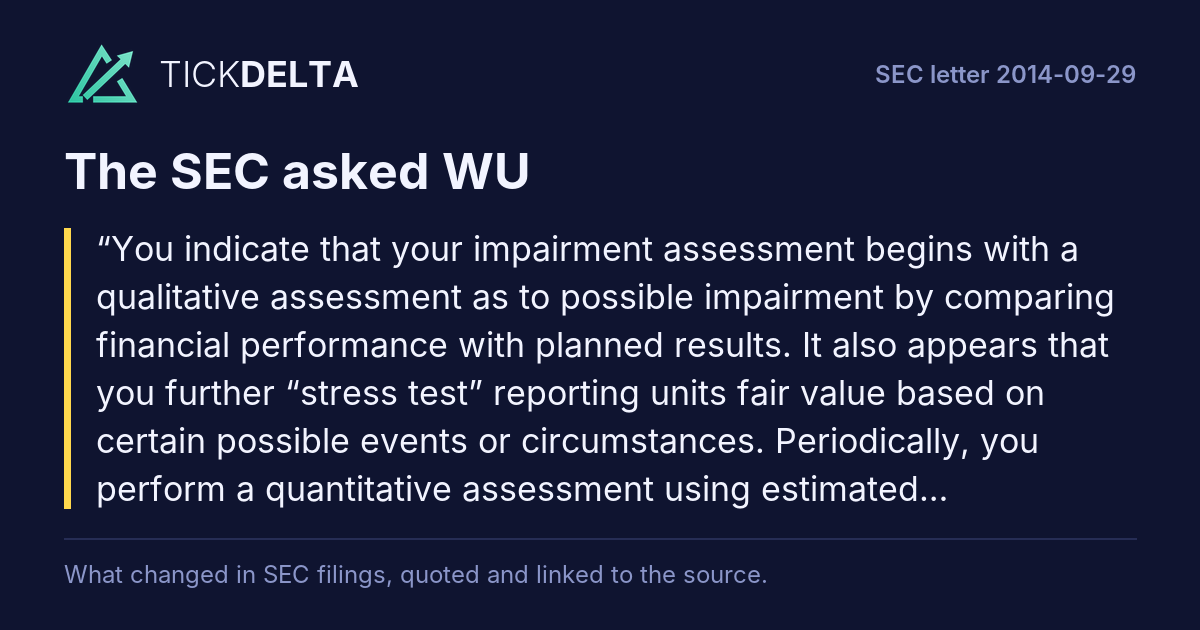
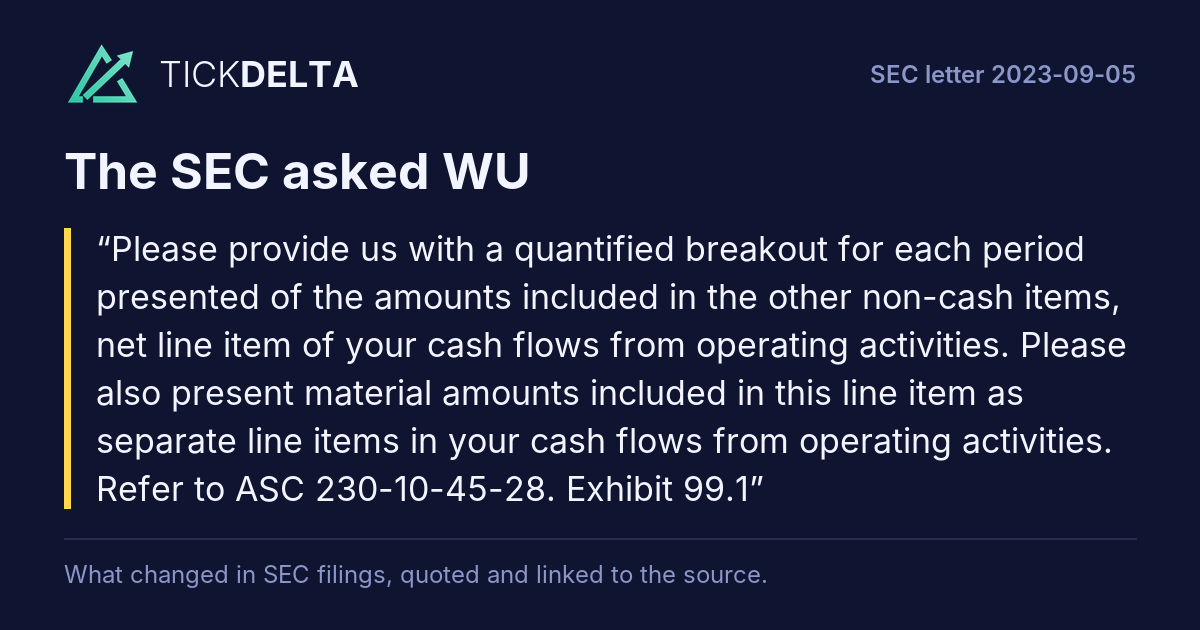
The Company includes purchases, sales and maturities of securities held for general corporate purposes, when applicable, within Cash flows from investing activities within its Consolidated Statements of Cash Flows on a gross basis. However, as described in the Company’s June 9, 2011 response to a related comment from the Staff, included below, the Company confirms the nature of its operations and industry are consistent with the basis for the earlier discussion, and therefore believes its current practice of netting changes in settlement assets and settlement obligations in the Consolidated
Rest of the answer
Statements of Cash Flows continues to be appropriate.
Full text of previous response:
Settlement assets represent funds received or to be received from agents for unsettled money transfers, money orders and customer payments, the receipt of which creates an equal and offsetting settlement obligation for subsequent payment to the intended recipient. The settlement assets may be in the form of cash and cash equivalents, receivables from agents or customers (which are typically converted to settlement cash in less than one week), or investment securities.
Settlement assets are segregated due to their fiduciary nature, as they are held for payout to customers and subject to restrictions in certain U.S. states and foreign jurisdictions pursuant to licensing requirements, and are reported as such in our required regulatory filings. In addition, the Company has elected a similar designation in other jurisdictions. The aforementioned licensing requirements permit us to hold and manage a combination of cash and cash equivalents, receivables, and high quality, investment grade securities to satisfy settlement obligations. Since settlement assets and the related settlement obligations always fluctuate in equal amounts with one another, they do not have a net impact on the Company’s cash flows.
The guidance regarding the presentation of restricted cash flows, especially guidance related to fiduciary funds, is limited.
However, we believe the Company’s practices are supported by Accounting Standards Codification (“ASC”) 230-10-45-22, which provides that “Certain cash receipts and payments have aspects of more than one class of cash flows….
If so, the appropriate classification shall depend on the activity that is likely to be the predominant source of cash flows for the item.” Also, at the 2006 AICPA Conference on Current SEC and PCAOB Developments, the SEC staff discussed changes in restricted cash (similar to our fiduciary settlement assets) and noted that when cash flow classification is unclear, registrants must use judgment and analysis that considers the nature of the activity and the predominant source of cash flow for these items. Further, in the basis for conclusions of FAS 95, paragraph 84, the Financial Accounting Standards Board acknowledges the importance of similar categorization for linked items by stating that “…grouping cash flows provided by or used in operating, investing, and financing activities enables significant relationships within and among the three kinds of activities to be evaluated” and “links cash flows that are often perceived to be related….” Given the fiduciary nature of settlement assets and the related settlement obligations and the aforementioned authoritative guidance, we believe segregating settlement assets from the related settlement obligations in different sections of the cash flow statement would ignore the fiduciary and regulatory link between such settlement assets and obligations, and the presentation of fluctuations in individual settlement assets and obligations would not help the reader assess the Company’s ability to generate positive future net cash flows, meet its obligations, pay dividends, or assess its need for external financing (ASC 230-10-10-2).
The Company’s policy is further supported by ASC 230-10-45-8, which states:
For certain items, the turnover is quick, the amounts are large, and the maturities are short. For certain other items…the entity is substantively holding or disbursing cash on behalf of its customers. Only the net changes during the period in assets and liabilities with those characteristics need be reported because knowledge of the gross cash receipts and payments related to them may not be necessary to understand the entity’s operating, investing and financing activities.
In this regard, our businesses transferred nearly $200 billion in principal and conducted over 800 million transactions on behalf of customers and businesses during 2010, which, on average, were completed within one week. Our net presentation is consistent with the above guidance because it reflects the nature of our business of collecting and remitting large amounts of principal on behalf of customers in short periods of time.
Despite the Company’s net presentation of settlement activity, the Company does disclose the $14.7 billion in proceeds from the sale and maturity of investment securities for the year ended December 31, 2010, as well as other required investment securities disclosures, in Footnote 7 “Investment Securities.” These proceeds were offset by purchases of investment securities of $14.9 billion for the year ended December 31, 2010 with the remaining principal flows resulting in a net increase in net settlement cash, receivables and obligations of $0.2 billion. Further information on the nature and composition of our settlement assets and obligations is included in Footnote 2 “Summary of Significant Accounting Policies – Settlement Assets and Obligations.”
Operating cash flow includes the Company’s revenue generating and operating expense activities. However, as settlement assets and settlement obligations themselves represent fiduciary principal and by nature do not “enter into the determination of net income,” a characteristic identified in ASC 230-10-20 that is generally expected of operating activities, we do not believe the cash flows contributing to the changes in these assets and liabilities associated with customer principal should impact operating activities. We believe impacting operating activities would confuse and/or mislead readers of our financial statements by inappropriately reflecting increases or decreases in operating cash flows simply as a result of changes in the composition of fiduciary funds held for settlement.
In summary, given the information above, the judgment necessary in this area, and the need to ensure financial statement readers can appropriately segregate between fiduciary and non-fiduciary cash flows in order to accurately assess the core operating, investing and financing activities of the Company, we believe the Company’s longstanding practice of netting changes in settlement assets and settlement obligations in the statement of cash flows is appropriate.
Notes to Consolidated Financial Statements, page 96
10. Income Taxes, page 117