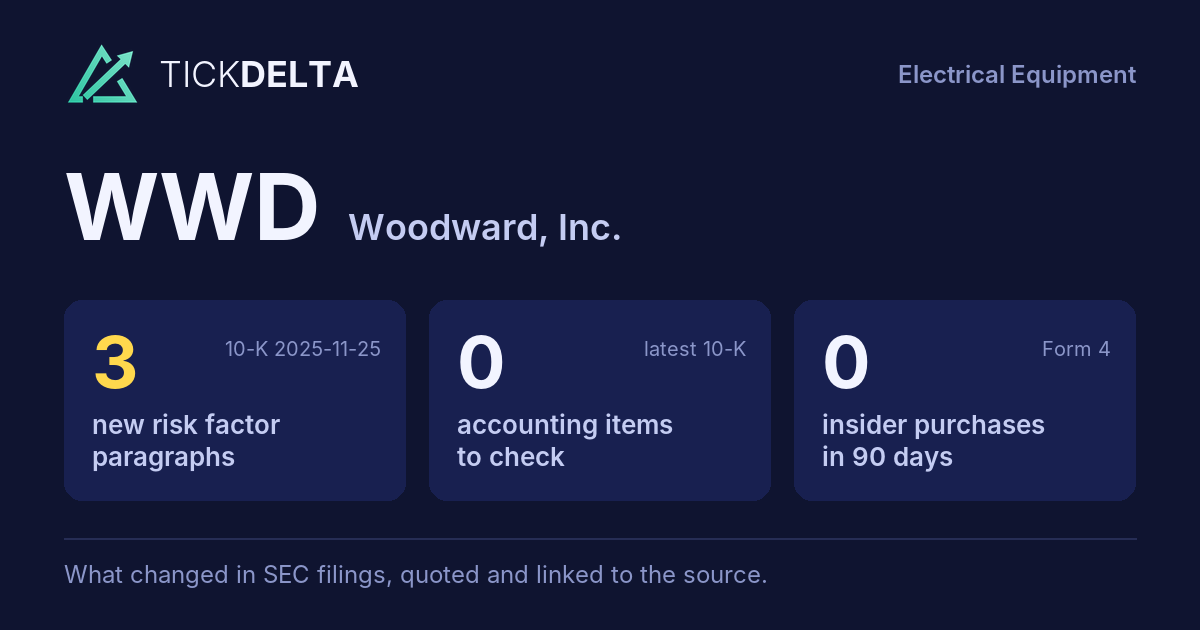
Paragraph 58 · 47% changed
Every version of it
Screener
/
SEC EDGAR
/CIK 0000108312
/10-K filed Nov 25, 2025, compared with Nov 26, 2024
/Numbers from the XBRL of the 10-Ks
Nasdaq
Industrials · Electrical Equipment
Woodward, Inc. WWD
The 10-K against last year's
143 changes: 26 added, 14 removed, 100 reworded, 3 quiet changes
10-K Nov 25, 2025 vs Nov 26, 2024
Risk Factors
17.5%
of the text changed · 8,902 words now · 3 new paragraphs, 2 gone
MD&A
31.2%
of the text changed · 9,242 words now · 23 new paragraphs, 12 gone
Legal Proceedings
6.8%
of the text changed · 447 words now
Accounting Policies
9.4%
of the text changed · 5,296 words now
10-K 0001193125-25-296204 (Nov 25, 2025) vs 10-K 0000950170-24-130891 (Nov 26, 2024)
Every paragraph, and how much of it changed
One bar per paragraph, in the order of the 10-K. Height and colour show the share of its words not in the closest paragraph a year earlier; the tallest bars are new paragraphs.
Risk Factors
107 paragraphs · 3 new · 46 reworded · 2 gone · 10-K Nov 25, 2025 against Nov 26, 2024
New paragraph
Reworded (5% of its words or more)
Same or nearly
Paragraph 72 · 44% changed
Every version of it
We and our third-party partners have implemented various security measures, including technical security controls, employee training, comprehensive monitoring of our networks and systems, independent third party security assessments, maintenance of backup systems, and the use of disaster recovery sites. In addition, we have, among other things, endeavored to align our practices and procedures with recognized IT security frameworks and select recommended practices, and through corroboration of our policies and procedures with local and federal agencies. Nonetheless, but our IT infrastructure, systems, networks, products, solutions, and services remain potentially vulnerable to numerous additional known or and unknown threats. Although We cannot guarantee that the measures we have implemented measures to prevent, detect, and respond to malicious activity, we cannot guarantee that such measures activities will be effective or sufficient to prevent a cyberattack or other means of effecting cybersecurity breaches or incidents. For example, given the nature of complex systems like ours and the scanning tools that we deploy in our IT environment, we regularly identify and track known security vulnerabilities; however, we cannot guarantee that patches or mitigating measures will be implemented before any vulnerabilities can be exploited by a threat actor.
Paragraph 86 · 43% changed
Every version of it
Paragraph 90 · 40% changed
Every version of it
Paragraph 67 · 33% changed
Every version of it
We are currently involved or may become involved in legal, regulatory, and other proceedings. These proceedings may include, without limitation, product liability matters, intellectual property matters, contract disputes or claims, pending or threatened litigation, and governmental investigations, as well as employment, tax, environmental, or other matters. These proceedings could lead to enforcement actions, adverse changes to our business practices, fines and penalties, business remedies, or the assertion of private litigation claims and/or damages that could be material, and of which could have a material adverse effect on our business, financial condition, results of operations, and cash flows. Even if the legal proceedings we face are decided in our favor, or are unfounded, we may incur material expenses and such matters may require significant management attention, and may harm our reputation with customers, employees or investors. We accrue for known individual matters if we believe it is probable that the matter will result in a loss when ultimately resolved using estimates of the most likely amount of loss. However, estimating possible losses involves significant judgment and outcomes are unpredictable, therefore, actual losses may exceed our estimates.
Paragraph 88 · 30% changed
Every version of it
Our business involves a significant level of product development activities, generally in connection with our customers’ activities and research and development activities. Industry standards, customer expectations, or other products may emerge that could render one or more of our products or services less desirable or obsolete. Additionally, our competitors may develop new technology, or more efficient ways to produce their existing products that could cause our existing products or services to become less desirable or obsolete. costs. Maintaining our market position requires continued investment in research and development. During an economic downturn or a subsequent recovery, we may need to maintain our investment in research and development, which may limit our ability to reduce these expenses in proportion to a sales shortfall.
Paragraph 57 · 30% changed
Every version of it
We rely on a highly trained workforce due to the specialized nature of our business. Further, approximately 13% of our workforce in the United States is unionized, and certain of our operations in the United States and internationally involve different employee/employer relationships and the existence of works’ councils. We periodically need to renegotiate our collective bargaining agreements, and any failure to negotiate new agreements or extensions in a timely manner could result in work stoppages or slowdowns. Any significant increases in labor costs, deterioration of employee member relations, including any conflicts with works’ councils or unions, or slowdowns or work stoppages at any of our locations, whether due to employee member turnover, changes in availability of qualified technical personnel, failure to have a collaborative and effective relationship with our employees, including our union employees, or an effective collective bargaining agreement in place with our union employees, members, or otherwise, could impair our ability to supply products or fulfill orders, and could otherwise have a material adverse effect on our business, our relationships with customers, and our financial condition, results of operations, and cash flows. Further increases in labor costs could significantly reduce our profit margins if we are unable to flow such costs through to our customers.
Paragraph 71 · 29% changed
Every version of it
Paragraph 58 · 47% changed
Every version of it
10-K Nov 26, 2024We rely on a highly trained workforce due to the specialized nature of our business. Further, approximately 13% of our workforce in the United States is unionized, and certain of our operations in the United States and internationally involve different employee/employer relationships and the existence of works’ councils. We periodically need to renegotiate our collective bargaining agreements, and any failure to negotiate new agreements or extensions in a timely manner could result in work stoppages or slowdowns. Any significant increases in labor costs, deterioration of employee relations, including any conflicts with works’ councils or unions, or slowdowns or work stoppages at any of our locations, whether due to employee turnover, changes in availability of qualified technical personnel, failure to have a collaborative and effective relationship with our employees, including our union employees, or an effective collective bargaining agreement in place with our union employees, or otherwise, could impair our ability to supply products or fulfill orders, and could otherwise have a material adverse effect on our business, our relationships with customers, and our financial condition, results of operations, and cash flows. Further increases in labor costs could significantly reduce our profit margins if we are unable to flow such costs through to our customers.
10-K Nov 25, 2025
Further, approximately 13% of our workforce in the United States is unionized, and certain of our operations in the United States and internationally involve different member/employer relationships and the existence of works’ councils. We cannot predict how stable our union relationships will be. We periodically need to renegotiate our collective bargaining agreements, and there can be no assurance that we will be able to timely agree to terms of future agreements or extensions without experiencing work stoppages, strikes, slowdowns, or other disruptions. One of our union contracts in the United States is currently expired, and the Company is continuing to honor this contract as status quo. There has been no associated work stoppage since the expiration of the union contract, but we cannot guarantee this will continue. Prolonged negotiations or labor disputes could disrupt our operations, lead to increased costs, or negatively impact our ability to serve customers and achieve our business objectives. Additionally, the terms of any renegotiated agreements could result in increased labor costs, operational restrictions, or other changes that could adversely affect our financial performance. Any deterioration in the relationship with our union members, or the failure to have effective collective bargaining agreements in place with our union members, could impair our ability to supply products or fulfill orders, and could otherwise have a material adverse effect on our business, our relationships with customers, and our financial condition, results of operations, and cash flows. Although we have not experienced any recent work stoppages, we may experience them in the future, which could adversely affect our business.
Paragraph 72 · 44% changed
Every version of it
10-K Nov 26, 2024
We have implemented various measures, including technical security controls, employee training, comprehensive monitoring of our networks and systems, independent third party security assessments, maintenance of backup systems, and the use of disaster recovery sites. In addition, we have, among other things, endeavored to align our practices and procedures with recognized IT security frameworks and select recommended practices, and through corroboration of our policies and procedures with local and federal agencies. Nonetheless, our IT infrastructure, systems, networks, products, solutions, and services remain potentially vulnerable to numerous additional known or unknown threats. Although we have implemented measures to prevent, detect, and respond to malicious activity, we cannot guarantee that such measures will be effective or sufficient to prevent a cyberattack or other means of effecting cybersecurity breaches or incidents.
10-K Nov 25, 2025
We and our third-party partners have implemented various security measures, but our IT infrastructure, systems, networks, products, solutions, and services remain vulnerable to numerous additional known and unknown threats. We cannot guarantee that the measures we have implemented to prevent, detect, and respond to malicious activities will be effective or sufficient to prevent a cyberattack or other means of effecting cybersecurity breaches or incidents. For example, given the nature of complex systems like ours and the scanning tools that we deploy in our IT environment, we regularly identify and track known security vulnerabilities; however, we cannot guarantee that patches or mitigating measures will be implemented before any vulnerabilities can be exploited by a threat actor.
Paragraph 86 · 43% changed
Every version of it
10-K Nov 26, 2024Further, the markets in which we operate experience rapidly changing technologies and frequent introductions of new products and services. Our technologies and the technological expertise we have developed and maintained could become less valuable if a competitor were to develop a new technology that would allow it to match or exceed the performance of existing technologies at a lower cost. If we are unable to develop competitive technologies, future sales or earnings could be lower than expected, which could have a material adverse effect on our business, financial condition, results of operations, and cash flows.
10-K Nov 25, 2025
The markets in which we operate experience rapidly changing technologies and frequent introductions of new products and services. We believe that we must continue to enhance our existing products and develop and manufacture new products with improved capabilities in order to effectively compete. We also must align our development activities with our customers’ development activities and expectations, along with emerging industry standards. Our technologies and the technological expertise we have developed and maintained could become less valuable if a competitor were to develop a new technology that would allow it to match or exceed the performance of existing technologies at a lower cost, or were to develop more efficient ways to produce their existing products that could cause our existing products or services to become less desirable or obsolete. We also believe that we must continue to make improvements in our productivity in order to maintain our competitive position. Difficulties or delays in research, development or production of new or enhanced products or failure to gain market acceptance of new or enhanced products and technologies may reduce future sales and adversely affect our competitive position. We continue to invest in the development and marketing of new or enhanced products. There can be no assurance that we will have sufficient resources to make such investments, that we will be able to make the technological advances necessary to maintain competitive advantages, or that we can recover major research and development expenses. If we are unable to develop competitive technologies, make innovations, launch products with quality problems, or the market does not accept our new products, future sales or earnings could be lower than expected, which could have a material adverse effect on our business, financial condition, results of operations, and cash flows. In addition, as new or enhanced products are introduced, we must successfully manage the transition from older products to minimize disruption in customers’ ordering patterns, avoid excessive levels of older product inventories, and ensure that we can deliver sufficient supplies of new products to meet customers’ demands.
Paragraph 90 · 40% changed
Every version of it
10-K Nov 26, 2024The occurrence of one or more of these risks, some of which are out of our control, could have a material adverse effect on our business, financial condition, results of operations, and cash flows.
10-K Nov 25, 2025
product cost structure, then our future sales, margins and/or earnings could be lower than expected, which could have a material adverse effect on our business, financial condition, results of operations, and cash flows.
Paragraph 67 · 33% changed
Every version of it
10-K Nov 26, 2024
We are currently involved or may become involved in legal, regulatory, and other proceedings. These proceedings may include, without limitation, product liability matters, intellectual property matters, contract disputes or claims, pending or threatened litigation, governmental investigations, as well as employment, tax, environmental, or other matters. These proceedings could lead to enforcement actions, adverse changes to our business practices, fines and penalties, business remedies, or the assertion of private litigation claims and/or damages that could be material, and of which could have a material adverse effect on our business, financial condition, results of operations, and cash flows. Even if the legal proceedings we face are decided in our favor, or are unfounded, we may incur material expenses and such matters may require significant management attention, and may harm our reputation with customers, employees or investors. We accrue for known individual matters if we believe it is probable that the matter will result in a loss when ultimately resolved using estimates of the most likely amount of loss. However, estimating possible losses involves significant judgment and outcomes are unpredictable, therefore, actual losses may exceed our estimates.
10-K Nov 25, 2025
We are currently involved or may become involved in legal, regulatory, and other proceedings. These proceedings may include, without limitation, product liability matters, intellectual property matters, contract disputes or claims, pending or threatened litigation, and governmental investigations, as well as employment, tax, environmental, or other matters. These proceedings could lead to enforcement actions, adverse changes to our business practices, fines and penalties, business remedies, or the assertion of private litigation claims and/or damages that could be material, and of which could have a
Paragraph 88 · 30% changed
Every version of it
10-K Nov 26, 2024
Our business involves a significant level of product development activities, generally in connection with our customers’ development activities. Industry standards, customer expectations, or other products may emerge that could render one or more of our products or services less desirable or obsolete. Additionally, our competitors may develop new technology, or more efficient ways to produce their existing products that could cause our existing products or services to become less desirable or obsolete. Maintaining our market position requires continued investment in research and development. During an economic downturn or a subsequent recovery, we may need to maintain our investment in research and development, which may limit our ability to reduce these expenses in proportion to a sales shortfall.
10-K Nov 25, 2025
Our business involves a significant level of product development activities and research and development costs. Maintaining our market position requires continued investment in research and development. During an economic downturn or a subsequent recovery, we may need to maintain our investment in research and development, which may limit our ability to reduce these expenses in proportion to a sales shortfall.
Paragraph 57 · 30% changed
Every version of it
10-K Nov 26, 2024
We rely on a highly trained workforce due to the specialized nature of our business. Further, approximately 13% of our workforce in the United States is unionized, and certain of our operations in the United States and internationally involve different employee/employer relationships and the existence of works’ councils. We periodically need to renegotiate our collective bargaining agreements, and any failure to negotiate new agreements or extensions in a timely manner could result in work stoppages or slowdowns. Any significant increases in labor costs, deterioration of employee relations, including any conflicts with works’ councils or unions, or slowdowns or work stoppages at any of our locations, whether due to employee turnover, changes in availability of qualified technical personnel, failure to have a collaborative and effective relationship with our employees, including our union employees, or an effective collective bargaining agreement in place with our union employees, or otherwise, could impair our ability to supply products or fulfill orders, and could otherwise have a material adverse effect on our business, our relationships with customers, and our financial condition, results of operations, and cash flows. Further increases in labor costs could significantly reduce our profit margins if we are unable to flow such costs through to our customers.
10-K Nov 25, 2025
We rely on a highly trained workforce due to the specialized nature of our business. Any significant increases in labor costs, deterioration of member relations, or slowdowns or work stoppages at any of our locations, whether due to member turnover, changes in availability of qualified technical personnel, failure to have a collaborative and effective relationship with our members, or otherwise, could impair our ability to supply products or fulfill orders, and could otherwise have a material adverse effect on our business, our relationships with customers, and our financial condition, results of operations, and cash flows.
Paragraph 71 · 29% changed
Every version of it
10-K Nov 26, 2024From time to time, we have experienced cyberattacks on our IT infrastructure and systems. We may become the target of cyber-attacks by third parties, either directly or indirectly via our supply chain or third-party vendors, seeking unauthorized access to our data or our customers’ data or to disrupt our operations or our ability to provide services. There is also a danger of loss, misuse, theft, unavailability, or unauthorized disclosure or other processing of information or assets (including source code), or damage to or other compromise of systems, components, and other IT assets, including the introduction of malicious code or other vulnerabilities by people who obtain unauthorized access to our facilities, systems, or information. There are many different techniques used to obtain unauthorized access to systems and data, and such techniques continue to evolve and become more sophisticated, and the adversaries are becoming more advanced, including nation states and actors sponsored by or affiliated with nation states, which target us and other defense contractors because we protect national security information, and other actors with substantial financial and technological resources. These techniques include, but are not limited to, the use of malicious software, destructive malware, ransomware, denial of service attacks, phishing and other means of social engineering, and other means of causing system or network disruptions, obtaining unauthorized access to data or systems, or causing other cybersecurity breaches and
10-K Nov 25, 2025
We and certain of our third-party providers have experienced cyberattacks on our IT infrastructure and systems. Given our industry, we expect continued targeting of cyberattacks, either directly against us or indirectly via our supply chain or third-party vendors, seeking unauthorized access to our data or our customers’ data or to disrupt our operations or our ability to provide services. We face many ongoing cybersecurity threats, such as the loss, misuse, theft, unavailability, or unauthorized disclosure or other processing of information or assets (including source code), or damage to or other compromise of systems, components, and other IT assets, including the introduction of malicious code or other vulnerabilities by people who obtain unauthorized access to our facilities, systems, or information. There are many different techniques used to obtain unauthorized access to systems and data, and such techniques continue to evolve and become more sophisticated, including the increasing use by threat actors of artificial intelligence, and the adversaries are becoming more advanced, including nation-states and actors sponsored by or affiliated with nation-states, which target us and other defense contractors because we have national security information in our possession, and other actors with substantial financial and technological resources. These techniques include, but are not limited to, the use of malicious software, destructive malware, ransomware, denial-of-service attacks, phishing and other means of social engineering, and other means of causing system or network disruptions, obtaining unauthorized access to data or systems, or causing other cybersecurity breaches and incidents. Additionally, we are exposed to system and service disruptions, and cybersecurity breaches or incidents resulting from employee or contractor error, negligence, or malfeasance. Further, we expect continued cyberattacks directed at our supply chain. We face continued cybersecurity threats resulting from tools, services, or other third-party components and security vulnerabilities within, or introduced by, such tools, services, or components. Due to the rapidly evolving threat environment and other factors, we cannot guarantee protection against all such attacks. Further, due to the evolving nature of these security threats and the national security aspects of much of the data in our possession, the full impact of any future security breach or incident cannot be predicted. In addition, because certain of our products and services are integrated with our customers’ systems and processes, the circumvention or failure of our cybersecurity measures may compromise the confidentiality, integrity, and availability of our customers’ systems or data. We have acquired and continue to acquire companies with vulnerabilities or unsophisticated security measures, which exposes us to cybersecurity risks.
MD&A
122 paragraphs · 23 new · 65 reworded · 12 gone · 10-K Nov 25, 2025 against Nov 26, 2024
New paragraph
Reworded (5% of its words or more)
Same or nearly
Paragraph 58 · 50% changed
Paragraph 10 · 48% changed
Paragraph 37 · 46% changed
Interest expense remained flat at $47,959, declined slightly to $45,689, or 1.3% of net sales for fiscal year 2025, compared to $47,959 or 1.4% of net sales for fiscal year 2024, compared to $47,898 or 1.6% of net sales for fiscal year 2023. Interest expense remained flat for fiscal year 2024 2024. This was primarily due to consistent borrowings and interest rates a lower long-term debt balance after we paid the full principal balance on our revolving credit agreement as compared to a series of private placement notes in the prior current fiscal year.
Paragraph 50 · 46% changed
Industrial segment net sales increased decreased by $149,168, $41,373, or 13.0%, 3.2%, to $1,254,258 for fiscal year 2025, compared to $1,295,631 for fiscal year 2024, compared 2024. This decrease was largely a result of lower sales volume and unfavorable mix, both related to $1,146,463 for fiscal year 2023. The increase in Industrial segment net sales in fiscal year 2024 as compared to the prior fiscal year was primarily attributable to growth in transportation, particularly in the reduced China on-highway natural gas truck business in China, price realization, and strong sales in power generation, demand, partially offset by a decrease in oil and gas sales. price realization.
Paragraph 44 · 46% changed
Defense OEM sales increased in fiscal year 2024 2025 as compared to prior fiscal year, primarily driven by the increased demand for smart defense. Our defense aftermarket sales increased in fiscal year 2024 compared to the prior fiscal year, 2024, primarily driven by increased output and supply chain stabilization. demand for our smart defense products, as well as price increases on certain smart defense products that took effect during the fourth quarter of the fiscal year. Defense services sales decreased in fiscal year 2025 as compared to fiscal year 2024 due to unfavorable mix.
Paragraph 104 · 44% changed
When determining the transaction price of each contract, we consider contractual consideration payable by the customer and variable consideration that may affect the total transaction price. Variable consideration, consisting of early payment discounts, rebates, and other sources of price variability, are included in the estimated transaction price based on both customer-specific information as well as historical experience. We regularly review our estimates of variable consideration on the transaction price and recognize changes in estimates on a cumulative catch-up basis as if the most current estimate of the transaction price adjusted for variable consideration had been known as of the inception of the contract.
Paragraph 79 · 43% changed
Paragraph 49 · 42% changed
Paragraph 58 · 50% changed
10-K Nov 26, 2024Nonsegment expenses decreased by $11,066 to $119,745 for fiscal year 2024, compared to $130,811 for fiscal year 2023. The decrease in nonsegment expenses is primarily due to significant costs that occurred in fiscal year 2023 that did not reoccur in fiscal year 2024.
10-K Nov 25, 2025
The significant items that impacted nonsegment expenses in the current fiscal year as compared to the prior fiscal year were:
Paragraph 10 · 48% changed
10-K Nov 26, 2024In February 2024, the Federal Aviation Administration (“FAA”) required a quality production plan from Boeing in response to several aircraft issues. As part of this quality production plan, the FAA is exercising enhanced oversight of Boeing, including a requirement that the FAA have approval authority for build rate increases on the 737 MAX. During fiscal year 2024, overall 737 MAX orders and demand have not changed significantly. In fiscal year 2024, the enhanced FAA oversight had a slightly negative impact on commercial OEM sales, but this was offset by price realization. In the event the FAA approves increases to Boeing's build rates, we anticipate initial provisioning sales would continue to increase in subsequent periods. In November 2024, Boeing's U.S. West Coast factory workers accepted a new contract offer, ending a seven-week strike that halted production of the 737 MAX as well as the 777. As a result of the work stoppage, our direct sales in fiscal year 2025 to Boeing have been negatively impacted. However, now that the strike has ended we expect that deliveries of the 737 MAX program will continue to increase in future periods and that the long-term demand for the aircraft has not changed. However, a prolonged depression of build rates of the Boeing 737 MAX could decrease our OEM and initial provisioning sales for the 737 MAX and CFM LEAP engines in the near term, which could have an adverse effect on our business results.
10-K Nov 25, 2025
halted production of the 737 MAX as well as the 777. As a result of the work stoppage and our disciplined and measured production ramp to meet demand following the work stoppage, our direct sales to Boeing for the first half of fiscal year 2025 were negatively impacted. We saw deliveries of the 737 MAX program increase in the second half of fiscal year 2025 as compared to the first half of the fiscal year, and we expect them to continue to increase in future periods as we do not expect the long-term demand for the aircraft to decline. Boeing's build rate did stabilize during fiscal year 2025 and, in October 2025, the FAA and Boeing jointly agreed they could increase the 737 build rates. The market expects Boeing to further increase its build rates in fiscal year 2026. Additionally, we anticipate an increase in OEM and initial provisioning sales for the 737 MAX and CFM LEAP engines in the coming months, which would have a positive effect on our business results.
Paragraph 37 · 46% changed
10-K Nov 26, 2024
Interest expense remained flat at $47,959, or 1.4% of net sales for fiscal year 2024, compared to $47,898 or 1.6% of net sales for fiscal year 2023. Interest expense remained flat for fiscal year 2024 primarily due to consistent borrowings and interest rates on our revolving credit agreement as compared to the prior fiscal year.
10-K Nov 25, 2025
Interest expense declined slightly to $45,689, or 1.3% of net sales for fiscal year 2025, compared to $47,959 or 1.4% of net sales for fiscal year 2024. This was primarily due to a lower long-term debt balance after we paid the full principal balance on a series of private placement notes in the current fiscal year.
Paragraph 50 · 46% changed
10-K Nov 26, 2024
Industrial segment net sales increased by $149,168, or 13.0%, to $1,295,631 for fiscal year 2024, compared to $1,146,463 for fiscal year 2023. The increase in Industrial segment net sales in fiscal year 2024 as compared to the prior fiscal year was primarily attributable to growth in transportation, particularly in the on-highway natural gas truck business in China, price realization, and strong sales in power generation, partially offset by a decrease in oil and gas sales.
10-K Nov 25, 2025
Industrial segment net sales decreased by $41,373, or 3.2%, to $1,254,258 for fiscal year 2025, compared to $1,295,631 for fiscal year 2024. This decrease was largely a result of lower sales volume and unfavorable mix, both related to reduced China on-highway demand, partially offset by price realization.
Paragraph 44 · 46% changed
10-K Nov 26, 2024
Defense OEM sales increased in fiscal year 2024 compared to prior fiscal year, primarily driven by the increased demand for smart defense. Our defense aftermarket sales increased in fiscal year 2024 compared to the prior fiscal year, primarily driven by increased output and supply chain stabilization.
10-K Nov 25, 2025
Defense OEM sales increased in fiscal year 2025 as compared to fiscal year 2024, primarily driven by increased demand for our smart defense products, as well as price increases on certain smart defense products that took effect during the fourth quarter of the fiscal year. Defense services sales decreased in fiscal year 2025 as compared to fiscal year 2024 due to unfavorable mix.
Paragraph 104 · 44% changed
10-K Nov 26, 2024
When determining the transaction price of each contract, we consider contractual consideration payable by the customer and variable consideration that may affect the total transaction price. Variable consideration, consisting of early payment discounts, rebates, and other sources of price variability, are included in the estimated transaction price based on both customer-specific information as well as historical experience. We regularly review our estimates of variable consideration on the transaction price and recognize changes in estimates on a cumulative catch-up basis as if the most current estimate of the transaction price adjusted for variable consideration had been known as of the inception of the contract.
10-K Nov 25, 2025
When determining the transaction price of each contract, we consider contractual consideration payable by the customer and variable consideration that may affect the total transaction price. Variable consideration, consisting of early
Paragraph 79 · 43% changed
10-K Nov 26, 2024a previous acquisition, (iv) certain non-restructuring separation costs, (v) a specific charge for excess and obsolete inventory, (vi) product rationalization, (vii) a non-recurring charge related to customer collections, and (viii) restructuring charges. The product rationalization adjustment pertains to a non-recurring write-off of inventory and assets related to the elimination of certain product lines. The specific charge for excess and obsolete inventory pertains to a non-recurring process change that resulted in the identification and write down of certain excess inventory unrelated to product rationalization. The non-recurring charge related to customer collections pertains to a discrete process issue that was identified and corrected. The Company believes that these excluded items are short-term in nature, not directly related to the ongoing operations of the business and therefore, the exclusion of them illustrates more clearly how the underlying business of Woodward is performing. Management uses adjusted net earnings to evaluate the Company’s performance excluding these infrequent or unusual period expenses that are not necessarily indicative of the Company’s operating performance for the period. Management defines adjusted earnings per share as adjusted net earnings, as defined above, divided by the weighted-average number of diluted shares of common stock outstanding for the period. Management uses both adjusted net earnings and adjusted earnings per share when comparing operating performance to other periods which may not have similar infrequent or unusual charges.
10-K Nov 25, 2025
Adjusted net earnings is defined by the Company as net earnings excluding, as applicable, (i) product rationalization, (ii) costs related to business development activities, (iii) a specific charge for excess and obsolete inventory, (iv) a non-recurring gain related to a previous acquisition, (v) a non-recurring charge related to a previous acquisition, (vi) certain non-restructuring separation costs, and (vii) the impact of a German corporate tax rate reduction. The product rationalization adjustment pertains to the elimination and divestiture of certain product lines. The specific charge for excess and obsolete inventory relates to the intended disposal of certain inventory in our Industrial segment due in part to an unexpected shift in sales patterns. This non-recurring charge is not related to product rationalization and reflects an isolated event. The Company believes that these excluded items are short-term in nature, not directly related to the ongoing operations of the business, and therefore, their exclusion illustrates more clearly how the underlying business of Woodward is performing.
Paragraph 49 · 42% changed
10-K Nov 26, 2024In the Aerospace segment, the increase in net sales for fiscal year 2024 as compared to fiscal year 2023 was primarily attributable to price realization, as well as increases in both commercial and defense aftermarket due to higher aircraft utilization.
10-K Nov 25, 2025
The increase in Aerospace segment earnings for fiscal year 2025 as compared to fiscal year 2024 was primarily due to price realization and higher sales volumes, partially offset by strategic investments in manufacturing capabilities, unfavorable mix, and inflation.
A paragraph is matched with the one last year that shares the most of its words; under half in common makes it new. The paragraphs shown are the 8 reworded the most in each section.
The paragraph that changed most in each section
The redline
Marked against last year's 10-K: cut words struck through, new words highlighted.
MD&A272 words changed in this paragraph; it is 34% similar to last year's version.
Source: Item 7, 10-K 0001193125-25-296204 vs Item 7, 10-K 0000950170-24-130891
Risk Factors246 words changed in this paragraph; it is 43% similar to last year's version.
Source: Item 1A, 10-K 0001193125-25-296204 vs Item 1A, 10-K 0000950170-24-130891
Accounting Policies149 words changed in this paragraph; it is 32% similar to last year's version.
In each of fiscal year 2024 and fiscal year 2023, Woodward has one indefinitely lived intangible asset performed the quantitative assessment consisting of comparing the Woodward L’Orange trade name. The Woodward L’Orange trade name intangible asset is tested for impairment on an annual basis and more often if an event occurs or circumstances change that indicate the implied fair value of the Woodward L’Orange intangible asset may be below its carrying amount. The impairment test consists of comparing the fair value of the Woodward L’Orange trade name intangible asset, determined using discounted cash flows, each reporting unit with its carrying amount. amount that includes goodwill. If the carrying amount of the Woodward L’Orange intangible asset reporting unit exceeds its implied fair value, Woodward compares the implied fair value of goodwill with the recorded carrying amount of goodwill. If the carrying amount of goodwill exceeds the implied fair value of goodwill, an impairment loss would be recognized to reduce the carrying amount to its implied fair value. Woodward has not recorded any impairment charges against the L'Orange trade name intangible asset since it was acquired.
Source: Item 8, Note 1 – Operations and summary of significant accounting policies, 10-K 0001193125-25-296204 vs Item 8, Note 1 – Operations and summary of significant accounting policies, 10-K 0000950170-24-130891
Legal Proceedings28 words changed in this paragraph; it is 71% similar to last year's version.
Woodward enters into unconditional purchase obligation arrangements (i.e., issuance of purchase orders, obligations to transfer funds in the future for fixed or minimum quantities of goods or services at fixed or minimum prices, such as "take-or-pay" contracts) in the normal course of business to ensure that adequate levels of sourced product are available to Woodward. Future minimum unconditional purchase obligations are as follows:
Source: Item 3, via Note 22 – Commitments and contingencies, 10-K 0001193125-25-296204 vs Item 3, via Note 22 – Commitments and contingencies, 10-K 0000950170-24-130891
Sentences and paragraphs added, removed or reworded
Every change, by type
Sentences and paragraphs of WWD's Risk Factors and MD&A, 10-K Nov 25, 2025 against 10-K Nov 26, 2024. Each links to the text at sec.gov.
Quiet changes are sentences kept from last year with one to four words changed, at least one of them a hedge, a modal or a qualifier (may, could, will, not, significant, material…). A year or date rolling forward is not counted.
The full word list
adverse, adversely, all, although, anticipate, anticipates, any, approximately, believe, believes, can, cannot, certain, could, expect, expects, generally, however, if, intend, intends, largely, likely, many, material, materially, may, might, most, must, never, no, not, possible, primarily, probable, should, significant, significantly, some, substantial, substantially, unlikely, will, would
AddedRisk Factors
The Organization for Economic Cooperation and Development ("OECD") has passed Pillar Two, an inclusive framework on Base Erosion and Profit Sharing, which would enact a minimum 15% tax for large multinational companies. Many countries are considering changes to their tax laws or proposing new tax laws to align with the recommendations that have been made by the OECD regarding Pillar Two. We are closely monitoring developments and evaluating the potential impacts of Pillar Two, which could adversely impact our effective tax rate, tax payments, results of operations, and cash flows.
Read it in 10-K Nov 25, 2025 at sec.gov
AddedRisk Factors
The United States and other countries have levied tariffs and taxes on certain goods, including during our fiscal year 2025. Some of our products are included in these tariffs, and certain commodities, raw materials, and other manufacturing inputs that we require are also included. The imposition of new or increased tariffs, duties, border adjustment taxes, or other trade restrictions by the United States could also result in the adoption of new or increased tariffs or other trade restrictions by other countries. While we have so far experienced minimal levels of cost pressure as a result of the recently implemented tariffs, future tariffs could increase our cost of materials, which could pressure our profitability if we are unable to secure commensurate price increases from our customers, or if the price increases we secure are not sufficient to fully offset the impact of the tariffs. The trade barriers implemented by the U.S. or other countries could have a significant adverse impact on our suppliers, our customers, and our business. We are not able to predict future trade policy of the United States or any foreign countries in which we operate or purchase goods, or the terms of any renegotiated trade agreements, or their impact on our business.
Read it in 10-K Nov 25, 2025 at sec.gov
AddedRisk Factors
If we fail to develop new products or enhance existing products, or our customers do not accept the new or enhanced products we develop, our business, financial condition, results of operations, and cash flows could be adversely affected.
Read it in 10-K Nov 25, 2025 at sec.gov
RemovedRisk Factors
RemovedRisk Factors
RewordedRisk Factors
Any significant increases deterioration in labor costs, deterioration of employee relations, including any conflicts the relationship with works’ councils our union members, or unions, or slowdowns or work stoppages at any of our locations, whether due to employee turnover, changes in availability of qualified technical personnel, the failure to have a collaborative and effective relationship with our employees, including our union employees, or an effective collective bargaining agreement agreements in place with our union employees, or otherwise, members, could impair our ability to supply products or fulfill orders, and could otherwise have a material adverse effect on our business, our relationships with customers, and our financial condition, results of operations, and cash flows.
Read it in 10-K Nov 25, 2025 at sec.gov
RewordedRisk Factors
RewordedRisk Factors
We periodically need to renegotiate our collective bargaining agreements, and any failure there can be no assurance that we will be able to negotiate new timely agree to terms of future agreements or extensions in a timely manner could result in without experiencing work stoppages stoppages, strikes, slowdowns, or slowdowns. other disruptions.
Read it in 10-K Nov 25, 2025 at sec.gov
Show the other 48
RewordedRisk Factors
If these activities are not as successful as currently anticipated, are not completed on a timely basis, or are more costly than currently anticipated, or if we are not able to produce newly developed products at a cost that meets the anticipated product cost structure, then our future sales, margins and/or earnings could be lower than expected, which could have a material adverse effect on our business, financial condition, results of operations, and cash flows.
Read it in 10-K Nov 25, 2025 at sec.gov
RewordedRisk Factors
Any significant increases in labor costs, deterioration of employee member relations, including any conflicts with works’ councils or unions, or slowdowns or work stoppages at any of our locations, whether due to employee member turnover, changes in availability of qualified technical personnel, failure to have a collaborative and effective relationship with our employees, including our union employees, or an effective collective bargaining agreement in place with our union employees, members, or otherwise, could impair our ability to supply products or fulfill orders, and could otherwise have a material adverse effect on our business, our relationships with customers, and our financial condition, results of operations, and cash flows.
Read it in 10-K Nov 25, 2025 at sec.gov
RewordedRisk Factors
Our technologies and the technological expertise we have developed and maintained could become less valuable if a competitor were to develop a new technology that would allow it to match or exceed the performance of existing technologies at a lower cost. cost, or were to develop more efficient ways to produce their existing products that could cause our existing products or services to become less desirable or obsolete.
Read it in 10-K Nov 25, 2025 at sec.gov
RewordedRisk Factors
There are many different techniques used to obtain unauthorized access to systems and data, and such techniques continue to evolve and become more sophisticated, including the increasing use by threat actors of artificial intelligence, and the adversaries are becoming more advanced, including nation states nation-states and actors sponsored by or affiliated with nation states, nation-states, which target us and other defense contractors because we protect have national security information, information in our possession, and other actors with substantial financial and technological resources.
Read it in 10-K Nov 25, 2025 at sec.gov
RewordedRisk Factors
RewordedRisk Factors
RewordedRisk Factors
In January 2016, Woodward and GE, GE (now GE Aerospace), consummated the formation of a strategic joint venture (the “JV”) and since April 2024, GE has been acting through GE Aerospace. “JV”).
Read it in 10-K Nov 25, 2025 at sec.gov
RewordedRisk Factors
RewordedRisk Factors
If we are unable to develop competitive technologies, make innovations, launch products with quality problems, or the market does not accept our new products, future sales or earnings could be lower than expected, which could have a material adverse effect on our business, financial condition, results of operations, and cash flows.
Read it in 10-K Nov 25, 2025 at sec.gov
Quiet changesRisk Factors
Defense budgets tend to rise when perceived threats to national security increase the level of concern over the country’s safety, but we can provide no assurance that an increase in defense spending will be allocated to programs that would benefit our business.
Read it in 10-K Nov 25, 2025 at sec.gov
Quiet changesRisk Factors
Also, due to political uncertainty and hostile military actions, we may be are subject to heightened risks of cybersecurity incidents and security breaches initiated by nation-state or affiliated actors.
Read it in 10-K Nov 25, 2025 at sec.gov
AddedMD&A
As global trade dynamics continue to evolve, the impact of increased trade tensions and related tariffs with U.S. trading partners remains a key factor in shaping global economic activity, supply chains, and market stability. Future tariff adjustments may emerge as countries negotiate trade agreements, respond to geopolitical shifts, and address the challenges of inflation and global competition. We expect increased cost pressure resulting from the already announced tariffs, and there are uncertainties surrounding future tariff policy changes and enforcement. However, the Company’s production and supply bases are largely in the same regions where our products are sold, which we believe will mitigate our exposure. Woodward is closely tracking costs from our supply base and customer forecasts regarding the potential impact of currently announced tariff levels, changes to such levels, and actual and potential retaliatory trade actions. We have experienced and are expecting minimal levels of cost pressure as a result of the implemented tariffs. We are proactively working to mitigate this cost pressure, potential sales risks, and potential supply chain disruptions.
Read it in 10-K Nov 25, 2025 at sec.gov
AddedMD&A
Commercial OEM – In the commercial aerospace markets, global air traffic remained strong. However, due to a strike at Boeing during our first quarter of fiscal 2025, production levels at Boeing did not grow as much as anticipated during the fiscal year. We also experienced inventory management and normalization by our customers, particularly in the second half of the fiscal year. Overall, the commercial OEM market was slightly down year over year.
Read it in 10-K Nov 25, 2025 at sec.gov
AddedMD&A
During fiscal year 2025, overall 737 MAX orders improved, but deliveries for new orders lag by several years. In November 2024, Boeing's U.S. West Coast factory workers accepted a new contract offer, ending a seven-week strike that
Read it in 10-K Nov 25, 2025 at sec.gov
AddedMD&A
We continue to explore opportunities on new engine and aircraft programs that are under consideration. We recently announced that Airbus has selected Woodward as the supplier for the electro-hydraulic A350 Spoiler Actuation System. The agreement includes the supply of actuation systems for 12 of the 14 aircraft spoilers on the A350, as well as maintenance and repair services for the Woodward-supplied A350 Spoiler Actuation Systems in support of A350 operators and Airbus’ Flight Hour Services business. In addition, Woodward announced the acquisition of Safran’s electromechanical actuation business. With that comes the A350 Trimmable Horizontal Stabilizer Actuator ("THSA") product. These new product offerings with Airbus strengthen Woodward’s position for future product wins.
Read it in 10-K Nov 25, 2025 at sec.gov
AddedMD&A
such as the Airbus A320 and the Boeing 777. In fiscal year 2026, we anticipate the commercial services growth rate to moderate as compared to fiscal year 2025 due to high levels of certain products in fiscal year 2025 and because we received advanced purchases from certain customers in the second half of fiscal year 2025 that we believe were made to take advantage of a window of trade stability.
Read it in 10-K Nov 25, 2025 at sec.gov
AddedMD&A
Power Generation – The demand for power generation, driven in part by rising data center requirements, remained robust in fiscal year 2025. A diverse mix of power generating assets serve this market, including heavy frame, aero derivative, small industrial gas turbines, and reciprocating engines. The increase in fiscal year 2025 was led by increased demand for power generation, data centers, and process industries, particularly in North America, the Middle East, and Asia. We expect this trend to continue as global electrification, renewable integration, and expanding data center loads drive increased electricity consumption. We anticipate continued increased demand in power generation in fiscal year 2026.
Read it in 10-K Nov 25, 2025 at sec.gov
AddedMD&A
Oil and Gas – During fiscal year 2025, we experienced growth driven by increased demand for solutions supporting liquified natural gas production. However, we did see decreased demand due to market dynamics related to global oil and gas processing. We expect market conditions to stabilize in fiscal year 2026, with early signs of increased demand for traditional oil and gas applications across both reciprocating engines and gas turbine solutions.
Read it in 10-K Nov 25, 2025 at sec.gov
AddedMD&A
Commercial OEM sales decreased in fiscal year 2025 as compared to fiscal year 2024, primarily due to the Boeing work stoppage earlier in the year and our disciplined and measured production ramp that followed, along with inventory normalization by airframers that occurred in the second half of the year. We expect Commercial OEM sales to grow in fiscal year 2026. Commercial services sales increased in fiscal year 2025 as compared to fiscal year 2024 primarily due to favorable pricing and higher volume supported by sustained high aircraft utilization of legacy aircraft and improved throughput by the MRO rates. We believe a portion of the fiscal year 2025 growth in commercial services sales was influenced by certain customers making advanced purchases in the second half of the fiscal year to take advantage of a window of trade stability.
Read it in 10-K Nov 25, 2025 at sec.gov
AddedMD&A
time these amounts are repatriated. Based on these variables, it is impractical to determine the income tax liability that might be incurred if these funds were to be repatriated.
Read it in 10-K Nov 25, 2025 at sec.gov
AddedMD&A
The following table summarizes certain cash requirements for known contractual and other obligations as of September 30, 2025, and the estimated timing thereof.
Read it in 10-K Nov 25, 2025 at sec.gov
AddedMD&A
Current Long-term Total Long-term debt, including finance leases $ 122,934 $ 457,613 $ 580,547 Pension and other post retirement 15,862 154,191 170,053 Purchase obligations 640,763 157,813 798,576
Read it in 10-K Nov 25, 2025 at sec.gov
AddedMD&A
On September 16, 2025, we announced plans to build a precision manufacturing facility in Greer, South Carolina, in Spartanburg County. The new site is a strategic investment for us and will require significant capital investment in the upcoming fiscal years. The site is expected to become operational in 2027 and will progressively scale production and hiring in subsequent years to meet market demand.
Read it in 10-K Nov 25, 2025 at sec.gov
RemovedMD&A
RemovedMD&A
RemovedMD&A
RemovedMD&A
RemovedMD&A
RemovedMD&A
RemovedMD&A
RemovedMD&A
RemovedMD&A
RemovedMD&A
RemovedMD&A
RemovedMD&A
RewordedMD&A
Year Ended September 30, 2025 2024 2023 Nonsegment expenses $ (126,226) $ (119,745) $ (130,811) Product rationalization (20,524) — Business development activities 7,310 5,902 Specific charge for excess and obsolete inventory 6,536 — Non-recurring gain related to a previous acquisition — (4,803) — Business development activities 5,902 — Non-recurring charge related to a previous acquisition — 4,378 — Certain non-restructuring separation costs — 2,666 2,208 Specific charge for excess and obsolete inventory — 11,995 Product rationalization — 10,504 Restructuring charges — 5,172 Non-recurring charge related to customer collections — 4,997 Nonsegment expenses excluding infrequent significant charges and gains $ (132,904) $ (111,602) $ (95,935)
Read it in 10-K Nov 25, 2025 at sec.gov
RewordedMD&A
GAAP adjustments to EBIT and EBITDA, in each case adjusted to exclude, as applicable, (i) a non-recurring gain related to a previous acquisition, product rationalization, (ii) costs related to business development activities, (iii) a specific charge for excess and obsolete inventory, (iv) a non-recurring gain related to a previous acquisition, (v) a non-recurring charge related to a previous acquisition, (iv) and (vi) certain non-restructuring separation costs, (v) a specific charge for excess and obsolete inventory, (vi) product rationalization, (vii) a non-recurring charge related to customer collections, and (viii) restructuring charges. costs.
Read it in 10-K Nov 25, 2025 at sec.gov
RewordedMD&A
In the Industrial segment, the increase decrease in net sales for fiscal year 2024 2025 as compared to fiscal year 2023 2024 was primarily attributable to growth in transportation, particularly in the lower sales volume and unfavorable mix, both related to reduced China on-highway natural gas truck business in China, price realization, and strong sales in power generation, demand, partially offset by a decrease in oil and gas sales. price realization.
Read it in 10-K Nov 25, 2025 at sec.gov
RewordedMD&A
The increase in cash used in investing activities in fiscal year 2024 2025 compared to fiscal year 2023 is 2024 was primarily due to increased payments for property, plant, and equipment. equipment, as well as payments related to the business acquisition of the Safran Electronics & Defense electromechanical actuation business, all partially offset by proceeds received from certain business divestitures as part of our product rationalization efforts.
Read it in 10-K Nov 25, 2025 at sec.gov
RewordedMD&A
The increase in net cash flows used in financing activities in fiscal year 2024 2025 compared to fiscal year 2023 2024 was primarily attributable to the increase change from net debt borrowings to net debt payments, partially offset by decreases in repurchases of common stock partially offset by a change in net debt borrowings as compared to payments. stock.
Read it in 10-K Nov 25, 2025 at sec.gov
RewordedMD&A
Defense OEM sales increased in fiscal year 2024 2025 as compared to prior fiscal year, year 2024, primarily driven by the increased demand for our smart defense. defense products, as well as price increases on certain smart defense products that took effect during the fourth quarter of the fiscal year.
Read it in 10-K Nov 25, 2025 at sec.gov
RewordedMD&A
RewordedMD&A
The increase in other income in fiscal year 2024 2025 compared to fiscal year 2023 2024 was primarily attributable to increased earnings of the JV and a non-recurring one-time gain related to a previous acquisition product rationalization activities that was recognized during in the current fiscal year that did not occur in the prior fiscal year.
Read it in 10-K Nov 25, 2025 at sec.gov
RewordedMD&A
Aerospace segment $506,613 $385,360 $290,104 Segment earnings as a percent of segment net sales 21.9% 19.0% 16.4% Industrial segment $182,524 $229,857 $161,622 Segment earnings as a percent of segment net sales 14.6% 17.7% 14.1% Consolidated net earnings $442,111 $372,971 $232,368 Adjusted net earnings $423,553 $379,136 $258,576 Effective tax rate 15.2% 17.8% 15.7% Adjusted effective tax rate 17.7% 18.0% 16.8% Consolidated diluted earnings per share $7.19 $6.01 $3.78 Consolidated adjusted diluted earnings per share $6.89 $6.11 $4.21 Earnings before interest and taxes ("EBIT") $562,911 $495,472 $320,915 Adjusted EBIT $556,233 $503,615 $355,791 Earnings before interest, taxes, depreciation, and amortization ("EBITDA") $676,189 $611,642 $440,658 Adjusted EBITDA $669,511 $619,785 $475,534
Read it in 10-K Nov 25, 2025 at sec.gov
RewordedMD&A
Our total cash and cash equivalents were $327,431 at September 30, 2025 and $282,270 at September 30, 2024 and $137,447 at September 30, 2023, 2024, and our working capital was $977,025 at September 30, 2025 and $820,101 at September 30, 2024 and $852,256 at September 30, 2023. 2024.
Read it in 10-K Nov 25, 2025 at sec.gov
RewordedMD&A
As a result of the work stoppage and our disciplined and measured production ramp to meet demand following the work stoppage, our direct sales in to Boeing for the first half of fiscal year 2025 to Boeing have been were negatively impacted.
Read it in 10-K Nov 25, 2025 at sec.gov
RewordedMD&A
In fiscal year 2025, we expect experienced a material decline in demand in for our on-highway on‑highway natural gas trucks truck business in China as compared to fiscal year 2024, and future demand remains uncertain due to the volatility of this business. 2024.
Read it in 10-K Nov 25, 2025 at sec.gov
Quiet changesMD&A
GAAP financial measures to the closest most directly comparable U.S.
Read it in 10-K Nov 25, 2025 at sec.gov
Sources
The two latest 10-Ks on EDGAR, section by section. Each change links to the text at sec.gov.
Also
New risk factors: paragraphs with nothing like them last year, quoted in full.
Work with it
Excel workbook · CSV. Google Sheet that stays up to date: paste =IMPORTDATA("https://tickdelta.com/company/WWD/export.csv") into a cell.