Form 10-K for the fiscal year ended December 31, 2015
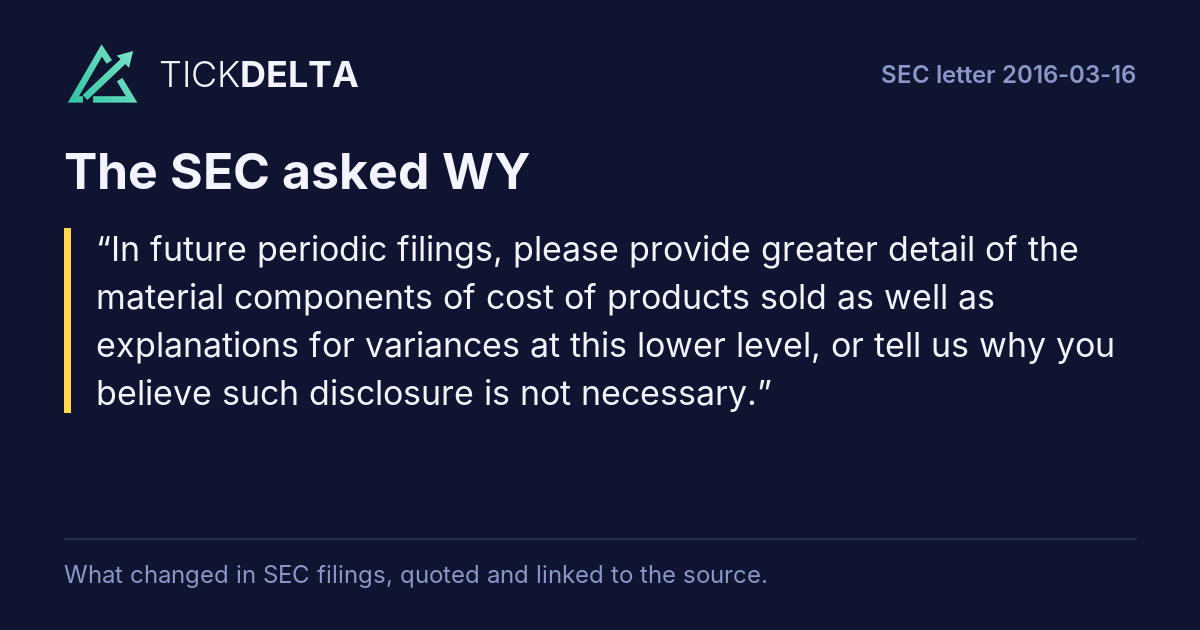
In future periodic filings, please provide greater detail of the material components of cost of products sold as well as explanations for variances at this lower level, or tell us why you believe such disclosure is not necessary.
Beginning with our first quarter 2016 Form 10-Q, we will disclose in greater detail the material components of our cost of products sold and will provide explanations for material variances. Read in the reply ↗
First report after the company's reply of 2016-04-12: 10-Q filed 2016-05-06 ↗, against the 10-Q filed 2015-10-30 ↗.
Tickdelta does not hold the text of both reports, so they are not compared here.
Regarding your estimation of depletion rates, please tell us what consideration you gave to providing a qualitative and quantitative description of the material assumptions used and a sensitivity analysis of those assumptions based upon reasonably likely changes. To the extent you will include such disclosures in future filings, please provide us an example of your proposed disclosure.
Prior to 2012, Weyerhaeuser included depletion as a critical accounting policy in our Form 10-K. In the process of preparing our 2012 Form 10-K, Weyerhaeuser’s analysis demonstrated that increasing or decreasing our depletion rates by significant percentages did not result in a material impact to the financial statements. Accordingly, we determined it was appropriate to remove depletion from our critical accounting policies.Read in the reply ↗Rest of the answer
Our analysis regarding depletion in recent years has been unchanged.
With the 2016 merger between Weyerhaeuser Company and Plum Creek Timber Company, Inc., which has nearly doubled our ownership in terms of acreage, we have revisited our conclusion and we expect to again include timber depletion as a critical accounting policy in our Form 10-K for fiscal year 2016. The following are examples of types of disclosures we intend to consider including in future filings.
TIMBER DEPLETION
We record depletion - the costs attributed to timber harvested - as trees are harvested.
To calculate our depletion rate, which is updated annually, we:
• take the total carrying cost of the timber and divide by the total timber volume estimated to be harvested during the harvest cycle.
Estimating the volume of timber available for harvest over the harvest cycle requires the consideration of the following factors:
effects of fertilizer and pesticide applications;
changes in environmental regulations and other regulatory restrictions;
limits on harvesting certain timberlands;
changes in harvest plans;
scientific advancement in seedling and growing technology; and changes in weather patterns.
In addition, the duration of the harvest cycle varies by geographic region and species of timber.
Depletion-rate calculations do not include estimates for:
future silviculture or sustainable forest management costs associated with existing stands;
future reforestation costs associated with a stand’s final harvest; and future volume in connection with the replanting of a stand subsequent to its final harvest.
A 5% decrease in our estimate of future harvest volumes would have:
Increased depletion expense by $______million for 2016
Increased depletion expense by $______million for 2015.
First report after the company's reply of 2016-04-12: 10-Q filed 2016-05-06 ↗, against the 10-Q filed 2015-10-30 ↗.
Tickdelta does not hold the text of both reports, so they are not compared here.
We note there was a $2.47 billion decrease in the acquired net assets of Plum Creek as compared to your previously estimated purchase price allocation, and that you attributed approximately $2.1 billion of the decrease to Timberlands. We further note the fair value estimates for acquired Timber and timberlands were determined using both income and market approaches.Rest of the question
Please provide to us the initial and updated fair value estimates of Timber and timberlands acquired from Plum Creek, and discuss the material factors causing the estimated fair value decrease. Additionally, tell us what consideration you gave to recording a bargain purchase gain for the acquisition of Plum Creek given the decrease in the purchase price when compared to the amount initially estimated; refer to paragraphs 2 through 4 of ASC 805-30-25.
As noted, the original preliminary purchase price allocation for timber and timberlands was $10.3 billion in the December 23, 2015 Form S-4 registration statement amendment filing and the updated preliminary purchase price allocation in the March 11, 2016 Form 8-K filing was $8.2 billion, a difference of $2.1 billion.
We stated in our pro forma disclosures that the purchase price allocation was preliminary and subject to change.Read in the reply ↗Rest of the answer
For example, we disclosed:
the proforma adjustments are preliminary;
the purchase price allocation and underlying valuation may change materially based on receipt of more detailed information;
fair value estimates for timber and timberlands are preliminary and may be adjusted as additional analyses are performed; and there can be no assurance that these additional analyses and final valuations will not result in significant changes to our initial estimates of fair value.
Timber and timberland assets vary widely in attributes and, accordingly, participants in a market may assign a range of potential values to parcels. Our estimated purchase price allocation as of December 23, 2015 assigned fair value estimates to timber and timberland assets based on the higher end of the range of per acre values for available timberland transaction data. We had contemplated that values utilized could change materially upon receiving further additional detailed information about the acquired properties, including third party data and appraisals.
In preparing the updated estimated purchase price allocation as of March 11, 2016, we evaluated additional information obtained including more specific regional market data and the macroeconomic conditions existing at the time of the transaction. Further, we were able to gather more data about the specific attributes of the timber and timberlands acquired in the merger that provided more specific insight into the nature and value of properties. After consideration of all of these factors, we concluded that valuing the timber and timberlands at this revised value was appropriate for pro forma purposes, while still noting that the values assigned were preliminary and subject to further adjustments as we continued to gather more detailed information. We also gave consideration to paragraphs 2 through 4 of ASC 805-30-25.
ASC 805-30-25-2 requires the acquirer in a business combination to recognize a gain (reported in net income) if the net fair value of acquired assets and liabilities is greater than the purchase price. ASC 805-30-25-3 notes that bargain purchase gains are rare although may arise with a forced sale. We do not believe any of the conditions listed in ASC 805-30-25-3 for reporting a bargain purchase gain are applicable in our circumstances (i.e., there was not a forced or distressed sales, and there are no mandated purchase price accounting requirements in special areas, such as income taxes, that require us to record an asset or liability at other than fair value).
In the event that a bargain purchase gain is initially identified, ASC 805-30-25-4 requires companies to first reassess whether all assets and liabilities have been properly identified and to reconfirm that identified assets and liabilities have been properly valued. Given the magnitude and complexity of the assets and liabilities acquired in the merger, we are still gathering additional detailed information that would allow us to assess fair value and conclude whether a bargain purchase gain exists.
First report after the company's reply of 2016-04-12: 10-Q filed 2016-05-06 ↗, against the 10-Q filed 2015-10-30 ↗.
Tickdelta does not hold the text of both reports, so they are not compared here.
We note your response to prior comment 3. a. Please tell us the specific macroeconomic conditions and regional market data existing at the transaction date, and how such information changed from the date of your initial purchase price allocation; b.Rest of the question
Please provide more detail regarding how you determined your initial preliminary fair value estimate of timber and timberlands using the income and market valuation approaches, and tell us your basis for your initial conclusion to assign fair value estimates to timber and timberlands based on the higher end of the range of per acre values for available timberland transaction data; c. Please provide more detail regarding how you determined your updated fair value estimate of timber and timberlands using the income and market valuation approaches; and d. Please compare the assigned fair value estimates for the timber and timberland components as of the initial purchase allocation date, and as updated to depict the merger of Plum Creek with and into Weyerhaeuser on February 19, 2016. Your response should qualitatively and quantitatively address the specific attributes assessed which provided you greater insight into the nature and value of the acquired properties, thereby causing the decrease to the assigned fair value estimates.
At the time of the transaction initial valuation, December 7, 2015, U.S. macro conditions were generally positive, so much so that on December 16, 2015, the Federal Reserve ended its accommodative monetary stance by raising interest rates by ¼ to ½ percent, its first increase since 2006. With the start of 2016, markets became pessimistic and volatile, due largely to concerns about growth outside the U.S. and the impact of a strong U.S. dollar on manufacturing and exports. These factors also undermined the outlook for oil and commodities and ultimately lowered expectations for U.S. growth.Read in the reply ↗Rest of the answer
Negative sentiment spread to long term assets such as timber. The S&P Global Timber and Forestry Index dropped 18.8% from December 7, 2015 through February 19, 2016, the merger transaction date. Similarly, the NCREIF (National Council of Real Estate Investment Fiduciaries) Timberland Property Index saw total returns shift from positive 1.86% in Q4 2015 to minus 0.26% in Q1 of 2016. Regional returns were minus 1.88% in the Northwest while the South was minus 0.33% for the capital appreciation component of the index. NCREIF indices are quite stable and rarely turn negative, suggesting a more negative view of timber assets during this timeframe.
b.
Please provide more detail regarding how you determined your initial preliminary fair value estimate of timber and timberlands using the income and market valuation approaches, and tell us your basis for your initial conclusion to assign fair value estimates to timber and timberlands based on the higher end of the range of per acre values for available timberland transaction data;
Response:
The initial preliminary fair value estimate of the Plum Creek timber and timberlands in December 2015 relied primarily on high-level market data because Weyerhaeuser and Plum Creek were still competitors operating as separate public companies with very limited ability to share competitive operating information. We did not share detailed operating data or internal models and assumptions until the transaction closed on February 19, 2016. This lack of detailed information is the primary reason why we stated in our pro forma financial statements filed on December 10, 2015, that the estimated fair values were preliminary and could change materially.
c.
Please provide more detail regarding how you determined your updated fair value estimate of timber and timberlands using the income and market valuation approaches; and
Response:
Weyerhaeuser relied on public data of transactions announced in 2015, including a September 2015 transaction between Plum Creek and a group of pension fund investors involving a sale and partnership contribution of Plum Creek’s southern timberlands. Additionally, the company relied on market data and derived data provided by our advisors. The range of values for timber and timberlands was disclosed in the description of the transaction included in the Registration Statement on Form S-4 filed December 10, 2015 and included $1,600 to $2,000 for the U.S. South, $2,600 to $3,700 for West of the Cascades, $1,000 to $1,200 for West Inland acres and $500 to $750 for the Great Lakes and Northeast geographies. These ranges vary due to location, timber volumes per acre, age class of the timber, access to the timber, and other factors.
In addition, the timber and timberlands reflect the value from potential real estate components including higher and better use properties, easements, mitigation banks and development. Our advisors assigned a range of value of $1.2 billion to $1.5 billion based on reviews of Plum Creek analyst presentations and professional judgement.
Weyerhaeuser had some overlap in the ownership of southern and western acres and did use internal discounted cash flow models to validate the public data and our advisor’s estimates. However, the market based approach was heavily weighted over the internal income models in the initial December values.
d.
Please compare the assigned fair value estimates for the timber and timberland components as of the initial purchase allocation date, and as updated to depict the merger of Plum Creek with and into Weyerhaeuser on February 19, 2016. Your response should qualitatively and quantitatively address the specific attributes assessed which provided you greater insight into the nature and value of the acquired properties, thereby causing the decrease to the assigned fair value estimates.
Response:
The March 11, 2016 fair value estimate was revised based on new information: 1) access to internal Plum Creek data following the close of the transaction and 2) initial valuation reports from an external expert hired to support Weyerhaeuser’s acquisition accounting. The external expert was provided data from Plum Creek to assist in the valuation analysis.
The additional information provided insight into the modeling assumptions, the timber age, the inventory characteristics, and real estate opportunities. This incremental data, plus the valuation work from the expert, resulted in heavier reliance on an income approach versus market approach in the second filing. Market based data was used to validate the income approach outcomes.
The updated estimates came in at approximately $1,750 an acre for U.S. South, $2,600 average for Western acres and $500 for the Northern Hardwoods acres and Montana, which were within the range of values disclosed in the S-4. Please see responses to b. and c. for the qualitative discussion of the attributes driving the change in the initial values to the updated values. To generate the fair value estimates for purchase accounting allocation purposes, the foregoing valuation data points were, necessarily, as of a specific point in time, and such valuation results could change materially based on macroeconomic and other factors.
First report after the company's reply of 2016-05-19: 10-Q filed 2016-08-05 ↗, against the 10-Q filed 2015-10-30 ↗.
Tickdelta does not hold the text of both reports, so they are not compared here.
Also in this review: request for more time, 2016-03-22, closing letter, 2016-06-03