Screener / SEC EDGAR /CIK 0001582313 /10-K filed Feb 26, 2026, compared with Feb 27, 2025 /Numbers from the XBRL of the 10-Ks
Nasdaq Health care · Pharmaceuticals

Xenon Pharmaceuticals Inc. XENE

Compare with peers Embed
The 10-K against last year's

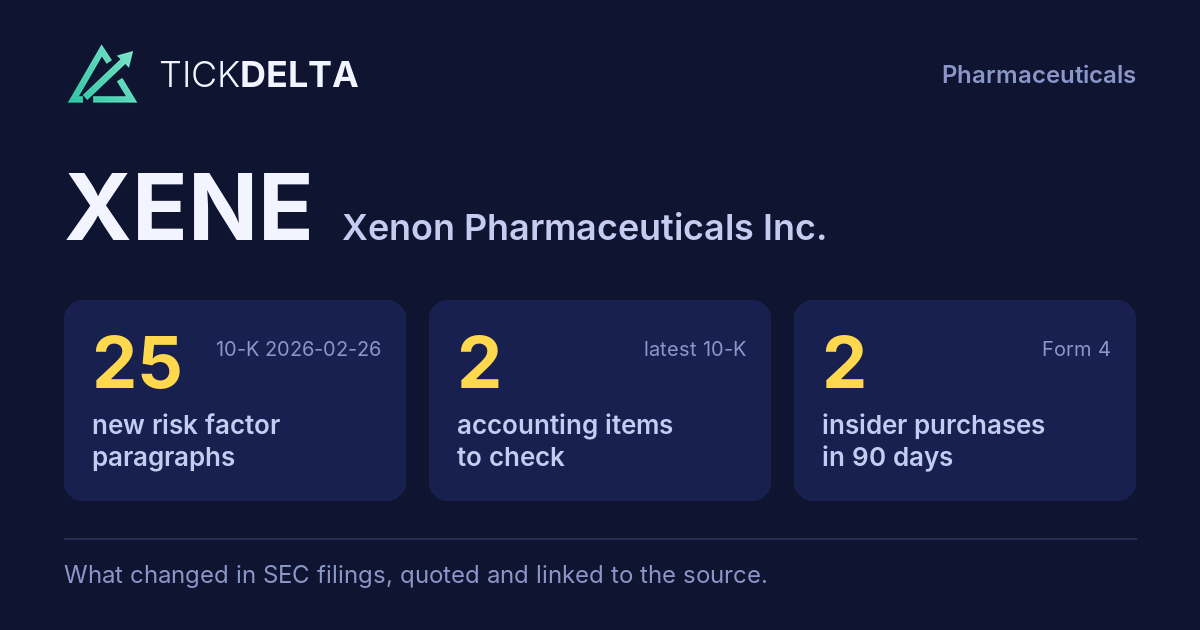
140 changes: 33 added, 18 removed, 87 reworded, 2 quiet changes

10-K Feb 26, 2026 vs Feb 27, 2025

10-K 0001193125-26-076650 (Feb 26, 2026) vs 10-K 0000950170-25-029149 (Feb 27, 2025)

Every paragraph, and how much of it changed

One bar per paragraph, in the order of the 10-K. Height and colour show the share of its words not in the closest paragraph a year earlier; the tallest bars are new paragraphs.

Risk Factors

426 paragraphs · 25 new · 117 reworded · 4 gone · 10-K Feb 26, 2026 against Feb 27, 2025
New paragraph Reworded (5% of its words or more) Same or nearly
Paragraph 142 · 46% changed Every version of it
•acceptance of azetukalner, if and when approved, by patients, the medical community community, third-party payers, national health systems, and third-party payers; health technology authorities where applicable to ensure effective market access and adoption by healthcare providers and patients;
Paragraph 219 · 46% changed Every version of it
If we are unable Even if regulatory agencies grant marketing approvals to establish azetukalner or any other of our own sales, marketing and distribution capabilities or enter into agreements for these purposes, product candidates, we may not be successful in independently commercializing any of our future products.
Paragraph 274 · 45% changed Every version of it
We are unable to predict The nature and extent of future healthcare reforms cannot be predicted. There is uncertainty regarding the future course nature or impact of any drug pricing or broader healthcare reform implemented at the federal or state healthcare level and the extent to which such action may be subject to litigation or other reform legislation in the U.S. Any further changes in the law or regulatory framework could reduce our ability to generate revenue in the future or increase our costs, either of which could have a material and adverse effect on our business, financial condition and results of operations. The continuing challenges. Ongoing efforts of the government and other third-party payers to contain or reduce costs of healthcare and/or impose price controls may adversely affect the demand for our product candidates, if approved, and our ability to achieve or maintain profitability.
Paragraph 74 · 37% changed Every version of it
In the U.S., federal, state, and local governments have enacted numerous data privacy and security laws, including data breach notification laws, personal data privacy laws, and consumer protection laws. For example, the U.S. federal Health Insurance Portability and Accountability Act of 1996, or HIPAA, as amended by the Health Information Technology for Economic and Clinical Health Act of 2009, or HITECH, imposes specific requirements relating to the privacy, security, and transmission of individually identifiable health information that apply to most U.S. healthcare providers with which we interact, such as our U.S. clinical trial study sites. At the state level, many jurisdictions in which we are operating also have laws and regulations relating to data privacy, cybersecurity and protection of personal information, including the California Consumer Privacy Act of 2018, Act, or CCPA, as amended CCPA. CCPA and supplemented by the California Privacy Rights Act, imposes similar state comprehensive consumer privacy laws create consumer rights protection and impose obligations on businesses on which they apply, including requirements to which it applies. The CCPA allows conduct data processing risk assessments, to enter data processing agreements with vendors and other third-parties with whom a business shares personal information, and to make detailed disclosures to residents of those states about the business’ data collection, use and sharing practices. Many of these state laws also allow for statutory fines for noncompliance. Although the CCPA exempts some data processed in the context of clinical trials, the CCPA, to the extent applicable to our business and operations, may increase compliance costs and potential liability with respect to other personal information we maintain about California residents. Other In addition, several states have also enacted data health-focused consumer privacy laws. In addition, laws, such as Washington state enacted the state's My Health, My Data Act, a health-focused consumer privacy law, which took effect in March 2024. This law imposes impose obligations related to the collection and sharing of certain health-related information that is not subject to HIPAA and that does not fall within certain other exceptions in the law. Other states have enacted, or are Although these state consumer data and consumer health data privacy laws generally exempt some data processed in the process context of enacting, similar health-focused consumer privacy laws. Additional data privacy clinical studies, to the extent they are applicable in our business and security operations, these laws have been proposed may increase compliance costs and enacted at the federal, state, and local levels in recent years, which could further complicate compliance efforts. For example, in June 2024, the Protecting Americans’ Data from Foreign Adversaries Act potential liability with respect to other personal information we maintain about residents of 2024 took effect. This law prohibits data brokers from making available certain personally identifiable sensitive data of U.S. individuals to “foreign adversary” countries, such as the People’s Republic of China, or the PRC, and entities controlled by such countries. Additionally, in January 2025, the U.S. Department of Justice published a final rule implementing President Biden’s Executive Order 14117, “Preventing Access to Americans’ Bulk Sensitive Personal Data and United States Government-Related Data by Countries of Concern.” This final rule prohibits certain data brokerage transactions and transactions involving certain bulk human ‘omic data, including human genomic data and biospecimens from which such data can be derived, with restricted persons and jurisdictions, such as the PRC. The final rule also places restrictions on certain vendor, employment and investment agreements with such jurisdictions. Most provisions of the final rule are scheduled to take effect in April 2025. These restrictions may affect our ability to engage in collaborations or license agreements with entities in restricted countries or with a nexus to such countries going forward. these states.
Paragraph 249 · 34% changed Every version of it
In addition, prescription drugs If any of our product candidates are approved, we must comply with requirements concerning the advertising and promotion of our products, which are subject to a variety of legal and regulatory restrictions and may be promoted only for the approved indications in accordance with the approved label. The FDA, EMA FDA and other agencies actively enforce the laws and regulations prohibiting the promotion of off-label uses, and a company that is found to have improperly promoted off-label use may be subject to significant liability. However, physicians may, in their independent medical judgment, prescribe legally available products for off-label uses. The FDA does not regulate the behavior of physicians in their choice of treatments but the FDA, EMA FDA and other foreign regulators do restrict manufacturers' communications on the subject of off-label use of their products. The EU and other foreign jurisdictions also prohibit direct-to-consumer advertising for prescription-only medicines. Even if any of our product candidates receive regulatory approval, our sales and marketing efforts may not be successful or may be limited by future governmental policies or initiatives. For example, the FDA stated in September 2025 that it intends to more aggressively enforce requirements for direct-to-consumer drug advertising and sent warning or untitled letters to a significant number of pharmaceutical companies alleging deceptive prescription drug advertising, which represents a dramatic increase in FDA actions compared to prior years. The current administration’s focus on pharmaceutical advertising heightens the risk that we may, in the future, receive a warning letter or be subject to enforcement action related to our advertising and marketing practices, which could adversely affect our business.
Paragraph 75 · 31% changed Every version of it
In the U.S., federal, state, and local governments have enacted numerous data privacy and security laws, including data breach notification laws, personal data privacy laws, and consumer protection laws. For example, the U.S. federal Health Insurance Portability and Accountability Act of 1996, or HIPAA, as amended by the Health Information Technology for Economic and Clinical Health Act of 2009, or HITECH, imposes specific requirements relating to the privacy, security, and transmission of individually identifiable health information that apply to most U.S. healthcare providers with which we interact, such as our U.S. clinical trial sites. At the state level, the California Consumer Privacy Act of 2018, or CCPA, as amended and supplemented by the California Privacy Rights Act, imposes obligations on businesses to which it applies. The CCPA allows for statutory fines for noncompliance. Although the CCPA exempts some data processed in the context of clinical trials, the CCPA, to the extent applicable to our business and operations, may increase compliance costs and potential liability with respect to other personal information we maintain about California residents. Other states have also enacted data privacy laws. In addition, Washington state enacted the My Health, My Data Act, a health-focused consumer privacy law, which took effect in March 2024. This law imposes obligations related to the collection and sharing of certain health-related information that is not subject to HIPAA and that does not fall within certain other exceptions in the law. Other states have enacted, or are in the process of enacting, similar health-focused consumer privacy laws. Additional data privacy and security laws have been proposed and enacted at the federal, state, and local levels in recent years, which could further complicate compliance efforts. For example, in June 2024, the Protecting Americans’ Data from Foreign Adversaries Act of 2024 took effect. This law prohibits data brokers from making available certain personally identifiable sensitive data of U.S. individuals to “foreign adversary” countries, such as the People’s Republic of China, or the PRC, and entities controlled by such countries. Additionally, in January 2025, the U.S. Department of Justice published a final rule implementing President Biden’s Executive Order 14117, “Preventing Access to Americans’ Bulk Sensitive Personal Data and United States Government-Related Data by Countries of Concern.” Concern,” which became effective in April 2025. This final rule prohibits certain data brokerage transactions and transactions involving certain bulk human ‘omic data, sensitive personal information, including human genomic data and biospecimens from which such data can be derived, with restricted persons and jurisdictions, such as the PRC. The final rule also places restrictions on certain vendor, employment and investment agreements with such jurisdictions. Most provisions of the final rule are scheduled to take effect in April 2025. These restrictions may affect our ability to engage in collaborations or license agreements with entities in restricted countries or with a nexus to such countries going forward.
Paragraph 279 · 31% changed Every version of it
Additionally, the Trump Administration current presidential administration has enacted taken several executive actions that could impose significant burdens on, or otherwise materially delay, the FDA’s ability to engage in routine regulatory and oversight activities. Further, the current presidential administration has substantially reduced the FDA’s workforce and may make further reductions, which may lead to disruptions and delays in the FDA’s review and oversight of our product candidates and impact the FDA’s ability to provide timely feedback on our development programs. Although it has been reported that there have not been reductions in workforce in the review or inspection divisions, any such reductions could extend review timelines, delay or prevent pre-approval inspections, and limit opportunities for FDA feedback on pending applications. It is difficult to predict how these executive actions and executive actions that may be taken under the current Trump Administration presidential administration may affect the FDA’s ability to exercise its regulatory authority. If these executive actions impose constraints on the FDA’s ability to engage in oversight and implementation activities in the normal course, our business may be negatively impacted.
Paragraph 272 · 26% changed Every version of it
In addition, other broader legislative changes Healthcare reform efforts have been adopted that and may continue to be subject to scrutiny, legal challenge and subsequent amendment, creating further uncertainty. Other government actions could have an adverse effect upon, and could prevent, our products’ commercial success. For example, the current presidential administration’s announced tariff on branded or patented drugs may increase the cost of drug products that are imported from abroad or manufactured using products or materials imported from abroad. The timeline for implementation of this tariff has not yet been finalized. As another example, the Budget Control Act of 2011, as amended, resulted in the imposition of reductions in Medicare (but not Medicaid) payments to providers in 2013 and remains in effect through 2032 unless additional Congressional action is taken. Any significant spending reductions affecting Medicare, Medicaid or other publicly funded or subsidized health programs that may be implemented and/or any significant taxes or fees that may be imposed on us could have an adverse impact on our results of operations.

MD&A

87 paragraphs · 8 new · 28 reworded · 14 gone · 10-K Feb 26, 2026 against Feb 27, 2025
New paragraph Reworded (5% of its words or more) Same or nearly
Paragraph 9 · 49% changed
•X-NOVA2, •Enrollment is ongoing for the first of three planned Phase 3 clinical trials X-NOVA2 and X-NOVA3 studies evaluating azetukalner in patients with MDD is currently enrolling patients, and X-NOVA3 is MDD, with topline data from X-NOVA2 expected to initiate mid-year. in H1 2027.
Paragraph 47 · 42% changed
We accrue for estimated costs of research and development activities conducted by third-party service providers, which include the conduct of pre-clinical studies and clinical trials, and manufacturing activities. Third-party service providers generally provide estimates of proportionate performance to allow us to determine an appropriate accrual. When determining the adequacy of an accrual, we analyze progress based on the level of services performed, progress of the studies, including the phase or completion of events, and contracted costs. Payments made to third parties under these arrangements in advance of the receipt of the related services are recorded as prepaid expenses until the services are rendered. Our historical prepaid and accrual estimates have not been materially different from the actual costs.
Paragraph 48 · 42% changed
Stock-based compensation is a critical accounting estimate due to the magnitude of and the many assumptions that are required to calculate stock-based compensation expense. We also grant stock options, restricted share units (“RSUs”) and performance share unit awards units (“PSUs”) to certain employees employees, consultants, directors and officers pursuant to our equity incentive plans. The grant date fair value of PSUs is determined based on the closing market price of our common shares. Compensation Stock-based compensation expense is recognized if the performance condition is considered probable of achievement using our best estimates and is amortized on a straight-line basis over the requisite service period of each separately vesting tranche of the award. Forfeitures period, and forfeitures are accounted for in the period they occur.
Paragraph 15 · 40% changed
•As part of our ongoing •In collaboration with Neurocrine Biosciences to develop treatments Biosciences, a Phase 1 study is ongoing for epilepsy, NBI-921355, a an investigational, selective inhibitor of voltage-gated sodium channels Nav1.2 and Nav1.6 sodium channel inhibitor in development for the potential treatment for of certain types of epilepsy, has progressed into a Phase 1 clinical study in healthy adult participants, triggering an anticipated $7.5 million milestone payment to Xenon. epilepsy.
Paragraph 14 · 38% changed
•We expect a lead candidate within •IND-enabling studies are ongoing for our Nav1.1 program will enter IND-enabling studies in 2025. program. Pre-clinical data suggests suggest that targeting Nav1.1 could potentially address the underlying cause and symptoms of Dravet Syndrome Syndrome.
Paragraph 4 · 38% changed
Azetukalner, a novel, highly potent, selective potent Kv7 potassium channel opener, represents the most advanced, clinically validated clinically-validated potassium channel modulator in late-stage clinical development for the treatment of multiple indications that include epilepsy, indications, including focal onset seizures, or FOS, two in epilepsy – FOS and primary generalized tonic-clonic seizures, or PGTCS, PGTCS – as well as neuropsychiatric disorders disorders, including major depressive disorder, or MDD and bipolar depression, or BPD.
Paragraph 50 · 38% changed
We also grant performance share unit awards (“PSUs”) to certain employees and officers pursuant to our equity incentive plans. The grant date fair value of RSUs and PSUs is determined based on the closing market price of our common shares. Compensation expense for PSUs is recognized if the performance condition is considered probable of achievement using our best estimates and is amortized on a straight-line basis over the requisite service period of each separately vesting tranche of the award. Forfeitures are accounted for in the period they occur. estimates.
Paragraph 55 · 34% changed
Research and development expenses increased by $42.9 million for the year ended December 31, 2024 as compared to 2023. Direct external costs related to azetukalner increased by $17.5 $59.1 million for the year ended December 31, 2025, primarily due to our ongoing Phase 3 epilepsy clinical trials studies in epilepsy, MDD and the initiation of our first Phase 3 MDD clinical trial, manufacturing activities to support current BPD. Preclinical, discovery and future clinical trials as well as our potential NDA submission, partially offset by a decrease in costs for our Phase 2 MDD clinical trial which completed in late 2023. The decrease in direct external costs related to XEN496 of $5.2 million is due to our decision in May 2023 to no longer pursue the clinical development of XEN496. Pre-clinical and discovery other program costs increased by $6.0 $7.6 million due to the advancement of multiple potential drug candidates targeting Kv7, Nav1.7 and Nav1.1. Pain program costs increased by $2.7 million due to the advancement of XEN1120 and XEN1701. Personnel-related costs increased by $22.9 $19.8 million driven by an increase in due to higher headcount to support late-stage product candidate development and an increase in stock-based compensation expense due to an increase in the number of options granted at a higher fair value. expense.

A paragraph is matched with the one last year that shares the most of its words; under half in common makes it new. The paragraphs shown are the 8 reworded the most in each section.

The paragraph that changed most in each section

The redline

Marked against last year's 10-K: cut words struck through, new words highlighted.

Risk Factors446 words changed in this paragraph; it is 42% similar to last year's version.
In the U.S., federal, state, and local governments have enacted numerous data privacy and security laws, including data breach notification laws, personal data privacy laws, and consumer protection laws. For example, the U.S. federal Health Insurance Portability and Accountability Act of 1996, or HIPAA, as amended by the Health Information Technology for Economic and Clinical Health Act of 2009, or HITECH, imposes specific requirements relating to the privacy, security, and transmission of individually identifiable health information that apply to most U.S. healthcare providers with which we interact, such as our U.S. clinical trial study sites. At the state level, many jurisdictions in which we are operating also have laws and regulations relating to data privacy, cybersecurity and protection of personal information, including the California Consumer Privacy Act of 2018, Act, or CCPA, as amended CCPA. CCPA and supplemented by the California Privacy Rights Act, imposes similar state comprehensive consumer privacy laws create consumer rights protection and impose obligations on businesses on which they apply, including requirements to which it applies. The CCPA allows conduct data processing risk assessments, to enter data processing agreements with vendors and other third-parties with whom a business shares personal information, and to make detailed disclosures to residents of those states about the business’ data collection, use and sharing practices. Many of these state laws also allow for statutory fines for noncompliance. Although the CCPA exempts some data processed in the context of clinical trials, the CCPA, to the extent applicable to our business and operations, may increase compliance costs and potential liability with respect to other personal information we maintain about California residents. Other In addition, several states have also enacted data health-focused consumer privacy laws. In addition, laws, such as Washington state enacted the state's My Health, My Data Act, a health-focused consumer privacy law, which took effect in March 2024. This law imposes impose obligations related to the collection and sharing of certain health-related information that is not subject to HIPAA and that does not fall within certain other exceptions in the law. Other states have enacted, or are Although these state consumer data and consumer health data privacy laws generally exempt some data processed in the process context of enacting, similar health-focused consumer privacy laws. Additional data privacy clinical studies, to the extent they are applicable in our business and security operations, these laws have been proposed may increase compliance costs and enacted at the federal, state, and local levels in recent years, which could further complicate compliance efforts. For example, in June 2024, the Protecting Americans’ Data from Foreign Adversaries Act potential liability with respect to other personal information we maintain about residents of 2024 took effect. This law prohibits data brokers from making available certain personally identifiable sensitive data of U.S. individuals to “foreign adversary” countries, such as the People’s Republic of China, or the PRC, and entities controlled by such countries. Additionally, in January 2025, the U.S. Department of Justice published a final rule implementing President Biden’s Executive Order 14117, “Preventing Access to Americans’ Bulk Sensitive Personal Data and United States Government-Related Data by Countries of Concern.” This final rule prohibits certain data brokerage transactions and transactions involving certain bulk human ‘omic data, including human genomic data and biospecimens from which such data can be derived, with restricted persons and jurisdictions, such as the PRC. The final rule also places restrictions on certain vendor, employment and investment agreements with such jurisdictions. Most provisions of the final rule are scheduled to take effect in April 2025. These restrictions may affect our ability to engage in collaborations or license agreements with entities in restricted countries or with a nexus to such countries going forward. these states.

Source: Item 1A, 10-K 0001193125-26-076650 vs Item 1A, 10-K 0000950170-25-029149

Accounting Policies212 words changed in this paragraph; it is 57% similar to last year's version.
Research and development expenses consist of costs incurred in performing research and development activities, including personnel-related expenses, consisting of salaries, benefits and stock-based compensation for employees engaged in scientific research and development, third-party expenses incurred in connection with the pre-clinical external research and clinical development of product candidates including under agreements with clinical research organizations, third-party expenses relating to formulation, process development and manufacture of drug substance and drug product for use in pre-clinical testing, clinical trials and potential commercial supply, costs, third-party acquisition, license and collaboration fees, laboratory consumables and certain indirect costs incurred in support of overall research and development activities, including facilities, depreciation and information technology costs. The amount of expenses recognized in a period related to service agreements is based on the work performed using the accrual basis of accounting. Third-party The Company recognizes external research and development costs for research and development activities conducted by third-party service providers generally provide estimates providers, in connection with the pre-clinical and clinical development of proportionate performance product candidates including under agreements with clinical research organizations, third-party expenses relating to allow the Company to determine an appropriate accrual. formulation, process development and manufacture of drug substance and drug product for use in pre-clinical testing, clinical studies and potential commercial supply. When determining the adequacy of an accrual, research and development expenses, the Company analyzes progress based on uses information and data provided by the vendors and third-party service providers. This process involves reviewing open contracts, communicating with applicable vendors and third-party service providers to identify services that have been performed, estimating the level of services performed, progress service performed and the associated cost incurred for the service when the Company has not yet been invoiced or otherwise notified of the studies, including the phase or completion of events, and contracted actual costs. Payments made to third parties under these arrangements in advance of the receipt of the related services are recorded as prepaid expenses until the services are rendered. Prepaid expenses are classified as current or non-current assets based on the expected timing of services.

Source: Item 8, Note 3 – Significant accounting policies:, 10-K 0001193125-26-076650 vs Item 8, Note 3 – Significant accounting policies:, 10-K 0000950170-25-029149

MD&A152 words changed in this paragraph; it is 43% similar to last year's version.
Research and development expenses increased by $42.9 million for the year ended December 31, 2024 as compared to 2023. Direct external costs related to azetukalner increased by $17.5 $59.1 million for the year ended December 31, 2025, primarily due to our ongoing Phase 3 epilepsy clinical trials studies in epilepsy, MDD and the initiation of our first Phase 3 MDD clinical trial, manufacturing activities to support current BPD. Preclinical, discovery and future clinical trials as well as our potential NDA submission, partially offset by a decrease in costs for our Phase 2 MDD clinical trial which completed in late 2023. The decrease in direct external costs related to XEN496 of $5.2 million is due to our decision in May 2023 to no longer pursue the clinical development of XEN496. Pre-clinical and discovery other program costs increased by $6.0 $7.6 million due to the advancement of multiple potential drug candidates targeting Kv7, Nav1.7 and Nav1.1. Pain program costs increased by $2.7 million due to the advancement of XEN1120 and XEN1701. Personnel-related costs increased by $22.9 $19.8 million driven by an increase in due to higher headcount to support late-stage product candidate development and an increase in stock-based compensation expense due to an increase in the number of options granted at a higher fair value. expense.

Source: Item 7, 10-K 0001193125-26-076650 vs Item 7, 10-K 0000950170-25-029149

Legal ProceedingsNew paragraph this year (43 words), with no similar paragraph last year.
From time to time, the Company is subject to claims and legal proceedings arising in the ordinary course of business, and such claims, individually or in the aggregate, are not likely to have a material adverse effect on the Company’s consolidated financial statements.

Source: Item 3, via Note 12 – Commitments and contingencies:, 10-K 0001193125-26-076650 vs Item 3, via Note 12 – Commitments and contingencies:, 10-K 0000950170-25-029149

Sentences and paragraphs added, removed or reworded

Every change, by type

Sentences and paragraphs of XENE's Risk Factors and MD&A, 10-K Feb 26, 2026 against 10-K Feb 27, 2025. Each links to the text at sec.gov.

Quiet changes are sentences kept from last year with one to four words changed, at least one of them a hedge, a modal or a qualifier (may, could, will, not, significant, material…). A year or date rolling forward is not counted.

The full word list

adverse, adversely, all, although, anticipate, anticipates, any, approximately, believe, believes, can, cannot, certain, could, expect, expects, generally, however, if, intend, intends, largely, likely, many, material, materially, may, might, most, must, never, no, not, possible, primarily, probable, should, significant, significantly, some, substantial, substantially, unlikely, will, would

AddedRisk Factors
We have no marketed proprietary products and are advancing clinical development through Phase 3 clinical studies for our azetukalner program in epilepsy, major depressive disorder, and bipolar depression. These studies may not result in regulatory approval or successful commercialization of our product candidates.
Read it in 10-K Feb 26, 2026 at sec.gov
AddedRisk Factors
While we are advancing our Phase 3 clinical studies in azetukalner, significant risks remain. There can be no assurance that these or any future clinical studies will be successful, that we will be able to obtain regulatory approval, or that we will be able to manufacture or independently commercialize any product candidates. We may encounter delays or difficulties in advancing our product candidates through late-stage development, obtaining regulatory approval, or achieving commercial success, which could adversely affect our business prospects.
Read it in 10-K Feb 26, 2026 at sec.gov
AddedRisk Factors
•changes in tariffs, trade barriers and regulatory requirements, including tariffs that have been imposed on certain goods by the current presidential administration and reciprocal tariffs imposed by Canada and other countries in which we do business, as well as potential tariffs on pharmaceutical products and components manufactured outside the United States that the current presidential administration has contemplated;
Read it in 10-K Feb 26, 2026 at sec.gov
AddedRisk Factors
Successful commercialization of any our current or future product candidates, if approved, could be materially adversely impacted by a number of foreseen and unforeseen factors, including:
Read it in 10-K Feb 26, 2026 at sec.gov
AddedRisk Factors
•any delays in our ability to produce sufficient quantities of or our current or future product candidates, at an acceptable cost or quality, including such delays arising out of quality assurance concerns or changes in regulatory guidance, or those caused by our reliance on our third-party manufacturers;
Read it in 10-K Feb 26, 2026 at sec.gov
Show the other 54
RemovedRisk Factors
We have no marketed proprietary products and have not yet completed clinical development beyond Phase 2 clinical trials, which makes it difficult to assess our ability to develop our future product candidates and commercialize any resulting products independently.
Read it in 10-K Feb 27, 2025 at sec.gov
RemovedRisk Factors
For example, in 2010, the Patient Protection and Affordable Care Act, as amended by the Health Care and Education Reconciliation Act of 2010, collectively, the PPACA, was enacted and includes measures that have significantly changed the way healthcare is financed by both governmental and private insurers. Beyond the ACA, there are ongoing and widespread healthcare reform efforts, a number of which have focused on regulation of prices or payment for drug products. Drug pricing and payment reform was a focus of the first Trump administration and the Biden administration. For example, federal legislation eliminated a statutory cap on Medicaid drug rebate program rebates effective January 1, 2024. As another example, the Inflation Reduction Act (IRA) of 2022 includes a number of changes intended to address rising prescription drug prices in Medicare Parts B and D. These changes, which have varying implementation dates, include caps on Medicare Part D out-of-pocket costs, Medicare Part B and Part D drug price inflation rebates, a new Medicare Part D manufacturer discount drug program (replacing the PPACA Medicare Part D coverage gap discount program) and a drug price negotiation program for certain high-spend Medicare Part B and D drugs. The IRA is likely to have a significant impact on the pharmaceutical industry as implementation proceeds. As another example, in 2022, subsequent to the enactment of the IRA, the Biden administration announced its commitment to expanding certain IRA reforms. Drug pricing and payment reform was a focus of the prior Trump administration and that focus is likely to continue under the new Trump administration. Other potential healthcare reform efforts under the Trump administration may affect access to healthcare coverage or the funding of health care benefits. There is significant uncertainty regarding the nature or impact of any such reform implemented by the Trump administration through executive action or by Congress. Further, a number of states have enacted state drug price transparency and reporting laws that could substantially increase our compliance burdens and expose us to greater liability under such state laws if and when we have marketed products. These and other health reform measures that are implemented may have a material adverse effect on our operations.
Read it in 10-K Feb 27, 2025 at sec.gov
RemovedRisk Factors
Healthcare reform efforts have been and may continue to be subject to scrutiny and legal challenge. For example, with respect to the PPACA, tax reform legislation was enacted that eliminated the tax penalty established for individuals who do not maintain mandated health insurance coverage beginning in 2019 and, in 2021, the U.S. Supreme Court dismissed the latest judicial challenge to the ACA brought by several states without specifically ruling on the constitutionality of the PPACA. As another example, revisions to regulations under the federal anti-kickback statute would remove protection for traditional Medicare Part D discounts offered by pharmaceutical manufacturers to pharmacy benefit managers and health plans. Pursuant to court order, the removal was delayed and recent legislation imposed a moratorium on implementation of the rule until January 2032. As another example, the IRA drug price negotiation program has been challenged in litigation filed by various pharmaceutical manufacturers and industry groups.
Read it in 10-K Feb 27, 2025 at sec.gov
RewordedRisk Factors
Such authorities suspensions or terminations may impose such arise from a suspension or termination due to a number variety of factors, including failure to conduct the clinical trial study in accordance with regulatory requirements or our clinical protocols, inspection of the clinical trial operations or trial site by the FDA, EMA or other foreign regulatory authorities resulting in the inspections, imposition of a clinical hold, product candidate manufacturing problems, unforeseen safety issues or adverse side effects, failure to demonstrate a benefit from using a drug, lack of demonstrated benefit, changes in governmental regulations or administrative actions or lack of adequate insufficient funding to continue the clinical trial. study.
Read it in 10-K Feb 26, 2026 at sec.gov
RewordedRisk Factors
A statutory instrument to amend the Medicines for Human Use (Clinical Trials) Regulations 2004 was laid before parliament The new regulations will take full effect on December 12, 2024, and will come into force in early April 10, 2026 after a 12-month implementation period to address the research sector’s need for a more efficient, streamlined and adaptable regulatory framework for clinical trials. studies.
Read it in 10-K Feb 26, 2026 at sec.gov
RewordedRisk Factors
Any challenges associated with Difficulties in identifying, screening and/or enrolling patients in our trials studies may extend the time needed to complete our clinical trials studies or require the initiation of additional sites to be initiated in order to achieve target enrollment numbers and to complete our clinical trials, which may increase the cost of our operations and/or delay the timing of our regulatory approval. studies.
Read it in 10-K Feb 26, 2026 at sec.gov
RewordedRisk Factors
A statutory instrument to amend the Medicines for Human Use (Clinical Trials) Regulations 2004 was laid before parliament on December 12, 2024, and will come into force in early 2026 after a 12-month implementation period to address the research sector’s need for a more efficient, streamlined and adaptable regulatory framework for clinical trials. 2024.
Read it in 10-K Feb 26, 2026 at sec.gov
RewordedRisk Factors
The current conflicts Current and future global conflicts, such as those between Ukraine and Russia and in the Middle East, as well as recent failures have created, and may in the global banking sector, have created future create, volatility in the capital markets and are expected to may have further global economic consequences.
Read it in 10-K Feb 26, 2026 at sec.gov
RewordedRisk Factors
Although the CCPA exempts these state consumer data and consumer health data privacy laws generally exempt some data processed in the context of clinical trials, the CCPA, studies, to the extent they are applicable to in our business and operations, these laws may increase compliance costs and potential liability with respect to other personal information we maintain about California residents. residents of these states.
Read it in 10-K Feb 26, 2026 at sec.gov
RewordedRisk Factors
In addition, Outside of the SEC and applicable United States, Canadian securities regulators regularly pursue various rulemaking efforts, including recently efforts with respect to environmental, social ESG matters, which has resulted in the adoption of new laws and governance, or ESG, matters. regulations.
Read it in 10-K Feb 26, 2026 at sec.gov
RewordedRisk Factors
Efforts to ensure that our activities comply with applicable healthcare laws and regulations will involve substantial costs. costs and, if and when one of our product candidates is approved, our compliance efforts will need to expand and evolve to address newly applicable laws.
Read it in 10-K Feb 26, 2026 at sec.gov
RewordedRisk Factors
This law imposes In addition, several states have enacted health-focused consumer privacy laws, such as Washington state's My Health, My Data Act, which impose obligations related to the collection and sharing of certain health-related information that is not subject to HIPAA and that does not fall within certain other exceptions in the law.
Read it in 10-K Feb 26, 2026 at sec.gov
RewordedRisk Factors
In addition, our ability to compete may be affected by decisions made by insurers or other third-party payers. payers or public health systems to secure favorable coverage and reimbursement as well as the commercial success of our product candidates.
Read it in 10-K Feb 26, 2026 at sec.gov
RewordedRisk Factors
In addition, the information we choose to publicly disclose regarding a particular study or clinical trial is based on what is typically extensive complex body of information, and you or others may not agree with our determination of what we determine is constitutes material or otherwise appropriate information to include in our for disclosure.
Read it in 10-K Feb 26, 2026 at sec.gov
RewordedRisk Factors
We had net losses of $345.9 million, $234.3 million, $182.4 million and $125.4 $182.4 million for the years ended December 31, 2024, 2023 2025, 2024 and 2022, 2023, respectively, and an accumulated deficit of $899.5 $1,245.4 million as of December 31, 2024, 2025, which were driven by expenses incurred in connection with our research and development programs and from general and administrative costs associated with our operations.
Read it in 10-K Feb 26, 2026 at sec.gov
Quiet changesRisk Factors
Our commercial success will depend, in part, on our ability to obtain and maintain patent, trademark and trade secret protection of our product candidates and future products, their respective components, formulations, methods used to manufacture them and methods of treatment, as well as successfully defending against possible third-party challenges.
Read it in 10-K Feb 26, 2026 at sec.gov
Quiet changesRisk Factors
Many of our directors and officers reside outside of the U.S., and all or a substantial portion of their assets as well as all or a substantial portion of our assets are located outside the U.S.
Read it in 10-K Feb 26, 2026 at sec.gov
AddedMD&A
•Phase 3 X-TOLE3 study of azetukalner in FOS continues to enroll and is intended to support regulatory submissions outside the United States. We have completed an ethnobridging study and shared results with Japan’s Pharmaceutical and Medical Devices Agency, or PMDA. We aligned with PMDA to enroll approximately 60 of the planned 360 X-TOLE3 participants in Japan to support a potential regulatory submission in Japan. X-TOLE3 enrollment outside of Japan is expected to complete in 2026.
Read it in 10-K Feb 26, 2026 at sec.gov
AddedMD&A
•We presented 48-month data from the X-TOLE OLE study at the American Epilepsy Society, or AES, annual meeting, reinforcing the long-term efficacy and safety of azetukalner with more than 775 patient-years of exposure data in the OLE. Among participants treated for ≥48 months, reductions in monthly FOS frequency were over 90% from double-blind period baseline, with over 38% achieving at least 12 months of seizure freedom.
Read it in 10-K Feb 26, 2026 at sec.gov
AddedMD&A
We continue to expand our portfolio of innovative potassium and sodium channel modulators. Nav1.7 and Kv7 are important targets for pain and have been developed using our strong heritage in human genetics, deep understanding of ion channel biology, and expertise in novel chemistries to design potent, selective ion channel modulators.
Read it in 10-K Feb 26, 2026 at sec.gov
AddedMD&A
•Phase 1 SAD/MAD study in healthy adult participants is underway for XEN1701 targeting Nav1.7. Study completion is expected in 2026 to support initiating a Phase 2 proof-of-concept study in acute pain.
Read it in 10-K Feb 26, 2026 at sec.gov
AddedMD&A
•Phase 1 SAD/MAD study in healthy adult participants is underway for XEN1120 targeting Kv7. Study completion is expected in 2026 to support initiating a Phase 2 proof-of-concept study in acute pain.
Read it in 10-K Feb 26, 2026 at sec.gov
AddedMD&A
We recognize external research and development costs for research and development activities conducted by third-party service providers, which include the conduct of pre-clinical studies and clinical studies, and manufacturing activities. When determining the research and development expense, we use information and data provided by our vendors and third-party service providers. This process involves reviewing open contracts, communicating with applicable vendors and third-party service providers to identify services that have been performed, estimating the level of service performed and the associated cost incurred for the service when we have not yet been invoiced or otherwise notified of actual costs.
Read it in 10-K Feb 26, 2026 at sec.gov
RemovedMD&A
•Building upon more than 700+ patient-years of data to date from the ongoing X-TOLE open-label extension, or OLE, study, we continue to generate long-term scientific evidence supporting azetukalner’s compelling efficacy and safety profile, with approximately one in three patients on drug for at least 36 months achieving seizure freedom for a period of one year or longer.
Read it in 10-K Feb 27, 2025 at sec.gov
RemovedMD&A
•We recently announced plans for a Phase 3 BPD program with initiation of the first of two azetukalner clinical studies in bipolar I and bipolar II depression expected by mid-year. Initiation of this program is based on a strong scientific rationale – supported by promising clinical data with azetukalner and the Kv7 mechanism in MDD and preclinical research examining the genetic links between BPD and Kv7 and evidence of Kv7 downregulation in BPD – as well as a large unmet medical need.
Read it in 10-K Feb 27, 2025 at sec.gov
RemovedMD&A
•Patient enrollment in the investigator-sponsored Phase 2 proof-of-concept study of azetukalner in MDD led by Icahn School of Medicine at Mount Sinai is complete, and topline results are anticipated in the first half of 2025.
Read it in 10-K Feb 27, 2025 at sec.gov
RemovedMD&A
We continue to expand our portfolio by leveraging our extensive expertise to discover and develop potassium and sodium channel therapeutics, with the goal of filing multiple INDs, or equivalent, in 2025.
Read it in 10-K Feb 27, 2025 at sec.gov
RemovedMD&A
•IND-enabling work is underway with multiple Kv7 development candidates. Kv7 may have utility in a broad range of therapeutic indications including seizures, pain, and neuropsychiatric disorders, such as MDD and BPD.
Read it in 10-K Feb 27, 2025 at sec.gov
RemovedMD&A
•IND-enabling work is underway with a lead Nav1.7 development candidate. Nav1.7 is an important pain-related target, based on strong human genetic validation, that may represent a new class of medicines without the limitations of opioids.
Read it in 10-K Feb 27, 2025 at sec.gov
RemovedMD&A
Pursuant to the terms of the Neurocrine Collaboration, we received an upfront cash payment of $30.0 million and a $20.0 million equity investment in our common shares in December 2019. The overall transaction price of the arrangement was measured and allocated to certain performance obligations and revenue was recognized as those performance obligations were completed. In January 2022, based on the U.S. Food and Drug Administration’s (“FDA”) approval to expand the SCN8A-DEE study population to include subjects aged between 2 and 11 years, we received an aggregate milestone payment of $15.0 million in the form of $6.75 million cash and $8.25 million equity investment in our common shares. The equity investment was measured at fair value on the date of issuance and the resulting premium with the cash payment, was recognized as revenue. Research and development services were recognized as revenue at fair market value as the services were rendered. The research collaboration was completed in June 2022.
Read it in 10-K Feb 27, 2025 at sec.gov
RemovedMD&A
Our primary sources of revenue are derived from non-refundable upfront payments, funding for research and development services, milestone payments, and royalties under license and collaboration agreements.
Read it in 10-K Feb 27, 2025 at sec.gov
RemovedMD&A
In contracts where we have more than one performance obligation to provide our customer with goods or services, each performance obligation is evaluated to determine whether it is distinct. The consideration under the contract is then allocated between the distinct performance obligations based on their respective relative standalone selling prices. The estimated standalone selling price of each deliverable reflects our best estimate of what the selling price would be if the deliverable was regularly sold on a standalone basis and is determined by reference to market rates for the good or service when sold to others or by using an adjusted market assessment approach if selling price on a standalone basis is not available.
Read it in 10-K Feb 27, 2025 at sec.gov
RemovedMD&A
The consideration allocated to each distinct performance obligation is recognized as revenue when control is transferred to our customer for the related goods or services. We generally recognize revenue from non-refundable upfront payments over the estimated term of the performance obligation or period in which the underlying benefit is transferred to our customer. If non-refundable license fees have value to the customer on a standalone basis, separate from the undelivered performance obligations, they are recognized upon delivery. We evaluate the measure of progress each reporting period and, if necessary, adjust the measure of performance and related revenue recognition. Consideration in exchange for research and development services performed by us on behalf of the licensee is recognized upon performance of such activities at rates consistent with prevailing market rates. Consideration associated with at-risk substantive performance milestones, including sales-based milestones, is recognized as revenue using the most likely amount method when it is probable that a significant reversal of the cumulative revenue recognized will not occur. At the end of each subsequent reporting period, we re-evaluate the probability of achievement of such milestones, and if necessary, adjust the estimate of the overall transaction price. Sales-based royalties received in connection with licenses of intellectual property are subject to a specific exception in the revenue standards, whereby the consideration is not included in the transaction price and recognized in revenue until the customer’s subsequent sales or usages occur.
Read it in 10-K Feb 27, 2025 at sec.gov
RewordedMD&A
Azetukalner, a novel, highly potent, selective potent Kv7 potassium channel opener, represents the most advanced, clinically validated clinically-validated potassium channel modulator in late-stage clinical development for the treatment of multiple indications that include epilepsy, indications, including focal onset seizures, or FOS, two in epilepsy – FOS and primary generalized tonic-clonic seizures, or PGTCS, PGTCS – as well as neuropsychiatric disorders disorders, including major depressive disorder, or MDD and bipolar depression, or BPD.
Read it in 10-K Feb 26, 2026 at sec.gov
RewordedMD&A
Personnel-related costs increased by $16.1 $4.6 million for the year ended December 31, 2025, primarily due to higher headcount to support our expanding research and development activities and future potential commercialization as well as an increase commercialization, partially offset by a decrease in stock-based compensation expense due to an increase in the number of options granted at a higher fair value. and recruitment costs.
Read it in 10-K Feb 26, 2026 at sec.gov
RewordedMD&A
Pre-clinical Pre-clinical, discovery and discovery other program costs increased decreased by $6.0 $4.0 million due to our decision in May 2023 to no longer pursue the clinical development of XEN496, partially offset by increase in costs due to the advancement of multiple potential drug candidates targeting Kv7, Nav1.7 and Nav1.1.
Read it in 10-K Feb 26, 2026 at sec.gov
RewordedMD&A
Personnel-related costs increased by $22.9 $19.8 million driven by an increase in due to higher headcount to support late-stage product candidate development and an increase in stock-based compensation expense due to an increase in the number of options granted at a higher fair value. expense.
Read it in 10-K Feb 26, 2026 at sec.gov
RewordedMD&A
As of December 31, 2024, 2025, an aggregate of 310,000 2,961,023 common shares have been sold for proceeds of $12.1 $124.2 million, net of commissions and transaction expenses. expenses, of which $112.2 million, net of commissions and transaction expense. were raised during the three months ended December 31, 2025.
Read it in 10-K Feb 26, 2026 at sec.gov
RewordedMD&A
Compensation expense for PSUs is recognized if the performance condition is considered probable of achievement using our best estimates and is amortized on a straight-line basis over the requisite service period of each separately vesting tranche of the award. estimates.
Read it in 10-K Feb 26, 2026 at sec.gov
RewordedMD&A
Professional and consulting fees increased by $5.4 $4.3 million primarily due to an increase in pre-commercial expenses, partially offset by lower legal costs associated with legal services in support of our ongoing business operations and pre-commercial activities.
Read it in 10-K Feb 26, 2026 at sec.gov
RewordedMD&A
We did not recognize any revenue in the years ended December 31, 2024 and 2023, as compared to recognized revenue from collaboration agreements of $9.4 $7.5 million for the year ended December 31, 2022. 2025.
Read it in 10-K Feb 26, 2026 at sec.gov
RewordedMD&A
The change was driven primarily by an increase a decrease in the redemption purchase of marketable securities, net of purchases. redemptions, as well as a decrease in the purchases of property, plant and equipment.
Read it in 10-K Feb 26, 2026 at sec.gov
RewordedMD&A
We did not recognize any revenue in the years ended December 31, 2024 and 2023, as compared to revenue from collaboration agreements of $9.4 million for the year ended December 31, 2022. 2023.
Read it in 10-K Feb 26, 2026 at sec.gov
RewordedMD&A
Interest income increased decreased by $18.9 $15.1 million for the year ended December 31, 2025, driven by a higher lower average balance of marketable securities and an increase in lower average market yields on investments.
Read it in 10-K Feb 26, 2026 at sec.gov
RewordedMD&A
The increase was primarily related to net proceeds from the issuance of $353.5 common shares of $112.2 million in 2023 2025 as compared to net proceeds of $277.8 $12.1 million in 2022 2024 from the issuance of common shares and pre-funded warrants. shares.
Read it in 10-K Feb 26, 2026 at sec.gov

Sources

The two latest 10-Ks on EDGAR, section by section. Each change links to the text at sec.gov.

Also

New risk factors: paragraphs with nothing like them last year, quoted in full.

Work with it

Excel workbook · CSV. Google Sheet that stays up to date: paste =IMPORTDATA("https://tickdelta.com/company/XENE/export.csv") into a cell.

Next:Related parties
Esc

Type a ticker such as AAPL, a name, an investor such as Buffett, or a topic such as tariffs. ↑ ↓ to move, Enter to open.