Form 10-K for the Fiscal Year ended December 31, 2025
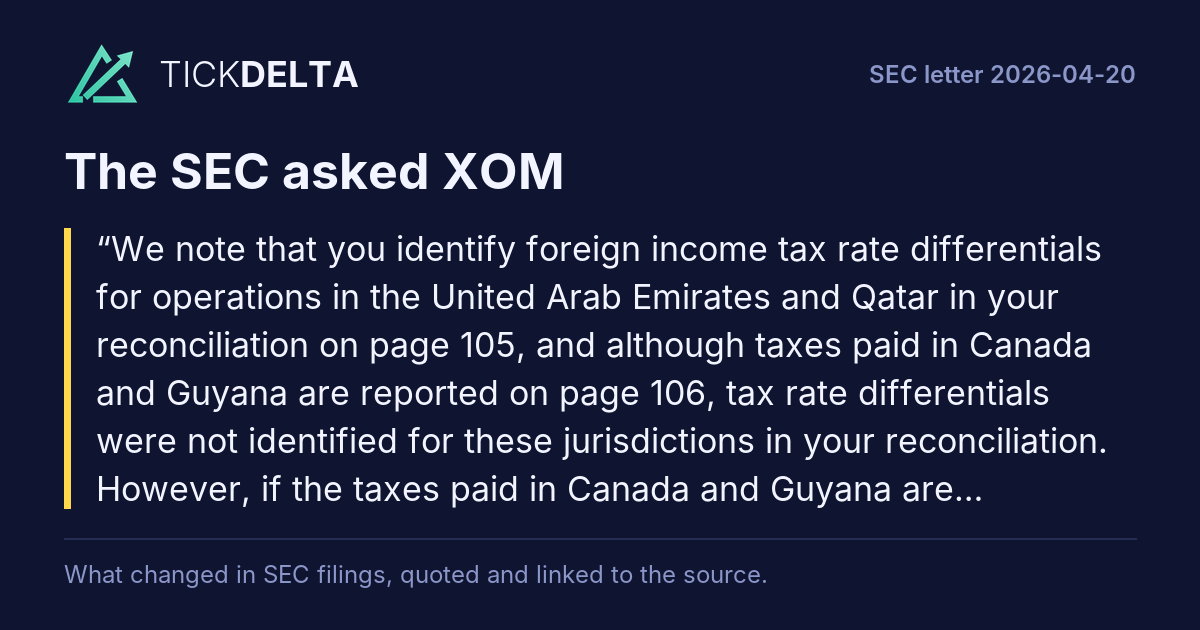
We note that you identify foreign income tax rate differentials for operations in the United Arab Emirates and Qatar in your reconciliation on page 105, and although taxes paid in Canada and Guyana are reported on page 106, tax rate differentials were not identified for these jurisdictions in your reconciliation.Rest of the question
However, if the taxes paid in Canada and Guyana are representative of the income tax expense and if the respective statutory foreign tax rates are representative of the effective rates, it would appear that differentials for these jurisdictions would also exceed the 5% disclosure threshold. Please explain to us how income tax expense in Canada and Guyana, and any offsetting amounts were considered in determining that differentials for these jurisdictions would not also be separately identified in your rate reconciliation. Please provide us with the analyses that you performed in formulating your disclosure, including the effective rates, amounts by nature, and calculations. Please also clarify how 1. the amount of taxes paid in Qatar were considered relative to the disclosure threshold in determining that these would not be shown in the table on page 106, and address the requirement in FASB ASC 740-10-50-12C, to discuss “the nature, effect, and underlying causes” of the reconciling items identified within your reconciliation.
In preparing our 2025 effective income tax rate reconciliation, management evaluated foreign jurisdictional tax impacts in accordance with ASC 740‑10‑50‑12, including both individual country effects and offsetting items, to determine whether any reconciling item exceeded the
5% quantitative disclosure threshold. For clarity, we calculated the 5% threshold to equal $433 million. This was based on 5% of our theoretical U.S.Read in the reply ↗Rest of the answer
federal statutory tax of $8.666 billion, as reported in our reconciliation on page 105 of our Form 10-K.
The Staff’s comment notes that the amount of income taxes paid in Canada and Guyana, as reported on page 106 of our Form 10-K, may suggest rate differentials that exceed the disclosure threshold. We would like to clarify that management does not use taxes paid as a proxy for effective tax rates when evaluating rate reconciliation disclosures under ASC 740.
Our determination of whether a jurisdiction exceeded the 5% disclosure threshold was based on income tax expense and effective tax rate impacts, not tax payments.
For both Canada and Guyana, the absolute amount of income tax expense arising from each jurisdiction did exceed $433 million. However, merely having tax expense that exceeds the threshold does not trigger disclosure. Instead, the disclosure provisions of ASC 740-10-50-12A require that a foreign jurisdiction be separately disclosed when the difference between (i) the pretax results for that jurisdiction taxed at the jurisdiction’s tax rate, and (ii) the pretax results for that jurisdiction taxed at the U.S. statutory federal corporate rate of 21%, exceeds the 5% threshold; in our case, that difference would have to exceed $433 million. We confirm that the magnitude of the difference in each of Canada’s and Guyana’s tax rates relative to the 21%
U.S. statutory rate did not exceed the $433 million disclosure threshold for separate presentation noted above.
Accordingly, the effects of these jurisdictions were aggregated and presented within the “All other countries” reconciling line on page 105. We confirm that no individual reconciling item for either country, whether gross or net of offsetting effects, exceeded the applicable quantitative threshold that would require separate disclosure.
The Staff also asked how taxes paid in Qatar were considered relative to the disclosure threshold and why they were not included in the table of income taxes paid on page 106.
Our interests in Qatar are held through equity method investments, not consolidated entities.
The equity method investee, not ExxonMobil, is responsible for paying the income tax associated with the equity method earnings reported in our financial statements. Accordingly, consistent with ASC 740 and the income taxes paid disclosure requirements, we limit our income tax payment disclosures to those entities which we consolidate. For these reasons, taxes paid in Qatar were appropriately excluded from the table on page 106, and their exclusion is unrelated to the quantitative disclosure threshold used for the rate reconciliation on page 105.
Supplementally, the inclusion of Qatar in the rate reconciliation table on page 105 is a direct result of utilizing equity method accounting for those investments. As required by U.S. GAAP, the presentation of income from equity method investees is on an after-tax basis, inherently creating a reconciling item to our disclosed theoretical U.S. federal statutory tax of $8.666 billion.
Based on the foregoing, we believe the disclosures provided in our 2025 Form 10‑K appropriately convey the significant drivers of our effective tax rate.
First report after the company's reply of 2026-04-29: 10-Q filed 2026-05-04 ↗, against the 10-Q filed 2025-11-03 ↗.
The part of the filing the question names could not be found in both reports. Read them on sec.gov.
Also in this review: closing letter, 2026-05-05