Screener / SEC EDGAR /CIK 0001166003 /10-K filed Feb 5, 2026, compared with Feb 7, 2025 /Numbers from the XBRL of the 10-Ks
NYSE Industrials · Travel Services

XPO, Inc. XPO

Compare with peers Embed
SEC comment letters, last 20 years

6 reviews of XPO's filings by SEC staff

UPLOAD and CORRESP
Reviews 6 latest letter Oct 15, 2021
Questions asked 18 each answered in the company's own letter
No closing letter 1 reviews without a letter saying the staff completed it

When the SEC's staff reviews a filing, it writes to the company with numbered questions, and the company answers each one in a letter. SEC publishes the exchange once the review is over, at least 20 business days later. A question is not an accusation; most reviews end with the company adding detail to its next filing.

How the reviews went

Every review on EDGAR, from the first staff letter to the letter that closes it

  1. 1. Staff letters 7 UPLOAD
  2. 2. Questions in them 18 numbered comments
  3. 3. Company replies 8 CORRESP
  4. 4. Reviews closed 5 of 6 closing letter

Half the closed reviews took 29 days or less from the first letter to the closing letter.

Form 10-K for the Fiscal Year Ended December 31, 2020

2021-10-15 to 2021-11-10 · 3 questions · 1 letter from the SEC, 1 from the company
Review closed 2021-11-10
Income taxesResults discussion (MD&A)SegmentsRevenue
Item 7. Management's Discussion and Analysis of Financial Condition and Results of Operations · Consolidated Summary Financial Table , page 39
SEC asked (1)
Your disclose on page 41 that the decrease in the effective tax rate in fiscal 2020 was primarily driven by income tax benefits associated with stock-based compensation. However, foreign tax rate differentials, contribution and margin-based taxes and Other items also had a material impact on your effective tax rate for 2020 based on your disclosures in Note 16.
Rest of the question

Please discuss and analyze changes in your effective tax rate and any material items that are not expected to recur. Please refer to Item 303 of Regulation S-K.

XPO answered
The Company acknowledges the Staff’s comment and respectfully advises the Staff that its evaluation and disclosure of movements in its effective tax rate in Management's Discussion and Analysis of

Financial Condition and Results of Operations has historically focused on material tax items. Foreign tax rate differentials, contribution and margin-based taxes and other items did not materially change for the year ended December 31, 2020 as compared to the prior year.
Rest of the answer

However, we recognize that these items did have a significant impact on the Company’s 2020 effective tax rate, primarily due to a significantly lower income before income tax provision in 2020 as compared to 2019. Specifically, income before income taxes was $148 million for the year ended December 31, 2020, as compared to $569 million for the prior year.

In future filings, the Company will disclose the impact of all significant non-recurring items impacting the effective tax rate regardless of whether the year over year absolute dollar amount materially changes.

For instance, in our third quarter 2021 Form 10-Q, we have provided the following disclosure:

Our effective income tax rates were 33.5% and 45.5% for the third quarter of 2021 and 2020, respectively, and 23.1% and 31.3% for the first nine months of 2021 and 2020, respectively. The effective tax rates for the third quarter and nine-month periods of 2021 and 2020 were based on forecasted full-year effective tax rates, adjusted for discrete items that occurred within the periods presented. The reduction in our effective income tax rate for the third quarter and first nine months of 2021 compared to the same periods in 2020 was primarily driven by reduced contribution and margin-based taxes coupled with increased pre-tax book income and the impact of discrete items. In the third quarter and first nine months of 2021, discrete tax benefits of $45 million related to a tax planning initiative that resulted in the recognition of a long-term capital loss were partially offset by discrete tax expenses of $41 million related to valuation allowances, of which $34 million were transferred to GXO. Additionally, impacting the nine-month period was a discrete tax benefit of $8 million resulting from changes in reserves for uncertain tax positions.

There were no material discrete items impacting the effective tax rate for the third quarter and first nine months of 2020.

Read in the reply
In its next report

First report after the company's reply of Nov 5, 2021: 10-K filed Feb 16, 2022 ↗, against the 10-K filed Feb 12, 2021 ↗.

Tickdelta does not hold the text of both reports, so they are not compared here.
Transportation Segment , page 41
SEC asked (2)
Revise your disclosure to explain how management analyzes the underlying factors, events and trends that directly affect the changes in revenue for the Less-Than-Truckload (LTL) and truck brokerage businesses. For example, it appears changes in the shipping weight and distance of the haul directly impacts the pricing and revenue of the LTL business.
Rest of the question

Additionally, it appears changes in the demand for the underlying commodity or product being shipped and fuel surcharges directly affect your revenue. Revise your disclosure to describe any known trends or uncertainties that are reasonably likely to have a material impact on your future revenues or operations as a result of these factors, events and trends. Refer to Item 303 of Regulation S-K. 16. Income Taxes, page 94

XPO answered
The Company acknowledges the Staff’s comment and supplemented its revenue disclosures in its third quarter 2021 Form 10-Q as set forth below. Also, the Company will include similar disclosure responsive to this comment in subsequent filings.

Impacts of COVID-19 and Supply Chain Challenges

We believe that the onset of the COVID-19 pandemic and associated impacts on economic activity had adverse effects on our results of operations and financial condition for the nine months ended September

30, 2020.
Rest of the answer

The rebound of our business began to occur midway through 2020; however, as the economy recovers, demand has outpaced supply in certain sectors. Additionally, labor shortages in the recovery – notably, a reduced supply of truck drivers – present challenges to many service industries, including freight transportation. These dynamics, together with equipment shortages and pent-up demand for semiconductor chips used by some of our end markets, have created supply chain disruptions and increased our cost of transportation and services. We cannot predict how long the current labor shortages and other disruptions will last, or whether future disruptions, if any, will adversely affect our results of operations.

North American Less-Than-Truckload Segment

Revenue in our North American LTL segment increased 14.8% to $1.1 billion for the third quarter of 2021, compared with $933 million for the same quarter in 2020. Revenue increased 18.7% to $3.1 billion for the first nine months of 2021, compared with $2.6 billion for the same period in 2020. Revenue included fuel surcharge revenue of $167 million and $108 million, respectively, for the third quarters of 2021 and 2020, and $466 million and $323 million, respectively, for the first nine months of 2021 and 2020.

We evaluate the revenue performance of our LTL business using several commonly used metrics, including volume (weight per day in pounds) and yield, which is a commonly used measure of LTL pricing trends. We measure yield using gross revenue per hundredweight excluding fuel surcharges. Impacts on yield can include weight per shipment and length of haul, among other factors. The following table summarizes our key revenue metrics:

Three Months Ended September 30,

Nine Months Ended September 30,

2021

Change

Pounds per day (thousands)

72,152

69,952

3.1

%

73,138

66,730

9.6

Gross revenue per hundredweight, excluding fuel surcharges

$

20.02

18.90

6.0

19.47

18.57

4.9

The year-over-year increases in revenue for both the third quarter and first nine months of 2021 reflect an increase in average weight per day and gross revenue per hundredweight. The increase in weight per day for the third quarter reflects higher weight per shipment. The increase in weight per day for the first nine months of 2021 reflects higher shipments per day and weight per shipment.

Brokerage and Other Services Segment

Revenue in our Brokerage and Other Services segment increased

27.2% to $2.3 billion for the third quarter of 2021, compared with $1.8 billion for the same quarter in 2020. Revenue increased 37.0% to $6.5 billion for the first nine months of 2021, compared with $4.7 billion for the same period in 2020. The year-over-year revenue increases for the third quarter and first nine months of 2021 reflect an increase in North American truck brokerage loads per day and improved pricing across segment services enhanced by our digital platform, as well as improving market conditions in the economic recovery from the COVID-19 pandemic. These gains were partially offset by the semiconductor shortage, which constrained customer demand for freight transportation services in North America and Europe, and by a truck driver shortage in the U.K. and North America.

16. Income Taxes, page 94

Read in the reply
In its next report

First report after the company's reply of Nov 5, 2021: 10-K filed Feb 16, 2022 ↗, against the 10-K filed Feb 12, 2021 ↗.

Tickdelta does not hold the text of both reports, so they are not compared here.

Transportation Segment , page 41
SEC asked (3)
Please tell us what consideration you gave to providing a further quantitative breakdown of the “Other” category in the income tax rate reconciliation schedule pursuant to Rule 408(h)(2) of Regulation S-X and FASB ASC 740-10-50-12.
XPO answered
advises the Staff that the key items in the “Other” category in the income tax rate reconciliation schedule represent research and development tax credits, tax return to tax provision adjustments based on changes in estimates between the 2020 tax provision and the final 2020 filed tax returns and U.S. GAAP income on certain foreign currency instruments that are not recognized for U.S. federal income tax purposes. As detailed in the supplemental table below, the amounts for the years ended December 31, 2019 and 2018 resulted in an immaterial impact on the effective tax rate.
Rest of the answer

In fiscal 2020, while the dollar amounts were immaterial, due to a significantly lower income before income taxes, they had a larger impact on the effective tax rate. The Company respectfully does not believe adding these items to the effective tax rate reconciliation provides meaningful information to the readers of the financial statements. These items will be re-evaluated, based on materiality, for disclosure in the effective tax rate reconciliation in the Company’s Form 10-K for the year ended December 31, 2021.

Years Ended December 31,

(Dollars in millions)

2019

2018

Income before income tax provision

148

569

566

"Other" on effective tax rate reconciliation

Tax

Expense/

(Benefit)

Impact on

Tax Rate

R&D tax credit

$ (2 )

-1.4 %

-0.4 %

$ -

0.0 %

Return to provision

(5 )

-3.2 %

(4 )

-0.7 %

(6 )

-1.0 %

Financial currency instruments

(2 )

-

Other

0.4 %

0.3 %

0.8 %

Total

$ (8 )

-5.6 %

$ (7 )

-1.2 %

-0.2 %

Read in the reply
In its next report

First report after the company's reply of Nov 5, 2021: 10-K filed Feb 16, 2022 ↗, against the 10-K filed Feb 12, 2021 ↗.

Tickdelta does not hold the text of both reports, so they are not compared here.

Also in this review: request for more time, Oct 22, 2021, closing letter, 2021-11-10
Form 10-K for the fiscal year ended December 31, 2019

2020-12-29 to 2021-02-23 · 1 question · 1 letter from the SEC, 1 from the company
Review closed 2021-02-23
Liquidity and cashExecutive pay
Form 10-K for the Fiscal Year Ended December 31, 2019 · Executive Compensation, page 98
SEC asked
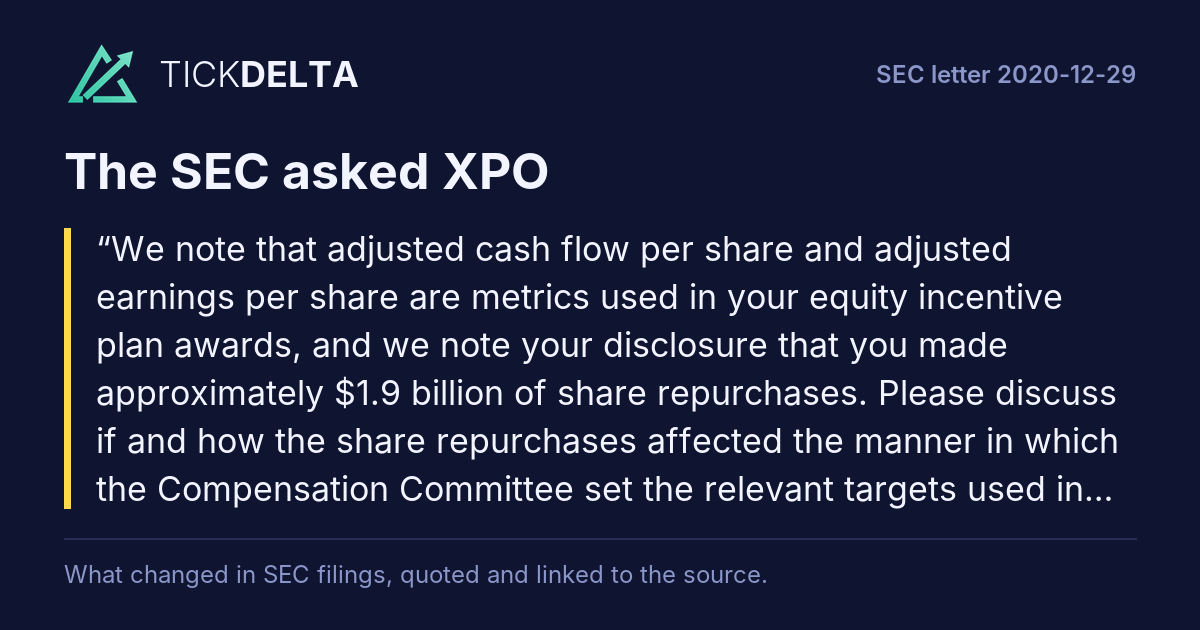
We note that adjusted cash flow per share and adjusted earnings per share are metrics used in your equity incentive plan awards, and we note your disclosure that you made approximately $1.9 billion of share repurchases.
Rest of the question

Please discuss if and how the share repurchases affected the manner in which the Compensation Committee set the relevant targets used in your equity incentive plan awards and determined whether such targets were met, or tell us why such information is not material.

XPO answered
Share Repurchases

Following a significant (greater than 50%) decline in our stock price from early October to mid-December 2018, our Board of Directors (the “Board”) took action in December 2018 to authorize the repurchase of up to $1.0 billion of our common stock. In February 2019, the Board authorized additional repurchases of up to $1.5 billion of our common stock. Under these programs, we repurchased 35 million shares of our common stock between December

2018 and May 2019 at a total cost of $1.9 billion (collectively, the “Share Repurchases”).
Rest of the answer

As of December 31, 2019, the remaining authorization was for $617 million.

Prior Disclosure

With respect to the equity incentive plan awards described below, we noted in our Proxy Statement for the 2020 Annual Meeting of Stockholders (page 51) that “[i]n a stock-buyback scenario, share count would decrease but interest expense would likely rise,” creating some offsetting effects in the calculation of adjusted cash flow per share and adjusted earnings per share (the “Prior Disclosure”).

Equity Incentive Plan Awards

The Company granted equity awards with adjusted cash flow per share and adjusted earnings per share performance targets as follows:

· In February 2016, prior to the authorization of any repurchase programs, the Company granted awards of cash-settled performance-based restricted stock units (the “2016 Awards”) that included certain adjusted cash flow per share performance goals for each of fiscal years 2016 through 2019. The adjusted cash flow per share calculation is based on the Company’s diluted share count, and the terms of the 2016 Awards do not call for a change to the calculation methodology in the event of a share repurchase.

The Company respectfully advises the Staff that, with respect to the 2016 Awards, the Company does not believe that additional disclosure regarding if and how the Share Repurchases affected the manner in which the Compensation Committee set the relevant targets and determined whether such targets were met is material for the following reasons:

o The Company previously addressed the potential impact of the Share Repurchases in the Prior Disclosure.

o The Compensation Committee established the performance targets, and determined whether the performance targets for fiscal years 2016 and 2017 were met, prior to the authorization of the Share Repurchases.

o The Compensation Committee determined that the performance targets for 2018 and 2019 (adjusted cash flow per share of $5.38 and $6.39, respectively) were met after the authorization of the Share Repurchases; however, in accordance with the terms of the 2016 Awards, the Share Repurchases did not affect the manner in which the Compensation Committee determined whether such targets were met.

o Even if the Company’s results had been adjusted to “back out” the net effects of the Share Repurchases, the 2018 and 2019 performance targets would still have been achieved.

· In August 2018, prior to the authorization of the Share Repurchases, the Company granted awards of performance-based restricted stock units (the “2018 Awards”) that included an adjusted cash flow per share performance goal. The adjusted cash flow per share calculation is based on the Company’s diluted share count, and the terms of the 2018 Awards do not call for a change to the calculation methodology in the event of a share repurchase.

respect to the 2018 Awards, the Company does not believe that additional disclosure regarding if and how the Share Repurchases affected the manner in which the Compensation Committee set the relevant target is material for the following reasons:

o The Compensation Committee approved the relevant target prior to the authorization of the Share Repurchases.

o The Company previously addressed the potential impact of the Share Repurchases in the Prior Disclosure.

Further, the Company respectfully advises the Staff that additional disclosure regarding if and how the Compensation Committee determined whether the performance targets for the 2018

Awards were met is not warranted at this time since the awards are not eligible to vest until December 31, 2022 (the end of the performance period). If the Compensation Committee were to determine that the adjusted cash flow per share target for the 2018

Awards is met following the completion of the performance period, the Company intends to disclose if and how the Share Repurchases affected the Compensation Committee’s determination of whether the target was met if such effect is material.

· In June 2019, the Company granted awards of performance-based restricted stock units (the “2019 Awards”) that included an adjusted earnings per share performance goal. The adjusted earnings per share calculation is based on the Company’s diluted share count, and the terms of the 2019 Awards do not call for a change to the calculation methodology in the event of a share repurchase.

respect to the 2019 Awards, the Company does not believe that additional disclosure regarding if and how the Share Repurchases affected the manner in which the Compensation Committee set the relevant targets is material for the following reasons:

o While the projections that were provided to the Compensation Committee in connection with the establishment of the applicable target assumed that there would be no further share repurchases in the relevant performance period, the Compensation Committee was aware at the time that it approved the target that the Company had recently completed the Share Repurchases and that the Company might pursue additional share repurchases in the future.

that additional disclosure regarding if and how the Compensation Committee determined whether the performance targets for the 2019

Awards were met is not warranted at this time, since the performance period for the 2019 Awards will not be completed until December

31, 2024 and the Compensation Committee will not make a determination regarding the achievement of the applicable performance goals until after the performance period is completed. If the Compensation Committee were to determine that the adjusted earnings per share target for the 2019 Awards is met following the completion of the performance period, the Company intends to disclose if and how the Share Repurchases affected the Compensation Committee’s determination of whether the target was met if such effect is material.

Read in the reply
In its next report

First report after the company's reply of Jan 12, 2021: 10-K filed Feb 12, 2021 ↗, against the 10-K filed Feb 10, 2020 ↗.

Tickdelta does not hold the text of both reports, so they are not compared here.

Also in this review: closing letter, 2021-02-23

Form 10-K

2017-12-21 to 2018-03-03 · 8 questions · 2 letters from the SEC, 2 from the company
Review closed 2018-03-03
Results discussion (MD&A)Liquidity and cashSegments
Form 10-K for the Fiscal Year Ended December 31, 2016 · Management’s Discussion and Analysis, page 23
SEC asked (1)
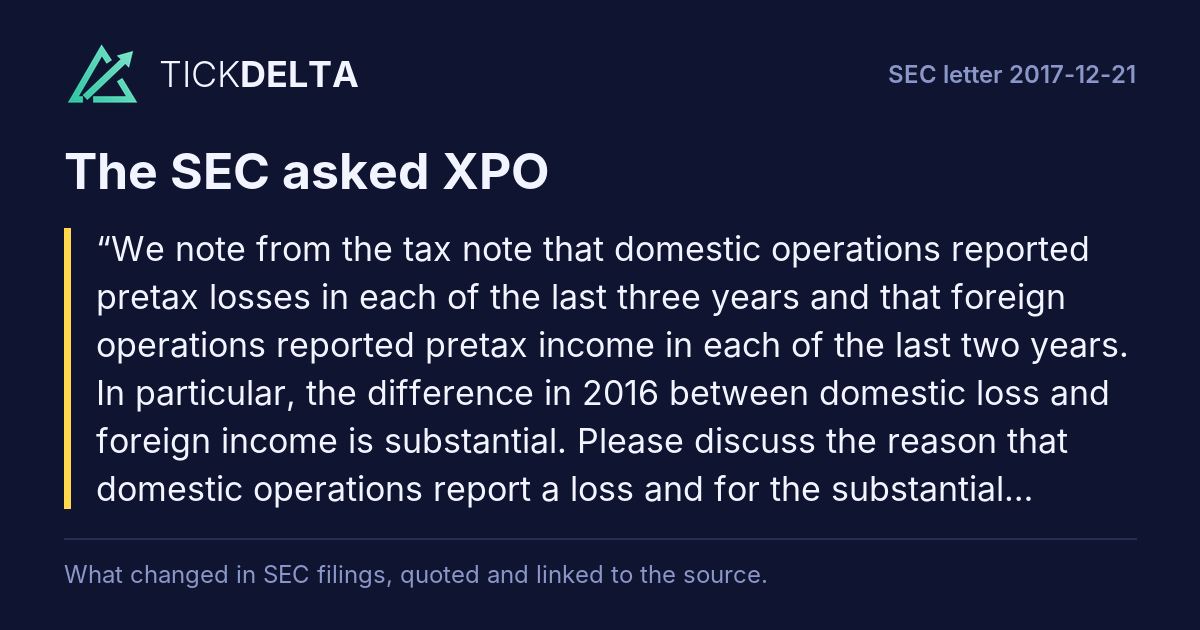
We note from the tax note that domestic operations reported pretax losses in each of the last three years and that foreign operations reported pretax income in each of the last two years. In particular, the difference in 2016 between domestic loss and foreign income is substantial.
Rest of the question

Please discuss the reason that domestic operations report a loss and for the substantial difference in results between domestic and foreign for 2016. Refer to Items 303(a) and 303(a)(3)(i) and (ii) of Regulation S-K for guidance. Provide us with a copy of your intended disclosure.

XPO answered
The disparity in income (loss) before taxes between our U.S. and non-U.S.

operations is largely the result of debt service costs, in particular the fact that substantially all of the interest costs associated with debt that the Company has issued (including debt that was issued to finance acquisitions of non-U.S. based companies) is reflected in our U.S. results. For instance, in 2015, our non-U.S. operations accounted for 42% of our consolidated revenue but only 8% of our interest costs.
Rest of the answer

For 2016, the figures were 38% and 14%, respectively.

In its 2017 Form 10-K, the Company proposes to include the following disclosure immediately preceding the discussion of its effective tax rates in the “Consolidated Results” section under the heading “Management’s Discussion and Analysis of Financial

Condition and Results of Operations”:

The Company’s consolidated income (loss) before income tax provision (benefit) for 2016 was income of $106.8 million, compared to a loss of $282.5 million for 2015. The increase compared to the prior year was driven by significantly higher operating income at both our Transportation and our Logistics segments, primarily due to our 2015 acquisitions of Norbert Dentressangle SA (“ND”) in June 2015 and Con-way Inc. (“Con-way”) in October 2015, and foreign currency gains, partially offset by higher interest expense and the 2016 debt extinguishment loss. With respect to our U.S. operations, loss before taxes decreased by $235.9 million in comparison to the prior year reflecting the full year impact of our acquisition of Con-way, partially offset by increased interest expense due to higher average debt balances. Our non-U.S. operations’ income before tax increased by

$153.4 million reflecting the full year impact of our acquisition of ND. The significant difference between our U.S. and non-U.S. income (loss) before income tax provision (benefit) reflects the fact that substantially all of the financing costs associated with debt we have issued to finance our operations and fund acquisitions is reflected within our U.S. results.

Liquidity and Capital Resources

Cash Flow,

Read in the reply
In its next report

First report after the company's reply of Jan 11, 2018: 10-K filed Feb 12, 2018 ↗, against the 10-K filed Feb 28, 2017 ↗.

Tickdelta does not hold the text of both reports, so they are not compared here.

Liquidity and Capital Resources · Cash Flow, page 27
SEC asked (2)
You disclose cash flows from operations increased (by approximately $535 million) in 2016 primarily due to the improvement in profitability. You also state an increase in your accounts receivable reduced your cash from operations by approximately $154 million in 2016 compared to approximately $8 million of cash provided in 2015. Please provide a more robust analysis of these changes.
Rest of the question

Additionally, provide a comparative analysis between the earliest periods reported (i.e., 2015 and 2014). Refer to instructions 1 and 4 to Instructions to Item 303(a) of Regulation S-K for guidance.

XPO answered
to the Staff’s comment, in its Form 2017 Form 10-K, the Company proposes to supplement its previous disclosure with the following explanation of the significant factors underlying the $534.6 million increase in cash provided by operating activities in 2016:

During 2016, we: (i) generated cash from operating activities of $625.4 million, (ii) generated proceeds from sales of a business and assets of $616.6 million and (iii) received proceeds, net of repayments, on our ABL facility of $30.0 million.
Rest of the answer

We used cash during this period principally to (i) purchase property and equipment of

$483.4 million, (ii) make repurchases, net of proceeds, of $511.4 million on our debt, (iii) make payments on long-term debt and capital leases of $151.4 million, (iv) make payments for tax withholdings on restricted shares of $11.1 million and (v) make payments for debt issuance costs of $25.8 million.

During 2015, we: (i) generated cash from operating activities of $90.8 million,

(ii) generated proceeds from sales of assets of $60.3 million, (iii) received proceeds on our debt of $4,151.8 million and (iv) received proceeds, net of issuance costs, from equity offerings of $1,228.1 million.

We used cash during this period principally to (i) acquire businesses for $3,887.0 million, (ii) purchase property and equipment of $249.0 million, (iii) make payments on long-term debt and capital leases of

$1,215.6 million, (iv) purchase non-controlling interests for $459.7 million, and (v) make payments for debt issuance costs of $42.9 million.

Cash flows from operating activities for 2016 increased by $534.6 million compared to the prior year due to higher cash-related net income1 of $689.8 million, partially offset by net movements in operating assets and liabilities of $155.2 million. The increase in cash-related net income was primarily a result of the full year impact of the ND and Con-way acquisitions that were completed in 2015. The changes in the balances of operating assets and liabilities in 2016 compared to the prior year was significantly impacted by both the post-acquisition growth of the acquired companies and organic growth of our legacy business, driving higher revenues and leading to a higher accounts receivable position on a year-over-year basis. Additionally, cash flows from operating activities was adversely impacted by higher cash paid for interest of $194.9 million due to increased indebtedness to fund the 2015 acquisitions of Con-way and ND.

Supplementally, we note the following with respect to the $112.1 million increase in cash flows from operating activities for 2015:

During 2015, we: (i) generated cash from operating activities of $90.8 million, (ii) generated proceeds from sales of assets of

$60.3 million, (iii) received proceeds on our debt of $4,151.8 million and (iv) received proceeds, net of issuance costs, from equity offerings of $1,228.1 million. We used cash during this period principally to (i) acquire businesses for $3,887.0 million, (ii) purchase property and equipment of $249.0 million, (iii) make payments on long-term debt and capital leases of $1,215.6 million, (iv) purchase non-controlling interests for $459.7 million and (v) make payments for debt issuance costs of $42.9 million.

During 2014, we: (i) received proceeds, net of issuance costs, from equity offerings of $1,097.4 million and (ii) received proceeds on our debt of $500.0 million. We used cash during this period principally to (i) fund operations for $21.3 million, (ii) acquire businesses for $814.0 million, (iii) purchase property and equipment of $44.6 million, (iv) make repayments, net of advances, on our ABL Facility of $75.0 million and (v) make payments for debt issuance costs of $10.4 million.

Cash flows from operating activities for 2015 increased by $112.1 million compared to the prior year due to higher cash-related net income of $95.4 million and net movements in operating assets and liabilities of $16.7 million. The increase in cash-related net income was primarily a result of acquisitions that were completed in 2015 and 2014. Additionally, cash flows from operating activities was adversely impacted by higher cash paid for interest of $149.2 million due to debt incurred by the Company to fund the 2015 acquisitions of Con-way and ND.

Cash-related net income represents total cash flows provided by operating activities less “Changes in assets and liabilities” on the statements of cash flows. The largest components of cash-related net income are net income plus depreciation and amortization.

Read in the reply
In its next report

First report after the company's reply of Jan 11, 2018: 10-K filed Feb 12, 2018 ↗, against the 10-K filed Feb 28, 2017 ↗.

Tickdelta does not hold the text of both reports, so they are not compared here.

Liquidity and Capital Resources · Cash Flow, page 27
SEC asked (3)
In connection with the comment above, your analysis should address the significant drivers underlying material changes in individual cash flow items cited and how they impact cash. Please note that citing items such as net results and working capital items may not provide a sufficient basis to understand how operating cash between comparative periods was affected and changed.
Rest of the question

Refer to section IV.B.1 of SEC Release No. 33-8350 for guidance. Also, quantify any variance factors cited, pursuant to section 501.04 of the staff’s Codification of Financial Reporting Releases for guidance.

XPO answered
We acknowledge the Staff’s comment. We will expand our future disclosure, to the extent material, to quantify, discuss and analyze changes in cash flows from operations including a comparative analysis between the earliest periods reported. Please refer to our response to the preceding comment for our anticipated disclosures in this regard.
Read in the reply
In its next report

First report after the company's reply of Jan 11, 2018: 10-K filed Feb 12, 2018 ↗, against the 10-K filed Feb 28, 2017 ↗.

Tickdelta does not hold the text of both reports, so they are not compared here.

Liquidity and Capital Resources · Cash Flow, page 27
SEC asked (4)
Please consider the above comments in providing an analysis of material changes in operating cash flows for interim periods. For example, the disclosure in “Sources and Uses of Cash” in the Form 10-Q for the fiscal period ended September 30, 2017 state the amount of cash provided by operating activities for each interim period presented but does not analyze the change of $120 million.
Rest of the question

Refer to the introductory paragraph of Item 303(b) and instruction 3 of instructions to paragraph (b) of Item 303 of Regulation S-K for guidance.

XPO answered
In response to the Staff’s comment, the Company proposes to supplement its disclosures in relevant future filings with analysis comparable to the underlined text below regarding the significant factors underlying the $120 million increase in cash provided by operating activities for the fiscal period ended September 30, 2017.
Rest of the answer

The existing disclosures from the Form 10-Q has been included to provide further context.

During the nine months ended September 30, 2017, we: (i) generated cash from operating activities of $524.7 million, (ii) generated proceeds from sales of assets of $59.6 million and (iii) received proceeds of $287.6 million from our common stock offering. We used cash during this period principally to

(i) purchase property and equipment of $389.9 million, (ii) redeem our Senior Notes due 2018 for $271.5 million, (iii) make payments on long-term debt and capital leases of $80.9 million, (iv) make repayments, net of advances, on our ABL Facility of $30.0 million, (v) make payments for tax withholdings on restricted shares of $15.2 million and (vi) make payments for debt issuance costs of $12.8 million in connection with the refinancing of our Term Loan facility.

During the nine months ended September 30, 2016, we: (i) generated cash from operating activities of $404.6 million, (ii) generated proceeds from sales of assets of $57.9 million, and (iii) received proceeds, net of repurchases, of $43.6 million on our debt. We used cash during this period principally to (i) purchase property and equipment of $318.5 million (ii) make payments on long-term debt and capital leases of $126.4 million and (iii) make payments for debt issuance costs of $24.9 million.

Cash flows from operating activities for the nine months ended September 30, 2017 increased by

$120.1 million compared to the prior year period due to higher cash-related net income of $146.2 million, partially offset by net movements in operating assets and liabilities of

$26.1 million. The variance in operating asset and liabilities primarily resulted from higher revenues and the timing of working capital payments. Cash paid for interest decreased $82.6 million compared to the prior year due to lower average debt balances and more favorable interest rates in 2017, primarily from the redemption of our Senior Notes due 2019 and debt refinancings.

Additionally, the Company respectfully advises the Staff that it will supplement the disclosures in its “Sources and Uses of Cash” section within the “Liquidity and Capital Resources” discussion in its 2017 Form 10-K and other relevant subsequent filings with an analysis of the significant factors underlying material changes in cash provided by operating activities, consistent with the above disclosures.

Read in the reply
In its next report

First report after the company's reply of Jan 11, 2018: 10-K filed Feb 12, 2018 ↗, against the 10-K filed Feb 28, 2017 ↗.

Tickdelta does not hold the text of both reports, so they are not compared here.

Divestitures · North American Truckload Operations, page 55
SEC asked (5)
Please tell us the amount of gain or loss recorded on the sale of the North American truckload operations and where recorded in the statement of operations, and the components in detail of how the gain/loss was computed.
XPO answered
The Company respectfully advises the Staff that on October 30, 2015 the Company completed the acquisition of Con-Way. The North American Truckload Operations were acquired as part of the Con-Way acquisition, and represented its own reporting unit.

The sale of North American Truckload occurred approximately one year later on October 27, 2016. As the proceeds from the sale of $558 million equaled the carrying value (inclusive of goodwill), there was no gain or loss recognized in connection with this divestiture.
Rest of the answer

In its 2017 Form 10-K and future filings, the Company proposes to update its disclosure to reflect the absence of a gain or loss on this transaction.

Read in the reply
In its next report

First report after the company's reply of Jan 11, 2018: 10-K filed Feb 12, 2018 ↗, against the 10-K filed Feb 28, 2017 ↗.

Tickdelta does not hold the text of both reports, so they are not compared here.

Note 18: Segment Reporting and Geographic Information, page 84
SEC asked (6)
You disclose you have two reportable segments, transportation and logistics, and your chief executive officer is the chief operating decision maker (“CODM”). We note your organization has executives that are responsible for geographic regions and, in some cases, lines of service (e.g., LTL).
Rest of the question

We further note you refer to or disclose operating results of geographic regions and service lines outside of your financial statements. Please identify for us your operating segments and disclose the factors you used to identify the segments, including the basis of organization (for example, whether management has chosen to organize the public entity around differences in products and services, geographic areas, regulatory environments, or a combination of factors and whether operating segments have been aggregated). Refer to ASC 280-10-50-21. If you aggregated them pursuant to ASC 280-10-50-11 for segment reporting, please include your analysis in terms of how you meet the aggregation criteria under the literature in your response.

XPO answered
The Company respectfully advises the Staff that the Company has determined it has three operating segments based on the types of services it provides to its customers- Transportation, North American Logistics (“NA Logistics”) and European Logistics. Each of these operating segments has its own segment manager.

Transportation is comprised of several service lines, including Freight Brokerage, Last Mile, Less-Than-Truckload (LTL), Full Truckload and

Global Forwarding.
Rest of the answer

Essentially all of these service lines provide the same basic service, which is transporting commercial shipments between locations on behalf of our customers.

Both NA Logistics and European Logistics provide the same service of managing customers’ warehouse and distribution centers, except that

NA Logistics provides such services in North America and European Logistics provides such services in Europe. The Company has aggregated these two operating segments into a single operating segment– Logistics2– because each operating segment provides the same service to its customers and because the aggregation of these two operating segments is consistent with the manner in which our CEO manages the

Company’s business.

The Company is organized and managed based on how our Chief Executive Officer, who is the CODM, regularly reviews and evaluates information at the operating segment level. In particular, our CODM communicates performance targets to the three segment managers, allocates resources to the three segments, and regularly meets with the segment managers to monitor segment performance. Additionally, the CODM determines the annual performance targets and operating budgets at the operating segment level. Lower level targets are set by the segment managers in collaboration with the service line leaders. Decisions regarding customer sales efforts, changes to staffing, capital expenditures, potential IT solutions and other changes to component operations are made by the segment managers.

Logistics represents its own reporting segment.

As noted above, we have aggregated the NA Logistics and European Logistics operating segments into a single Logistics operating segment. This aggregation is consistent with the criteria set forth in ASC 280-10-50-11, which provides that two or more operating segments may be aggregated (into a single operating segment) if aggregation is consistent with the principles of segment reporting; if the segments have similar economic characteristics; and if the segments are similar in all of the following areas: nature of products and services, type or class of customer, methods used to distribute services, and the regulatory environment, if applicable. With respect to the qualitative factors, we note the following:

the operations of the NA Logistics and European Logistics businesses are virtually identical with the only substantive difference being the geographies covered; the core of both businesses is managing the warehouse and distribution centers of their customers; the customer types are similar; and regulatory considerations are not material for either. Additionally, it is worth noting that the two operating segments have significant customer overlap; utilize single account managers for shared customers; use similar IT infrastructures, and closely collaborate on go-to-market strategies. ASC 280 also provides that operating segments must have similar economic characteristics to be aggregated. When assessing whether the NA Logistics and European Logistics businesses have similar economic characteristics, we considered Operating Margins. As the following table illustrates, the variance in operating margin for the 2016 and 2017 periods was 0.5 percentage points and the variance for the forecasted 2018 period is .10 percentage points. Therefore, we consider them economically similar3:

NA

Europe

Difference

2016

2017

Operating Margin

4.2%

4.6%

3.7%

4.1%

0.5pp

Accordingly, we believe disaggregation would not be meaningful, and given the customer overlap and other similarities, could in fact be misleading, to investors.

Read in the reply
In its next report

First report after the company's reply of Jan 11, 2018: 10-K filed Feb 12, 2018 ↗, against the 10-K filed Feb 28, 2017 ↗.

Tickdelta does not hold the text of both reports, so they are not compared here.

Notes to Consolidated Financial Statements · Note 18: Segment Reporting and Geographic Information, page 84
SEC asked (1)
Refer to your response to prior comment 6 regarding your aggregation of North America and European Logistics operating segments. We note from your filing the two segments are subject to different economic and regulatory environments such as differences in tariffs, trade, tax, labor laws, and occupancy costs as well as foreign currency exchange and legal compliance issues within different jurisdictions such as the
Rest of the question

Foreign Corrupt Practices Act in the U.S. and the U.K. Bribery Act. As such, please explain to us in further detail how your segment reporting is consistent with the objective of requiring disclosures about segments in regard to the different economic environments in which an entity operates as specified within ASC 280-10-10-1. In that regard, please address how you consider the different economic and regulatory factors between the two operating segments as noted above in your consideration of the guidance within ASC 280-10-50-11 in determining whether aggregation is appropriate.

XPO answered
We believe that the nature of the regulatory and economic environments in which our North American and European Logistics operating segments operate are sufficiently similar to support aggregation of these operating segments within one reporting segment consistent with the requirements for aggregation as set forth in ASC 280-10-50-11.

While there may be particular differences between the regulatory environments in which our logistics businesses operate in North America and

Europe, taken as a whole, our North America and European Logistics operating segments are generally subject to a broad
Rest of the answer

range of similar local and national regulations. The regulatory environment applicable to both our North American and European logistics services essentially focuses on protecting people, warehoused goods and the environment. This focus is reflected in the setup of our logistics hubs, the installation and maintenance of safety equipment, and the use of specific operational and safety processes.

In particular, both our North American and European logistics operations are subject to a broad range of similar environmental and health and safety requirements, including those relating to the discharge of hazardous substances into soils and waters, emissions of toxic air pollutants, and the generation, handling, disposal, storage and release of solid and hazardous substances and wastes, and human health and safety. In the course of our logistics operations, we may be asked to store, transport or arrange for the storage or transportation of substances defined as hazardous under applicable laws. If a release of hazardous substances occurs on or from our facilities or from the transporter, we may be required to participate in, or have liability for, the response costs and remediation of such release and/or we may be subject to claims for personal injury, property damage and damage to natural resources. Further, at sites on which we operate or have previously operated, or where we have disposed or arranged for the disposal of hazardous substances, we could be liable for historical contamination, regardless of fault or the legality of the original conduct.

In addition, some of our North America logistics operations involve contracts and business with the U.S. Government, where we are subject to various government contracting, acquisition, and procurement regulations; we are also subject to similar government contracting requirements in other jurisdictions, including Europe. We are generally also subject to broadly similar anti-money laundering legislation and a number of anticorruption laws and regulations, including the Foreign Corrupt Practices Act in the U.S., the U.K. Bribery Act and similar legislation in the other jurisdictions in which we operate.

We believe that the costs of regulatory compliance are an ordinary operating cost of both our North America and European Logistics businesses. We do not believe that costs of regulatory compliance, including the cost of compliance with anti-money laundering and anticorruption laws and regulations, have had a material adverse impact on our logistics operations to date, nor do they present a material difference in the current or expected future operational performance of our North America and European Logistics operating segments.

With respect to the economies of North America and Europe, they are both large, mature markets experiencing similar developments related to the proliferation of e-commerce and supply chain outsourcing. Additionally, each economy generally supports the free movement of goods and money. Lastly, within each market, large multinational corporations with international supply chains are a dominant force. For both our North America and European Logistics businesses, the vast majority of all revenue and expense transactions are denominated in the functional currency of the respective entity and, as such, there is no significant foreign currency transaction risk which impacts the results of operations of either operating segment. We believe the North American and European markets are sufficiently similar to support aggregation into a single operating segment.

Read in the reply
In its next report

First report after the company's reply of Feb 14, 2018: 10-Q filed May 7, 2018 ↗, against the 10-Q filed Nov 6, 2017 ↗.

Tickdelta does not hold the text of both reports, so they are not compared here.

Notes to Consolidated Financial Statements · Note 18: Segment Reporting and Geographic Information, page 84
SEC asked (2)
In your response to comment 6, you state the Transportation reportable segment consists of several service lines. We also note there are foreign and domestic operations within that segment. In that regard, please tell us how you organize within the Transportation reportable segment around differences in services, geographical areas, regulatory environments or a combination of factors and whether there are operating
Rest of the question

segments that you aggregate within the Transportation reportable segment. Refer to ASC 280-10-50-1 and 280-10-50-21a.

XPO answered
The

Company’s Transportation reportable segment is organized as follows:

•

We have determined that Troy Cooper, the COO, is the Segment Manager of Transportation. Mr. Cooper reports directly to Brad Jacobs, the CEO and CODM.

Mr. Cooper’s direct reports include the Presidents of Last Mile, North American Transport (NAT) and Less-than-Truckload (LTL) as well as the Managing Director Transport Europe. LTL and Last Mile are service lines. NAT includes the Freight Brokerage and Global Forwarding service lines.
Rest of the answer

Transport Europe includes the Full Truckload and LTL service lines.

When the CODM makes decisions regarding resource allocation and evaluates performance, his focus is on the Transportation reporting segment. Specifically, during the budgeting process, the CEO sets targets for key metrics such as organic revenue growth and adjusted EBITDA at the Transportation reporting segment level. In connection with the development of these targets (which inform compensation and the financial guidance we provide to the investment community), the CEO makes decisions related to capital expenditures, information technology spend and headcount levels. Lower level targets (for instance, at the service line level) are set by Mr. Cooper directly with the Presidents of Last

Mile, NAT and LTL as well as the Managing Director Transport Europe. The CODM’s evaluation of the performance of the Transportation reporting segment is achieved primarily through weekly 1:1 meetings with Mr. Cooper and, to a lesser extent, through the monthly Company- wide operating reviews or MORs. In the weekly 1:1 meetings, the focus is on the Transportation reporting segment’s month-to-date performance for key operating and financial metrics. The metrics reviewed include: organic revenue growth; adjusted EBITDA; and volume, rate and pricing performance. There is also a discussion of the sales pipeline (customers won, lost and new entrants); cross-selling; and performance on key strategic initiatives such as improved pricing. These discussions may include service line performance to add color or context, but are generally not the focus. The MORs which are run by Mr. Jacobs are similarly focused on the key metrics referenced above at the Transportation reporting segment level, once again with service line results reviewed to add context.

Because the CODM’s focus in managing the Transportation business is at the Transportation reporting segment level, we do not believe there are operating segments within the Transportation reportable segment.

Read in the reply
In its next report

First report after the company's reply of Feb 14, 2018: 10-Q filed May 7, 2018 ↗, against the 10-Q filed Nov 6, 2017 ↗.

Tickdelta does not hold the text of both reports, so they are not compared here.

Also in this review: closing letter, 2018-03-03

Form 10-K

2016-11-08 to 2016-12-07 · 2 questions · 1 letter from the SEC, 1 from the company
Review closed 2016-12-07
RevenueSegmentsResults discussion (MD&A)Controls
Item 7. Management’s Discussion and Analysis of Financial Condition and Results of Operations · Results of Operations, page 32
SEC asked (1)
We note that “cost of transportation and services” is material to your consolidated and segment results and it appears to vary materially as a percent of revenue between annual and corresponding interim periods on a consolidated and segment basis.
Rest of the question

Please quantify, discuss, and analyze changes in cost of transportation and services on a stand-alone basis in addition to your current disclosure which is made in the context of net revenues. Refer to Item 303(a)(3)(i) of Regulation S-K and instruction number 4 of “Instructions to paragraph 303(a)” for guidance. In your revised disclosure, please consider quantifying and discussing the significant components of cost of transportation and services, to the extent material.

XPO answered
We acknowledge the Staff’s comment. We will expand our future disclosure, to the extent material, to quantify, discuss and analyze changes in cost of transportation and services and its significant components.

As disclosed in our Form 10-K for the year ended December 31, 2015 under Item 7. Management Discussion and Analysis of Financial Condition and Results of Operation – Other Reporting Disclosures, the “cost of transportation and services” caption includes, among other items, the cost of providing or procuring freight transportation services for XPO’s customers, salaries paid to employee
Rest of the answer

drivers in our full truckload and less-than-truckload businesses, commissions paid to independent station owners in our global forwarding business, and insurance and truck leasing expense in our expedited business.

For each period covered in our Form 10-K for the year ended December 31, 2015, “cost of transportation and services” increased primarily as a result of acquisitions. The increase in cost of transportation and services of 145% from 2014 to 2015 was primarily the result of the acquisitions of BTT, ND and Con-way. As a percentage of revenue, cost of transportation and services decreased to 54.7% in 2015 compared to 72.2% in 2014, primarily as a result of a shift in the mix of our business with a more significant component of our revenue being attributable to our Logistics segment following the acquisitions of ND and Con-way. Cost of transportation and services typically represents a substantially lower percentage of revenue in our Logistics segment than in our Transportation segment due to the more limited proportional role of transportation services provided to our Logistics segment customers.

We will expand our disclosure in future filings to address the foregoing.

Read in the reply
In its next report

First report after the company's reply of Nov 22, 2016: 10-K filed Feb 28, 2017 ↗, against the 10-K filed Feb 29, 2016 ↗.

Tickdelta does not hold the text of both reports, so they are not compared here.

Item 4. Controls and Procedures · Conclusion Regarding the Effectiveness of Disclosure Controls and Procedures, page 32
SEC asked (2)
Your conclusion regarding the effectiveness of disclosures controls and procedures refers to “material” information, but the definition of disclosure controls and procedures as defined in Exchange Act Rules 13a-15(e) and 15d-15(e) does not contain such limitation.
Rest of the question

In addition, your disclosure did not indicate that information required to be disclosed is accumulated and communicated to management as appropriate “to allow timely decisions regarding required disclosure.” Although there is no requirement to disclose the full definition, deviation from the definition gives the appearance of limiting or qualifying management’s conclusion. Please represent to us and revise future filings to state management’s conclusion in regard to the company’s disclosure controls and procedures as fully defined in Exchange Act rules 13a-15(e) and 15d-15(e).

XPO answered
We acknowledge the Staff’s comment. In response, we have revised the text of Item 4. Controls and Procedures – Conclusion Regarding the Effectiveness of Disclosure Controls and Procedures in our Form 10-Q for the quarter ended September 30, 2016, filed on November 8, 2016, as shown below and will include such revised disclosure in future filings. In addition, we confirm that our conclusion included in our Form 10-Q for the quarter ended June 30, 2016, does not contain any limitations or qualifications regarding the design and operations of our disclosure controls and procedures.

Item 4.
Rest of the answer

Controls and Procedures.

Conclusion Regarding the Effectiveness of Disclosure Controls and Procedures

Under the supervision and with the participation of our management, including our principal executive officer and principal financial officer, we conducted an evaluation of the effectiveness of the design and operation of our disclosure controls and procedures, as such term is defined in Rules 13a-15(e) and 15d-15(e) under the Exchange Act, as of the end of the period covered by this report. Based on their evaluation, our principal executive officer and principal financial officer concluded that our disclosure controls and procedures were effective as of such time such that the information required to be included in our SEC reports is (i) recorded, processed, summarized and reported within the time periods specified in SEC rules and forms relating to the Company, including our consolidated subsidiaries, and (ii) accumulated and communicated to our management, including our principal executive officer and principal financial officer, as appropriate to allow timely decisions regarding required disclosure.

Read in the reply
In its next report

First report after the company's reply of Nov 22, 2016: 10-K filed Feb 28, 2017 ↗, against the 10-K filed Feb 29, 2016 ↗.

Tickdelta does not hold the text of both reports, so they are not compared here.

Also in this review: closing letter, 2016-12-07

Schedule 14A

2015-06-25 to 2015-07-17 · 3 questions · 1 letter from the SEC, 1 from the company
Review closed 2015-07-17
General
SEC asked (1)
We note that you reference certain documents being incorporated by reference into this preliminary proxy statement on pages 3, 9, 12, 14 and 25. Information may be incorporated by reference only in the manner and to the extent specifically permitted in the Items of Schedule 14A.
Rest of the question

Please provide us your analysis supporting the incorporation by reference of these documents in order to satisfy your disclosure obligations. Please refer to Note D of Schedule 14A.

XPO answered
In response to the Staff’s comment, the Company has revised the Proxy Statement throughout Amendment No. 1 to remove the use of incorporation by reference.
Read in the reply
General
SEC asked (2)
Please also tell us whether you intend to deliver the reports listed on page 25 with the proxy statement. Refer to Item 13(b)(2) of Schedule 14A.
XPO answered
In light of the Company’s revision to the Proxy Statement to remove the use of incorporation by reference, the Company no longer believes that Item 13(b)(2) of Schedule 14A is applicable to the Proxy Statement.
Read in the reply
Authorized Shares Proposal, page 16
SEC asked (3)
Please disclose whether you have any current plans to issue the additional shares.
XPO answered
In response to the Staff’s comment, the Company has added additional disclosure on page 16 of Amendment No. 1.
Read in the reply

Also in this review: closing letter, 2015-07-17

Form S-4

2014-02-07 to 2014-02-24 · 1 question · 1 letter from the SEC, 2 from the company
No closing letter
Legal and contingencies
Litigation Related to the Merger, page 80
SEC asked
Please provide us with copies of the complaints for the shareholder litigation actions related to the merger discussed in this section.
XPO answered
In response to the Staff’s comment, enclosed with this letter, the Company is providing to the Staff copies of the five complaints for the shareholder litigation actions related to the merger on a supplemental basis pursuant to Rule 418 under the U.S. Securities Act of 1933, as amended, and Rule 12b-4 under the U.S. Securities Exchange Act of 1934, as amended.
Read in the reply

Also in this review: company letter, Feb 24, 2014

From the SEC's correspondence on EDGAR: staff letters (form UPLOAD) and company letters (form CORRESP), 21 letters filed since 2014-02-07. Questions and answers are matched by their numbers; topics come from words in each question. The reports are compared word for word (same form, before the first SEC letter against the first report after the company's reply). No AI.

Sources

The SEC's correspondence on EDGAR: staff letters (form UPLOAD) and company letters (form CORRESP), matched question by question. No AI.

Also

Filings: the letters in the filing list.

Work with it

Excel workbook · CSV. Google Sheet that stays up to date: paste =IMPORTDATA("https://tickdelta.com/company/XPO/export.csv") into a cell.

Next in Owners and insiders:Insider trades
Esc

Type a ticker such as AAPL, a name, an investor such as Buffett, or a topic such as tariffs. ↑ ↓ to move, Enter to open.