Form 10-K for the Fiscal Year Ended December 31, 2020
Your disclose on page 41 that the decrease in the effective tax rate in fiscal 2020 was primarily driven by income tax benefits associated with stock-based compensation. However, foreign tax rate differentials, contribution and margin-based taxes and Other items also had a material impact on your effective tax rate for 2020 based on your disclosures in Note 16.Rest of the question
Please discuss and analyze changes in your effective tax rate and any material items that are not expected to recur. Please refer to Item 303 of Regulation S-K.
The Company acknowledges the Staff’s comment and respectfully advises the Staff that its evaluation and disclosure of movements in its effective tax rate in Management's Discussion and Analysis ofRead in the reply
Financial Condition and Results of Operations has historically focused on material tax items. Foreign tax rate differentials, contribution and margin-based taxes and other items did not materially change for the year ended December 31, 2020 as compared to the prior year.Rest of the answer
However, we recognize that these items did have a significant impact on the Company’s 2020 effective tax rate, primarily due to a significantly lower income before income tax provision in 2020 as compared to 2019. Specifically, income before income taxes was $148 million for the year ended December 31, 2020, as compared to $569 million for the prior year.
In future filings, the Company will disclose the impact of all significant non-recurring items impacting the effective tax rate regardless of whether the year over year absolute dollar amount materially changes.
For instance, in our third quarter 2021 Form 10-Q, we have provided the following disclosure:
Our effective income tax rates were 33.5% and 45.5% for the third quarter of 2021 and 2020, respectively, and 23.1% and 31.3% for the first nine months of 2021 and 2020, respectively. The effective tax rates for the third quarter and nine-month periods of 2021 and 2020 were based on forecasted full-year effective tax rates, adjusted for discrete items that occurred within the periods presented. The reduction in our effective income tax rate for the third quarter and first nine months of 2021 compared to the same periods in 2020 was primarily driven by reduced contribution and margin-based taxes coupled with increased pre-tax book income and the impact of discrete items. In the third quarter and first nine months of 2021, discrete tax benefits of $45 million related to a tax planning initiative that resulted in the recognition of a long-term capital loss were partially offset by discrete tax expenses of $41 million related to valuation allowances, of which $34 million were transferred to GXO. Additionally, impacting the nine-month period was a discrete tax benefit of $8 million resulting from changes in reserves for uncertain tax positions.
There were no material discrete items impacting the effective tax rate for the third quarter and first nine months of 2020.
First report after the company's reply of Nov 5, 2021: 10-K filed Feb 16, 2022 ↗, against the 10-K filed Feb 12, 2021 ↗.
Tickdelta does not hold the text of both reports, so they are not compared here.
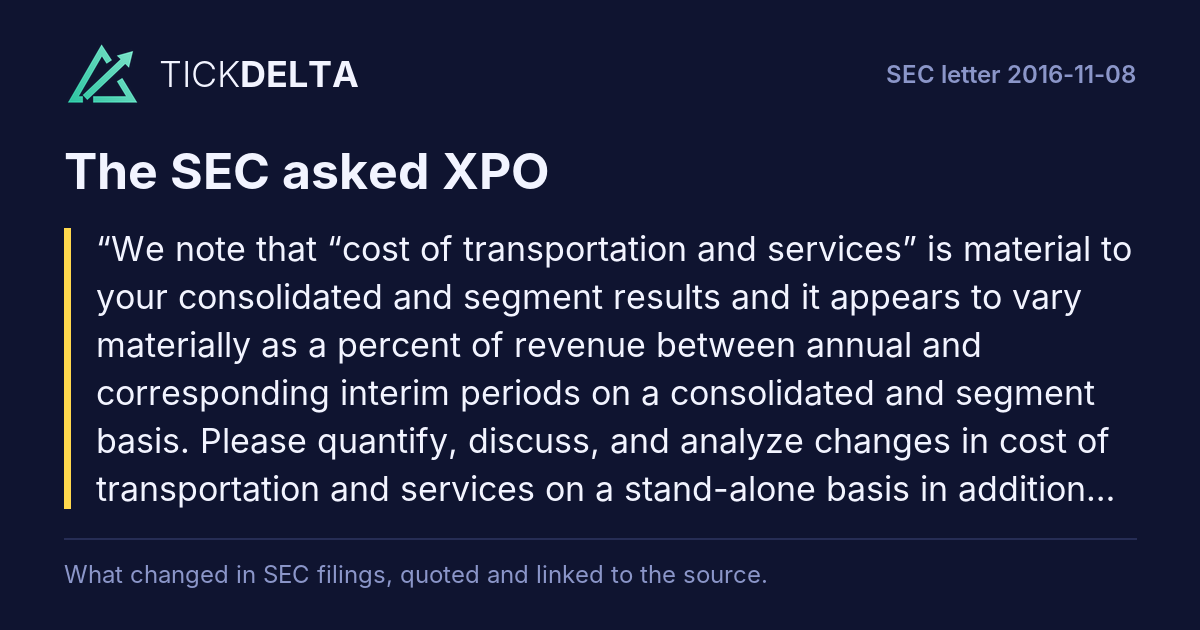
Revise your disclosure to explain how management analyzes the underlying factors, events and trends that directly affect the changes in revenue for the Less-Than-Truckload (LTL) and truck brokerage businesses. For example, it appears changes in the shipping weight and distance of the haul directly impacts the pricing and revenue of the LTL business.Rest of the question
Additionally, it appears changes in the demand for the underlying commodity or product being shipped and fuel surcharges directly affect your revenue. Revise your disclosure to describe any known trends or uncertainties that are reasonably likely to have a material impact on your future revenues or operations as a result of these factors, events and trends. Refer to Item 303 of Regulation S-K. 16. Income Taxes, page 94
The Company acknowledges the Staff’s comment and supplemented its revenue disclosures in its third quarter 2021 Form 10-Q as set forth below. Also, the Company will include similar disclosure responsive to this comment in subsequent filings.Read in the reply
Impacts of COVID-19 and Supply Chain Challenges
We believe that the onset of the COVID-19 pandemic and associated impacts on economic activity had adverse effects on our results of operations and financial condition for the nine months ended September
30, 2020.Rest of the answer
The rebound of our business began to occur midway through 2020; however, as the economy recovers, demand has outpaced supply in certain sectors. Additionally, labor shortages in the recovery – notably, a reduced supply of truck drivers – present challenges to many service industries, including freight transportation. These dynamics, together with equipment shortages and pent-up demand for semiconductor chips used by some of our end markets, have created supply chain disruptions and increased our cost of transportation and services. We cannot predict how long the current labor shortages and other disruptions will last, or whether future disruptions, if any, will adversely affect our results of operations.
North American Less-Than-Truckload Segment
Revenue in our North American LTL segment increased 14.8% to $1.1 billion for the third quarter of 2021, compared with $933 million for the same quarter in 2020. Revenue increased 18.7% to $3.1 billion for the first nine months of 2021, compared with $2.6 billion for the same period in 2020. Revenue included fuel surcharge revenue of $167 million and $108 million, respectively, for the third quarters of 2021 and 2020, and $466 million and $323 million, respectively, for the first nine months of 2021 and 2020.
We evaluate the revenue performance of our LTL business using several commonly used metrics, including volume (weight per day in pounds) and yield, which is a commonly used measure of LTL pricing trends. We measure yield using gross revenue per hundredweight excluding fuel surcharges. Impacts on yield can include weight per shipment and length of haul, among other factors. The following table summarizes our key revenue metrics:
Three Months Ended September 30,
Nine Months Ended September 30,
2021
Change
Pounds per day (thousands)
72,152
69,952
3.1
%
73,138
66,730
9.6
Gross revenue per hundredweight, excluding fuel surcharges
$
20.02
18.90
6.0
19.47
18.57
4.9
The year-over-year increases in revenue for both the third quarter and first nine months of 2021 reflect an increase in average weight per day and gross revenue per hundredweight. The increase in weight per day for the third quarter reflects higher weight per shipment. The increase in weight per day for the first nine months of 2021 reflects higher shipments per day and weight per shipment.
Brokerage and Other Services Segment
Revenue in our Brokerage and Other Services segment increased
27.2% to $2.3 billion for the third quarter of 2021, compared with $1.8 billion for the same quarter in 2020. Revenue increased 37.0% to $6.5 billion for the first nine months of 2021, compared with $4.7 billion for the same period in 2020. The year-over-year revenue increases for the third quarter and first nine months of 2021 reflect an increase in North American truck brokerage loads per day and improved pricing across segment services enhanced by our digital platform, as well as improving market conditions in the economic recovery from the COVID-19 pandemic. These gains were partially offset by the semiconductor shortage, which constrained customer demand for freight transportation services in North America and Europe, and by a truck driver shortage in the U.K. and North America.
16. Income Taxes, page 94
First report after the company's reply of Nov 5, 2021: 10-K filed Feb 16, 2022 ↗, against the 10-K filed Feb 12, 2021 ↗.
Tickdelta does not hold the text of both reports, so they are not compared here.
Please tell us what consideration you gave to providing a further quantitative breakdown of the “Other” category in the income tax rate reconciliation schedule pursuant to Rule 408(h)(2) of Regulation S-X and FASB ASC 740-10-50-12.
advises the Staff that the key items in the “Other” category in the income tax rate reconciliation schedule represent research and development tax credits, tax return to tax provision adjustments based on changes in estimates between the 2020 tax provision and the final 2020 filed tax returns and U.S. GAAP income on certain foreign currency instruments that are not recognized for U.S. federal income tax purposes. As detailed in the supplemental table below, the amounts for the years ended December 31, 2019 and 2018 resulted in an immaterial impact on the effective tax rate.Read in the replyRest of the answer
In fiscal 2020, while the dollar amounts were immaterial, due to a significantly lower income before income taxes, they had a larger impact on the effective tax rate. The Company respectfully does not believe adding these items to the effective tax rate reconciliation provides meaningful information to the readers of the financial statements. These items will be re-evaluated, based on materiality, for disclosure in the effective tax rate reconciliation in the Company’s Form 10-K for the year ended December 31, 2021.
Years Ended December 31,
(Dollars in millions)
2019
2018
Income before income tax provision
148
569
566
"Other" on effective tax rate reconciliation
Tax
Expense/
(Benefit)
Impact on
Tax Rate
R&D tax credit
$ (2 )
-1.4 %
-0.4 %
$ -
0.0 %
Return to provision
(5 )
-3.2 %
(4 )
-0.7 %
(6 )
-1.0 %
Financial currency instruments
(2 )
-
Other
0.4 %
0.3 %
0.8 %
Total
$ (8 )
-5.6 %
$ (7 )
-1.2 %
-0.2 %
First report after the company's reply of Nov 5, 2021: 10-K filed Feb 16, 2022 ↗, against the 10-K filed Feb 12, 2021 ↗.
Tickdelta does not hold the text of both reports, so they are not compared here.

Also in this review: request for more time, Oct 22, 2021, closing letter, 2021-11-10