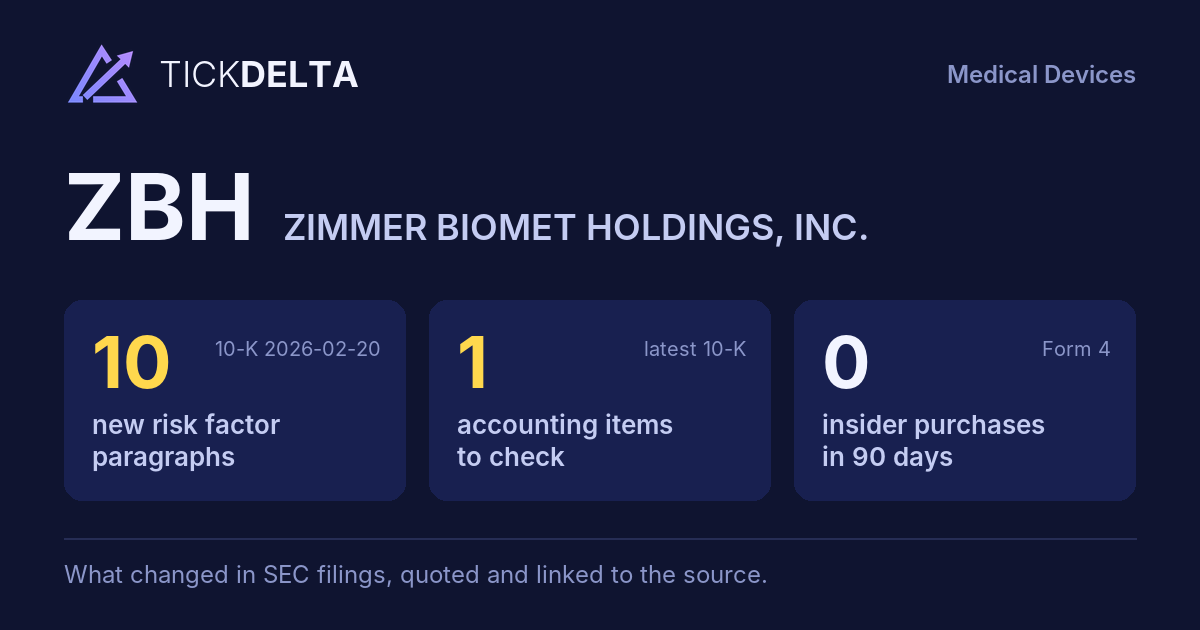
Sentences and paragraphs of ZBH's Risk Factors and MD&A, 10-K 2026-02-20 against 10-K 2025-02-25.
Each links to the text at sec.gov.
AddedRisk Factors
We are transforming aspects of our sales and distribution network and go-to-market model in the U.S. and certain other markets, and these efforts may not be successful and they involve risks and challenges that may adversely impact our business, results of operations and financial condition.
Read it in 10-K 2026-02-20 at sec.gov ↗
AddedRisk Factors
We are converting substantial portions of our U.S. sales force from independent distributors and sales representatives to our employees in a multi-year initiative. We are also increasing product category specialization and focus across our U.S. sales force, which may lead to disruptions for our sales personnel. We may not successfully execute or manage this transformation and transition, which could materially and adversely affect our business, results of operations and financial condition. These transformative actions present significant operational, legal, financial and cultural challenges and require effective planning and execution across recruiting, onboarding, training, systems integration, compensation, compliance and management. We could experience operational disruptions, increased costs and reduced sales, and we may lose key sales personnel, including high-performing distributors, sales leaders and sales representatives, to competitors if they decline employment with us or depart following the transition. Any such departures could lead to loss of customer relationships, sales coverage gaps, diminished sales effectiveness and lower net sales. Even if we are able to retain key personnel, we expect to experience disruption to our U.S. sales force as roles, territories, product category sales coverage, compensation structures, incentive plans, reporting lines, systems and processes change, which could reduce morale, productivity and continuity in customer engagement, which could adversely affect our business, results of operations and financial condition. Additionally, competitors are attempting, and may continue to attempt, to recruit our sales personnel (whether independent or employed) and target our customer relationships during and after the transition. The magnitude and duration of these impacts are uncertain and may be exacerbated by macroeconomic conditions, competition or other factors.
Read it in 10-K 2026-02-20 at sec.gov ↗
AddedRisk Factors
We are additionally making certain changes to our sales force and go-to-market models in certain other countries in an effort to optimize our commercial strategies and improve our performance on a consistent basis in those markets. We are separately tailoring the nature, timing and scale of the changes to the requirements of individual markets, and do not expect the changes to be uniform. Throughout the transition to this new model in certain emerging markets, we expect revenue performance to be inconsistent as we negotiate with the displaced distributors, execute initial stocking orders with the new platform distributors and allow the platform distributors to coordinate with their sub-distributor network. Each market’s transformation efforts present significant operational, legal, financial and cultural challenges and risks that are similar to those found in our above-described U.S. sales force transformation efforts, which risks may be magnified by the complexity of implementing different changes across multiple markets in parallel. The change in go-to-market strategy, outcome of existing litigation and the potential for additional litigation could have a material adverse impact on our financial results in the impacted markets.
Read it in 10-K 2026-02-20 at sec.gov ↗
AddedRisk Factors
We are rationalizing our product portfolio to streamline our operations, enhance focus on strategic offerings, and improve cost efficiency. Effective management of our product portfolio is a complex process requiring
Read it in 10-K 2026-02-20 at sec.gov ↗
AddedRisk Factors
consideration of different regulatory requirements and approvals, preferences for different surgical techniques, reimbursement rates and other factors. Product portfolio rationalization may lead to the loss of product breadth valued by customers, potential disruption in customer relationships, and reduced sales in affected categories. It may also create transitional inefficiencies, including supply chain adjustments, inventory imbalances and challenges in forecasting demand for remaining products. These activities can divert management attention and resources away from other strategic priorities and may result in higher-than-expected costs, higher-than-expected inventory obsolescence, asset impairments or delays in achieving anticipated benefits. If our product portfolio rationalization efforts do not yield the expected operational improvements, cost savings, or market focus, or if such changes are not well-received by customers, our competitive position, business, financial condition, results of operations, and cash flows could be adversely affected.
Read it in 10-K 2026-02-20 at sec.gov ↗
AddedRisk Factors
Further, our use of artificial intelligence and machine learning in our infrastructure and products exposes us to a variety of threats, risks and uncertainties, including with respect to changing laws and regulations regarding the use of such technologies; the risks of inaccuracies, errors and interruptions affecting business processes supported by artificial intelligence; the risks of inaccuracies, errors and interruptions to our products and services using artificial intelligence, which could result in harm to patients or other adverse outcomes; and the variety of risks associated with any other use of information technology, including risks relating to data privacy and access, interruption, compliance, implementation and other factors.
Read it in 10-K 2026-02-20 at sec.gov ↗
AddedRisk Factors
Natural disasters present risks to our business and financial results which are difficult to predict and address. We face current and long-term operational risks and have in the past experienced business interruptions from severe weather events and other natural conditions, such as hurricanes, tornadoes, droughts, extreme temperatures, wildfires or flooding. Such severe weather events and other natural disasters have in the past and could in the future increase our operational costs, pose physical risks to our facilities, cause population dislocations and adversely impact our supply chain, manufacturing and distribution networks, and pose risks to the availability and cost of raw materials, components, energy, transportation or other inputs necessary for the operation of our business. Concerns over climate change and natural disasters have also resulted in, and may continue to result in, new laws or regulations that are more stringent than current legal or regulatory requirements, and we may experience increased compliance burdens and costs to meet the regulatory obligations as well as adverse impacts on raw material sourcing, manufacturing operations and the distribution of our products.
Read it in 10-K 2026-02-20 at sec.gov ↗
AddedRisk Factors
Our commitments, goals and disclosures related to corporate responsibility matters, and the perception of our activities in these areas, may adversely impact us.
Read it in 10-K 2026-02-20 at sec.gov ↗
Show the other 13
AddedRisk Factors
Companies across all industries are facing increasing scrutiny, and potentially negative actions, from investors, regulators, customers, employees and other stakeholders related to their corporate responsibility commitments, performance, and disclosures, including those related to climate change, social matters and governance standards. Responding to and acting on these considerations involves risks and uncertainties, requires investments and depends in part on our relative performance against third parties that is beyond our control. Additionally, multiple organizations have developed differing ratings processes and standards to evaluate companies on their respective approaches to corporate responsibility matters, which ratings are increasingly being employed by investors, lenders and customers to inform their investment, financing and purchasing decisions. If we do not meet the evolving, varied and sometimes conflicting expectations of our investors, customers, regulators, employees and other stakeholders, we could experience reduced demand for our products, loss of customers and employees and suffer other negative impacts.
Read it in 10-K 2026-02-20 at sec.gov ↗
AddedRisk Factors
•inconsistent and unpredictable demand for our products, especially in developing markets;
Read it in 10-K 2026-02-20 at sec.gov ↗
AddedMD&A
Our net earnings were $705.1 million in 2025 compared to $903.8 million in 2024. The decline in net earnings was driven by inventory and instrument charges of approximately $170 million related to certain product lines we intend to discontinue; costs related to the acquisition of Paragon 28 and the acquisition of Monogram Technologies Inc. (“Monogram”) on October 7, 2025, including acquisition-related costs and higher interest expense incurred for debt borrowed for the acquisitions; U.S. tariffs; higher performance-related compensation; and investments made to direct-to-patient marketing, medical education and information technology in the current year. These unfavorable items were partially offset by the net sales increase, a favorable mix shift to higher margin products and markets, favorable adjustments related to contingent consideration for acquisitions, gains recognized on our equity investments in 2025 compared to losses in 2024, lower restructuring costs due to the timing of our restructuring programs, and lower litigation-related charges.
Read it in 10-K 2026-02-20 at sec.gov ↗
AddedMD&A
Acquisition, integration, divestiture and related expenses increased in 2025 when compared to 2024 due to the acquisitions made in 2025. The Paragon 28 and Monogram acquisitions included $55.1 million of compensation expense related to the discretionary accelerated vesting of Paragon 28 and Monogram unvested restricted stock units and stock options as agreed upon as part of the acquisition agreements. These costs were partially offset by $77.1 million of net gains related declines in the estimated fair values of contingent consideration from acquisitions due to updated forecasts of net sales.
Read it in 10-K 2026-02-20 at sec.gov ↗
AddedMD&A
In the Americas, operating profit increased, but operating profit as a percentage of net sales decreased, in 2025 compared to 2024. Operating profit increased primarily due to the acquisition of Paragon 28, which was partially offset by higher manufacturing costs included in segment operating profit. In addition, the Americas benefited from opportunistic end-of-year customer purchases and capital sales above historic levels. Operating profit as a percentage of net sales decreased because of the higher manufacturing costs as well as the fact that the operating profit contributed by Paragon 28 is at a lower operating profit margin.
Read it in 10-K 2026-02-20 at sec.gov ↗
AddedMD&A
In EMEA, operating profit increased slightly, but operating profit as a percentage of net sales decreased, in 2025 when compared to 2024. The decrease in operating profit as a percentage of net sales was due to higher manufacturing costs included in segment operating profit, as well as the fact that the operating profit contributed by Paragon 28 is at a lower operating profit margin.
Read it in 10-K 2026-02-20 at sec.gov ↗
AddedMD&A
In Asia Pacific, operating profit and operating profit as a percentage of net sales decreased in 2025 when compared to 2024. The decreases were due to higher manufacturing costs included in segment operating profit and higher bad debt expense, as well as the fact that the operating profit contributed by Paragon 28 is at a lower operating profit margin.
Read it in 10-K 2026-02-20 at sec.gov ↗
AddedMD&A
repurchase program effective February 9, 2026, with no expiration date, and terminated the existing May 2024 share repurchase program.
Read it in 10-K 2026-02-20 at sec.gov ↗
AddedMD&A
For each of our acquisitions that include contingent consideration, there is a maximum payout. Accordingly, the range of our potential contingent consideration payments are $25 million to $795 million as of December 31, 2025, that may be paid out through 2031.
Read it in 10-K 2026-02-20 at sec.gov ↗
AddedMD&A
Business Combinations - In accordance with ASC Topic 805, Business Combinations, we use the acquisition method of accounting to allocate the purchase price of an acquired business to the assets acquired and liabilities assumed based on their estimated fair values at the date of acquisition. The excess of the purchase price over the estimated fair value of assets and liabilities is recorded as goodwill. Assigning fair market values to the assets acquired and liabilities assumed at the date of an acquisition often requires the application of judgment regarding estimates and assumptions. These estimates include, but are not limited to, a market participant’s expectation of future cash flows from acquired technology and in-process research and development. All acquisition costs are expensed as incurred. During the measurement period, not to exceed one year from the acquisition date, we may record adjustments to the fair value of the tangible and intangible assets acquired and liabilities assumed if new information is obtained related to facts and circumstances that existed as of the acquisition date.
Read it in 10-K 2026-02-20 at sec.gov ↗
AddedMD&A
Contingent Consideration - In connection with an acquisition, we may be required to pay future consideration that is contingent upon the achievement of specified objectives, such as receipt of regulatory approval, commercialization of a product or achievement of revenue targets. In a business combination, we record a contingent consideration liability, as of the acquisition date, representing the estimated fair value of the contingent consideration we expect to pay. We determined the fair value of the contingent consideration related to the Monogram acquisition, which represented most of our contingent consideration at December 31, 2025, using a Monte Carlo valuation approach, which simulates future revenues during the earn out-period using management's best estimates. We determined the fair value of our other contingent consideration using a discounted cash flow analysis. Significant judgment is required in determining the assumptions used to calculate the fair value of the contingent consideration. Increases in projected revenues and probabilities of payment may result in significantly higher fair value measurements; decreases in these items may have the opposite effect. Increases in discount rates in the periods prior to payment may result in significantly lower fair value measurements; decreases may have the opposite effect. See Note 9 to the consolidated financial statements included in this Annual Report on Form 10-K for additional information.
Read it in 10-K 2026-02-20 at sec.gov ↗
AddedMD&A
We remeasure our contingent consideration each reporting period and recognize the change in the contingent consideration’s fair value “Acquisition, integration, divestiture and related” in our consolidated statement of income. As of December 31, 2025 and 2024, we recorded $299.2 million and $180.7 million of contingent consideration, respectively, related to completed business combinations.
Read it in 10-K 2026-02-20 at sec.gov ↗
AddedMD&A
If the transaction is determined to be an asset acquisition rather than a business combination, contingent consideration is recognized when the specified objective is deemed probable and is estimable.
Read it in 10-K 2026-02-20 at sec.gov ↗