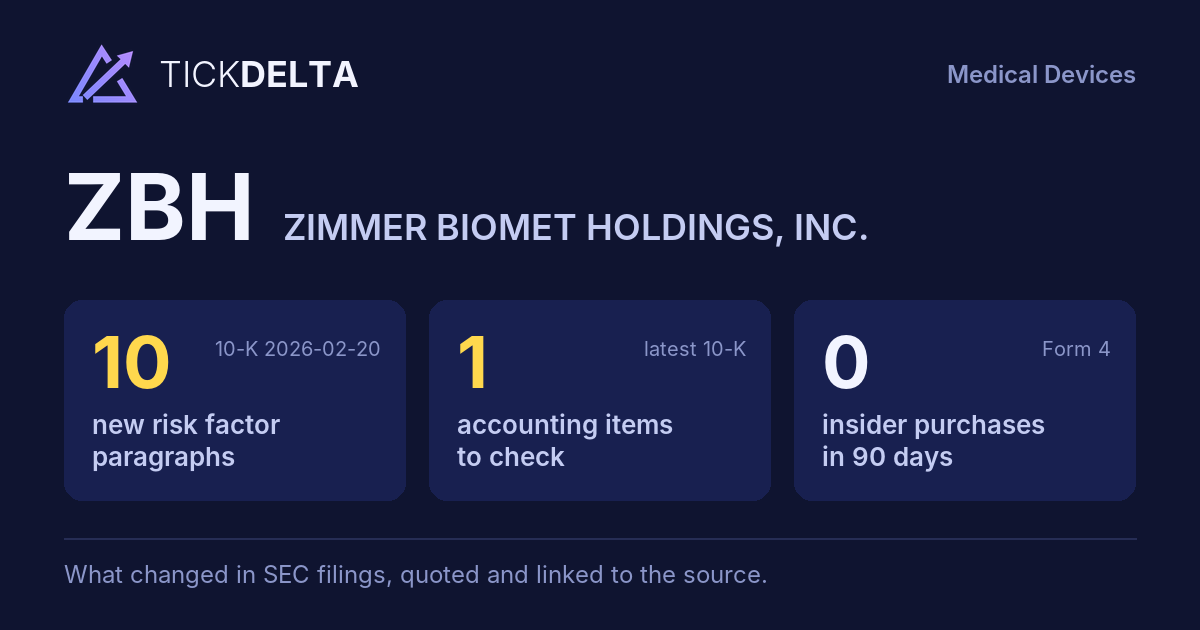
10-K 0001193125-26-059853 (2026-02-20) vs 10-K 0000950170-25-026604 (2025-02-25)
| Section | Compared text | Words now | Changed |
|---|
| Risk Factors | Item 1A | 9,933 |
17.1% |
| MD&A | Item 7 | 5,616 |
33.0% |
| Legal Proceedings | Item 3, via Note 20 – Commitments and Contingencies | 646 |
42.7% |
| Accounting Policies | Item 8, Note 2 – Significant Accounting Policies | 3,755 |
15.9% |
The redline: what was cut and what was added
In each section, the paragraph that changed most, marked against last year's 10-K:
cut words struck through, new words highlighted and underlined.
Risk Factors 194 words changed in this paragraph; it is 45% similar to last year's version.
Changes in the tax laws and regulations of the jurisdictions where we do business, including an increase in tax rates or an adverse change in the treatment of an item of income or expense, could result in a material increase in our tax expense and/or tax payments, could increase tax uncertainty and could have a material adverse impact on our business, financial condition or results of operations.Tax law changes in certain foreign jurisdictions in which we operate conforming to Pillar Two of the base erosion and profit shifting plan (“Pillar Two”) undertaken by the operations. The Organisation for Economic Co-operation and Development began (OECD) has a framework to take implement a global minimum corporate tax of 15% for companies with global revenue and profits above certain thresholds (referred to as Pillar 2). Although the U.S. has not enacted legislation to implement Pillar 2, certain countries in which we operate have adopted legislation, and other countries are in the process of introducing legislation to implement Pillar 2. The OECD issued new administrative guidance on January 5, 2026, with respect to Pillar 2 which modifies key aspects of the framework for countries to enact in their own laws. It remains uncertain whether or how countries will implement Pillar 2 and the OECD administrative guidance, which may have a further adverse effect in 2024. We expect the implementation and interpretation of Pillar Two across jurisdictions where we do business to have adverse effects on our effective tax rate, results of operations, and cash flows. These tax law changes require profits earned in such jurisdictions to be subject to a minimum 15 percent income tax rate. liabilities.
Source: Item 1A, 10-K 0001193125-26-059853 vs Item 1A, 10-K 0000950170-25-026604
MD&A 161 words changed in this paragraph; it is 42% similar to last year's version.
In 2024, 2025, our net sales increased 3.8 7.2 percent when compared to 2023. 2024. Net sales growth was driven by a combination of our acquisition of Paragon 28, Inc. (“Paragon 28”) on April 21, 2025, market growth, new product introductions, positive price realization and commercial execution across lower net sales in the organization. These favorable items were negatively impacted by our transition in July 2024 prior year due to operational challenges fulfilling customer orders as a consequence of a new enterprise resource planning ("ERP") software system for implementation. Paragon 28 had a significant portion of positive impact on our U.S. and Canada sales and commercial operations. As a result of this ERP implementation, we experienced operational challenges which affected our ability to fulfill certain customer orders. This disruption mostly affected our U.S. net sales, but our International net sales were also impacted as shipments to our international affiliates were delayed. Shipping levels returned to similar levels that existed prior to the implementation by the end growth of the year. For the full year 2024, we estimate this ERP implementation had less than a one 2.5 percent impact to our net sales. in 2025. In addition, our net sales in 2024 were tempered by experienced a negative 1.0 positive effect of 0.8 percent effect from changes in foreign currency exchange rates. rates in 2025.
Source: Item 7, 10-K 0001193125-26-059853 vs Item 7, 10-K 0000950170-25-026604
Accounting Policies 84 words changed in this paragraph; it is 77% similar to last year's version.
Intangible assets with an indefinite life, including certain trademarks and trade names and in-process research and development (“IPR&D”) projects, are not amortized. Indefinite life intangible assets are assessed annually to determine whether events and circumstances continue to support an indefinite life. Intangible assets with an indefinite life are tested for impairment annually or whenever events or circumstances indicate that the fair value of the asset is more likely than not below its carrying amount. An impairment loss is recognized if the carrying amount exceeds the estimated fair value of the asset. The amount of the impairment loss to be recorded would be determined based upon the excess of the asset’s carrying value over its fair value. The fair values of indefinite lived intangible assets are determined based upon a discounted cash flow analysis using the relief from royalty method or a qualitative assessment may be performed for any changes to the asset’s fair value from the last quantitative assessment. The relief from royalty method estimates the cost savings associated with owning, rather than licensing, assets. Significant assumptions are incorporated into these discounted cash flow analyses such as estimated growth rates, royalty rates and risk-adjusted discount rates. We may do a qualitative assessment when the results of the previous quantitative test indicated that the asset’s fair value was significantly in excess of its carrying value.
Source: Item 8, Note 2 – Significant Accounting Policies, 10-K 0001193125-26-059853 vs Item 8, Note 2 – Significant Accounting Policies, 10-K 0000950170-25-026604
Legal Proceedings 11 words changed in this paragraph; it is 95% similar to last year's version.
We recognize litigation-related charges and gains in Selling, general and administrative expense on our consolidated statement of earnings. During the years ended December 31, 2024, 2025, 2024 and 2023, and 2022, we recognized $22.7 million, $30.5 million, $21.6 million and $65.9 $21.6 million, respectively, of net litigation-related charges. At December 31, 2024 2025 and 2023, 2024, accrued litigation liabilities were $156.4 $136.2 million and $244.1 $156.4 million, respectively. These litigation-related charges and accrued liabilities reflect all of our litigation-related contingencies and not just the matters discussed below. contingencies. The ultimate cost of litigation could be materially different than the amount of the current estimates and accruals and could have a material adverse impact on our financial condition and results of operations.
Source: Item 3, via Note 20 – Commitments and Contingencies, 10-K 0001193125-26-059853 vs Item 3, via Note 21 – Commitments and Contingencies, 10-K 0000950170-25-026604
Every change, by type
Sentences and paragraphs of ZBH's Risk Factors and MD&A, 10-K 2026-02-20 against 10-K 2025-02-25.
Each links to the text at sec.gov.
Quiet changes are sentences kept from last year with one to four words changed, at least one of them a hedge, a modal or a qualifier
(may, could, will, not, significant, material…). A year or date rolling forward is not counted.
The full word list
adverse, adversely, all, although, anticipate, anticipates, any, approximately, believe, believes, can, cannot, certain, could, expect, expects, generally, however, if, intend, intends, largely, likely, many, material, materially, may, might, most, must, never, no, not, possible, primarily, probable, should, significant, significantly, some, substantial, substantially, unlikely, will, would
AddedRisk Factors
We are transforming aspects of our sales and distribution network and go-to-market model in the U.S. and certain other markets, and these efforts may not be successful and they involve risks and challenges that may adversely impact our business, results of operations and financial condition.
Read it in 10-K 2026-02-20 at sec.gov ↗
AddedRisk Factors
We are converting substantial portions of our U.S. sales force from independent distributors and sales representatives to our employees in a multi-year initiative. We are also increasing product category specialization and focus across our U.S. sales force, which may lead to disruptions for our sales personnel. We may not successfully execute or manage this transformation and transition, which could materially and adversely affect our business, results of operations and financial condition. These transformative actions present significant operational, legal, financial and cultural challenges and require effective planning and execution across recruiting, onboarding, training, systems integration, compensation, compliance and management. We could experience operational disruptions, increased costs and reduced sales, and we may lose key sales personnel, including high-performing distributors, sales leaders and sales representatives, to competitors if they decline employment with us or depart following the transition. Any such departures could lead to loss of customer relationships, sales coverage gaps, diminished sales effectiveness and lower net sales. Even if we are able to retain key personnel, we expect to experience disruption to our U.S. sales force as roles, territories, product category sales coverage, compensation structures, incentive plans, reporting lines, systems and processes change, which could reduce morale, productivity and continuity in customer engagement, which could adversely affect our business, results of operations and financial condition. Additionally, competitors are attempting, and may continue to attempt, to recruit our sales personnel (whether independent or employed) and target our customer relationships during and after the transition. The magnitude and duration of these impacts are uncertain and may be exacerbated by macroeconomic conditions, competition or other factors.
Read it in 10-K 2026-02-20 at sec.gov ↗
AddedRisk Factors
We are additionally making certain changes to our sales force and go-to-market models in certain other countries in an effort to optimize our commercial strategies and improve our performance on a consistent basis in those markets. We are separately tailoring the nature, timing and scale of the changes to the requirements of individual markets, and do not expect the changes to be uniform. Throughout the transition to this new model in certain emerging markets, we expect revenue performance to be inconsistent as we negotiate with the displaced distributors, execute initial stocking orders with the new platform distributors and allow the platform distributors to coordinate with their sub-distributor network. Each market’s transformation efforts present significant operational, legal, financial and cultural challenges and risks that are similar to those found in our above-described U.S. sales force transformation efforts, which risks may be magnified by the complexity of implementing different changes across multiple markets in parallel. The change in go-to-market strategy, outcome of existing litigation and the potential for additional litigation could have a material adverse impact on our financial results in the impacted markets.
Read it in 10-K 2026-02-20 at sec.gov ↗
AddedRisk Factors
We are rationalizing our product portfolio to streamline our operations, enhance focus on strategic offerings, and improve cost efficiency. Effective management of our product portfolio is a complex process requiring
Read it in 10-K 2026-02-20 at sec.gov ↗
AddedRisk Factors
consideration of different regulatory requirements and approvals, preferences for different surgical techniques, reimbursement rates and other factors. Product portfolio rationalization may lead to the loss of product breadth valued by customers, potential disruption in customer relationships, and reduced sales in affected categories. It may also create transitional inefficiencies, including supply chain adjustments, inventory imbalances and challenges in forecasting demand for remaining products. These activities can divert management attention and resources away from other strategic priorities and may result in higher-than-expected costs, higher-than-expected inventory obsolescence, asset impairments or delays in achieving anticipated benefits. If our product portfolio rationalization efforts do not yield the expected operational improvements, cost savings, or market focus, or if such changes are not well-received by customers, our competitive position, business, financial condition, results of operations, and cash flows could be adversely affected.
Read it in 10-K 2026-02-20 at sec.gov ↗
AddedRisk Factors
Further, our use of artificial intelligence and machine learning in our infrastructure and products exposes us to a variety of threats, risks and uncertainties, including with respect to changing laws and regulations regarding the use of such technologies; the risks of inaccuracies, errors and interruptions affecting business processes supported by artificial intelligence; the risks of inaccuracies, errors and interruptions to our products and services using artificial intelligence, which could result in harm to patients or other adverse outcomes; and the variety of risks associated with any other use of information technology, including risks relating to data privacy and access, interruption, compliance, implementation and other factors.
Read it in 10-K 2026-02-20 at sec.gov ↗
AddedRisk Factors
Natural disasters present risks to our business and financial results which are difficult to predict and address. We face current and long-term operational risks and have in the past experienced business interruptions from severe weather events and other natural conditions, such as hurricanes, tornadoes, droughts, extreme temperatures, wildfires or flooding. Such severe weather events and other natural disasters have in the past and could in the future increase our operational costs, pose physical risks to our facilities, cause population dislocations and adversely impact our supply chain, manufacturing and distribution networks, and pose risks to the availability and cost of raw materials, components, energy, transportation or other inputs necessary for the operation of our business. Concerns over climate change and natural disasters have also resulted in, and may continue to result in, new laws or regulations that are more stringent than current legal or regulatory requirements, and we may experience increased compliance burdens and costs to meet the regulatory obligations as well as adverse impacts on raw material sourcing, manufacturing operations and the distribution of our products.
Read it in 10-K 2026-02-20 at sec.gov ↗
AddedRisk Factors
Our commitments, goals and disclosures related to corporate responsibility matters, and the perception of our activities in these areas, may adversely impact us.
Read it in 10-K 2026-02-20 at sec.gov ↗
AddedRisk Factors
Companies across all industries are facing increasing scrutiny, and potentially negative actions, from investors, regulators, customers, employees and other stakeholders related to their corporate responsibility commitments, performance, and disclosures, including those related to climate change, social matters and governance standards. Responding to and acting on these considerations involves risks and uncertainties, requires investments and depends in part on our relative performance against third parties that is beyond our control. Additionally, multiple organizations have developed differing ratings processes and standards to evaluate companies on their respective approaches to corporate responsibility matters, which ratings are increasingly being employed by investors, lenders and customers to inform their investment, financing and purchasing decisions. If we do not meet the evolving, varied and sometimes conflicting expectations of our investors, customers, regulators, employees and other stakeholders, we could experience reduced demand for our products, loss of customers and employees and suffer other negative impacts.
Read it in 10-K 2026-02-20 at sec.gov ↗
AddedRisk Factors
•inconsistent and unpredictable demand for our products, especially in developing markets;
Read it in 10-K 2026-02-20 at sec.gov ↗
RemovedRisk Factors
demand in some instances. As a result, we may experience lost sales, which we may be unable to recover, loss of market share, which we may be unable to recapture, and/or harm to our reputation, which could adversely affect our business, financial condition and results of operations.
Read it in 10-K 2025-02-25 at sec.gov ↗
RewordedRisk Factors
Changes in the tax laws and regulations of the jurisdictions where we do business, including an increase in tax rates or an adverse change in the treatment of an item of income or expense, could result in a material increase in our tax expense and/or tax payments, could increase tax uncertainty and could have a material adverse impact on our business, financial condition or results of operations.Tax law changes in certain foreign jurisdictions in which we operate conforming to Pillar Two of the base erosion and profit shifting plan (“Pillar Two”) undertaken by the Organisation for Economic Co-operation and Development began to take effect in 2024. operations.
Read it in 10-K 2026-02-20 at sec.gov ↗
RewordedRisk Factors
The legislative and regulatory framework for privacy and data protection issues worldwide is rapidly evolving as countries continue to adopt privacy and data security laws that may apply to us, both because our operations are located in those countries and/or because we provide products and services to customers in those countries.
Read it in 10-K 2026-02-20 at sec.gov ↗
RewordedRisk Factors
Damage to one or more facilities or related operations from weather or natural disaster-related events, vulnerabilities in technology, cyber-attacks cyber attacks against our information systems or the information systems of our business partners (such as ransomware attacks), partners’ information systems, issues in manufacturing arising from failure to follow specific internal protocols and procedures, compliance concerns relating to the Quality System Regulation (“QSR”) and Good Manufacturing Practice requirements, equipment breakdown or malfunction, reductions in operations and/or worker absences, trade impediments, international sanctions, wars or other factors has in the past adversely affected, and could in the future adversely affect affect, the ability to manufacture and distribute our products.
Read it in 10-K 2026-02-20 at sec.gov ↗
RewordedRisk Factors
Any significant breakdown, intrusion, breach, interruption, corruption or destruction of these systems could have a material adverse effect on our business and reputation and could materially adversely affect our results of operations and financial condition.
Read it in 10-K 2026-02-20 at sec.gov ↗
RewordedRisk Factors
In the event of an interruption in manufacturing If we suffer, or involving a critical supplier, supplier suffers, a manufacturing interruption, we may be unable to move quickly to alternate means of producing or acquiring affected products or to meet customer demand, and alternative sources of supply may not be adequate to accommodate sudden increases in demand.
Read it in 10-K 2026-02-20 at sec.gov ↗
RewordedRisk Factors
Tariffs, trade restrictions and other trade Natural disasters, or legal, regulatory or market measures to address natural disasters, could materially adversely affect our business and financial results.
Read it in 10-K 2026-02-20 at sec.gov ↗
RewordedRisk Factors
Similarly, the Italian Public Administration has implemented a “Pay Back” law to obtain reimbursement from the medical device industry to contribute to government overspending on medical devices beginning in 2015, which assessments we have challenged, 2015 and a “Fund for the Government of Medical Devices” applicable to revenues relating to medical devices, large medical equipment and in vitro diagnostic devices commencing in 2024, which assessment we have also challenged. 2024.
Read it in 10-K 2026-02-20 at sec.gov ↗
RewordedRisk Factors
In addition, some We process personal and personal health data in our business, and certain of our products and services incorporate software or information technology that processes patient health data for treatment, maintenance and other purposes.
Read it in 10-K 2026-02-20 at sec.gov ↗
RewordedRisk Factors
Therefore, Cyber attacks are becoming more sophisticated, frequent and adaptive, and therefore, despite our efforts, we cannot assure that cybersecurity incidents or data breaches will not occur or that technology or information system issues will not arise in the future.
Read it in 10-K 2026-02-20 at sec.gov ↗
RewordedRisk Factors
In addition, as a result of our adoption of remote work arrangements in many positions, a significant number of our employees who are able to work remotely are doing so, and malicious cyber actors may increase efforts targeting remote workers, which exposes us to additional cybersecurity risks.
Read it in 10-K 2026-02-20 at sec.gov ↗
RewordedRisk Factors
Changes to tariffs, trade restrictions and protection measures applicable to trade with certain countries, trade in certain types of goods, or otherwise; new import or export requirements; changes to trade agreements; new or increased tariffs, trade embargoes, sanctions and other trade barriers barriers, have in the past and may in the future prevent us from shipping products to or from a particular market, restrict our access to certain sources of raw materials and other inputs, increase our operating costs and disrupt our ability to collect payment for our products and services in particular markets.
Read it in 10-K 2026-02-20 at sec.gov ↗
RewordedRisk Factors
Our restructuring programs product portfolio rationalization activities may not be successful or we may not fully realize the expected cost savings and/or operating efficiencies from our restructuring portfolio rationalization initiatives.
Read it in 10-K 2026-02-20 at sec.gov ↗
Quiet changesRisk Factors
The global supply chain has been and continues to be negatively impacted by a variety of macro factors which have, in part, resulted in challenges to meet end market demand in some instances.
Read it in 10-K 2026-02-20 at sec.gov ↗
Quiet changesRisk Factors
The effects of emerging, expanding and new conflicts, such as a possible expansion of the Russian-Ukrainian conflict, a possible expansion of conflicts in the Middle East, or a possible conflict involving China and Taiwan, may not be limited to the specific markets involved.
Read it in 10-K 2026-02-20 at sec.gov ↗
AddedMD&A
Our net earnings were $705.1 million in 2025 compared to $903.8 million in 2024. The decline in net earnings was driven by inventory and instrument charges of approximately $170 million related to certain product lines we intend to discontinue; costs related to the acquisition of Paragon 28 and the acquisition of Monogram Technologies Inc. (“Monogram”) on October 7, 2025, including acquisition-related costs and higher interest expense incurred for debt borrowed for the acquisitions; U.S. tariffs; higher performance-related compensation; and investments made to direct-to-patient marketing, medical education and information technology in the current year. These unfavorable items were partially offset by the net sales increase, a favorable mix shift to higher margin products and markets, favorable adjustments related to contingent consideration for acquisitions, gains recognized on our equity investments in 2025 compared to losses in 2024, lower restructuring costs due to the timing of our restructuring programs, and lower litigation-related charges.
Read it in 10-K 2026-02-20 at sec.gov ↗
AddedMD&A
Acquisition, integration, divestiture and related expenses increased in 2025 when compared to 2024 due to the acquisitions made in 2025. The Paragon 28 and Monogram acquisitions included $55.1 million of compensation expense related to the discretionary accelerated vesting of Paragon 28 and Monogram unvested restricted stock units and stock options as agreed upon as part of the acquisition agreements. These costs were partially offset by $77.1 million of net gains related declines in the estimated fair values of contingent consideration from acquisitions due to updated forecasts of net sales.
Read it in 10-K 2026-02-20 at sec.gov ↗
AddedMD&A
In the Americas, operating profit increased, but operating profit as a percentage of net sales decreased, in 2025 compared to 2024. Operating profit increased primarily due to the acquisition of Paragon 28, which was partially offset by higher manufacturing costs included in segment operating profit. In addition, the Americas benefited from opportunistic end-of-year customer purchases and capital sales above historic levels. Operating profit as a percentage of net sales decreased because of the higher manufacturing costs as well as the fact that the operating profit contributed by Paragon 28 is at a lower operating profit margin.
Read it in 10-K 2026-02-20 at sec.gov ↗
AddedMD&A
In EMEA, operating profit increased slightly, but operating profit as a percentage of net sales decreased, in 2025 when compared to 2024. The decrease in operating profit as a percentage of net sales was due to higher manufacturing costs included in segment operating profit, as well as the fact that the operating profit contributed by Paragon 28 is at a lower operating profit margin.
Read it in 10-K 2026-02-20 at sec.gov ↗
AddedMD&A
In Asia Pacific, operating profit and operating profit as a percentage of net sales decreased in 2025 when compared to 2024. The decreases were due to higher manufacturing costs included in segment operating profit and higher bad debt expense, as well as the fact that the operating profit contributed by Paragon 28 is at a lower operating profit margin.
Read it in 10-K 2026-02-20 at sec.gov ↗
AddedMD&A
repurchase program effective February 9, 2026, with no expiration date, and terminated the existing May 2024 share repurchase program.
Read it in 10-K 2026-02-20 at sec.gov ↗
AddedMD&A
For each of our acquisitions that include contingent consideration, there is a maximum payout. Accordingly, the range of our potential contingent consideration payments are $25 million to $795 million as of December 31, 2025, that may be paid out through 2031.
Read it in 10-K 2026-02-20 at sec.gov ↗
AddedMD&A
Business Combinations - In accordance with ASC Topic 805, Business Combinations, we use the acquisition method of accounting to allocate the purchase price of an acquired business to the assets acquired and liabilities assumed based on their estimated fair values at the date of acquisition. The excess of the purchase price over the estimated fair value of assets and liabilities is recorded as goodwill. Assigning fair market values to the assets acquired and liabilities assumed at the date of an acquisition often requires the application of judgment regarding estimates and assumptions. These estimates include, but are not limited to, a market participant’s expectation of future cash flows from acquired technology and in-process research and development. All acquisition costs are expensed as incurred. During the measurement period, not to exceed one year from the acquisition date, we may record adjustments to the fair value of the tangible and intangible assets acquired and liabilities assumed if new information is obtained related to facts and circumstances that existed as of the acquisition date.
Read it in 10-K 2026-02-20 at sec.gov ↗
AddedMD&A
Contingent Consideration - In connection with an acquisition, we may be required to pay future consideration that is contingent upon the achievement of specified objectives, such as receipt of regulatory approval, commercialization of a product or achievement of revenue targets. In a business combination, we record a contingent consideration liability, as of the acquisition date, representing the estimated fair value of the contingent consideration we expect to pay. We determined the fair value of the contingent consideration related to the Monogram acquisition, which represented most of our contingent consideration at December 31, 2025, using a Monte Carlo valuation approach, which simulates future revenues during the earn out-period using management's best estimates. We determined the fair value of our other contingent consideration using a discounted cash flow analysis. Significant judgment is required in determining the assumptions used to calculate the fair value of the contingent consideration. Increases in projected revenues and probabilities of payment may result in significantly higher fair value measurements; decreases in these items may have the opposite effect. Increases in discount rates in the periods prior to payment may result in significantly lower fair value measurements; decreases may have the opposite effect. See Note 9 to the consolidated financial statements included in this Annual Report on Form 10-K for additional information.
Read it in 10-K 2026-02-20 at sec.gov ↗
AddedMD&A
We remeasure our contingent consideration each reporting period and recognize the change in the contingent consideration’s fair value “Acquisition, integration, divestiture and related” in our consolidated statement of income. As of December 31, 2025 and 2024, we recorded $299.2 million and $180.7 million of contingent consideration, respectively, related to completed business combinations.
Read it in 10-K 2026-02-20 at sec.gov ↗
AddedMD&A
If the transaction is determined to be an asset acquisition rather than a business combination, contingent consideration is recognized when the specified objective is deemed probable and is estimable.
Read it in 10-K 2026-02-20 at sec.gov ↗
RemovedMD&A
On March 1, 2022, we completed the spinoff of our spine and dental businesses into ZimVie. The historical results of our spine and dental businesses have been reflected as discontinued operations in our consolidated financial statements in our 2022 results through the date of the spinoff. See Note 3 to our consolidated financial statements for additional information. The following discussion and analysis is presented on a continuing operations basis unless otherwise noted.
Read it in 10-K 2025-02-25 at sec.gov ↗
RemovedMD&A
Our net earnings were $903.8 million in 2024 compared to $1,024.0 million in 2023. The decline in net earnings was driven by higher favorable tax settlements in 2023 compared to 2024, higher charges from our 2023 Restructuring Plan which was instituted at the end of 2023 and continued into 2024, including $84.6 million in employee termination benefits-related charges recognized in 2024, and higher intangible asset amortization. These unfavorable items were partially offset by the net sales increase, savings from our 2023 Restructuring Plan and other initiatives, and lower research and development ("R&D") spending for initial compliance with the European Union Medical Device Regulation ("EU MDR").
Read it in 10-K 2025-02-25 at sec.gov ↗
RemovedMD&A
2025 Outlook (excludes any impacts from the proposed Paragon 28, Inc. acquisition)
Read it in 10-K 2025-02-25 at sec.gov ↗
RemovedMD&A
In the Americas, operating profit increased, but operating profit as a percentage of net sales slightly decreased, in 2024 compared to 2023. The increase in operating profit in 2024 was primarily due to higher net sales driven by market growth and new product introductions, coupled with lower royalty expense as a result of agreements we entered into in 2023 to acquire intellectual property through the buyout of certain licensing arrangements. However, operating profit as a percentage of net sales decreased slightly due to investments in instruments to support new product introductions and higher bad debt-related charges in 2024.
Read it in 10-K 2025-02-25 at sec.gov ↗
RemovedMD&A
In EMEA, operating profit and operating profit as a percentage of net sales increased in 2024 when compared to 2023. The increases were due to higher net sales driven by market growth and improved pricing, lower excess and obsolete inventory charges, reduced royalty expense as a result of agreements we entered into in 2023 to acquire intellectual property through the buyout of certain licensing arrangements, and lower expenses driven by our 2023 Restructuring Plan and cost savings initiatives.
Read it in 10-K 2025-02-25 at sec.gov ↗
RemovedMD&A
In Asia Pacific, operating profit and operating profit as a percentage of net sales increased in 2024 when compared to 2023. The increases were due to higher net sales driven by market growth and improved pricing, reduced royalty expense as a result of agreements we entered into in 2023 to acquire intellectual property through the buyout of certain licensing arrangements, and lower expenses driven by our 2023 Restructuring Plan and cost savings initiatives.
Read it in 10-K 2025-02-25 at sec.gov ↗
RemovedMD&A
In January 2025, we entered into a definitive agreement to acquire all outstanding shares of Paragon 28, Inc (“Paragon 28”). The proposed transaction will require initial consideration of approximately $1.2 billion to be paid at closing, which is expected to occur in the first half of 2025. We expect to fund the proposed transaction through a combination of cash on hand and other available debt financing sources. See Note 22 to our consolidated financial statements for additional information related to this proposed transaction.
Read it in 10-K 2025-02-25 at sec.gov ↗
RemovedMD&A
In February 2025, we issued senior notes with aggregate principal amounts of $600 million of 4.700% notes due 2027 (“2027 Notes”), $550 million of 5.050% notes due 2030 (“2030 Notes”), and $600 million of 5.500% notes due 2035 (“2035 Notes”). We intend to use the net proceeds from these notes, together with cash on hand or other immediately available funds, to pay the consideration, fees, and expenses for the Paragon 28 acquisition. We further intend to use a portion of the proceeds of the 2027 Notes for general corporate purposes, which may include the repayment of other indebtedness (which could include the repayment of our 3.550% notes due April 1, 2025), share repurchases, financing capital commitments and financing future acquisitions. If we fail to consummate the Paragon 28 acquisition either (i) prior to November 28, 2025 (as such date may be extended in accordance with the terms of the Paragon 28 merger agreement and the supplemental indenture governing the 2030 Notes and the 2035 Notes); or (ii) due to the termination of Paragon 28 merger agreement pursuant to its terms, then we will be obligated to redeem all of the 2030 notes and the 2035 notes on the special mandatory redemption date at a redemption price equal to 101% of the principal amount of such series of notes, plus accrued and unpaid interest to, but excluding, the special mandatory redemption date.
Read it in 10-K 2025-02-25 at sec.gov ↗
RewordedMD&A
Year Ended December 31, 2025 2024 2023 2022 2025 vs. 2024 Inc/(Dec) 2024 vs. 2023 Inc/(Dec) 2023 vs. 2022 Inc/(Dec) Cost of products sold, excluding intangible asset amortization 30.3 % 28.5 % 28.2 % 29.1 1.8 % 0.3 % (0.9)% 0.3% Intangible asset amortization 8.1 7.7 7.6 7.6 0.4 0.1 - Research and development 5.6 5.7 6.2 5.9 (0.1) (0.5) 0.3 Selling, general and administrative 39.6 38.2 38.4 39.8 1.4 (0.2) (1.4) Goodwill and intangible asset impairment - - 4.2 - (4.2) Restructuring and other cost reduction initiatives 2.2 2.9 2.1 2.8 (0.7) 0.8 (0.7) Quality remediation - - 0.5 - (0.5) Acquisition, integration, divestiture and related 0.9 0.3 0.3 0.2 0.6 - 0.1 Operating Profit 13.3 16.7 17.3 10.0 (3.4) (0.6) 7.3
Read it in 10-K 2026-02-20 at sec.gov ↗
RewordedMD&A
S.E.T. net sales growth was primarily driven by the Paragon 28 acquisition, which had a positive effect of 10.5 percent on net sales growth, as well as net sales growth in CMFT, upper extremities and sports medicine and upper extremities products of 14.0 12.5 percent, 13.1 8.2 percent and 6.0 5.5 percent, respectively, partially offset by a 0.5 percent decline in net sales of trauma products. respectively.
Read it in 10-K 2026-02-20 at sec.gov ↗
RewordedMD&A
Interest expense, net, increased in 2024 2025 when compared to 2023, 2024, primarily from due to higher average debt balances, higher interest rates on balances outstanding related to the Paragon 28 acquisition and new debt issued borrowings in late 2024 that replaced debt that matured and higher losses incurred on our fixed-to-variable with lower interest rate swaps in 2024. rates.
Read it in 10-K 2026-02-20 at sec.gov ↗
RewordedMD&A
The decreases increase in amount was driven by Paragon 28-related R&D expenses and higher spending on certain technology-based projects, but were driven partially offset by lower spending on our initial compliance with the EU MDR European Union Medical Device Regulation as we continue to make progress on the approvals of our products, and savings from our 2023 Restructuring Plan. products.
Read it in 10-K 2026-02-20 at sec.gov ↗
RewordedMD&A
Technology & Data, Bone Cement and Surgical product category net sales increased by 0.7 4.0 percent in 2024 2025 when compared to 2023 2024, primarily due to higher net sales for our ROSA robot in the first half of the year, but was partially offset by the operational challenges from our ERP system implementation. new product introductions.
Read it in 10-K 2026-02-20 at sec.gov ↗
RewordedMD&A
Our ETR in future periods could also potentially be impacted by: changes in our mix of pre-tax earnings; changes in tax rates, tax laws or their interpretation, including the continued adoption OECD framework to implement a global minimum corporate tax of 15% for companies with global revenue and profits above certain thresholds (referred to as Pillar Two proposals which began to take effect in 2024; 2); the outcome of various federal, state and foreign audits, appeals, and litigation; and the expiration of certain statutes of limitations.
Read it in 10-K 2026-02-20 at sec.gov ↗
RewordedMD&A
The expenses were higher lower in 2024 2025 compared to 2023 2024 primarily due to additional expenses related to the 2023 Restructuring Plan that had just been initiated at the end of 2023 and additional lower expenses related to our U.S. and Canada ERP implementation. implementation and other optimization projects.
Read it in 10-K 2026-02-20 at sec.gov ↗
RewordedMD&A
In our original estimates, we expected to reduce We estimate the program resulted in a reduction of gross annual pre-tax operating expenses by of approximately $180 million to $280 million relative to the 2019 baseline expenses by the end of 2023 as benefits under the 2019 Restructuring Plan were realized. 2025.
Read it in 10-K 2026-02-20 at sec.gov ↗
RewordedMD&A
Intangible asset amortization expense increased in amount and as a percentage of net sales in 2024 2025 when compared to 2023 2024 due to the Paragon 28 acquisition, other acquisitions and technology-based asset purchases we made in 2024 and 2023, the buyout of certain royalty-related licensing agreements as described above and other technology-based asset purchases in 2024.
Read it in 10-K 2026-02-20 at sec.gov ↗
RewordedMD&A
In 2024, 2025, we incurred recognized a gain of $25.5 million in our other income (expense), net compared to a loss of $31.1 million in our other expense, net compared to a loss of $9.3 million in 2023. 2024.
Read it in 10-K 2026-02-20 at sec.gov ↗
RewordedMD&A
In addition, in 2024 2025 we paid $276.3 $1,393.2 million, net of cash acquired, for the acquisitions of Paragon 28 and Monogram, as well as paid $52.4 million related to acquisitions and $153.0 million to acquire the ownership rights or to gain access to various technologies that were recognized as intangible assets.
Read it in 10-K 2026-02-20 at sec.gov ↗
RewordedMD&A
In 2023, we We used the proceeds from draws on our existing credit facilities, these proceeds, along with cash on hand, for the acquisition of Paragon 28, to redeem $1,463.0 million of senior notes, and to repurchase $692.2 $487.0 million of our common stock.
Read it in 10-K 2026-02-20 at sec.gov ↗