Form 10-K for the Fiscal Year Ended December 31, 2016
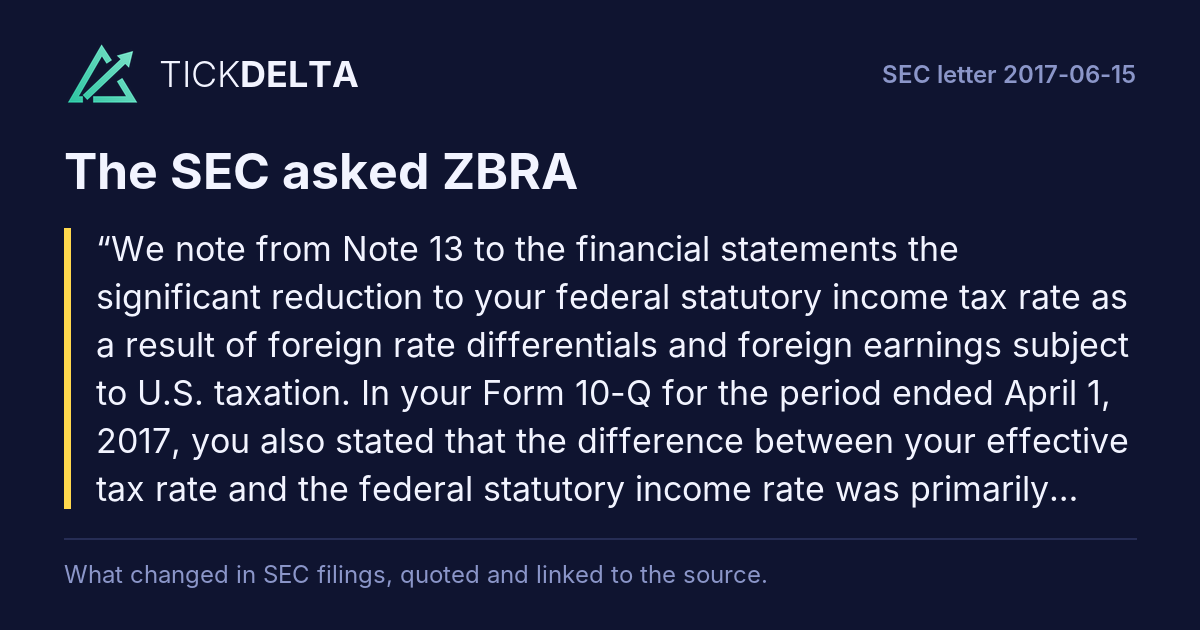
We note from Note 13 to the financial statements the significant reduction to your federal statutory income tax rate as a result of foreign rate differentials and foreign earnings subject to U.S. taxation. In your Form 10-Q for the period ended April 1, 2017, you also stated that the difference between your effective tax rate and the federal statutory income rate was primarily attributable to unbenefited foreignRest of the question
losses, benefits of foreign rates and rate changes in foreign jurisdictions, among other factors. In future filings, please revise the income tax discussion in this section to explain the impact of non-U.S. lower taxed jurisdictions on your effective tax rate, including a discussion of the primary taxing jurisdictions where your foreign earnings are derived, the location of tax holidays and the relevant statutory rates in those jurisdictions. Discuss any uncertainties relating to the income tax rates or benefits you currently receive in those jurisdictions. Refer to Item 303(a)(3) of Regulation S-K.
We will revise future filings with the Commission to explain the impact of non-U.S. lower taxed jurisdictions on the Company’s effective tax rate, including a discussion of the primary taxing jurisdictions where the Company’s foreign earnings are derived, the location of tax holidays (if any) and the relevant statutory rates in those jurisdictions. In addition, the
Company will discuss any uncertainties relating to the income tax rates or benefits that it currently receives in those jurisdictions. Read in the reply ↗
First report after the company's reply of 2017-06-23: 10-Q filed 2017-08-08 ↗, against the 10-Q filed 2017-05-09 ↗.
Tickdelta does not hold the text of both reports, so they are not compared here.
We note that you present several non-GAAP measures, such as Net sales excluding the impact of the Acquisition of the Enterprise business; Gross margin as a percent of sales excluding the effect of the Enterprise business; Operating expenses excluding the Enterprise business as percentage of sales; and Operating income excluding the effect of the Enterprise business, etc., in this section If you elect to presentRest of the question
these or similar non- GAAP measures in future filings, please revise your presentations to identify the measures as non-GAAP, and provide the reconciliations and other disclosures required by Item 10(e) of Regulation S-K.
We respectfully confirm to the extent we include non-GAAP measures excluding the impact of the Acquisition of the Enterprise business in future filings, we will include and present appropriate non-GAAP reconciliations. Read in the reply ↗
First report after the company's reply of 2017-06-23: 10-Q filed 2017-08-08 ↗, against the 10-Q filed 2017-05-09 ↗.
Tickdelta does not hold the text of both reports, so they are not compared here.
Similarly, we note that you discuss several measures on a constant currency basis, such as the 2016 percentage sales decline on a constant currency basis and excluding purchase accounting adjustments, the percentage increase in 2015 net sales on a constant currency basis, etc. The disclosures appear to be based on non-GAAP financial measures.Rest of the question
Please revise future filings to provide a reconciliation of sales excluding the effects of currency and describe the process for calculating the currency effects. Refer to question 104.06 of the Compliance and Disclosure Interpretations related to Non-GAAP measures updated May 17, 2016. We also note similar disclosures in your discussion of segment sales. This comment also applies to your Form 10-Q for the period ended April 1, 2017.
In future filings, the Company will include a reconciliation of each reported GAAP financial measure to each non-GAAP financial measure within Management’s Discussion and Analysis of Financial Condition and Results of Operations and will include explanations as to the reasoning behind including the supplemental disclosures. Read in the reply ↗
First report after the company's reply of 2017-06-23: 10-Q filed 2017-08-08 ↗, against the 10-Q filed 2017-05-09 ↗.
Tickdelta does not hold the text of both reports, so they are not compared here.
In light of the guidance in SAB Topic 5.BB and ASC 330-10-35-14 indicating that a reduction in the carrying amount of an inventory item from cost to market value at the end of a fiscal year is viewed as creating a new "cost basis" for the item, in future filings please revise to remove the information relating to the inventory allowance as compliance with that guidance would not result in a valuation account.Rest of the question
Further, please note that amounts recorded in separate accounts to recognize obsolete and slow-moving inventory are not considered reserves for the purpose of this schedule because those amounts in substance represent normal adjustments of inventory rather than true "reserves."
The Company will revise future filings to remove the information relating to the inventory allowance in its Schedule II: Valuation and
Qualifying Accounts.
We hope that the foregoing has been responsive to the Staff’s comments. Should you have any questions relating to any of the foregoing, please feel free to contact me directly at 847-793-2683. Read in the reply ↗
First report after the company's reply of 2017-06-23: 10-Q filed 2017-08-08 ↗, against the 10-Q filed 2017-05-09 ↗.
Tickdelta does not hold the text of both reports, so they are not compared here.
Also in this review: closing letter, 2017-07-10