Zeta Global Holdings Corp. ZETA
New risk paragraphs, branching off last year
Each branch is a paragraph in Risk Factors with nothing like it in the 10-K filed Feb 26, 2025. A box jumps to the paragraph as filed, below.
Paragraphs with nothing like them in last year's 10-K
5 paragraphs in Risk Factors of the 10-K filed Feb 25, 2026 with nothing like them in the 10-K filed Feb 26, 2025. Quoted exactly. Paragraphs that were only edited are under 10-K change.
In the European Union, we are also indirectly subject to the requirements of the Digital and Operational Resilience Act (“DORA”) in the EU, as contractually imposed on us, by customers that are financial institutions directly subject to DORA. Consequently, we have an increased compliance burden in this regard, which may require additional resources and incur costs, and non-compliance may result in breach of contract claims and possible loss of business from certain DORA regulated customers.
We may use and modify certain third party generative AI models that may be made available under an open source license. In certain cases, we may train our models for our generative AI Technologies on datasets that may be open source, and we may not be certain that some licensors of certain open source datasets had sufficient rights in the underlying data to be able to make them available under an open source license. Use of such open-source generative AI technologies or datasets could introduce inaccuracies or vulnerabilities that we may be unable to anticipate, detect, or control. If the licensor for such open-source generative AI technologies developed their models by training on data that was inaccurate, biased or for which it did not have the appropriate rights, we could be subject to claims or lawsuits, including for infringement of third-party intellectual property. Sophisticated attackers may exploit vulnerabilities in open-source generative AI technologies to obtain access to our sensitive data or alter the outputs or results. In addition, any usage of open-source generative AI technologies may, under some open source licenses, require us to license our data or intellectual property to third parties and limit our ability to protect our intellectual property rights or proprietary data.
In the United States and internationally, AI is the subject of evolving review by various governmental and regulatory agencies, including the SEC and the FTC and amongst the states, and changes in laws, rules, directives and regulations governing the use of AI may adversely affect the ability of our business to use or rely on AI. For example, Congress has yet to enact meaningful AI legislation. Instead, federal policy on AI has been shaped by a series of executive orders that have shifted priorities and requirements substantially depending on the administration in power. Further, in October 2023, President Biden issued an executive order on the Safe, Secure and Trustworthy Development and Use of AI, which emphasized AI safety and security and addressed topics such as civil rights, privacy, consumer protection, and accountable federal use of AI. In January and July 2025, President Trump issued three executive orders on AI, one of which repealed President Biden’s 2023 Executive Order, shifting the focus towards removing regulatory barriers to the adoption of AI Technologies and accelerating AI deployment. In the absence of federal AI legislation, states have filled the void by enacting laws regulating different aspects of AI Technologies. For example, California has enacted laws and regulations related to AI safety protocols, reporting and transparency, among other AI-related topics. In addition, Colorado’s Artificial Intelligence Act will require developers and deployers of “high-risk” AI systems to implement certain safeguards against algorithmic discrimination (among other requirements), and the Texas Responsible Artificial Intelligence Governance Act prohibits the development and deployment of AI systems for certain purposes while establishing a regulatory sandbox. Numerous other states have enacted, passed, or are considering AI-focused legislation, creating a patchwork of regulations and a complex compliance challenge. However, the durability of these laws and the potential of additional state-level legislative activity faces uncertainty following President Trump’s December 2025 Executive Order “Ensuring a National Policy Framework for Artificial Intelligence.” This Executive Order establishes a federal policy favoring a uniform national AI regulatory framework designed to promote innovation and U.S. global competitiveness. The order directs federal agencies to identify, challenge, and potentially pre-empt state and local AI laws that are viewed as inconsistent with or burdensome to this national approach. It remains to be seen how agencies will effectuate this directive, and how states will approach AI legislation moving forward.
Furthermore, over 140 member jurisdictions of the G20/Organization for Economic Co-operation and Development (“OECD”) have agreed to participate in an accord commonly referred to as “Pillar Two” to set a minimum global corporate tax rate of 15%. Although many member jurisdictions have advanced Pillar Two by enacting legislation and issuing additional guidance in connection with the implementation of Pillar Two, this initiative remains under negotiation and continues to evolve. For example, in response to concerns raised by the United States, the OECD recently released a “side-by-side” framework under which certain U.S.-parented multinational enterprises may be exempt from Pillar Two. However, the precise contours of this side-by-side arrangement, as well as the details about its implementation by specific jurisdictions, are uncertain, and it is unclear what impact, if any, adoption of Pillar Two guidelines (including the side-by-side framework) and their implementations may have on taxes applicable to us. We are continuing to evaluate Pillar Two and the side-by-side framework and to assess their potential impact on future periods.
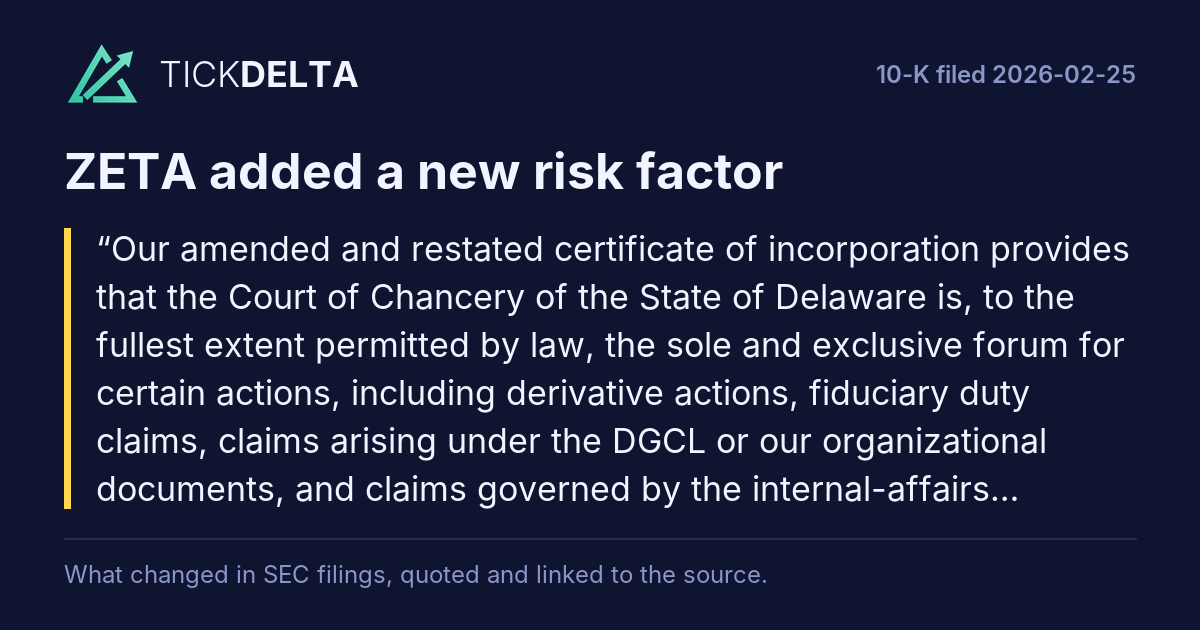
Our amended and restated certificate of incorporation provides that the Court of Chancery of the State of Delaware is, to the fullest extent permitted by law, the sole and exclusive forum for certain actions, including derivative actions, fiduciary duty claims, claims arising under the DGCL or our organizational documents, and claims governed by the internal-affairs doctrine. In addition, our amended and restated certificate of incorporation provides that, unless we consent in writing to the selection of an alternative forum, the federal district courts of the United States will be the exclusive forum for resolving any complaint asserting a cause of action arising under the Securities Act. These exclusive forum provisions do not apply to claims arising under the Exchange Act, which must be brought in federal court.
Paragraphs in the 10-Q filed Nov 9, 2026 that were not in the one before
New in the latest 10-Q
4 paragraphs in the 10-Q filed Nov 9, 2026 with nothing like them in the 10-Q filed Aug 5, 2026 (at least half the words must differ; new numbers alone do not count). Quoted exactly, grouped by the item heading above them. This is text that changed, not a judgement of how serious it is.
Financial statements and notes
4. Excludes $ 1,558 of stock-based compensation related to shares issued in connection with a long-term strategic partnership agreement.
Read in the 10-Q
The fair value of the loan advances, included in “Other non-current assets” on the condensed unaudited consolidated balance sheets, approximates its carrying value as of September 30, 2026, as the interest rate related to the financial instruments approximated market rate.
Read in the 10-Q
On October 7, 2026, the Company acquired all outstanding equity interests in Senso Agentic Inc. (“Senso”) for consideration of approximately $27,500, consisting of $7,500 in cash, $10,000 paid in the form of 287,711 shares of the Company's Class A Common Stock, and a potential earnout payment of up to $10,000 to be settled in shares of the Company's Class A Common Stock based on the achievement of certain performance targets. The consideration is subject to customary adjustments and holdback arrangements.
Read in the 10-Q
On October 22, 2026, the Company acquired all outstanding equity interests in Social Audience B.V. (“Digital Audience”) for consideration of approximately $35,000, consisting of $5,564 in cash, $13,436 paid in the form of 406,871 shares of the Company’s Class A Common Stock, and a potential earnout payments of up to $16,000 to be settled in shares of the Company's Class A Common Stock based on the achievement of certain performance targets. The consideration is subject to customary adjustments and holdback arrangements.
Read in the 10-Q
The 10-Q's risk factors against the 10-K
Item 1A of the 10-Q filed Nov 9, 2026 against Item 1A of the 10-K filed Feb 25, 2026.
A 10-Q repeats only the risks that changed, so a 10-K paragraph that is missing from it is not counted as removed.
Added is a paragraph with nothing like it in the 10-K, Reworded a sentence that is in both with several words changed,
Quiet changes a sentence in both where one to four words changed and one is a hedge or a modal
(cut words struck through, new words highlighted).
Text on the page, not a score; each links to the filing at sec.gov.
What the 10-Q itself says about its risk factors:There have been no material changes to the risk factors previously disclosed in Part I, Item 1A “Risk Factors” in our 2025 Annual Report.
Read in the 10-Q
1 paragraph in the 10-Q's Item 1A, and none of them adds, rewords or quietly edits a paragraph of the 10-K's.
Phrases used for the first time
Two-word phrases in Risk Factors of the 10-K filed Feb 25, 2026 that are in none of the 1 earlier 10-Ks stored, back to Feb 26, 2025
Where each one is used
- marigold’s enterprise: • Acquisitions or strategic investments could be difficult to identify and integrate (including the integration of our recent acquisition of Marigold’s Enterprise Business), divert the attention of management and disrupt our business, dilute stockholder value and adversely affect our business, operating results and...
- midterm election: • We may experience fluctuations in our operating results, including during presidential and, to a lesser extent, midterm election years where we generally generate higher revenues, which could make our future operating results difficult to compare and predict.
- new super-scaled: Our success is dependent on regularly adding new customers, in particular new super-scaled customers, and increasing our existing customers’ usage of our platform in order to convert our customers into super-scaled customers. Many of our contracts and relationships with customers do not include automatic renewal or...
- open-source generative: We may use and modify certain third party generative AI models that may be made available under an open source license. In certain cases, we may train our models for our generative AI Technologies on datasets that may be open source, and we may not be certain that some licensors of certain open source datasets had...
- lesser extent: • We may experience fluctuations in our operating results, including during presidential and, to a lesser extent, midterm election years where we generally generate higher revenues, which could make our future operating results difficult to compare and predict.
- extent midterm: • We may experience fluctuations in our operating results, including during presidential and, to a lesser extent, midterm election years where we generally generate higher revenues, which could make our future operating results difficult to compare and predict.
- side-by-side framework: Furthermore, over 140 member jurisdictions of the G20/Organization for Economic Co-operation and Development (“OECD”) have agreed to participate in an accord commonly referred to as “Pillar Two” to set a minimum global corporate tax rate of 15%. Although many member jurisdictions have advanced Pillar Two by...
- add grow: • Our success and revenue growth depends on our ability to add, grow and retain super-scaled customers.
Used at least twice, small words left out. Counted, not picked: a phrase can be new because the company renamed something.
What was taken out
10 paragraphs of last year's Risk Factors with nothing like them now. The longest are quoted.
Sources
Item 1A of each 10-K and 10-Q on EDGAR, quoted exactly. Each paragraph links to the filing at sec.gov.
Also
10-K change: what was reworded or cut, section by section.
Work with it
Excel workbook · CSV. Google Sheet that stays up to date: paste =IMPORTDATA("https://tickdelta.com/company/ZETA/export.csv") into a cell.