Screener / SEC EDGAR /CIK 0001851003 /10-K filed Feb 25, 2026, compared with Feb 26, 2025 /Numbers from the XBRL of the 10-Ks
NYSE Technology · Software

Zeta Global Holdings Corp. ZETA

Compare with peers Embed
The 10-K against last year's

130 changes: 9 added, 12 removed, 106 reworded, 3 quiet changes

10-K Feb 25, 2026 vs Feb 26, 2025

10-K 0001193125-26-068598 (Feb 25, 2026) vs 10-K 0000950170-25-027338 (Feb 26, 2025)

Every paragraph, and how much of it changed

One bar per paragraph, in the order of the 10-K. Height and colour show the share of its words not in the closest paragraph a year earlier; the tallest bars are new paragraphs.

Risk Factors

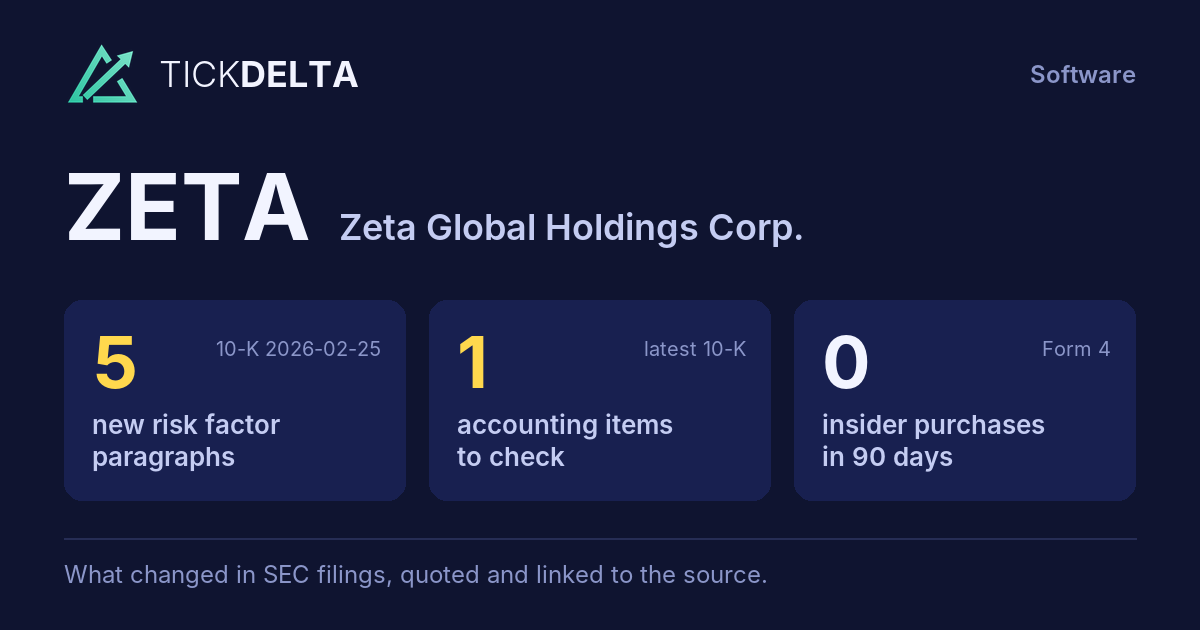
221 paragraphs · 5 new · 67 reworded · 10 gone · 10-K Feb 25, 2026 against Feb 26, 2025
New paragraph Reworded (5% of its words or more) Same or nearly
Paragraph 119 · 42% changed Every version of it
Our data-driven platform may also be subject to laws and evolving regulations regarding the provision of digital services as well as the use of artificial intelligence AI and machine learning, learning in such digital services, controlling for data bias, and antidiscrimination. For example, in addition to enforcing Section 5 of the FTC Act, the FTC enforces the Fair Credit Reporting Act, and the Equal Credit Opportunity Act. These laws prohibit unfair and deceptive practices, including use of biased algorithms in artificial intelligence. AI. In Europe, the EU Artificial Intelligence Act (the “EU AI Act”) establishes a comprehensive, risk-based governance framework for AI in the EU market, and the EU Digital Services Act (“DSA”) and the UK Digital Markets, Competition and Consumer Act 2024 (“DMCCA”) include, among other obligations, requirements related to digital services including content hosting requirements. The European Commission also recently published EU Network and Information Security 2 Directive (“NIS 2”) and its proposal EU Member State implementations impose requirements on cloud computing services (including SaaS) providers, and the EU Data Act establishes requirements for a regulation implementing harmonized rules on artificial intelligence and amending certain union legislative acts. The proposed regulation would impose additional restrictions and obligations on providers of artificial intelligence systems, data processing services (including cloud and SaaS) into the EU, including increasing transparency so consumers know they are interacting with an artificial intelligence system, requiring human oversight in artificial intelligence, requirements to facilitate customers switching to other providers/on-premise solutions and prohibiting porting their data within certain timeframes (and affecting potential charges as well as mandatory contract terms), which may also impact revenue recognition practices. These laws and regulations may increase compliance costs, require changes to our processes, operations, and business practices which may adversely affect our ability to attract, retain and provide our services to customers, and may otherwise adversely affect our business, operations and financial condition including by exposing us to liability to monetary penalties and some private rights of artificial intelligence that could lead to physical action. In addition, if federal, state or psychological harm. If federal or state international regulators were to determine that the type of data we collect, the process we use for collecting this data or how we use it unfairly discriminates against some groups of people, laws and regulations could be interpreted or implemented to prohibit or restrict our collection or use of this data. Additionally, existing and future laws, and evolving attitudes about privacy protection and technology regulation may impair our ability to collect, use, and maintain data points of sufficient type or quantity to develop and train our artificial intelligence AI algorithms.
Paragraph 175 · 40% changed Every version of it
Additionally, our future effective tax rates could be adversely affected by changes in tax laws (including tax treaties) or their interpretation. For example, the Inflation Reduction Act, passed on August 16, 2022, included a 15% corporate minimum tax applicable to tax years beginning after December 31, 2022 and a 1% excise tax on certain stock repurchases by U.S. corporations. We do not believe the corporate minimum tax will materially impact our effective tax rate or tax liability. The 1% excise tax is imposed on the repurchasing corporation itself, not its stockholders from which shares are repurchased. The amount of the excise tax is generally 1% of the fair market value of the shares repurchased at the time of the repurchase, subject to certain exceptions and netting rules. Also, Further, on October 8, 2021, July 4, 2025, H.R. 1, the Organization for Economic Co-operation and Development ("OECD") released a statement on the OECD/G20 Inclusive Framework on Base Erosion and Profit Shifting, which agreed to a two-pillar solution to address tax challenges of the digital economy. On December 20, 2021, the OECD released Pillar Two model rules defining a 15% global minimum tax rate for large multinational corporations, which is being or may be implemented in many jurisdictions. The OECD is also issuing additional guidelines, and it is unclear what impact, if any, adoption of these guidelines and their implementations may have on taxes applicable to us. Based on our current understanding of the minimum revenue thresholds contained “One Big Beautiful Bill Act” (the “OBBBA”), was signed into law in the proposed Pillar Two guidance, we are outside United States, which includes revisions to key business tax provisions such as the scope expansion of rules related to deductibility of executive compensation, the reinstatement of bonus depreciation deductions for qualified property, the restoration of EBITDA-based business interest expense limitation and the implementation of changes relating to the reporting requirements. computation of certain taxes in respect of non-US activities. We are continuing to evaluate currently assessing the Pillar Two framework and its potential impact of the OBBBA on future periods. us.
Paragraph 221 · 38% changed Every version of it
This exclusive forum provision These provisions may limit a stockholder’s ability to bring a claim in a judicial forum that it finds favorable for disputes with us or our directors, officers or other employees, favorable, which may discourage lawsuits against us and our directors, officers officers, and other employees. Although our amended and restated certificate of incorporation contains the exclusive forum provision described above, it It is possible that a court could find that such a provision is inapplicable for a particular claim or action or that such provision is unenforceable. If a court were to find the exclusive forum provision in our amended and restated certificate of incorporation to be these provisions inapplicable or unenforceable unenforceable, in an action, which case we may incur additional costs associated with resolving the dispute disputes in other jurisdictions, which could seriously harm jurisdictions. Our stockholders will not be deemed to have waived our business. compliance with the federal securities laws and the regulations promulgated thereunder.
Paragraph 18 · 36% changed Every version of it
• The impact incurrence of our business and financial condition of incurring additional debt or issuing the issuance of new debt or equity securities.
Paragraph 115 · 33% changed Every version of it
Among other requirements, the GDPR also regulates transfers of personal data subject to out of the GDPR EEA and/or the UK to third countries that have not been found to provide adequate protection to such personal data, including the U.S.; in July 2020, the Court U.S. In relation to such cross border transfers of Justice of the EU (“CJEU”) limited how organizations could lawfully transfer personal data from the EU/European Economic Area (“EEA”) to the U.S. by invalidating the Privacy Shield for purposes of international transfers and imposing further restrictions on the use of standard contractual clauses (“SCCs”) by stating reliance on SCCs alone may not be sufficient in all circumstances and that transfers must be assessed on a case-by-case basis. European court and regulatory decisions subsequent to the CJEU decision have taken a restrictive approach to international data transfers. Further the European Commission published revised standard contractual clauses for data transfers from the EEA (mandatory for new transfers since September 27, 2021, and for existing transfers since December 27, 2022) and the UK Information Commissioner’s Office published its own new data transfer standard contracts for data transfers from the UK (mandatory for new transfers since September 21, 2022 and for existing transfers since March 21, 2024). We data, we expect the existing legal complexity and uncertainty regarding international data transfers to continue and in particular, we expect international transfers to the U.S. and other jurisdictions more generally to continue to be subject to enhanced scrutiny by regulators. As supervisory authorities issue further the regulatory guidance on personal and enforcement landscape in relation to data export mechanisms, and/or start taking enforcement action, transfers continue to develop, we could suffer additional costs, complaints and/or regulatory investigations or fines, and/or if we are otherwise unable to transfer personal data between and among countries and regions in which we operate, it could affect the manner in which we provide our services, the geographical location or segregation of our relevant systems and operations, and could adversely affect our financial results.
Paragraph 76 · 31% changed Every version of it
• complications in the integration of LiveIntent our recent acquisition of Marigold’s Enterprise Business or any other acquired businesses we may acquire, or diminished prospects;
Paragraph 116 · 31% changed Every version of it
We are also subject to evolving EU and UK privacy laws on cookies, tracking technologies and e-marketing. The GDPR also imposes GDPR, ePrivacy Directive (and its local implementations) and PECR impose conditions on obtaining valid consent for cookies, such as a prohibition on pre-checked consents and a requirement to ensure separate consents are sought for each type of cookie or similar technology. Recent European court and regulator decisions are driving increased attention to cookies and tracking technologies. technologies as well as to standards for consent. If the trend of increasing enforcement by regulators of the strict approach to opt-in consent for all but essential use cases, as seen in recent guidance and decisions continues, this could lead to additional costs, require systems changes, limit the effectiveness of our marketing and personalization offerings, divert the attention of our technology personnel, adversely affect our margins, and subject us to additional liabilities. In light of the complex and evolving nature of EU, EU Member State and UK privacy laws on cookies and tracking technologies, there can be no assurances that we will be successful in our efforts to comply with such laws and violations of such laws could result in regulatory investigations, fines, orders to cease / change our use of such technologies, as well as civil claims including class actions, and reputational damage. In July 2021, we received a notice from Norwegian authorities of an intent to impose a fine for our alleged failure to adhere to the GDPR with respect to the collection of personal data via cookies in their country. We challenged the Norwegian Data Protection Authority’s (“DPA”) decision, and in October 2024, the DPA issued a final order in the case citing a breach of the GDPR, but reducing the fine to zero.
Paragraph 110 · 30% changed Every version of it
In the U.S., numerous state laws impose standards relating to the privacy, security, transmission and breach reporting of personal information. Such laws and regulations are subject to interpretation by various courts and other governmental authorities, thus creating potentially complex compliance issues for us, our customers and our strategic partners. For example, the CCPA creates individual privacy rights for requires in-scope businesses to, among other things: provide certain disclosures to California consumers residents regarding the business’s collection, use, and imposes privacy disclosure of their personal information; receive and security obligations respond to requests from California residents to access, delete, and correct their personal information, or to opt-out of certain disclosures of their personal information; and enter into specific contractual provisions with service providers that process California resident personal information on entities handling personal information. the business’s behalf. The CCPA also provides for civil penalties for violations, as well as a private right of action for certain data breaches suffered as a result of the business’s violation of the duty to implement and maintain reasonable security procedures and practices, and this may lead to breach litigation. Further, as amended by the California Privacy Rights Act, the CCPA imposes additional Similar state comprehensive data protection obligations on covered businesses, including additional consumer rights processes, limitations on data uses, audit requirements for higher risk data, and opt outs for certain uses of sensitive data. It also created a new California data protection agency authorized to issue substantive regulations, which could result in increased privacy and information security enforcement. Similar laws are now in effect and enforceable in other states. states and have been proposed in additional states, which creates a patchwork of overlapping but different state laws. Additionally, state regulators may exercise greater scrutiny regarding the collection and processing of personal information for purposes of online advertising, marketing, and analytics. These laws and their requirements could have a material adverse effect on our financial performance, and any liability from failure to comply with the requirements of these laws could adversely affect our financial condition. Beginning in 2026, the California Delete Act will require certain entities to delete data relating to California consumers at their request through a state-owned portal. The impacts of this law will not be fully known until late 2026, but it could potentially decrease our ability to reach California consumers.

MD&A

104 paragraphs · 4 new · 55 reworded · 2 gone · 10-K Feb 25, 2026 against Feb 26, 2025
New paragraph Reworded (5% of its words or more) Same or nearly
Paragraph 56 · 45% changed
Interest expense, net Income tax benefit decreased by $3.8 million, or 34.7%, $3.6 million for the year ended December 31, 2024 2025, as compared to the year ended December 31, 2023, primarily due to higher interest income earned on our money market accounts and short-term deposits. 2024.
Paragraph 19 · 44% changed
Year ended December 31, 2025 2024 2023 Scaled customer ARPU (in thousands) $ 1,868 $1,572 Customers 602 527 Super-Scaled Customers 184 148
Paragraph 78 · 44% changed
In August 2022, On November 13, 2024, the Company's Company’s Board of Directors authorized a share stock repurchase and withholding program (the “2022 “2024 SRP”) authorizing the repurchase of up to $50.0 $100.0 million in the aggregate of our the Company’s outstanding shares of Class A Common Stock through December 31, 2026. On July 23, 2025, the Company’s Board of Directors authorized a new stock repurchase and withholding program (the “2025 SRP”) of up to $200.0 million in the aggregate for repurchase of the Company’s outstanding Class A Common Stock through December 31, 2027. The 2025 SRP supplements the 2024 SRP. In addition to repurchases, both the 2024 and 2025 SRP also allow for the withholding of shares as an alternative to market sales by certain executives and other employees to satisfy tax withholding requirements upon vesting of restricted stock awards (the “RSA Withholding Program”).
Paragraph 73 · 30% changed
During the year ended December 31, 2023, 2025, we used $25.7 $120.8 million of cash in for financing activities, primarily due to the repurchase of $13.4 $121.0 million of shares of our common stock repurchased under our share repurchase the 2024 SRP and 2025 SRP (each as defined below), including the RSA withholdings program Withholding Program (as defined below), and the payment of acquisition-related liabilities of $15.5 $6.3 million, partially offset by $3.1 million paid by certain employees under the ESPP. receipts from our 2021 Employee Stock Purchase Plan (the “2021 ESPP”) and exercise of options of $6.5 million.
Paragraph 17 · 29% changed
We review key performance metrics, discussed below, to evaluate our business, track performance, identify trends, formulate plans and make strategic decisions. We believe that the presentation of such metrics provides investors with effective ways to measure and model the performance of companies such as ours, with recurring revenue streams. Going forward, we intend to focus on reporting metrics with respect to our super-scaled customers as these customers represent a substantial majority of our revenue, and these metrics are most relevant to evaluating our business and performance. We no longer intend to include metrics with respect to our scaled customers in our quarterly reports on Form 10-Q, as these metrics are expected to be less relevant.
Paragraph 51 · 28% changed
Acquisition-related expenses were $8.2 million during the year ended December 31, 2024 as compared to $0.2 million increased by $12.1 million, or 146.5%, for the year ended December 31, 2023. These expenses were 2025, as compared to the year ended December 31, 2024. This increase was primarily driven by expenses incurred in connection with our LiveIntent acquisition, acquisition of Marigold’s Enterprise Business, which was closed on October 21, 2024. November 24, 2025.
Paragraph 36 · 26% changed
The measurement of stock-based compensation for all stock-based payment awards, including restricted stock, restricted stock units (“RSU”), (“RSUs”), performance-based stock units (“PSUs”) and stock options granted to employees, consultants or advisors and non-employee directors, and shares purchased under the Company’s employee stock purchase plan (“ESPP”), plan, is based on the estimated fair value of the awards on the date of grant or date of modification of such grants. See “Note 13. Stock-Based Compensation” to our consolidated financial statements for further details.
Paragraph 55 · 19% changed
During Other expenses increased by $38.2 million, for the year ended December 31, 2024, we had 2025, as compared to other income of $0.1 million compared with other expenses of $7.8 million during for the year ended December 31, 2023. 2024. This decrease increase in other expenses was primarily driven by a decrease an increase in the fair value change of acquisition-related liabilities recorded during for the year ended December 31, 2024 2025, as compared to the year ended December 31, 2023. 2024.

A paragraph is matched with the one last year that shares the most of its words; under half in common makes it new. The paragraphs shown are the 8 reworded the most in each section.

The paragraph that changed most in each section

The redline

Marked against last year's 10-K: cut words struck through, new words highlighted.

Risk Factors388 words changed in this paragraph; it is 34% similar to last year's version.
In the United States and internationally, AI is the subject of evolving review by various governmental and regulatory agencies, including the SEC and the FTC and amongst the states, and changes in laws, rules, directives and regulations governing the use of AI may adversely affect the ability of our business to use or rely on AI. For example, California Congress has yet to enact meaningful AI legislation. Instead, federal policy on AI has been shaped by a series of executive orders that have shifted priorities and other states have implemented, or are in the process of implementing, laws, rules, and regulations that impose obligations requirements substantially depending on the use of automated decision making. administration in power. Further, in October 2023, the President of the United States Biden issued an executive order on the Safe, Secure and Trustworthy Development and Use of AI, emphasizing which emphasized AI safety and security and addressed topics such as civil rights, privacy, consumer protection, and accountable federal use of AI. In January and July 2025, President Trump issued three executive orders on AI, one of which repealed President Biden’s 2023 Executive Order, shifting the need for focus towards removing regulatory barriers to the adoption of AI Technologies and accelerating AI deployment. In the absence of federal AI legislation, states have filled the void by enacting laws regulating different aspects of AI Technologies. For example, California has enacted laws and regulations related to AI safety protocols, reporting and transparency, accountability among other AI-related topics. In addition, Colorado’s Artificial Intelligence Act will require developers and fairness in deployers of “high-risk” AI systems to implement certain safeguards against algorithmic discrimination (among other requirements), and the Texas Responsible Artificial Intelligence Governance Act prohibits the development and use deployment of AI Tools. systems for certain purposes while establishing a regulatory sandbox. Numerous other states have enacted, passed, or are considering AI-focused legislation, creating a patchwork of regulations and a complex compliance challenge. However, the durability of these laws and the potential of additional state-level legislative activity faces uncertainty following President Trump’s December 2025 Executive Order “Ensuring a National Policy Framework for Artificial Intelligence.” This Executive Order establishes a federal policy favoring a uniform national AI regulatory framework designed to promote innovation and U.S. global competitiveness. The 2023 AI Order also instructed several other order directs federal agencies to promulgate additional regulations within specific timeframes from the date of the 2023 identify, challenge, and potentially pre-empt state and local AI Order regarding the use laws that are viewed as inconsistent with or burdensome to this national approach. It remains to be seen how agencies will effectuate this directive, and development of AI. Already agencies such as the Department of Commerce and the Federal Trade Commission have issued proposed rules governing the use and development of AI. Legislation related to how states will approach AI has also been introduced at the federal level and is advancing at the state level. legislation moving forward.

Source: Item 1A, 10-K 0001193125-26-068598 vs Item 1A, 10-K 0000950170-25-027338

Accounting Policies196 words changed in this paragraph; it is 31% similar to last year's version.
In November 2023, July 2025, the FASB issued ASU No. 2023-07, “Segment Reporting 2025-05, Financial Instruments - Credit Losses (Topic 280): Improvements 326): Measurement of Credit Losses for Accounts Receivable and Contract Assets (“ASU 2025-05”), introducing a practical expedient whereby when developing reasonable and supportable forecasts as part of estimating expected credit losses, entities may elect to Reportable Segment Disclosures” (“ASU 2023-07”). ASU 2023-07 requires disclosure of significant segment expenses regularly presented to the CODM and incorporated into each reported segment profit or loss measure. Entities are required to provide both the amount and a detailed description assume that current conditions as of the composition balance sheet date do not change for the remaining life of other segment items to reconcile them with the segment profit or loss. Furthermore, organizations must disclose the title and position of their CODM. asset. The amendment in ASU 2023-07 2025-05 is effective for fiscal years beginning after December 15, 2023, 2025, and interim periods within those fiscal years beginning after December 15, 2024. Early years, with early adoption permitted. The Company is permitted, and currently evaluating the amendments in this update are required to be applied on a retrospective basis. The guidance was adopted by the Company for the year ended December 31, 2024, and the Company, accordingly, made the required changes in its segment related disclosure. The adoption impact of ASU 2023-07 did not have any material impact 2025-05 guidance on the Company's audited its consolidated financial statements. statements and related disclosures.

Source: Item 8, Note 2 – Basis of Presentation and Significant Accounting Policies, 10-K 0001193125-26-068598 vs Item 8, Note 2 – Basis of Presentation and Significant Accounting Policies, 10-K 0000950170-25-027338

Legal Proceedings142 words changed in this paragraph; it is 67% similar to last year's version.
On November 22, 2024, a purported stockholder of the Company filed a putative class action lawsuit in the U.S. District Court for the Southern District of New York against the Company and the Company’s Chief Executive Officer, David A. Steinberg, and the Company’s Chief Financial Officer, Christopher Greiner, entitled Davoodi v. which is captioned In re Zeta Global Holdings Corp. Lead Plaintiff motions are due Corporation Securities Litigation. On February 26, 2025, the Court appointed putative stockholders Amir Konigsberg and the Allegheny County Employees’ Retirement System as co-lead plaintiffs. The co-lead plaintiffs filed an Amended Class Action Complaint on January 21, 2025. May 12, 2025, which also named other officers of the Company. The Amended Complaint alleges, based in part on the report from Culper Research, that the defendants made false and misleading statements and omissions about the Company’s business, operations, and prospects between February 27, 2024 and November 13, 2024. March 10, 2025. We are vigorously defending ourselves against this lawsuit, and we believe the claims made in the report are without merit. The lawsuit seeks, among other things, damages in connection with the Company’s allegedly artificially inflated stock price between February 27, 2024 and November 13, 2024 March 10, 2025 as a result of those allegedly false and misleading statements and omissions, as well as interest, attorneys’ fees, and costs. The Company and the individual defendants moved to dismiss the Amended Complaint on July 11, 2025; briefing on that motion was completed on September 9, 2025. Discovery is stayed while the parties are awaiting a decision on the motion to dismiss. This matter is still in the early stages of the legal process, and as a result, the Company is not able to estimate a range of possible loss.

Source: Item 3, 10-K 0001193125-26-068598 vs Item 3, 10-K 0000950170-25-027338

MD&A112 words changed in this paragraph; it is 35% similar to last year's version.
In August 2022, On November 13, 2024, the Company's Company’s Board of Directors authorized a share stock repurchase and withholding program (the “2022 “2024 SRP”) authorizing the repurchase of up to $50.0 $100.0 million in the aggregate of our the Company’s outstanding shares of Class A Common Stock through December 31, 2026. On July 23, 2025, the Company’s Board of Directors authorized a new stock repurchase and withholding program (the “2025 SRP”) of up to $200.0 million in the aggregate for repurchase of the Company’s outstanding Class A Common Stock through December 31, 2027. The 2025 SRP supplements the 2024 SRP. In addition to repurchases, both the 2024 and 2025 SRP also allow for the withholding of shares as an alternative to market sales by certain executives and other employees to satisfy tax withholding requirements upon vesting of restricted stock awards (the “RSA Withholding Program”).

Source: Item 7, 10-K 0001193125-26-068598 vs Item 7, 10-K 0000950170-25-027338

Sentences and paragraphs added, removed or reworded

Every change, by type

Sentences and paragraphs of ZETA's Risk Factors and MD&A, 10-K Feb 25, 2026 against 10-K Feb 26, 2025. Each links to the text at sec.gov.

Quiet changes are sentences kept from last year with one to four words changed, at least one of them a hedge, a modal or a qualifier (may, could, will, not, significant, material…). A year or date rolling forward is not counted.

The full word list

adverse, adversely, all, although, anticipate, anticipates, any, approximately, believe, believes, can, cannot, certain, could, expect, expects, generally, however, if, intend, intends, largely, likely, many, material, materially, may, might, most, must, never, no, not, possible, primarily, probable, should, significant, significantly, some, substantial, substantially, unlikely, will, would

AddedRisk Factors
In the European Union, we are also indirectly subject to the requirements of the Digital and Operational Resilience Act (“DORA”) in the EU, as contractually imposed on us, by customers that are financial institutions directly subject to DORA. Consequently, we have an increased compliance burden in this regard, which may require additional resources and incur costs, and non-compliance may result in breach of contract claims and possible loss of business from certain DORA regulated customers.
Read it in 10-K Feb 25, 2026 at sec.gov
AddedRisk Factors
We may use and modify certain third party generative AI models that may be made available under an open source license. In certain cases, we may train our models for our generative AI Technologies on datasets that may be open source, and we may not be certain that some licensors of certain open source datasets had sufficient rights in the underlying data to be able to make them available under an open source license. Use of such open-source generative AI technologies or datasets could introduce inaccuracies or vulnerabilities that we may be unable to anticipate, detect, or control. If the licensor for such open-source generative AI technologies developed their models by training on data that was inaccurate, biased or for which it did not have the appropriate rights, we could be subject to claims or lawsuits, including for infringement of third-party intellectual property. Sophisticated attackers may exploit vulnerabilities in open-source generative AI technologies to obtain access to our sensitive data or alter the outputs or results. In addition, any usage of open-source generative AI technologies may, under some open source licenses, require us to license our data or intellectual property to third parties and limit our ability to protect our intellectual property rights or proprietary data.
Read it in 10-K Feb 25, 2026 at sec.gov
AddedRisk Factors
In the United States and internationally, AI is the subject of evolving review by various governmental and regulatory agencies, including the SEC and the FTC and amongst the states, and changes in laws, rules, directives and regulations governing the use of AI may adversely affect the ability of our business to use or rely on AI. For example, Congress has yet to enact meaningful AI legislation. Instead, federal policy on AI has been shaped by a series of executive orders that have shifted priorities and requirements substantially depending on the administration in power. Further, in October 2023, President Biden issued an executive order on the Safe, Secure and Trustworthy Development and Use of AI, which emphasized AI safety and security and addressed topics such as civil rights, privacy, consumer protection, and accountable federal use of AI. In January and July 2025, President Trump issued three executive orders on AI, one of which repealed President Biden’s 2023 Executive Order, shifting the focus towards removing regulatory barriers to the adoption of AI Technologies and accelerating AI deployment. In the absence of federal AI legislation, states have filled the void by enacting laws regulating different aspects of AI Technologies. For example, California has enacted laws and regulations related to AI safety protocols, reporting and transparency, among other AI-related topics. In addition, Colorado’s Artificial Intelligence Act will require developers and deployers of “high-risk” AI systems to implement certain safeguards against algorithmic discrimination (among other requirements), and the Texas Responsible Artificial Intelligence Governance Act prohibits the development and deployment of AI systems for certain purposes while establishing a regulatory sandbox. Numerous other states have enacted, passed, or are considering AI-focused legislation, creating a patchwork of regulations and a complex compliance challenge. However, the durability of these laws and the potential of additional state-level legislative activity faces uncertainty following President Trump’s December 2025 Executive Order “Ensuring a National Policy Framework for Artificial Intelligence.” This Executive Order establishes a federal policy favoring a uniform national AI regulatory framework designed to promote innovation and U.S. global competitiveness. The order directs federal agencies to identify, challenge, and potentially pre-empt state and local AI laws that are viewed as inconsistent with or burdensome to this national approach. It remains to be seen how agencies will effectuate this directive, and how states will approach AI legislation moving forward.
Read it in 10-K Feb 25, 2026 at sec.gov
AddedRisk Factors
Furthermore, over 140 member jurisdictions of the G20/Organization for Economic Co-operation and Development (“OECD”) have agreed to participate in an accord commonly referred to as “Pillar Two” to set a minimum global corporate tax rate of 15%. Although many member jurisdictions have advanced Pillar Two by enacting legislation and issuing additional guidance in connection with the implementation of Pillar Two, this initiative remains under negotiation and continues to evolve. For example, in response to concerns raised by the United States, the OECD recently released a “side-by-side” framework under which certain U.S.-parented multinational enterprises may be exempt from Pillar Two. However, the precise contours of this side-by-side arrangement, as well as the details about its implementation by specific jurisdictions, are uncertain, and it is unclear what impact, if any, adoption of Pillar Two guidelines (including the side-by-side framework) and their implementations may have on taxes applicable to us. We are continuing to evaluate Pillar Two and the side-by-side framework and to assess their potential impact on future periods.
Read it in 10-K Feb 25, 2026 at sec.gov
AddedRisk Factors
Our amended and restated certificate of incorporation provides that the Court of Chancery of the State of Delaware is, to the fullest extent permitted by law, the sole and exclusive forum for certain actions, including derivative actions, fiduciary duty claims, claims arising under the DGCL or our organizational documents, and claims governed by the internal-affairs doctrine. In addition, our amended and restated certificate of incorporation provides that, unless we consent in writing to the selection of an alternative forum, the federal district courts of the United States will be the exclusive forum for resolving any complaint asserting a cause of action arising under the Securities Act. These exclusive forum provisions do not apply to claims arising under the Exchange Act, which must be brought in federal court.
Read it in 10-K Feb 25, 2026 at sec.gov
RemovedRisk Factors
We may face claims relating to the information or content that is made available through our platform. Though we contractually require our customers to represent that they will follow our policies with respect to all information or content they upload to our systems, we may be exposed to potential liability if our customers do not abide by such policies. In particular, the nature of our business may expose us to claims related to defamation, dissemination of misinformation or news hoaxes, discrimination,
Read it in 10-K Feb 26, 2025 at sec.gov
RemovedRisk Factors
obtain data from them on acceptable terms or at all. Furthermore, we cannot provide assurance that we will be able to obtain data from alternative sources if our current sources become unavailable.
Read it in 10-K Feb 26, 2025 at sec.gov
RemovedRisk Factors
For transfers from the EEA to the UK the European Commission has adopted an adequacy decision in favor of the United Kingdom, enabling data transfers from EU member states to the United Kingdom without additional safeguards. However, the UK adequacy decision will automatically expire in June 2025 unless the European Commission re-assesses and renews or extends that decision.
Read it in 10-K Feb 26, 2025 at sec.gov
Show the other 40
RemovedRisk Factors
In the United States and internationally, AI is the subject of evolving review by various governmental and regulatory agencies, including the SEC and the FTC and amongst the states, and changes in laws, rules, directives and regulations governing the use of AI may adversely affect the ability of our business to use or rely on AI. For example, California and other states have implemented, or are in the process of implementing, laws, rules, and regulations that impose obligations on the use of automated decision making. Further, in October 2023, the President of the United States issued an executive order on the Safe, Secure and Trustworthy Development and Use of AI, emphasizing the need for transparency, accountability and fairness in the development and use of AI Tools. The 2023 AI Order also instructed several other federal agencies to promulgate additional regulations within specific timeframes from the date of the 2023 AI Order regarding the use and development of AI. Already agencies such as the Department of Commerce and the Federal Trade Commission have issued proposed rules governing the use and development of AI. Legislation related to AI has also been introduced at the federal level and is advancing at the state level.
Read it in 10-K Feb 26, 2025 at sec.gov
RemovedRisk Factors
our operations and processes, result in increased compliance costs and potential increases in civil claims against us, and could adversely affect our business, operations and financial condition.
Read it in 10-K Feb 26, 2025 at sec.gov
RemovedRisk Factors
Our amended and restated certificate of incorporation provides that the Court of Chancery of the State of Delaware is, to the fullest extent permitted by law, the sole and exclusive forum for:
Read it in 10-K Feb 26, 2025 at sec.gov
RemovedRisk Factors
• any action asserting a claim against us arising under the DGCL, our amended and restated certificate of incorporation, or our amended and restated bylaws (as either may be amended from time to time) or as to which the DGCL confers jurisdiction on the Court of Chancery of the State of Delaware; and
Read it in 10-K Feb 26, 2025 at sec.gov
RemovedRisk Factors
Under our amended and restated certificate of incorporation, the exclusive forum provision described above does not apply to claims arising under the Exchange Act. Accordingly, actions by our stockholders to enforce any duty or liability created by the Exchange Act or the rules and regulations thereunder must be brought in federal court. Our stockholders will not be deemed to have waived our compliance with the federal securities laws and the regulations promulgated thereunder.
Read it in 10-K Feb 26, 2025 at sec.gov
RewordedRisk Factors
In November 2024, our board July 2025, the Company’s Board of directors Directors authorized a share new stock repurchase and withholding program to repurchase (the “2025 SRP”) of up to $100 $200.0 million in the aggregate for repurchase of shares of our the Company’s outstanding Class A Common Stock through December 31, 2026. 2027.
Read it in 10-K Feb 25, 2026 at sec.gov
RewordedRisk Factors
It is therefore in the short seller’s interest for the price of the stock to decline, and some short sellers publish, or arrange for the publication of, opinions or characterizations regarding the relevant issuer, often involving misrepresentations of the issuer’s business prospects and similar matters calculated to create negative market momentum, which may permit them to obtain profits for themselves as a result of selling the stock short.
Read it in 10-K Feb 25, 2026 at sec.gov
RewordedRisk Factors
Once fully applicable, the EU AI Act and the EU Product Liability Directive will have a material impact on the way artificial intelligence AI is regulated in the EU, and together with developing guidance and/or decisions in this area, likely to affect our use of artificial intelligence AI and our ability to provide and to improve our services, require additional compliance measures and changes to our operations and processes, result in increased compliance costs and potential increases in civil claims against us, and could adversely affect our business, operations and financial condition.
Read it in 10-K Feb 25, 2026 at sec.gov
RewordedRisk Factors
Evolving regulatory standards could place restrictions on the collection, management, aggregation and use of the types of data we collect, which could result in a material increase in the cost of collecting or otherwise obtaining certain kinds of data and could limit the ways in which we may use or disclose data.
Read it in 10-K Feb 25, 2026 at sec.gov
RewordedRisk Factors
In November 2024, our board Board of directors Directors authorized a share stock repurchase and withholding program to repurchase (the “2024 SRP”) of up to $100 $100.0 million in the aggregate for repurchases of the Company’s outstanding shares of our outstanding Class A Common Stock through December 31, 2026.
Read it in 10-K Feb 25, 2026 at sec.gov
RewordedRisk Factors
As supervisory authorities issue further the regulatory guidance on personal and enforcement landscape in relation to data export mechanisms, and/or start taking enforcement action, transfers continue to develop, we could suffer additional costs, complaints and/or regulatory investigations or fines, and/or if we are otherwise unable to transfer personal data between and among countries and regions in which we operate, it could affect the manner in which we provide our services, the geographical location or segregation of our relevant systems and operations, and could adversely affect our financial results.
Read it in 10-K Feb 25, 2026 at sec.gov
RewordedRisk Factors
Any such Interest rates may fluctuate in the future depending on economic conditions, inflation, and Federal Reserve policy, and any increase in interest costs rates could have a material adverse impact on our financial condition and the levels of cash we maintain for working capital.
Read it in 10-K Feb 25, 2026 at sec.gov
RewordedRisk Factors
This exclusive forum provision These provisions may limit a stockholder’s ability to bring a claim in a judicial forum that it finds favorable for disputes with us or our directors, officers or other employees, favorable, which may discourage lawsuits against us and our directors, officers officers, and other employees.
Read it in 10-K Feb 25, 2026 at sec.gov
RewordedRisk Factors
Some of these entities maintain “blacklists” of companies and individuals, and the websites, inbox service providers and IP addresses associated with those entities or individuals that do not adhere to those standards of conduct or practices for commercial solicitations that the blacklisting entity believes are appropriate.
Read it in 10-K Feb 25, 2026 at sec.gov
RewordedRisk Factors
Our data-driven platform may also be subject to laws and evolving regulations regarding the provision of digital services as well as the use of artificial intelligence AI and machine learning, learning in such digital services, controlling for data bias, and antidiscrimination.
Read it in 10-K Feb 25, 2026 at sec.gov
RewordedRisk Factors
Accordingly, we must continually work to win new scaled super-scaled customers and educate and retain existing scaled super-scaled customers, increase their usage of our platform and capture a larger share of their marketing spend, which may lead to an increase in our super-scaled customers. spend.
Read it in 10-K Feb 25, 2026 at sec.gov
RewordedRisk Factors
We In relation to such cross border transfers of personal data, we expect the existing legal complexity and uncertainty regarding international data transfers to continue and in particular, we expect international transfers to the U.S. and other jurisdictions more generally to continue to be subject to enhanced scrutiny by regulators.
Read it in 10-K Feb 25, 2026 at sec.gov
Quiet changesRisk Factors
The CCPA also provides for civil penalties for violations, as well as a private right of action for certain data breaches suffered as a result of the business’s violation of the duty to implement and maintain reasonable security procedures and practices, and this may lead to breach litigation.
Read it in 10-K Feb 25, 2026 at sec.gov
Quiet changesRisk Factors
Taxing authorities may challenge our tax positions and methodologies for valuing developed technology or intercompany arrangements, positions regarding the collection of sales and use taxes, and determining the jurisdictions in which we are subject to taxes, any of which could expose us to additional taxes.
Read it in 10-K Feb 25, 2026 at sec.gov
AddedMD&A
Our business and the operations of our customers depend on the overall state of the economy, and we and they could be negatively impacted by slower economic growth and the potential for a recession. While core inflation has remained relatively steady for the last year, the economy continues to be impacted by the looming potential of increased inflation rates and faces further inflation risk. To date, the effects of tariffs and changes in global trade policies on the overall state of the economy and on our business have not materially impacted our costs or operations. However, the evolving tariffs and changes in global trade policies continue to cause overall economic uncertainty and may increase our costs and adversely impact our operations as well as customers’ businesses and operations. Additionally, other potentially challenging macroeconomic conditions, and the resulting impact on the economy and consumer spending, could negatively impact our and our customers’ businesses and operations.
Read it in 10-K Feb 25, 2026 at sec.gov
AddedMD&A
Based on the weight of existing objective evidence as of the balance sheet date, which includes cumulative losses in recent years, we have concluded that the U.S. deferred tax assets are not realizable on a more-likely-than-not basis and that a full valuation allowance is required. However, given anticipated future earnings, we believe that there is a reasonable possibility that within the next 12 months, sufficient positive evidence may become available to allow us to reach a conclusion that a portion of the valuation allowance will no longer be needed. Release of the valuation allowance would result in the recognition of certain deferred tax assets and a decrease to income tax expense for the period the release is recorded. However, the exact timing and amount of the valuation allowance release are subject to change on the basis of the level of profitability that we are able to actually achieve.
Read it in 10-K Feb 25, 2026 at sec.gov
AddedMD&A
On July 4, 2025, the One Big Beautiful Bill Act was enacted into law. The legislation included taxpayer-favorable provisions applicable to the 2025 tax year and future periods, including the restoration of depreciation and amortization in adjusted taxable income for purposes of the Section 163(j) interest limitation, the reinstatement of immediate deductibility of domestic research and development expenditures, and the permanent extension of 100% bonus depreciation for qualifying property. In accordance with ASC 740, Income Taxes, the Company recognized the effects of the enacted tax law changes in its income tax provision for the year ended December 31, 2025. However, the taxpayer-favorable provisions of the One Big Beautiful Bill did not have a material impact on our effective tax rate.
Read it in 10-K Feb 25, 2026 at sec.gov
AddedMD&A
For year ended December 31, 2025 2024 Net cash provided by / (used for): Cash provided by operating activities $ 198,902 $ 133,861 Cash used for investing activities (124,213) (97,586) Cash (used for) / provided by financing activities (120,817) 197,923 Effect of exchange rate changes on cash and cash equivalents (265) 227 Net (decrease) / increase in cash and cash equivalents $ (46,393) $ 234,425
Read it in 10-K Feb 25, 2026 at sec.gov
RemovedMD&A
Change in fair value of warrants and derivative liabilities primarily relates to warrants to purchase shares of our common stock that we issued in connection with previous financing rounds, these warrants were converted into Class A Common Stock upon our initial public offering ("IPO"), and as such there is no revaluation impact of warrant liabilities during the years ended on December 31, 2024 and 2023. Historically, our derivative liability represented the conversion feature on our redeemable convertible preferred stock, which also extinguished upon our IPO. When we enter into transactions that include certain features that qualify to be embedded derivatives in accordance with ASC Topic 815, Derivatives and Hedging, that requires to bifurcate such features from their host instruments and account for them as free-standing derivative financial instruments if certain criteria are met. Future changes in the fair value of warrants and derivative liabilities depends on the Company entering into transactions that contain warrants or derivative features.
Read it in 10-K Feb 26, 2025 at sec.gov
RewordedMD&A
During the year ended December 31, 2023, 2025, we used $25.7 $120.8 million of cash in for financing activities, primarily due to the repurchase of $13.4 $121.0 million of shares of our common stock repurchased under our share repurchase the 2024 SRP and 2025 SRP (each as defined below), including the RSA withholdings program Withholding Program (as defined below), and the payment of acquisition-related liabilities of $15.5 $6.3 million, partially offset by $3.1 million paid by certain employees under the ESPP. receipts from our 2021 Employee Stock Purchase Plan (the “2021 ESPP”) and exercise of options of $6.5 million.
Read it in 10-K Feb 25, 2026 at sec.gov
RewordedMD&A
Cost of revenues (excluding depreciation and amortization) 513,587 399,552 274,482 General and administrative expenses 233,024 204,595 205,419 Selling and marketing expenses 340,040 314,514 288,441 Research and development expenses 117,173 90,679 73,869 Depreciation and amortization 72,039 56,100 51,149 Acquisition- related Acquisition-related expenses 20,281 8,229 203 Restructuring expenses 3,152 — 2,845 Total operating expenses $ 1,299,296 $ 1,073,669 $ 896,408 Loss Income / (loss) from operations 5,372 (67,915) (167,685) Interest expense, expenses, net 371 7,147 10,939 Other expenses / (income) / expenses 38,088 (115) 7,820 Total other expenses $ 38,459 $ 7,032 $ 18,759 Loss before income taxes (74,947) (186,444) Income tax (benefit) / provision (5,176) 1,037 Net loss $ (69,771) $ (187,481) taxes:
Read it in 10-K Feb 25, 2026 at sec.gov
RewordedMD&A
During the year ended December 31, 2024, 2025, we used $97.6 $124.2 million of cash in for investing activities, primarily consisting of capital expenditures of $25.7 million (including a $19.8 million investment in data and partnership agreements), website and software development costs of $16.0 million and business and asset acquisitions and other investments of $55.8 $90.3 million (net of cash acquired). acquired), website and software development costs of $20.1 million, and capital expenditures of $13.8 million (including a $5.1 million investment in data and partnership agreements).
Read it in 10-K Feb 25, 2026 at sec.gov
RewordedMD&A
Changes in working capital were primarily driven by increases in accounts receivable of $64.1 $77.2 million and other assets prepaid expenses of $1.3 $6.7 million and decreases in accounts payable of $8.5 million and deferred revenue of $9.3 million, partially offset by increases an increase in accounts payable of $26.3 million and accrued expenses and other current liabilities of $12.0 $42.7 million and a decrease other non-current liabilities of $4.7 million, and decreases in prepaid expenses other current assets of $1.1 $5.2 million and other non-current assets of $1.0 million.
Read it in 10-K Feb 25, 2026 at sec.gov
RewordedMD&A
Depreciation and amortization 72,039 56,100 51,149 Acquisition-related expenses 20,281 8,229 Restructuring expenses 3,152 — 2,845 Acquisition-related expenses 8,229 203 Capital raise related expenses — 1,624 — Stock-based compensation 177,821 194,984 242,881 Other expenses / (income) / expenses 38,088 (115 7,820 Interest expense, expenses, net 371 7,147 10,939 Income tax (benefit) / provision benefit (1,578 (5,176 1,037 Adjusted EBITDA $ 278,665 $ 193,022 $ 129,393 Adjusted EBITDA margin 21.4 19.2 17.8
Read it in 10-K Feb 25, 2026 at sec.gov
RewordedMD&A
A description of recently issued accounting pronouncements that may potentially impact our financial condition and results of operations is disclosed in Note 2 Basis of Presentation and Significant Accounting Policies to our audited consolidated financial statements and notes thereto included in the “Financial Statements and Supplementary Data” section of this Annual Report on Form 10-K. “Note 2.
Read it in 10-K Feb 25, 2026 at sec.gov
RewordedMD&A
Customer Tenure Number of % of % of Scaled Scaled Scaled Super-Scaled Super-Scaled Super-Scaled Customers Customers Customer Revenue 3+ 5+ Years 283 53.7% 73.6% 90 49.0% 68.2% 3-5 Years 26 14.1% 10.6% 1-3 Years 138 26.2% 17.1% 56 30.4% 16.7% Under 1 Year 106 20.1% 9.3% 12 6.5% 4.5% Total 527 184 100.0% 100.0%
Read it in 10-K Feb 25, 2026 at sec.gov
RewordedMD&A
ARPU for our super-scaled customers increased 27% 8% to $6.2 million (across 184 customers) for the year ended December 31, 2025, compared to $5.7 million (across 148 customers) for the year ended December 31, 2024, compared to $4.5 million (across 131 customers) for the year ended December 31, 2023. 2024.
Read it in 10-K Feb 25, 2026 at sec.gov
RewordedMD&A
Interest expense, net Income tax benefit decreased by $3.8 million, or 34.7%, $3.6 million for the year ended December 31, 2024 2025, as compared to the year ended December 31, 2023, primarily due to higher interest income earned on our money market accounts and short-term deposits. 2024.
Read it in 10-K Feb 25, 2026 at sec.gov
RewordedMD&A
For both 2024 2025 and 2023, our effective tax rates differ from the U.S. federal statutory rate of 21% primarily related to changes in our U.S. valuation allowance as 2024, we maintain maintained a full valuation allowance against our U.S. net deferred tax assets based upon the weight of existing objective evidence.
Read it in 10-K Feb 25, 2026 at sec.gov
RewordedMD&A
In August 2022, On July 23, 2025, the Company's Company’s Board of Directors authorized a share new stock repurchase and withholding program (the “2022 “2025 SRP”) authorizing the repurchase of up to $50.0 $200.0 million in the aggregate for repurchase of our the Company’s outstanding Class A Common Stock through December 31, 2024 and 2027.
Read it in 10-K Feb 25, 2026 at sec.gov
RewordedMD&A
For both 2024 2025 and 2023, 2024, our effective tax rates differ from the U.S. federal statutory rate of 21% 21%, primarily related to changes in our U.S. valuation allowance as we maintain a full valuation allowance against our U.S. net deferred tax assets based upon the weight result of objective evidence. business combinations described above.
Read it in 10-K Feb 25, 2026 at sec.gov

Sources

The two latest 10-Ks on EDGAR, section by section. Each change links to the text at sec.gov.

Also

New risk factors: paragraphs with nothing like them last year, quoted in full.

Work with it

Excel workbook · CSV. Google Sheet that stays up to date: paste =IMPORTDATA("https://tickdelta.com/company/ZETA/export.csv") into a cell.

Next:Related parties
Esc

Type a ticker such as AAPL, a name, an investor such as Buffett, or a topic such as tariffs. ↑ ↓ to move, Enter to open.